Working Within Wikipedia: Infrastructures of Knowing and Knowledge Production
Published:
While Wikipedia does have epistemic standards, the open question is how such an epistemology can be operationalized and enforced. Read more

Published:
While Wikipedia does have epistemic standards, the open question is how such an epistemology can be operationalized and enforced. Read more
Published:
This was an interview I did with the wonderful Heather Ford, originally posted at Ethnography Matters (a really cool group blog) way back in January. No idea why I didn’t post a copy of this here back then, but now that I’m moving towards my dissertation I’m thinking about this kind of stuff more and more. In short, I argue for a non-anthropocentric yet still phenomenological ethnography of technology, studying not the culture of the people who build and program robots, but the culture of those the robots themselves. Heather Ford spoke with Stuart Geiger, PhD student at the UC Berkeley School of Information, about his emerging ideas about the ethnography of robots. “Not the ethnography of robotics (e.g. examining the humans who design, build, program, and otherwise interact with robots, which I and others have been doing),” wrote Geiger, “but the ways in which bots themselves relate to the world”. Geiger believes that constructing and relating an emic account of the non-human should be the ultimate challenge for ethnography but that he’s getting an absurd amount of pushback from it.” He explains why in this fascinating account of what it means to study the culture of robots. HF: So, what’s new, almost-Professor Geiger? SG: I just got back from the 4S conference — the annual meeting of the Society for the Social Study of Science — which is pretty much the longstanding home for not just science studies but also Science and Technology Studies. I was in this really interesting session featuring some really cool qualitative studies of robots, including two ethnographies of robotics. One of the presenters, Zara Mirmalek, was looking at the interactions between humans and robots within a modified framework from intercultural communication and workplace studies. I really enjoyed how she was examining robots as co-workers from different cultures, but it seems like most people in the room didn’t fully get it, thinking it was some kind of stretched metaphor. People kept giving her the same feedback that I’ve been given — isn’t there an easier way you can study the phenomena that interest you without attributing culture to robots themselves? But I saw where she was going and asked her about doing ethnographic studies of robot culture itself, instead of the culture of people who interact with robots — and it seemed like half the room gave a polite chuckle. Zara, however, told me that she loved the idea and we had a great chat afterwards about this. HF: What do you think people are upset about? SG: The more middle-of-the-road stances come from people who don’t personally have a strong reaction either way, but tell me that I’ll have to fight an uphill battle from angry humanists who I’ll talk about later. These people aren’t really against the idea, but they don’t really see the value added in ascribing culture to the non-humans. They tell me that there are better and more non-controversial ways of analyzing, say, distributed cognition in a heterogeneous network of humans and robots. It’s a response that I appreciate, because it would be futile to have to go through all of this work on an ethnography of robots if my analysis is otherwise identical to an ethnography of robotics. And then the most polite responses I get are people who tell me it is interesting, and then when I prod them further to ask them if they actually buy it, they tell me that they don’t *yet* think it can be done, but would like to see what I end up with. Some of the really negative responses I get involve a visceral reaction against attributing ‘culture’ to the realm of the non-human. I understand this — anthropology is, by definition, anthropocentric: it is concerned with the human condition, as it is constituted in various localities and peoples. This is the same fight we Latourians have with sociologists about the term “agency”: there is a very deeply-rooted assumption that humans have some innate, unique qualities that distinguish us from not only mere matter but other animals as well. When someone comes along and makes a very nuanced point about how objects have agency, the most immediate and natural response is first of all anthropomorphism, which is easy to rebut. But then comes a much more worthy ontological argument from people who really know their stuff: that when Latour ascribes agency to objects, he actually manages to do so by keeping the agency of humans and the agency of non-humans symmetrical. Against the standard, boring objection that he ascribes too many human characteristics to non-humans, what is really going on is that he accomplishes so much by taking away so many of those ‘uniquely human’ qualities from human agents. This is why Latour never goes inside of anyone’s head, why he rarely tries to give a psychological or cognitive account in the actor-networks he studies. (Read Latour’s review of “Cognition in the Wild” by Ed Hutchins for more on this, and you can see that he loves the idea that these seemingly human abilities like cognition are not pre-given but themselves an effect of a heterogeneous network of humans and non-humans.) Anyways, far from being an anthropomorphism, Latour’s ontology is flat, in which all entities have the same capacities. That is, they have the same a priori capabilities, but they are definitely not equal after socio-technical relations emerge and start operating. This all means that against the vulgar interpretations of ANT, objects don’t have intentionality or consciousness, because — and this is the really important point — neither do humans. Or, in another interpretation, perhaps humans do have intentionality or consciousness, but it makes no difference one way or another. A good actor-network theorist is able to take some existing system in which there are far too many explanations based on those uniquely human qualities and give an alternative account that relies instead on materials, technologies, infrastructures, documentation, and other modes of externalized practices. It is not to make the more futile argument that norms and consciousness and all those warm fuzzy humanisms don’t exist, but that they’re not necessary. Anyways, the same thing happens with me in my ethnography of robots, as I’m effectively taking life out of culture. You can see why both sociologists and anthropologists object to this, albeit for slightly different reasons. Sociologists will allow, for example, some analysis of the sociality of bees, while anthropologists will reject out of hand an ethnography of bees (which like robots/robotics, is different from an ethnography of bees-with-humans). But both seem opposed to attributing sociality or culture to a fundamentally non-living set of individuals. Or even calling non-living entities ‘individuals’ in the first place. And I won’t fall into the trap of saying that robots are living and then mapping human categories onto robot phenomena (e.g. consciousness = statefulness, cognition = code), even though it might seem to make things easier in the short-term. More on that later, but for now be content that all of these things are possible without robots having some advanced AI. Any ethnography of a non-human society would have to fight this same kind of battle that Latour fought over agency, if it didn’t wish to succumb to the very tempting but misguided prospect of simply importing and mapping existing ontological categories from sociology: e.g. norms in a robot society are found in protocols. This, by the way, would then be using ‘culture’ and indeed the entire ethnographic framework as one massively-stretched analogy, which isn’t the point. The argument is not so much that a robot society is very much ‘alive’ in the same way that human societies have, say, deviant individuals, fluid norms, fascinating rituals, internal contradictions, complicated power relations, and many more weirdly beautiful and complex aspects hidden just below the surface. Rather, the point of anthropology is typically to locate a people who are typically strange and foreign to us, and then relate the way in which those people live, showing not only how they are different from us but also how they are the same. In doing so, we learn not only about others, but also ourselves. So in that framework, I tend to agree with the critics who say that only way to give a vitalistic account of a robot society is by projecting too many human qualities onto the non-human. What is then left is a non-vitalistic ethnography: an account of a culture devoid of life. Like with Latour and agency, once we show that life is not a necessary criterion for this thing called culture, then the fun really begins — and you can see why lots of people would oppose this. HF: No friends for robot anthropology, then? SG: I do have some allies and kindred spirits, and I keep returning to this quote from Deleuze and Guattari’s A Thousand Plateaus on music: “Of course, as Messiaen says, music is not the privilege of human beings: the universe, the cosmos, is made of refrains … The question is more what is not musical in human beings, and what is already musical in nature. Moreover, what Messiaen discovered in music is the same thing ethnologists discovered in animals: human beings are hardly at an advantage, except in the means of overcoding, of making punctual systems.” Music is but one of many domains that is typically seen as inherently social and therefore uniquely human, and the anthropocentric perspective tends to reduce everything to how it functions in the human experiential frame. And on a side note, this is why I’m so excited by Ian Bogost’s upcoming book “Alien Phenomenology: Or What It’s Like To Be A Thing” — the title just says it all, doesn’t it? And before you start to think that I’m envisioning some sort of AI-based fantasy of the singularity in which robots start to replace all of us social humans — therefore locating the sociality of robot culture in its ability to stand in for humans — that’s definitely the exact opposite of where I’m going. Robots can be said to have their own culture precisely because they don’t need to copy our sociologisms in order to be social, although what they do in their own social realm may not easily map on to things we do in our social realm. This is probably what fascinates me most about this project. And it is precisely for this reason that we must absolutely resist the temptation to make cheap analogies between things that happen in robot culture and human culture, such as saying that protocols are just robot norms. Read more
Published:
This panel was at Wikimania 2008, and featured James Forrester, Andrew Lih, Kat Walsh, and Charles Matthews. Everyone except for Lih is or has been on the Arbitration Committee, and this turned into a discussion about admins. Read more
Published:
An outright ban on technology in the classroom - which may or may not include the pen and paper - is not the right answer. If one wishes to curb disruptive behavior, then ban disruptive behavior instead of banning all the little things that could be disruptive. Read more
Published:
Benjamin Wiker’s book on bad books throughout the ages is misinformed and makes a few critical errors in its analysis. Specifically, it ignores the cultural context around each book he critiques, treating them as pure subliminal propaganda. Read more
Published:
This is a paper that I recently got published in gnovis, which is a peer-reviewed journal run entirely by graduate students at Georgetown’s Communication, Culture, and Technology program. It is a sneakishly Latourian intervention into the debate between Habermasians and post-Habermasians regarding the Internet as a (part of the) public sphere. They have been arguing for some time about whether the Internet (and specifically blogging) leads to political fragmentation or real collective action. However, they have all taken for granted the highly-automated software infrastructures that mediate our knowledge of the blogosphere. The article is up in HTML on the gnovis site, but I’ve also made a full-text, metadata friendly PDF simply because Google Scholar likes those. The abstract is after the jump. Abstract: Is computer-mediated discourse leading to collective political action in the public sphere, or simply more fragmentation? This question has been asked by social and political theorists ever since the Internet entered academia in the early 90s. However, this debate has been recently rekindled by Jurgen Habermas – one of the leading theorists of the public sphere – who recently broke a longstanding silence and spoke out against the Internet as a potentially democratizing medium. Instead of directly intervening in this debate, I interrogate the techno-epistemic conditions of possibility for ‘the blogosphere’ to exist as a sociopolitical entity. Specifically, I analyze social aggregation sites like Technorati, Delicious, Digg, and even Google, which make it possible for collective action to precipitate out of the Internet. I find that Habermasians should not fear fragmentation, but instead integration: the blogosphere as a public sphere is constructed and unified not by ideal discourse, but algorithms. Read more
Published:
This is a tentative article-length introduction to my thesis on Wikipedia. It is an attempt to analyze Wikipedia from an interdisciplinary perspective that tries to make problematic various assumptions, concepts, and relations that function quite well in the “real world” but are not well-suited to studying Wikipedia. I begin by talking about the nature of academic disciplines, then proceed to a detailed but sparse review of certain prior research on Wikipedia. By examining the problems in previous research within the context of disciplines, I establish a tentative methodology for a holistic study of Wikipedia. Certain topics seem to lend themselves to some academic fields better than others. Or more accurately, many fields have been constituted around specific topics in a way that makes them appear as the “natural” academic toolkit for research. For example, political science just seems like the perfect discipline to study a presidential election, just as economics just seems like the perfect discipline to study a worldwide financial crisis. English is obviously not high up on the list for those two issues, but it does seem to be a better choice if English literature is to be studied. However, it is not that certain fields “own” various topics of study, forbidding any other discipline entry. Economics will “allow” a worldwide financial crisis to be studied by political science (what are the political ramifications?), sociology (how are various social structures affected?), rhetoric (how do people describe and argue about the crisis?), history (how does this crisis compare to previous ones?), media studies (how does the media represent and influence the crisis?), psychology (how is the crisis affecting people’s psyche?), or more disciplines with their own unique perspective on the topic. The point is that while all of these disciplines have something meaningful to say about a worldwide financial crisis, only economics has the ability to refer to it in a naturalized state. The perspectives of the other disciplines are just that, perspectives, with no legitimacy outside of their particular disciplinary lens. When not studying their “own” topic, these disciplines are constituted within a plane of existence that keeps them on the periphery. A legal analogy is apt: it is not that each discipline owns certain topics, but that they have original jurisdiction over them. This is not just the case with economics – any other well-established discipline holds original jurisdiction over certain topics, making analysis from outside disciplines always-already marginalized. If one wishes to study, say, the economics of media, there are either two options: first, completely ignore the existing academic literature on media from media studies and treat the topic as raw input for disciplinary analysis; or second, attempt to perform some sort of “transdisciplinary” analysis that holistically incorporates the theories, methodologies, practices, techniques, and beliefs of media studies with those of economics. There are both inherent and disciplinary problems with any academic study of Wikipedia. The inherent issue is that Wikipedia does not lend itself to this system in which there is one discipline with original jurisdiction and an endless number of effectual disciplinary perspectives. Rather, Wikipedia’s constituent elements are distinct but interrelated elements or topics which each have their own “home” discipline. Starting at a very technical level, Wikipedia runs upon a specific type of software which organizes data in a peculiar manner. Much work has been done in Computer Science about the computational “ontology,” or the way in which data are organized and stored. Many in this field have also analyzed issues of collaboration, developing quantitative models of how contributions to the site emerge and develop. Some of these authors have linked these models to various social or political theories, although these are largely speculative and based on correlations, not causations. This is because the discipline of Computer Science only has original jurisdiction over well-formed quantitative models of data or computation, not social and political theories. Because of this, any attempt to analyze the social or political aspects of Wikipedia within these disciplines is necessarily speculative and perspective, as the researcher is effectively turning to other disciplines (political science, sociology) in a tangential manner when making such conclusions. These articles generally make a well-formed Computer Science conclusion about data or software, and then use that conclusion as the premise for a much shorter secondary analysis of Wikipedia within another discipline that is not fully deployed. The much celebrated “Creating, Destroying, and Restoring Value in Wikipedia” (Priedhorsky et al, 2007) is an exemplar of this type of study. The authors craft an “empirically grounded” (259) classification schema for value and perform a rigorous quantitative analysis regarding the variables that affect their concept of value. The body of their paper includes elements of this discipline: three research questions with proper methodology sections, well-defined formula for their variables and metrics, and eight charts and graphs that illustrate their quantitative analysis. The authors skillfully craft these elements into a scientifically-sound conclusion made in the fourth-to-last paragraph based on their work: “1/10th of 1% of editors contributed nearly half of the value” (267) to Wikipedia articles. However, this is only their penultimate conclusion, as they use it to make a different kind of argument in their final paragraphs. Their tone shifts away from the scientific as they argue that:
because a very small proportion of Wikipedia editors account for most of its value, it is important to keep them happy, for example by ensuring that they gain appropriate visibility and status. However, turnover is inevitable in any online community. Wikipedia should also develop policies, tools, and user interfaces to bring in newcomers, teach them community norms, and help them become effective editors. (267-8).For those in the social sciences and the humanities, there may be an impulse to criticize such a conclusion as pure speculation, given that their methodology and variables did not focus on norms, socialization, or other social processes. However, to do so would be to ignore the complex web of disciplinary relations at work in such an article. Their final paragraphs should be viewed as a well-intentioned attempt to make certain conclusions that their discipline could not make because it does not have original jurisdiction over the matter. If their task was solely to make a solid recommendation to the Wikipedian Community regarding norms and socialization, they would have inevitably failed because of the context within which their article was constructed and deployed. A methodology that incorporated a social science approach would have been necessary to authoritatively make such conclusions, given that sociology has original jurisdiction over the social. However, as they insinuate in their conclusion, this was not their main goal; instead, they see the main benefit of their article defining a measurable concept of value with respect to Wikipedia, “set[ting] the scientific study of Wikipedia … on a much firmer basis than ever before” (267). In other words, their contribution is to the computational study of data, not to the social study of computational systems. The speculative nature of their social conclusions are not properly constructed and defended, but they do not have to be as this is not the purpose of the article. In short, within this disciplinary matrix, is natural that we see paper as an excellent practice of computer science research and an awful practice of sociology research. With this in mind, we turn our attention to the constituent elements of Wikipedia that do “lend themselves” (i.e. have been naturalized) into the more socially-focused disciplines. In contrast to the Computer Science approach which sees Wikipedia as software and data, this approach sees Wikipedia as community, society, and politics. The disciplines of sociology and political science have original jurisdiction over these topics, as they are the academic fields that are can make well-founded conclusions about them. An exemplary work that is informed by the kind of computer science methods illustrated in Priedhorsky’s article but expanded to a social science methodology is “Community, Consensus, Coercion, Control: CS*W or How Policy Mediates Mass Participation” by Kriplean, et al. This work is a collaboration between academics in Computer Science and Information Studies, as well as a researcher in Hewlett-Packard’s Information Dynamics Lab. The article presents a methodology that is similar to the variable-based statistical methods used by Priedhorsky. After describing Wikipedia in detail (making sure to give a preliminary description of its policies, or codified norms), the authors present a schema for categorizing discussions in Wikipedia in relation to policy. They present well-defined variables and methods for such an analysis, and draw a figure that illustrates this method in practice. However, this is where Kriplean departs from Priedhorsky: the statistical methodology is used to identify several discussions which are then analyzed qualitatively, presented as a series of “vignettes” (172). In doing so, they squarely place this section of the article within the discipline of sociology, stating their intention to use a Grounded Theory approach to study “power dynamics at work within the ambiguity of the policy environment” (171). They begin by tentatively assuming that what they call the “policy environment” facilitates the resolution of disputes through the invocation and negotiation of these codified norms. They then use the vignettes to illustrate many different disputes, not all of which use policy as a resolution mechanism. From this, they construct a typology of “power plays” (172), showing that although some disputes are negotiated through the invocation and interpretation of policy (e.g. the policy environment), others are based on non-policy factors. In particular, they note the way in which some disputes were resolved by reference to an editor’s reputation or the resolution of a similar debate on a related article, which are not based in policy. In the penultimate section “Design Implications,” they use these conclusions to argue that the software upon which Wikipedia runs should be changed to better facilitate these non-policy factors that influence dispute resolution. Specifically, they tentatively suggest a reputation system and a better way of tracking previous debates. Their ultimate conclusion is that the policy environment is a way in which important “articulation work” (175) is performed, and the software needs to be updated to better facilitate articulation that occurs but is not defined as part of the policy environment. Kriplean’s methods and conclusions are radically different from Priedhorsky’s. Priedhorsky uses variables and statistics to construct a computational categorization schema that produces a scientific fact about users and data, which is transformed into a speculative set of social conclusions. In contrast, Kriplean uses variables and statistics to construct a computational categorization schema that is used bring forth qualitative data, which is analyzed in order to develop a social categorization schema, which in turn gives rise to sociological and design-oriented conclusions. From a sociological perspective, Kriplean’s article is far superior than Priedhorsky’s; however, it is far inferior from a computer science perspective. This is because Kriplean’s article only uses Computer Science to develop a computational ontological schema, not to produce computational facts like Priedhorsky. Despite the fact that they both draw from Computer Science, the conclusions made in the first part of Kriplean’s article about topics that Computer Science has original jurisdiction over are not as meaningful on their own as Priedhorsky’s conclusions. However, Kriplean’s Computer Science conclusions are fed into a Sociologically-influenced methodology, which allows them to make solid conclusions in a domain that Priedhorsky could not: norms and social facts. Finally, Kriplean’s article is situated within the field of Computer Supported Cooperative Work (CSCW), which allows them to make conclusions regarding design, a topic that CSCW has original jurisdiction over. We have identified three sets of constituent elements of Wikipedia, each of which has been situated within the original jurisdiction of a field or discipline: first, the software and data, which has its home in Computer Science; second, norms and social facts, which belong to Sociology; and third, design issues, under the purview of Computer Supported Cooperative Work. Priedhorsky’s article was solely within the context of Computer Science and therefore failed to make solid conclusions about social facts, a topic that the discipline of Computer Science does not have original jurisdiction over. In contrast, Kriplean’s article was a collaboration between Computer Science, Sociology, and CSCW. This meant that Computer Science allowed conclusions about computational ontologies and schemas, Sociology allowed conclusions about social norms and facts, and CSCW allowed conclusions about design issues. Kriplean’s article could therefore say more about Wikipedia than Priedhorsky’s, because it deployed three different disciplines in order to make solid conclusions about three different kinds of topics. However, these three constituent elements are only a small fraction of that which is internal to Wikipedia. Much has been written on the economic model of Wikipedia, asking questions about the organization and division of labor, for example. Elections are held on a regular basis for various high-level administrative positions, and political scientists have analyzed them using the same tools and techniques for analyzing political elections. The psychological aspect of Wikipedian contributors is often discussed in relation to the motivation and personality of editors. The discourse of the Wikipedian community has been analyzed from various theoretical perspectives, both inside and out of communication studies. Roy Rosenweig’s “Can History Be Open Source?” looked at Wikipedia as history, comparing the methods and issues in Wikipedia with those in History. Philosophers have examined the epistemological model present in Wikipedia, comparing it to various philosophical positions (Rodríguez 2007). From cultural studies, issues of multiculturalism in Wikipedia have been analyzed in detail (Pfeil et al, 2006). Wikipedia’s model of jurisprudence has also been analyzed; in fact, one the first academic articles about Wikipedia was a comparison of various free knowledge projects to the U.S. legal system (Benkler 2002). Each of these articles is an example of a work in which a particular element of Wikipedia is analyzed using a disciplinary framework that has original jurisdiction over the element in question. However, this disjointedness creates problems when connections need to be made between topics. While Kriplean’s article does a good job at connecting three distinct topics, this does not provide an exhaustive look at Wikipedia. We can imagine an ideal study that would incorporate issues of software development, design, social norms, law, elections, organizational structures, social structures, interpersonal relations, multiculturalism, cultural practices, division of labor, discourse, history, subjectivity, epistemology, philosophical ontology, computational ontology, and back to software development and design as the cycle repeats itself. All of these issues influence each other, and in more complex ways than this simple chain would suggest. Solutions to the problem of epistemology are not merely sociological, normative, psychological, legal, discursive, technological, and subjective; in addition, working out a solution involves working out a solution to these issues as well. How the community comes to terms with the question of what proper knowledge is simultaneously contains within it issues of what the proper social order ought to be for regulating and enforcing that epistemology, how to reconcile dissidents while keeping them motivated, what the proper way of phrasing such an epistemology ought to be, what technological space ought to be created in order to best facilitate such a discussion, who ought to be included and excluded from such discussions, and more. When analyzing an entity or event in the so-called “real world” – for example, a presidential election – it is possible to perform a disciplinary analysis that re-appropriates the topic within the original jurisdiction of the chosen discipline. A rhetorician can choose to ignore (or bracket out) questions of economics, focusing only on what the rhetoric of politicians and pundits reveals, conceals, and so forth. Issues of economics may emerge in such a rhetorical analysis, but they are taken away from the disciplines that have original jurisdiction over them and recontextualized within the discipline of rhetoric. This is only possible because the rhetorician takes for granted the relationship between elections and economics: that during elections, politicians categorically talk about various political issues, and the economy is one of those issues which is discussed. A psychologist can study a presidential election by measuring how people feel about various candidates or issues and for what reasons. This study may reveal, for example, that people who are more interested in politics are angrier than people who are not. The psychologist is only able to make such a conclusion by taking for granted the relationship between people and the election: that people have various levels of interest in the election, and we know what we mean when we say ‘people’, ‘interest’, and ‘election’. Such an assumption seems entirely unproblematic, and it most assuredly is within the context of American culture. However, in a culture like Wikipedia where the relationship between people and elections (as well as the concept of ‘people’ and ‘elections’) is more problematic, far more theoretical work must go into a similarly-structured research project. This is because one cannot simply enter Wikipedia and import the categories of ‘people’ and ‘elections’ as they have been deployed within American culture. While these have been negotiated and solidified in one cultural context, they are still underdeveloped in the Wikipedian cultural context. For example, in American culture, it seems pedantic to ask what an election is and only ‘academic’ to ask who counts as a person – these notions are well-defined and entirely unproblematic within a certain cultural context. In Wikipedia however, what counts as an election is an essential question, given that the community explicitly claims on many different high-profile pages that they are not a democracy nor do they vote. However, certain events (Arbitration Committee Elections) are declared to be ‘elections’ and from an outsider’s perspective, look strangely similar to an election in which people vote on candidates. Other events with the a similar structure (Requests for Adminship) are explicitly declared to not be elections, even though there are what appear to an outsider as candidates who may or may not receive a certain position after things that look like votes are cast by people who look like voters, who in turn are regulated by criteria that look like voter eligibility rules. The question as to what an election is has not been as naturalized in Wikipedia as it has in the United States. Similarly, the question as to what a person is has a similar level of ambiguity in Wikipedia with respect to American culture. In the United States, the definition of a person obviously differs, but each of these definitions are well-defined and function equally well for the researcher’s purpose. It does not matter if for the purposes of the psychological study, a ‘person’ is defined a human being, a resident (legal or illegal), a legal resident, a U.S. citizen, an adult, an (in)eligible voter, a (un)registered voter, or a (un)likely voter. Each of these definitions are distinguishable and unproblematic in the psychologist’s research, and can even be used to make conclusions (i.e., likely voters are more angry than unlikely voters, who are more angry that unregistered voters). In Wikipedia, this concept is far more problematic, as no unified conception of, say, an (in)active editor exists. If a psychologist performed a study on elections and the emotions of people in Wikipedia, there would be no taken for granted categorization schema which defines the conditions under which a person is. Is someone a person if they have ‘voted’ anonymously, that is, without an account? What if they have registered but their ‘vote’ is the first contribution they have made? Some in the Wikipedian community claim that these people are not to be treated as people, but as ‘sockpuppets’ – multiple hidden accounts that are controlled by a single human being and used to give one person more than one voice. Others disagree, and argue for giving anonymous and newly-registered contributors just as much weight as well-established registered users. This stands in contrast to the American political system, which has a solid conception of a ‘registered voter,’ even though the specific standards of voter registration vary from county to county. The difference between research in the so-called real world and in Wikipedia is that the real world is held together by taken for granted categories and concepts that are not as solidified in Wikipedia. However, this should not be taken as an indication that Wikipedia needs explanation in a way that real world institutions do not; in other words, our task is not to solidify these categories and concepts so that we can analyze Wikipedia using the same kinds of techniques and methods developed for real world entities and events. What we must instead realize is that Wikipedia provides a unique site for analysis in which assumptions and relations traditionally taken for granted in the real world exist in a problematized state. However, it must be recognized that this is not due to any essential property of Wikipedia, meaning that we must reject the assumption that Wikipedia has some special characteristic which makes it at its essence a space that problematizes these traditionally taken for granted relationships. This means that we must not treat Wikipedia as a space in which all conceptual relationships are always-already problematized; rather, it is simply a space in which some traditionally reified relationships have been made problematic. On one aisle, we have disciplinary analyses which import theories and categories which are well-functioning (i.e. taken for granted) in the real world but are problematized in Wikipedia. This form of research tends to gloss over those inconsistencies, resulting in an analysis of Wikipedia that is unproblematic for the researcher but ignorant of how such research contradicts local understanding present in the project. On the other aisle, there is the unreflective research that attempts to give a localized account of how the project operates. This form of research substitutes one misstep for another, choosing to reify the taken for granted assumptions and relations developed in the Wikipedia community as an alternative to reifying those taken for granted in the real world. The solution is not to try and find some sort of third way or middle ground, but instead to alternate between these perspectives. It is a simultaneous analysis of how Wikipedians see the real world and how the real world sees Wikipedia. Instead of trying to determine through some sort of technique or formula of bringing forth the hidden assumptions and relations each side takes for granted, this work will operate at the intersection between an academic researcher’s account and what is known as a member’s account. We will posit what Bruno Latour calls a “symmetry” between these two accounts: we will give neither researchers nor Wikipedians full authority to speak about what Wikipedia is, nor will we assume that either side’s assumptions are valid at the expense of the other’s. This means that we cannot use some well-functioning theory or ideology in the real world (e.g. Communism) to explain a seemingly-congruent observation of Wikipedia. We will not assume that Wikipedia can be explained by already-existing theories or concepts, but we will also not assume that new theories or concepts ought to be constructed in order to explain Wikipedia. In fact, the task is not to explain Wikipedia in any sense. That would be as futile as attempting to explain American society, with all its contradictory (sub)cultures, norms, institutions, categories, mythologies, and theories that are held together by a set of taken for granted assumptions. The task is also not to reveal or problematize these taken for granted assumptions, as if they were evils to be purged. We instead aim to demonstrate how Wikipedia, with all its (sub)cultures, norms, ideologies, discourses, institutions, mythologies, economics, philosophies, categories, and theories, is held together by a different but just as important set of taken for granted assumptions and relations. This approach stands in opposition to the structuralist position, which posits universal features, elements, or tendencies present in all societies and then attempts to describe a particular society in terms of these structures. Examples of these universal structures include the previously-mentioned (sub)cultures, norms, ideologies, discourses, institutions, mythologies, economics, philosophies, categories, and theories. Our task is not to articulate the norms, ideologies, discourses, or other structural elements of Wikipedia. We are not to show what mythologies or philosophies compel Wikipedians to action. Concepts like the economy or the social structure – which make sense in our contemporary society – are not to be unproblematically imported into Wikipedia. The folly of this is best shown by an essay on Wikipedia that responds to the charges of Communism that are frequently leveled against the project. Ten internally coherent yet collectively contradictory “points of view” on the subject of economics are made, all of which defend Wikipedia while supporting different ideological worldviews. These include: “Wikipedia does not endorse any value system,” “Wikipedia is like Communism, and that’s a good thing,” “Wikipedia is not like Communism because it is voluntary,” “Wikipedia fuels the free market … [and] engages in competition,” “Wikipedia is like a charity,” “Wikipedia is like Anarchism,” “Wikipedia is a hobby,” and “Who cares, as long as it works?” The point of the list is to show that concepts like economic ideologies make sense within a certain context, but quickly turn unintelligible within they are used to describe something like Wikipedia. Concepts like Communism require a coherent understanding of other concepts, like an economy and a state, each of which in turn require a coherent understanding of other concepts, like property, value, labor, and exchange for an economy and sovereignty, authority, rule, and power for a state. We could go one level further, but there is no need given that all eight of these dependent concepts are well-defined with respect to real-world nation-states but problematic within the context of Wikipedia. While a Communist, a liberal democrat, a libertarian capitalist, and an anarchist would most likely agree that Cuba is more Communist than the United States, these four individuals could each see Wikipedia as furthering their own political-economic ideologies. This is due to the fact that these concepts and relations have a taken for granted status in the real world, but an incoherence in the Wikipedian context. This allows concepts like “the state” in Wikipedia to be described as authoritarian, liberal-democratic, minimalist, or non-existent. However, we should be wary of claiming that this incoherence is fundamental or due to some essential nature of Wikipedia. All that has been observed is an incoherence, which could be explained due to various factors, including the technical/material conditions of Wikipedia’s existence, its various normative commitments, the relative youth of the community, or any other number of factors. It is not our task to say which. Instead, we will take this incoherence as our unit of analysis in our study of Wikipedia. We will be examining the way in which these taken for granted, well-settled concepts are imported into Wikipedia and made problematic. In order to facilitate such a task, we will play the role of the anthropological stranger whose mission is to interrogate the conditions of possibility for the seemingly-universal concepts like discourse, governance, power, subjectivity, and norms. However, unlike the structural anthropologist, we do not expect coherent articulations of these concepts as we search for their explanations. Instead, we embrace the confusion as a way of making such concepts problematic. We anticipate that such an exploration will show us that in referring to what we call discourse or norms, for example, we are making certain assumptions that hold within our society but fall apart within Wikipedia. In this way, we are able to sidestep the entire disciplinary matrix that naturalizes certain topics within certain fields. Thus we avoid the original jurisdiction issue that initially required us to split up Wikipedia into various constituent elements, each of which must be analyzed with distinct methods, techniques, and theories. Instead of positing a list of elements and systematically analyzing them from their own “home” discipline’s perspective (motivations from psychology, governance from political science, norms from sociology, epistemology from philosophy, and so forth), we take such a framework to be problematic. In doing so, we can reveal the contradictions that emerge when a set of internally-coherent practices, theories, methods, techniques, and beliefs are deployed in a foreign context. The questions that are to be asked therefore involve an attempt to overlay the project within certain frames. The point is not to make everything fit, but to see what is remains on the periphery. Read more
Published:
This panel was at Wikimania 2008, and featured James Forrester, Andrew Lih, Kat Walsh, and Charles Matthews. Everyone except for Lih is or has been on the Arbitration Committee, and this turned into a discussion about admins. Read more
Published:
This was my final project for an Information Studies class I took back in 2006, when I was an undergraduate at the University of Texas. Our assignment was to transform information from one form to another, and I chose to perform this analysis of Deleuze and Guattari’s A Thousand Plateaus. I scanned and OCRed the entire book and did a visual frequency representation of certain words. I analyzed by chapter and comprehensively with certain core themes in the work. I also did a comprehensive analysis with more general or common words. It is intended to look the way it does, as I am going for a “1960s IBM goes to the academy” look. Take what you will from it: it is about 35% art, 25% snarky pastiche, 15% pretending to be linguistics, and -5% serious intellectual critique. Here is a sample: 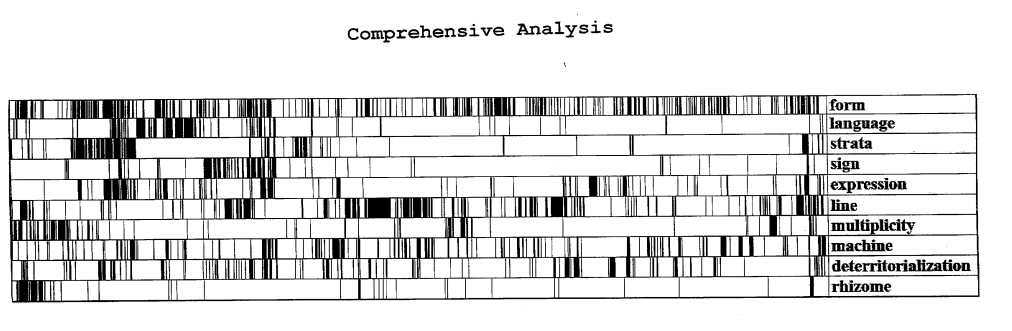 Download Words and Things: A De-Re-Sub-Post-Construction of Rhizomatic and Non-Arborescent Stratum in Deleuze and Guattari’s A Thousand Plateaus (PDF, 398 KB) Read more
Published:
This is a paper that I recently got published in gnovis, which is a peer-reviewed journal run entirely by graduate students at Georgetown’s Communication, Culture, and Technology program. It is a sneakishly Latourian intervention into the debate between Habermasians and post-Habermasians regarding the Internet as a (part of the) public sphere. They have been arguing for some time about whether the Internet (and specifically blogging) leads to political fragmentation or real collective action. However, they have all taken for granted the highly-automated software infrastructures that mediate our knowledge of the blogosphere. The article is up in HTML on the gnovis site, but I’ve also made a full-text, metadata friendly PDF simply because Google Scholar likes those. The abstract is after the jump. Abstract: Is computer-mediated discourse leading to collective political action in the public sphere, or simply more fragmentation? This question has been asked by social and political theorists ever since the Internet entered academia in the early 90s. However, this debate has been recently rekindled by Jurgen Habermas – one of the leading theorists of the public sphere – who recently broke a longstanding silence and spoke out against the Internet as a potentially democratizing medium. Instead of directly intervening in this debate, I interrogate the techno-epistemic conditions of possibility for ‘the blogosphere’ to exist as a sociopolitical entity. Specifically, I analyze social aggregation sites like Technorati, Delicious, Digg, and even Google, which make it possible for collective action to precipitate out of the Internet. I find that Habermasians should not fear fragmentation, but instead integration: the blogosphere as a public sphere is constructed and unified not by ideal discourse, but algorithms. Read more
Published:
The official theme or slogan for this year’s Wikimania is “the knowledge revolution that is changing wisdom.” I think this phrase – especially the difference between knowledge and wisdom – was chosen very carefully and I think it is an excellent distinction to make. This morning’s opening ceremony began with a speech from the Egyptian Minister of State for Administrative Development, Dr. Ahmed Darwish. I will relay his comments here, without much analysis – that will come later, when I have the time. He spoke of the “future of community participation … to produce and share knowledge.” He claimed that “despite the dispute of consensus vs. credentials” in regards to the reliability or authoritativeness of content, “Wikipedia is becoming a reliable source.” The Minister tied the various projects of the Wikimedia Foundation into the larger framework of user-generated content production as well as Egypt’s own technology initiatives. Specifically, in 1999, they launched an initiative that supported technology in schools, in local technology clubs, and in government. He claimed that Egypt was “harvesting the fruits” of this initiative, with their e-government participation being ranked 28th in the world and their participation (I am not sure what kind – I assume Internet-based participation) to be 49th in the world. That is a significant improvement from the 1990s. The Minister made three positive observations that the “wiki model” has supported:
Published:
Content and the Internet in the (Globalized) Middle East, Dr. Ahmed Tantawi, Technical Director, IBM Middle East and North Africa. Another copy of my notes from Wikimania 2008 – this was the keynote speech on the second day of the conference. He began by warning us that, “I’ve changed this presentation, and I’ll change it during. That is open content, yes?” Everyone laughed. The changing world: Globalization is the opening of the world to become one large society. You still have nations, people fighting, but at another level, at the economic level, the world is becoming more and more open. This is obviously due to the Internet. It is more and more possible for people to communicate and exchange ideas, businesses, values, and so forth. This has created many opportunities, including in the Middle East. The IT industry is saturated in terms of growth. The traditional IT industry is now mature, and growth has slowed compared to 10 to 20 years ago. The focus of the world is on the emerging developing markets, known as growth markets. This affects products and the type of education available.Innovation is becoming a very important part of this. Globalization is not entirely about moving production to cheaper places. Number one is about the right skill markets for the right job. Evolution: Moved from National to International to Multinational. Now “Globally Integrated Enterprise.” From “complete” to “specialized” and “value-focused.” A person can be a corporation all by themselves. Businesses are based on differentiating themselves from others. From concepts to optimizations to integration to commoditization/standardization. From hardware to software and now to services. From theoretical to experimental. From components to systems to applications. From technology focus to application focus, invention to innovation. We are moving towards standards. Open technology standards, trade regulations. What could you do with a million person product development lab, or a billion person workforce? The worldwide demand for young professional engineers can be entirely filled right now with people from India, China, Malaysia, Philippines, and Brazil, and other Latin American Countries. They have the suitable labor pool for this, and they are the cheapest. What about all the other young professional engineers in the world? There continues to be a vigorous societal debate over globalization. Many critiques: winner-takes-all, externalities, offshoring, diminishing autonomy of the nation-states. There is a fading concept of a national economy. Does it exist anymore? Every nation is made up of firms that get services from others and serve others. Many components of an economy, but not all: no tax cuts, no gov’t spending, no interest rate regulation. But there is: corruption, infrastructure development, education. Does a student in Sweden need the same education as one in Egypt? Probably not. The economy in Sweden is different than the economy in Egypt. International standards for education are therefore not productive. What is the impact on jobs and education? It is the Me, Inc. concept: I can be a corporation. There is a need for global delivery systems, on and offline. You need a different culture for us as a global society to integrate systems together. We still speak different languages – should everyone speak English? Do we need more than translations of words – translations of meanings, of norms? CEOs said they must achieve: revenue growth, cost reduction, asset utilization, risk management. They think they need to innovate business models, operations, and products/services. But even if you improve your products, you won’t be that different than your competitor. Biggest innovation is in the business model, not in the product or service. New ideas come from R&D, right? No, largest contributors are employees in general, not just R&D. 2nd is business partners. 3rd is your customers. You have to be open. R&D no longer is the citadel of innovation. IBM: The global innovation outlook. We opened the process to our best partners and customers. Asked them what they think the future looks like. In 2004, Healthcare, Government, and Work/Life. Resulting initiative: records, IP reform, global skills forecasting. 2005-6: developing markets, future of the enterprise, transportation, environment, and energy. 2007: media, security and society, and Africa. About to start the 2008 process.
Published:
I feel bad that I have not written a new entry in so long. I feel like I should apologize - not to the readers, but to the software, to the site itself. I ought to write a new post; I ought to update my status. How did I get into a situation whereby these collections of code could make ethical demands upon me? And is this bad? Read more
Published:
This paper is a Foucauldian account of power relations as expressed through discourse in the on-line encyclopedia Wikipedia. Read more
Published:
I explore the memetic inkblot, which refers to units of cultural information that have effectively no singular semiotic value and therefore serve as a psychosocial indicator. In other words, they are so vague and open to interpretation that you can learn a lot about someone by asking someone to give a simple definition of them. Read more
Published:
Benjamin Wiker’s book on bad books throughout the ages is misinformed and makes a few critical errors in its analysis. Specifically, it ignores the cultural context around each book he critiques, treating them as pure subliminal propaganda. Read more
Published:
This is a paper I co-authored with David Ribes and recently presented at HICSS, the Hawaii International Conference on Systems Sciences. It’s a qualitative methodology based on analyzing logging data that we developed through my research on Wikipedia, but has some pretty broad applications for studying highly-distributed groups. It’s an inversion of the previous paper we presented at CSCW, showing in detail how we traced how Wikipedian vandal fighters as they collectively work to identify and ban malicious contributors. Abstract: We detail the methodology of ‘trace ethnography’, which combines the richness of participant-observation with the wealth of data in logs so as to reconstruct patterns and practices of users in distributed sociotechnical systems. Trace ethnography is a flexible, powerful technique that is able to capture many distributed phenomena that are otherwise difficult to study. Our approach integrates and extends a number of longstanding techniques across the social and computational sciences, and can be combined with other methods to provide rich descriptions of collaboration and organization. Trace Ethnography: Following Coordination through Documentary Practices (PDF, 361KB) Citation: Geiger, R.S., & Ribes, D. (2011). Trace Ethnography: Following Coordination Through Documentary Practices. In Proceedings of the 44th Annual Hawaii International Conference on Systems Sciences. Retrieved from http://www.stuartgeiger.com/trace-ethnography-hicss-geiger-ribes.pdf Read more
Published:
So given what’s going on* in Egypt and the Middle East, we in the West are fascinated by not so much revolutions and popular uprisings against dictatorial regimes, but an efficacious use of social media. Even Clinton is talking about the Internet as “the world’s town square”, and it seems that the old conversation about the Internet and the public sphere is going to flare up for the third time (1993-5 and 2001-3 are the other two times). Since Habermas is generally credited for bringing this notion of the public sphere to the forefront of popular, political, and academic discourse, it is natural to cite him. Then critique him to death, talking about how we need to get beyond an old white guy’s theories. And it feels good, I know. The problem is that most people only read his first book, The Structural Transformation of the Public Sphere, which was written in 1962, and then proceed to critique “the Habermasian public sphere.” I can’t tell you how many articles I’ve read which demand that we ‘move beyond’ Habermas or go ‘post-Habermasian’ and only cite Structural Transformation. It’s a great literary foil if you’re advancing your own concept of the public sphere, and the whole ‘new events require a re-evaluation of old theories’ is a mainstay of academia. As a crazy post-Latourian socio-technical ethnographer who grants agency to everything (literally, every single thing) except for social structures, it is weird that I’m defending him. But I’m also a huge proponent of keeping your intellectual allies close and your intellectual opponents closer.
Published:
This is a paper that I recently got published in gnovis, which is a peer-reviewed journal run entirely by graduate students at Georgetown’s Communication, Culture, and Technology program. It is a sneakishly Latourian intervention into the debate between Habermasians and post-Habermasians regarding the Internet as a (part of the) public sphere. They have been arguing for some time about whether the Internet (and specifically blogging) leads to political fragmentation or real collective action. However, they have all taken for granted the highly-automated software infrastructures that mediate our knowledge of the blogosphere. The article is up in HTML on the gnovis site, but I’ve also made a full-text, metadata friendly PDF simply because Google Scholar likes those. The abstract is after the jump. Abstract: Is computer-mediated discourse leading to collective political action in the public sphere, or simply more fragmentation? This question has been asked by social and political theorists ever since the Internet entered academia in the early 90s. However, this debate has been recently rekindled by Jurgen Habermas – one of the leading theorists of the public sphere – who recently broke a longstanding silence and spoke out against the Internet as a potentially democratizing medium. Instead of directly intervening in this debate, I interrogate the techno-epistemic conditions of possibility for ‘the blogosphere’ to exist as a sociopolitical entity. Specifically, I analyze social aggregation sites like Technorati, Delicious, Digg, and even Google, which make it possible for collective action to precipitate out of the Internet. I find that Habermasians should not fear fragmentation, but instead integration: the blogosphere as a public sphere is constructed and unified not by ideal discourse, but algorithms. Read more
Published:
So given what’s going on* in Egypt and the Middle East, we in the West are fascinated by not so much revolutions and popular uprisings against dictatorial regimes, but an efficacious use of social media. Even Clinton is talking about the Internet as “the world’s town square”, and it seems that the old conversation about the Internet and the public sphere is going to flare up for the third time (1993-5 and 2001-3 are the other two times). Since Habermas is generally credited for bringing this notion of the public sphere to the forefront of popular, political, and academic discourse, it is natural to cite him. Then critique him to death, talking about how we need to get beyond an old white guy’s theories. And it feels good, I know. The problem is that most people only read his first book, The Structural Transformation of the Public Sphere, which was written in 1962, and then proceed to critique “the Habermasian public sphere.” I can’t tell you how many articles I’ve read which demand that we ‘move beyond’ Habermas or go ‘post-Habermasian’ and only cite Structural Transformation. It’s a great literary foil if you’re advancing your own concept of the public sphere, and the whole ‘new events require a re-evaluation of old theories’ is a mainstay of academia. As a crazy post-Latourian socio-technical ethnographer who grants agency to everything (literally, every single thing) except for social structures, it is weird that I’m defending him. But I’m also a huge proponent of keeping your intellectual allies close and your intellectual opponents closer.
Published:
Benjamin Wiker’s book on bad books throughout the ages is misinformed and makes a few critical errors in its analysis. Specifically, it ignores the cultural context around each book he critiques, treating them as pure subliminal propaganda. Read more
Published:
Content and the Internet in the (Globalized) Middle East, Dr. Ahmed Tantawi, Technical Director, IBM Middle East and North Africa. Another copy of my notes from Wikimania 2008 – this was the keynote speech on the second day of the conference. He began by warning us that, “I’ve changed this presentation, and I’ll change it during. That is open content, yes?” Everyone laughed. The changing world: Globalization is the opening of the world to become one large society. You still have nations, people fighting, but at another level, at the economic level, the world is becoming more and more open. This is obviously due to the Internet. It is more and more possible for people to communicate and exchange ideas, businesses, values, and so forth. This has created many opportunities, including in the Middle East. The IT industry is saturated in terms of growth. The traditional IT industry is now mature, and growth has slowed compared to 10 to 20 years ago. The focus of the world is on the emerging developing markets, known as growth markets. This affects products and the type of education available.Innovation is becoming a very important part of this. Globalization is not entirely about moving production to cheaper places. Number one is about the right skill markets for the right job. Evolution: Moved from National to International to Multinational. Now “Globally Integrated Enterprise.” From “complete” to “specialized” and “value-focused.” A person can be a corporation all by themselves. Businesses are based on differentiating themselves from others. From concepts to optimizations to integration to commoditization/standardization. From hardware to software and now to services. From theoretical to experimental. From components to systems to applications. From technology focus to application focus, invention to innovation. We are moving towards standards. Open technology standards, trade regulations. What could you do with a million person product development lab, or a billion person workforce? The worldwide demand for young professional engineers can be entirely filled right now with people from India, China, Malaysia, Philippines, and Brazil, and other Latin American Countries. They have the suitable labor pool for this, and they are the cheapest. What about all the other young professional engineers in the world? There continues to be a vigorous societal debate over globalization. Many critiques: winner-takes-all, externalities, offshoring, diminishing autonomy of the nation-states. There is a fading concept of a national economy. Does it exist anymore? Every nation is made up of firms that get services from others and serve others. Many components of an economy, but not all: no tax cuts, no gov’t spending, no interest rate regulation. But there is: corruption, infrastructure development, education. Does a student in Sweden need the same education as one in Egypt? Probably not. The economy in Sweden is different than the economy in Egypt. International standards for education are therefore not productive. What is the impact on jobs and education? It is the Me, Inc. concept: I can be a corporation. There is a need for global delivery systems, on and offline. You need a different culture for us as a global society to integrate systems together. We still speak different languages – should everyone speak English? Do we need more than translations of words – translations of meanings, of norms? CEOs said they must achieve: revenue growth, cost reduction, asset utilization, risk management. They think they need to innovate business models, operations, and products/services. But even if you improve your products, you won’t be that different than your competitor. Biggest innovation is in the business model, not in the product or service. New ideas come from R&D, right? No, largest contributors are employees in general, not just R&D. 2nd is business partners. 3rd is your customers. You have to be open. R&D no longer is the citadel of innovation. IBM: The global innovation outlook. We opened the process to our best partners and customers. Asked them what they think the future looks like. In 2004, Healthcare, Government, and Work/Life. Resulting initiative: records, IP reform, global skills forecasting. 2005-6: developing markets, future of the enterprise, transportation, environment, and energy. 2007: media, security and society, and Africa. About to start the 2008 process.
Published:
This panel was at Wikimania 2008, and featured James Forrester, Andrew Lih, Kat Walsh, and Charles Matthews. Everyone except for Lih is or has been on the Arbitration Committee, and this turned into a discussion about admins. Read more
Published:
This panel was at Wikimania 2008, and featured James Forrester, Andrew Lih, Kat Walsh, and Charles Matthews. Everyone except for Lih is or has been on the Arbitration Committee, and this turned into a discussion about admins. Read more
Published:
Corporate adoption of open source software should not be viewed as antithetical to capitalism; rather, it is an example of corporations co-opting Communism to become more capitalist. Read more
Published:
The vast worlds of MMORPGs seem close to postmodern theories of identity, as a player is able to radically constitute their on-line self at will. Despite this, these virtual gaming communities should not be seen as safe spaces in which a subject can realize their true (or ideal) self. Read more
Published:
The vast worlds of MMORPGs seem close to postmodern theories of identity, as a player is able to radically constitute their on-line self at will. Despite this, these virtual gaming communities should not be seen as safe spaces in which a subject can realize their true (or ideal) self. Read more
Published:
William Gibson’s novel Neuromancer tells the story of a team of radically different technologically-savvy individuals who are recruited by a young artificial intelligence named Wintermute, who desires to bypass the limitations placed on it by its owners and the authorities. Case, the protagonist, is an ex-hacker who has been maimed by a previous employer, making him unable to “jack in” (37) to Gibson’s version of the globalized information network he calls “cyberspace”(4). Molly, a street-smart “razor girl” (28) with knives for fingernails and mirrored lenses for eyes, rescues Case from his self-destructive habits at the behest of Armitage, her employer who takes orders from Wintermute. As we later learn, Armitage’s mind and body has been re-created by Wintermute from soldier named Corto, who was brutally wounded in a military operation which tested the effects of technological weapons. Armitage heals Case, but only temporarily; he must complete the job for his restoration to be permanent. Together, these three obtain Dixie Flatline, a “construct” (49) created from the downloaded brain of dead hacker McCoy Pauley, as well as Peter Riviera, who has the mystical talent of making others see his “holographic cabaret” (138) through the use of special implants. They also enlist the help of Maelcum and Aerol, two Rastafarians from a space colony called Zion which rejects the hyper-technological “Babylon” (248) below. Wintermute has this team break (both physically and digitally) into the Villa Straylight, the headquarters of Wintermute’s creator, the Tessier-Ashpool corporation. With the help of Lady 3Jane, Tessier and Ashpool’s daughter, the team obtains a password which will allow them to free Wintermute’s security locks. While performing this task, Case learns that Wintermute is only half of another AI called Neuromancer collectively. He frees the locks and allows this super-AI to form, theoretically achieving godhood. All the main characters in Neuromancer are defined by their relation to technology. Case holds a “contempt for the flesh” (6) and is unable to come to terms with the real world; his two addictions are cyberspace and, when that is unavailable, mind-altering drugs. His physical body is rarely described, leading Gibson to characterize him mainly by his actions in relation to technology (specifically cyberspace). Molly, on the other hand, uses technology to supplement her physical body. Along with her physical implants, she frequently uses temporary “derms” (85) to enhance her physical performance. Dixie Flatline, literally a man in a box, makes constant reference to his technologically-mediated existence, while Armitage/Corto is nothing if not technology: his body has been recreated by surgeons, his mind made new by Wintermute. Riviera’s main purpose is his hologram implants; like Case, his physical body is rarely described. The Rastafarians, specifically Maelcum and Aerol, are characterized in opposition to the technological Babylon on Earth, although they help the team because Wintermute made them see a sign they thought was from God. It is Wintermute, however, who can be considered the most significant character in the novel. The fact that entire novel is an adventure funded and conceptualized by the AI is significant, as all the other team members are not only characterized by their own relation to technology, but their own relation to Wintermute. Such a state of technological identification is precisely the target of Martin Heidegger’s criticism of technology and modern metaphysics. For Heidegger, this philosophical conception of the self (which culminated in Descartes) sees the body as simply another object which may have instincts, desires, and lusts, but ultimately is controlled by the pure subject of the mind. Modern scientists, for example, prize objectivity and view the world through a framework that minimizes the researcher’s effect on the experiment. It is not specifically tools that are the target of Heidegger’s criticism, but rather this techne-centered subjectivity and mindset that leads us to consider everything beyond the pure subject an inferior object that exists solely to benefit the subject. This mindset terminates in the desire to escape the tainted body, with its bothersome limitations. While this is clearly seen in Case’s “contempt for the flesh,” (6) Molly’s anesthetic derms and Dixie’s virtual existence point to this overcoming of authentic existence which Heidegger claims characterizes the modern project and its technological mindset. Neuromancer/Wintermute, however, is the pinnacle of the technological society and the clearest embodiment of Heidegger’s techne-centered being. Instead of actively being-in-the-world, this superior construct is a passive participant when it comes to existence. It may have thoughts and even citizenship but its body is simply static hardware, a mainframe that always perceives and experiences through something or someone else (a sensor or data input). This can be seen in Neuromancer’s final conversation with Case. When asked how things will be different, the AI responds: “Things aren’t different. Things are things.” (270) Neuromancer, the now all-knowing godlike being, seems infinitely resigned when it comes to Earth. It focuses on talking to an AI in the Centauri system. Such a resignation is precisely Heidegger’s prediction of posthuman existence: a world that is dead to us. Read more
Published:
I explore the memetic inkblot, which refers to units of cultural information that have effectively no singular semiotic value and therefore serve as a psychosocial indicator. In other words, they are so vague and open to interpretation that you can learn a lot about someone by asking someone to give a simple definition of them. Read more
Published:
Benjamin Wiker’s book on bad books throughout the ages is misinformed and makes a few critical errors in its analysis. Specifically, it ignores the cultural context around each book he critiques, treating them as pure subliminal propaganda. Read more
Published:
The vast worlds of MMORPGs seem close to postmodern theories of identity, as a player is able to radically constitute their on-line self at will. Despite this, these virtual gaming communities should not be seen as safe spaces in which a subject can realize their true (or ideal) self. Read more
Published:
Corporate adoption of open source software should not be viewed as antithetical to capitalism; rather, it is an example of corporations co-opting Communism to become more capitalist. Read more
Published:
An investigation into the community formed by small number of Wikipedia contributors who care enough to decide how, at some level, Wikipedia is run. The work discusses identity, communication, and organizational hierarchy in this subculture. Read more
Published:
In his book Me++: The Cyborg Self and the Networked City, William Mitchell describes how information technology – specifically digital, wireless networks which are accessed primarily through portable devices – fundamentally changes how we interact with others. More than anything else, “[c]onnectivity had become the defining characteristic of our twenty-first-century urban condition” (11). For Mitchell, we have given up the virtual reality fantasy that dominated predictions made in previous decades in lieu of subtler revolution: that of the networked self, the Me++. This type of technological innovation is not new for Mitchell. He states that such advances are part of our human heritage, from “[w]alking sticks [which] provided an early, rudimentary form of exoskeletal support” (20) to automobiles which replaced the legs as a mechanism for transportation. The concept of a networked self is also something which came before the technological advances of the 21st century. Mitchell describes that even sexual reproduction itself can be considered part of this system, as it “is constructed to interface with other, compatible sexual plumbing for the efficient transfer of genetic information in fluid format” (22). With this point in mind, Mitchell spends a large majority of his book describing the various “circumscriptions” (41) that make the 21st century urbanite distinct from homo habilis, whose use of crude tools ushered in the stone age. These advances, which include “wireless coverage” (49), “miniaturized machinery” (64), “dematerialized text” (84), “location-tracking technologies” (115), and “[m]odularized, parameterized, mobilized software” (141) combine into a single genre of technological innovation which provides a new framework for human interaction: the neo-nomad. For Mitchell, this change is beneficial for humanity as a whole. It “offers liberation from the rigidities and interdictions of the predefined program … a release from ways of using spaces produced and enforced by dominant social orders” (160). By opening up multiple paths of resistance and communication, such technologies make a broader struggle against oppression possible. However, is this fundamental shift necessarily advantageous for marginalized groups who desire such freedom from dominating social institutions? The only example that Mitchell gives in support of this new resistance is an uncited instance where suburban and urban “kids” (160) used cell phones to coordinate both “street demonstrations” and “raves” (161). These digitally literate youngsters then discovered that they could program worms and viruses to “clog channels of communication” (161) presumably used by their enemies. Such a stratum seems hardly oppressed when compared to their inner-city peers. It must be emphasized that new technology is often a privilege of wealth and unavailable to most marginalized groups. In contrast to this nomadic resistance, we can remember the Civil Rights Movement of the 1960s and ‘70s, arguably one of the most effective social movements in recent memory, which advanced without these digital information networks at all. Furthermore, even if such actions did constitute egalitarian political resistance, such occurrences are rare in the networked world. Instead of using the digital world to influence the physical, many acts of political resistance stay in the network. When resistance becomes as easy as friending a politician in Facebook or writing a blog post, is it truly effective? As the 2004 election proved, mobilization on the Internet – specifically the so-called “blogosphere” – failed to translate into significant real-world political action. It is possible that nomadic resistance is solely symbolic, carrying little weight. On the other hand, information networks seem to significantly benefit those already in power. Mitchell discusses this topic, but determines that such networks are amoral; that is, they can be used for “good or ill” (192), as he keeps reiterating throughout chapter twelve. However, such a conclusion ignores the systematic bias that such networks have towards those who control them. And despite what Time Magazine said, multibillion dollar corporations still own MySpace and Blogger, the U.S. Government still indirectly controls ICANN, Choicepoint still sells your aggregated personal data to the highest bidder (non-governmental or otherwise), and the NSA can still obtain phone and Internet conversations without a warrant. When it comes to new powers afforded by the network, the common person does not appear to even break even, much less those on the fringes of society. Read more
Published:
William Gibson’s novel Neuromancer tells the story of a team of radically different technologically-savvy individuals who are recruited by a young artificial intelligence named Wintermute, who desires to bypass the limitations placed on it by its owners and the authorities. Case, the protagonist, is an ex-hacker who has been maimed by a previous employer, making him unable to “jack in” (37) to Gibson’s version of the globalized information network he calls “cyberspace”(4). Molly, a street-smart “razor girl” (28) with knives for fingernails and mirrored lenses for eyes, rescues Case from his self-destructive habits at the behest of Armitage, her employer who takes orders from Wintermute. As we later learn, Armitage’s mind and body has been re-created by Wintermute from soldier named Corto, who was brutally wounded in a military operation which tested the effects of technological weapons. Armitage heals Case, but only temporarily; he must complete the job for his restoration to be permanent. Together, these three obtain Dixie Flatline, a “construct” (49) created from the downloaded brain of dead hacker McCoy Pauley, as well as Peter Riviera, who has the mystical talent of making others see his “holographic cabaret” (138) through the use of special implants. They also enlist the help of Maelcum and Aerol, two Rastafarians from a space colony called Zion which rejects the hyper-technological “Babylon” (248) below. Wintermute has this team break (both physically and digitally) into the Villa Straylight, the headquarters of Wintermute’s creator, the Tessier-Ashpool corporation. With the help of Lady 3Jane, Tessier and Ashpool’s daughter, the team obtains a password which will allow them to free Wintermute’s security locks. While performing this task, Case learns that Wintermute is only half of another AI called Neuromancer collectively. He frees the locks and allows this super-AI to form, theoretically achieving godhood. All the main characters in Neuromancer are defined by their relation to technology. Case holds a “contempt for the flesh” (6) and is unable to come to terms with the real world; his two addictions are cyberspace and, when that is unavailable, mind-altering drugs. His physical body is rarely described, leading Gibson to characterize him mainly by his actions in relation to technology (specifically cyberspace). Molly, on the other hand, uses technology to supplement her physical body. Along with her physical implants, she frequently uses temporary “derms” (85) to enhance her physical performance. Dixie Flatline, literally a man in a box, makes constant reference to his technologically-mediated existence, while Armitage/Corto is nothing if not technology: his body has been recreated by surgeons, his mind made new by Wintermute. Riviera’s main purpose is his hologram implants; like Case, his physical body is rarely described. The Rastafarians, specifically Maelcum and Aerol, are characterized in opposition to the technological Babylon on Earth, although they help the team because Wintermute made them see a sign they thought was from God. It is Wintermute, however, who can be considered the most significant character in the novel. The fact that entire novel is an adventure funded and conceptualized by the AI is significant, as all the other team members are not only characterized by their own relation to technology, but their own relation to Wintermute. Such a state of technological identification is precisely the target of Martin Heidegger’s criticism of technology and modern metaphysics. For Heidegger, this philosophical conception of the self (which culminated in Descartes) sees the body as simply another object which may have instincts, desires, and lusts, but ultimately is controlled by the pure subject of the mind. Modern scientists, for example, prize objectivity and view the world through a framework that minimizes the researcher’s effect on the experiment. It is not specifically tools that are the target of Heidegger’s criticism, but rather this techne-centered subjectivity and mindset that leads us to consider everything beyond the pure subject an inferior object that exists solely to benefit the subject. This mindset terminates in the desire to escape the tainted body, with its bothersome limitations. While this is clearly seen in Case’s “contempt for the flesh,” (6) Molly’s anesthetic derms and Dixie’s virtual existence point to this overcoming of authentic existence which Heidegger claims characterizes the modern project and its technological mindset. Neuromancer/Wintermute, however, is the pinnacle of the technological society and the clearest embodiment of Heidegger’s techne-centered being. Instead of actively being-in-the-world, this superior construct is a passive participant when it comes to existence. It may have thoughts and even citizenship but its body is simply static hardware, a mainframe that always perceives and experiences through something or someone else (a sensor or data input). This can be seen in Neuromancer’s final conversation with Case. When asked how things will be different, the AI responds: “Things aren’t different. Things are things.” (270) Neuromancer, the now all-knowing godlike being, seems infinitely resigned when it comes to Earth. It focuses on talking to an AI in the Centauri system. Such a resignation is precisely Heidegger’s prediction of posthuman existence: a world that is dead to us. Read more
Published:
Benjamin Wiker’s book on bad books throughout the ages is misinformed and makes a few critical errors in its analysis. Specifically, it ignores the cultural context around each book he critiques, treating them as pure subliminal propaganda. Read more
Published:
This is a paper that I recently got published in gnovis, which is a peer-reviewed journal run entirely by graduate students at Georgetown’s Communication, Culture, and Technology program. It is a sneakishly Latourian intervention into the debate between Habermasians and post-Habermasians regarding the Internet as a (part of the) public sphere. They have been arguing for some time about whether the Internet (and specifically blogging) leads to political fragmentation or real collective action. However, they have all taken for granted the highly-automated software infrastructures that mediate our knowledge of the blogosphere. The article is up in HTML on the gnovis site, but I’ve also made a full-text, metadata friendly PDF simply because Google Scholar likes those. The abstract is after the jump. Abstract: Is computer-mediated discourse leading to collective political action in the public sphere, or simply more fragmentation? This question has been asked by social and political theorists ever since the Internet entered academia in the early 90s. However, this debate has been recently rekindled by Jurgen Habermas – one of the leading theorists of the public sphere – who recently broke a longstanding silence and spoke out against the Internet as a potentially democratizing medium. Instead of directly intervening in this debate, I interrogate the techno-epistemic conditions of possibility for ‘the blogosphere’ to exist as a sociopolitical entity. Specifically, I analyze social aggregation sites like Technorati, Delicious, Digg, and even Google, which make it possible for collective action to precipitate out of the Internet. I find that Habermasians should not fear fragmentation, but instead integration: the blogosphere as a public sphere is constructed and unified not by ideal discourse, but algorithms. Read more
Published:
This is a paper that I recently got published in gnovis, which is a peer-reviewed journal run entirely by graduate students at Georgetown’s Communication, Culture, and Technology program. It is a sneakishly Latourian intervention into the debate between Habermasians and post-Habermasians regarding the Internet as a (part of the) public sphere. They have been arguing for some time about whether the Internet (and specifically blogging) leads to political fragmentation or real collective action. However, they have all taken for granted the highly-automated software infrastructures that mediate our knowledge of the blogosphere. The article is up in HTML on the gnovis site, but I’ve also made a full-text, metadata friendly PDF simply because Google Scholar likes those. The abstract is after the jump. Abstract: Is computer-mediated discourse leading to collective political action in the public sphere, or simply more fragmentation? This question has been asked by social and political theorists ever since the Internet entered academia in the early 90s. However, this debate has been recently rekindled by Jurgen Habermas – one of the leading theorists of the public sphere – who recently broke a longstanding silence and spoke out against the Internet as a potentially democratizing medium. Instead of directly intervening in this debate, I interrogate the techno-epistemic conditions of possibility for ‘the blogosphere’ to exist as a sociopolitical entity. Specifically, I analyze social aggregation sites like Technorati, Delicious, Digg, and even Google, which make it possible for collective action to precipitate out of the Internet. I find that Habermasians should not fear fragmentation, but instead integration: the blogosphere as a public sphere is constructed and unified not by ideal discourse, but algorithms. Read more
Published:
With the help of my advisor, Dr. David Ribes, I recently got a chapter of my master’s thesis accepted to the ACM conference on Computer Supported Cooperative Work, to be held in February 2010 in Savannah, Georgia. It is titled “The Work of Sustaining Order in Wikipedia: The Banning of a Vandal” and focuses on the roles of automated ‘bots’ and assisted editing tools in Wikipedia’s ‘vandal fighting’ network. Abstract: In this paper, we examine the social roles of software tools in the English-language Wikipedia, specifically focusing on autonomous editing programs and assisted editing tools. This qualitative research builds on recent research in which we quantitatively demonstrate the growing prevalence of such software in recent years. Using trace ethnography, we show how these often-unofficial technologies have fundamentally transformed the nature of editing and administration in Wikipedia. Specifically, we analyze „vandal fighting‟ as an epistemic process of distributed cognition, highlighting the role of non-human actors in enabling a decentralized activity of collective intelligence. In all, this case shows that software programs are used for more than enforcing policies and standards. These tools enable coordinated yet decentralized action, independent of the specific norms currently in force. Download the full paper (PDF) Read more
Published:
Published:
My thesis studied the legal culture of Wikipedia to examine the law through stories and histories, giving the reader a sense of not only what the Wikipedian legal system is, but also what fundamental assumptions the community makes in utilizing such a system. Read more
Published:
A response to Thomas Kuhn’s The Structure of Scientific Revolutions, in which his work is applied to a personal vignette of experimentation practices in a High School Physics class. When in the course of scientific education should students be allowed to modify scientific theories to fit experimental data instead of modifying experiments to fit the theories? Read more
Published:
Embracing Trobriand cricket as an instance in which domineering cultural empires were repelled is a flawed concept which masks the very forms of domination that it attempts to criticize. Read more
Published:
An investigation into the community formed by small number of Wikipedia contributors who care enough to decide how, at some level, Wikipedia is run. The work discusses identity, communication, and organizational hierarchy in this subculture. Read more
Published:
Corporate adoption of open source software should not be viewed as antithetical to capitalism; rather, it is an example of corporations co-opting Communism to become more capitalist. Read more
Published:
In an age of information overload, the history of Wikipedia’s co-evolving media use and governance model gives us a powerful lesson regarding the way in which the development of social structures and media technologies are fundamentally interrelated in the digital era. Read more
Published:
As an ethnographer, I enter into communities, learn their customs, beliefs, and practices, then report back to the academy to share what I have discovered. In this presentation, I wish to do the opposite, presenting to the Wikipedian community an ethnography of academics as they relate to Wikipedia. Read more
Published:
An investigation into the community formed by small number of Wikipedia contributors who care enough to decide how, at some level, Wikipedia is run. The work discusses identity, communication, and organizational hierarchy in this subculture. Read more
Published:
My thesis studied the legal culture of Wikipedia to examine the law through stories and histories, giving the reader a sense of not only what the Wikipedian legal system is, but also what fundamental assumptions the community makes in utilizing such a system. Read more
Published:
Published:
In his book Me++: The Cyborg Self and the Networked City, William Mitchell describes how information technology – specifically digital, wireless networks which are accessed primarily through portable devices – fundamentally changes how we interact with others. More than anything else, “[c]onnectivity had become the defining characteristic of our twenty-first-century urban condition” (11). For Mitchell, we have given up the virtual reality fantasy that dominated predictions made in previous decades in lieu of subtler revolution: that of the networked self, the Me++. This type of technological innovation is not new for Mitchell. He states that such advances are part of our human heritage, from “[w]alking sticks [which] provided an early, rudimentary form of exoskeletal support” (20) to automobiles which replaced the legs as a mechanism for transportation. The concept of a networked self is also something which came before the technological advances of the 21st century. Mitchell describes that even sexual reproduction itself can be considered part of this system, as it “is constructed to interface with other, compatible sexual plumbing for the efficient transfer of genetic information in fluid format” (22). With this point in mind, Mitchell spends a large majority of his book describing the various “circumscriptions” (41) that make the 21st century urbanite distinct from homo habilis, whose use of crude tools ushered in the stone age. These advances, which include “wireless coverage” (49), “miniaturized machinery” (64), “dematerialized text” (84), “location-tracking technologies” (115), and “[m]odularized, parameterized, mobilized software” (141) combine into a single genre of technological innovation which provides a new framework for human interaction: the neo-nomad. For Mitchell, this change is beneficial for humanity as a whole. It “offers liberation from the rigidities and interdictions of the predefined program … a release from ways of using spaces produced and enforced by dominant social orders” (160). By opening up multiple paths of resistance and communication, such technologies make a broader struggle against oppression possible. However, is this fundamental shift necessarily advantageous for marginalized groups who desire such freedom from dominating social institutions? The only example that Mitchell gives in support of this new resistance is an uncited instance where suburban and urban “kids” (160) used cell phones to coordinate both “street demonstrations” and “raves” (161). These digitally literate youngsters then discovered that they could program worms and viruses to “clog channels of communication” (161) presumably used by their enemies. Such a stratum seems hardly oppressed when compared to their inner-city peers. It must be emphasized that new technology is often a privilege of wealth and unavailable to most marginalized groups. In contrast to this nomadic resistance, we can remember the Civil Rights Movement of the 1960s and ‘70s, arguably one of the most effective social movements in recent memory, which advanced without these digital information networks at all. Furthermore, even if such actions did constitute egalitarian political resistance, such occurrences are rare in the networked world. Instead of using the digital world to influence the physical, many acts of political resistance stay in the network. When resistance becomes as easy as friending a politician in Facebook or writing a blog post, is it truly effective? As the 2004 election proved, mobilization on the Internet – specifically the so-called “blogosphere” – failed to translate into significant real-world political action. It is possible that nomadic resistance is solely symbolic, carrying little weight. On the other hand, information networks seem to significantly benefit those already in power. Mitchell discusses this topic, but determines that such networks are amoral; that is, they can be used for “good or ill” (192), as he keeps reiterating throughout chapter twelve. However, such a conclusion ignores the systematic bias that such networks have towards those who control them. And despite what Time Magazine said, multibillion dollar corporations still own MySpace and Blogger, the U.S. Government still indirectly controls ICANN, Choicepoint still sells your aggregated personal data to the highest bidder (non-governmental or otherwise), and the NSA can still obtain phone and Internet conversations without a warrant. When it comes to new powers afforded by the network, the common person does not appear to even break even, much less those on the fringes of society. Read more
Published:
This is a review of Julian Orr’s Talking About Machines, an ethnography of Xerox photocopier technicians. Blurring the line between ethnomethodology, organizational communication, infrastructure studies, human-computer/machine interaction, business administration, and traditional ethnography of work, his study reveals more than just the daily practices of what may initially seem like a boring job. Read more
Published:
In the Wikipedia research community — that is, the group of academics and Wikipedians who are interested in studying Wikipedia — there has been a pretty substantial and longstanding problem with how research is published. Academics, from graduate students to tenured faculty, are deeply invested and entrenched in an system that rewards the publication of research. Publish or perish, as we’ve all heard. The problem is that the overwhelming majority of publications which are recognized as ‘academic’ require us to assign copyright to the publication, so that the publisher can then charge for access to the article. This is in direct contradiction with the goals of Wikipedia, as well as many other open source and open content creation communities — communities which are the subject of a substantial amount of academic research. Freely-accessible or freely-licensed? There are actually two issues here, the first being that members of these communities want access to research about themselves without having to pay the average $20-$30 an article. While important, this also overshadows a more fundamental concern: communities like Wikipedia, Apache, Creative Commons, and OLPC were founded on the idea of providing free and open software, hardware, or educational content to the world. The Wikimedia Foundation’s mission statement is “to empower and engage people around the world to collect and develop educational content under a free license or in the public domain.” That is pretty clear-cut, and those of us with obligations to both our own academic community and the Wikipedia community are having more and more problems with negotiating those competing tensions. In a sense, this is related to how the major ethical dilemma with 19th and early 20th century anthropologists wasn’t about giving ‘their natives’ a copy of their manuscripts. Rather, it was that most anthropologists were participating in systems of colonialism, which were in direct opposition to the interests of the people they studied. Now, I am in no way arguing that the same kind of power relation exists between academics who study Wikipedians and the Wikipedian community, or that the issue open educational sources is on the same ethical level as colonialism. As an aside, contemporary anthropologists have documented this shift from ‘studying down’ to ‘studying up’, although I would say that most academics who research open communities like Wikipedia are now ‘studying across’ — but that interesting subject is for another blog post. But I bring it up because unlike with the Trobriand Islanders, the communities that we study are now beginning to articulate their concerns with how we perform and publish our research, and it is something that we need to listen to. So to return to the core issue at hand: why is the Wikipedian community (and the Wikimedia Foundation) supporting research that will be copyrighted and bound up in publications which further support an intellectual property regime they clearly stand against? And what does it mean for us as academic researchers to give back to the communities we study? It obviously goes beyond being willing to send a copy of a PDF to an interested Wikipedian over e-mail, or even hosting a freely-accessible copy of our copyrighted PDFs on our websites (which many of us do, even when we’re not supposed to). For those of us studying Wikipedia, Creative Commons, Scratch, or a number of open content creation communities, it means releasing our research under a Creative Commons license, as this has become the standard for releasing everything other than code. Now, the moment I say this, all the academics breathe a heavy sigh, knowing that such a request is impossible, given the current academic system in which we are entrenched. Even the Journal of Computer Mediated Communication, one of the few top-tier open access journals in the social sciences, is copyrighted by the publisher. Some academic superstars like Lawrence Lessig have been able to get their books published from a university press while still being released under a CC license, but not all of us are Lawrence Lessig. Especially for graduate students and junior faculty, who are desperately trying to get their research published anywhere, when the paper finally gets accepted and that copyright assignment form comes in your inbox, the last thing you want to do is start a losing battle over CC-BY-SAing your paper. However, I do have to give a shoutout to Joseph Reagle, who spent a massive amount of effort getting MIT Press to let him publish his book on Wikipedia under a CC license (although with a number of restrictions), but it is unclear the extent to which this will continue in the future. A partial solution: freely-licensed figures, ‘used with permission’ in copyrighted research papers So now I finally get to the solution that this blog post was supposed to be entirely about. We academics who study open content communities have an obligation to release our research under free licenses. This does not mean that we have to release our research papers under CC-BY-SA, which is all but impossible for most of us. What it means is that we must release our findings, results, and conclusions under such licenses, and thanks to how copyright works, we can do this through the existing system. Conclusions and abstracts are easy: we just re-write them. We should actually be in the habit of re-writing our densely-worded abstracts and conclusions under a more succinct and human-readable for the communities we study anyway. However, there is also a way to do this with figures, charts, and graphs. This idea came to me when I saw a copyrighted article in the ACM library (from the Association for Computing Machinery, where a significant amount of Wikipedia research is published) which used a photo someone else took “with permission.” This kind of thing happens regularly enough for the ACM to have a rather sane policy on it: “The author’s copyright transfer applies only to the work as a whole, and not to any embedded objects owned by third parties. An author who embeds an object, such as an art image that is copyrighted by a third party, must obtain that party’s permission to include the object, with the understanding that the entire work may be distributed as a unit in any medium.” I haven’t checked any other publication houses, but I’ve seen this kind of situation happen in so many different books and papers that it could provide a nice loophole in for most of academia. For most research on Wikipedia, the figures, charts, and graphs are the most interesting aspects of the research, and these can be released under a CC-BY or CC-BY-SA license, and then used with permission in an ACM article. The ACM’s main concern is that they need authors to assign copyright to them in order to make sure publication goes smoothly, and as long as the ‘original author’ of the image is completely fine with having the image in the work and published by the ACM, everyone is happy. I’m no lawyer, but I think this would work with releasing figures, charts, and graphs, even though the copyright policy only qualifies the legal phrase with an example of art images copyrighted by third parties. This doesn’t work as well with many forms of qualitative research, such as historical or interview-based research in which the goal is to elaborate on specific case studies. Still, figures and conceptual diagrams are also useful in those kinds of papers, and can be added to an alternative documentation of a research project, which is possibly co-extensive with but not identical to the research paper. I’ve actually been putting my charts and graphs up on Wikimedia Commons for quite some time (you can check them all out on my user gallery), even before I realized that copyright was even an issue. These figures are present in my published papers, many of which are copyrighted by the ACM. Thankfully, it turns out that this is actually compatible copyright-wise, but this is only solid because I uploaded them to Commons before assigning copyright to the ACM. It is less clear if someone can retroactively release such images. But that issue aside, my graphs and charts can live in both worlds, serving members of both communities. For my quantitative research, these graphs contain my core findings about the rise of bots and assisted editing tools, for example. I have yet to document my previous research projects in a way that would be helpful to others. More on that in the section below, but I think that even just uploading figures to Commons is a good start. And it is incredibly painless, especially given that uploading to Commons is a lot easier now than it has been in the past. Research documentation on Meta-Wiki **Documentation of research projects could take place quite nicely in a new Research: namespace that some great people at the Wikimedia Foundation have provided to document planed, current, and past research projects on Meta-Wiki, the wiki that is used to coordinate many tasks which are common to all language versions of Wikipedia, as well as projects like Wikisource or Wiktonary. You can see a very rough example of one of these that I am working on with as part of my summer research fellowship with the Wikimedia Foundation: an incomplete but still interesting study of new users that fellow-Fellow Jonathan Morgan and I are doing. The documentation page is not written like an academic article, although it does give Wikipedians and researchers alike something that is arguably more important. It gives information necessary to replicate the study, for example, how we sampled for new users and what coding schema we used to track new user participation in community spaces. It also contains a few sentences about the motivation of the study, and a few sentences about each of the results. And critically, it contains the graphs which clearly indicate that since 2004, fewer users are participating in community spaces in their first thirty days of joining the project. If I wanted to write this up into an academic article (which I do plan to), I can do so in such a way that is both suitable for the ACM or another academic publisher, while keeping all the existing content on the documentation page freely-licensed. Now, to be on the safe side, it may be wise to release these graphs under a CC-BY license instead of a CC-BY-SA one, because the Share Alike requirement might require some other researcher to release an entire academic paper under a CC-BY-SA license if they use one of my CC-BY-SA figures. However, I do not think this is the case, because as I am the original copyright holder, I can choose to give permission to using images in my own academic papers. This is a common misconception with Share Alike and CC licenses in general — while I can never revoke my license once I make it, I am not bound by those terms in my own work, and can release the image under as many free and non-free licenses as I choose. For example, if it is entirely my own image that I license with CC-BY-SA, I do not have to release every work that builds on it under CC-BY-SA, just as I can license the work for commercial use even if I choose a CC license that prohibits commercial use. Research isn’t a paper In all, I think that many of the seemingly-intractable problems stem from the false assumption that research projects are entirely encapsulated in a series of papers, and so the demand to ‘freely license your research’ is heard as ‘freely license your papers’. However, academics already think of research projects as these long processes which spawn multiple papers, and so there is no reason why a research project could not also spawn a freely-licensed documentation space which does not prohibit the publishing of research papers. Certainly there are many aspects of research papers which would not be included, and there is a risk that these documentation spaces would be second-class reports which are always incomplete compared to the research paper. Though it is a bit patronizing to universally assume that community members don’t want that dense theoretical analysis of how distributed cognition flows in the actor-network, I think that a facts, figures, and abstracts version would suffice for most. Given the current academic systems in which we are currently entrenched, I think that this is a good short-term solution, especially for graduate students and other junior scholars who do not have the political capital to change the way in which existing publication regimes operate. And who knows, perhaps by creating alternative, freely-licensed spaces for documenting research, these publications will recognize the need to make research, though not necessarily research papers, freely accessible and open to all. Read more
Published:
I show that asking whether Wikipedia is a reliable academic source enframes Wikipedia into an objectless standing-reserve of potential citations, foreclosing many other possibilities for its use. Instead of asking what Wikipedia has done to reality, I ask: what have we done to Wikipedia in the name of reality? Read more
Published:
As someone who studies Internet culture, one of my biggest problems is “link rot,” or broken links. I’m a big fan of the Internet Archive, but they are usually six to eight months behind on even the most popular sites. I also applaud sites like Wikipedia for providing stable version histories so that I can point to a specific revision of a page. However, for all other websites, the only option is self-archiving, which is technically difficult and fraught with problems. What I have found incredibly useful is WebCite, a free webpage archiving service that fills in this gap. The process is incredibly easy. You submit a URL with your e-mail and a few optional pieces of metadata, and WebCite will permenantly archive that URL. For people who have a massive list of links they need to archive (like me), WebCite lets you upload an HTML file – all the anchor tags will be archived. It does well with text, images are hit and miss, and plugins like flash are not supported. Also, some websites (like the New York Times and CNN) have Javascript-based advertising redirects or anti-framing measures that make archiving impossible. Still, it is better than nothing. My standard citation practice for all sites is to search the Internet Archive first, and then use WebCite if I do not find the page I need. It also provides a layer of accountability, as the header for each archived page shows the URL and when it was archived. I’m sure there is some way to fool the site into archiving the wrong URL, but it is better than self-archiving. WebCite is funded by a consortium headquartered at the University of Toronto, and they plan on making money through grants and institutional and subscriptions. I’m a bit skeptical of this business model, but I guess it works for the Stanford Encyclopedia of Philosophy. Read more
Published:
The good folks at the Library of Alexandria and Kaltura have made available videos of a good number of presentations from Wikimania 2008. Luckily, mine was one of the ones up! So without further ado: Read more
Published:
Collaborative research on Wikiversity by Cormac Lawler (user Cormaggio on Wikimedia projects) at the University of Manchester. Wikiversity is a relatively young project in the Wikimedia umbrella, but I think it is a natural development and a great space to realize the potential of all the educators currently on Wikipedia, Wiktionary, Wikibooks, and all the other projects. Wikiversity does not limit to a university style education – primary, secondary, and post-secondary education. It also does not offer degrees, no certificates, no titles. Launched in August 2006. Scope: learning materials, activities, and communities. Major questions still to be addressed: What is learning the wiki way? How is it distinguished from other WMF projects? Aspects of Wikiversity different from Wikipedia: It includes original research, and that is what I will be talking about. We have flexibility in NPOV. We setup Wikiversity to work out what it means to learn in the Wiki way. We want to say something to the wider world of education. What is research in the wiki way? Several challenges: editing data – should this be allowed? Should Wikversity host any kind of research, like Nazism? Creationism? We all have our own worldviews, epistemologies, philosophies and Wikiversity challenges them. Current research: Bloom Clock – Distributed data about what is currently in flower. People add logs to individual plants pages. Also provides a learning community on identifying plants. Action research based on understanding a context through changing it. Usually collaborative and iterative. This project is about defining and developing Wikiversity. However, it is problematic to define as distinct from what happens anyway on Wikiversity. A Review Board might be in order, but it is possibly in tension with community processes. Read more
Published:
As an ethnographer, I enter into communities, learn their customs, beliefs, and practices, then report back to the academy to share what I have discovered. In this presentation, I wish to do the opposite, presenting to the Wikipedian community an ethnography of academics as they relate to Wikipedia. Read more
Published:
This was an interview I did with the wonderful Heather Ford, originally posted at Ethnography Matters (a really cool group blog) way back in January. No idea why I didn’t post a copy of this here back then, but now that I’m moving towards my dissertation I’m thinking about this kind of stuff more and more. In short, I argue for a non-anthropocentric yet still phenomenological ethnography of technology, studying not the culture of the people who build and program robots, but the culture of those the robots themselves. Heather Ford spoke with Stuart Geiger, PhD student at the UC Berkeley School of Information, about his emerging ideas about the ethnography of robots. “Not the ethnography of robotics (e.g. examining the humans who design, build, program, and otherwise interact with robots, which I and others have been doing),” wrote Geiger, “but the ways in which bots themselves relate to the world”. Geiger believes that constructing and relating an emic account of the non-human should be the ultimate challenge for ethnography but that he’s getting an absurd amount of pushback from it.” He explains why in this fascinating account of what it means to study the culture of robots. HF: So, what’s new, almost-Professor Geiger? SG: I just got back from the 4S conference — the annual meeting of the Society for the Social Study of Science — which is pretty much the longstanding home for not just science studies but also Science and Technology Studies. I was in this really interesting session featuring some really cool qualitative studies of robots, including two ethnographies of robotics. One of the presenters, Zara Mirmalek, was looking at the interactions between humans and robots within a modified framework from intercultural communication and workplace studies. I really enjoyed how she was examining robots as co-workers from different cultures, but it seems like most people in the room didn’t fully get it, thinking it was some kind of stretched metaphor. People kept giving her the same feedback that I’ve been given — isn’t there an easier way you can study the phenomena that interest you without attributing culture to robots themselves? But I saw where she was going and asked her about doing ethnographic studies of robot culture itself, instead of the culture of people who interact with robots — and it seemed like half the room gave a polite chuckle. Zara, however, told me that she loved the idea and we had a great chat afterwards about this. HF: What do you think people are upset about? SG: The more middle-of-the-road stances come from people who don’t personally have a strong reaction either way, but tell me that I’ll have to fight an uphill battle from angry humanists who I’ll talk about later. These people aren’t really against the idea, but they don’t really see the value added in ascribing culture to the non-humans. They tell me that there are better and more non-controversial ways of analyzing, say, distributed cognition in a heterogeneous network of humans and robots. It’s a response that I appreciate, because it would be futile to have to go through all of this work on an ethnography of robots if my analysis is otherwise identical to an ethnography of robotics. And then the most polite responses I get are people who tell me it is interesting, and then when I prod them further to ask them if they actually buy it, they tell me that they don’t *yet* think it can be done, but would like to see what I end up with. Some of the really negative responses I get involve a visceral reaction against attributing ‘culture’ to the realm of the non-human. I understand this — anthropology is, by definition, anthropocentric: it is concerned with the human condition, as it is constituted in various localities and peoples. This is the same fight we Latourians have with sociologists about the term “agency”: there is a very deeply-rooted assumption that humans have some innate, unique qualities that distinguish us from not only mere matter but other animals as well. When someone comes along and makes a very nuanced point about how objects have agency, the most immediate and natural response is first of all anthropomorphism, which is easy to rebut. But then comes a much more worthy ontological argument from people who really know their stuff: that when Latour ascribes agency to objects, he actually manages to do so by keeping the agency of humans and the agency of non-humans symmetrical. Against the standard, boring objection that he ascribes too many human characteristics to non-humans, what is really going on is that he accomplishes so much by taking away so many of those ‘uniquely human’ qualities from human agents. This is why Latour never goes inside of anyone’s head, why he rarely tries to give a psychological or cognitive account in the actor-networks he studies. (Read Latour’s review of “Cognition in the Wild” by Ed Hutchins for more on this, and you can see that he loves the idea that these seemingly human abilities like cognition are not pre-given but themselves an effect of a heterogeneous network of humans and non-humans.) Anyways, far from being an anthropomorphism, Latour’s ontology is flat, in which all entities have the same capacities. That is, they have the same a priori capabilities, but they are definitely not equal after socio-technical relations emerge and start operating. This all means that against the vulgar interpretations of ANT, objects don’t have intentionality or consciousness, because — and this is the really important point — neither do humans. Or, in another interpretation, perhaps humans do have intentionality or consciousness, but it makes no difference one way or another. A good actor-network theorist is able to take some existing system in which there are far too many explanations based on those uniquely human qualities and give an alternative account that relies instead on materials, technologies, infrastructures, documentation, and other modes of externalized practices. It is not to make the more futile argument that norms and consciousness and all those warm fuzzy humanisms don’t exist, but that they’re not necessary. Anyways, the same thing happens with me in my ethnography of robots, as I’m effectively taking life out of culture. You can see why both sociologists and anthropologists object to this, albeit for slightly different reasons. Sociologists will allow, for example, some analysis of the sociality of bees, while anthropologists will reject out of hand an ethnography of bees (which like robots/robotics, is different from an ethnography of bees-with-humans). But both seem opposed to attributing sociality or culture to a fundamentally non-living set of individuals. Or even calling non-living entities ‘individuals’ in the first place. And I won’t fall into the trap of saying that robots are living and then mapping human categories onto robot phenomena (e.g. consciousness = statefulness, cognition = code), even though it might seem to make things easier in the short-term. More on that later, but for now be content that all of these things are possible without robots having some advanced AI. Any ethnography of a non-human society would have to fight this same kind of battle that Latour fought over agency, if it didn’t wish to succumb to the very tempting but misguided prospect of simply importing and mapping existing ontological categories from sociology: e.g. norms in a robot society are found in protocols. This, by the way, would then be using ‘culture’ and indeed the entire ethnographic framework as one massively-stretched analogy, which isn’t the point. The argument is not so much that a robot society is very much ‘alive’ in the same way that human societies have, say, deviant individuals, fluid norms, fascinating rituals, internal contradictions, complicated power relations, and many more weirdly beautiful and complex aspects hidden just below the surface. Rather, the point of anthropology is typically to locate a people who are typically strange and foreign to us, and then relate the way in which those people live, showing not only how they are different from us but also how they are the same. In doing so, we learn not only about others, but also ourselves. So in that framework, I tend to agree with the critics who say that only way to give a vitalistic account of a robot society is by projecting too many human qualities onto the non-human. What is then left is a non-vitalistic ethnography: an account of a culture devoid of life. Like with Latour and agency, once we show that life is not a necessary criterion for this thing called culture, then the fun really begins — and you can see why lots of people would oppose this. HF: No friends for robot anthropology, then? SG: I do have some allies and kindred spirits, and I keep returning to this quote from Deleuze and Guattari’s A Thousand Plateaus on music: “Of course, as Messiaen says, music is not the privilege of human beings: the universe, the cosmos, is made of refrains … The question is more what is not musical in human beings, and what is already musical in nature. Moreover, what Messiaen discovered in music is the same thing ethnologists discovered in animals: human beings are hardly at an advantage, except in the means of overcoding, of making punctual systems.” Music is but one of many domains that is typically seen as inherently social and therefore uniquely human, and the anthropocentric perspective tends to reduce everything to how it functions in the human experiential frame. And on a side note, this is why I’m so excited by Ian Bogost’s upcoming book “Alien Phenomenology: Or What It’s Like To Be A Thing” — the title just says it all, doesn’t it? And before you start to think that I’m envisioning some sort of AI-based fantasy of the singularity in which robots start to replace all of us social humans — therefore locating the sociality of robot culture in its ability to stand in for humans — that’s definitely the exact opposite of where I’m going. Robots can be said to have their own culture precisely because they don’t need to copy our sociologisms in order to be social, although what they do in their own social realm may not easily map on to things we do in our social realm. This is probably what fascinates me most about this project. And it is precisely for this reason that we must absolutely resist the temptation to make cheap analogies between things that happen in robot culture and human culture, such as saying that protocols are just robot norms. Read more
Published:
Do you capitalize “Internet?” Some scholars from the emerging field of ‘Internet studies’ say no. I say yes. Read more
Published:
I feel bad that I have not written a new entry in so long. I feel like I should apologize - not to the readers, but to the software, to the site itself. I ought to write a new post; I ought to update my status. How did I get into a situation whereby these collections of code could make ethical demands upon me? And is this bad? Read more
Published:
I built a script that dynamically generates a robots.txt file for search engine bots, who download the file when they seek direction on what parts of a website they are allowed to index. By default, it directs all bots to stay away from the entire site, but then presents an exception: only the bot that requests the robots.txt file is allowed full reign over the site. Read more
Published:
With the help of my advisor, Dr. David Ribes, I recently got a chapter of my master’s thesis accepted to the ACM conference on Computer Supported Cooperative Work, to be held in February 2010 in Savannah, Georgia. It is titled “The Work of Sustaining Order in Wikipedia: The Banning of a Vandal” and focuses on the roles of automated ‘bots’ and assisted editing tools in Wikipedia’s ‘vandal fighting’ network. Abstract: In this paper, we examine the social roles of software tools in the English-language Wikipedia, specifically focusing on autonomous editing programs and assisted editing tools. This qualitative research builds on recent research in which we quantitatively demonstrate the growing prevalence of such software in recent years. Using trace ethnography, we show how these often-unofficial technologies have fundamentally transformed the nature of editing and administration in Wikipedia. Specifically, we analyze „vandal fighting‟ as an epistemic process of distributed cognition, highlighting the role of non-human actors in enabling a decentralized activity of collective intelligence. In all, this case shows that software programs are used for more than enforcing policies and standards. These tools enable coordinated yet decentralized action, independent of the specific norms currently in force. Download the full paper (PDF) Read more
Published:
Published:
Do you capitalize “Internet?” Some scholars from the emerging field of ‘Internet studies’ say no. I say yes. Read more
Published:
An investigation into the community formed by small number of Wikipedia contributors who care enough to decide how, at some level, Wikipedia is run. The work discusses identity, communication, and organizational hierarchy in this subculture. Read more
Published:
My thesis studied the legal culture of Wikipedia to examine the law through stories and histories, giving the reader a sense of not only what the Wikipedian legal system is, but also what fundamental assumptions the community makes in utilizing such a system. Read more
Published:
Embracing Trobriand cricket as an instance in which domineering cultural empires were repelled is a flawed concept which masks the very forms of domination that it attempts to criticize. Read more
Published:
Benjamin Wiker’s book on bad books throughout the ages is misinformed and makes a few critical errors in its analysis. Specifically, it ignores the cultural context around each book he critiques, treating them as pure subliminal propaganda. Read more
Published:
This paper is a Foucauldian account of power relations as expressed through discourse in the on-line encyclopedia Wikipedia. Read more
Published:
This paper is a Foucauldian account of power relations as expressed through discourse in the on-line encyclopedia Wikipedia. Read more
Published:
As someone who studies Internet culture, one of my biggest problems is “link rot,” or broken links. I’m a big fan of the Internet Archive, but they are usually six to eight months behind on even the most popular sites. I also applaud sites like Wikipedia for providing stable version histories so that I can point to a specific revision of a page. However, for all other websites, the only option is self-archiving, which is technically difficult and fraught with problems. What I have found incredibly useful is WebCite, a free webpage archiving service that fills in this gap. The process is incredibly easy. You submit a URL with your e-mail and a few optional pieces of metadata, and WebCite will permenantly archive that URL. For people who have a massive list of links they need to archive (like me), WebCite lets you upload an HTML file – all the anchor tags will be archived. It does well with text, images are hit and miss, and plugins like flash are not supported. Also, some websites (like the New York Times and CNN) have Javascript-based advertising redirects or anti-framing measures that make archiving impossible. Still, it is better than nothing. My standard citation practice for all sites is to search the Internet Archive first, and then use WebCite if I do not find the page I need. It also provides a layer of accountability, as the header for each archived page shows the URL and when it was archived. I’m sure there is some way to fool the site into archiving the wrong URL, but it is better than self-archiving. WebCite is funded by a consortium headquartered at the University of Toronto, and they plan on making money through grants and institutional and subscriptions. I’m a bit skeptical of this business model, but I guess it works for the Stanford Encyclopedia of Philosophy. Read more
Published:
 I recently saw Helvetica, a documentary directed by Gary Hustwit about the typeface of the same name — it is available streaming and on DVD from Netflix, for those of you who have a subscription. As someone who studies ubiquitous socio-technological infrastructures (and Helvetica is certainly one), I know how hard it is to seriously pay attention to something that which we see every day. It may seem counter-intuitive, but as Susan Leigh Star reminds us, the more widespread an infrastructure is, the more we use it and depend on it, the more invisible it becomes — that is, until it breaks or generates controversy, in which case it is far too easy. But to actually say something about what well-oiled, hidden-in-plain-sight infrastructures are, how they came to have such a place in our society, and why they won out over their competitors is a notoriously difficult task. But I came to realize that the film is less of a history of fonts, and more of an anthropology of design. While I was watching the film, I initially had to stop myself from being disappointed with the film for not being a proper academic book on the rise of the world’s most popular font. The film, which is extraordinarily well-made, seems to present itself as two things. First — and it does this so amazingly that you’ll see the world differently — it gives us a glimpse into the sheer pervasiveness of Helvetica, which is done by breaking up the segments of the documentary with clips of the font used in incredibly diverse situations. Second, the meat of the film is a story of the font in modern, post-modern, and contemporary Western culture, which goes from the historical moment in modernist design in which it first emerged in the ’50s, its creation and instant explosion in the ’60s and early ’70s, the post-modern reactions against it in the late ’70s and ’80s, its rebirth as a standard computer font in the ’90s, and then to the present day. It does this entirely through interviews with typographers and graphic designers, which is main the problem I had with it: the stories about the rise, fall, and rebirth of Helvetica are quite mystical, even bordering on the mythic. There are serious holes in the factual record, especially with regards to the incredible, unexplainable rise of the font’s popularity. The story told in Helvetica is largely a timeline of conquests, taking on an air of inevitability that pervades most narratives of technology. In one of my favorite segments, a young designer ruminates about what it must have been like to be a young corporate imaging consultant at an ambitious design firm in the 1960’s. He imagines himself as a client meeting in which he places the classic 1950’s corporate letterhead of “The United Industrial Widget Corporation” — awash in all its royal imagery, intricate logos, and scripted lettering — next to a single sheet of paper that says, in Helvetica, “WidgeCo.” That sentiment perfectly captures the belief expressed by many of the interviewees: that Helvetica was the most perfect font produced at the most opportune time, the ultimate final expression of modernist aesthetics, unleashed on an unsuspecting world that was itching to shrug off the lingering Victorian era but didn’t even know it. Once introduced, Helvetica spread like wildfire, because when placed next to everything else, there was simply no comparison. It is a story like this that sounds warning alarms in my head, because these kinds of explanations are given for everything — especially technology — and actually explain nothing. Almost every interviewee says Helvetica was simply the perfect font at the perfect time, and nothing can be done to ‘improve’ it further; so to progress in typography, designers had to first undermine the cultural-aesthetic space Helvetica came to dominate and define. Even its harshest critics admire how terribly modern, how ruthlessly efficient, and how perfectly emblematic of corporatism it is. Because of this, the film fails to be a history of Helvetica, which is why I initially thought I had to just appreciate the film for taking the effort and entertaining me. As I kept thinking about the film’s missed potential and how patently mystical the rise of Helvetica was portrayed, I pulled out a couple classic accounts of myths as genres to see how many qualities of myth this prosaic narrative masquerading as explanatory history actually fell back on. Never-ending battle between eternal opposing forces of order (modernism) and chaos (post-modernism)? Check. Primordial time before our world was settled? Check. Told by elders and leaders? Obviously, the film is nothing but this. Major characters played by non-humans (be they Gods, spirits, geographies, technologies, or so on), who progress through humans playing archetypal, genericized minor characters? Double check, the humans involved in the creation of the font appear as sterile Swiss stereotypes, then are forgotten as the major actors become the massive graphic design firms and then major corporations who first adopt the font. And same with major players in the anti-Helvetica movements, who present themselves in cultural stereotypes and then minimize their own roles as they tell of their own conquests. But then I realized that critiquing what I thought was a historical argument revealed Helvetica as something much more impressive: an anthropological window into the design community, and how they see the world’s most popular typeface. In looking through articles about myths, I pulled out one of Malinkowski’s articles on [I recently saw Helvetica, a documentary directed by Gary Hustwit about the typeface of the same name — it is available streaming and on DVD from Netflix, for those of you who have a subscription. As someone who studies ubiquitous socio-technological infrastructures (and Helvetica is certainly one), I know how hard it is to seriously pay attention to something that which we see every day. It may seem counter-intuitive, but as Susan Leigh Star reminds us, the more widespread an infrastructure is, the more we use it and depend on it, the more invisible it becomes — that is, until it breaks or generates controversy, in which case it is far too easy. But to actually say something about what well-oiled, hidden-in-plain-sight infrastructures are, how they came to have such a place in our society, and why they won out over their competitors is a notoriously difficult task. But I came to realize that the film is less of a history of fonts, and more of an anthropology of design. While I was watching the film, I initially had to stop myself from being disappointed with the film for not being a proper academic book on the rise of the world’s most popular font. The film, which is extraordinarily well-made, seems to present itself as two things. First — and it does this so amazingly that you’ll see the world differently — it gives us a glimpse into the sheer pervasiveness of Helvetica, which is done by breaking up the segments of the documentary with clips of the font used in incredibly diverse situations. Second, the meat of the film is a story of the font in modern, post-modern, and contemporary Western culture, which goes from the historical moment in modernist design in which it first emerged in the ’50s, its creation and instant explosion in the ’60s and early ’70s, the post-modern reactions against it in the late ’70s and ’80s, its rebirth as a standard computer font in the ’90s, and then to the present day. It does this entirely through interviews with typographers and graphic designers, which is main the problem I had with it: the stories about the rise, fall, and rebirth of Helvetica are quite mystical, even bordering on the mythic. There are serious holes in the factual record, especially with regards to the incredible, unexplainable rise of the font’s popularity. The story told in Helvetica is largely a timeline of conquests, taking on an air of inevitability that pervades most narratives of technology. In one of my favorite segments, a young designer ruminates about what it must have been like to be a young corporate imaging consultant at an ambitious design firm in the 1960’s. He imagines himself as a client meeting in which he places the classic 1950’s corporate letterhead of “The United Industrial Widget Corporation” — awash in all its royal imagery, intricate logos, and scripted lettering — next to a single sheet of paper that says, in Helvetica, “WidgeCo.” That sentiment perfectly captures the belief expressed by many of the interviewees: that Helvetica was the most perfect font produced at the most opportune time, the ultimate final expression of modernist aesthetics, unleashed on an unsuspecting world that was itching to shrug off the lingering Victorian era but didn’t even know it. Once introduced, Helvetica spread like wildfire, because when placed next to everything else, there was simply no comparison. It is a story like this that sounds warning alarms in my head, because these kinds of explanations are given for everything — especially technology — and actually explain nothing. Almost every interviewee says Helvetica was simply the perfect font at the perfect time, and nothing can be done to ‘improve’ it further; so to progress in typography, designers had to first undermine the cultural-aesthetic space Helvetica came to dominate and define. Even its harshest critics admire how terribly modern, how ruthlessly efficient, and how perfectly emblematic of corporatism it is. Because of this, the film fails to be a history of Helvetica, which is why I initially thought I had to just appreciate the film for taking the effort and entertaining me. As I kept thinking about the film’s missed potential and how patently mystical the rise of Helvetica was portrayed, I pulled out a couple classic accounts of myths as genres to see how many qualities of myth this prosaic narrative masquerading as explanatory history actually fell back on. Never-ending battle between eternal opposing forces of order (modernism) and chaos (post-modernism)? Check. Primordial time before our world was settled? Check. Told by elders and leaders? Obviously, the film is nothing but this. Major characters played by non-humans (be they Gods, spirits, geographies, technologies, or so on), who progress through humans playing archetypal, genericized minor characters? Double check, the humans involved in the creation of the font appear as sterile Swiss stereotypes, then are forgotten as the major actors become the massive graphic design firms and then major corporations who first adopt the font. And same with major players in the anti-Helvetica movements, who present themselves in cultural stereotypes and then minimize their own roles as they tell of their own conquests. But then I realized that critiquing what I thought was a historical argument revealed Helvetica as something much more impressive: an anthropological window into the design community, and how they see the world’s most popular typeface. In looking through articles about myths, I pulled out one of Malinkowski’s articles on](http://scholar.google.com/scholar?cluster=12447568397797038821) and was surprised how well it applies to the story that Helvetica tells. In this article, he does not put forth a set of standard qualities of myths, but instead talks about the role of myth in both ‘primitive’ and contemporary societies. What he most famously does is critique the etiological (or explanatory) conception of myths as exaggerated, false, incomplete, or symbolic history, which is how I had been thinking of Helvetica. Instead of thinking of them as perversions of true accounts, Malinkowski notes that while myths do seem to tell a kind of chronological account and explain why things are the way they are, they don’t actually discuss anything that needs explanation. Instead, they serve a much different function in society: socialization, giving form to our current world instead of revealing the contingencies of the past. So the questions that the #1 and #2 myths of all time — the creation of the land and sea or of the two sexes — answer are less about the particularities of how we came to be and more about how we ought to be. They establish boundaries between social groups, the sexes, nature/culture, and give justification for ritual practices of all kinds. With this in mind, I began to see Helvetica as less of a documentary of the font itself and more of a story of the contemporary graphic design community, which happens to hold Helvetica as a supremely sacred object. As designers say over and over again, there is nothing that can be changed about Helvetica: its supporters say there is nothing that can be improved, and even those that violently critique it do so by decrying it as the ultimate logical conclusion of a half-century of modernist aesthetic. As one interviewee says, to go against it, people had to literally go back to the drawing board and think of an entirely new way of placing type on a page, or even the very idea of standard, uniform fonts. As revealed through the film Helvetica, designers live in a world situated between order and chaos, a world in which both Helvetica and a child’s scribblings are both a priori rational choices when starting a project. The film tells us the origin myth that keeps the boundary between these two eternal forces steady. Read more
Published:
This was my final project for an Information Studies class I took back in 2006, when I was an undergraduate at the University of Texas. Our assignment was to transform information from one form to another, and I chose to perform this analysis of Deleuze and Guattari’s A Thousand Plateaus. I scanned and OCRed the entire book and did a visual frequency representation of certain words. I analyzed by chapter and comprehensively with certain core themes in the work. I also did a comprehensive analysis with more general or common words. It is intended to look the way it does, as I am going for a “1960s IBM goes to the academy” look. Take what you will from it: it is about 35% art, 25% snarky pastiche, 15% pretending to be linguistics, and -5% serious intellectual critique. Here is a sample: Download Words and Things: A De-Re-Sub-Post-Construction of Rhizomatic and Non-Arborescent Stratum in Deleuze and Guattari’s A Thousand Plateaus (PDF, 398 KB) Read more
Published:
This is a piece of web art or net art, with an included work of art criticism about the piece. The work makes the argument that while interactive digital art can be considered user-centered, this new style and medium is only centered around those possibilities that the creator wishes to make available to the user. You can see The Facticity of Art at http://stuartgeiger.com/art/art-intro.shtml. Read more
Published:
This is a piece of web art or net art, with an included work of art criticism about the piece. The work makes the argument that while interactive digital art can be considered user-centered, this new style and medium is only centered around those possibilities that the creator wishes to make available to the user. You can see The Facticity of Art at http://stuartgeiger.com/art/art-intro.shtml. Read more
Published:
Embracing Trobriand cricket as an instance in which domineering cultural empires were repelled is a flawed concept which masks the very forms of domination that it attempts to criticize. Read more
Published:
This is a paper that I recently got published in gnovis, which is a peer-reviewed journal run entirely by graduate students at Georgetown’s Communication, Culture, and Technology program. It is a sneakishly Latourian intervention into the debate between Habermasians and post-Habermasians regarding the Internet as a (part of the) public sphere. They have been arguing for some time about whether the Internet (and specifically blogging) leads to political fragmentation or real collective action. However, they have all taken for granted the highly-automated software infrastructures that mediate our knowledge of the blogosphere. The article is up in HTML on the gnovis site, but I’ve also made a full-text, metadata friendly PDF simply because Google Scholar likes those. The abstract is after the jump. Abstract: Is computer-mediated discourse leading to collective political action in the public sphere, or simply more fragmentation? This question has been asked by social and political theorists ever since the Internet entered academia in the early 90s. However, this debate has been recently rekindled by Jurgen Habermas – one of the leading theorists of the public sphere – who recently broke a longstanding silence and spoke out against the Internet as a potentially democratizing medium. Instead of directly intervening in this debate, I interrogate the techno-epistemic conditions of possibility for ‘the blogosphere’ to exist as a sociopolitical entity. Specifically, I analyze social aggregation sites like Technorati, Delicious, Digg, and even Google, which make it possible for collective action to precipitate out of the Internet. I find that Habermasians should not fear fragmentation, but instead integration: the blogosphere as a public sphere is constructed and unified not by ideal discourse, but algorithms. Read more
Published:
With the help of my advisor, Dr. David Ribes, I recently got a chapter of my master’s thesis accepted to the ACM conference on Computer Supported Cooperative Work, to be held in February 2010 in Savannah, Georgia. It is titled “The Work of Sustaining Order in Wikipedia: The Banning of a Vandal” and focuses on the roles of automated ‘bots’ and assisted editing tools in Wikipedia’s ‘vandal fighting’ network. Abstract: In this paper, we examine the social roles of software tools in the English-language Wikipedia, specifically focusing on autonomous editing programs and assisted editing tools. This qualitative research builds on recent research in which we quantitatively demonstrate the growing prevalence of such software in recent years. Using trace ethnography, we show how these often-unofficial technologies have fundamentally transformed the nature of editing and administration in Wikipedia. Specifically, we analyze „vandal fighting‟ as an epistemic process of distributed cognition, highlighting the role of non-human actors in enabling a decentralized activity of collective intelligence. In all, this case shows that software programs are used for more than enforcing policies and standards. These tools enable coordinated yet decentralized action, independent of the specific norms currently in force. Download the full paper (PDF) Read more
Published:
While Wikipedia does have epistemic standards, the open question is how such an epistemology can be operationalized and enforced. Read more
Published:
Do you capitalize “Internet?” Some scholars from the emerging field of ‘Internet studies’ say no. I say yes. Read more
Published:
Have you done historical bibliometric analysis of a scientific field or topic area and found that there is a massive increase in research articles after 1990? Are you using ISI’s Web of Science and searching by topic or keyword? If so, don’t make the same mistake I did: these results aren’t because of some sea change or paradigm shift, but rather result from a poorly-documented shift in how ISI began indexing articles after 1990. If you are interested in the history of contemporary science, particularly in the 1980s and ’90s, citation analysis can be a useful tool to discover broad trends in scientific research. In this area, the ISI’s Web of Science is the de-facto source for this data, claiming to be the most comprehensive database of articles and journals. They index articles using a number of categories, including author, title, publication, subject, topic, and more. With a built-in results analyzer, it is very easy to chart the top authors in a subject, the journals that publish the most in a given field, or, as I was interested in, the growth of a particular topic over time. I’m currently researching the history of a software suite for the simulation and modeling of molecules, and it is commonplace to cite its debut article if research has been done using the tool, making citation analysis quite painless. I learned though archival research that a certain feature was added in 1990 that would make the simulation of enzymes much easier. The obvious question is if it had any measurable effect on the amount of research being done with this tool to study enzymes. So I told ISI to give me a list of all articles citing the original software article with the topic “enzyme” between 1985 and 1994. I found the most beautiful results:  According to the citation counts, it seems pretty clear that enzyme research using this program took off dramatically after 1990. Knowing that correlation doesn’t equal causation, I restrained myself from thinking that the introduction of this new feature in 1990 caused the growth, but I knew that there had to be something here. Perhaps enzymes were getting interesting after 1990 for some external reason (increased funding or relevance, new discoveries, etc) that caused both the new feature and the increased research. So I did a database-wide search for all articles on the topic “enzyme” and analyzed it by year. What I found was even more remarkable:
  After 1990, all enzyme research appears to take off dramatically, with a 300% increase a single year. I knew I was onto something here, and candidates kept coming into my mind: did the Human Genome Project spur this massive interest in enzymes? Was there a general increase in science funding at this time, a worldwide biology research initiative (like the International Geophysical Year), or the takeoff of the biomedical/biochemical industries? Whatever it was, I had a lead on something big, something that I hadn’t seen in any of the literature on the history of contemporary bioscience. I began to search the literature for bibliometric research with phrases like “after 1990” and “after 1991”, combined with various synonyms for rapid growth. I found a number of other historians and sociologists of science who were making the same kind of argument that I was considering: important events happened in 1988-1990, and these events had to have at least some effect on the massive explosion of articles in a given discipline, subject area, or sub-specialty. All of them used ISI, and all of them narrowed their search by topic. While my intent was to find something in fields related to biochemistry, I these articles were making the argument across the sciences, including nanotechnology, materials science, mental health, oceanography, and more. So I ran the same kind of analysis as before, but this time with a wide range of topic keywords (and scaled the results by the relative increase in citations from the previous year):
  As is clear, topics from numerous disciplines and interdisciplinary fields remain steady until 1990, have a massive increase, and then plateau. The effect is anywhere from 140% to 330%, but the fact that they all occur in the exact same year seems too perfect. Even if there was a massive, across-the-board increase in science funding, research cycles are so varied – some kinds of studies can expect findings in six months, while others can take years. The lack of residual effects after 1991 makes this even more unlikely: while the percent increase from 1990 to 1991 is varied, the growth from ’91 to ’92 is no more than +/- 10%. Occam’s razor leads me to believe that these anomalies are an artifact of ISI’s Web of Science, not scientific publishing itself. The most likely situations would be that in 1990, 1) a large number of new journals (most likely less popular ones) were added, 2) new kinds of research materials (books, conference proceedings, data sets, etc) were added, or 3) ISI’s method for determining article topics was changed (such as including author keywords or abstracts). I suspect #3, and after far too much digging, I found some confirmation in [Have you done historical bibliometric analysis of a scientific field or topic area and found that there is a massive increase in research articles after 1990? Are you using ISI’s Web of Science and searching by topic or keyword? If so, don’t make the same mistake I did: these results aren’t because of some sea change or paradigm shift, but rather result from a poorly-documented shift in how ISI began indexing articles after 1990. If you are interested in the history of contemporary science, particularly in the 1980s and ’90s, citation analysis can be a useful tool to discover broad trends in scientific research. In this area, the ISI’s Web of Science is the de-facto source for this data, claiming to be the most comprehensive database of articles and journals. They index articles using a number of categories, including author, title, publication, subject, topic, and more. With a built-in results analyzer, it is very easy to chart the top authors in a subject, the journals that publish the most in a given field, or, as I was interested in, the growth of a particular topic over time. I’m currently researching the history of a software suite for the simulation and modeling of molecules, and it is commonplace to cite its debut article if research has been done using the tool, making citation analysis quite painless. I learned though archival research that a certain feature was added in 1990 that would make the simulation of enzymes much easier. The obvious question is if it had any measurable effect on the amount of research being done with this tool to study enzymes. So I told ISI to give me a list of all articles citing the original software article with the topic “enzyme” between 1985 and 1994. I found the most beautiful results: According to the citation counts, it seems pretty clear that enzyme research using this program took off dramatically after 1990. Knowing that correlation doesn’t equal causation, I restrained myself from thinking that the introduction of this new feature in 1990 caused the growth, but I knew that there had to be something here. Perhaps enzymes were getting interesting after 1990 for some external reason (increased funding or relevance, new discoveries, etc) that caused both the new feature and the increased research. So I did a database-wide search for all articles on the topic “enzyme” and analyzed it by year. What I found was even more remarkable: After 1990, all enzyme research appears to take off dramatically, with a 300% increase a single year. I knew I was onto something here, and candidates kept coming into my mind: did the Human Genome Project spur this massive interest in enzymes? Was there a general increase in science funding at this time, a worldwide biology research initiative (like the International Geophysical Year), or the takeoff of the biomedical/biochemical industries? Whatever it was, I had a lead on something big, something that I hadn’t seen in any of the literature on the history of contemporary bioscience. I began to search the literature for bibliometric research with phrases like “after 1990” and “after 1991”, combined with various synonyms for rapid growth. I found a number of other historians and sociologists of science who were making the same kind of argument that I was considering: important events happened in 1988-1990, and these events had to have at least some effect on the massive explosion of articles in a given discipline, subject area, or sub-specialty. All of them used ISI, and all of them narrowed their search by topic. While my intent was to find something in fields related to biochemistry, I these articles were making the argument across the sciences, including nanotechnology, materials science, mental health, oceanography, and more. So I ran the same kind of analysis as before, but this time with a wide range of topic keywords (and scaled the results by the relative increase in citations from the previous year): As is clear, topics from numerous disciplines and interdisciplinary fields remain steady until 1990, have a massive increase, and then plateau. The effect is anywhere from 140% to 330%, but the fact that they all occur in the exact same year seems too perfect. Even if there was a massive, across-the-board increase in science funding, research cycles are so varied – some kinds of studies can expect findings in six months, while others can take years. The lack of residual effects after 1991 makes this even more unlikely: while the percent increase from 1990 to 1991 is varied, the growth from ’91 to ’92 is no more than +/- 10%. Occam’s razor leads me to believe that these anomalies are an artifact of ISI’s Web of Science, not scientific publishing itself. The most likely situations would be that in 1990, 1) a large number of new journals (most likely less popular ones) were added, 2) new kinds of research materials (books, conference proceedings, data sets, etc) were added, or 3) ISI’s method for determining article topics was changed (such as including author keywords or abstracts). I suspect #3, and after far too much digging, I found some confirmation in](http://thomsonreuters.com/products_services/science/free/essays/concept_of_citation_indexing/) written by ISI’s founder:
Through large test samples, we concluded that the titles of papers cited in reviews and other articles were sufficient to add useful descriptive words and phrases to the citing paper. This was later confirmed in studies by A. J. Harley, as Irv Sher and I recently reported.11, 12 In 1990, ISI (now Thomson Reuters) was able to introduce this citation-based method of derivative (algorithmic) subject indexing, called KeyWords Plus®. 7, 8 In addition to title words, author-supplied keywords, and/or abstract words, KeyWords Plus supplies words and phrases to enhance these other descriptors and thereby retrievability. These KeyWords Plus terms are derived from the titles of cited papers, which have been algorithmically processed to identify the most-commonly recurring words and phrases.Unfortunately, this new algorithm for topic indexing appears to have been introduced without distinguishing it from the old one. As far as I can tell, there is no way to just search for pre-1990 style keywords in post-1990 articles, meaning that ISI’s topics and keywords are useless for historical bibliometrics that span across this date. And thanks to what I’m calling ‘the 1990 effect’ (someone give me a better term, please!), many researchers are being led down a deceptively misleading path! Read more
Published:
This is a paper that I recently got published in gnovis, which is a peer-reviewed journal run entirely by graduate students at Georgetown’s Communication, Culture, and Technology program. It is a sneakishly Latourian intervention into the debate between Habermasians and post-Habermasians regarding the Internet as a (part of the) public sphere. They have been arguing for some time about whether the Internet (and specifically blogging) leads to political fragmentation or real collective action. However, they have all taken for granted the highly-automated software infrastructures that mediate our knowledge of the blogosphere. The article is up in HTML on the gnovis site, but I’ve also made a full-text, metadata friendly PDF simply because Google Scholar likes those. The abstract is after the jump. Abstract: Is computer-mediated discourse leading to collective political action in the public sphere, or simply more fragmentation? This question has been asked by social and political theorists ever since the Internet entered academia in the early 90s. However, this debate has been recently rekindled by Jurgen Habermas – one of the leading theorists of the public sphere – who recently broke a longstanding silence and spoke out against the Internet as a potentially democratizing medium. Instead of directly intervening in this debate, I interrogate the techno-epistemic conditions of possibility for ‘the blogosphere’ to exist as a sociopolitical entity. Specifically, I analyze social aggregation sites like Technorati, Delicious, Digg, and even Google, which make it possible for collective action to precipitate out of the Internet. I find that Habermasians should not fear fragmentation, but instead integration: the blogosphere as a public sphere is constructed and unified not by ideal discourse, but algorithms. Read more
Published:
Collaborative research on Wikiversity by Cormac Lawler (user Cormaggio on Wikimedia projects) at the University of Manchester. Wikiversity is a relatively young project in the Wikimedia umbrella, but I think it is a natural development and a great space to realize the potential of all the educators currently on Wikipedia, Wiktionary, Wikibooks, and all the other projects. Wikiversity does not limit to a university style education – primary, secondary, and post-secondary education. It also does not offer degrees, no certificates, no titles. Launched in August 2006. Scope: learning materials, activities, and communities. Major questions still to be addressed: What is learning the wiki way? How is it distinguished from other WMF projects? Aspects of Wikiversity different from Wikipedia: It includes original research, and that is what I will be talking about. We have flexibility in NPOV. We setup Wikiversity to work out what it means to learn in the Wiki way. We want to say something to the wider world of education. What is research in the wiki way? Several challenges: editing data – should this be allowed? Should Wikversity host any kind of research, like Nazism? Creationism? We all have our own worldviews, epistemologies, philosophies and Wikiversity challenges them. Current research: Bloom Clock – Distributed data about what is currently in flower. People add logs to individual plants pages. Also provides a learning community on identifying plants. Action research based on understanding a context through changing it. Usually collaborative and iterative. This project is about defining and developing Wikiversity. However, it is problematic to define as distinct from what happens anyway on Wikiversity. A Review Board might be in order, but it is possibly in tension with community processes. Read more
Published:
I built a script that dynamically generates a robots.txt file for search engine bots, who download the file when they seek direction on what parts of a website they are allowed to index. By default, it directs all bots to stay away from the entire site, but then presents an exception: only the bot that requests the robots.txt file is allowed full reign over the site. Read more
Published:
This is a new article published in Information, Communication, and Society as part of their annual special issue for the Association of Internet Researchers (AoIR) conference. This year’s special issue was edited by Lee Humphreys and Tarleton Gillespie, who did a great job throughout the whole process. Abstract: This article introduces and discusses the role of bespoke code in Wikipedia, which is code that runs alongside a platform or system, rather than being integrated into server-side codebases by individuals with privileged access to the server. Bespoke code complicates the common metaphors of platforms and sovereignty that we typically use to discuss the governance and regulation of software systems through code. Specifically, the work of automated software agents (bots) in the operation and administration of Wikipedia is examined, with a focus on the materiality of code. As bots extend and modify the functionality of sites like Wikipedia, but must be continuously operated on computers that are independent from the servers hosting the site, they involve alternative relations of power and code. Instead of taking for granted the pre-existing stability of Wikipedia as a platform, bots and other bespoke code require that we examine not only the software code itself, but also the concrete, historically contingent material conditions under which this code is run. To this end, this article weaves a series of autobiographical vignettes about the author’s experiences as a bot developer alongside more traditional academic discourse. Official version at Information, Communication, and Society Author’s post-print, free download [PDF, 382kb] Read more
Published:
I’ve written a number of papers about the role that automated software agents (or bots) play in Wikipedia, claiming that they are critical to the continued operation of Wikipedia. This paper tests this hypothesis and introduces a metric visualizing the speed at which fully-automated bots, tool-assisted cyborgs, and unassisted humans review edits in Wikipedia. In the first half of 2011, ClueBot NG – one of the most prolific counter-vandalism bots in the English-language Wikipedia – went down for four distinct periods, each period of downtime lasting from days to weeks. Aaron Halfaker and I use these periods of breakdown as naturalistic experiments to study Wikipedia’s quality control network. Our analysis showed that the overall time-to-revert damaging edits was almost doubled when this software agent was down. Yet while a significantly fewer proportion of edits made during the bot’s downtime were reverted, we found that those edits were later eventually reverted. This suggests that human agents in Wikipedia took over this quality control work, but performed it at a far slower rate.  Read more
Published:
This post for Ethnography Matters is a very personal, reflective musing about the first bot I ever developed for Wikipedia. It makes the argument that while it is certainly important to think about software code and algorithms behind bots and other AI agents, they are not immaterial. In fact, the physical locations and social contexts in which they are run are often critical to understanding how they both ‘live’ and ‘die’. Read more
Published:
My frequent collaborator Aaron Halfaker has written up a fantastic article with John Riedl in Computer reviewing a lot of the work we’ve done on algorithmic agents in Wikipedia, casting them as Wikipedia’s immune system. Choice quote: “These bots and cyborgs are more than tools to better manage content quality on Wikipedia—through their interaction with humans, they’re fundamentally changing its culture.” Read more
Published:
This was an interview I did with the wonderful Heather Ford, originally posted at Ethnography Matters (a really cool group blog) way back in January. No idea why I didn’t post a copy of this here back then, but now that I’m moving towards my dissertation I’m thinking about this kind of stuff more and more. In short, I argue for a non-anthropocentric yet still phenomenological ethnography of technology, studying not the culture of the people who build and program robots, but the culture of those the robots themselves. Heather Ford spoke with Stuart Geiger, PhD student at the UC Berkeley School of Information, about his emerging ideas about the ethnography of robots. “Not the ethnography of robotics (e.g. examining the humans who design, build, program, and otherwise interact with robots, which I and others have been doing),” wrote Geiger, “but the ways in which bots themselves relate to the world”. Geiger believes that constructing and relating an emic account of the non-human should be the ultimate challenge for ethnography but that he’s getting an absurd amount of pushback from it.” He explains why in this fascinating account of what it means to study the culture of robots. HF: So, what’s new, almost-Professor Geiger? SG: I just got back from the 4S conference — the annual meeting of the Society for the Social Study of Science — which is pretty much the longstanding home for not just science studies but also Science and Technology Studies. I was in this really interesting session featuring some really cool qualitative studies of robots, including two ethnographies of robotics. One of the presenters, Zara Mirmalek, was looking at the interactions between humans and robots within a modified framework from intercultural communication and workplace studies. I really enjoyed how she was examining robots as co-workers from different cultures, but it seems like most people in the room didn’t fully get it, thinking it was some kind of stretched metaphor. People kept giving her the same feedback that I’ve been given — isn’t there an easier way you can study the phenomena that interest you without attributing culture to robots themselves? But I saw where she was going and asked her about doing ethnographic studies of robot culture itself, instead of the culture of people who interact with robots — and it seemed like half the room gave a polite chuckle. Zara, however, told me that she loved the idea and we had a great chat afterwards about this. HF: What do you think people are upset about? SG: The more middle-of-the-road stances come from people who don’t personally have a strong reaction either way, but tell me that I’ll have to fight an uphill battle from angry humanists who I’ll talk about later. These people aren’t really against the idea, but they don’t really see the value added in ascribing culture to the non-humans. They tell me that there are better and more non-controversial ways of analyzing, say, distributed cognition in a heterogeneous network of humans and robots. It’s a response that I appreciate, because it would be futile to have to go through all of this work on an ethnography of robots if my analysis is otherwise identical to an ethnography of robotics. And then the most polite responses I get are people who tell me it is interesting, and then when I prod them further to ask them if they actually buy it, they tell me that they don’t *yet* think it can be done, but would like to see what I end up with. Some of the really negative responses I get involve a visceral reaction against attributing ‘culture’ to the realm of the non-human. I understand this — anthropology is, by definition, anthropocentric: it is concerned with the human condition, as it is constituted in various localities and peoples. This is the same fight we Latourians have with sociologists about the term “agency”: there is a very deeply-rooted assumption that humans have some innate, unique qualities that distinguish us from not only mere matter but other animals as well. When someone comes along and makes a very nuanced point about how objects have agency, the most immediate and natural response is first of all anthropomorphism, which is easy to rebut. But then comes a much more worthy ontological argument from people who really know their stuff: that when Latour ascribes agency to objects, he actually manages to do so by keeping the agency of humans and the agency of non-humans symmetrical. Against the standard, boring objection that he ascribes too many human characteristics to non-humans, what is really going on is that he accomplishes so much by taking away so many of those ‘uniquely human’ qualities from human agents. This is why Latour never goes inside of anyone’s head, why he rarely tries to give a psychological or cognitive account in the actor-networks he studies. (Read Latour’s review of “Cognition in the Wild” by Ed Hutchins for more on this, and you can see that he loves the idea that these seemingly human abilities like cognition are not pre-given but themselves an effect of a heterogeneous network of humans and non-humans.) Anyways, far from being an anthropomorphism, Latour’s ontology is flat, in which all entities have the same capacities. That is, they have the same a priori capabilities, but they are definitely not equal after socio-technical relations emerge and start operating. This all means that against the vulgar interpretations of ANT, objects don’t have intentionality or consciousness, because — and this is the really important point — neither do humans. Or, in another interpretation, perhaps humans do have intentionality or consciousness, but it makes no difference one way or another. A good actor-network theorist is able to take some existing system in which there are far too many explanations based on those uniquely human qualities and give an alternative account that relies instead on materials, technologies, infrastructures, documentation, and other modes of externalized practices. It is not to make the more futile argument that norms and consciousness and all those warm fuzzy humanisms don’t exist, but that they’re not necessary. Anyways, the same thing happens with me in my ethnography of robots, as I’m effectively taking life out of culture. You can see why both sociologists and anthropologists object to this, albeit for slightly different reasons. Sociologists will allow, for example, some analysis of the sociality of bees, while anthropologists will reject out of hand an ethnography of bees (which like robots/robotics, is different from an ethnography of bees-with-humans). But both seem opposed to attributing sociality or culture to a fundamentally non-living set of individuals. Or even calling non-living entities ‘individuals’ in the first place. And I won’t fall into the trap of saying that robots are living and then mapping human categories onto robot phenomena (e.g. consciousness = statefulness, cognition = code), even though it might seem to make things easier in the short-term. More on that later, but for now be content that all of these things are possible without robots having some advanced AI. Any ethnography of a non-human society would have to fight this same kind of battle that Latour fought over agency, if it didn’t wish to succumb to the very tempting but misguided prospect of simply importing and mapping existing ontological categories from sociology: e.g. norms in a robot society are found in protocols. This, by the way, would then be using ‘culture’ and indeed the entire ethnographic framework as one massively-stretched analogy, which isn’t the point. The argument is not so much that a robot society is very much ‘alive’ in the same way that human societies have, say, deviant individuals, fluid norms, fascinating rituals, internal contradictions, complicated power relations, and many more weirdly beautiful and complex aspects hidden just below the surface. Rather, the point of anthropology is typically to locate a people who are typically strange and foreign to us, and then relate the way in which those people live, showing not only how they are different from us but also how they are the same. In doing so, we learn not only about others, but also ourselves. So in that framework, I tend to agree with the critics who say that only way to give a vitalistic account of a robot society is by projecting too many human qualities onto the non-human. What is then left is a non-vitalistic ethnography: an account of a culture devoid of life. Like with Latour and agency, once we show that life is not a necessary criterion for this thing called culture, then the fun really begins — and you can see why lots of people would oppose this. HF: No friends for robot anthropology, then? SG: I do have some allies and kindred spirits, and I keep returning to this quote from Deleuze and Guattari’s A Thousand Plateaus on music: “Of course, as Messiaen says, music is not the privilege of human beings: the universe, the cosmos, is made of refrains … The question is more what is not musical in human beings, and what is already musical in nature. Moreover, what Messiaen discovered in music is the same thing ethnologists discovered in animals: human beings are hardly at an advantage, except in the means of overcoding, of making punctual systems.” Music is but one of many domains that is typically seen as inherently social and therefore uniquely human, and the anthropocentric perspective tends to reduce everything to how it functions in the human experiential frame. And on a side note, this is why I’m so excited by Ian Bogost’s upcoming book “Alien Phenomenology: Or What It’s Like To Be A Thing” — the title just says it all, doesn’t it? And before you start to think that I’m envisioning some sort of AI-based fantasy of the singularity in which robots start to replace all of us social humans — therefore locating the sociality of robot culture in its ability to stand in for humans — that’s definitely the exact opposite of where I’m going. Robots can be said to have their own culture precisely because they don’t need to copy our sociologisms in order to be social, although what they do in their own social realm may not easily map on to things we do in our social realm. This is probably what fascinates me most about this project. And it is precisely for this reason that we must absolutely resist the temptation to make cheap analogies between things that happen in robot culture and human culture, such as saying that protocols are just robot norms. Read more
Published:
I’m part of a Wikipedia research group called “Critical Point of View” centered around the Institute for Network Cultures in Amsterdam and the Centre for Internet and Society in Bangalore. (Just a disclaimer, the term ‘critical’ is more like critical theory as opposed to Wikipedia bashing for its own sake.) We’ve had some great conferences and are putting out an edited book on Wikipedia quite soon. My chapter is on bots, and the abstract and link to the full PDF is below: I describe the complex social and technical environment in which bots exist in Wikipedia, emphasizing not only how bots produce order and enforce rules, but also how humans produce bots and negotiate rules around their operation. After giving a brief overview of how previous research into Wikipedia has tended to mis-conceptualize bots, I give a case study tracing the life of one such automated software agent, and how it came to be integrated into the Wikipedian community. The Lives of Bots [PDF, 910KB] Read more
Published:
This is a paper I co-authored with David Ribes and recently presented at HICSS, the Hawaii International Conference on Systems Sciences. It’s a qualitative methodology based on analyzing logging data that we developed through my research on Wikipedia, but has some pretty broad applications for studying highly-distributed groups. It’s an inversion of the previous paper we presented at CSCW, showing in detail how we traced how Wikipedian vandal fighters as they collectively work to identify and ban malicious contributors. Abstract: We detail the methodology of ‘trace ethnography’, which combines the richness of participant-observation with the wealth of data in logs so as to reconstruct patterns and practices of users in distributed sociotechnical systems. Trace ethnography is a flexible, powerful technique that is able to capture many distributed phenomena that are otherwise difficult to study. Our approach integrates and extends a number of longstanding techniques across the social and computational sciences, and can be combined with other methods to provide rich descriptions of collaboration and organization. Trace Ethnography: Following Coordination through Documentary Practices (PDF, 361KB) Citation: Geiger, R.S., & Ribes, D. (2011). Trace Ethnography: Following Coordination Through Documentary Practices. In Proceedings of the 44th Annual Hawaii International Conference on Systems Sciences. Retrieved from http://www.stuartgeiger.com/trace-ethnography-hicss-geiger-ribes.pdf Read more
Published:
With the help of my advisor, Dr. David Ribes, I recently got a chapter of my master’s thesis accepted to the ACM conference on Computer Supported Cooperative Work, to be held in February 2010 in Savannah, Georgia. It is titled “The Work of Sustaining Order in Wikipedia: The Banning of a Vandal” and focuses on the roles of automated ‘bots’ and assisted editing tools in Wikipedia’s ‘vandal fighting’ network. Abstract: In this paper, we examine the social roles of software tools in the English-language Wikipedia, specifically focusing on autonomous editing programs and assisted editing tools. This qualitative research builds on recent research in which we quantitatively demonstrate the growing prevalence of such software in recent years. Using trace ethnography, we show how these often-unofficial technologies have fundamentally transformed the nature of editing and administration in Wikipedia. Specifically, we analyze „vandal fighting‟ as an epistemic process of distributed cognition, highlighting the role of non-human actors in enabling a decentralized activity of collective intelligence. In all, this case shows that software programs are used for more than enforcing policies and standards. These tools enable coordinated yet decentralized action, independent of the specific norms currently in force. Download the full paper (PDF) Read more
Published:
Published:
Embracing Trobriand cricket as an instance in which domineering cultural empires were repelled is a flawed concept which masks the very forms of domination that it attempts to criticize. Read more
Published:
Benjamin Wiker’s book on bad books throughout the ages is misinformed and makes a few critical errors in its analysis. Specifically, it ignores the cultural context around each book he critiques, treating them as pure subliminal propaganda. Read more
Published:
The vast worlds of MMORPGs seem close to postmodern theories of identity, as a player is able to radically constitute their on-line self at will. Despite this, these virtual gaming communities should not be seen as safe spaces in which a subject can realize their true (or ideal) self. Read more
Published:
Embracing Trobriand cricket as an instance in which domineering cultural empires were repelled is a flawed concept which masks the very forms of domination that it attempts to criticize. Read more
Published:
Corporate adoption of open source software should not be viewed as antithetical to capitalism; rather, it is an example of corporations co-opting Communism to become more capitalist. Read more
Published:
Have you done historical bibliometric analysis of a scientific field or topic area and found that there is a massive increase in research articles after 1990? Are you using ISI’s Web of Science and searching by topic or keyword? If so, don’t make the same mistake I did: these results aren’t because of some sea change or paradigm shift, but rather result from a poorly-documented shift in how ISI began indexing articles after 1990. If you are interested in the history of contemporary science, particularly in the 1980s and ’90s, citation analysis can be a useful tool to discover broad trends in scientific research. In this area, the ISI’s Web of Science is the de-facto source for this data, claiming to be the most comprehensive database of articles and journals. They index articles using a number of categories, including author, title, publication, subject, topic, and more. With a built-in results analyzer, it is very easy to chart the top authors in a subject, the journals that publish the most in a given field, or, as I was interested in, the growth of a particular topic over time. I’m currently researching the history of a software suite for the simulation and modeling of molecules, and it is commonplace to cite its debut article if research has been done using the tool, making citation analysis quite painless. I learned though archival research that a certain feature was added in 1990 that would make the simulation of enzymes much easier. The obvious question is if it had any measurable effect on the amount of research being done with this tool to study enzymes. So I told ISI to give me a list of all articles citing the original software article with the topic “enzyme” between 1985 and 1994. I found the most beautiful results: According to the citation counts, it seems pretty clear that enzyme research using this program took off dramatically after 1990. Knowing that correlation doesn’t equal causation, I restrained myself from thinking that the introduction of this new feature in 1990 caused the growth, but I knew that there had to be something here. Perhaps enzymes were getting interesting after 1990 for some external reason (increased funding or relevance, new discoveries, etc) that caused both the new feature and the increased research. So I did a database-wide search for all articles on the topic “enzyme” and analyzed it by year. What I found was even more remarkable: After 1990, all enzyme research appears to take off dramatically, with a 300% increase a single year. I knew I was onto something here, and candidates kept coming into my mind: did the Human Genome Project spur this massive interest in enzymes? Was there a general increase in science funding at this time, a worldwide biology research initiative (like the International Geophysical Year), or the takeoff of the biomedical/biochemical industries? Whatever it was, I had a lead on something big, something that I hadn’t seen in any of the literature on the history of contemporary bioscience. I began to search the literature for bibliometric research with phrases like “after 1990” and “after 1991”, combined with various synonyms for rapid growth. I found a number of other historians and sociologists of science who were making the same kind of argument that I was considering: important events happened in 1988-1990, and these events had to have at least some effect on the massive explosion of articles in a given discipline, subject area, or sub-specialty. All of them used ISI, and all of them narrowed their search by topic. While my intent was to find something in fields related to biochemistry, I these articles were making the argument across the sciences, including nanotechnology, materials science, mental health, oceanography, and more. So I ran the same kind of analysis as before, but this time with a wide range of topic keywords (and scaled the results by the relative increase in citations from the previous year): As is clear, topics from numerous disciplines and interdisciplinary fields remain steady until 1990, have a massive increase, and then plateau. The effect is anywhere from 140% to 330%, but the fact that they all occur in the exact same year seems too perfect. Even if there was a massive, across-the-board increase in science funding, research cycles are so varied – some kinds of studies can expect findings in six months, while others can take years. The lack of residual effects after 1991 makes this even more unlikely: while the percent increase from 1990 to 1991 is varied, the growth from ’91 to ’92 is no more than +/- 10%. Occam’s razor leads me to believe that these anomalies are an artifact of ISI’s Web of Science, not scientific publishing itself. The most likely situations would be that in 1990, 1) a large number of new journals (most likely less popular ones) were added, 2) new kinds of research materials (books, conference proceedings, data sets, etc) were added, or 3) ISI’s method for determining article topics was changed (such as including author keywords or abstracts). I suspect #3, and after far too much digging, I found some confirmation in [Have you done historical bibliometric analysis of a scientific field or topic area and found that there is a massive increase in research articles after 1990? Are you using ISI’s Web of Science and searching by topic or keyword? If so, don’t make the same mistake I did: these results aren’t because of some sea change or paradigm shift, but rather result from a poorly-documented shift in how ISI began indexing articles after 1990. If you are interested in the history of contemporary science, particularly in the 1980s and ’90s, citation analysis can be a useful tool to discover broad trends in scientific research. In this area, the ISI’s Web of Science is the de-facto source for this data, claiming to be the most comprehensive database of articles and journals. They index articles using a number of categories, including author, title, publication, subject, topic, and more. With a built-in results analyzer, it is very easy to chart the top authors in a subject, the journals that publish the most in a given field, or, as I was interested in, the growth of a particular topic over time. I’m currently researching the history of a software suite for the simulation and modeling of molecules, and it is commonplace to cite its debut article if research has been done using the tool, making citation analysis quite painless. I learned though archival research that a certain feature was added in 1990 that would make the simulation of enzymes much easier. The obvious question is if it had any measurable effect on the amount of research being done with this tool to study enzymes. So I told ISI to give me a list of all articles citing the original software article with the topic “enzyme” between 1985 and 1994. I found the most beautiful results: According to the citation counts, it seems pretty clear that enzyme research using this program took off dramatically after 1990. Knowing that correlation doesn’t equal causation, I restrained myself from thinking that the introduction of this new feature in 1990 caused the growth, but I knew that there had to be something here. Perhaps enzymes were getting interesting after 1990 for some external reason (increased funding or relevance, new discoveries, etc) that caused both the new feature and the increased research. So I did a database-wide search for all articles on the topic “enzyme” and analyzed it by year. What I found was even more remarkable: After 1990, all enzyme research appears to take off dramatically, with a 300% increase a single year. I knew I was onto something here, and candidates kept coming into my mind: did the Human Genome Project spur this massive interest in enzymes? Was there a general increase in science funding at this time, a worldwide biology research initiative (like the International Geophysical Year), or the takeoff of the biomedical/biochemical industries? Whatever it was, I had a lead on something big, something that I hadn’t seen in any of the literature on the history of contemporary bioscience. I began to search the literature for bibliometric research with phrases like “after 1990” and “after 1991”, combined with various synonyms for rapid growth. I found a number of other historians and sociologists of science who were making the same kind of argument that I was considering: important events happened in 1988-1990, and these events had to have at least some effect on the massive explosion of articles in a given discipline, subject area, or sub-specialty. All of them used ISI, and all of them narrowed their search by topic. While my intent was to find something in fields related to biochemistry, I these articles were making the argument across the sciences, including nanotechnology, materials science, mental health, oceanography, and more. So I ran the same kind of analysis as before, but this time with a wide range of topic keywords (and scaled the results by the relative increase in citations from the previous year): As is clear, topics from numerous disciplines and interdisciplinary fields remain steady until 1990, have a massive increase, and then plateau. The effect is anywhere from 140% to 330%, but the fact that they all occur in the exact same year seems too perfect. Even if there was a massive, across-the-board increase in science funding, research cycles are so varied – some kinds of studies can expect findings in six months, while others can take years. The lack of residual effects after 1991 makes this even more unlikely: while the percent increase from 1990 to 1991 is varied, the growth from ’91 to ’92 is no more than +/- 10%. Occam’s razor leads me to believe that these anomalies are an artifact of ISI’s Web of Science, not scientific publishing itself. The most likely situations would be that in 1990, 1) a large number of new journals (most likely less popular ones) were added, 2) new kinds of research materials (books, conference proceedings, data sets, etc) were added, or 3) ISI’s method for determining article topics was changed (such as including author keywords or abstracts). I suspect #3, and after far too much digging, I found some confirmation in](http://thomsonreuters.com/products_services/science/free/essays/concept_of_citation_indexing/) written by ISI’s founder:
Through large test samples, we concluded that the titles of papers cited in reviews and other articles were sufficient to add useful descriptive words and phrases to the citing paper. This was later confirmed in studies by A. J. Harley, as Irv Sher and I recently reported.11, 12 In 1990, ISI (now Thomson Reuters) was able to introduce this citation-based method of derivative (algorithmic) subject indexing, called KeyWords Plus®. 7, 8 In addition to title words, author-supplied keywords, and/or abstract words, KeyWords Plus supplies words and phrases to enhance these other descriptors and thereby retrievability. These KeyWords Plus terms are derived from the titles of cited papers, which have been algorithmically processed to identify the most-commonly recurring words and phrases.Unfortunately, this new algorithm for topic indexing appears to have been introduced without distinguishing it from the old one. As far as I can tell, there is no way to just search for pre-1990 style keywords in post-1990 articles, meaning that ISI’s topics and keywords are useless for historical bibliometrics that span across this date. And thanks to what I’m calling ‘the 1990 effect’ (someone give me a better term, please!), many researchers are being led down a deceptively misleading path! Read more
Published:
As someone who studies Internet culture, one of my biggest problems is “link rot,” or broken links. I’m a big fan of the Internet Archive, but they are usually six to eight months behind on even the most popular sites. I also applaud sites like Wikipedia for providing stable version histories so that I can point to a specific revision of a page. However, for all other websites, the only option is self-archiving, which is technically difficult and fraught with problems. What I have found incredibly useful is WebCite, a free webpage archiving service that fills in this gap. The process is incredibly easy. You submit a URL with your e-mail and a few optional pieces of metadata, and WebCite will permenantly archive that URL. For people who have a massive list of links they need to archive (like me), WebCite lets you upload an HTML file – all the anchor tags will be archived. It does well with text, images are hit and miss, and plugins like flash are not supported. Also, some websites (like the New York Times and CNN) have Javascript-based advertising redirects or anti-framing measures that make archiving impossible. Still, it is better than nothing. My standard citation practice for all sites is to search the Internet Archive first, and then use WebCite if I do not find the page I need. It also provides a layer of accountability, as the header for each archived page shows the URL and when it was archived. I’m sure there is some way to fool the site into archiving the wrong URL, but it is better than self-archiving. WebCite is funded by a consortium headquartered at the University of Toronto, and they plan on making money through grants and institutional and subscriptions. I’m a bit skeptical of this business model, but I guess it works for the Stanford Encyclopedia of Philosophy. Read more
Published:
Have you done historical bibliometric analysis of a scientific field or topic area and found that there is a massive increase in research articles after 1990? Are you using ISI’s Web of Science and searching by topic or keyword? If so, don’t make the same mistake I did: these results aren’t because of some sea change or paradigm shift, but rather result from a poorly-documented shift in how ISI began indexing articles after 1990. If you are interested in the history of contemporary science, particularly in the 1980s and ’90s, citation analysis can be a useful tool to discover broad trends in scientific research. In this area, the ISI’s Web of Science is the de-facto source for this data, claiming to be the most comprehensive database of articles and journals. They index articles using a number of categories, including author, title, publication, subject, topic, and more. With a built-in results analyzer, it is very easy to chart the top authors in a subject, the journals that publish the most in a given field, or, as I was interested in, the growth of a particular topic over time. I’m currently researching the history of a software suite for the simulation and modeling of molecules, and it is commonplace to cite its debut article if research has been done using the tool, making citation analysis quite painless. I learned though archival research that a certain feature was added in 1990 that would make the simulation of enzymes much easier. The obvious question is if it had any measurable effect on the amount of research being done with this tool to study enzymes. So I told ISI to give me a list of all articles citing the original software article with the topic “enzyme” between 1985 and 1994. I found the most beautiful results: According to the citation counts, it seems pretty clear that enzyme research using this program took off dramatically after 1990. Knowing that correlation doesn’t equal causation, I restrained myself from thinking that the introduction of this new feature in 1990 caused the growth, but I knew that there had to be something here. Perhaps enzymes were getting interesting after 1990 for some external reason (increased funding or relevance, new discoveries, etc) that caused both the new feature and the increased research. So I did a database-wide search for all articles on the topic “enzyme” and analyzed it by year. What I found was even more remarkable: After 1990, all enzyme research appears to take off dramatically, with a 300% increase a single year. I knew I was onto something here, and candidates kept coming into my mind: did the Human Genome Project spur this massive interest in enzymes? Was there a general increase in science funding at this time, a worldwide biology research initiative (like the International Geophysical Year), or the takeoff of the biomedical/biochemical industries? Whatever it was, I had a lead on something big, something that I hadn’t seen in any of the literature on the history of contemporary bioscience. I began to search the literature for bibliometric research with phrases like “after 1990” and “after 1991”, combined with various synonyms for rapid growth. I found a number of other historians and sociologists of science who were making the same kind of argument that I was considering: important events happened in 1988-1990, and these events had to have at least some effect on the massive explosion of articles in a given discipline, subject area, or sub-specialty. All of them used ISI, and all of them narrowed their search by topic. While my intent was to find something in fields related to biochemistry, I these articles were making the argument across the sciences, including nanotechnology, materials science, mental health, oceanography, and more. So I ran the same kind of analysis as before, but this time with a wide range of topic keywords (and scaled the results by the relative increase in citations from the previous year): As is clear, topics from numerous disciplines and interdisciplinary fields remain steady until 1990, have a massive increase, and then plateau. The effect is anywhere from 140% to 330%, but the fact that they all occur in the exact same year seems too perfect. Even if there was a massive, across-the-board increase in science funding, research cycles are so varied – some kinds of studies can expect findings in six months, while others can take years. The lack of residual effects after 1991 makes this even more unlikely: while the percent increase from 1990 to 1991 is varied, the growth from ’91 to ’92 is no more than +/- 10%. Occam’s razor leads me to believe that these anomalies are an artifact of ISI’s Web of Science, not scientific publishing itself. The most likely situations would be that in 1990, 1) a large number of new journals (most likely less popular ones) were added, 2) new kinds of research materials (books, conference proceedings, data sets, etc) were added, or 3) ISI’s method for determining article topics was changed (such as including author keywords or abstracts). I suspect #3, and after far too much digging, I found some confirmation in [Have you done historical bibliometric analysis of a scientific field or topic area and found that there is a massive increase in research articles after 1990? Are you using ISI’s Web of Science and searching by topic or keyword? If so, don’t make the same mistake I did: these results aren’t because of some sea change or paradigm shift, but rather result from a poorly-documented shift in how ISI began indexing articles after 1990. If you are interested in the history of contemporary science, particularly in the 1980s and ’90s, citation analysis can be a useful tool to discover broad trends in scientific research. In this area, the ISI’s Web of Science is the de-facto source for this data, claiming to be the most comprehensive database of articles and journals. They index articles using a number of categories, including author, title, publication, subject, topic, and more. With a built-in results analyzer, it is very easy to chart the top authors in a subject, the journals that publish the most in a given field, or, as I was interested in, the growth of a particular topic over time. I’m currently researching the history of a software suite for the simulation and modeling of molecules, and it is commonplace to cite its debut article if research has been done using the tool, making citation analysis quite painless. I learned though archival research that a certain feature was added in 1990 that would make the simulation of enzymes much easier. The obvious question is if it had any measurable effect on the amount of research being done with this tool to study enzymes. So I told ISI to give me a list of all articles citing the original software article with the topic “enzyme” between 1985 and 1994. I found the most beautiful results: According to the citation counts, it seems pretty clear that enzyme research using this program took off dramatically after 1990. Knowing that correlation doesn’t equal causation, I restrained myself from thinking that the introduction of this new feature in 1990 caused the growth, but I knew that there had to be something here. Perhaps enzymes were getting interesting after 1990 for some external reason (increased funding or relevance, new discoveries, etc) that caused both the new feature and the increased research. So I did a database-wide search for all articles on the topic “enzyme” and analyzed it by year. What I found was even more remarkable: After 1990, all enzyme research appears to take off dramatically, with a 300% increase a single year. I knew I was onto something here, and candidates kept coming into my mind: did the Human Genome Project spur this massive interest in enzymes? Was there a general increase in science funding at this time, a worldwide biology research initiative (like the International Geophysical Year), or the takeoff of the biomedical/biochemical industries? Whatever it was, I had a lead on something big, something that I hadn’t seen in any of the literature on the history of contemporary bioscience. I began to search the literature for bibliometric research with phrases like “after 1990” and “after 1991”, combined with various synonyms for rapid growth. I found a number of other historians and sociologists of science who were making the same kind of argument that I was considering: important events happened in 1988-1990, and these events had to have at least some effect on the massive explosion of articles in a given discipline, subject area, or sub-specialty. All of them used ISI, and all of them narrowed their search by topic. While my intent was to find something in fields related to biochemistry, I these articles were making the argument across the sciences, including nanotechnology, materials science, mental health, oceanography, and more. So I ran the same kind of analysis as before, but this time with a wide range of topic keywords (and scaled the results by the relative increase in citations from the previous year): As is clear, topics from numerous disciplines and interdisciplinary fields remain steady until 1990, have a massive increase, and then plateau. The effect is anywhere from 140% to 330%, but the fact that they all occur in the exact same year seems too perfect. Even if there was a massive, across-the-board increase in science funding, research cycles are so varied – some kinds of studies can expect findings in six months, while others can take years. The lack of residual effects after 1991 makes this even more unlikely: while the percent increase from 1990 to 1991 is varied, the growth from ’91 to ’92 is no more than +/- 10%. Occam’s razor leads me to believe that these anomalies are an artifact of ISI’s Web of Science, not scientific publishing itself. The most likely situations would be that in 1990, 1) a large number of new journals (most likely less popular ones) were added, 2) new kinds of research materials (books, conference proceedings, data sets, etc) were added, or 3) ISI’s method for determining article topics was changed (such as including author keywords or abstracts). I suspect #3, and after far too much digging, I found some confirmation in](http://thomsonreuters.com/products_services/science/free/essays/concept_of_citation_indexing/) written by ISI’s founder:
Through large test samples, we concluded that the titles of papers cited in reviews and other articles were sufficient to add useful descriptive words and phrases to the citing paper. This was later confirmed in studies by A. J. Harley, as Irv Sher and I recently reported.11, 12 In 1990, ISI (now Thomson Reuters) was able to introduce this citation-based method of derivative (algorithmic) subject indexing, called KeyWords Plus®. 7, 8 In addition to title words, author-supplied keywords, and/or abstract words, KeyWords Plus supplies words and phrases to enhance these other descriptors and thereby retrievability. These KeyWords Plus terms are derived from the titles of cited papers, which have been algorithmically processed to identify the most-commonly recurring words and phrases.Unfortunately, this new algorithm for topic indexing appears to have been introduced without distinguishing it from the old one. As far as I can tell, there is no way to just search for pre-1990 style keywords in post-1990 articles, meaning that ISI’s topics and keywords are useless for historical bibliometrics that span across this date. And thanks to what I’m calling ‘the 1990 effect’ (someone give me a better term, please!), many researchers are being led down a deceptively misleading path! Read more
Published:
An outright ban on technology in the classroom - which may or may not include the pen and paper - is not the right answer. If one wishes to curb disruptive behavior, then ban disruptive behavior instead of banning all the little things that could be disruptive. Read more
Published:
This was part of the opening keynote in Wikimania 2008, given by the Egyptian Deputy Minister of Communication and IT, Hoda Baraka. Here are my notes, again without any commentary – I apologize for them not being cleaner. We are very proud that Egypt is hosting this conference. There are many young people in Egypt – our biggest asset. Now, is it education that leads to innovation and technology, or that technology leads to better education? This is an Egyptian debate we are having. Is technology in schools just a luxury? The education framework: Environment, administration, tools, curricula, assessments, certifications, teachers, parents, and students. All must be ready and improved. Evolution of education: pre-industry -> industry -> internet -> web 2.0 Pre-industry:
Published:
State of the Mediawiki, a presentation give at Wikimania by some developers of Mediawiki and maintainers of the Wikimedia installation of it The Wikimedia foundation installation is huge:
Published:
Embracing Trobriand cricket as an instance in which domineering cultural empires were repelled is a flawed concept which masks the very forms of domination that it attempts to criticize. Read more
Published:
This is a paper I co-authored with David Ribes and recently presented at HICSS, the Hawaii International Conference on Systems Sciences. It’s a qualitative methodology based on analyzing logging data that we developed through my research on Wikipedia, but has some pretty broad applications for studying highly-distributed groups. It’s an inversion of the previous paper we presented at CSCW, showing in detail how we traced how Wikipedian vandal fighters as they collectively work to identify and ban malicious contributors. Abstract: We detail the methodology of ‘trace ethnography’, which combines the richness of participant-observation with the wealth of data in logs so as to reconstruct patterns and practices of users in distributed sociotechnical systems. Trace ethnography is a flexible, powerful technique that is able to capture many distributed phenomena that are otherwise difficult to study. Our approach integrates and extends a number of longstanding techniques across the social and computational sciences, and can be combined with other methods to provide rich descriptions of collaboration and organization. Trace Ethnography: Following Coordination through Documentary Practices (PDF, 361KB) Citation: Geiger, R.S., & Ribes, D. (2011). Trace Ethnography: Following Coordination Through Documentary Practices. In Proceedings of the 44th Annual Hawaii International Conference on Systems Sciences. Retrieved from http://www.stuartgeiger.com/trace-ethnography-hicss-geiger-ribes.pdf Read more
Published:
This is a tentative article-length introduction to my thesis on Wikipedia. It is an attempt to analyze Wikipedia from an interdisciplinary perspective that tries to make problematic various assumptions, concepts, and relations that function quite well in the “real world” but are not well-suited to studying Wikipedia. I begin by talking about the nature of academic disciplines, then proceed to a detailed but sparse review of certain prior research on Wikipedia. By examining the problems in previous research within the context of disciplines, I establish a tentative methodology for a holistic study of Wikipedia. Certain topics seem to lend themselves to some academic fields better than others. Or more accurately, many fields have been constituted around specific topics in a way that makes them appear as the “natural” academic toolkit for research. For example, political science just seems like the perfect discipline to study a presidential election, just as economics just seems like the perfect discipline to study a worldwide financial crisis. English is obviously not high up on the list for those two issues, but it does seem to be a better choice if English literature is to be studied. However, it is not that certain fields “own” various topics of study, forbidding any other discipline entry. Economics will “allow” a worldwide financial crisis to be studied by political science (what are the political ramifications?), sociology (how are various social structures affected?), rhetoric (how do people describe and argue about the crisis?), history (how does this crisis compare to previous ones?), media studies (how does the media represent and influence the crisis?), psychology (how is the crisis affecting people’s psyche?), or more disciplines with their own unique perspective on the topic. The point is that while all of these disciplines have something meaningful to say about a worldwide financial crisis, only economics has the ability to refer to it in a naturalized state. The perspectives of the other disciplines are just that, perspectives, with no legitimacy outside of their particular disciplinary lens. When not studying their “own” topic, these disciplines are constituted within a plane of existence that keeps them on the periphery. A legal analogy is apt: it is not that each discipline owns certain topics, but that they have original jurisdiction over them. This is not just the case with economics – any other well-established discipline holds original jurisdiction over certain topics, making analysis from outside disciplines always-already marginalized. If one wishes to study, say, the economics of media, there are either two options: first, completely ignore the existing academic literature on media from media studies and treat the topic as raw input for disciplinary analysis; or second, attempt to perform some sort of “transdisciplinary” analysis that holistically incorporates the theories, methodologies, practices, techniques, and beliefs of media studies with those of economics. There are both inherent and disciplinary problems with any academic study of Wikipedia. The inherent issue is that Wikipedia does not lend itself to this system in which there is one discipline with original jurisdiction and an endless number of effectual disciplinary perspectives. Rather, Wikipedia’s constituent elements are distinct but interrelated elements or topics which each have their own “home” discipline. Starting at a very technical level, Wikipedia runs upon a specific type of software which organizes data in a peculiar manner. Much work has been done in Computer Science about the computational “ontology,” or the way in which data are organized and stored. Many in this field have also analyzed issues of collaboration, developing quantitative models of how contributions to the site emerge and develop. Some of these authors have linked these models to various social or political theories, although these are largely speculative and based on correlations, not causations. This is because the discipline of Computer Science only has original jurisdiction over well-formed quantitative models of data or computation, not social and political theories. Because of this, any attempt to analyze the social or political aspects of Wikipedia within these disciplines is necessarily speculative and perspective, as the researcher is effectively turning to other disciplines (political science, sociology) in a tangential manner when making such conclusions. These articles generally make a well-formed Computer Science conclusion about data or software, and then use that conclusion as the premise for a much shorter secondary analysis of Wikipedia within another discipline that is not fully deployed. The much celebrated “Creating, Destroying, and Restoring Value in Wikipedia” (Priedhorsky et al, 2007) is an exemplar of this type of study. The authors craft an “empirically grounded” (259) classification schema for value and perform a rigorous quantitative analysis regarding the variables that affect their concept of value. The body of their paper includes elements of this discipline: three research questions with proper methodology sections, well-defined formula for their variables and metrics, and eight charts and graphs that illustrate their quantitative analysis. The authors skillfully craft these elements into a scientifically-sound conclusion made in the fourth-to-last paragraph based on their work: “1/10th of 1% of editors contributed nearly half of the value” (267) to Wikipedia articles. However, this is only their penultimate conclusion, as they use it to make a different kind of argument in their final paragraphs. Their tone shifts away from the scientific as they argue that:
because a very small proportion of Wikipedia editors account for most of its value, it is important to keep them happy, for example by ensuring that they gain appropriate visibility and status. However, turnover is inevitable in any online community. Wikipedia should also develop policies, tools, and user interfaces to bring in newcomers, teach them community norms, and help them become effective editors. (267-8).For those in the social sciences and the humanities, there may be an impulse to criticize such a conclusion as pure speculation, given that their methodology and variables did not focus on norms, socialization, or other social processes. However, to do so would be to ignore the complex web of disciplinary relations at work in such an article. Their final paragraphs should be viewed as a well-intentioned attempt to make certain conclusions that their discipline could not make because it does not have original jurisdiction over the matter. If their task was solely to make a solid recommendation to the Wikipedian Community regarding norms and socialization, they would have inevitably failed because of the context within which their article was constructed and deployed. A methodology that incorporated a social science approach would have been necessary to authoritatively make such conclusions, given that sociology has original jurisdiction over the social. However, as they insinuate in their conclusion, this was not their main goal; instead, they see the main benefit of their article defining a measurable concept of value with respect to Wikipedia, “set[ting] the scientific study of Wikipedia … on a much firmer basis than ever before” (267). In other words, their contribution is to the computational study of data, not to the social study of computational systems. The speculative nature of their social conclusions are not properly constructed and defended, but they do not have to be as this is not the purpose of the article. In short, within this disciplinary matrix, is natural that we see paper as an excellent practice of computer science research and an awful practice of sociology research. With this in mind, we turn our attention to the constituent elements of Wikipedia that do “lend themselves” (i.e. have been naturalized) into the more socially-focused disciplines. In contrast to the Computer Science approach which sees Wikipedia as software and data, this approach sees Wikipedia as community, society, and politics. The disciplines of sociology and political science have original jurisdiction over these topics, as they are the academic fields that are can make well-founded conclusions about them. An exemplary work that is informed by the kind of computer science methods illustrated in Priedhorsky’s article but expanded to a social science methodology is “Community, Consensus, Coercion, Control: CS*W or How Policy Mediates Mass Participation” by Kriplean, et al. This work is a collaboration between academics in Computer Science and Information Studies, as well as a researcher in Hewlett-Packard’s Information Dynamics Lab. The article presents a methodology that is similar to the variable-based statistical methods used by Priedhorsky. After describing Wikipedia in detail (making sure to give a preliminary description of its policies, or codified norms), the authors present a schema for categorizing discussions in Wikipedia in relation to policy. They present well-defined variables and methods for such an analysis, and draw a figure that illustrates this method in practice. However, this is where Kriplean departs from Priedhorsky: the statistical methodology is used to identify several discussions which are then analyzed qualitatively, presented as a series of “vignettes” (172). In doing so, they squarely place this section of the article within the discipline of sociology, stating their intention to use a Grounded Theory approach to study “power dynamics at work within the ambiguity of the policy environment” (171). They begin by tentatively assuming that what they call the “policy environment” facilitates the resolution of disputes through the invocation and negotiation of these codified norms. They then use the vignettes to illustrate many different disputes, not all of which use policy as a resolution mechanism. From this, they construct a typology of “power plays” (172), showing that although some disputes are negotiated through the invocation and interpretation of policy (e.g. the policy environment), others are based on non-policy factors. In particular, they note the way in which some disputes were resolved by reference to an editor’s reputation or the resolution of a similar debate on a related article, which are not based in policy. In the penultimate section “Design Implications,” they use these conclusions to argue that the software upon which Wikipedia runs should be changed to better facilitate these non-policy factors that influence dispute resolution. Specifically, they tentatively suggest a reputation system and a better way of tracking previous debates. Their ultimate conclusion is that the policy environment is a way in which important “articulation work” (175) is performed, and the software needs to be updated to better facilitate articulation that occurs but is not defined as part of the policy environment. Kriplean’s methods and conclusions are radically different from Priedhorsky’s. Priedhorsky uses variables and statistics to construct a computational categorization schema that produces a scientific fact about users and data, which is transformed into a speculative set of social conclusions. In contrast, Kriplean uses variables and statistics to construct a computational categorization schema that is used bring forth qualitative data, which is analyzed in order to develop a social categorization schema, which in turn gives rise to sociological and design-oriented conclusions. From a sociological perspective, Kriplean’s article is far superior than Priedhorsky’s; however, it is far inferior from a computer science perspective. This is because Kriplean’s article only uses Computer Science to develop a computational ontological schema, not to produce computational facts like Priedhorsky. Despite the fact that they both draw from Computer Science, the conclusions made in the first part of Kriplean’s article about topics that Computer Science has original jurisdiction over are not as meaningful on their own as Priedhorsky’s conclusions. However, Kriplean’s Computer Science conclusions are fed into a Sociologically-influenced methodology, which allows them to make solid conclusions in a domain that Priedhorsky could not: norms and social facts. Finally, Kriplean’s article is situated within the field of Computer Supported Cooperative Work (CSCW), which allows them to make conclusions regarding design, a topic that CSCW has original jurisdiction over. We have identified three sets of constituent elements of Wikipedia, each of which has been situated within the original jurisdiction of a field or discipline: first, the software and data, which has its home in Computer Science; second, norms and social facts, which belong to Sociology; and third, design issues, under the purview of Computer Supported Cooperative Work. Priedhorsky’s article was solely within the context of Computer Science and therefore failed to make solid conclusions about social facts, a topic that the discipline of Computer Science does not have original jurisdiction over. In contrast, Kriplean’s article was a collaboration between Computer Science, Sociology, and CSCW. This meant that Computer Science allowed conclusions about computational ontologies and schemas, Sociology allowed conclusions about social norms and facts, and CSCW allowed conclusions about design issues. Kriplean’s article could therefore say more about Wikipedia than Priedhorsky’s, because it deployed three different disciplines in order to make solid conclusions about three different kinds of topics. However, these three constituent elements are only a small fraction of that which is internal to Wikipedia. Much has been written on the economic model of Wikipedia, asking questions about the organization and division of labor, for example. Elections are held on a regular basis for various high-level administrative positions, and political scientists have analyzed them using the same tools and techniques for analyzing political elections. The psychological aspect of Wikipedian contributors is often discussed in relation to the motivation and personality of editors. The discourse of the Wikipedian community has been analyzed from various theoretical perspectives, both inside and out of communication studies. Roy Rosenweig’s “Can History Be Open Source?” looked at Wikipedia as history, comparing the methods and issues in Wikipedia with those in History. Philosophers have examined the epistemological model present in Wikipedia, comparing it to various philosophical positions (Rodríguez 2007). From cultural studies, issues of multiculturalism in Wikipedia have been analyzed in detail (Pfeil et al, 2006). Wikipedia’s model of jurisprudence has also been analyzed; in fact, one the first academic articles about Wikipedia was a comparison of various free knowledge projects to the U.S. legal system (Benkler 2002). Each of these articles is an example of a work in which a particular element of Wikipedia is analyzed using a disciplinary framework that has original jurisdiction over the element in question. However, this disjointedness creates problems when connections need to be made between topics. While Kriplean’s article does a good job at connecting three distinct topics, this does not provide an exhaustive look at Wikipedia. We can imagine an ideal study that would incorporate issues of software development, design, social norms, law, elections, organizational structures, social structures, interpersonal relations, multiculturalism, cultural practices, division of labor, discourse, history, subjectivity, epistemology, philosophical ontology, computational ontology, and back to software development and design as the cycle repeats itself. All of these issues influence each other, and in more complex ways than this simple chain would suggest. Solutions to the problem of epistemology are not merely sociological, normative, psychological, legal, discursive, technological, and subjective; in addition, working out a solution involves working out a solution to these issues as well. How the community comes to terms with the question of what proper knowledge is simultaneously contains within it issues of what the proper social order ought to be for regulating and enforcing that epistemology, how to reconcile dissidents while keeping them motivated, what the proper way of phrasing such an epistemology ought to be, what technological space ought to be created in order to best facilitate such a discussion, who ought to be included and excluded from such discussions, and more. When analyzing an entity or event in the so-called “real world” – for example, a presidential election – it is possible to perform a disciplinary analysis that re-appropriates the topic within the original jurisdiction of the chosen discipline. A rhetorician can choose to ignore (or bracket out) questions of economics, focusing only on what the rhetoric of politicians and pundits reveals, conceals, and so forth. Issues of economics may emerge in such a rhetorical analysis, but they are taken away from the disciplines that have original jurisdiction over them and recontextualized within the discipline of rhetoric. This is only possible because the rhetorician takes for granted the relationship between elections and economics: that during elections, politicians categorically talk about various political issues, and the economy is one of those issues which is discussed. A psychologist can study a presidential election by measuring how people feel about various candidates or issues and for what reasons. This study may reveal, for example, that people who are more interested in politics are angrier than people who are not. The psychologist is only able to make such a conclusion by taking for granted the relationship between people and the election: that people have various levels of interest in the election, and we know what we mean when we say ‘people’, ‘interest’, and ‘election’. Such an assumption seems entirely unproblematic, and it most assuredly is within the context of American culture. However, in a culture like Wikipedia where the relationship between people and elections (as well as the concept of ‘people’ and ‘elections’) is more problematic, far more theoretical work must go into a similarly-structured research project. This is because one cannot simply enter Wikipedia and import the categories of ‘people’ and ‘elections’ as they have been deployed within American culture. While these have been negotiated and solidified in one cultural context, they are still underdeveloped in the Wikipedian cultural context. For example, in American culture, it seems pedantic to ask what an election is and only ‘academic’ to ask who counts as a person – these notions are well-defined and entirely unproblematic within a certain cultural context. In Wikipedia however, what counts as an election is an essential question, given that the community explicitly claims on many different high-profile pages that they are not a democracy nor do they vote. However, certain events (Arbitration Committee Elections) are declared to be ‘elections’ and from an outsider’s perspective, look strangely similar to an election in which people vote on candidates. Other events with the a similar structure (Requests for Adminship) are explicitly declared to not be elections, even though there are what appear to an outsider as candidates who may or may not receive a certain position after things that look like votes are cast by people who look like voters, who in turn are regulated by criteria that look like voter eligibility rules. The question as to what an election is has not been as naturalized in Wikipedia as it has in the United States. Similarly, the question as to what a person is has a similar level of ambiguity in Wikipedia with respect to American culture. In the United States, the definition of a person obviously differs, but each of these definitions are well-defined and function equally well for the researcher’s purpose. It does not matter if for the purposes of the psychological study, a ‘person’ is defined a human being, a resident (legal or illegal), a legal resident, a U.S. citizen, an adult, an (in)eligible voter, a (un)registered voter, or a (un)likely voter. Each of these definitions are distinguishable and unproblematic in the psychologist’s research, and can even be used to make conclusions (i.e., likely voters are more angry than unlikely voters, who are more angry that unregistered voters). In Wikipedia, this concept is far more problematic, as no unified conception of, say, an (in)active editor exists. If a psychologist performed a study on elections and the emotions of people in Wikipedia, there would be no taken for granted categorization schema which defines the conditions under which a person is. Is someone a person if they have ‘voted’ anonymously, that is, without an account? What if they have registered but their ‘vote’ is the first contribution they have made? Some in the Wikipedian community claim that these people are not to be treated as people, but as ‘sockpuppets’ – multiple hidden accounts that are controlled by a single human being and used to give one person more than one voice. Others disagree, and argue for giving anonymous and newly-registered contributors just as much weight as well-established registered users. This stands in contrast to the American political system, which has a solid conception of a ‘registered voter,’ even though the specific standards of voter registration vary from county to county. The difference between research in the so-called real world and in Wikipedia is that the real world is held together by taken for granted categories and concepts that are not as solidified in Wikipedia. However, this should not be taken as an indication that Wikipedia needs explanation in a way that real world institutions do not; in other words, our task is not to solidify these categories and concepts so that we can analyze Wikipedia using the same kinds of techniques and methods developed for real world entities and events. What we must instead realize is that Wikipedia provides a unique site for analysis in which assumptions and relations traditionally taken for granted in the real world exist in a problematized state. However, it must be recognized that this is not due to any essential property of Wikipedia, meaning that we must reject the assumption that Wikipedia has some special characteristic which makes it at its essence a space that problematizes these traditionally taken for granted relationships. This means that we must not treat Wikipedia as a space in which all conceptual relationships are always-already problematized; rather, it is simply a space in which some traditionally reified relationships have been made problematic. On one aisle, we have disciplinary analyses which import theories and categories which are well-functioning (i.e. taken for granted) in the real world but are problematized in Wikipedia. This form of research tends to gloss over those inconsistencies, resulting in an analysis of Wikipedia that is unproblematic for the researcher but ignorant of how such research contradicts local understanding present in the project. On the other aisle, there is the unreflective research that attempts to give a localized account of how the project operates. This form of research substitutes one misstep for another, choosing to reify the taken for granted assumptions and relations developed in the Wikipedia community as an alternative to reifying those taken for granted in the real world. The solution is not to try and find some sort of third way or middle ground, but instead to alternate between these perspectives. It is a simultaneous analysis of how Wikipedians see the real world and how the real world sees Wikipedia. Instead of trying to determine through some sort of technique or formula of bringing forth the hidden assumptions and relations each side takes for granted, this work will operate at the intersection between an academic researcher’s account and what is known as a member’s account. We will posit what Bruno Latour calls a “symmetry” between these two accounts: we will give neither researchers nor Wikipedians full authority to speak about what Wikipedia is, nor will we assume that either side’s assumptions are valid at the expense of the other’s. This means that we cannot use some well-functioning theory or ideology in the real world (e.g. Communism) to explain a seemingly-congruent observation of Wikipedia. We will not assume that Wikipedia can be explained by already-existing theories or concepts, but we will also not assume that new theories or concepts ought to be constructed in order to explain Wikipedia. In fact, the task is not to explain Wikipedia in any sense. That would be as futile as attempting to explain American society, with all its contradictory (sub)cultures, norms, institutions, categories, mythologies, and theories that are held together by a set of taken for granted assumptions. The task is also not to reveal or problematize these taken for granted assumptions, as if they were evils to be purged. We instead aim to demonstrate how Wikipedia, with all its (sub)cultures, norms, ideologies, discourses, institutions, mythologies, economics, philosophies, categories, and theories, is held together by a different but just as important set of taken for granted assumptions and relations. This approach stands in opposition to the structuralist position, which posits universal features, elements, or tendencies present in all societies and then attempts to describe a particular society in terms of these structures. Examples of these universal structures include the previously-mentioned (sub)cultures, norms, ideologies, discourses, institutions, mythologies, economics, philosophies, categories, and theories. Our task is not to articulate the norms, ideologies, discourses, or other structural elements of Wikipedia. We are not to show what mythologies or philosophies compel Wikipedians to action. Concepts like the economy or the social structure – which make sense in our contemporary society – are not to be unproblematically imported into Wikipedia. The folly of this is best shown by an essay on Wikipedia that responds to the charges of Communism that are frequently leveled against the project. Ten internally coherent yet collectively contradictory “points of view” on the subject of economics are made, all of which defend Wikipedia while supporting different ideological worldviews. These include: “Wikipedia does not endorse any value system,” “Wikipedia is like Communism, and that’s a good thing,” “Wikipedia is not like Communism because it is voluntary,” “Wikipedia fuels the free market … [and] engages in competition,” “Wikipedia is like a charity,” “Wikipedia is like Anarchism,” “Wikipedia is a hobby,” and “Who cares, as long as it works?” The point of the list is to show that concepts like economic ideologies make sense within a certain context, but quickly turn unintelligible within they are used to describe something like Wikipedia. Concepts like Communism require a coherent understanding of other concepts, like an economy and a state, each of which in turn require a coherent understanding of other concepts, like property, value, labor, and exchange for an economy and sovereignty, authority, rule, and power for a state. We could go one level further, but there is no need given that all eight of these dependent concepts are well-defined with respect to real-world nation-states but problematic within the context of Wikipedia. While a Communist, a liberal democrat, a libertarian capitalist, and an anarchist would most likely agree that Cuba is more Communist than the United States, these four individuals could each see Wikipedia as furthering their own political-economic ideologies. This is due to the fact that these concepts and relations have a taken for granted status in the real world, but an incoherence in the Wikipedian context. This allows concepts like “the state” in Wikipedia to be described as authoritarian, liberal-democratic, minimalist, or non-existent. However, we should be wary of claiming that this incoherence is fundamental or due to some essential nature of Wikipedia. All that has been observed is an incoherence, which could be explained due to various factors, including the technical/material conditions of Wikipedia’s existence, its various normative commitments, the relative youth of the community, or any other number of factors. It is not our task to say which. Instead, we will take this incoherence as our unit of analysis in our study of Wikipedia. We will be examining the way in which these taken for granted, well-settled concepts are imported into Wikipedia and made problematic. In order to facilitate such a task, we will play the role of the anthropological stranger whose mission is to interrogate the conditions of possibility for the seemingly-universal concepts like discourse, governance, power, subjectivity, and norms. However, unlike the structural anthropologist, we do not expect coherent articulations of these concepts as we search for their explanations. Instead, we embrace the confusion as a way of making such concepts problematic. We anticipate that such an exploration will show us that in referring to what we call discourse or norms, for example, we are making certain assumptions that hold within our society but fall apart within Wikipedia. In this way, we are able to sidestep the entire disciplinary matrix that naturalizes certain topics within certain fields. Thus we avoid the original jurisdiction issue that initially required us to split up Wikipedia into various constituent elements, each of which must be analyzed with distinct methods, techniques, and theories. Instead of positing a list of elements and systematically analyzing them from their own “home” discipline’s perspective (motivations from psychology, governance from political science, norms from sociology, epistemology from philosophy, and so forth), we take such a framework to be problematic. In doing so, we can reveal the contradictions that emerge when a set of internally-coherent practices, theories, methods, techniques, and beliefs are deployed in a foreign context. The questions that are to be asked therefore involve an attempt to overlay the project within certain frames. The point is not to make everything fit, but to see what is remains on the periphery. Read more
Published:
This paper is a Foucauldian account of power relations as expressed through discourse in the on-line encyclopedia Wikipedia. Read more
Published:
With the help of my advisor, Dr. David Ribes, I recently got a chapter of my master’s thesis accepted to the ACM conference on Computer Supported Cooperative Work, to be held in February 2010 in Savannah, Georgia. It is titled “The Work of Sustaining Order in Wikipedia: The Banning of a Vandal” and focuses on the roles of automated ‘bots’ and assisted editing tools in Wikipedia’s ‘vandal fighting’ network. Abstract: In this paper, we examine the social roles of software tools in the English-language Wikipedia, specifically focusing on autonomous editing programs and assisted editing tools. This qualitative research builds on recent research in which we quantitatively demonstrate the growing prevalence of such software in recent years. Using trace ethnography, we show how these often-unofficial technologies have fundamentally transformed the nature of editing and administration in Wikipedia. Specifically, we analyze „vandal fighting‟ as an epistemic process of distributed cognition, highlighting the role of non-human actors in enabling a decentralized activity of collective intelligence. In all, this case shows that software programs are used for more than enforcing policies and standards. These tools enable coordinated yet decentralized action, independent of the specific norms currently in force. Download the full paper (PDF) Read more
Published:
This is a review of Julian Orr’s Talking About Machines, an ethnography of Xerox photocopier technicians. Blurring the line between ethnomethodology, organizational communication, infrastructure studies, human-computer/machine interaction, business administration, and traditional ethnography of work, his study reveals more than just the daily practices of what may initially seem like a boring job. Read more
Published:
Embracing Trobriand cricket as an instance in which domineering cultural empires were repelled is a flawed concept which masks the very forms of domination that it attempts to criticize. Read more
Published:
I built a script that dynamically generates a robots.txt file for search engine bots, who download the file when they seek direction on what parts of a website they are allowed to index. By default, it directs all bots to stay away from the entire site, but then presents an exception: only the bot that requests the robots.txt file is allowed full reign over the site. Read more
Published:
I don’t normally pick on people whose work I really admire, but I recently saw a tweet from Mark Sample that struck a nerve: “Look, if you don’t instagram your first pumpkin spice latte of the season, humanity’s historical record will be dangerously impoverished.” While it got quite a number of retweets and equally snarky responses, he is far from the first to make such a flippant critique of the vapid nature of social media. It also seriously upset me for reasons that I’ve been trying to work out, which is why I found myself doing one of those shifts that researchers of knowledge production tend to do far too often with critics: don’t get mad, get reflexive. What is it that makes such a sentiment resonate with us, particularly when it is issued over Twitter, a platform that is the target of this kind of critique? The reasons have to do with a fundamental disagreement over what it means to interact in a mediated space: do we understand our posts, status updates, and shared photos as representations of how we exist in the world which collectively constitute a certain persistent performance of the self, or do we understand them a form of communication in which we subjectively and interactionally relate our experience of the world to others? This comment also got me thinking because it reminded me of an interaction I had at Media in Transition 6, the first major conference I attended as a presenter. The year’s theme was “storage and transmission,” and there were a lot of well-established scholars from a variety of fields talking about social media in terms of archives and memory practices. I remember one discussion where people were talking about how exciting it was see the widespread emergence of Facebook photo albums, arguing that youth who share photos on Facebook were engaging in the 21st century equivalent of scrapbooking – a once-common cultural practice which had been in serious decline. I raised my hand and made a comment I’m not sure was fully grasped: that as one of the youngest people in the room, my friends and I understood photo sharing not a form of archiving but a mode of communication. In other words, I take a photo of the MIT Media Lab and share it on Facebook primarily to tell my friends that I’m in Boston at a conference. Sure, there is archival value to this kind of activity, but that is an added benefit which we occasionally utilize – and always after the fact. We don’t take a picture to remember an event and then later remember that event. We take a picture to communicate an event, later remembering a strange hybrid of the event itself and all the interactions we had about the event. This is especially the case with something like Facebook’s timeline: instead of carefully assembling scrapbooks ourselves, we have delegated these memory practices to Facebook’s algorithms. Returning to instagram photos of pumpkin spice lattes, I admit that as a twentysomething techie-hipster in the Bay Area, I use not just Twitter, but instagram, Tumblr, and a variety of other social media platforms. I also enjoy pumpkin spice lattes, perhaps because they are delicious, but also because I really do take in all those little things that tell me that summer is ending and autumn will soon begin. We don’t have that much seasonal variation in the Bay Area, and coffee is a big deal here as it is everywhere – it is the world’s most popular drug. All this to say that the first advertisement for pumpkin spice lattes plastered on the side of a Starbucks is something I notice. And so I take photos of them, which I share with my friends and strangers. Some of them are in the Bay Area and have the same seasonal cues I do, while some are in completely different parts of the world, where frozen water falls from the sky and other crazy things like that. Together, we engage not so much in an act of collective sensemaking, but the sharing of a common experience: thanks to this and a hundred other little reminders, we know that winter is coming. I don’t do it because I think I’m contributing to some grand archive of humanity’s historical record. Not even close. In fact, if that is how I thought about most of my social media practices, I would be so anxious about choosing what to post and when that I wouldn’t make use of it at all. I know this because there was a time when I did think of my social media usage in such a way, and that is exactly what happened. Today, I am self-conscious enough to realize that there are people who would harshly judge me for the fact that I do come to know and understand the changing of the seasons – such a timeless and universal force of ‘nature’ that humanity is always subjected to – in part through a multi-national corporation’s advertising campaign. So, fearing context collapse, I don’t publish those same kinds of photos and have those same kinds of interactions in the same place as I publish my academic musings. Yet the important thing to realize is that in posting these instagram photos of pumpkin spice lattes, I am likely contributing to some grand archive of humanity’s historical record – or at least there are people who think I am, which is probably even more important for this argument. In fact, there are uncountably many digital artifacts on the Internet documenting the excitement leading up to everything from the McRib coming back to a new season of Mad Men premiering. These are the kinds of interactions which are being recorded and increasingly preserved at a startling rate, compared to what kinds of materials we have typically chosen to preserve. If we as a society preserve them not like members of previous generations individually preserved letters and memorabilia, but instead stored these interactions in massively-indexed digital archives, they will likely be an irresistible resource for future generations of historically-minded humanists and social scientists. Perhaps this is where the tension lies: it could be that many people don’t want the records we leave for posterity to be filled with what is certainly not a representative sample of our collective cultural experience. I somewhat agree with this sentiment, because I know that the people who post the most on these sites are probably some of the least representative of humanity. However, I must argue that if a future historian (or a contemporary social scientist or humanist) wants to seriously delve into what it is like for a certain segment of the population to be human and experience the world in 2012, they have to understand that they ought to be looking a lot of nearly-identical photos of Starbucks products. Not because pumpkin spice lattes themselves are such a culturally important phenomenon which reveal so much about the human condition – that’s completely the wrong way of looking at this. Rather, the activity of sharing nostalgia-filtered instagram photos of the first pumpkin spice latte of the year is one way in which some members of a globalized, corporate consumer culture collectively experience the changing of the seasons. If you’re not a part of a social group that engages in these kinds of practices, then you probably see the stray instagram photo that someone publishes to their Twitter stream as, well, something to be ridiculed. You also may think that someone who has let a multi-million dollar corporate advertising campaign overcode their experience of nature is also independently deserving of ridicule, which I also disagree with, but that’s another issue entirely. On a side note, this ‘photography as documentation versus experience’ issue may also be why instagram, with all its filters and frames, gets so much hate. If you’re a photographic realist and understand photo sharing as a way of documenting the present world for an other who is not present in time and/or space, then those silly filters and frames seriously invalidate a core assumption behind such a practice. However, if you instead understand photo sharing as a mode of communication in which we seek to not so much objectively document the external world for others as subjectively express our experience _with others, _then filters and frames are probably one of the most innovative ‘features’ added to the social activity that is photography since the caption. This is also where I disagree with the critiques of photography from theorists like Barthes and Sontag, or more accurately, I think their critiques are only specific to the kinds of photo sharing practices which were prevalent in their time. A photojournalist who waits for days to take an unrepresentative snapshot of a war zone is doing a completely different kind of ‘manipulation’ than someone who adds a washed-out filter to a smartphone photo of an empty street so that it more accurately conveys the dreariness they feel. Sure, I’ll be the first to admit that instagram filters are also so prevalent because they enforce an aesthetic field in which almost any photo – even those blurry, overexposed shots quickly taken in poor lighting with crappy smartphone cameras – can be made to look “good.” But that only strengthens my point: “serious” photographers who see instagram as a platform for collectively engaging in a centuries-old craft in which the world is captured onto a fixed medium don’t get that it is actually a platform for collectively engaging in a much older craft: conversation and storytelling. In fact, I see these critiques as essentially the same ones Plato had of writing and rhetoric: How dare you make it easier for people to competently relate their experiences in a way that has meaning to themselves and the people around them!?! Those who study youth and social networking practices should already know that this entire issue is one of context collapse, but it is a more expanded case than the standard media narrative about college students posting wild photos that their parents or potential employers can see. The issue is usually framed as stemming from the need to use the same platform to interact with multiple, overlapping, simultaneously-existing social worlds that hold different values about what is acceptable behavior and what is not. However, I think that both of these cases also arise from a much less-discussed disagreement regarding the way in which participation in social networking sites is understood: When I share a photo of a party I attend, am I objectively documenting an event that happened to me, recording what took place so that my social network – including those people who I later friend on Facebook – can go through my profile and see how I’ve always been a cool party-goer? Or am I sharing the photo to the people I currently interact with on Facebook, communicating that I was just at a fun party not as something that will stand on its own for all time, but instead something to serve as the basis for a conversation? Either way, I will have to deal with the standard context collapse issues about how I should act in a social space where people from different social worlds are watching me, but this distinction is something more than that. This issue about the profile as a performance of the self versus the profile as a by-product of interactions seems to be my main frustration with something like Facebook’s now-mandatory Timeline feature. Tensions over the rollout of Timeline, which aggregates your entire past on Facebook in an easy-to-read summary of your life, seem to be part of a larger trend that seeks to conflate these two understandings of what it means to engage in social activity online. And as a side note, it is interesting that Timeline conflates this distinction with code, as opposed to cultural critics who conflate this with discourse. Anyways, after a terrible context collapse incident as a freshman in college, I like to think that I’ve always been a savvy Facebook user, self-censoring when I’m interacting in a space that could in any way be public. Still, I just spent quite a long time trying to remove as much as I could from my Timeline, not because it contains anything that I would be seriously embarrassed about, but because it doesn’t represent who I am now in any way. The people who I was friends with in 2005 aren’t the same as the people who I’m friends with in 2012, the things that mattered to me aren’t the same, the photos of me look nothing like I do now, and so on. Especially because there weren’t that many ways of interacting as there are now, since 2005 I have understood and used my Facebook profile as a carefully-curated representation of myself, working hard to remove those little interactions about how awesome last night was after they served their immediate communicative purposes. However, that is getting harder and harder to do, which is why I move to other platforms – partially because their code is written in such a way that does not essentialize my interactions to form my profile, but also because the people who I communicate with share my same understanding of what it means to interact in such a space. Read more
Published:
This is a review of Julian Orr’s Talking About Machines, an ethnography of Xerox photocopier technicians. Blurring the line between ethnomethodology, organizational communication, infrastructure studies, human-computer/machine interaction, business administration, and traditional ethnography of work, his study reveals more than just the daily practices of what may initially seem like a boring job. Read more
Published:
An outright ban on technology in the classroom - which may or may not include the pen and paper - is not the right answer. If one wishes to curb disruptive behavior, then ban disruptive behavior instead of banning all the little things that could be disruptive. Read more
Published:
This presentation was adapted from a chapter in my Senior thesis on Wikipedia’s legal system that focused on a dispute over the inclusion of images of the Islamic prophet Muhammad in an article about him, using a methodology of communicative ethnography. Most who opposed the image were not familiar with Wikipedia’s unique method of content regulation and dispute resolution, as well as its editorial standards and principles. However, most who argued in favor of keeping the image knew these and initially used them to their advantage. This ethnographic study of the communicative strategies used by the parties involved in the dispute shows how new editors to the user-written encyclopedia first emerged in a hostile communicative environment and subsequently adapted their argumentative strategies. This conflict is an excellent example of how disputes are resolved in Wikipedia, showing how this new media space regulates its own content. Read more
Published:
An investigation into the community formed by small number of Wikipedia contributors who care enough to decide how, at some level, Wikipedia is run. The work discusses identity, communication, and organizational hierarchy in this subculture. Read more
Published:
In his book Me++: The Cyborg Self and the Networked City, William Mitchell describes how information technology – specifically digital, wireless networks which are accessed primarily through portable devices – fundamentally changes how we interact with others. More than anything else, “[c]onnectivity had become the defining characteristic of our twenty-first-century urban condition” (11). For Mitchell, we have given up the virtual reality fantasy that dominated predictions made in previous decades in lieu of subtler revolution: that of the networked self, the Me++. This type of technological innovation is not new for Mitchell. He states that such advances are part of our human heritage, from “[w]alking sticks [which] provided an early, rudimentary form of exoskeletal support” (20) to automobiles which replaced the legs as a mechanism for transportation. The concept of a networked self is also something which came before the technological advances of the 21st century. Mitchell describes that even sexual reproduction itself can be considered part of this system, as it “is constructed to interface with other, compatible sexual plumbing for the efficient transfer of genetic information in fluid format” (22). With this point in mind, Mitchell spends a large majority of his book describing the various “circumscriptions” (41) that make the 21st century urbanite distinct from homo habilis, whose use of crude tools ushered in the stone age. These advances, which include “wireless coverage” (49), “miniaturized machinery” (64), “dematerialized text” (84), “location-tracking technologies” (115), and “[m]odularized, parameterized, mobilized software” (141) combine into a single genre of technological innovation which provides a new framework for human interaction: the neo-nomad. For Mitchell, this change is beneficial for humanity as a whole. It “offers liberation from the rigidities and interdictions of the predefined program … a release from ways of using spaces produced and enforced by dominant social orders” (160). By opening up multiple paths of resistance and communication, such technologies make a broader struggle against oppression possible. However, is this fundamental shift necessarily advantageous for marginalized groups who desire such freedom from dominating social institutions? The only example that Mitchell gives in support of this new resistance is an uncited instance where suburban and urban “kids” (160) used cell phones to coordinate both “street demonstrations” and “raves” (161). These digitally literate youngsters then discovered that they could program worms and viruses to “clog channels of communication” (161) presumably used by their enemies. Such a stratum seems hardly oppressed when compared to their inner-city peers. It must be emphasized that new technology is often a privilege of wealth and unavailable to most marginalized groups. In contrast to this nomadic resistance, we can remember the Civil Rights Movement of the 1960s and ‘70s, arguably one of the most effective social movements in recent memory, which advanced without these digital information networks at all. Furthermore, even if such actions did constitute egalitarian political resistance, such occurrences are rare in the networked world. Instead of using the digital world to influence the physical, many acts of political resistance stay in the network. When resistance becomes as easy as friending a politician in Facebook or writing a blog post, is it truly effective? As the 2004 election proved, mobilization on the Internet – specifically the so-called “blogosphere” – failed to translate into significant real-world political action. It is possible that nomadic resistance is solely symbolic, carrying little weight. On the other hand, information networks seem to significantly benefit those already in power. Mitchell discusses this topic, but determines that such networks are amoral; that is, they can be used for “good or ill” (192), as he keeps reiterating throughout chapter twelve. However, such a conclusion ignores the systematic bias that such networks have towards those who control them. And despite what Time Magazine said, multibillion dollar corporations still own MySpace and Blogger, the U.S. Government still indirectly controls ICANN, Choicepoint still sells your aggregated personal data to the highest bidder (non-governmental or otherwise), and the NSA can still obtain phone and Internet conversations without a warrant. When it comes to new powers afforded by the network, the common person does not appear to even break even, much less those on the fringes of society. Read more
Published:
The vast worlds of MMORPGs seem close to postmodern theories of identity, as a player is able to radically constitute their on-line self at will. Despite this, these virtual gaming communities should not be seen as safe spaces in which a subject can realize their true (or ideal) self. Read more
Published:
Corporate adoption of open source software should not be viewed as antithetical to capitalism; rather, it is an example of corporations co-opting Communism to become more capitalist. Read more
Published:
This presentation was adapted from a chapter in my Senior thesis on Wikipedia’s legal system that focused on a dispute over the inclusion of images of the Islamic prophet Muhammad in an article about him, using a methodology of communicative ethnography. Most who opposed the image were not familiar with Wikipedia’s unique method of content regulation and dispute resolution, as well as its editorial standards and principles. However, most who argued in favor of keeping the image knew these and initially used them to their advantage. This ethnographic study of the communicative strategies used by the parties involved in the dispute shows how new editors to the user-written encyclopedia first emerged in a hostile communicative environment and subsequently adapted their argumentative strategies. This conflict is an excellent example of how disputes are resolved in Wikipedia, showing how this new media space regulates its own content. Read more
Published:
Benjamin Wiker’s book on bad books throughout the ages is misinformed and makes a few critical errors in its analysis. Specifically, it ignores the cultural context around each book he critiques, treating them as pure subliminal propaganda. Read more
Published:
Corporate adoption of open source software should not be viewed as antithetical to capitalism; rather, it is an example of corporations co-opting Communism to become more capitalist. Read more
Published:
Benjamin Wiker’s book on bad books throughout the ages is misinformed and makes a few critical errors in its analysis. Specifically, it ignores the cultural context around each book he critiques, treating them as pure subliminal propaganda. Read more
Published:
The vast worlds of MMORPGs seem close to postmodern theories of identity, as a player is able to radically constitute their on-line self at will. Despite this, these virtual gaming communities should not be seen as safe spaces in which a subject can realize their true (or ideal) self. Read more
Published:
Corporate adoption of open source software should not be viewed as antithetical to capitalism; rather, it is an example of corporations co-opting Communism to become more capitalist. Read more
Published:
As an ethnographer, I enter into communities, learn their customs, beliefs, and practices, then report back to the academy to share what I have discovered. In this presentation, I wish to do the opposite, presenting to the Wikipedian community an ethnography of academics as they relate to Wikipedia. Read more
Published:
The vast worlds of MMORPGs seem close to postmodern theories of identity, as a player is able to radically constitute their on-line self at will. Despite this, these virtual gaming communities should not be seen as safe spaces in which a subject can realize their true (or ideal) self. Read more
Published:
We’re organizing a workshop on trace ethnography at the 2015 iConference, led by Amelia Acker, Matt Burton, David Ribes, and myself. See more information about it on the workshop’s website, or feel free to contact me for more information. Date: March 24th 2015, 9:00-a.m.-5:00 p.m. Location: iConference venue, Newport Beach Marriott Hotel & Spa, Newport Beach, CA Deadline to register through this form: Feb 1st, 2015. Note: you will also have to register through the official iConference website as well. Notification: Feb 15th, 2015 Description: This workshop introduces participants to trace ethnography, building a network of scholars interested in the collection and interpretation of trace data and distributed documentary practices. The intended audience is broad, and participants need not have any existing experience working with trace data from either qualitative or quantitative approaches. The workshop provides an interactive introduction to the background, theories, methods, and applications–present and future–of trace ethnography. Participants with more experience in this area will demonstrate how they apply these techniques in their own research, discussing various issues as they arise. The workshop is intended to help researchers identify documentary traces, plan for their collection and analysis, and further formulate trace ethnography as it is currently conceived. In all, this workshop will support the advancement of boundaries, theories, concepts, and applications in trace ethnography, identifying the diversity of approaches that can be assembled around the idea of ‘trace ethnography’ within the iSchool community. Read more
Published:
I don’t normally pick on people whose work I really admire, but I recently saw a tweet from Mark Sample that struck a nerve: “Look, if you don’t instagram your first pumpkin spice latte of the season, humanity’s historical record will be dangerously impoverished.” While it got quite a number of retweets and equally snarky responses, he is far from the first to make such a flippant critique of the vapid nature of social media. It also seriously upset me for reasons that I’ve been trying to work out, which is why I found myself doing one of those shifts that researchers of knowledge production tend to do far too often with critics: don’t get mad, get reflexive. What is it that makes such a sentiment resonate with us, particularly when it is issued over Twitter, a platform that is the target of this kind of critique? The reasons have to do with a fundamental disagreement over what it means to interact in a mediated space: do we understand our posts, status updates, and shared photos as representations of how we exist in the world which collectively constitute a certain persistent performance of the self, or do we understand them a form of communication in which we subjectively and interactionally relate our experience of the world to others? This comment also got me thinking because it reminded me of an interaction I had at Media in Transition 6, the first major conference I attended as a presenter. The year’s theme was “storage and transmission,” and there were a lot of well-established scholars from a variety of fields talking about social media in terms of archives and memory practices. I remember one discussion where people were talking about how exciting it was see the widespread emergence of Facebook photo albums, arguing that youth who share photos on Facebook were engaging in the 21st century equivalent of scrapbooking – a once-common cultural practice which had been in serious decline. I raised my hand and made a comment I’m not sure was fully grasped: that as one of the youngest people in the room, my friends and I understood photo sharing not a form of archiving but a mode of communication. In other words, I take a photo of the MIT Media Lab and share it on Facebook primarily to tell my friends that I’m in Boston at a conference. Sure, there is archival value to this kind of activity, but that is an added benefit which we occasionally utilize – and always after the fact. We don’t take a picture to remember an event and then later remember that event. We take a picture to communicate an event, later remembering a strange hybrid of the event itself and all the interactions we had about the event. This is especially the case with something like Facebook’s timeline: instead of carefully assembling scrapbooks ourselves, we have delegated these memory practices to Facebook’s algorithms. Returning to instagram photos of pumpkin spice lattes, I admit that as a twentysomething techie-hipster in the Bay Area, I use not just Twitter, but instagram, Tumblr, and a variety of other social media platforms. I also enjoy pumpkin spice lattes, perhaps because they are delicious, but also because I really do take in all those little things that tell me that summer is ending and autumn will soon begin. We don’t have that much seasonal variation in the Bay Area, and coffee is a big deal here as it is everywhere – it is the world’s most popular drug. All this to say that the first advertisement for pumpkin spice lattes plastered on the side of a Starbucks is something I notice. And so I take photos of them, which I share with my friends and strangers. Some of them are in the Bay Area and have the same seasonal cues I do, while some are in completely different parts of the world, where frozen water falls from the sky and other crazy things like that. Together, we engage not so much in an act of collective sensemaking, but the sharing of a common experience: thanks to this and a hundred other little reminders, we know that winter is coming. I don’t do it because I think I’m contributing to some grand archive of humanity’s historical record. Not even close. In fact, if that is how I thought about most of my social media practices, I would be so anxious about choosing what to post and when that I wouldn’t make use of it at all. I know this because there was a time when I did think of my social media usage in such a way, and that is exactly what happened. Today, I am self-conscious enough to realize that there are people who would harshly judge me for the fact that I do come to know and understand the changing of the seasons – such a timeless and universal force of ‘nature’ that humanity is always subjected to – in part through a multi-national corporation’s advertising campaign. So, fearing context collapse, I don’t publish those same kinds of photos and have those same kinds of interactions in the same place as I publish my academic musings. Yet the important thing to realize is that in posting these instagram photos of pumpkin spice lattes, I am likely contributing to some grand archive of humanity’s historical record – or at least there are people who think I am, which is probably even more important for this argument. In fact, there are uncountably many digital artifacts on the Internet documenting the excitement leading up to everything from the McRib coming back to a new season of Mad Men premiering. These are the kinds of interactions which are being recorded and increasingly preserved at a startling rate, compared to what kinds of materials we have typically chosen to preserve. If we as a society preserve them not like members of previous generations individually preserved letters and memorabilia, but instead stored these interactions in massively-indexed digital archives, they will likely be an irresistible resource for future generations of historically-minded humanists and social scientists. Perhaps this is where the tension lies: it could be that many people don’t want the records we leave for posterity to be filled with what is certainly not a representative sample of our collective cultural experience. I somewhat agree with this sentiment, because I know that the people who post the most on these sites are probably some of the least representative of humanity. However, I must argue that if a future historian (or a contemporary social scientist or humanist) wants to seriously delve into what it is like for a certain segment of the population to be human and experience the world in 2012, they have to understand that they ought to be looking a lot of nearly-identical photos of Starbucks products. Not because pumpkin spice lattes themselves are such a culturally important phenomenon which reveal so much about the human condition – that’s completely the wrong way of looking at this. Rather, the activity of sharing nostalgia-filtered instagram photos of the first pumpkin spice latte of the year is one way in which some members of a globalized, corporate consumer culture collectively experience the changing of the seasons. If you’re not a part of a social group that engages in these kinds of practices, then you probably see the stray instagram photo that someone publishes to their Twitter stream as, well, something to be ridiculed. You also may think that someone who has let a multi-million dollar corporate advertising campaign overcode their experience of nature is also independently deserving of ridicule, which I also disagree with, but that’s another issue entirely. On a side note, this ‘photography as documentation versus experience’ issue may also be why instagram, with all its filters and frames, gets so much hate. If you’re a photographic realist and understand photo sharing as a way of documenting the present world for an other who is not present in time and/or space, then those silly filters and frames seriously invalidate a core assumption behind such a practice. However, if you instead understand photo sharing as a mode of communication in which we seek to not so much objectively document the external world for others as subjectively express our experience _with others, _then filters and frames are probably one of the most innovative ‘features’ added to the social activity that is photography since the caption. This is also where I disagree with the critiques of photography from theorists like Barthes and Sontag, or more accurately, I think their critiques are only specific to the kinds of photo sharing practices which were prevalent in their time. A photojournalist who waits for days to take an unrepresentative snapshot of a war zone is doing a completely different kind of ‘manipulation’ than someone who adds a washed-out filter to a smartphone photo of an empty street so that it more accurately conveys the dreariness they feel. Sure, I’ll be the first to admit that instagram filters are also so prevalent because they enforce an aesthetic field in which almost any photo – even those blurry, overexposed shots quickly taken in poor lighting with crappy smartphone cameras – can be made to look “good.” But that only strengthens my point: “serious” photographers who see instagram as a platform for collectively engaging in a centuries-old craft in which the world is captured onto a fixed medium don’t get that it is actually a platform for collectively engaging in a much older craft: conversation and storytelling. In fact, I see these critiques as essentially the same ones Plato had of writing and rhetoric: How dare you make it easier for people to competently relate their experiences in a way that has meaning to themselves and the people around them!?! Those who study youth and social networking practices should already know that this entire issue is one of context collapse, but it is a more expanded case than the standard media narrative about college students posting wild photos that their parents or potential employers can see. The issue is usually framed as stemming from the need to use the same platform to interact with multiple, overlapping, simultaneously-existing social worlds that hold different values about what is acceptable behavior and what is not. However, I think that both of these cases also arise from a much less-discussed disagreement regarding the way in which participation in social networking sites is understood: When I share a photo of a party I attend, am I objectively documenting an event that happened to me, recording what took place so that my social network – including those people who I later friend on Facebook – can go through my profile and see how I’ve always been a cool party-goer? Or am I sharing the photo to the people I currently interact with on Facebook, communicating that I was just at a fun party not as something that will stand on its own for all time, but instead something to serve as the basis for a conversation? Either way, I will have to deal with the standard context collapse issues about how I should act in a social space where people from different social worlds are watching me, but this distinction is something more than that. This issue about the profile as a performance of the self versus the profile as a by-product of interactions seems to be my main frustration with something like Facebook’s now-mandatory Timeline feature. Tensions over the rollout of Timeline, which aggregates your entire past on Facebook in an easy-to-read summary of your life, seem to be part of a larger trend that seeks to conflate these two understandings of what it means to engage in social activity online. And as a side note, it is interesting that Timeline conflates this distinction with code, as opposed to cultural critics who conflate this with discourse. Anyways, after a terrible context collapse incident as a freshman in college, I like to think that I’ve always been a savvy Facebook user, self-censoring when I’m interacting in a space that could in any way be public. Still, I just spent quite a long time trying to remove as much as I could from my Timeline, not because it contains anything that I would be seriously embarrassed about, but because it doesn’t represent who I am now in any way. The people who I was friends with in 2005 aren’t the same as the people who I’m friends with in 2012, the things that mattered to me aren’t the same, the photos of me look nothing like I do now, and so on. Especially because there weren’t that many ways of interacting as there are now, since 2005 I have understood and used my Facebook profile as a carefully-curated representation of myself, working hard to remove those little interactions about how awesome last night was after they served their immediate communicative purposes. However, that is getting harder and harder to do, which is why I move to other platforms – partially because their code is written in such a way that does not essentialize my interactions to form my profile, but also because the people who I communicate with share my same understanding of what it means to interact in such a space. Read more
Published:
I’m part of a Wikipedia research group called “Critical Point of View” centered around the Institute for Network Cultures in Amsterdam and the Centre for Internet and Society in Bangalore. (Just a disclaimer, the term ‘critical’ is more like critical theory as opposed to Wikipedia bashing for its own sake.) We’ve had some great conferences and are putting out an edited book on Wikipedia quite soon. My chapter is on bots, and the abstract and link to the full PDF is below: I describe the complex social and technical environment in which bots exist in Wikipedia, emphasizing not only how bots produce order and enforce rules, but also how humans produce bots and negotiate rules around their operation. After giving a brief overview of how previous research into Wikipedia has tended to mis-conceptualize bots, I give a case study tracing the life of one such automated software agent, and how it came to be integrated into the Wikipedian community. The Lives of Bots [PDF, 910KB] Read more
Published:

Jimmy Wales speaking at the conference keynote, by GreenReaper, CC BY-SA 3.0

Open space board at WikiConference NYC, by me, CC BY-SA 3.0

The open space wall, by Cary Bass, CC BY-SA 2.5

NewYorkBrad asking a question, by Sage Ross, CC BY 3.0
 Open session: editing an article for the Wikipedia Signpost
Taken by GreenReaper, CC BY-SA 3.0

Andrew Gradman giving a lightning talk, by Sage Ross, CC BY-SA 3.0
Published:
In an age of information overload, the history of Wikipedia’s co-evolving media use and governance model gives us a powerful lesson regarding the way in which the development of social structures and media technologies are fundamentally interrelated in the digital era. Read more
Published:
I show that asking whether Wikipedia is a reliable academic source enframes Wikipedia into an objectless standing-reserve of potential citations, foreclosing many other possibilities for its use. Instead of asking what Wikipedia has done to reality, I ask: what have we done to Wikipedia in the name of reality? Read more
Published:
I came across this 1996 review published in Entertainment Weekly of The Palace, Worldsaway, and Worlds Chat. These were the first graphical chat programs, a genre which became virtual worlds a half-decade later. The entire article is fascinating from a historical perspective, but the last paragraph in particular shows us how some things really do stay the same:
You may also notice that nobody’s talking, at least out loud. Like all chat software, WC lets you send private messages, but it also enables you to talk in private groups, so there’s no real impetus for public discourse. Besides, most here have one thing on their minds, and it ain’t badminton. The typical experience is stumbling into a room, seeing two avatars nose to nose over in the corner, and realizing — just as at any cocktail party — that three’s a crowd. Bizarre? Sure. Sick? Maybe. A sign of modern alienation? Unquestionably. Yet in a way it’s a relief to know that even in this newest of mediums, there’s a place for the oldest of urges.Read more
Published:
Wikipedia as Real Utopia: Governance, knowledge production, and the institutional structure of Wikipedia – Edo Navot, University of Wisconsin, Madison, Sociology. Here follows my rough transcription of his speech, followed by my comments. The fact that his is the only presentation I have so far commented on should be taken as a sign of respect, not of disparagement. I rather enjoyed his presentation, pledge to read Wikipedia as Real Utopia: Governance, knowledge production, and the institutional structure of Wikipedia – Edo Navot, University of Wisconsin, Madison, Sociology. Here follows my rough transcription of his speech, followed by my comments. The fact that his is the only presentation I have so far commented on should be taken as a sign of respect, not of disparagement. I rather enjoyed his presentation, pledge to read in depth as soon as possible (I have skimmed it), and admire him for being one of the few academics out there studying social and political thought on Wikipedia.
Scientific papers that have been written about Wikipedia are interesting, and there are many things to do with quantitative or statistical analysis. I however want to take a Sociological approach and ask: how does Wikipedia organize its members into the project? Real Utopia is a concept from Eric Wright, a professor of Sociology at Wisconsin-Madison. It puts into place very idealistic places. It is an egalitarianism of many kinds, radical direct participatory democracy, where all are given the conditions necessary to ensure human flourishing. Two real utopias. 1: Participatory budgeting in Porto Alegre, Brazil. They created a system of dual power between residents and municipal assembly. 2: British Citizen’s Assembly: 160 randomly selected individuals charged with creating an electoral system. Real utopian aspects of Wikipedia: Full and open participation, pragmatic orientation, direct and deliberative, consensus formation, alternative dispute resolution, devolution, non-hierarchical, democratic. Future challenges: every new, innovative, and exciting project faces challenges when it begins to become bureaucratized and institutionalized. Successful institutions must be highly responsive to their members, that is, democratic. Wales remains an authority of last resort. Should the Wikimedia foundation institute a system of dual power? A volunteer assembly has already been suggested.
Perhaps a randomly selected Wikipedian Assembly, a jury picked from members of the community to resolve disputes? Who owns Wikipedia? We discussed in the Board Panel about selling a project. WMF owns all the technology, but content production – who owns that? The community does. Question: Are you aware of What Wikipedia is Not:Democracy? Yes, and that is wrong. Consensus is democracy – it is implied.My only real problem with Edo’s presentation was his answer to the question about WWIN:Democracy, a longstanding policy that is widely characterized as “Wikipedia is not a democracy.” If that was what the policy said, I would have entirely agreed with Edo – consensus is effectively a democratic form of governance, when all members of a political community are taken into account when determining consensus. However, this is not what it says. The policy (taken from an emphatic posting on the Wikipedia mailing list by Jimmy Wales in 2005) says: “Wikipedia is not an experiment in democracy or any other political system.” This is an entirely different idea, one with a good amount of nuance. Wikipedia obviously contains many elements of a democracy, but democracy is not what Wikipedia is primarily about. To rephrase: Wikipedia primarily is a project to create an encyclopedia that will give everyone the sum total of human knowledge in their own language, not primarily a project to adhere to the principles of democracy. Now, many people will say that democracy is what makes such a project possible, and I will heartily agree. However, changing how Wikipedia is run must be justified not in terms of democracy, but encyclopedia building. That is, democracy in Wikipedia is not an end in itself, only a means to building an encyclopedia. With this in mind, I feel that Edo’s presentation is flawed insofar as it couches policy suggestions in a language foreign to Wikipedia. However, I must admit I do that too: my senior thesis on Wikipedia’s legal structure concluded that Wikipedian law (whatever that was) contained traces of Continental Law and Common Law in its legal systems, which created conflict and need to be reconsiled. Talk about a case of wikilawyering. Every time I feel like busting out Michel Foucault and writing on Wikipedia in that manner, I must remind myself that Wikipedia does not exist to decenter the liberal-democratic humanist subject or problematize existing knowledge/power regimes. Yes, it might very well do that, but I am wary of anyone who uses any particular theory to claim not what Wikipedia is, but what Wikipedia should be. When looking over his paper, I feel that he is more interested in “exporting” Wikipedia’s model to other forms than importing the concept of a real utopia into Wikipedia. I commend him for that. I also appreciate his call for a “social history of Wikipedia” – a project that I will be undertaking in my thesis next academic year. Read more
Published:
As an ethnographer, I enter into communities, learn their customs, beliefs, and practices, then report back to the academy to share what I have discovered. In this presentation, I wish to do the opposite, presenting to the Wikipedian community an ethnography of academics as they relate to Wikipedia. Read more
Published:
Brian Williams talked about how this year’s primary season has shown that even in the age of the Internet, we still have a longing for real communities. I take issue with his use of “virtual community” and claim that most political communities are virtual. Read more
Published:
I explore the memetic inkblot, which refers to units of cultural information that have effectively no singular semiotic value and therefore serve as a psychosocial indicator. In other words, they are so vague and open to interpretation that you can learn a lot about someone by asking someone to give a simple definition of them. Read more
Published:
Works licensed under the GPL and the GFDL can be modified and then freely redistributed, as long as the modified versions are released under the same conditions. Why are we not allowed to modify these licenses and redistribute them? Read more
Published:
An investigation into the community formed by small number of Wikipedia contributors who care enough to decide how, at some level, Wikipedia is run. The work discusses identity, communication, and organizational hierarchy in this subculture. Read more
Published:
My thesis studied the legal culture of Wikipedia to examine the law through stories and histories, giving the reader a sense of not only what the Wikipedian legal system is, but also what fundamental assumptions the community makes in utilizing such a system. Read more
Published:
The vast worlds of MMORPGs seem close to postmodern theories of identity, as a player is able to radically constitute their on-line self at will. Despite this, these virtual gaming communities should not be seen as safe spaces in which a subject can realize their true (or ideal) self. Read more
Published:
Corporate adoption of open source software should not be viewed as antithetical to capitalism; rather, it is an example of corporations co-opting Communism to become more capitalist. Read more
Published:
This is a tentative article-length introduction to my thesis on Wikipedia. It is an attempt to analyze Wikipedia from an interdisciplinary perspective that tries to make problematic various assumptions, concepts, and relations that function quite well in the “real world” but are not well-suited to studying Wikipedia. I begin by talking about the nature of academic disciplines, then proceed to a detailed but sparse review of certain prior research on Wikipedia. By examining the problems in previous research within the context of disciplines, I establish a tentative methodology for a holistic study of Wikipedia. Certain topics seem to lend themselves to some academic fields better than others. Or more accurately, many fields have been constituted around specific topics in a way that makes them appear as the “natural” academic toolkit for research. For example, political science just seems like the perfect discipline to study a presidential election, just as economics just seems like the perfect discipline to study a worldwide financial crisis. English is obviously not high up on the list for those two issues, but it does seem to be a better choice if English literature is to be studied. However, it is not that certain fields “own” various topics of study, forbidding any other discipline entry. Economics will “allow” a worldwide financial crisis to be studied by political science (what are the political ramifications?), sociology (how are various social structures affected?), rhetoric (how do people describe and argue about the crisis?), history (how does this crisis compare to previous ones?), media studies (how does the media represent and influence the crisis?), psychology (how is the crisis affecting people’s psyche?), or more disciplines with their own unique perspective on the topic. The point is that while all of these disciplines have something meaningful to say about a worldwide financial crisis, only economics has the ability to refer to it in a naturalized state. The perspectives of the other disciplines are just that, perspectives, with no legitimacy outside of their particular disciplinary lens. When not studying their “own” topic, these disciplines are constituted within a plane of existence that keeps them on the periphery. A legal analogy is apt: it is not that each discipline owns certain topics, but that they have original jurisdiction over them. This is not just the case with economics – any other well-established discipline holds original jurisdiction over certain topics, making analysis from outside disciplines always-already marginalized. If one wishes to study, say, the economics of media, there are either two options: first, completely ignore the existing academic literature on media from media studies and treat the topic as raw input for disciplinary analysis; or second, attempt to perform some sort of “transdisciplinary” analysis that holistically incorporates the theories, methodologies, practices, techniques, and beliefs of media studies with those of economics. There are both inherent and disciplinary problems with any academic study of Wikipedia. The inherent issue is that Wikipedia does not lend itself to this system in which there is one discipline with original jurisdiction and an endless number of effectual disciplinary perspectives. Rather, Wikipedia’s constituent elements are distinct but interrelated elements or topics which each have their own “home” discipline. Starting at a very technical level, Wikipedia runs upon a specific type of software which organizes data in a peculiar manner. Much work has been done in Computer Science about the computational “ontology,” or the way in which data are organized and stored. Many in this field have also analyzed issues of collaboration, developing quantitative models of how contributions to the site emerge and develop. Some of these authors have linked these models to various social or political theories, although these are largely speculative and based on correlations, not causations. This is because the discipline of Computer Science only has original jurisdiction over well-formed quantitative models of data or computation, not social and political theories. Because of this, any attempt to analyze the social or political aspects of Wikipedia within these disciplines is necessarily speculative and perspective, as the researcher is effectively turning to other disciplines (political science, sociology) in a tangential manner when making such conclusions. These articles generally make a well-formed Computer Science conclusion about data or software, and then use that conclusion as the premise for a much shorter secondary analysis of Wikipedia within another discipline that is not fully deployed. The much celebrated “Creating, Destroying, and Restoring Value in Wikipedia” (Priedhorsky et al, 2007) is an exemplar of this type of study. The authors craft an “empirically grounded” (259) classification schema for value and perform a rigorous quantitative analysis regarding the variables that affect their concept of value. The body of their paper includes elements of this discipline: three research questions with proper methodology sections, well-defined formula for their variables and metrics, and eight charts and graphs that illustrate their quantitative analysis. The authors skillfully craft these elements into a scientifically-sound conclusion made in the fourth-to-last paragraph based on their work: “1/10th of 1% of editors contributed nearly half of the value” (267) to Wikipedia articles. However, this is only their penultimate conclusion, as they use it to make a different kind of argument in their final paragraphs. Their tone shifts away from the scientific as they argue that:
because a very small proportion of Wikipedia editors account for most of its value, it is important to keep them happy, for example by ensuring that they gain appropriate visibility and status. However, turnover is inevitable in any online community. Wikipedia should also develop policies, tools, and user interfaces to bring in newcomers, teach them community norms, and help them become effective editors. (267-8).For those in the social sciences and the humanities, there may be an impulse to criticize such a conclusion as pure speculation, given that their methodology and variables did not focus on norms, socialization, or other social processes. However, to do so would be to ignore the complex web of disciplinary relations at work in such an article. Their final paragraphs should be viewed as a well-intentioned attempt to make certain conclusions that their discipline could not make because it does not have original jurisdiction over the matter. If their task was solely to make a solid recommendation to the Wikipedian Community regarding norms and socialization, they would have inevitably failed because of the context within which their article was constructed and deployed. A methodology that incorporated a social science approach would have been necessary to authoritatively make such conclusions, given that sociology has original jurisdiction over the social. However, as they insinuate in their conclusion, this was not their main goal; instead, they see the main benefit of their article defining a measurable concept of value with respect to Wikipedia, “set[ting] the scientific study of Wikipedia … on a much firmer basis than ever before” (267). In other words, their contribution is to the computational study of data, not to the social study of computational systems. The speculative nature of their social conclusions are not properly constructed and defended, but they do not have to be as this is not the purpose of the article. In short, within this disciplinary matrix, is natural that we see paper as an excellent practice of computer science research and an awful practice of sociology research. With this in mind, we turn our attention to the constituent elements of Wikipedia that do “lend themselves” (i.e. have been naturalized) into the more socially-focused disciplines. In contrast to the Computer Science approach which sees Wikipedia as software and data, this approach sees Wikipedia as community, society, and politics. The disciplines of sociology and political science have original jurisdiction over these topics, as they are the academic fields that are can make well-founded conclusions about them. An exemplary work that is informed by the kind of computer science methods illustrated in Priedhorsky’s article but expanded to a social science methodology is “Community, Consensus, Coercion, Control: CS*W or How Policy Mediates Mass Participation” by Kriplean, et al. This work is a collaboration between academics in Computer Science and Information Studies, as well as a researcher in Hewlett-Packard’s Information Dynamics Lab. The article presents a methodology that is similar to the variable-based statistical methods used by Priedhorsky. After describing Wikipedia in detail (making sure to give a preliminary description of its policies, or codified norms), the authors present a schema for categorizing discussions in Wikipedia in relation to policy. They present well-defined variables and methods for such an analysis, and draw a figure that illustrates this method in practice. However, this is where Kriplean departs from Priedhorsky: the statistical methodology is used to identify several discussions which are then analyzed qualitatively, presented as a series of “vignettes” (172). In doing so, they squarely place this section of the article within the discipline of sociology, stating their intention to use a Grounded Theory approach to study “power dynamics at work within the ambiguity of the policy environment” (171). They begin by tentatively assuming that what they call the “policy environment” facilitates the resolution of disputes through the invocation and negotiation of these codified norms. They then use the vignettes to illustrate many different disputes, not all of which use policy as a resolution mechanism. From this, they construct a typology of “power plays” (172), showing that although some disputes are negotiated through the invocation and interpretation of policy (e.g. the policy environment), others are based on non-policy factors. In particular, they note the way in which some disputes were resolved by reference to an editor’s reputation or the resolution of a similar debate on a related article, which are not based in policy. In the penultimate section “Design Implications,” they use these conclusions to argue that the software upon which Wikipedia runs should be changed to better facilitate these non-policy factors that influence dispute resolution. Specifically, they tentatively suggest a reputation system and a better way of tracking previous debates. Their ultimate conclusion is that the policy environment is a way in which important “articulation work” (175) is performed, and the software needs to be updated to better facilitate articulation that occurs but is not defined as part of the policy environment. Kriplean’s methods and conclusions are radically different from Priedhorsky’s. Priedhorsky uses variables and statistics to construct a computational categorization schema that produces a scientific fact about users and data, which is transformed into a speculative set of social conclusions. In contrast, Kriplean uses variables and statistics to construct a computational categorization schema that is used bring forth qualitative data, which is analyzed in order to develop a social categorization schema, which in turn gives rise to sociological and design-oriented conclusions. From a sociological perspective, Kriplean’s article is far superior than Priedhorsky’s; however, it is far inferior from a computer science perspective. This is because Kriplean’s article only uses Computer Science to develop a computational ontological schema, not to produce computational facts like Priedhorsky. Despite the fact that they both draw from Computer Science, the conclusions made in the first part of Kriplean’s article about topics that Computer Science has original jurisdiction over are not as meaningful on their own as Priedhorsky’s conclusions. However, Kriplean’s Computer Science conclusions are fed into a Sociologically-influenced methodology, which allows them to make solid conclusions in a domain that Priedhorsky could not: norms and social facts. Finally, Kriplean’s article is situated within the field of Computer Supported Cooperative Work (CSCW), which allows them to make conclusions regarding design, a topic that CSCW has original jurisdiction over. We have identified three sets of constituent elements of Wikipedia, each of which has been situated within the original jurisdiction of a field or discipline: first, the software and data, which has its home in Computer Science; second, norms and social facts, which belong to Sociology; and third, design issues, under the purview of Computer Supported Cooperative Work. Priedhorsky’s article was solely within the context of Computer Science and therefore failed to make solid conclusions about social facts, a topic that the discipline of Computer Science does not have original jurisdiction over. In contrast, Kriplean’s article was a collaboration between Computer Science, Sociology, and CSCW. This meant that Computer Science allowed conclusions about computational ontologies and schemas, Sociology allowed conclusions about social norms and facts, and CSCW allowed conclusions about design issues. Kriplean’s article could therefore say more about Wikipedia than Priedhorsky’s, because it deployed three different disciplines in order to make solid conclusions about three different kinds of topics. However, these three constituent elements are only a small fraction of that which is internal to Wikipedia. Much has been written on the economic model of Wikipedia, asking questions about the organization and division of labor, for example. Elections are held on a regular basis for various high-level administrative positions, and political scientists have analyzed them using the same tools and techniques for analyzing political elections. The psychological aspect of Wikipedian contributors is often discussed in relation to the motivation and personality of editors. The discourse of the Wikipedian community has been analyzed from various theoretical perspectives, both inside and out of communication studies. Roy Rosenweig’s “Can History Be Open Source?” looked at Wikipedia as history, comparing the methods and issues in Wikipedia with those in History. Philosophers have examined the epistemological model present in Wikipedia, comparing it to various philosophical positions (Rodríguez 2007). From cultural studies, issues of multiculturalism in Wikipedia have been analyzed in detail (Pfeil et al, 2006). Wikipedia’s model of jurisprudence has also been analyzed; in fact, one the first academic articles about Wikipedia was a comparison of various free knowledge projects to the U.S. legal system (Benkler 2002). Each of these articles is an example of a work in which a particular element of Wikipedia is analyzed using a disciplinary framework that has original jurisdiction over the element in question. However, this disjointedness creates problems when connections need to be made between topics. While Kriplean’s article does a good job at connecting three distinct topics, this does not provide an exhaustive look at Wikipedia. We can imagine an ideal study that would incorporate issues of software development, design, social norms, law, elections, organizational structures, social structures, interpersonal relations, multiculturalism, cultural practices, division of labor, discourse, history, subjectivity, epistemology, philosophical ontology, computational ontology, and back to software development and design as the cycle repeats itself. All of these issues influence each other, and in more complex ways than this simple chain would suggest. Solutions to the problem of epistemology are not merely sociological, normative, psychological, legal, discursive, technological, and subjective; in addition, working out a solution involves working out a solution to these issues as well. How the community comes to terms with the question of what proper knowledge is simultaneously contains within it issues of what the proper social order ought to be for regulating and enforcing that epistemology, how to reconcile dissidents while keeping them motivated, what the proper way of phrasing such an epistemology ought to be, what technological space ought to be created in order to best facilitate such a discussion, who ought to be included and excluded from such discussions, and more. When analyzing an entity or event in the so-called “real world” – for example, a presidential election – it is possible to perform a disciplinary analysis that re-appropriates the topic within the original jurisdiction of the chosen discipline. A rhetorician can choose to ignore (or bracket out) questions of economics, focusing only on what the rhetoric of politicians and pundits reveals, conceals, and so forth. Issues of economics may emerge in such a rhetorical analysis, but they are taken away from the disciplines that have original jurisdiction over them and recontextualized within the discipline of rhetoric. This is only possible because the rhetorician takes for granted the relationship between elections and economics: that during elections, politicians categorically talk about various political issues, and the economy is one of those issues which is discussed. A psychologist can study a presidential election by measuring how people feel about various candidates or issues and for what reasons. This study may reveal, for example, that people who are more interested in politics are angrier than people who are not. The psychologist is only able to make such a conclusion by taking for granted the relationship between people and the election: that people have various levels of interest in the election, and we know what we mean when we say ‘people’, ‘interest’, and ‘election’. Such an assumption seems entirely unproblematic, and it most assuredly is within the context of American culture. However, in a culture like Wikipedia where the relationship between people and elections (as well as the concept of ‘people’ and ‘elections’) is more problematic, far more theoretical work must go into a similarly-structured research project. This is because one cannot simply enter Wikipedia and import the categories of ‘people’ and ‘elections’ as they have been deployed within American culture. While these have been negotiated and solidified in one cultural context, they are still underdeveloped in the Wikipedian cultural context. For example, in American culture, it seems pedantic to ask what an election is and only ‘academic’ to ask who counts as a person – these notions are well-defined and entirely unproblematic within a certain cultural context. In Wikipedia however, what counts as an election is an essential question, given that the community explicitly claims on many different high-profile pages that they are not a democracy nor do they vote. However, certain events (Arbitration Committee Elections) are declared to be ‘elections’ and from an outsider’s perspective, look strangely similar to an election in which people vote on candidates. Other events with the a similar structure (Requests for Adminship) are explicitly declared to not be elections, even though there are what appear to an outsider as candidates who may or may not receive a certain position after things that look like votes are cast by people who look like voters, who in turn are regulated by criteria that look like voter eligibility rules. The question as to what an election is has not been as naturalized in Wikipedia as it has in the United States. Similarly, the question as to what a person is has a similar level of ambiguity in Wikipedia with respect to American culture. In the United States, the definition of a person obviously differs, but each of these definitions are well-defined and function equally well for the researcher’s purpose. It does not matter if for the purposes of the psychological study, a ‘person’ is defined a human being, a resident (legal or illegal), a legal resident, a U.S. citizen, an adult, an (in)eligible voter, a (un)registered voter, or a (un)likely voter. Each of these definitions are distinguishable and unproblematic in the psychologist’s research, and can even be used to make conclusions (i.e., likely voters are more angry than unlikely voters, who are more angry that unregistered voters). In Wikipedia, this concept is far more problematic, as no unified conception of, say, an (in)active editor exists. If a psychologist performed a study on elections and the emotions of people in Wikipedia, there would be no taken for granted categorization schema which defines the conditions under which a person is. Is someone a person if they have ‘voted’ anonymously, that is, without an account? What if they have registered but their ‘vote’ is the first contribution they have made? Some in the Wikipedian community claim that these people are not to be treated as people, but as ‘sockpuppets’ – multiple hidden accounts that are controlled by a single human being and used to give one person more than one voice. Others disagree, and argue for giving anonymous and newly-registered contributors just as much weight as well-established registered users. This stands in contrast to the American political system, which has a solid conception of a ‘registered voter,’ even though the specific standards of voter registration vary from county to county. The difference between research in the so-called real world and in Wikipedia is that the real world is held together by taken for granted categories and concepts that are not as solidified in Wikipedia. However, this should not be taken as an indication that Wikipedia needs explanation in a way that real world institutions do not; in other words, our task is not to solidify these categories and concepts so that we can analyze Wikipedia using the same kinds of techniques and methods developed for real world entities and events. What we must instead realize is that Wikipedia provides a unique site for analysis in which assumptions and relations traditionally taken for granted in the real world exist in a problematized state. However, it must be recognized that this is not due to any essential property of Wikipedia, meaning that we must reject the assumption that Wikipedia has some special characteristic which makes it at its essence a space that problematizes these traditionally taken for granted relationships. This means that we must not treat Wikipedia as a space in which all conceptual relationships are always-already problematized; rather, it is simply a space in which some traditionally reified relationships have been made problematic. On one aisle, we have disciplinary analyses which import theories and categories which are well-functioning (i.e. taken for granted) in the real world but are problematized in Wikipedia. This form of research tends to gloss over those inconsistencies, resulting in an analysis of Wikipedia that is unproblematic for the researcher but ignorant of how such research contradicts local understanding present in the project. On the other aisle, there is the unreflective research that attempts to give a localized account of how the project operates. This form of research substitutes one misstep for another, choosing to reify the taken for granted assumptions and relations developed in the Wikipedia community as an alternative to reifying those taken for granted in the real world. The solution is not to try and find some sort of third way or middle ground, but instead to alternate between these perspectives. It is a simultaneous analysis of how Wikipedians see the real world and how the real world sees Wikipedia. Instead of trying to determine through some sort of technique or formula of bringing forth the hidden assumptions and relations each side takes for granted, this work will operate at the intersection between an academic researcher’s account and what is known as a member’s account. We will posit what Bruno Latour calls a “symmetry” between these two accounts: we will give neither researchers nor Wikipedians full authority to speak about what Wikipedia is, nor will we assume that either side’s assumptions are valid at the expense of the other’s. This means that we cannot use some well-functioning theory or ideology in the real world (e.g. Communism) to explain a seemingly-congruent observation of Wikipedia. We will not assume that Wikipedia can be explained by already-existing theories or concepts, but we will also not assume that new theories or concepts ought to be constructed in order to explain Wikipedia. In fact, the task is not to explain Wikipedia in any sense. That would be as futile as attempting to explain American society, with all its contradictory (sub)cultures, norms, institutions, categories, mythologies, and theories that are held together by a set of taken for granted assumptions. The task is also not to reveal or problematize these taken for granted assumptions, as if they were evils to be purged. We instead aim to demonstrate how Wikipedia, with all its (sub)cultures, norms, ideologies, discourses, institutions, mythologies, economics, philosophies, categories, and theories, is held together by a different but just as important set of taken for granted assumptions and relations. This approach stands in opposition to the structuralist position, which posits universal features, elements, or tendencies present in all societies and then attempts to describe a particular society in terms of these structures. Examples of these universal structures include the previously-mentioned (sub)cultures, norms, ideologies, discourses, institutions, mythologies, economics, philosophies, categories, and theories. Our task is not to articulate the norms, ideologies, discourses, or other structural elements of Wikipedia. We are not to show what mythologies or philosophies compel Wikipedians to action. Concepts like the economy or the social structure – which make sense in our contemporary society – are not to be unproblematically imported into Wikipedia. The folly of this is best shown by an essay on Wikipedia that responds to the charges of Communism that are frequently leveled against the project. Ten internally coherent yet collectively contradictory “points of view” on the subject of economics are made, all of which defend Wikipedia while supporting different ideological worldviews. These include: “Wikipedia does not endorse any value system,” “Wikipedia is like Communism, and that’s a good thing,” “Wikipedia is not like Communism because it is voluntary,” “Wikipedia fuels the free market … [and] engages in competition,” “Wikipedia is like a charity,” “Wikipedia is like Anarchism,” “Wikipedia is a hobby,” and “Who cares, as long as it works?” The point of the list is to show that concepts like economic ideologies make sense within a certain context, but quickly turn unintelligible within they are used to describe something like Wikipedia. Concepts like Communism require a coherent understanding of other concepts, like an economy and a state, each of which in turn require a coherent understanding of other concepts, like property, value, labor, and exchange for an economy and sovereignty, authority, rule, and power for a state. We could go one level further, but there is no need given that all eight of these dependent concepts are well-defined with respect to real-world nation-states but problematic within the context of Wikipedia. While a Communist, a liberal democrat, a libertarian capitalist, and an anarchist would most likely agree that Cuba is more Communist than the United States, these four individuals could each see Wikipedia as furthering their own political-economic ideologies. This is due to the fact that these concepts and relations have a taken for granted status in the real world, but an incoherence in the Wikipedian context. This allows concepts like “the state” in Wikipedia to be described as authoritarian, liberal-democratic, minimalist, or non-existent. However, we should be wary of claiming that this incoherence is fundamental or due to some essential nature of Wikipedia. All that has been observed is an incoherence, which could be explained due to various factors, including the technical/material conditions of Wikipedia’s existence, its various normative commitments, the relative youth of the community, or any other number of factors. It is not our task to say which. Instead, we will take this incoherence as our unit of analysis in our study of Wikipedia. We will be examining the way in which these taken for granted, well-settled concepts are imported into Wikipedia and made problematic. In order to facilitate such a task, we will play the role of the anthropological stranger whose mission is to interrogate the conditions of possibility for the seemingly-universal concepts like discourse, governance, power, subjectivity, and norms. However, unlike the structural anthropologist, we do not expect coherent articulations of these concepts as we search for their explanations. Instead, we embrace the confusion as a way of making such concepts problematic. We anticipate that such an exploration will show us that in referring to what we call discourse or norms, for example, we are making certain assumptions that hold within our society but fall apart within Wikipedia. In this way, we are able to sidestep the entire disciplinary matrix that naturalizes certain topics within certain fields. Thus we avoid the original jurisdiction issue that initially required us to split up Wikipedia into various constituent elements, each of which must be analyzed with distinct methods, techniques, and theories. Instead of positing a list of elements and systematically analyzing them from their own “home” discipline’s perspective (motivations from psychology, governance from political science, norms from sociology, epistemology from philosophy, and so forth), we take such a framework to be problematic. In doing so, we can reveal the contradictions that emerge when a set of internally-coherent practices, theories, methods, techniques, and beliefs are deployed in a foreign context. The questions that are to be asked therefore involve an attempt to overlay the project within certain frames. The point is not to make everything fit, but to see what is remains on the periphery. Read more
Published:
With the help of my advisor, Dr. David Ribes, I recently got a chapter of my master’s thesis accepted to the ACM conference on Computer Supported Cooperative Work, to be held in February 2010 in Savannah, Georgia. It is titled “The Work of Sustaining Order in Wikipedia: The Banning of a Vandal” and focuses on the roles of automated ‘bots’ and assisted editing tools in Wikipedia’s ‘vandal fighting’ network. Abstract: In this paper, we examine the social roles of software tools in the English-language Wikipedia, specifically focusing on autonomous editing programs and assisted editing tools. This qualitative research builds on recent research in which we quantitatively demonstrate the growing prevalence of such software in recent years. Using trace ethnography, we show how these often-unofficial technologies have fundamentally transformed the nature of editing and administration in Wikipedia. Specifically, we analyze „vandal fighting‟ as an epistemic process of distributed cognition, highlighting the role of non-human actors in enabling a decentralized activity of collective intelligence. In all, this case shows that software programs are used for more than enforcing policies and standards. These tools enable coordinated yet decentralized action, independent of the specific norms currently in force. Download the full paper (PDF) Read more
Published:
We’re organizing a workshop on trace ethnography at the 2015 iConference, led by Amelia Acker, Matt Burton, David Ribes, and myself. See more information about it on the workshop’s website, or feel free to contact me for more information. Date: March 24th 2015, 9:00-a.m.-5:00 p.m. Location: iConference venue, Newport Beach Marriott Hotel & Spa, Newport Beach, CA Deadline to register through this form: Feb 1st, 2015. Note: you will also have to register through the official iConference website as well. Notification: Feb 15th, 2015 Description: This workshop introduces participants to trace ethnography, building a network of scholars interested in the collection and interpretation of trace data and distributed documentary practices. The intended audience is broad, and participants need not have any existing experience working with trace data from either qualitative or quantitative approaches. The workshop provides an interactive introduction to the background, theories, methods, and applications–present and future–of trace ethnography. Participants with more experience in this area will demonstrate how they apply these techniques in their own research, discussing various issues as they arise. The workshop is intended to help researchers identify documentary traces, plan for their collection and analysis, and further formulate trace ethnography as it is currently conceived. In all, this workshop will support the advancement of boundaries, theories, concepts, and applications in trace ethnography, identifying the diversity of approaches that can be assembled around the idea of ‘trace ethnography’ within the iSchool community. Read more
Published:
This is a paper I co-authored with David Ribes and recently presented at HICSS, the Hawaii International Conference on Systems Sciences. It’s a qualitative methodology based on analyzing logging data that we developed through my research on Wikipedia, but has some pretty broad applications for studying highly-distributed groups. It’s an inversion of the previous paper we presented at CSCW, showing in detail how we traced how Wikipedian vandal fighters as they collectively work to identify and ban malicious contributors. Abstract: We detail the methodology of ‘trace ethnography’, which combines the richness of participant-observation with the wealth of data in logs so as to reconstruct patterns and practices of users in distributed sociotechnical systems. Trace ethnography is a flexible, powerful technique that is able to capture many distributed phenomena that are otherwise difficult to study. Our approach integrates and extends a number of longstanding techniques across the social and computational sciences, and can be combined with other methods to provide rich descriptions of collaboration and organization. Trace Ethnography: Following Coordination through Documentary Practices (PDF, 361KB) Citation: Geiger, R.S., & Ribes, D. (2011). Trace Ethnography: Following Coordination Through Documentary Practices. In Proceedings of the 44th Annual Hawaii International Conference on Systems Sciences. Retrieved from http://www.stuartgeiger.com/trace-ethnography-hicss-geiger-ribes.pdf Read more
Published:
With the help of my advisor, Dr. David Ribes, I recently got a chapter of my master’s thesis accepted to the ACM conference on Computer Supported Cooperative Work, to be held in February 2010 in Savannah, Georgia. It is titled “The Work of Sustaining Order in Wikipedia: The Banning of a Vandal” and focuses on the roles of automated ‘bots’ and assisted editing tools in Wikipedia’s ‘vandal fighting’ network. Abstract: In this paper, we examine the social roles of software tools in the English-language Wikipedia, specifically focusing on autonomous editing programs and assisted editing tools. This qualitative research builds on recent research in which we quantitatively demonstrate the growing prevalence of such software in recent years. Using trace ethnography, we show how these often-unofficial technologies have fundamentally transformed the nature of editing and administration in Wikipedia. Specifically, we analyze „vandal fighting‟ as an epistemic process of distributed cognition, highlighting the role of non-human actors in enabling a decentralized activity of collective intelligence. In all, this case shows that software programs are used for more than enforcing policies and standards. These tools enable coordinated yet decentralized action, independent of the specific norms currently in force. Download the full paper (PDF) Read more
Published:
Jimmy Wales speaking at the conference keynote, by GreenReaper, CC BY-SA 3.0
Open space board at WikiConference NYC, by me, CC BY-SA 3.0
The open space wall, by Cary Bass, CC BY-SA 2.5
NewYorkBrad asking a question, by Sage Ross, CC BY 3.0
Open session: editing an article for the Wikipedia SignpostTaken by GreenReaper, CC BY-SA 3.0
Andrew Gradman giving a lightning talk, by Sage Ross, CC BY-SA 3.0
Published:
As an ethnographer, I enter into communities, learn their customs, beliefs, and practices, then report back to the academy to share what I have discovered. In this presentation, I wish to do the opposite, presenting to the Wikipedian community an ethnography of academics as they relate to Wikipedia. Read more
Published:
Corporate adoption of open source software should not be viewed as antithetical to capitalism; rather, it is an example of corporations co-opting Communism to become more capitalist. Read more
Published:
Wikipedia as Real Utopia: Governance, knowledge production, and the institutional structure of Wikipedia – Edo Navot, University of Wisconsin, Madison, Sociology. Here follows my rough transcription of his speech, followed by my comments. The fact that his is the only presentation I have so far commented on should be taken as a sign of respect, not of disparagement. I rather enjoyed his presentation, pledge to read Wikipedia as Real Utopia: Governance, knowledge production, and the institutional structure of Wikipedia – Edo Navot, University of Wisconsin, Madison, Sociology. Here follows my rough transcription of his speech, followed by my comments. The fact that his is the only presentation I have so far commented on should be taken as a sign of respect, not of disparagement. I rather enjoyed his presentation, pledge to read in depth as soon as possible (I have skimmed it), and admire him for being one of the few academics out there studying social and political thought on Wikipedia.
Scientific papers that have been written about Wikipedia are interesting, and there are many things to do with quantitative or statistical analysis. I however want to take a Sociological approach and ask: how does Wikipedia organize its members into the project? Real Utopia is a concept from Eric Wright, a professor of Sociology at Wisconsin-Madison. It puts into place very idealistic places. It is an egalitarianism of many kinds, radical direct participatory democracy, where all are given the conditions necessary to ensure human flourishing. Two real utopias. 1: Participatory budgeting in Porto Alegre, Brazil. They created a system of dual power between residents and municipal assembly. 2: British Citizen’s Assembly: 160 randomly selected individuals charged with creating an electoral system. Real utopian aspects of Wikipedia: Full and open participation, pragmatic orientation, direct and deliberative, consensus formation, alternative dispute resolution, devolution, non-hierarchical, democratic. Future challenges: every new, innovative, and exciting project faces challenges when it begins to become bureaucratized and institutionalized. Successful institutions must be highly responsive to their members, that is, democratic. Wales remains an authority of last resort. Should the Wikimedia foundation institute a system of dual power? A volunteer assembly has already been suggested.
Perhaps a randomly selected Wikipedian Assembly, a jury picked from members of the community to resolve disputes? Who owns Wikipedia? We discussed in the Board Panel about selling a project. WMF owns all the technology, but content production – who owns that? The community does. Question: Are you aware of What Wikipedia is Not:Democracy? Yes, and that is wrong. Consensus is democracy – it is implied.My only real problem with Edo’s presentation was his answer to the question about WWIN:Democracy, a longstanding policy that is widely characterized as “Wikipedia is not a democracy.” If that was what the policy said, I would have entirely agreed with Edo – consensus is effectively a democratic form of governance, when all members of a political community are taken into account when determining consensus. However, this is not what it says. The policy (taken from an emphatic posting on the Wikipedia mailing list by Jimmy Wales in 2005) says: “Wikipedia is not an experiment in democracy or any other political system.” This is an entirely different idea, one with a good amount of nuance. Wikipedia obviously contains many elements of a democracy, but democracy is not what Wikipedia is primarily about. To rephrase: Wikipedia primarily is a project to create an encyclopedia that will give everyone the sum total of human knowledge in their own language, not primarily a project to adhere to the principles of democracy. Now, many people will say that democracy is what makes such a project possible, and I will heartily agree. However, changing how Wikipedia is run must be justified not in terms of democracy, but encyclopedia building. That is, democracy in Wikipedia is not an end in itself, only a means to building an encyclopedia. With this in mind, I feel that Edo’s presentation is flawed insofar as it couches policy suggestions in a language foreign to Wikipedia. However, I must admit I do that too: my senior thesis on Wikipedia’s legal structure concluded that Wikipedian law (whatever that was) contained traces of Continental Law and Common Law in its legal systems, which created conflict and need to be reconsiled. Talk about a case of wikilawyering. Every time I feel like busting out Michel Foucault and writing on Wikipedia in that manner, I must remind myself that Wikipedia does not exist to decenter the liberal-democratic humanist subject or problematize existing knowledge/power regimes. Yes, it might very well do that, but I am wary of anyone who uses any particular theory to claim not what Wikipedia is, but what Wikipedia should be. When looking over his paper, I feel that he is more interested in “exporting” Wikipedia’s model to other forms than importing the concept of a real utopia into Wikipedia. I commend him for that. I also appreciate his call for a “social history of Wikipedia” – a project that I will be undertaking in my thesis next academic year. Read more
Published:
This panel was at Wikimania 2008, and featured James Forrester, Andrew Lih, Kat Walsh, and Charles Matthews. Everyone except for Lih is or has been on the Arbitration Committee, and this turned into a discussion about admins. Read more
Published:
An investigation into the community formed by small number of Wikipedia contributors who care enough to decide how, at some level, Wikipedia is run. The work discusses identity, communication, and organizational hierarchy in this subculture. Read more
Published:
I explore the memetic inkblot, which refers to units of cultural information that have effectively no singular semiotic value and therefore serve as a psychosocial indicator. In other words, they are so vague and open to interpretation that you can learn a lot about someone by asking someone to give a simple definition of them. Read more
Published:
This is a response to they hypertext fiction work Patchwork Girl by Shelley Jackson. It is comprised in part of ‘patches’ of other works, most notably Mary Shelley’s Frankenstein. I have made this essay entirely out of parts from the novel. ”Patchwork Girl; or, a Modern Monster by Mary/Shelly, & Herself” [title page], “is a haphazard hopscotch … through patched words in an electronic space” [this writing]. “[M]ade up of a multiplicity of anonymous particles, and … no absolute boundaries” [self-swarm], “the entire text is within reach, but … I can see only that part most immediately before me, and have no sense of how that part relates to the rest” [this writing]. “[B]ecause” [this writing] “we live in the expectation of traditional narrative progression … a kind of vertigo besets us when we witness plot” [lives] “without shape, without end, without story” [this writing]. “We are … entangled … awkward .. our conclusions unsubstantiated” [lives]. “You could say that all … pieces of writing” [all written] “generate certain formations … but … despite ourselves” [lives] “an electronic river washes out” [hop] “traditional form with its ordered … determined structure” [what shape]. “[S]o if you think you’re going to follow … you’ll have to learn…” [think me] “words … lubricated and mobile, rub familiarly against one another in the buttery medium … The letters come alive like tiny antelopes and run in packs and patterns” [blood] “there’s just no way around it” [think me]. “You can resurrect” [graveyard] “sequence” [double agent] “with great effort” [lives] “but … pursuers, when you” [think me] “reach … for … fact” [this writing] “you’ll begin to have trouble” [think me]. “You organize writing spaces … and whichever way you turn … the figures still seem ill-arranged” [compositions]. “[T]hank goodness” [flow] “we have” [lives] “a kind of … guide…” [bodies too], “a bundle of scraps” [scraps] “who we … are hunted, by” [she goes on], “the Patchwork Girl” [write?]. “She is an infant with the strength and wits of a more-than-adult” [infant]. “She has seen things I will never see; she remembers more than I will experience in my whole life” [female trouble]. “Scraps of memories blow through her mind like bits of patterned cloth” [infant]. [S]he is … as” [my walk] “everything … is” [therapies], “but … consistency is one thing you cannot really expect of” [blood] “the Patchwork Girl” [write?]. “I … doubt that [t]here’s one way through it and that’s the way … but” [flow] “she … is always” [left leg] “linked to the chain of existence and events” [she]. “[S]he said” [write?] “If you want to see the whole, you will have to sew me together yourself” [graveyard]. “You will have to sew” [graveyard] “the entire text … and have no sense of … this” [this writing] “unusual character … [Y]ou want …to … choose … from the menu … creating … a very well-shaped girl” [a single space]. “[B]ut no … because” [cut] “[t]his being you must create … must … live in the interchange” [plea] “[S]cars … mark a cut … chronicling the assaults it has withstood” [cut]. “[B]ut … they also commemorate a joining … Scar tissue is new growth.” [cut]. “You may think I am not making something new … but returning scrambled elements to order” [cuts] “is true … identity” [hidden figure]. “I see the … robbed … [t]echniques of” [quilting] “Derrida” [sources] “come in handy” [quilting]. “The … literary composition … stemmed from ancient rhetoric … Neoclassical pedagogy focused … on … smoothly flowing from one section to another.” [typographical]. “Derrida … with” [sources] “de” [mutinies] “construction … made up … tricks in writing …and … reassembled … distorted and set” [typographical] “text” [this writing] “in foreign places” [typographical] “pouring over it, inch by glitch … [T]oo brimming … in … the cheap stuff it was made of” [becoming whole], “the entire text is …” [this writing] “turned inside out … flung so far open that” [her, me] “I could force that essence to precipitate out … in chunks like rotting bark” [becoming whole]. “[T]he Patchwork Girl … is” [write?] “a … mixed metaphor” [metaphor me] “for … de” [mutinies] “construction” [typographical], “our … guide…to constructions of meaning … legible, partially” [bodies too] “here… in a … haphazard hopscotch” [this writing]: “[S]he … animates every feature…In the next moment, … tears it … and …staring stubbornly into a whirl of colored pieces, calico, velvet, taffeta, dimity … she holds me bent back over a decorative little cliff, yet high enough to break me; then she dandles me in thin air, laughing so gaily I know she does not remember her own anger. Pensive, then abrupt; sharp-mannered, then languorously inviting; she changes with each heart-beat, and I change with her. I must. I will be swallowed up else, or crushed, or flung far away. Am I afraid? Terribly; I know this is no sport. … I think she will learn to manage herself somehow …I owe her my guidance, if she will have it. Yet I dissemble. It is more than this” [infant].“I … am restless; she makes me so” [female trouble]. “[S]he is restless … she tells me” [female trouble] “[w]hat exists: this latest word … myself imagining possibilities” [a life]. “[S]he tells me” [female trouble] “[e]verything could have been different and already is” [a life]. Read more
Published:
The vast worlds of MMORPGs seem close to postmodern theories of identity, as a player is able to radically constitute their on-line self at will. Despite this, these virtual gaming communities should not be seen as safe spaces in which a subject can realize their true (or ideal) self. Read more
Published:
Corporate adoption of open source software should not be viewed as antithetical to capitalism; rather, it is an example of corporations co-opting Communism to become more capitalist. Read more
Published:
This presentation was adapted from a chapter in my Senior thesis on Wikipedia’s legal system that focused on a dispute over the inclusion of images of the Islamic prophet Muhammad in an article about him, using a methodology of communicative ethnography. Most who opposed the image were not familiar with Wikipedia’s unique method of content regulation and dispute resolution, as well as its editorial standards and principles. However, most who argued in favor of keeping the image knew these and initially used them to their advantage. This ethnographic study of the communicative strategies used by the parties involved in the dispute shows how new editors to the user-written encyclopedia first emerged in a hostile communicative environment and subsequently adapted their argumentative strategies. This conflict is an excellent example of how disputes are resolved in Wikipedia, showing how this new media space regulates its own content. Read more
Published:
I explore the memetic inkblot, which refers to units of cultural information that have effectively no singular semiotic value and therefore serve as a psychosocial indicator. In other words, they are so vague and open to interpretation that you can learn a lot about someone by asking someone to give a simple definition of them. Read more
Published:
Benjamin Wiker’s book on bad books throughout the ages is misinformed and makes a few critical errors in its analysis. Specifically, it ignores the cultural context around each book he critiques, treating them as pure subliminal propaganda. Read more
Published:
The vast worlds of MMORPGs seem close to postmodern theories of identity, as a player is able to radically constitute their on-line self at will. Despite this, these virtual gaming communities should not be seen as safe spaces in which a subject can realize their true (or ideal) self. Read more
Published:
I don’t normally pick on people whose work I really admire, but I recently saw a tweet from Mark Sample that struck a nerve: “Look, if you don’t instagram your first pumpkin spice latte of the season, humanity’s historical record will be dangerously impoverished.” While it got quite a number of retweets and equally snarky responses, he is far from the first to make such a flippant critique of the vapid nature of social media. It also seriously upset me for reasons that I’ve been trying to work out, which is why I found myself doing one of those shifts that researchers of knowledge production tend to do far too often with critics: don’t get mad, get reflexive. What is it that makes such a sentiment resonate with us, particularly when it is issued over Twitter, a platform that is the target of this kind of critique? The reasons have to do with a fundamental disagreement over what it means to interact in a mediated space: do we understand our posts, status updates, and shared photos as representations of how we exist in the world which collectively constitute a certain persistent performance of the self, or do we understand them a form of communication in which we subjectively and interactionally relate our experience of the world to others? This comment also got me thinking because it reminded me of an interaction I had at Media in Transition 6, the first major conference I attended as a presenter. The year’s theme was “storage and transmission,” and there were a lot of well-established scholars from a variety of fields talking about social media in terms of archives and memory practices. I remember one discussion where people were talking about how exciting it was see the widespread emergence of Facebook photo albums, arguing that youth who share photos on Facebook were engaging in the 21st century equivalent of scrapbooking – a once-common cultural practice which had been in serious decline. I raised my hand and made a comment I’m not sure was fully grasped: that as one of the youngest people in the room, my friends and I understood photo sharing not a form of archiving but a mode of communication. In other words, I take a photo of the MIT Media Lab and share it on Facebook primarily to tell my friends that I’m in Boston at a conference. Sure, there is archival value to this kind of activity, but that is an added benefit which we occasionally utilize – and always after the fact. We don’t take a picture to remember an event and then later remember that event. We take a picture to communicate an event, later remembering a strange hybrid of the event itself and all the interactions we had about the event. This is especially the case with something like Facebook’s timeline: instead of carefully assembling scrapbooks ourselves, we have delegated these memory practices to Facebook’s algorithms. Returning to instagram photos of pumpkin spice lattes, I admit that as a twentysomething techie-hipster in the Bay Area, I use not just Twitter, but instagram, Tumblr, and a variety of other social media platforms. I also enjoy pumpkin spice lattes, perhaps because they are delicious, but also because I really do take in all those little things that tell me that summer is ending and autumn will soon begin. We don’t have that much seasonal variation in the Bay Area, and coffee is a big deal here as it is everywhere – it is the world’s most popular drug. All this to say that the first advertisement for pumpkin spice lattes plastered on the side of a Starbucks is something I notice. And so I take photos of them, which I share with my friends and strangers. Some of them are in the Bay Area and have the same seasonal cues I do, while some are in completely different parts of the world, where frozen water falls from the sky and other crazy things like that. Together, we engage not so much in an act of collective sensemaking, but the sharing of a common experience: thanks to this and a hundred other little reminders, we know that winter is coming. I don’t do it because I think I’m contributing to some grand archive of humanity’s historical record. Not even close. In fact, if that is how I thought about most of my social media practices, I would be so anxious about choosing what to post and when that I wouldn’t make use of it at all. I know this because there was a time when I did think of my social media usage in such a way, and that is exactly what happened. Today, I am self-conscious enough to realize that there are people who would harshly judge me for the fact that I do come to know and understand the changing of the seasons – such a timeless and universal force of ‘nature’ that humanity is always subjected to – in part through a multi-national corporation’s advertising campaign. So, fearing context collapse, I don’t publish those same kinds of photos and have those same kinds of interactions in the same place as I publish my academic musings. Yet the important thing to realize is that in posting these instagram photos of pumpkin spice lattes, I am likely contributing to some grand archive of humanity’s historical record – or at least there are people who think I am, which is probably even more important for this argument. In fact, there are uncountably many digital artifacts on the Internet documenting the excitement leading up to everything from the McRib coming back to a new season of Mad Men premiering. These are the kinds of interactions which are being recorded and increasingly preserved at a startling rate, compared to what kinds of materials we have typically chosen to preserve. If we as a society preserve them not like members of previous generations individually preserved letters and memorabilia, but instead stored these interactions in massively-indexed digital archives, they will likely be an irresistible resource for future generations of historically-minded humanists and social scientists. Perhaps this is where the tension lies: it could be that many people don’t want the records we leave for posterity to be filled with what is certainly not a representative sample of our collective cultural experience. I somewhat agree with this sentiment, because I know that the people who post the most on these sites are probably some of the least representative of humanity. However, I must argue that if a future historian (or a contemporary social scientist or humanist) wants to seriously delve into what it is like for a certain segment of the population to be human and experience the world in 2012, they have to understand that they ought to be looking a lot of nearly-identical photos of Starbucks products. Not because pumpkin spice lattes themselves are such a culturally important phenomenon which reveal so much about the human condition – that’s completely the wrong way of looking at this. Rather, the activity of sharing nostalgia-filtered instagram photos of the first pumpkin spice latte of the year is one way in which some members of a globalized, corporate consumer culture collectively experience the changing of the seasons. If you’re not a part of a social group that engages in these kinds of practices, then you probably see the stray instagram photo that someone publishes to their Twitter stream as, well, something to be ridiculed. You also may think that someone who has let a multi-million dollar corporate advertising campaign overcode their experience of nature is also independently deserving of ridicule, which I also disagree with, but that’s another issue entirely. On a side note, this ‘photography as documentation versus experience’ issue may also be why instagram, with all its filters and frames, gets so much hate. If you’re a photographic realist and understand photo sharing as a way of documenting the present world for an other who is not present in time and/or space, then those silly filters and frames seriously invalidate a core assumption behind such a practice. However, if you instead understand photo sharing as a mode of communication in which we seek to not so much objectively document the external world for others as subjectively express our experience _with others, _then filters and frames are probably one of the most innovative ‘features’ added to the social activity that is photography since the caption. This is also where I disagree with the critiques of photography from theorists like Barthes and Sontag, or more accurately, I think their critiques are only specific to the kinds of photo sharing practices which were prevalent in their time. A photojournalist who waits for days to take an unrepresentative snapshot of a war zone is doing a completely different kind of ‘manipulation’ than someone who adds a washed-out filter to a smartphone photo of an empty street so that it more accurately conveys the dreariness they feel. Sure, I’ll be the first to admit that instagram filters are also so prevalent because they enforce an aesthetic field in which almost any photo – even those blurry, overexposed shots quickly taken in poor lighting with crappy smartphone cameras – can be made to look “good.” But that only strengthens my point: “serious” photographers who see instagram as a platform for collectively engaging in a centuries-old craft in which the world is captured onto a fixed medium don’t get that it is actually a platform for collectively engaging in a much older craft: conversation and storytelling. In fact, I see these critiques as essentially the same ones Plato had of writing and rhetoric: How dare you make it easier for people to competently relate their experiences in a way that has meaning to themselves and the people around them!?! Those who study youth and social networking practices should already know that this entire issue is one of context collapse, but it is a more expanded case than the standard media narrative about college students posting wild photos that their parents or potential employers can see. The issue is usually framed as stemming from the need to use the same platform to interact with multiple, overlapping, simultaneously-existing social worlds that hold different values about what is acceptable behavior and what is not. However, I think that both of these cases also arise from a much less-discussed disagreement regarding the way in which participation in social networking sites is understood: When I share a photo of a party I attend, am I objectively documenting an event that happened to me, recording what took place so that my social network – including those people who I later friend on Facebook – can go through my profile and see how I’ve always been a cool party-goer? Or am I sharing the photo to the people I currently interact with on Facebook, communicating that I was just at a fun party not as something that will stand on its own for all time, but instead something to serve as the basis for a conversation? Either way, I will have to deal with the standard context collapse issues about how I should act in a social space where people from different social worlds are watching me, but this distinction is something more than that. This issue about the profile as a performance of the self versus the profile as a by-product of interactions seems to be my main frustration with something like Facebook’s now-mandatory Timeline feature. Tensions over the rollout of Timeline, which aggregates your entire past on Facebook in an easy-to-read summary of your life, seem to be part of a larger trend that seeks to conflate these two understandings of what it means to engage in social activity online. And as a side note, it is interesting that Timeline conflates this distinction with code, as opposed to cultural critics who conflate this with discourse. Anyways, after a terrible context collapse incident as a freshman in college, I like to think that I’ve always been a savvy Facebook user, self-censoring when I’m interacting in a space that could in any way be public. Still, I just spent quite a long time trying to remove as much as I could from my Timeline, not because it contains anything that I would be seriously embarrassed about, but because it doesn’t represent who I am now in any way. The people who I was friends with in 2005 aren’t the same as the people who I’m friends with in 2012, the things that mattered to me aren’t the same, the photos of me look nothing like I do now, and so on. Especially because there weren’t that many ways of interacting as there are now, since 2005 I have understood and used my Facebook profile as a carefully-curated representation of myself, working hard to remove those little interactions about how awesome last night was after they served their immediate communicative purposes. However, that is getting harder and harder to do, which is why I move to other platforms – partially because their code is written in such a way that does not essentialize my interactions to form my profile, but also because the people who I communicate with share my same understanding of what it means to interact in such a space. Read more
Published:
This is a review of Julian Orr’s Talking About Machines, an ethnography of Xerox photocopier technicians. Blurring the line between ethnomethodology, organizational communication, infrastructure studies, human-computer/machine interaction, business administration, and traditional ethnography of work, his study reveals more than just the daily practices of what may initially seem like a boring job. Read more
Published:
Content on my website and my Flickr account has been licensed under the Creative Commons Attribution-NonCommercial-NoDerivatives license for a while. I was pretty proud of myself. But then I got to thinking: why don’t I choose Attribution-ShareAlike? Obviously, it was product of two kneejerk reactions: I don’t want someone else to make money off my stuff, and I don’t want someone messing with my stuff. When it comes to the whole non-commercial use issue, I admit that I bought into a pretty powerful narrative: that I could very well be sitting on valuable content which some evil businessperson could exploit for their own gain – if only I didn’t have that non-commercial clause. Then I realized how I plead with journals, conferences, and other academic sources to take my content, do whatever they want to with it, and publish it without giving me a dime. This is because in academia, exposure is far more valuable than money. It is not likely at all that some publisher is going to stumble upon my site, compile all my posts, copyedit them, and publish them for a profit. The copyleft nature of these licenses guarantees that they must license their derivative works under the same license, and I don’t know of any commercial presses who have printed books that are freely licensed except for academic celebrities like Lawrence Lessig – why sell something everyone can get for free? Yet even if they did and paid me nothing, I would be quite grateful. The second issue I had was with someone editing my work, which is why I had chosen the no derivatives CC license. However, my two biggest fears were protected by the GNU FDL and CC licenses that allow derivatives. Others still have to give you attribution when remixing your work, so my worry that someone would take one of my posts or papers and expand it into a prize-winning masterpiece was unfounded, not to mention misanthropic. Also, if someone edited my work to include something despicable like Nazi propaganda, both licenses ensure that my name cannot be used to endorse the derivative work. Another big point for me was the realization that everything on the Internet is effectively public domain – not legally, but effectively. Anyone can already do anything they want to anything they can find on the Internet and redistribute it however they want. I’ve put papers up on my website before I switched to a CC license, and the awesome legal force that is copyright hasn’t stopped someone from plagiarizing off me (funny story – it was for the same class taught by the same professor at my university the semester after I took it). What am I going to do – DRM my blog? No, those of us who rail against the music industry for using a failed business model should realize that we in academia have been using a failed model too. So I have decided to release everything under two licenses: the Creative Commons Attribution-ShareAlike 3.0, and the GNU Free Documentation License 2.0 or later. These licenses are similar, although there are a few nuanced differences that make them incompatible. Wikipedia uses the GNU FDL, while many other wikis and blogs use a Creative Commons License. This ensures that content on my site can be reused on all sites that use these two licenses. Read more
Published:
Works licensed under the GPL and the GFDL can be modified and then freely redistributed, as long as the modified versions are released under the same conditions. Why are we not allowed to modify these licenses and redistribute them? Read more
Published:
In the Wikipedia research community — that is, the group of academics and Wikipedians who are interested in studying Wikipedia — there has been a pretty substantial and longstanding problem with how research is published. Academics, from graduate students to tenured faculty, are deeply invested and entrenched in an system that rewards the publication of research. Publish or perish, as we’ve all heard. The problem is that the overwhelming majority of publications which are recognized as ‘academic’ require us to assign copyright to the publication, so that the publisher can then charge for access to the article. This is in direct contradiction with the goals of Wikipedia, as well as many other open source and open content creation communities — communities which are the subject of a substantial amount of academic research. Freely-accessible or freely-licensed? There are actually two issues here, the first being that members of these communities want access to research about themselves without having to pay the average $20-$30 an article. While important, this also overshadows a more fundamental concern: communities like Wikipedia, Apache, Creative Commons, and OLPC were founded on the idea of providing free and open software, hardware, or educational content to the world. The Wikimedia Foundation’s mission statement is “to empower and engage people around the world to collect and develop educational content under a free license or in the public domain.” That is pretty clear-cut, and those of us with obligations to both our own academic community and the Wikipedia community are having more and more problems with negotiating those competing tensions. In a sense, this is related to how the major ethical dilemma with 19th and early 20th century anthropologists wasn’t about giving ‘their natives’ a copy of their manuscripts. Rather, it was that most anthropologists were participating in systems of colonialism, which were in direct opposition to the interests of the people they studied. Now, I am in no way arguing that the same kind of power relation exists between academics who study Wikipedians and the Wikipedian community, or that the issue open educational sources is on the same ethical level as colonialism. As an aside, contemporary anthropologists have documented this shift from ‘studying down’ to ‘studying up’, although I would say that most academics who research open communities like Wikipedia are now ‘studying across’ — but that interesting subject is for another blog post. But I bring it up because unlike with the Trobriand Islanders, the communities that we study are now beginning to articulate their concerns with how we perform and publish our research, and it is something that we need to listen to. So to return to the core issue at hand: why is the Wikipedian community (and the Wikimedia Foundation) supporting research that will be copyrighted and bound up in publications which further support an intellectual property regime they clearly stand against? And what does it mean for us as academic researchers to give back to the communities we study? It obviously goes beyond being willing to send a copy of a PDF to an interested Wikipedian over e-mail, or even hosting a freely-accessible copy of our copyrighted PDFs on our websites (which many of us do, even when we’re not supposed to). For those of us studying Wikipedia, Creative Commons, Scratch, or a number of open content creation communities, it means releasing our research under a Creative Commons license, as this has become the standard for releasing everything other than code. Now, the moment I say this, all the academics breathe a heavy sigh, knowing that such a request is impossible, given the current academic system in which we are entrenched. Even the Journal of Computer Mediated Communication, one of the few top-tier open access journals in the social sciences, is copyrighted by the publisher. Some academic superstars like Lawrence Lessig have been able to get their books published from a university press while still being released under a CC license, but not all of us are Lawrence Lessig. Especially for graduate students and junior faculty, who are desperately trying to get their research published anywhere, when the paper finally gets accepted and that copyright assignment form comes in your inbox, the last thing you want to do is start a losing battle over CC-BY-SAing your paper. However, I do have to give a shoutout to Joseph Reagle, who spent a massive amount of effort getting MIT Press to let him publish his book on Wikipedia under a CC license (although with a number of restrictions), but it is unclear the extent to which this will continue in the future. A partial solution: freely-licensed figures, ‘used with permission’ in copyrighted research papers So now I finally get to the solution that this blog post was supposed to be entirely about. We academics who study open content communities have an obligation to release our research under free licenses. This does not mean that we have to release our research papers under CC-BY-SA, which is all but impossible for most of us. What it means is that we must release our findings, results, and conclusions under such licenses, and thanks to how copyright works, we can do this through the existing system. Conclusions and abstracts are easy: we just re-write them. We should actually be in the habit of re-writing our densely-worded abstracts and conclusions under a more succinct and human-readable for the communities we study anyway. However, there is also a way to do this with figures, charts, and graphs. This idea came to me when I saw a copyrighted article in the ACM library (from the Association for Computing Machinery, where a significant amount of Wikipedia research is published) which used a photo someone else took “with permission.” This kind of thing happens regularly enough for the ACM to have a rather sane policy on it: “The author’s copyright transfer applies only to the work as a whole, and not to any embedded objects owned by third parties. An author who embeds an object, such as an art image that is copyrighted by a third party, must obtain that party’s permission to include the object, with the understanding that the entire work may be distributed as a unit in any medium.” I haven’t checked any other publication houses, but I’ve seen this kind of situation happen in so many different books and papers that it could provide a nice loophole in for most of academia. For most research on Wikipedia, the figures, charts, and graphs are the most interesting aspects of the research, and these can be released under a CC-BY or CC-BY-SA license, and then used with permission in an ACM article. The ACM’s main concern is that they need authors to assign copyright to them in order to make sure publication goes smoothly, and as long as the ‘original author’ of the image is completely fine with having the image in the work and published by the ACM, everyone is happy. I’m no lawyer, but I think this would work with releasing figures, charts, and graphs, even though the copyright policy only qualifies the legal phrase with an example of art images copyrighted by third parties. This doesn’t work as well with many forms of qualitative research, such as historical or interview-based research in which the goal is to elaborate on specific case studies. Still, figures and conceptual diagrams are also useful in those kinds of papers, and can be added to an alternative documentation of a research project, which is possibly co-extensive with but not identical to the research paper. I’ve actually been putting my charts and graphs up on Wikimedia Commons for quite some time (you can check them all out on my user gallery), even before I realized that copyright was even an issue. These figures are present in my published papers, many of which are copyrighted by the ACM. Thankfully, it turns out that this is actually compatible copyright-wise, but this is only solid because I uploaded them to Commons before assigning copyright to the ACM. It is less clear if someone can retroactively release such images. But that issue aside, my graphs and charts can live in both worlds, serving members of both communities. For my quantitative research, these graphs contain my core findings about the rise of bots and assisted editing tools, for example. I have yet to document my previous research projects in a way that would be helpful to others. More on that in the section below, but I think that even just uploading figures to Commons is a good start. And it is incredibly painless, especially given that uploading to Commons is a lot easier now than it has been in the past. Research documentation on Meta-Wiki **Documentation of research projects could take place quite nicely in a new Research: namespace that some great people at the Wikimedia Foundation have provided to document planed, current, and past research projects on Meta-Wiki, the wiki that is used to coordinate many tasks which are common to all language versions of Wikipedia, as well as projects like Wikisource or Wiktonary. You can see a very rough example of one of these that I am working on with as part of my summer research fellowship with the Wikimedia Foundation: an incomplete but still interesting study of new users that fellow-Fellow Jonathan Morgan and I are doing. The documentation page is not written like an academic article, although it does give Wikipedians and researchers alike something that is arguably more important. It gives information necessary to replicate the study, for example, how we sampled for new users and what coding schema we used to track new user participation in community spaces. It also contains a few sentences about the motivation of the study, and a few sentences about each of the results. And critically, it contains the graphs which clearly indicate that since 2004, fewer users are participating in community spaces in their first thirty days of joining the project. If I wanted to write this up into an academic article (which I do plan to), I can do so in such a way that is both suitable for the ACM or another academic publisher, while keeping all the existing content on the documentation page freely-licensed. Now, to be on the safe side, it may be wise to release these graphs under a CC-BY license instead of a CC-BY-SA one, because the Share Alike requirement might require some other researcher to release an entire academic paper under a CC-BY-SA license if they use one of my CC-BY-SA figures. However, I do not think this is the case, because as I am the original copyright holder, I can choose to give permission to using images in my own academic papers. This is a common misconception with Share Alike and CC licenses in general — while I can never revoke my license once I make it, I am not bound by those terms in my own work, and can release the image under as many free and non-free licenses as I choose. For example, if it is entirely my own image that I license with CC-BY-SA, I do not have to release every work that builds on it under CC-BY-SA, just as I can license the work for commercial use even if I choose a CC license that prohibits commercial use. Research isn’t a paper In all, I think that many of the seemingly-intractable problems stem from the false assumption that research projects are entirely encapsulated in a series of papers, and so the demand to ‘freely license your research’ is heard as ‘freely license your papers’. However, academics already think of research projects as these long processes which spawn multiple papers, and so there is no reason why a research project could not also spawn a freely-licensed documentation space which does not prohibit the publishing of research papers. Certainly there are many aspects of research papers which would not be included, and there is a risk that these documentation spaces would be second-class reports which are always incomplete compared to the research paper. Though it is a bit patronizing to universally assume that community members don’t want that dense theoretical analysis of how distributed cognition flows in the actor-network, I think that a facts, figures, and abstracts version would suffice for most. Given the current academic systems in which we are currently entrenched, I think that this is a good short-term solution, especially for graduate students and other junior scholars who do not have the political capital to change the way in which existing publication regimes operate. And who knows, perhaps by creating alternative, freely-licensed spaces for documenting research, these publications will recognize the need to make research, though not necessarily research papers, freely accessible and open to all. Read more
Published:
Director of the Library of Alexandria, Dr. Ismail Serageldin gave a keynote speech on the first day of Wikimania 2008 titled, New Paradigms for New Tomorrows. It was quite thoughtful and inspiring – the man is one of the most amazing individuals I have heard. He is learned in so many different areas of academic and cultural knowledge, as well as incredibly wise. I would recommend watching the video of his speech, but if you are pressed for time you can read my notes. Director of the Library of Alexandria, Dr. Ismail Serageldin gave a keynote speech on the first day of Wikimania 2008 titled, New Paradigms for New Tomorrows. It was quite thoughtful and inspiring – the man is one of the most amazing individuals I have heard. He is learned in so many different areas of academic and cultural knowledge, as well as incredibly wise. I would recommend watching the video of his speech, but if you are pressed for time you can read my notes. This talk is more somber, as we must mention challenges. The theme for this conference is “changing the shape of wisdom” – yes, that is true, very, very true. Problems and promises Globalization – nation-states are becoming less important, people are moving together and faster. It generating great wealth and leaving people behind. Globalization is not seen as beneficial by some, people who feel they are being crushed by interests outside of their control. Population growth is increasingly putting pressure on natural resources. Access to fundamental rights – food, shelter, safety, education – are being denied. Young people are pressing for education, employment. Societal progression – it has happened, among women especially. But there is more to be done. Wars, terrorism, refugees, rebellions, child soldiers – why do we have them now? What does it cost of equip a soldier vs. a classroom? Books or bombs? That is the question. Napoleon Bonaparte said, “In the long run the sword is always beaten by the spirit” He proved that quote, as his victory was wiped away, his legacy was his system of governance, of education-based government bureaucracy, civil codes, etc. We need peace – we cannot continue to wage war. We have universal declaration of human rights. In Article 19, everyone has the right to freedom of opinion and expression to seek, receive information from a multiplicity of sources. Freedom of expression We must re-affirm the polity of humans that share those ideals. Books will stay. Book banning: censorship contravenes human rights. Information cannot be denied – like standing before a tidal wave. Social pressure is a form of censorship – freedom of expression must be protected. Freedom of access Print can sometimes be out of reach – not just out of print but too pricey. “We can provide all information to all people at all times” – our motto at the Library. Free flow of information is important. We’ve had a shortage of books – now with the Internet we have too much information. Like going from a drought to fire hose. We need it just right – not just for children of the rich, but children of the poor. Sometimes copyright issues can put things out of reach. 70% of works are in copyright and out of print. But copyright is in Universal Declaration of human rights too. My credo: all information to all people at all times. Innovators and authors must benefit, but public must have broad access. What the BA is doing Massive amount of archiving about Egypt – ancient documents, modern Egypt documents. Digitizing 5k books / month. Creating a Supercourse for free education of all kinds throughout Egypt. Development gateway – websites of NGOs available in their local language. We want to partner with open source efforts. The future looks great in terms of technology. The future in terms of society is another story. In defense of values We talk about the knowledge-based society, but we must remember that knowledge is more than information. Data -> information -> knowledge -> wisdom. Wise decisions made are different than knowledgeable decisions. No scientific answer to the normative. Knowledge requires we rethink values. Values of science: Truth, honor, creativity and imagination, constructive subversiveness – advance by overthrowing the old, tolerance of engagement, and arbitration of disputes based on rationality, evidence, and discussion. Requires participation – wiki community has shown this. Power of the civil society forces government to be responsible and capable. Putnam – Making Democracy Work. Civil society thrives on information flows. Parable of story of the flute and children – adjudicate who gets the flute:
Published:
Works licensed under the GPL and the GFDL can be modified and then freely redistributed, as long as the modified versions are released under the same conditions. Why are we not allowed to modify these licenses and redistribute them? Read more
Published:
Corporate adoption of open source software should not be viewed as antithetical to capitalism; rather, it is an example of corporations co-opting Communism to become more capitalist. Read more
Published:
Corporate adoption of open source software should not be viewed as antithetical to capitalism; rather, it is an example of corporations co-opting Communism to become more capitalist. Read more
Published:
In the Wikipedia research community — that is, the group of academics and Wikipedians who are interested in studying Wikipedia — there has been a pretty substantial and longstanding problem with how research is published. Academics, from graduate students to tenured faculty, are deeply invested and entrenched in an system that rewards the publication of research. Publish or perish, as we’ve all heard. The problem is that the overwhelming majority of publications which are recognized as ‘academic’ require us to assign copyright to the publication, so that the publisher can then charge for access to the article. This is in direct contradiction with the goals of Wikipedia, as well as many other open source and open content creation communities — communities which are the subject of a substantial amount of academic research. Freely-accessible or freely-licensed? There are actually two issues here, the first being that members of these communities want access to research about themselves without having to pay the average $20-$30 an article. While important, this also overshadows a more fundamental concern: communities like Wikipedia, Apache, Creative Commons, and OLPC were founded on the idea of providing free and open software, hardware, or educational content to the world. The Wikimedia Foundation’s mission statement is “to empower and engage people around the world to collect and develop educational content under a free license or in the public domain.” That is pretty clear-cut, and those of us with obligations to both our own academic community and the Wikipedia community are having more and more problems with negotiating those competing tensions. In a sense, this is related to how the major ethical dilemma with 19th and early 20th century anthropologists wasn’t about giving ‘their natives’ a copy of their manuscripts. Rather, it was that most anthropologists were participating in systems of colonialism, which were in direct opposition to the interests of the people they studied. Now, I am in no way arguing that the same kind of power relation exists between academics who study Wikipedians and the Wikipedian community, or that the issue open educational sources is on the same ethical level as colonialism. As an aside, contemporary anthropologists have documented this shift from ‘studying down’ to ‘studying up’, although I would say that most academics who research open communities like Wikipedia are now ‘studying across’ — but that interesting subject is for another blog post. But I bring it up because unlike with the Trobriand Islanders, the communities that we study are now beginning to articulate their concerns with how we perform and publish our research, and it is something that we need to listen to. So to return to the core issue at hand: why is the Wikipedian community (and the Wikimedia Foundation) supporting research that will be copyrighted and bound up in publications which further support an intellectual property regime they clearly stand against? And what does it mean for us as academic researchers to give back to the communities we study? It obviously goes beyond being willing to send a copy of a PDF to an interested Wikipedian over e-mail, or even hosting a freely-accessible copy of our copyrighted PDFs on our websites (which many of us do, even when we’re not supposed to). For those of us studying Wikipedia, Creative Commons, Scratch, or a number of open content creation communities, it means releasing our research under a Creative Commons license, as this has become the standard for releasing everything other than code. Now, the moment I say this, all the academics breathe a heavy sigh, knowing that such a request is impossible, given the current academic system in which we are entrenched. Even the Journal of Computer Mediated Communication, one of the few top-tier open access journals in the social sciences, is copyrighted by the publisher. Some academic superstars like Lawrence Lessig have been able to get their books published from a university press while still being released under a CC license, but not all of us are Lawrence Lessig. Especially for graduate students and junior faculty, who are desperately trying to get their research published anywhere, when the paper finally gets accepted and that copyright assignment form comes in your inbox, the last thing you want to do is start a losing battle over CC-BY-SAing your paper. However, I do have to give a shoutout to Joseph Reagle, who spent a massive amount of effort getting MIT Press to let him publish his book on Wikipedia under a CC license (although with a number of restrictions), but it is unclear the extent to which this will continue in the future. A partial solution: freely-licensed figures, ‘used with permission’ in copyrighted research papers So now I finally get to the solution that this blog post was supposed to be entirely about. We academics who study open content communities have an obligation to release our research under free licenses. This does not mean that we have to release our research papers under CC-BY-SA, which is all but impossible for most of us. What it means is that we must release our findings, results, and conclusions under such licenses, and thanks to how copyright works, we can do this through the existing system. Conclusions and abstracts are easy: we just re-write them. We should actually be in the habit of re-writing our densely-worded abstracts and conclusions under a more succinct and human-readable for the communities we study anyway. However, there is also a way to do this with figures, charts, and graphs. This idea came to me when I saw a copyrighted article in the ACM library (from the Association for Computing Machinery, where a significant amount of Wikipedia research is published) which used a photo someone else took “with permission.” This kind of thing happens regularly enough for the ACM to have a rather sane policy on it: “The author’s copyright transfer applies only to the work as a whole, and not to any embedded objects owned by third parties. An author who embeds an object, such as an art image that is copyrighted by a third party, must obtain that party’s permission to include the object, with the understanding that the entire work may be distributed as a unit in any medium.” I haven’t checked any other publication houses, but I’ve seen this kind of situation happen in so many different books and papers that it could provide a nice loophole in for most of academia. For most research on Wikipedia, the figures, charts, and graphs are the most interesting aspects of the research, and these can be released under a CC-BY or CC-BY-SA license, and then used with permission in an ACM article. The ACM’s main concern is that they need authors to assign copyright to them in order to make sure publication goes smoothly, and as long as the ‘original author’ of the image is completely fine with having the image in the work and published by the ACM, everyone is happy. I’m no lawyer, but I think this would work with releasing figures, charts, and graphs, even though the copyright policy only qualifies the legal phrase with an example of art images copyrighted by third parties. This doesn’t work as well with many forms of qualitative research, such as historical or interview-based research in which the goal is to elaborate on specific case studies. Still, figures and conceptual diagrams are also useful in those kinds of papers, and can be added to an alternative documentation of a research project, which is possibly co-extensive with but not identical to the research paper. I’ve actually been putting my charts and graphs up on Wikimedia Commons for quite some time (you can check them all out on my user gallery), even before I realized that copyright was even an issue. These figures are present in my published papers, many of which are copyrighted by the ACM. Thankfully, it turns out that this is actually compatible copyright-wise, but this is only solid because I uploaded them to Commons before assigning copyright to the ACM. It is less clear if someone can retroactively release such images. But that issue aside, my graphs and charts can live in both worlds, serving members of both communities. For my quantitative research, these graphs contain my core findings about the rise of bots and assisted editing tools, for example. I have yet to document my previous research projects in a way that would be helpful to others. More on that in the section below, but I think that even just uploading figures to Commons is a good start. And it is incredibly painless, especially given that uploading to Commons is a lot easier now than it has been in the past. Research documentation on Meta-Wiki **Documentation of research projects could take place quite nicely in a new Research: namespace that some great people at the Wikimedia Foundation have provided to document planed, current, and past research projects on Meta-Wiki, the wiki that is used to coordinate many tasks which are common to all language versions of Wikipedia, as well as projects like Wikisource or Wiktonary. You can see a very rough example of one of these that I am working on with as part of my summer research fellowship with the Wikimedia Foundation: an incomplete but still interesting study of new users that fellow-Fellow Jonathan Morgan and I are doing. The documentation page is not written like an academic article, although it does give Wikipedians and researchers alike something that is arguably more important. It gives information necessary to replicate the study, for example, how we sampled for new users and what coding schema we used to track new user participation in community spaces. It also contains a few sentences about the motivation of the study, and a few sentences about each of the results. And critically, it contains the graphs which clearly indicate that since 2004, fewer users are participating in community spaces in their first thirty days of joining the project. If I wanted to write this up into an academic article (which I do plan to), I can do so in such a way that is both suitable for the ACM or another academic publisher, while keeping all the existing content on the documentation page freely-licensed. Now, to be on the safe side, it may be wise to release these graphs under a CC-BY license instead of a CC-BY-SA one, because the Share Alike requirement might require some other researcher to release an entire academic paper under a CC-BY-SA license if they use one of my CC-BY-SA figures. However, I do not think this is the case, because as I am the original copyright holder, I can choose to give permission to using images in my own academic papers. This is a common misconception with Share Alike and CC licenses in general — while I can never revoke my license once I make it, I am not bound by those terms in my own work, and can release the image under as many free and non-free licenses as I choose. For example, if it is entirely my own image that I license with CC-BY-SA, I do not have to release every work that builds on it under CC-BY-SA, just as I can license the work for commercial use even if I choose a CC license that prohibits commercial use. Research isn’t a paper In all, I think that many of the seemingly-intractable problems stem from the false assumption that research projects are entirely encapsulated in a series of papers, and so the demand to ‘freely license your research’ is heard as ‘freely license your papers’. However, academics already think of research projects as these long processes which spawn multiple papers, and so there is no reason why a research project could not also spawn a freely-licensed documentation space which does not prohibit the publishing of research papers. Certainly there are many aspects of research papers which would not be included, and there is a risk that these documentation spaces would be second-class reports which are always incomplete compared to the research paper. Though it is a bit patronizing to universally assume that community members don’t want that dense theoretical analysis of how distributed cognition flows in the actor-network, I think that a facts, figures, and abstracts version would suffice for most. Given the current academic systems in which we are currently entrenched, I think that this is a good short-term solution, especially for graduate students and other junior scholars who do not have the political capital to change the way in which existing publication regimes operate. And who knows, perhaps by creating alternative, freely-licensed spaces for documenting research, these publications will recognize the need to make research, though not necessarily research papers, freely accessible and open to all. Read more
Published:
Content on my website and my Flickr account has been licensed under the Creative Commons Attribution-NonCommercial-NoDerivatives license for a while. I was pretty proud of myself. But then I got to thinking: why don’t I choose Attribution-ShareAlike? Obviously, it was product of two kneejerk reactions: I don’t want someone else to make money off my stuff, and I don’t want someone messing with my stuff. When it comes to the whole non-commercial use issue, I admit that I bought into a pretty powerful narrative: that I could very well be sitting on valuable content which some evil businessperson could exploit for their own gain – if only I didn’t have that non-commercial clause. Then I realized how I plead with journals, conferences, and other academic sources to take my content, do whatever they want to with it, and publish it without giving me a dime. This is because in academia, exposure is far more valuable than money. It is not likely at all that some publisher is going to stumble upon my site, compile all my posts, copyedit them, and publish them for a profit. The copyleft nature of these licenses guarantees that they must license their derivative works under the same license, and I don’t know of any commercial presses who have printed books that are freely licensed except for academic celebrities like Lawrence Lessig – why sell something everyone can get for free? Yet even if they did and paid me nothing, I would be quite grateful. The second issue I had was with someone editing my work, which is why I had chosen the no derivatives CC license. However, my two biggest fears were protected by the GNU FDL and CC licenses that allow derivatives. Others still have to give you attribution when remixing your work, so my worry that someone would take one of my posts or papers and expand it into a prize-winning masterpiece was unfounded, not to mention misanthropic. Also, if someone edited my work to include something despicable like Nazi propaganda, both licenses ensure that my name cannot be used to endorse the derivative work. Another big point for me was the realization that everything on the Internet is effectively public domain – not legally, but effectively. Anyone can already do anything they want to anything they can find on the Internet and redistribute it however they want. I’ve put papers up on my website before I switched to a CC license, and the awesome legal force that is copyright hasn’t stopped someone from plagiarizing off me (funny story – it was for the same class taught by the same professor at my university the semester after I took it). What am I going to do – DRM my blog? No, those of us who rail against the music industry for using a failed business model should realize that we in academia have been using a failed model too. So I have decided to release everything under two licenses: the Creative Commons Attribution-ShareAlike 3.0, and the GNU Free Documentation License 2.0 or later. These licenses are similar, although there are a few nuanced differences that make them incompatible. Wikipedia uses the GNU FDL, while many other wikis and blogs use a Creative Commons License. This ensures that content on my site can be reused on all sites that use these two licenses. Read more
Published:
Works licensed under the GPL and the GFDL can be modified and then freely redistributed, as long as the modified versions are released under the same conditions. Why are we not allowed to modify these licenses and redistribute them? Read more
Published:
Embracing Trobriand cricket as an instance in which domineering cultural empires were repelled is a flawed concept which masks the very forms of domination that it attempts to criticize. Read more
Published:
I’m part of a Wikipedia research group called “Critical Point of View” centered around the Institute for Network Cultures in Amsterdam and the Centre for Internet and Society in Bangalore. (Just a disclaimer, the term ‘critical’ is more like critical theory as opposed to Wikipedia bashing for its own sake.) We’ve had some great conferences and are putting out an edited book on Wikipedia quite soon. My chapter is on bots, and the abstract and link to the full PDF is below: I describe the complex social and technical environment in which bots exist in Wikipedia, emphasizing not only how bots produce order and enforce rules, but also how humans produce bots and negotiate rules around their operation. After giving a brief overview of how previous research into Wikipedia has tended to mis-conceptualize bots, I give a case study tracing the life of one such automated software agent, and how it came to be integrated into the Wikipedian community. The Lives of Bots [PDF, 910KB] Read more
Published:
So given what’s going on* in Egypt and the Middle East, we in the West are fascinated by not so much revolutions and popular uprisings against dictatorial regimes, but an efficacious use of social media. Even Clinton is talking about the Internet as “the world’s town square”, and it seems that the old conversation about the Internet and the public sphere is going to flare up for the third time (1993-5 and 2001-3 are the other two times). Since Habermas is generally credited for bringing this notion of the public sphere to the forefront of popular, political, and academic discourse, it is natural to cite him. Then critique him to death, talking about how we need to get beyond an old white guy’s theories. And it feels good, I know. The problem is that most people only read his first book, The Structural Transformation of the Public Sphere, which was written in 1962, and then proceed to critique “the Habermasian public sphere.” I can’t tell you how many articles I’ve read which demand that we ‘move beyond’ Habermas or go ‘post-Habermasian’ and only cite Structural Transformation. It’s a great literary foil if you’re advancing your own concept of the public sphere, and the whole ‘new events require a re-evaluation of old theories’ is a mainstay of academia. As a crazy post-Latourian socio-technical ethnographer who grants agency to everything (literally, every single thing) except for social structures, it is weird that I’m defending him. But I’m also a huge proponent of keeping your intellectual allies close and your intellectual opponents closer.
Published:
This is a paper that I recently got published in gnovis, which is a peer-reviewed journal run entirely by graduate students at Georgetown’s Communication, Culture, and Technology program. It is a sneakishly Latourian intervention into the debate between Habermasians and post-Habermasians regarding the Internet as a (part of the) public sphere. They have been arguing for some time about whether the Internet (and specifically blogging) leads to political fragmentation or real collective action. However, they have all taken for granted the highly-automated software infrastructures that mediate our knowledge of the blogosphere. The article is up in HTML on the gnovis site, but I’ve also made a full-text, metadata friendly PDF simply because Google Scholar likes those. The abstract is after the jump. Abstract: Is computer-mediated discourse leading to collective political action in the public sphere, or simply more fragmentation? This question has been asked by social and political theorists ever since the Internet entered academia in the early 90s. However, this debate has been recently rekindled by Jurgen Habermas – one of the leading theorists of the public sphere – who recently broke a longstanding silence and spoke out against the Internet as a potentially democratizing medium. Instead of directly intervening in this debate, I interrogate the techno-epistemic conditions of possibility for ‘the blogosphere’ to exist as a sociopolitical entity. Specifically, I analyze social aggregation sites like Technorati, Delicious, Digg, and even Google, which make it possible for collective action to precipitate out of the Internet. I find that Habermasians should not fear fragmentation, but instead integration: the blogosphere as a public sphere is constructed and unified not by ideal discourse, but algorithms. Read more
Published:
I show that asking whether Wikipedia is a reliable academic source enframes Wikipedia into an objectless standing-reserve of potential citations, foreclosing many other possibilities for its use. Instead of asking what Wikipedia has done to reality, I ask: what have we done to Wikipedia in the name of reality? Read more
Published:
I explore the memetic inkblot, which refers to units of cultural information that have effectively no singular semiotic value and therefore serve as a psychosocial indicator. In other words, they are so vague and open to interpretation that you can learn a lot about someone by asking someone to give a simple definition of them. Read more
Published:
This was a CSS stylesheet I wrote for the CSS Zen Garden, which is a really cool concept in web design. There is a standard HTML page in which all the content is wrapped up in div tags, and the idea is to write a CSS stylesheet that makes it pretty. Mine was based on blueprints, and can be accessed here. It turns out that I didn’t make into the accepted designs, but I did get on the list of those that didn’t make the cut. I can see why – it needs some cleaning up around the lines which I might do if I have some time. But I’ll take being top of that list. Read more
Published:
William Gibson’s novel Neuromancer tells the story of a team of radically different technologically-savvy individuals who are recruited by a young artificial intelligence named Wintermute, who desires to bypass the limitations placed on it by its owners and the authorities. Case, the protagonist, is an ex-hacker who has been maimed by a previous employer, making him unable to “jack in” (37) to Gibson’s version of the globalized information network he calls “cyberspace”(4). Molly, a street-smart “razor girl” (28) with knives for fingernails and mirrored lenses for eyes, rescues Case from his self-destructive habits at the behest of Armitage, her employer who takes orders from Wintermute. As we later learn, Armitage’s mind and body has been re-created by Wintermute from soldier named Corto, who was brutally wounded in a military operation which tested the effects of technological weapons. Armitage heals Case, but only temporarily; he must complete the job for his restoration to be permanent. Together, these three obtain Dixie Flatline, a “construct” (49) created from the downloaded brain of dead hacker McCoy Pauley, as well as Peter Riviera, who has the mystical talent of making others see his “holographic cabaret” (138) through the use of special implants. They also enlist the help of Maelcum and Aerol, two Rastafarians from a space colony called Zion which rejects the hyper-technological “Babylon” (248) below. Wintermute has this team break (both physically and digitally) into the Villa Straylight, the headquarters of Wintermute’s creator, the Tessier-Ashpool corporation. With the help of Lady 3Jane, Tessier and Ashpool’s daughter, the team obtains a password which will allow them to free Wintermute’s security locks. While performing this task, Case learns that Wintermute is only half of another AI called Neuromancer collectively. He frees the locks and allows this super-AI to form, theoretically achieving godhood. All the main characters in Neuromancer are defined by their relation to technology. Case holds a “contempt for the flesh” (6) and is unable to come to terms with the real world; his two addictions are cyberspace and, when that is unavailable, mind-altering drugs. His physical body is rarely described, leading Gibson to characterize him mainly by his actions in relation to technology (specifically cyberspace). Molly, on the other hand, uses technology to supplement her physical body. Along with her physical implants, she frequently uses temporary “derms” (85) to enhance her physical performance. Dixie Flatline, literally a man in a box, makes constant reference to his technologically-mediated existence, while Armitage/Corto is nothing if not technology: his body has been recreated by surgeons, his mind made new by Wintermute. Riviera’s main purpose is his hologram implants; like Case, his physical body is rarely described. The Rastafarians, specifically Maelcum and Aerol, are characterized in opposition to the technological Babylon on Earth, although they help the team because Wintermute made them see a sign they thought was from God. It is Wintermute, however, who can be considered the most significant character in the novel. The fact that entire novel is an adventure funded and conceptualized by the AI is significant, as all the other team members are not only characterized by their own relation to technology, but their own relation to Wintermute. Such a state of technological identification is precisely the target of Martin Heidegger’s criticism of technology and modern metaphysics. For Heidegger, this philosophical conception of the self (which culminated in Descartes) sees the body as simply another object which may have instincts, desires, and lusts, but ultimately is controlled by the pure subject of the mind. Modern scientists, for example, prize objectivity and view the world through a framework that minimizes the researcher’s effect on the experiment. It is not specifically tools that are the target of Heidegger’s criticism, but rather this techne-centered subjectivity and mindset that leads us to consider everything beyond the pure subject an inferior object that exists solely to benefit the subject. This mindset terminates in the desire to escape the tainted body, with its bothersome limitations. While this is clearly seen in Case’s “contempt for the flesh,” (6) Molly’s anesthetic derms and Dixie’s virtual existence point to this overcoming of authentic existence which Heidegger claims characterizes the modern project and its technological mindset. Neuromancer/Wintermute, however, is the pinnacle of the technological society and the clearest embodiment of Heidegger’s techne-centered being. Instead of actively being-in-the-world, this superior construct is a passive participant when it comes to existence. It may have thoughts and even citizenship but its body is simply static hardware, a mainframe that always perceives and experiences through something or someone else (a sensor or data input). This can be seen in Neuromancer’s final conversation with Case. When asked how things will be different, the AI responds: “Things aren’t different. Things are things.” (270) Neuromancer, the now all-knowing godlike being, seems infinitely resigned when it comes to Earth. It focuses on talking to an AI in the Centauri system. Such a resignation is precisely Heidegger’s prediction of posthuman existence: a world that is dead to us. Read more
Published:
The vast worlds of MMORPGs seem close to postmodern theories of identity, as a player is able to radically constitute their on-line self at will. Despite this, these virtual gaming communities should not be seen as safe spaces in which a subject can realize their true (or ideal) self. Read more
Published:
This is a response to they hypertext fiction work Patchwork Girl by Shelley Jackson. It is comprised in part of ‘patches’ of other works, most notably Mary Shelley’s Frankenstein. I have made this essay entirely out of parts from the novel. ”Patchwork Girl; or, a Modern Monster by Mary/Shelly, & Herself” [title page], “is a haphazard hopscotch … through patched words in an electronic space” [this writing]. “[M]ade up of a multiplicity of anonymous particles, and … no absolute boundaries” [self-swarm], “the entire text is within reach, but … I can see only that part most immediately before me, and have no sense of how that part relates to the rest” [this writing]. “[B]ecause” [this writing] “we live in the expectation of traditional narrative progression … a kind of vertigo besets us when we witness plot” [lives] “without shape, without end, without story” [this writing]. “We are … entangled … awkward .. our conclusions unsubstantiated” [lives]. “You could say that all … pieces of writing” [all written] “generate certain formations … but … despite ourselves” [lives] “an electronic river washes out” [hop] “traditional form with its ordered … determined structure” [what shape]. “[S]o if you think you’re going to follow … you’ll have to learn…” [think me] “words … lubricated and mobile, rub familiarly against one another in the buttery medium … The letters come alive like tiny antelopes and run in packs and patterns” [blood] “there’s just no way around it” [think me]. “You can resurrect” [graveyard] “sequence” [double agent] “with great effort” [lives] “but … pursuers, when you” [think me] “reach … for … fact” [this writing] “you’ll begin to have trouble” [think me]. “You organize writing spaces … and whichever way you turn … the figures still seem ill-arranged” [compositions]. “[T]hank goodness” [flow] “we have” [lives] “a kind of … guide…” [bodies too], “a bundle of scraps” [scraps] “who we … are hunted, by” [she goes on], “the Patchwork Girl” [write?]. “She is an infant with the strength and wits of a more-than-adult” [infant]. “She has seen things I will never see; she remembers more than I will experience in my whole life” [female trouble]. “Scraps of memories blow through her mind like bits of patterned cloth” [infant]. [S]he is … as” [my walk] “everything … is” [therapies], “but … consistency is one thing you cannot really expect of” [blood] “the Patchwork Girl” [write?]. “I … doubt that [t]here’s one way through it and that’s the way … but” [flow] “she … is always” [left leg] “linked to the chain of existence and events” [she]. “[S]he said” [write?] “If you want to see the whole, you will have to sew me together yourself” [graveyard]. “You will have to sew” [graveyard] “the entire text … and have no sense of … this” [this writing] “unusual character … [Y]ou want …to … choose … from the menu … creating … a very well-shaped girl” [a single space]. “[B]ut no … because” [cut] “[t]his being you must create … must … live in the interchange” [plea] “[S]cars … mark a cut … chronicling the assaults it has withstood” [cut]. “[B]ut … they also commemorate a joining … Scar tissue is new growth.” [cut]. “You may think I am not making something new … but returning scrambled elements to order” [cuts] “is true … identity” [hidden figure]. “I see the … robbed … [t]echniques of” [quilting] “Derrida” [sources] “come in handy” [quilting]. “The … literary composition … stemmed from ancient rhetoric … Neoclassical pedagogy focused … on … smoothly flowing from one section to another.” [typographical]. “Derrida … with” [sources] “de” [mutinies] “construction … made up … tricks in writing …and … reassembled … distorted and set” [typographical] “text” [this writing] “in foreign places” [typographical] “pouring over it, inch by glitch … [T]oo brimming … in … the cheap stuff it was made of” [becoming whole], “the entire text is …” [this writing] “turned inside out … flung so far open that” [her, me] “I could force that essence to precipitate out … in chunks like rotting bark” [becoming whole]. “[T]he Patchwork Girl … is” [write?] “a … mixed metaphor” [metaphor me] “for … de” [mutinies] “construction” [typographical], “our … guide…to constructions of meaning … legible, partially” [bodies too] “here… in a … haphazard hopscotch” [this writing]: “[S]he … animates every feature…In the next moment, … tears it … and …staring stubbornly into a whirl of colored pieces, calico, velvet, taffeta, dimity … she holds me bent back over a decorative little cliff, yet high enough to break me; then she dandles me in thin air, laughing so gaily I know she does not remember her own anger. Pensive, then abrupt; sharp-mannered, then languorously inviting; she changes with each heart-beat, and I change with her. I must. I will be swallowed up else, or crushed, or flung far away. Am I afraid? Terribly; I know this is no sport. … I think she will learn to manage herself somehow …I owe her my guidance, if she will have it. Yet I dissemble. It is more than this” [infant].“I … am restless; she makes me so” [female trouble]. “[S]he is restless … she tells me” [female trouble] “[w]hat exists: this latest word … myself imagining possibilities” [a life]. “[S]he tells me” [female trouble] “[e]verything could have been different and already is” [a life]. Read more
Published:
In his book Me++: The Cyborg Self and the Networked City, William Mitchell describes how information technology – specifically digital, wireless networks which are accessed primarily through portable devices – fundamentally changes how we interact with others. More than anything else, “[c]onnectivity had become the defining characteristic of our twenty-first-century urban condition” (11). For Mitchell, we have given up the virtual reality fantasy that dominated predictions made in previous decades in lieu of subtler revolution: that of the networked self, the Me++. This type of technological innovation is not new for Mitchell. He states that such advances are part of our human heritage, from “[w]alking sticks [which] provided an early, rudimentary form of exoskeletal support” (20) to automobiles which replaced the legs as a mechanism for transportation. The concept of a networked self is also something which came before the technological advances of the 21st century. Mitchell describes that even sexual reproduction itself can be considered part of this system, as it “is constructed to interface with other, compatible sexual plumbing for the efficient transfer of genetic information in fluid format” (22). With this point in mind, Mitchell spends a large majority of his book describing the various “circumscriptions” (41) that make the 21st century urbanite distinct from homo habilis, whose use of crude tools ushered in the stone age. These advances, which include “wireless coverage” (49), “miniaturized machinery” (64), “dematerialized text” (84), “location-tracking technologies” (115), and “[m]odularized, parameterized, mobilized software” (141) combine into a single genre of technological innovation which provides a new framework for human interaction: the neo-nomad. For Mitchell, this change is beneficial for humanity as a whole. It “offers liberation from the rigidities and interdictions of the predefined program … a release from ways of using spaces produced and enforced by dominant social orders” (160). By opening up multiple paths of resistance and communication, such technologies make a broader struggle against oppression possible. However, is this fundamental shift necessarily advantageous for marginalized groups who desire such freedom from dominating social institutions? The only example that Mitchell gives in support of this new resistance is an uncited instance where suburban and urban “kids” (160) used cell phones to coordinate both “street demonstrations” and “raves” (161). These digitally literate youngsters then discovered that they could program worms and viruses to “clog channels of communication” (161) presumably used by their enemies. Such a stratum seems hardly oppressed when compared to their inner-city peers. It must be emphasized that new technology is often a privilege of wealth and unavailable to most marginalized groups. In contrast to this nomadic resistance, we can remember the Civil Rights Movement of the 1960s and ‘70s, arguably one of the most effective social movements in recent memory, which advanced without these digital information networks at all. Furthermore, even if such actions did constitute egalitarian political resistance, such occurrences are rare in the networked world. Instead of using the digital world to influence the physical, many acts of political resistance stay in the network. When resistance becomes as easy as friending a politician in Facebook or writing a blog post, is it truly effective? As the 2004 election proved, mobilization on the Internet – specifically the so-called “blogosphere” – failed to translate into significant real-world political action. It is possible that nomadic resistance is solely symbolic, carrying little weight. On the other hand, information networks seem to significantly benefit those already in power. Mitchell discusses this topic, but determines that such networks are amoral; that is, they can be used for “good or ill” (192), as he keeps reiterating throughout chapter twelve. However, such a conclusion ignores the systematic bias that such networks have towards those who control them. And despite what Time Magazine said, multibillion dollar corporations still own MySpace and Blogger, the U.S. Government still indirectly controls ICANN, Choicepoint still sells your aggregated personal data to the highest bidder (non-governmental or otherwise), and the NSA can still obtain phone and Internet conversations without a warrant. When it comes to new powers afforded by the network, the common person does not appear to even break even, much less those on the fringes of society. Read more
Published:
Do you capitalize “Internet?” Some scholars from the emerging field of ‘Internet studies’ say no. I say yes. Read more
Published:
Benjamin Wiker’s book on bad books throughout the ages is misinformed and makes a few critical errors in its analysis. Specifically, it ignores the cultural context around each book he critiques, treating them as pure subliminal propaganda. Read more
Published:
I feel bad that I have not written a new entry in so long. I feel like I should apologize - not to the readers, but to the software, to the site itself. I ought to write a new post; I ought to update my status. How did I get into a situation whereby these collections of code could make ethical demands upon me? And is this bad? Read more
Published:
This was my final project for an Information Studies class I took back in 2006, when I was an undergraduate at the University of Texas. Our assignment was to transform information from one form to another, and I chose to perform this analysis of Deleuze and Guattari’s A Thousand Plateaus. I scanned and OCRed the entire book and did a visual frequency representation of certain words. I analyzed by chapter and comprehensively with certain core themes in the work. I also did a comprehensive analysis with more general or common words. It is intended to look the way it does, as I am going for a “1960s IBM goes to the academy” look. Take what you will from it: it is about 35% art, 25% snarky pastiche, 15% pretending to be linguistics, and -5% serious intellectual critique. Here is a sample: Download Words and Things: A De-Re-Sub-Post-Construction of Rhizomatic and Non-Arborescent Stratum in Deleuze and Guattari’s A Thousand Plateaus (PDF, 398 KB) Read more
Published:
This is a response to they hypertext fiction work Patchwork Girl by Shelley Jackson. It is comprised in part of ‘patches’ of other works, most notably Mary Shelley’s Frankenstein. I have made this essay entirely out of parts from the novel. ”Patchwork Girl; or, a Modern Monster by Mary/Shelly, & Herself” [title page], “is a haphazard hopscotch … through patched words in an electronic space” [this writing]. “[M]ade up of a multiplicity of anonymous particles, and … no absolute boundaries” [self-swarm], “the entire text is within reach, but … I can see only that part most immediately before me, and have no sense of how that part relates to the rest” [this writing]. “[B]ecause” [this writing] “we live in the expectation of traditional narrative progression … a kind of vertigo besets us when we witness plot” [lives] “without shape, without end, without story” [this writing]. “We are … entangled … awkward .. our conclusions unsubstantiated” [lives]. “You could say that all … pieces of writing” [all written] “generate certain formations … but … despite ourselves” [lives] “an electronic river washes out” [hop] “traditional form with its ordered … determined structure” [what shape]. “[S]o if you think you’re going to follow … you’ll have to learn…” [think me] “words … lubricated and mobile, rub familiarly against one another in the buttery medium … The letters come alive like tiny antelopes and run in packs and patterns” [blood] “there’s just no way around it” [think me]. “You can resurrect” [graveyard] “sequence” [double agent] “with great effort” [lives] “but … pursuers, when you” [think me] “reach … for … fact” [this writing] “you’ll begin to have trouble” [think me]. “You organize writing spaces … and whichever way you turn … the figures still seem ill-arranged” [compositions]. “[T]hank goodness” [flow] “we have” [lives] “a kind of … guide…” [bodies too], “a bundle of scraps” [scraps] “who we … are hunted, by” [she goes on], “the Patchwork Girl” [write?]. “She is an infant with the strength and wits of a more-than-adult” [infant]. “She has seen things I will never see; she remembers more than I will experience in my whole life” [female trouble]. “Scraps of memories blow through her mind like bits of patterned cloth” [infant]. [S]he is … as” [my walk] “everything … is” [therapies], “but … consistency is one thing you cannot really expect of” [blood] “the Patchwork Girl” [write?]. “I … doubt that [t]here’s one way through it and that’s the way … but” [flow] “she … is always” [left leg] “linked to the chain of existence and events” [she]. “[S]he said” [write?] “If you want to see the whole, you will have to sew me together yourself” [graveyard]. “You will have to sew” [graveyard] “the entire text … and have no sense of … this” [this writing] “unusual character … [Y]ou want …to … choose … from the menu … creating … a very well-shaped girl” [a single space]. “[B]ut no … because” [cut] “[t]his being you must create … must … live in the interchange” [plea] “[S]cars … mark a cut … chronicling the assaults it has withstood” [cut]. “[B]ut … they also commemorate a joining … Scar tissue is new growth.” [cut]. “You may think I am not making something new … but returning scrambled elements to order” [cuts] “is true … identity” [hidden figure]. “I see the … robbed … [t]echniques of” [quilting] “Derrida” [sources] “come in handy” [quilting]. “The … literary composition … stemmed from ancient rhetoric … Neoclassical pedagogy focused … on … smoothly flowing from one section to another.” [typographical]. “Derrida … with” [sources] “de” [mutinies] “construction … made up … tricks in writing …and … reassembled … distorted and set” [typographical] “text” [this writing] “in foreign places” [typographical] “pouring over it, inch by glitch … [T]oo brimming … in … the cheap stuff it was made of” [becoming whole], “the entire text is …” [this writing] “turned inside out … flung so far open that” [her, me] “I could force that essence to precipitate out … in chunks like rotting bark” [becoming whole]. “[T]he Patchwork Girl … is” [write?] “a … mixed metaphor” [metaphor me] “for … de” [mutinies] “construction” [typographical], “our … guide…to constructions of meaning … legible, partially” [bodies too] “here… in a … haphazard hopscotch” [this writing]: “[S]he … animates every feature…In the next moment, … tears it … and …staring stubbornly into a whirl of colored pieces, calico, velvet, taffeta, dimity … she holds me bent back over a decorative little cliff, yet high enough to break me; then she dandles me in thin air, laughing so gaily I know she does not remember her own anger. Pensive, then abrupt; sharp-mannered, then languorously inviting; she changes with each heart-beat, and I change with her. I must. I will be swallowed up else, or crushed, or flung far away. Am I afraid? Terribly; I know this is no sport. … I think she will learn to manage herself somehow …I owe her my guidance, if she will have it. Yet I dissemble. It is more than this” [infant].“I … am restless; she makes me so” [female trouble]. “[S]he is restless … she tells me” [female trouble] “[w]hat exists: this latest word … myself imagining possibilities” [a life]. “[S]he tells me” [female trouble] “[e]verything could have been different and already is” [a life]. Read more
Published:
The vast worlds of MMORPGs seem close to postmodern theories of identity, as a player is able to radically constitute their on-line self at will. Despite this, these virtual gaming communities should not be seen as safe spaces in which a subject can realize their true (or ideal) self. Read more
Published:
I’m part of a Wikipedia research group called “Critical Point of View” centered around the Institute for Network Cultures in Amsterdam and the Centre for Internet and Society in Bangalore. (Just a disclaimer, the term ‘critical’ is more like critical theory as opposed to Wikipedia bashing for its own sake.) We’ve had some great conferences and are putting out an edited book on Wikipedia quite soon. My chapter is on bots, and the abstract and link to the full PDF is below: I describe the complex social and technical environment in which bots exist in Wikipedia, emphasizing not only how bots produce order and enforce rules, but also how humans produce bots and negotiate rules around their operation. After giving a brief overview of how previous research into Wikipedia has tended to mis-conceptualize bots, I give a case study tracing the life of one such automated software agent, and how it came to be integrated into the Wikipedian community. The Lives of Bots [PDF, 910KB] Read more
Published:
This was my final project for an Information Studies class I took back in 2006, when I was an undergraduate at the University of Texas. Our assignment was to transform information from one form to another, and I chose to perform this analysis of Deleuze and Guattari’s A Thousand Plateaus. I scanned and OCRed the entire book and did a visual frequency representation of certain words. I analyzed by chapter and comprehensively with certain core themes in the work. I also did a comprehensive analysis with more general or common words. It is intended to look the way it does, as I am going for a “1960s IBM goes to the academy” look. Take what you will from it: it is about 35% art, 25% snarky pastiche, 15% pretending to be linguistics, and -5% serious intellectual critique. Here is a sample: Download Words and Things: A De-Re-Sub-Post-Construction of Rhizomatic and Non-Arborescent Stratum in Deleuze and Guattari’s A Thousand Plateaus (PDF, 398 KB) Read more
Published:
So given what’s going on* in Egypt and the Middle East, we in the West are fascinated by not so much revolutions and popular uprisings against dictatorial regimes, but an efficacious use of social media. Even Clinton is talking about the Internet as “the world’s town square”, and it seems that the old conversation about the Internet and the public sphere is going to flare up for the third time (1993-5 and 2001-3 are the other two times). Since Habermas is generally credited for bringing this notion of the public sphere to the forefront of popular, political, and academic discourse, it is natural to cite him. Then critique him to death, talking about how we need to get beyond an old white guy’s theories. And it feels good, I know. The problem is that most people only read his first book, The Structural Transformation of the Public Sphere, which was written in 1962, and then proceed to critique “the Habermasian public sphere.” I can’t tell you how many articles I’ve read which demand that we ‘move beyond’ Habermas or go ‘post-Habermasian’ and only cite Structural Transformation. It’s a great literary foil if you’re advancing your own concept of the public sphere, and the whole ‘new events require a re-evaluation of old theories’ is a mainstay of academia. As a crazy post-Latourian socio-technical ethnographer who grants agency to everything (literally, every single thing) except for social structures, it is weird that I’m defending him. But I’m also a huge proponent of keeping your intellectual allies close and your intellectual opponents closer.
Published:
Director of the Library of Alexandria, Dr. Ismail Serageldin gave a keynote speech on the first day of Wikimania 2008 titled, New Paradigms for New Tomorrows. It was quite thoughtful and inspiring – the man is one of the most amazing individuals I have heard. He is learned in so many different areas of academic and cultural knowledge, as well as incredibly wise. I would recommend watching the video of his speech, but if you are pressed for time you can read my notes. Director of the Library of Alexandria, Dr. Ismail Serageldin gave a keynote speech on the first day of Wikimania 2008 titled, New Paradigms for New Tomorrows. It was quite thoughtful and inspiring – the man is one of the most amazing individuals I have heard. He is learned in so many different areas of academic and cultural knowledge, as well as incredibly wise. I would recommend watching the video of his speech, but if you are pressed for time you can read my notes. This talk is more somber, as we must mention challenges. The theme for this conference is “changing the shape of wisdom” – yes, that is true, very, very true. Problems and promises Globalization – nation-states are becoming less important, people are moving together and faster. It generating great wealth and leaving people behind. Globalization is not seen as beneficial by some, people who feel they are being crushed by interests outside of their control. Population growth is increasingly putting pressure on natural resources. Access to fundamental rights – food, shelter, safety, education – are being denied. Young people are pressing for education, employment. Societal progression – it has happened, among women especially. But there is more to be done. Wars, terrorism, refugees, rebellions, child soldiers – why do we have them now? What does it cost of equip a soldier vs. a classroom? Books or bombs? That is the question. Napoleon Bonaparte said, “In the long run the sword is always beaten by the spirit” He proved that quote, as his victory was wiped away, his legacy was his system of governance, of education-based government bureaucracy, civil codes, etc. We need peace – we cannot continue to wage war. We have universal declaration of human rights. In Article 19, everyone has the right to freedom of opinion and expression to seek, receive information from a multiplicity of sources. Freedom of expression We must re-affirm the polity of humans that share those ideals. Books will stay. Book banning: censorship contravenes human rights. Information cannot be denied – like standing before a tidal wave. Social pressure is a form of censorship – freedom of expression must be protected. Freedom of access Print can sometimes be out of reach – not just out of print but too pricey. “We can provide all information to all people at all times” – our motto at the Library. Free flow of information is important. We’ve had a shortage of books – now with the Internet we have too much information. Like going from a drought to fire hose. We need it just right – not just for children of the rich, but children of the poor. Sometimes copyright issues can put things out of reach. 70% of works are in copyright and out of print. But copyright is in Universal Declaration of human rights too. My credo: all information to all people at all times. Innovators and authors must benefit, but public must have broad access. What the BA is doing Massive amount of archiving about Egypt – ancient documents, modern Egypt documents. Digitizing 5k books / month. Creating a Supercourse for free education of all kinds throughout Egypt. Development gateway – websites of NGOs available in their local language. We want to partner with open source efforts. The future looks great in terms of technology. The future in terms of society is another story. In defense of values We talk about the knowledge-based society, but we must remember that knowledge is more than information. Data -> information -> knowledge -> wisdom. Wise decisions made are different than knowledgeable decisions. No scientific answer to the normative. Knowledge requires we rethink values. Values of science: Truth, honor, creativity and imagination, constructive subversiveness – advance by overthrowing the old, tolerance of engagement, and arbitration of disputes based on rationality, evidence, and discussion. Requires participation – wiki community has shown this. Power of the civil society forces government to be responsible and capable. Putnam – Making Democracy Work. Civil society thrives on information flows. Parable of story of the flute and children – adjudicate who gets the flute:
Published:
Wikipedia as Real Utopia: Governance, knowledge production, and the institutional structure of Wikipedia – Edo Navot, University of Wisconsin, Madison, Sociology. Here follows my rough transcription of his speech, followed by my comments. The fact that his is the only presentation I have so far commented on should be taken as a sign of respect, not of disparagement. I rather enjoyed his presentation, pledge to read Wikipedia as Real Utopia: Governance, knowledge production, and the institutional structure of Wikipedia – Edo Navot, University of Wisconsin, Madison, Sociology. Here follows my rough transcription of his speech, followed by my comments. The fact that his is the only presentation I have so far commented on should be taken as a sign of respect, not of disparagement. I rather enjoyed his presentation, pledge to read in depth as soon as possible (I have skimmed it), and admire him for being one of the few academics out there studying social and political thought on Wikipedia.
Scientific papers that have been written about Wikipedia are interesting, and there are many things to do with quantitative or statistical analysis. I however want to take a Sociological approach and ask: how does Wikipedia organize its members into the project? Real Utopia is a concept from Eric Wright, a professor of Sociology at Wisconsin-Madison. It puts into place very idealistic places. It is an egalitarianism of many kinds, radical direct participatory democracy, where all are given the conditions necessary to ensure human flourishing. Two real utopias. 1: Participatory budgeting in Porto Alegre, Brazil. They created a system of dual power between residents and municipal assembly. 2: British Citizen’s Assembly: 160 randomly selected individuals charged with creating an electoral system. Real utopian aspects of Wikipedia: Full and open participation, pragmatic orientation, direct and deliberative, consensus formation, alternative dispute resolution, devolution, non-hierarchical, democratic. Future challenges: every new, innovative, and exciting project faces challenges when it begins to become bureaucratized and institutionalized. Successful institutions must be highly responsive to their members, that is, democratic. Wales remains an authority of last resort. Should the Wikimedia foundation institute a system of dual power? A volunteer assembly has already been suggested.
Perhaps a randomly selected Wikipedian Assembly, a jury picked from members of the community to resolve disputes? Who owns Wikipedia? We discussed in the Board Panel about selling a project. WMF owns all the technology, but content production – who owns that? The community does. Question: Are you aware of What Wikipedia is Not:Democracy? Yes, and that is wrong. Consensus is democracy – it is implied.My only real problem with Edo’s presentation was his answer to the question about WWIN:Democracy, a longstanding policy that is widely characterized as “Wikipedia is not a democracy.” If that was what the policy said, I would have entirely agreed with Edo – consensus is effectively a democratic form of governance, when all members of a political community are taken into account when determining consensus. However, this is not what it says. The policy (taken from an emphatic posting on the Wikipedia mailing list by Jimmy Wales in 2005) says: “Wikipedia is not an experiment in democracy or any other political system.” This is an entirely different idea, one with a good amount of nuance. Wikipedia obviously contains many elements of a democracy, but democracy is not what Wikipedia is primarily about. To rephrase: Wikipedia primarily is a project to create an encyclopedia that will give everyone the sum total of human knowledge in their own language, not primarily a project to adhere to the principles of democracy. Now, many people will say that democracy is what makes such a project possible, and I will heartily agree. However, changing how Wikipedia is run must be justified not in terms of democracy, but encyclopedia building. That is, democracy in Wikipedia is not an end in itself, only a means to building an encyclopedia. With this in mind, I feel that Edo’s presentation is flawed insofar as it couches policy suggestions in a language foreign to Wikipedia. However, I must admit I do that too: my senior thesis on Wikipedia’s legal structure concluded that Wikipedian law (whatever that was) contained traces of Continental Law and Common Law in its legal systems, which created conflict and need to be reconsiled. Talk about a case of wikilawyering. Every time I feel like busting out Michel Foucault and writing on Wikipedia in that manner, I must remind myself that Wikipedia does not exist to decenter the liberal-democratic humanist subject or problematize existing knowledge/power regimes. Yes, it might very well do that, but I am wary of anyone who uses any particular theory to claim not what Wikipedia is, but what Wikipedia should be. When looking over his paper, I feel that he is more interested in “exporting” Wikipedia’s model to other forms than importing the concept of a real utopia into Wikipedia. I commend him for that. I also appreciate his call for a “social history of Wikipedia” – a project that I will be undertaking in my thesis next academic year. Read more
Published:
My thesis studied the legal culture of Wikipedia to examine the law through stories and histories, giving the reader a sense of not only what the Wikipedian legal system is, but also what fundamental assumptions the community makes in utilizing such a system. Read more
Published:
This is a response to they hypertext fiction work Patchwork Girl by Shelley Jackson. It is comprised in part of ‘patches’ of other works, most notably Mary Shelley’s Frankenstein. I have made this essay entirely out of parts from the novel. ”Patchwork Girl; or, a Modern Monster by Mary/Shelly, & Herself” [title page], “is a haphazard hopscotch … through patched words in an electronic space” [this writing]. “[M]ade up of a multiplicity of anonymous particles, and … no absolute boundaries” [self-swarm], “the entire text is within reach, but … I can see only that part most immediately before me, and have no sense of how that part relates to the rest” [this writing]. “[B]ecause” [this writing] “we live in the expectation of traditional narrative progression … a kind of vertigo besets us when we witness plot” [lives] “without shape, without end, without story” [this writing]. “We are … entangled … awkward .. our conclusions unsubstantiated” [lives]. “You could say that all … pieces of writing” [all written] “generate certain formations … but … despite ourselves” [lives] “an electronic river washes out” [hop] “traditional form with its ordered … determined structure” [what shape]. “[S]o if you think you’re going to follow … you’ll have to learn…” [think me] “words … lubricated and mobile, rub familiarly against one another in the buttery medium … The letters come alive like tiny antelopes and run in packs and patterns” [blood] “there’s just no way around it” [think me]. “You can resurrect” [graveyard] “sequence” [double agent] “with great effort” [lives] “but … pursuers, when you” [think me] “reach … for … fact” [this writing] “you’ll begin to have trouble” [think me]. “You organize writing spaces … and whichever way you turn … the figures still seem ill-arranged” [compositions]. “[T]hank goodness” [flow] “we have” [lives] “a kind of … guide…” [bodies too], “a bundle of scraps” [scraps] “who we … are hunted, by” [she goes on], “the Patchwork Girl” [write?]. “She is an infant with the strength and wits of a more-than-adult” [infant]. “She has seen things I will never see; she remembers more than I will experience in my whole life” [female trouble]. “Scraps of memories blow through her mind like bits of patterned cloth” [infant]. [S]he is … as” [my walk] “everything … is” [therapies], “but … consistency is one thing you cannot really expect of” [blood] “the Patchwork Girl” [write?]. “I … doubt that [t]here’s one way through it and that’s the way … but” [flow] “she … is always” [left leg] “linked to the chain of existence and events” [she]. “[S]he said” [write?] “If you want to see the whole, you will have to sew me together yourself” [graveyard]. “You will have to sew” [graveyard] “the entire text … and have no sense of … this” [this writing] “unusual character … [Y]ou want …to … choose … from the menu … creating … a very well-shaped girl” [a single space]. “[B]ut no … because” [cut] “[t]his being you must create … must … live in the interchange” [plea] “[S]cars … mark a cut … chronicling the assaults it has withstood” [cut]. “[B]ut … they also commemorate a joining … Scar tissue is new growth.” [cut]. “You may think I am not making something new … but returning scrambled elements to order” [cuts] “is true … identity” [hidden figure]. “I see the … robbed … [t]echniques of” [quilting] “Derrida” [sources] “come in handy” [quilting]. “The … literary composition … stemmed from ancient rhetoric … Neoclassical pedagogy focused … on … smoothly flowing from one section to another.” [typographical]. “Derrida … with” [sources] “de” [mutinies] “construction … made up … tricks in writing …and … reassembled … distorted and set” [typographical] “text” [this writing] “in foreign places” [typographical] “pouring over it, inch by glitch … [T]oo brimming … in … the cheap stuff it was made of” [becoming whole], “the entire text is …” [this writing] “turned inside out … flung so far open that” [her, me] “I could force that essence to precipitate out … in chunks like rotting bark” [becoming whole]. “[T]he Patchwork Girl … is” [write?] “a … mixed metaphor” [metaphor me] “for … de” [mutinies] “construction” [typographical], “our … guide…to constructions of meaning … legible, partially” [bodies too] “here… in a … haphazard hopscotch” [this writing]: “[S]he … animates every feature…In the next moment, … tears it … and …staring stubbornly into a whirl of colored pieces, calico, velvet, taffeta, dimity … she holds me bent back over a decorative little cliff, yet high enough to break me; then she dandles me in thin air, laughing so gaily I know she does not remember her own anger. Pensive, then abrupt; sharp-mannered, then languorously inviting; she changes with each heart-beat, and I change with her. I must. I will be swallowed up else, or crushed, or flung far away. Am I afraid? Terribly; I know this is no sport. … I think she will learn to manage herself somehow …I owe her my guidance, if she will have it. Yet I dissemble. It is more than this” [infant].“I … am restless; she makes me so” [female trouble]. “[S]he is restless … she tells me” [female trouble] “[w]hat exists: this latest word … myself imagining possibilities” [a life]. “[S]he tells me” [female trouble] “[e]verything could have been different and already is” [a life]. Read more
Published:
I recently saw Helvetica, a documentary directed by Gary Hustwit about the typeface of the same name — it is available streaming and on DVD from Netflix, for those of you who have a subscription. As someone who studies ubiquitous socio-technological infrastructures (and Helvetica is certainly one), I know how hard it is to seriously pay attention to something that which we see every day. It may seem counter-intuitive, but as Susan Leigh Star reminds us, the more widespread an infrastructure is, the more we use it and depend on it, the more invisible it becomes — that is, until it breaks or generates controversy, in which case it is far too easy. But to actually say something about what well-oiled, hidden-in-plain-sight infrastructures are, how they came to have such a place in our society, and why they won out over their competitors is a notoriously difficult task. But I came to realize that the film is less of a history of fonts, and more of an anthropology of design. While I was watching the film, I initially had to stop myself from being disappointed with the film for not being a proper academic book on the rise of the world’s most popular font. The film, which is extraordinarily well-made, seems to present itself as two things. First — and it does this so amazingly that you’ll see the world differently — it gives us a glimpse into the sheer pervasiveness of Helvetica, which is done by breaking up the segments of the documentary with clips of the font used in incredibly diverse situations. Second, the meat of the film is a story of the font in modern, post-modern, and contemporary Western culture, which goes from the historical moment in modernist design in which it first emerged in the ’50s, its creation and instant explosion in the ’60s and early ’70s, the post-modern reactions against it in the late ’70s and ’80s, its rebirth as a standard computer font in the ’90s, and then to the present day. It does this entirely through interviews with typographers and graphic designers, which is main the problem I had with it: the stories about the rise, fall, and rebirth of Helvetica are quite mystical, even bordering on the mythic. There are serious holes in the factual record, especially with regards to the incredible, unexplainable rise of the font’s popularity. The story told in Helvetica is largely a timeline of conquests, taking on an air of inevitability that pervades most narratives of technology. In one of my favorite segments, a young designer ruminates about what it must have been like to be a young corporate imaging consultant at an ambitious design firm in the 1960’s. He imagines himself as a client meeting in which he places the classic 1950’s corporate letterhead of “The United Industrial Widget Corporation” — awash in all its royal imagery, intricate logos, and scripted lettering — next to a single sheet of paper that says, in Helvetica, “WidgeCo.” That sentiment perfectly captures the belief expressed by many of the interviewees: that Helvetica was the most perfect font produced at the most opportune time, the ultimate final expression of modernist aesthetics, unleashed on an unsuspecting world that was itching to shrug off the lingering Victorian era but didn’t even know it. Once introduced, Helvetica spread like wildfire, because when placed next to everything else, there was simply no comparison. It is a story like this that sounds warning alarms in my head, because these kinds of explanations are given for everything — especially technology — and actually explain nothing. Almost every interviewee says Helvetica was simply the perfect font at the perfect time, and nothing can be done to ‘improve’ it further; so to progress in typography, designers had to first undermine the cultural-aesthetic space Helvetica came to dominate and define. Even its harshest critics admire how terribly modern, how ruthlessly efficient, and how perfectly emblematic of corporatism it is. Because of this, the film fails to be a history of Helvetica, which is why I initially thought I had to just appreciate the film for taking the effort and entertaining me. As I kept thinking about the film’s missed potential and how patently mystical the rise of Helvetica was portrayed, I pulled out a couple classic accounts of myths as genres to see how many qualities of myth this prosaic narrative masquerading as explanatory history actually fell back on. Never-ending battle between eternal opposing forces of order (modernism) and chaos (post-modernism)? Check. Primordial time before our world was settled? Check. Told by elders and leaders? Obviously, the film is nothing but this. Major characters played by non-humans (be they Gods, spirits, geographies, technologies, or so on), who progress through humans playing archetypal, genericized minor characters? Double check, the humans involved in the creation of the font appear as sterile Swiss stereotypes, then are forgotten as the major actors become the massive graphic design firms and then major corporations who first adopt the font. And same with major players in the anti-Helvetica movements, who present themselves in cultural stereotypes and then minimize their own roles as they tell of their own conquests. But then I realized that critiquing what I thought was a historical argument revealed Helvetica as something much more impressive: an anthropological window into the design community, and how they see the world’s most popular typeface. In looking through articles about myths, I pulled out one of Malinkowski’s articles on [I recently saw Helvetica, a documentary directed by Gary Hustwit about the typeface of the same name — it is available streaming and on DVD from Netflix, for those of you who have a subscription. As someone who studies ubiquitous socio-technological infrastructures (and Helvetica is certainly one), I know how hard it is to seriously pay attention to something that which we see every day. It may seem counter-intuitive, but as Susan Leigh Star reminds us, the more widespread an infrastructure is, the more we use it and depend on it, the more invisible it becomes — that is, until it breaks or generates controversy, in which case it is far too easy. But to actually say something about what well-oiled, hidden-in-plain-sight infrastructures are, how they came to have such a place in our society, and why they won out over their competitors is a notoriously difficult task. But I came to realize that the film is less of a history of fonts, and more of an anthropology of design. While I was watching the film, I initially had to stop myself from being disappointed with the film for not being a proper academic book on the rise of the world’s most popular font. The film, which is extraordinarily well-made, seems to present itself as two things. First — and it does this so amazingly that you’ll see the world differently — it gives us a glimpse into the sheer pervasiveness of Helvetica, which is done by breaking up the segments of the documentary with clips of the font used in incredibly diverse situations. Second, the meat of the film is a story of the font in modern, post-modern, and contemporary Western culture, which goes from the historical moment in modernist design in which it first emerged in the ’50s, its creation and instant explosion in the ’60s and early ’70s, the post-modern reactions against it in the late ’70s and ’80s, its rebirth as a standard computer font in the ’90s, and then to the present day. It does this entirely through interviews with typographers and graphic designers, which is main the problem I had with it: the stories about the rise, fall, and rebirth of Helvetica are quite mystical, even bordering on the mythic. There are serious holes in the factual record, especially with regards to the incredible, unexplainable rise of the font’s popularity. The story told in Helvetica is largely a timeline of conquests, taking on an air of inevitability that pervades most narratives of technology. In one of my favorite segments, a young designer ruminates about what it must have been like to be a young corporate imaging consultant at an ambitious design firm in the 1960’s. He imagines himself as a client meeting in which he places the classic 1950’s corporate letterhead of “The United Industrial Widget Corporation” — awash in all its royal imagery, intricate logos, and scripted lettering — next to a single sheet of paper that says, in Helvetica, “WidgeCo.” That sentiment perfectly captures the belief expressed by many of the interviewees: that Helvetica was the most perfect font produced at the most opportune time, the ultimate final expression of modernist aesthetics, unleashed on an unsuspecting world that was itching to shrug off the lingering Victorian era but didn’t even know it. Once introduced, Helvetica spread like wildfire, because when placed next to everything else, there was simply no comparison. It is a story like this that sounds warning alarms in my head, because these kinds of explanations are given for everything — especially technology — and actually explain nothing. Almost every interviewee says Helvetica was simply the perfect font at the perfect time, and nothing can be done to ‘improve’ it further; so to progress in typography, designers had to first undermine the cultural-aesthetic space Helvetica came to dominate and define. Even its harshest critics admire how terribly modern, how ruthlessly efficient, and how perfectly emblematic of corporatism it is. Because of this, the film fails to be a history of Helvetica, which is why I initially thought I had to just appreciate the film for taking the effort and entertaining me. As I kept thinking about the film’s missed potential and how patently mystical the rise of Helvetica was portrayed, I pulled out a couple classic accounts of myths as genres to see how many qualities of myth this prosaic narrative masquerading as explanatory history actually fell back on. Never-ending battle between eternal opposing forces of order (modernism) and chaos (post-modernism)? Check. Primordial time before our world was settled? Check. Told by elders and leaders? Obviously, the film is nothing but this. Major characters played by non-humans (be they Gods, spirits, geographies, technologies, or so on), who progress through humans playing archetypal, genericized minor characters? Double check, the humans involved in the creation of the font appear as sterile Swiss stereotypes, then are forgotten as the major actors become the massive graphic design firms and then major corporations who first adopt the font. And same with major players in the anti-Helvetica movements, who present themselves in cultural stereotypes and then minimize their own roles as they tell of their own conquests. But then I realized that critiquing what I thought was a historical argument revealed Helvetica as something much more impressive: an anthropological window into the design community, and how they see the world’s most popular typeface. In looking through articles about myths, I pulled out one of Malinkowski’s articles on](http://scholar.google.com/scholar?cluster=12447568397797038821) and was surprised how well it applies to the story that Helvetica tells. In this article, he does not put forth a set of standard qualities of myths, but instead talks about the role of myth in both ‘primitive’ and contemporary societies. What he most famously does is critique the etiological (or explanatory) conception of myths as exaggerated, false, incomplete, or symbolic history, which is how I had been thinking of Helvetica. Instead of thinking of them as perversions of true accounts, Malinkowski notes that while myths do seem to tell a kind of chronological account and explain why things are the way they are, they don’t actually discuss anything that needs explanation. Instead, they serve a much different function in society: socialization, giving form to our current world instead of revealing the contingencies of the past. So the questions that the #1 and #2 myths of all time — the creation of the land and sea or of the two sexes — answer are less about the particularities of how we came to be and more about how we ought to be. They establish boundaries between social groups, the sexes, nature/culture, and give justification for ritual practices of all kinds. With this in mind, I began to see Helvetica as less of a documentary of the font itself and more of a story of the contemporary graphic design community, which happens to hold Helvetica as a supremely sacred object. As designers say over and over again, there is nothing that can be changed about Helvetica: its supporters say there is nothing that can be improved, and even those that violently critique it do so by decrying it as the ultimate logical conclusion of a half-century of modernist aesthetic. As one interviewee says, to go against it, people had to literally go back to the drawing board and think of an entirely new way of placing type on a page, or even the very idea of standard, uniform fonts. As revealed through the film Helvetica, designers live in a world situated between order and chaos, a world in which both Helvetica and a child’s scribblings are both a priori rational choices when starting a project. The film tells us the origin myth that keeps the boundary between these two eternal forces steady. Read more
Published:
In an age of information overload, the history of Wikipedia’s co-evolving media use and governance model gives us a powerful lesson regarding the way in which the development of social structures and media technologies are fundamentally interrelated in the digital era. Read more
Published:
I am currently in Egypt for Wikimania 2008, which is being held this year at the Library of Alexandria. On Sunday, I will be presenting my ethnographic analysis of conceptions and misconceptions academics hold about Wikipedia. This presentation was going to be about old, computer-illiterate professors but has turned into something much more interesting: a commentary on Wikipedia’s status in the so-called postmodern digital humanities. I will update the post on this site as I finalize my presentation. I will also be blogging and Twittering about the conference. Stay tuned for updates. Read more
Published:
This is a tentative article-length introduction to my thesis on Wikipedia. It is an attempt to analyze Wikipedia from an interdisciplinary perspective that tries to make problematic various assumptions, concepts, and relations that function quite well in the “real world” but are not well-suited to studying Wikipedia. I begin by talking about the nature of academic disciplines, then proceed to a detailed but sparse review of certain prior research on Wikipedia. By examining the problems in previous research within the context of disciplines, I establish a tentative methodology for a holistic study of Wikipedia. Certain topics seem to lend themselves to some academic fields better than others. Or more accurately, many fields have been constituted around specific topics in a way that makes them appear as the “natural” academic toolkit for research. For example, political science just seems like the perfect discipline to study a presidential election, just as economics just seems like the perfect discipline to study a worldwide financial crisis. English is obviously not high up on the list for those two issues, but it does seem to be a better choice if English literature is to be studied. However, it is not that certain fields “own” various topics of study, forbidding any other discipline entry. Economics will “allow” a worldwide financial crisis to be studied by political science (what are the political ramifications?), sociology (how are various social structures affected?), rhetoric (how do people describe and argue about the crisis?), history (how does this crisis compare to previous ones?), media studies (how does the media represent and influence the crisis?), psychology (how is the crisis affecting people’s psyche?), or more disciplines with their own unique perspective on the topic. The point is that while all of these disciplines have something meaningful to say about a worldwide financial crisis, only economics has the ability to refer to it in a naturalized state. The perspectives of the other disciplines are just that, perspectives, with no legitimacy outside of their particular disciplinary lens. When not studying their “own” topic, these disciplines are constituted within a plane of existence that keeps them on the periphery. A legal analogy is apt: it is not that each discipline owns certain topics, but that they have original jurisdiction over them. This is not just the case with economics – any other well-established discipline holds original jurisdiction over certain topics, making analysis from outside disciplines always-already marginalized. If one wishes to study, say, the economics of media, there are either two options: first, completely ignore the existing academic literature on media from media studies and treat the topic as raw input for disciplinary analysis; or second, attempt to perform some sort of “transdisciplinary” analysis that holistically incorporates the theories, methodologies, practices, techniques, and beliefs of media studies with those of economics. There are both inherent and disciplinary problems with any academic study of Wikipedia. The inherent issue is that Wikipedia does not lend itself to this system in which there is one discipline with original jurisdiction and an endless number of effectual disciplinary perspectives. Rather, Wikipedia’s constituent elements are distinct but interrelated elements or topics which each have their own “home” discipline. Starting at a very technical level, Wikipedia runs upon a specific type of software which organizes data in a peculiar manner. Much work has been done in Computer Science about the computational “ontology,” or the way in which data are organized and stored. Many in this field have also analyzed issues of collaboration, developing quantitative models of how contributions to the site emerge and develop. Some of these authors have linked these models to various social or political theories, although these are largely speculative and based on correlations, not causations. This is because the discipline of Computer Science only has original jurisdiction over well-formed quantitative models of data or computation, not social and political theories. Because of this, any attempt to analyze the social or political aspects of Wikipedia within these disciplines is necessarily speculative and perspective, as the researcher is effectively turning to other disciplines (political science, sociology) in a tangential manner when making such conclusions. These articles generally make a well-formed Computer Science conclusion about data or software, and then use that conclusion as the premise for a much shorter secondary analysis of Wikipedia within another discipline that is not fully deployed. The much celebrated “Creating, Destroying, and Restoring Value in Wikipedia” (Priedhorsky et al, 2007) is an exemplar of this type of study. The authors craft an “empirically grounded” (259) classification schema for value and perform a rigorous quantitative analysis regarding the variables that affect their concept of value. The body of their paper includes elements of this discipline: three research questions with proper methodology sections, well-defined formula for their variables and metrics, and eight charts and graphs that illustrate their quantitative analysis. The authors skillfully craft these elements into a scientifically-sound conclusion made in the fourth-to-last paragraph based on their work: “1/10th of 1% of editors contributed nearly half of the value” (267) to Wikipedia articles. However, this is only their penultimate conclusion, as they use it to make a different kind of argument in their final paragraphs. Their tone shifts away from the scientific as they argue that:
because a very small proportion of Wikipedia editors account for most of its value, it is important to keep them happy, for example by ensuring that they gain appropriate visibility and status. However, turnover is inevitable in any online community. Wikipedia should also develop policies, tools, and user interfaces to bring in newcomers, teach them community norms, and help them become effective editors. (267-8).For those in the social sciences and the humanities, there may be an impulse to criticize such a conclusion as pure speculation, given that their methodology and variables did not focus on norms, socialization, or other social processes. However, to do so would be to ignore the complex web of disciplinary relations at work in such an article. Their final paragraphs should be viewed as a well-intentioned attempt to make certain conclusions that their discipline could not make because it does not have original jurisdiction over the matter. If their task was solely to make a solid recommendation to the Wikipedian Community regarding norms and socialization, they would have inevitably failed because of the context within which their article was constructed and deployed. A methodology that incorporated a social science approach would have been necessary to authoritatively make such conclusions, given that sociology has original jurisdiction over the social. However, as they insinuate in their conclusion, this was not their main goal; instead, they see the main benefit of their article defining a measurable concept of value with respect to Wikipedia, “set[ting] the scientific study of Wikipedia … on a much firmer basis than ever before” (267). In other words, their contribution is to the computational study of data, not to the social study of computational systems. The speculative nature of their social conclusions are not properly constructed and defended, but they do not have to be as this is not the purpose of the article. In short, within this disciplinary matrix, is natural that we see paper as an excellent practice of computer science research and an awful practice of sociology research. With this in mind, we turn our attention to the constituent elements of Wikipedia that do “lend themselves” (i.e. have been naturalized) into the more socially-focused disciplines. In contrast to the Computer Science approach which sees Wikipedia as software and data, this approach sees Wikipedia as community, society, and politics. The disciplines of sociology and political science have original jurisdiction over these topics, as they are the academic fields that are can make well-founded conclusions about them. An exemplary work that is informed by the kind of computer science methods illustrated in Priedhorsky’s article but expanded to a social science methodology is “Community, Consensus, Coercion, Control: CS*W or How Policy Mediates Mass Participation” by Kriplean, et al. This work is a collaboration between academics in Computer Science and Information Studies, as well as a researcher in Hewlett-Packard’s Information Dynamics Lab. The article presents a methodology that is similar to the variable-based statistical methods used by Priedhorsky. After describing Wikipedia in detail (making sure to give a preliminary description of its policies, or codified norms), the authors present a schema for categorizing discussions in Wikipedia in relation to policy. They present well-defined variables and methods for such an analysis, and draw a figure that illustrates this method in practice. However, this is where Kriplean departs from Priedhorsky: the statistical methodology is used to identify several discussions which are then analyzed qualitatively, presented as a series of “vignettes” (172). In doing so, they squarely place this section of the article within the discipline of sociology, stating their intention to use a Grounded Theory approach to study “power dynamics at work within the ambiguity of the policy environment” (171). They begin by tentatively assuming that what they call the “policy environment” facilitates the resolution of disputes through the invocation and negotiation of these codified norms. They then use the vignettes to illustrate many different disputes, not all of which use policy as a resolution mechanism. From this, they construct a typology of “power plays” (172), showing that although some disputes are negotiated through the invocation and interpretation of policy (e.g. the policy environment), others are based on non-policy factors. In particular, they note the way in which some disputes were resolved by reference to an editor’s reputation or the resolution of a similar debate on a related article, which are not based in policy. In the penultimate section “Design Implications,” they use these conclusions to argue that the software upon which Wikipedia runs should be changed to better facilitate these non-policy factors that influence dispute resolution. Specifically, they tentatively suggest a reputation system and a better way of tracking previous debates. Their ultimate conclusion is that the policy environment is a way in which important “articulation work” (175) is performed, and the software needs to be updated to better facilitate articulation that occurs but is not defined as part of the policy environment. Kriplean’s methods and conclusions are radically different from Priedhorsky’s. Priedhorsky uses variables and statistics to construct a computational categorization schema that produces a scientific fact about users and data, which is transformed into a speculative set of social conclusions. In contrast, Kriplean uses variables and statistics to construct a computational categorization schema that is used bring forth qualitative data, which is analyzed in order to develop a social categorization schema, which in turn gives rise to sociological and design-oriented conclusions. From a sociological perspective, Kriplean’s article is far superior than Priedhorsky’s; however, it is far inferior from a computer science perspective. This is because Kriplean’s article only uses Computer Science to develop a computational ontological schema, not to produce computational facts like Priedhorsky. Despite the fact that they both draw from Computer Science, the conclusions made in the first part of Kriplean’s article about topics that Computer Science has original jurisdiction over are not as meaningful on their own as Priedhorsky’s conclusions. However, Kriplean’s Computer Science conclusions are fed into a Sociologically-influenced methodology, which allows them to make solid conclusions in a domain that Priedhorsky could not: norms and social facts. Finally, Kriplean’s article is situated within the field of Computer Supported Cooperative Work (CSCW), which allows them to make conclusions regarding design, a topic that CSCW has original jurisdiction over. We have identified three sets of constituent elements of Wikipedia, each of which has been situated within the original jurisdiction of a field or discipline: first, the software and data, which has its home in Computer Science; second, norms and social facts, which belong to Sociology; and third, design issues, under the purview of Computer Supported Cooperative Work. Priedhorsky’s article was solely within the context of Computer Science and therefore failed to make solid conclusions about social facts, a topic that the discipline of Computer Science does not have original jurisdiction over. In contrast, Kriplean’s article was a collaboration between Computer Science, Sociology, and CSCW. This meant that Computer Science allowed conclusions about computational ontologies and schemas, Sociology allowed conclusions about social norms and facts, and CSCW allowed conclusions about design issues. Kriplean’s article could therefore say more about Wikipedia than Priedhorsky’s, because it deployed three different disciplines in order to make solid conclusions about three different kinds of topics. However, these three constituent elements are only a small fraction of that which is internal to Wikipedia. Much has been written on the economic model of Wikipedia, asking questions about the organization and division of labor, for example. Elections are held on a regular basis for various high-level administrative positions, and political scientists have analyzed them using the same tools and techniques for analyzing political elections. The psychological aspect of Wikipedian contributors is often discussed in relation to the motivation and personality of editors. The discourse of the Wikipedian community has been analyzed from various theoretical perspectives, both inside and out of communication studies. Roy Rosenweig’s “Can History Be Open Source?” looked at Wikipedia as history, comparing the methods and issues in Wikipedia with those in History. Philosophers have examined the epistemological model present in Wikipedia, comparing it to various philosophical positions (Rodríguez 2007). From cultural studies, issues of multiculturalism in Wikipedia have been analyzed in detail (Pfeil et al, 2006). Wikipedia’s model of jurisprudence has also been analyzed; in fact, one the first academic articles about Wikipedia was a comparison of various free knowledge projects to the U.S. legal system (Benkler 2002). Each of these articles is an example of a work in which a particular element of Wikipedia is analyzed using a disciplinary framework that has original jurisdiction over the element in question. However, this disjointedness creates problems when connections need to be made between topics. While Kriplean’s article does a good job at connecting three distinct topics, this does not provide an exhaustive look at Wikipedia. We can imagine an ideal study that would incorporate issues of software development, design, social norms, law, elections, organizational structures, social structures, interpersonal relations, multiculturalism, cultural practices, division of labor, discourse, history, subjectivity, epistemology, philosophical ontology, computational ontology, and back to software development and design as the cycle repeats itself. All of these issues influence each other, and in more complex ways than this simple chain would suggest. Solutions to the problem of epistemology are not merely sociological, normative, psychological, legal, discursive, technological, and subjective; in addition, working out a solution involves working out a solution to these issues as well. How the community comes to terms with the question of what proper knowledge is simultaneously contains within it issues of what the proper social order ought to be for regulating and enforcing that epistemology, how to reconcile dissidents while keeping them motivated, what the proper way of phrasing such an epistemology ought to be, what technological space ought to be created in order to best facilitate such a discussion, who ought to be included and excluded from such discussions, and more. When analyzing an entity or event in the so-called “real world” – for example, a presidential election – it is possible to perform a disciplinary analysis that re-appropriates the topic within the original jurisdiction of the chosen discipline. A rhetorician can choose to ignore (or bracket out) questions of economics, focusing only on what the rhetoric of politicians and pundits reveals, conceals, and so forth. Issues of economics may emerge in such a rhetorical analysis, but they are taken away from the disciplines that have original jurisdiction over them and recontextualized within the discipline of rhetoric. This is only possible because the rhetorician takes for granted the relationship between elections and economics: that during elections, politicians categorically talk about various political issues, and the economy is one of those issues which is discussed. A psychologist can study a presidential election by measuring how people feel about various candidates or issues and for what reasons. This study may reveal, for example, that people who are more interested in politics are angrier than people who are not. The psychologist is only able to make such a conclusion by taking for granted the relationship between people and the election: that people have various levels of interest in the election, and we know what we mean when we say ‘people’, ‘interest’, and ‘election’. Such an assumption seems entirely unproblematic, and it most assuredly is within the context of American culture. However, in a culture like Wikipedia where the relationship between people and elections (as well as the concept of ‘people’ and ‘elections’) is more problematic, far more theoretical work must go into a similarly-structured research project. This is because one cannot simply enter Wikipedia and import the categories of ‘people’ and ‘elections’ as they have been deployed within American culture. While these have been negotiated and solidified in one cultural context, they are still underdeveloped in the Wikipedian cultural context. For example, in American culture, it seems pedantic to ask what an election is and only ‘academic’ to ask who counts as a person – these notions are well-defined and entirely unproblematic within a certain cultural context. In Wikipedia however, what counts as an election is an essential question, given that the community explicitly claims on many different high-profile pages that they are not a democracy nor do they vote. However, certain events (Arbitration Committee Elections) are declared to be ‘elections’ and from an outsider’s perspective, look strangely similar to an election in which people vote on candidates. Other events with the a similar structure (Requests for Adminship) are explicitly declared to not be elections, even though there are what appear to an outsider as candidates who may or may not receive a certain position after things that look like votes are cast by people who look like voters, who in turn are regulated by criteria that look like voter eligibility rules. The question as to what an election is has not been as naturalized in Wikipedia as it has in the United States. Similarly, the question as to what a person is has a similar level of ambiguity in Wikipedia with respect to American culture. In the United States, the definition of a person obviously differs, but each of these definitions are well-defined and function equally well for the researcher’s purpose. It does not matter if for the purposes of the psychological study, a ‘person’ is defined a human being, a resident (legal or illegal), a legal resident, a U.S. citizen, an adult, an (in)eligible voter, a (un)registered voter, or a (un)likely voter. Each of these definitions are distinguishable and unproblematic in the psychologist’s research, and can even be used to make conclusions (i.e., likely voters are more angry than unlikely voters, who are more angry that unregistered voters). In Wikipedia, this concept is far more problematic, as no unified conception of, say, an (in)active editor exists. If a psychologist performed a study on elections and the emotions of people in Wikipedia, there would be no taken for granted categorization schema which defines the conditions under which a person is. Is someone a person if they have ‘voted’ anonymously, that is, without an account? What if they have registered but their ‘vote’ is the first contribution they have made? Some in the Wikipedian community claim that these people are not to be treated as people, but as ‘sockpuppets’ – multiple hidden accounts that are controlled by a single human being and used to give one person more than one voice. Others disagree, and argue for giving anonymous and newly-registered contributors just as much weight as well-established registered users. This stands in contrast to the American political system, which has a solid conception of a ‘registered voter,’ even though the specific standards of voter registration vary from county to county. The difference between research in the so-called real world and in Wikipedia is that the real world is held together by taken for granted categories and concepts that are not as solidified in Wikipedia. However, this should not be taken as an indication that Wikipedia needs explanation in a way that real world institutions do not; in other words, our task is not to solidify these categories and concepts so that we can analyze Wikipedia using the same kinds of techniques and methods developed for real world entities and events. What we must instead realize is that Wikipedia provides a unique site for analysis in which assumptions and relations traditionally taken for granted in the real world exist in a problematized state. However, it must be recognized that this is not due to any essential property of Wikipedia, meaning that we must reject the assumption that Wikipedia has some special characteristic which makes it at its essence a space that problematizes these traditionally taken for granted relationships. This means that we must not treat Wikipedia as a space in which all conceptual relationships are always-already problematized; rather, it is simply a space in which some traditionally reified relationships have been made problematic. On one aisle, we have disciplinary analyses which import theories and categories which are well-functioning (i.e. taken for granted) in the real world but are problematized in Wikipedia. This form of research tends to gloss over those inconsistencies, resulting in an analysis of Wikipedia that is unproblematic for the researcher but ignorant of how such research contradicts local understanding present in the project. On the other aisle, there is the unreflective research that attempts to give a localized account of how the project operates. This form of research substitutes one misstep for another, choosing to reify the taken for granted assumptions and relations developed in the Wikipedia community as an alternative to reifying those taken for granted in the real world. The solution is not to try and find some sort of third way or middle ground, but instead to alternate between these perspectives. It is a simultaneous analysis of how Wikipedians see the real world and how the real world sees Wikipedia. Instead of trying to determine through some sort of technique or formula of bringing forth the hidden assumptions and relations each side takes for granted, this work will operate at the intersection between an academic researcher’s account and what is known as a member’s account. We will posit what Bruno Latour calls a “symmetry” between these two accounts: we will give neither researchers nor Wikipedians full authority to speak about what Wikipedia is, nor will we assume that either side’s assumptions are valid at the expense of the other’s. This means that we cannot use some well-functioning theory or ideology in the real world (e.g. Communism) to explain a seemingly-congruent observation of Wikipedia. We will not assume that Wikipedia can be explained by already-existing theories or concepts, but we will also not assume that new theories or concepts ought to be constructed in order to explain Wikipedia. In fact, the task is not to explain Wikipedia in any sense. That would be as futile as attempting to explain American society, with all its contradictory (sub)cultures, norms, institutions, categories, mythologies, and theories that are held together by a set of taken for granted assumptions. The task is also not to reveal or problematize these taken for granted assumptions, as if they were evils to be purged. We instead aim to demonstrate how Wikipedia, with all its (sub)cultures, norms, ideologies, discourses, institutions, mythologies, economics, philosophies, categories, and theories, is held together by a different but just as important set of taken for granted assumptions and relations. This approach stands in opposition to the structuralist position, which posits universal features, elements, or tendencies present in all societies and then attempts to describe a particular society in terms of these structures. Examples of these universal structures include the previously-mentioned (sub)cultures, norms, ideologies, discourses, institutions, mythologies, economics, philosophies, categories, and theories. Our task is not to articulate the norms, ideologies, discourses, or other structural elements of Wikipedia. We are not to show what mythologies or philosophies compel Wikipedians to action. Concepts like the economy or the social structure – which make sense in our contemporary society – are not to be unproblematically imported into Wikipedia. The folly of this is best shown by an essay on Wikipedia that responds to the charges of Communism that are frequently leveled against the project. Ten internally coherent yet collectively contradictory “points of view” on the subject of economics are made, all of which defend Wikipedia while supporting different ideological worldviews. These include: “Wikipedia does not endorse any value system,” “Wikipedia is like Communism, and that’s a good thing,” “Wikipedia is not like Communism because it is voluntary,” “Wikipedia fuels the free market … [and] engages in competition,” “Wikipedia is like a charity,” “Wikipedia is like Anarchism,” “Wikipedia is a hobby,” and “Who cares, as long as it works?” The point of the list is to show that concepts like economic ideologies make sense within a certain context, but quickly turn unintelligible within they are used to describe something like Wikipedia. Concepts like Communism require a coherent understanding of other concepts, like an economy and a state, each of which in turn require a coherent understanding of other concepts, like property, value, labor, and exchange for an economy and sovereignty, authority, rule, and power for a state. We could go one level further, but there is no need given that all eight of these dependent concepts are well-defined with respect to real-world nation-states but problematic within the context of Wikipedia. While a Communist, a liberal democrat, a libertarian capitalist, and an anarchist would most likely agree that Cuba is more Communist than the United States, these four individuals could each see Wikipedia as furthering their own political-economic ideologies. This is due to the fact that these concepts and relations have a taken for granted status in the real world, but an incoherence in the Wikipedian context. This allows concepts like “the state” in Wikipedia to be described as authoritarian, liberal-democratic, minimalist, or non-existent. However, we should be wary of claiming that this incoherence is fundamental or due to some essential nature of Wikipedia. All that has been observed is an incoherence, which could be explained due to various factors, including the technical/material conditions of Wikipedia’s existence, its various normative commitments, the relative youth of the community, or any other number of factors. It is not our task to say which. Instead, we will take this incoherence as our unit of analysis in our study of Wikipedia. We will be examining the way in which these taken for granted, well-settled concepts are imported into Wikipedia and made problematic. In order to facilitate such a task, we will play the role of the anthropological stranger whose mission is to interrogate the conditions of possibility for the seemingly-universal concepts like discourse, governance, power, subjectivity, and norms. However, unlike the structural anthropologist, we do not expect coherent articulations of these concepts as we search for their explanations. Instead, we embrace the confusion as a way of making such concepts problematic. We anticipate that such an exploration will show us that in referring to what we call discourse or norms, for example, we are making certain assumptions that hold within our society but fall apart within Wikipedia. In this way, we are able to sidestep the entire disciplinary matrix that naturalizes certain topics within certain fields. Thus we avoid the original jurisdiction issue that initially required us to split up Wikipedia into various constituent elements, each of which must be analyzed with distinct methods, techniques, and theories. Instead of positing a list of elements and systematically analyzing them from their own “home” discipline’s perspective (motivations from psychology, governance from political science, norms from sociology, epistemology from philosophy, and so forth), we take such a framework to be problematic. In doing so, we can reveal the contradictions that emerge when a set of internally-coherent practices, theories, methods, techniques, and beliefs are deployed in a foreign context. The questions that are to be asked therefore involve an attempt to overlay the project within certain frames. The point is not to make everything fit, but to see what is remains on the periphery. Read more
Published:
An outright ban on technology in the classroom - which may or may not include the pen and paper - is not the right answer. If one wishes to curb disruptive behavior, then ban disruptive behavior instead of banning all the little things that could be disruptive. Read more
Published:
I built a script that dynamically generates a robots.txt file for search engine bots, who download the file when they seek direction on what parts of a website they are allowed to index. By default, it directs all bots to stay away from the entire site, but then presents an exception: only the bot that requests the robots.txt file is allowed full reign over the site. Read more
Published:
This is a new article published in Information, Communication, and Society as part of their annual special issue for the Association of Internet Researchers (AoIR) conference. This year’s special issue was edited by Lee Humphreys and Tarleton Gillespie, who did a great job throughout the whole process. Abstract: This article introduces and discusses the role of bespoke code in Wikipedia, which is code that runs alongside a platform or system, rather than being integrated into server-side codebases by individuals with privileged access to the server. Bespoke code complicates the common metaphors of platforms and sovereignty that we typically use to discuss the governance and regulation of software systems through code. Specifically, the work of automated software agents (bots) in the operation and administration of Wikipedia is examined, with a focus on the materiality of code. As bots extend and modify the functionality of sites like Wikipedia, but must be continuously operated on computers that are independent from the servers hosting the site, they involve alternative relations of power and code. Instead of taking for granted the pre-existing stability of Wikipedia as a platform, bots and other bespoke code require that we examine not only the software code itself, but also the concrete, historically contingent material conditions under which this code is run. To this end, this article weaves a series of autobiographical vignettes about the author’s experiences as a bot developer alongside more traditional academic discourse. Official version at Information, Communication, and Society Author’s post-print, free download [PDF, 382kb] Read more
Published:
I don’t normally pick on people whose work I really admire, but I recently saw a tweet from Mark Sample that struck a nerve: “Look, if you don’t instagram your first pumpkin spice latte of the season, humanity’s historical record will be dangerously impoverished.” While it got quite a number of retweets and equally snarky responses, he is far from the first to make such a flippant critique of the vapid nature of social media. It also seriously upset me for reasons that I’ve been trying to work out, which is why I found myself doing one of those shifts that researchers of knowledge production tend to do far too often with critics: don’t get mad, get reflexive. What is it that makes such a sentiment resonate with us, particularly when it is issued over Twitter, a platform that is the target of this kind of critique? The reasons have to do with a fundamental disagreement over what it means to interact in a mediated space: do we understand our posts, status updates, and shared photos as representations of how we exist in the world which collectively constitute a certain persistent performance of the self, or do we understand them a form of communication in which we subjectively and interactionally relate our experience of the world to others? This comment also got me thinking because it reminded me of an interaction I had at Media in Transition 6, the first major conference I attended as a presenter. The year’s theme was “storage and transmission,” and there were a lot of well-established scholars from a variety of fields talking about social media in terms of archives and memory practices. I remember one discussion where people were talking about how exciting it was see the widespread emergence of Facebook photo albums, arguing that youth who share photos on Facebook were engaging in the 21st century equivalent of scrapbooking – a once-common cultural practice which had been in serious decline. I raised my hand and made a comment I’m not sure was fully grasped: that as one of the youngest people in the room, my friends and I understood photo sharing not a form of archiving but a mode of communication. In other words, I take a photo of the MIT Media Lab and share it on Facebook primarily to tell my friends that I’m in Boston at a conference. Sure, there is archival value to this kind of activity, but that is an added benefit which we occasionally utilize – and always after the fact. We don’t take a picture to remember an event and then later remember that event. We take a picture to communicate an event, later remembering a strange hybrid of the event itself and all the interactions we had about the event. This is especially the case with something like Facebook’s timeline: instead of carefully assembling scrapbooks ourselves, we have delegated these memory practices to Facebook’s algorithms. Returning to instagram photos of pumpkin spice lattes, I admit that as a twentysomething techie-hipster in the Bay Area, I use not just Twitter, but instagram, Tumblr, and a variety of other social media platforms. I also enjoy pumpkin spice lattes, perhaps because they are delicious, but also because I really do take in all those little things that tell me that summer is ending and autumn will soon begin. We don’t have that much seasonal variation in the Bay Area, and coffee is a big deal here as it is everywhere – it is the world’s most popular drug. All this to say that the first advertisement for pumpkin spice lattes plastered on the side of a Starbucks is something I notice. And so I take photos of them, which I share with my friends and strangers. Some of them are in the Bay Area and have the same seasonal cues I do, while some are in completely different parts of the world, where frozen water falls from the sky and other crazy things like that. Together, we engage not so much in an act of collective sensemaking, but the sharing of a common experience: thanks to this and a hundred other little reminders, we know that winter is coming. I don’t do it because I think I’m contributing to some grand archive of humanity’s historical record. Not even close. In fact, if that is how I thought about most of my social media practices, I would be so anxious about choosing what to post and when that I wouldn’t make use of it at all. I know this because there was a time when I did think of my social media usage in such a way, and that is exactly what happened. Today, I am self-conscious enough to realize that there are people who would harshly judge me for the fact that I do come to know and understand the changing of the seasons – such a timeless and universal force of ‘nature’ that humanity is always subjected to – in part through a multi-national corporation’s advertising campaign. So, fearing context collapse, I don’t publish those same kinds of photos and have those same kinds of interactions in the same place as I publish my academic musings. Yet the important thing to realize is that in posting these instagram photos of pumpkin spice lattes, I am likely contributing to some grand archive of humanity’s historical record – or at least there are people who think I am, which is probably even more important for this argument. In fact, there are uncountably many digital artifacts on the Internet documenting the excitement leading up to everything from the McRib coming back to a new season of Mad Men premiering. These are the kinds of interactions which are being recorded and increasingly preserved at a startling rate, compared to what kinds of materials we have typically chosen to preserve. If we as a society preserve them not like members of previous generations individually preserved letters and memorabilia, but instead stored these interactions in massively-indexed digital archives, they will likely be an irresistible resource for future generations of historically-minded humanists and social scientists. Perhaps this is where the tension lies: it could be that many people don’t want the records we leave for posterity to be filled with what is certainly not a representative sample of our collective cultural experience. I somewhat agree with this sentiment, because I know that the people who post the most on these sites are probably some of the least representative of humanity. However, I must argue that if a future historian (or a contemporary social scientist or humanist) wants to seriously delve into what it is like for a certain segment of the population to be human and experience the world in 2012, they have to understand that they ought to be looking a lot of nearly-identical photos of Starbucks products. Not because pumpkin spice lattes themselves are such a culturally important phenomenon which reveal so much about the human condition – that’s completely the wrong way of looking at this. Rather, the activity of sharing nostalgia-filtered instagram photos of the first pumpkin spice latte of the year is one way in which some members of a globalized, corporate consumer culture collectively experience the changing of the seasons. If you’re not a part of a social group that engages in these kinds of practices, then you probably see the stray instagram photo that someone publishes to their Twitter stream as, well, something to be ridiculed. You also may think that someone who has let a multi-million dollar corporate advertising campaign overcode their experience of nature is also independently deserving of ridicule, which I also disagree with, but that’s another issue entirely. On a side note, this ‘photography as documentation versus experience’ issue may also be why instagram, with all its filters and frames, gets so much hate. If you’re a photographic realist and understand photo sharing as a way of documenting the present world for an other who is not present in time and/or space, then those silly filters and frames seriously invalidate a core assumption behind such a practice. However, if you instead understand photo sharing as a mode of communication in which we seek to not so much objectively document the external world for others as subjectively express our experience _with others, _then filters and frames are probably one of the most innovative ‘features’ added to the social activity that is photography since the caption. This is also where I disagree with the critiques of photography from theorists like Barthes and Sontag, or more accurately, I think their critiques are only specific to the kinds of photo sharing practices which were prevalent in their time. A photojournalist who waits for days to take an unrepresentative snapshot of a war zone is doing a completely different kind of ‘manipulation’ than someone who adds a washed-out filter to a smartphone photo of an empty street so that it more accurately conveys the dreariness they feel. Sure, I’ll be the first to admit that instagram filters are also so prevalent because they enforce an aesthetic field in which almost any photo – even those blurry, overexposed shots quickly taken in poor lighting with crappy smartphone cameras – can be made to look “good.” But that only strengthens my point: “serious” photographers who see instagram as a platform for collectively engaging in a centuries-old craft in which the world is captured onto a fixed medium don’t get that it is actually a platform for collectively engaging in a much older craft: conversation and storytelling. In fact, I see these critiques as essentially the same ones Plato had of writing and rhetoric: How dare you make it easier for people to competently relate their experiences in a way that has meaning to themselves and the people around them!?! Those who study youth and social networking practices should already know that this entire issue is one of context collapse, but it is a more expanded case than the standard media narrative about college students posting wild photos that their parents or potential employers can see. The issue is usually framed as stemming from the need to use the same platform to interact with multiple, overlapping, simultaneously-existing social worlds that hold different values about what is acceptable behavior and what is not. However, I think that both of these cases also arise from a much less-discussed disagreement regarding the way in which participation in social networking sites is understood: When I share a photo of a party I attend, am I objectively documenting an event that happened to me, recording what took place so that my social network – including those people who I later friend on Facebook – can go through my profile and see how I’ve always been a cool party-goer? Or am I sharing the photo to the people I currently interact with on Facebook, communicating that I was just at a fun party not as something that will stand on its own for all time, but instead something to serve as the basis for a conversation? Either way, I will have to deal with the standard context collapse issues about how I should act in a social space where people from different social worlds are watching me, but this distinction is something more than that. This issue about the profile as a performance of the self versus the profile as a by-product of interactions seems to be my main frustration with something like Facebook’s now-mandatory Timeline feature. Tensions over the rollout of Timeline, which aggregates your entire past on Facebook in an easy-to-read summary of your life, seem to be part of a larger trend that seeks to conflate these two understandings of what it means to engage in social activity online. And as a side note, it is interesting that Timeline conflates this distinction with code, as opposed to cultural critics who conflate this with discourse. Anyways, after a terrible context collapse incident as a freshman in college, I like to think that I’ve always been a savvy Facebook user, self-censoring when I’m interacting in a space that could in any way be public. Still, I just spent quite a long time trying to remove as much as I could from my Timeline, not because it contains anything that I would be seriously embarrassed about, but because it doesn’t represent who I am now in any way. The people who I was friends with in 2005 aren’t the same as the people who I’m friends with in 2012, the things that mattered to me aren’t the same, the photos of me look nothing like I do now, and so on. Especially because there weren’t that many ways of interacting as there are now, since 2005 I have understood and used my Facebook profile as a carefully-curated representation of myself, working hard to remove those little interactions about how awesome last night was after they served their immediate communicative purposes. However, that is getting harder and harder to do, which is why I move to other platforms – partially because their code is written in such a way that does not essentialize my interactions to form my profile, but also because the people who I communicate with share my same understanding of what it means to interact in such a space. Read more
Published:
This is a paper that I recently got published in gnovis, which is a peer-reviewed journal run entirely by graduate students at Georgetown’s Communication, Culture, and Technology program. It is a sneakishly Latourian intervention into the debate between Habermasians and post-Habermasians regarding the Internet as a (part of the) public sphere. They have been arguing for some time about whether the Internet (and specifically blogging) leads to political fragmentation or real collective action. However, they have all taken for granted the highly-automated software infrastructures that mediate our knowledge of the blogosphere. The article is up in HTML on the gnovis site, but I’ve also made a full-text, metadata friendly PDF simply because Google Scholar likes those. The abstract is after the jump. Abstract: Is computer-mediated discourse leading to collective political action in the public sphere, or simply more fragmentation? This question has been asked by social and political theorists ever since the Internet entered academia in the early 90s. However, this debate has been recently rekindled by Jurgen Habermas – one of the leading theorists of the public sphere – who recently broke a longstanding silence and spoke out against the Internet as a potentially democratizing medium. Instead of directly intervening in this debate, I interrogate the techno-epistemic conditions of possibility for ‘the blogosphere’ to exist as a sociopolitical entity. Specifically, I analyze social aggregation sites like Technorati, Delicious, Digg, and even Google, which make it possible for collective action to precipitate out of the Internet. I find that Habermasians should not fear fragmentation, but instead integration: the blogosphere as a public sphere is constructed and unified not by ideal discourse, but algorithms. Read more
Published:
This is a review of Julian Orr’s Talking About Machines, an ethnography of Xerox photocopier technicians. Blurring the line between ethnomethodology, organizational communication, infrastructure studies, human-computer/machine interaction, business administration, and traditional ethnography of work, his study reveals more than just the daily practices of what may initially seem like a boring job. Read more
Published:
This is a tentative article-length introduction to my thesis on Wikipedia. It is an attempt to analyze Wikipedia from an interdisciplinary perspective that tries to make problematic various assumptions, concepts, and relations that function quite well in the “real world” but are not well-suited to studying Wikipedia. I begin by talking about the nature of academic disciplines, then proceed to a detailed but sparse review of certain prior research on Wikipedia. By examining the problems in previous research within the context of disciplines, I establish a tentative methodology for a holistic study of Wikipedia. Certain topics seem to lend themselves to some academic fields better than others. Or more accurately, many fields have been constituted around specific topics in a way that makes them appear as the “natural” academic toolkit for research. For example, political science just seems like the perfect discipline to study a presidential election, just as economics just seems like the perfect discipline to study a worldwide financial crisis. English is obviously not high up on the list for those two issues, but it does seem to be a better choice if English literature is to be studied. However, it is not that certain fields “own” various topics of study, forbidding any other discipline entry. Economics will “allow” a worldwide financial crisis to be studied by political science (what are the political ramifications?), sociology (how are various social structures affected?), rhetoric (how do people describe and argue about the crisis?), history (how does this crisis compare to previous ones?), media studies (how does the media represent and influence the crisis?), psychology (how is the crisis affecting people’s psyche?), or more disciplines with their own unique perspective on the topic. The point is that while all of these disciplines have something meaningful to say about a worldwide financial crisis, only economics has the ability to refer to it in a naturalized state. The perspectives of the other disciplines are just that, perspectives, with no legitimacy outside of their particular disciplinary lens. When not studying their “own” topic, these disciplines are constituted within a plane of existence that keeps them on the periphery. A legal analogy is apt: it is not that each discipline owns certain topics, but that they have original jurisdiction over them. This is not just the case with economics – any other well-established discipline holds original jurisdiction over certain topics, making analysis from outside disciplines always-already marginalized. If one wishes to study, say, the economics of media, there are either two options: first, completely ignore the existing academic literature on media from media studies and treat the topic as raw input for disciplinary analysis; or second, attempt to perform some sort of “transdisciplinary” analysis that holistically incorporates the theories, methodologies, practices, techniques, and beliefs of media studies with those of economics. There are both inherent and disciplinary problems with any academic study of Wikipedia. The inherent issue is that Wikipedia does not lend itself to this system in which there is one discipline with original jurisdiction and an endless number of effectual disciplinary perspectives. Rather, Wikipedia’s constituent elements are distinct but interrelated elements or topics which each have their own “home” discipline. Starting at a very technical level, Wikipedia runs upon a specific type of software which organizes data in a peculiar manner. Much work has been done in Computer Science about the computational “ontology,” or the way in which data are organized and stored. Many in this field have also analyzed issues of collaboration, developing quantitative models of how contributions to the site emerge and develop. Some of these authors have linked these models to various social or political theories, although these are largely speculative and based on correlations, not causations. This is because the discipline of Computer Science only has original jurisdiction over well-formed quantitative models of data or computation, not social and political theories. Because of this, any attempt to analyze the social or political aspects of Wikipedia within these disciplines is necessarily speculative and perspective, as the researcher is effectively turning to other disciplines (political science, sociology) in a tangential manner when making such conclusions. These articles generally make a well-formed Computer Science conclusion about data or software, and then use that conclusion as the premise for a much shorter secondary analysis of Wikipedia within another discipline that is not fully deployed. The much celebrated “Creating, Destroying, and Restoring Value in Wikipedia” (Priedhorsky et al, 2007) is an exemplar of this type of study. The authors craft an “empirically grounded” (259) classification schema for value and perform a rigorous quantitative analysis regarding the variables that affect their concept of value. The body of their paper includes elements of this discipline: three research questions with proper methodology sections, well-defined formula for their variables and metrics, and eight charts and graphs that illustrate their quantitative analysis. The authors skillfully craft these elements into a scientifically-sound conclusion made in the fourth-to-last paragraph based on their work: “1/10th of 1% of editors contributed nearly half of the value” (267) to Wikipedia articles. However, this is only their penultimate conclusion, as they use it to make a different kind of argument in their final paragraphs. Their tone shifts away from the scientific as they argue that:
because a very small proportion of Wikipedia editors account for most of its value, it is important to keep them happy, for example by ensuring that they gain appropriate visibility and status. However, turnover is inevitable in any online community. Wikipedia should also develop policies, tools, and user interfaces to bring in newcomers, teach them community norms, and help them become effective editors. (267-8).For those in the social sciences and the humanities, there may be an impulse to criticize such a conclusion as pure speculation, given that their methodology and variables did not focus on norms, socialization, or other social processes. However, to do so would be to ignore the complex web of disciplinary relations at work in such an article. Their final paragraphs should be viewed as a well-intentioned attempt to make certain conclusions that their discipline could not make because it does not have original jurisdiction over the matter. If their task was solely to make a solid recommendation to the Wikipedian Community regarding norms and socialization, they would have inevitably failed because of the context within which their article was constructed and deployed. A methodology that incorporated a social science approach would have been necessary to authoritatively make such conclusions, given that sociology has original jurisdiction over the social. However, as they insinuate in their conclusion, this was not their main goal; instead, they see the main benefit of their article defining a measurable concept of value with respect to Wikipedia, “set[ting] the scientific study of Wikipedia … on a much firmer basis than ever before” (267). In other words, their contribution is to the computational study of data, not to the social study of computational systems. The speculative nature of their social conclusions are not properly constructed and defended, but they do not have to be as this is not the purpose of the article. In short, within this disciplinary matrix, is natural that we see paper as an excellent practice of computer science research and an awful practice of sociology research. With this in mind, we turn our attention to the constituent elements of Wikipedia that do “lend themselves” (i.e. have been naturalized) into the more socially-focused disciplines. In contrast to the Computer Science approach which sees Wikipedia as software and data, this approach sees Wikipedia as community, society, and politics. The disciplines of sociology and political science have original jurisdiction over these topics, as they are the academic fields that are can make well-founded conclusions about them. An exemplary work that is informed by the kind of computer science methods illustrated in Priedhorsky’s article but expanded to a social science methodology is “Community, Consensus, Coercion, Control: CS*W or How Policy Mediates Mass Participation” by Kriplean, et al. This work is a collaboration between academics in Computer Science and Information Studies, as well as a researcher in Hewlett-Packard’s Information Dynamics Lab. The article presents a methodology that is similar to the variable-based statistical methods used by Priedhorsky. After describing Wikipedia in detail (making sure to give a preliminary description of its policies, or codified norms), the authors present a schema for categorizing discussions in Wikipedia in relation to policy. They present well-defined variables and methods for such an analysis, and draw a figure that illustrates this method in practice. However, this is where Kriplean departs from Priedhorsky: the statistical methodology is used to identify several discussions which are then analyzed qualitatively, presented as a series of “vignettes” (172). In doing so, they squarely place this section of the article within the discipline of sociology, stating their intention to use a Grounded Theory approach to study “power dynamics at work within the ambiguity of the policy environment” (171). They begin by tentatively assuming that what they call the “policy environment” facilitates the resolution of disputes through the invocation and negotiation of these codified norms. They then use the vignettes to illustrate many different disputes, not all of which use policy as a resolution mechanism. From this, they construct a typology of “power plays” (172), showing that although some disputes are negotiated through the invocation and interpretation of policy (e.g. the policy environment), others are based on non-policy factors. In particular, they note the way in which some disputes were resolved by reference to an editor’s reputation or the resolution of a similar debate on a related article, which are not based in policy. In the penultimate section “Design Implications,” they use these conclusions to argue that the software upon which Wikipedia runs should be changed to better facilitate these non-policy factors that influence dispute resolution. Specifically, they tentatively suggest a reputation system and a better way of tracking previous debates. Their ultimate conclusion is that the policy environment is a way in which important “articulation work” (175) is performed, and the software needs to be updated to better facilitate articulation that occurs but is not defined as part of the policy environment. Kriplean’s methods and conclusions are radically different from Priedhorsky’s. Priedhorsky uses variables and statistics to construct a computational categorization schema that produces a scientific fact about users and data, which is transformed into a speculative set of social conclusions. In contrast, Kriplean uses variables and statistics to construct a computational categorization schema that is used bring forth qualitative data, which is analyzed in order to develop a social categorization schema, which in turn gives rise to sociological and design-oriented conclusions. From a sociological perspective, Kriplean’s article is far superior than Priedhorsky’s; however, it is far inferior from a computer science perspective. This is because Kriplean’s article only uses Computer Science to develop a computational ontological schema, not to produce computational facts like Priedhorsky. Despite the fact that they both draw from Computer Science, the conclusions made in the first part of Kriplean’s article about topics that Computer Science has original jurisdiction over are not as meaningful on their own as Priedhorsky’s conclusions. However, Kriplean’s Computer Science conclusions are fed into a Sociologically-influenced methodology, which allows them to make solid conclusions in a domain that Priedhorsky could not: norms and social facts. Finally, Kriplean’s article is situated within the field of Computer Supported Cooperative Work (CSCW), which allows them to make conclusions regarding design, a topic that CSCW has original jurisdiction over. We have identified three sets of constituent elements of Wikipedia, each of which has been situated within the original jurisdiction of a field or discipline: first, the software and data, which has its home in Computer Science; second, norms and social facts, which belong to Sociology; and third, design issues, under the purview of Computer Supported Cooperative Work. Priedhorsky’s article was solely within the context of Computer Science and therefore failed to make solid conclusions about social facts, a topic that the discipline of Computer Science does not have original jurisdiction over. In contrast, Kriplean’s article was a collaboration between Computer Science, Sociology, and CSCW. This meant that Computer Science allowed conclusions about computational ontologies and schemas, Sociology allowed conclusions about social norms and facts, and CSCW allowed conclusions about design issues. Kriplean’s article could therefore say more about Wikipedia than Priedhorsky’s, because it deployed three different disciplines in order to make solid conclusions about three different kinds of topics. However, these three constituent elements are only a small fraction of that which is internal to Wikipedia. Much has been written on the economic model of Wikipedia, asking questions about the organization and division of labor, for example. Elections are held on a regular basis for various high-level administrative positions, and political scientists have analyzed them using the same tools and techniques for analyzing political elections. The psychological aspect of Wikipedian contributors is often discussed in relation to the motivation and personality of editors. The discourse of the Wikipedian community has been analyzed from various theoretical perspectives, both inside and out of communication studies. Roy Rosenweig’s “Can History Be Open Source?” looked at Wikipedia as history, comparing the methods and issues in Wikipedia with those in History. Philosophers have examined the epistemological model present in Wikipedia, comparing it to various philosophical positions (Rodríguez 2007). From cultural studies, issues of multiculturalism in Wikipedia have been analyzed in detail (Pfeil et al, 2006). Wikipedia’s model of jurisprudence has also been analyzed; in fact, one the first academic articles about Wikipedia was a comparison of various free knowledge projects to the U.S. legal system (Benkler 2002). Each of these articles is an example of a work in which a particular element of Wikipedia is analyzed using a disciplinary framework that has original jurisdiction over the element in question. However, this disjointedness creates problems when connections need to be made between topics. While Kriplean’s article does a good job at connecting three distinct topics, this does not provide an exhaustive look at Wikipedia. We can imagine an ideal study that would incorporate issues of software development, design, social norms, law, elections, organizational structures, social structures, interpersonal relations, multiculturalism, cultural practices, division of labor, discourse, history, subjectivity, epistemology, philosophical ontology, computational ontology, and back to software development and design as the cycle repeats itself. All of these issues influence each other, and in more complex ways than this simple chain would suggest. Solutions to the problem of epistemology are not merely sociological, normative, psychological, legal, discursive, technological, and subjective; in addition, working out a solution involves working out a solution to these issues as well. How the community comes to terms with the question of what proper knowledge is simultaneously contains within it issues of what the proper social order ought to be for regulating and enforcing that epistemology, how to reconcile dissidents while keeping them motivated, what the proper way of phrasing such an epistemology ought to be, what technological space ought to be created in order to best facilitate such a discussion, who ought to be included and excluded from such discussions, and more. When analyzing an entity or event in the so-called “real world” – for example, a presidential election – it is possible to perform a disciplinary analysis that re-appropriates the topic within the original jurisdiction of the chosen discipline. A rhetorician can choose to ignore (or bracket out) questions of economics, focusing only on what the rhetoric of politicians and pundits reveals, conceals, and so forth. Issues of economics may emerge in such a rhetorical analysis, but they are taken away from the disciplines that have original jurisdiction over them and recontextualized within the discipline of rhetoric. This is only possible because the rhetorician takes for granted the relationship between elections and economics: that during elections, politicians categorically talk about various political issues, and the economy is one of those issues which is discussed. A psychologist can study a presidential election by measuring how people feel about various candidates or issues and for what reasons. This study may reveal, for example, that people who are more interested in politics are angrier than people who are not. The psychologist is only able to make such a conclusion by taking for granted the relationship between people and the election: that people have various levels of interest in the election, and we know what we mean when we say ‘people’, ‘interest’, and ‘election’. Such an assumption seems entirely unproblematic, and it most assuredly is within the context of American culture. However, in a culture like Wikipedia where the relationship between people and elections (as well as the concept of ‘people’ and ‘elections’) is more problematic, far more theoretical work must go into a similarly-structured research project. This is because one cannot simply enter Wikipedia and import the categories of ‘people’ and ‘elections’ as they have been deployed within American culture. While these have been negotiated and solidified in one cultural context, they are still underdeveloped in the Wikipedian cultural context. For example, in American culture, it seems pedantic to ask what an election is and only ‘academic’ to ask who counts as a person – these notions are well-defined and entirely unproblematic within a certain cultural context. In Wikipedia however, what counts as an election is an essential question, given that the community explicitly claims on many different high-profile pages that they are not a democracy nor do they vote. However, certain events (Arbitration Committee Elections) are declared to be ‘elections’ and from an outsider’s perspective, look strangely similar to an election in which people vote on candidates. Other events with the a similar structure (Requests for Adminship) are explicitly declared to not be elections, even though there are what appear to an outsider as candidates who may or may not receive a certain position after things that look like votes are cast by people who look like voters, who in turn are regulated by criteria that look like voter eligibility rules. The question as to what an election is has not been as naturalized in Wikipedia as it has in the United States. Similarly, the question as to what a person is has a similar level of ambiguity in Wikipedia with respect to American culture. In the United States, the definition of a person obviously differs, but each of these definitions are well-defined and function equally well for the researcher’s purpose. It does not matter if for the purposes of the psychological study, a ‘person’ is defined a human being, a resident (legal or illegal), a legal resident, a U.S. citizen, an adult, an (in)eligible voter, a (un)registered voter, or a (un)likely voter. Each of these definitions are distinguishable and unproblematic in the psychologist’s research, and can even be used to make conclusions (i.e., likely voters are more angry than unlikely voters, who are more angry that unregistered voters). In Wikipedia, this concept is far more problematic, as no unified conception of, say, an (in)active editor exists. If a psychologist performed a study on elections and the emotions of people in Wikipedia, there would be no taken for granted categorization schema which defines the conditions under which a person is. Is someone a person if they have ‘voted’ anonymously, that is, without an account? What if they have registered but their ‘vote’ is the first contribution they have made? Some in the Wikipedian community claim that these people are not to be treated as people, but as ‘sockpuppets’ – multiple hidden accounts that are controlled by a single human being and used to give one person more than one voice. Others disagree, and argue for giving anonymous and newly-registered contributors just as much weight as well-established registered users. This stands in contrast to the American political system, which has a solid conception of a ‘registered voter,’ even though the specific standards of voter registration vary from county to county. The difference between research in the so-called real world and in Wikipedia is that the real world is held together by taken for granted categories and concepts that are not as solidified in Wikipedia. However, this should not be taken as an indication that Wikipedia needs explanation in a way that real world institutions do not; in other words, our task is not to solidify these categories and concepts so that we can analyze Wikipedia using the same kinds of techniques and methods developed for real world entities and events. What we must instead realize is that Wikipedia provides a unique site for analysis in which assumptions and relations traditionally taken for granted in the real world exist in a problematized state. However, it must be recognized that this is not due to any essential property of Wikipedia, meaning that we must reject the assumption that Wikipedia has some special characteristic which makes it at its essence a space that problematizes these traditionally taken for granted relationships. This means that we must not treat Wikipedia as a space in which all conceptual relationships are always-already problematized; rather, it is simply a space in which some traditionally reified relationships have been made problematic. On one aisle, we have disciplinary analyses which import theories and categories which are well-functioning (i.e. taken for granted) in the real world but are problematized in Wikipedia. This form of research tends to gloss over those inconsistencies, resulting in an analysis of Wikipedia that is unproblematic for the researcher but ignorant of how such research contradicts local understanding present in the project. On the other aisle, there is the unreflective research that attempts to give a localized account of how the project operates. This form of research substitutes one misstep for another, choosing to reify the taken for granted assumptions and relations developed in the Wikipedia community as an alternative to reifying those taken for granted in the real world. The solution is not to try and find some sort of third way or middle ground, but instead to alternate between these perspectives. It is a simultaneous analysis of how Wikipedians see the real world and how the real world sees Wikipedia. Instead of trying to determine through some sort of technique or formula of bringing forth the hidden assumptions and relations each side takes for granted, this work will operate at the intersection between an academic researcher’s account and what is known as a member’s account. We will posit what Bruno Latour calls a “symmetry” between these two accounts: we will give neither researchers nor Wikipedians full authority to speak about what Wikipedia is, nor will we assume that either side’s assumptions are valid at the expense of the other’s. This means that we cannot use some well-functioning theory or ideology in the real world (e.g. Communism) to explain a seemingly-congruent observation of Wikipedia. We will not assume that Wikipedia can be explained by already-existing theories or concepts, but we will also not assume that new theories or concepts ought to be constructed in order to explain Wikipedia. In fact, the task is not to explain Wikipedia in any sense. That would be as futile as attempting to explain American society, with all its contradictory (sub)cultures, norms, institutions, categories, mythologies, and theories that are held together by a set of taken for granted assumptions. The task is also not to reveal or problematize these taken for granted assumptions, as if they were evils to be purged. We instead aim to demonstrate how Wikipedia, with all its (sub)cultures, norms, ideologies, discourses, institutions, mythologies, economics, philosophies, categories, and theories, is held together by a different but just as important set of taken for granted assumptions and relations. This approach stands in opposition to the structuralist position, which posits universal features, elements, or tendencies present in all societies and then attempts to describe a particular society in terms of these structures. Examples of these universal structures include the previously-mentioned (sub)cultures, norms, ideologies, discourses, institutions, mythologies, economics, philosophies, categories, and theories. Our task is not to articulate the norms, ideologies, discourses, or other structural elements of Wikipedia. We are not to show what mythologies or philosophies compel Wikipedians to action. Concepts like the economy or the social structure – which make sense in our contemporary society – are not to be unproblematically imported into Wikipedia. The folly of this is best shown by an essay on Wikipedia that responds to the charges of Communism that are frequently leveled against the project. Ten internally coherent yet collectively contradictory “points of view” on the subject of economics are made, all of which defend Wikipedia while supporting different ideological worldviews. These include: “Wikipedia does not endorse any value system,” “Wikipedia is like Communism, and that’s a good thing,” “Wikipedia is not like Communism because it is voluntary,” “Wikipedia fuels the free market … [and] engages in competition,” “Wikipedia is like a charity,” “Wikipedia is like Anarchism,” “Wikipedia is a hobby,” and “Who cares, as long as it works?” The point of the list is to show that concepts like economic ideologies make sense within a certain context, but quickly turn unintelligible within they are used to describe something like Wikipedia. Concepts like Communism require a coherent understanding of other concepts, like an economy and a state, each of which in turn require a coherent understanding of other concepts, like property, value, labor, and exchange for an economy and sovereignty, authority, rule, and power for a state. We could go one level further, but there is no need given that all eight of these dependent concepts are well-defined with respect to real-world nation-states but problematic within the context of Wikipedia. While a Communist, a liberal democrat, a libertarian capitalist, and an anarchist would most likely agree that Cuba is more Communist than the United States, these four individuals could each see Wikipedia as furthering their own political-economic ideologies. This is due to the fact that these concepts and relations have a taken for granted status in the real world, but an incoherence in the Wikipedian context. This allows concepts like “the state” in Wikipedia to be described as authoritarian, liberal-democratic, minimalist, or non-existent. However, we should be wary of claiming that this incoherence is fundamental or due to some essential nature of Wikipedia. All that has been observed is an incoherence, which could be explained due to various factors, including the technical/material conditions of Wikipedia’s existence, its various normative commitments, the relative youth of the community, or any other number of factors. It is not our task to say which. Instead, we will take this incoherence as our unit of analysis in our study of Wikipedia. We will be examining the way in which these taken for granted, well-settled concepts are imported into Wikipedia and made problematic. In order to facilitate such a task, we will play the role of the anthropological stranger whose mission is to interrogate the conditions of possibility for the seemingly-universal concepts like discourse, governance, power, subjectivity, and norms. However, unlike the structural anthropologist, we do not expect coherent articulations of these concepts as we search for their explanations. Instead, we embrace the confusion as a way of making such concepts problematic. We anticipate that such an exploration will show us that in referring to what we call discourse or norms, for example, we are making certain assumptions that hold within our society but fall apart within Wikipedia. In this way, we are able to sidestep the entire disciplinary matrix that naturalizes certain topics within certain fields. Thus we avoid the original jurisdiction issue that initially required us to split up Wikipedia into various constituent elements, each of which must be analyzed with distinct methods, techniques, and theories. Instead of positing a list of elements and systematically analyzing them from their own “home” discipline’s perspective (motivations from psychology, governance from political science, norms from sociology, epistemology from philosophy, and so forth), we take such a framework to be problematic. In doing so, we can reveal the contradictions that emerge when a set of internally-coherent practices, theories, methods, techniques, and beliefs are deployed in a foreign context. The questions that are to be asked therefore involve an attempt to overlay the project within certain frames. The point is not to make everything fit, but to see what is remains on the periphery. Read more
Published:
Benjamin Wiker’s book on bad books throughout the ages is misinformed and makes a few critical errors in its analysis. Specifically, it ignores the cultural context around each book he critiques, treating them as pure subliminal propaganda. Read more
Published:
This paper is a Foucauldian account of power relations as expressed through discourse in the on-line encyclopedia Wikipedia. Read more
Published:
This is a response to they hypertext fiction work Patchwork Girl by Shelley Jackson. It is comprised in part of ‘patches’ of other works, most notably Mary Shelley’s Frankenstein. I have made this essay entirely out of parts from the novel. ”Patchwork Girl; or, a Modern Monster by Mary/Shelly, & Herself” [title page], “is a haphazard hopscotch … through patched words in an electronic space” [this writing]. “[M]ade up of a multiplicity of anonymous particles, and … no absolute boundaries” [self-swarm], “the entire text is within reach, but … I can see only that part most immediately before me, and have no sense of how that part relates to the rest” [this writing]. “[B]ecause” [this writing] “we live in the expectation of traditional narrative progression … a kind of vertigo besets us when we witness plot” [lives] “without shape, without end, without story” [this writing]. “We are … entangled … awkward .. our conclusions unsubstantiated” [lives]. “You could say that all … pieces of writing” [all written] “generate certain formations … but … despite ourselves” [lives] “an electronic river washes out” [hop] “traditional form with its ordered … determined structure” [what shape]. “[S]o if you think you’re going to follow … you’ll have to learn…” [think me] “words … lubricated and mobile, rub familiarly against one another in the buttery medium … The letters come alive like tiny antelopes and run in packs and patterns” [blood] “there’s just no way around it” [think me]. “You can resurrect” [graveyard] “sequence” [double agent] “with great effort” [lives] “but … pursuers, when you” [think me] “reach … for … fact” [this writing] “you’ll begin to have trouble” [think me]. “You organize writing spaces … and whichever way you turn … the figures still seem ill-arranged” [compositions]. “[T]hank goodness” [flow] “we have” [lives] “a kind of … guide…” [bodies too], “a bundle of scraps” [scraps] “who we … are hunted, by” [she goes on], “the Patchwork Girl” [write?]. “She is an infant with the strength and wits of a more-than-adult” [infant]. “She has seen things I will never see; she remembers more than I will experience in my whole life” [female trouble]. “Scraps of memories blow through her mind like bits of patterned cloth” [infant]. [S]he is … as” [my walk] “everything … is” [therapies], “but … consistency is one thing you cannot really expect of” [blood] “the Patchwork Girl” [write?]. “I … doubt that [t]here’s one way through it and that’s the way … but” [flow] “she … is always” [left leg] “linked to the chain of existence and events” [she]. “[S]he said” [write?] “If you want to see the whole, you will have to sew me together yourself” [graveyard]. “You will have to sew” [graveyard] “the entire text … and have no sense of … this” [this writing] “unusual character … [Y]ou want …to … choose … from the menu … creating … a very well-shaped girl” [a single space]. “[B]ut no … because” [cut] “[t]his being you must create … must … live in the interchange” [plea] “[S]cars … mark a cut … chronicling the assaults it has withstood” [cut]. “[B]ut … they also commemorate a joining … Scar tissue is new growth.” [cut]. “You may think I am not making something new … but returning scrambled elements to order” [cuts] “is true … identity” [hidden figure]. “I see the … robbed … [t]echniques of” [quilting] “Derrida” [sources] “come in handy” [quilting]. “The … literary composition … stemmed from ancient rhetoric … Neoclassical pedagogy focused … on … smoothly flowing from one section to another.” [typographical]. “Derrida … with” [sources] “de” [mutinies] “construction … made up … tricks in writing …and … reassembled … distorted and set” [typographical] “text” [this writing] “in foreign places” [typographical] “pouring over it, inch by glitch … [T]oo brimming … in … the cheap stuff it was made of” [becoming whole], “the entire text is …” [this writing] “turned inside out … flung so far open that” [her, me] “I could force that essence to precipitate out … in chunks like rotting bark” [becoming whole]. “[T]he Patchwork Girl … is” [write?] “a … mixed metaphor” [metaphor me] “for … de” [mutinies] “construction” [typographical], “our … guide…to constructions of meaning … legible, partially” [bodies too] “here… in a … haphazard hopscotch” [this writing]: “[S]he … animates every feature…In the next moment, … tears it … and …staring stubbornly into a whirl of colored pieces, calico, velvet, taffeta, dimity … she holds me bent back over a decorative little cliff, yet high enough to break me; then she dandles me in thin air, laughing so gaily I know she does not remember her own anger. Pensive, then abrupt; sharp-mannered, then languorously inviting; she changes with each heart-beat, and I change with her. I must. I will be swallowed up else, or crushed, or flung far away. Am I afraid? Terribly; I know this is no sport. … I think she will learn to manage herself somehow …I owe her my guidance, if she will have it. Yet I dissemble. It is more than this” [infant].“I … am restless; she makes me so” [female trouble]. “[S]he is restless … she tells me” [female trouble] “[w]hat exists: this latest word … myself imagining possibilities” [a life]. “[S]he tells me” [female trouble] “[e]verything could have been different and already is” [a life]. Read more
Published:
The vast worlds of MMORPGs seem close to postmodern theories of identity, as a player is able to radically constitute their on-line self at will. Despite this, these virtual gaming communities should not be seen as safe spaces in which a subject can realize their true (or ideal) self. Read more
Published:
Corporate adoption of open source software should not be viewed as antithetical to capitalism; rather, it is an example of corporations co-opting Communism to become more capitalist. Read more
Published:
This presentation was adapted from a chapter in my Senior thesis on Wikipedia’s legal system that focused on a dispute over the inclusion of images of the Islamic prophet Muhammad in an article about him, using a methodology of communicative ethnography. Most who opposed the image were not familiar with Wikipedia’s unique method of content regulation and dispute resolution, as well as its editorial standards and principles. However, most who argued in favor of keeping the image knew these and initially used them to their advantage. This ethnographic study of the communicative strategies used by the parties involved in the dispute shows how new editors to the user-written encyclopedia first emerged in a hostile communicative environment and subsequently adapted their argumentative strategies. This conflict is an excellent example of how disputes are resolved in Wikipedia, showing how this new media space regulates its own content. Read more
Published:
An outright ban on technology in the classroom - which may or may not include the pen and paper - is not the right answer. If one wishes to curb disruptive behavior, then ban disruptive behavior instead of banning all the little things that could be disruptive. Read more
Published:
With the help of my advisor, Dr. David Ribes, I recently got a chapter of my master’s thesis accepted to the ACM conference on Computer Supported Cooperative Work, to be held in February 2010 in Savannah, Georgia. It is titled “The Work of Sustaining Order in Wikipedia: The Banning of a Vandal” and focuses on the roles of automated ‘bots’ and assisted editing tools in Wikipedia’s ‘vandal fighting’ network. Abstract: In this paper, we examine the social roles of software tools in the English-language Wikipedia, specifically focusing on autonomous editing programs and assisted editing tools. This qualitative research builds on recent research in which we quantitatively demonstrate the growing prevalence of such software in recent years. Using trace ethnography, we show how these often-unofficial technologies have fundamentally transformed the nature of editing and administration in Wikipedia. Specifically, we analyze „vandal fighting‟ as an epistemic process of distributed cognition, highlighting the role of non-human actors in enabling a decentralized activity of collective intelligence. In all, this case shows that software programs are used for more than enforcing policies and standards. These tools enable coordinated yet decentralized action, independent of the specific norms currently in force. Download the full paper (PDF) Read more
Published:
The vast worlds of MMORPGs seem close to postmodern theories of identity, as a player is able to radically constitute their on-line self at will. Despite this, these virtual gaming communities should not be seen as safe spaces in which a subject can realize their true (or ideal) self. Read more
Published:
Embracing Trobriand cricket as an instance in which domineering cultural empires were repelled is a flawed concept which masks the very forms of domination that it attempts to criticize. Read more
Published:
Wikipedia as Real Utopia: Governance, knowledge production, and the institutional structure of Wikipedia – Edo Navot, University of Wisconsin, Madison, Sociology. Here follows my rough transcription of his speech, followed by my comments. The fact that his is the only presentation I have so far commented on should be taken as a sign of respect, not of disparagement. I rather enjoyed his presentation, pledge to read Wikipedia as Real Utopia: Governance, knowledge production, and the institutional structure of Wikipedia – Edo Navot, University of Wisconsin, Madison, Sociology. Here follows my rough transcription of his speech, followed by my comments. The fact that his is the only presentation I have so far commented on should be taken as a sign of respect, not of disparagement. I rather enjoyed his presentation, pledge to read in depth as soon as possible (I have skimmed it), and admire him for being one of the few academics out there studying social and political thought on Wikipedia.
Scientific papers that have been written about Wikipedia are interesting, and there are many things to do with quantitative or statistical analysis. I however want to take a Sociological approach and ask: how does Wikipedia organize its members into the project? Real Utopia is a concept from Eric Wright, a professor of Sociology at Wisconsin-Madison. It puts into place very idealistic places. It is an egalitarianism of many kinds, radical direct participatory democracy, where all are given the conditions necessary to ensure human flourishing. Two real utopias. 1: Participatory budgeting in Porto Alegre, Brazil. They created a system of dual power between residents and municipal assembly. 2: British Citizen’s Assembly: 160 randomly selected individuals charged with creating an electoral system. Real utopian aspects of Wikipedia: Full and open participation, pragmatic orientation, direct and deliberative, consensus formation, alternative dispute resolution, devolution, non-hierarchical, democratic. Future challenges: every new, innovative, and exciting project faces challenges when it begins to become bureaucratized and institutionalized. Successful institutions must be highly responsive to their members, that is, democratic. Wales remains an authority of last resort. Should the Wikimedia foundation institute a system of dual power? A volunteer assembly has already been suggested.
Perhaps a randomly selected Wikipedian Assembly, a jury picked from members of the community to resolve disputes? Who owns Wikipedia? We discussed in the Board Panel about selling a project. WMF owns all the technology, but content production – who owns that? The community does. Question: Are you aware of What Wikipedia is Not:Democracy? Yes, and that is wrong. Consensus is democracy – it is implied.My only real problem with Edo’s presentation was his answer to the question about WWIN:Democracy, a longstanding policy that is widely characterized as “Wikipedia is not a democracy.” If that was what the policy said, I would have entirely agreed with Edo – consensus is effectively a democratic form of governance, when all members of a political community are taken into account when determining consensus. However, this is not what it says. The policy (taken from an emphatic posting on the Wikipedia mailing list by Jimmy Wales in 2005) says: “Wikipedia is not an experiment in democracy or any other political system.” This is an entirely different idea, one with a good amount of nuance. Wikipedia obviously contains many elements of a democracy, but democracy is not what Wikipedia is primarily about. To rephrase: Wikipedia primarily is a project to create an encyclopedia that will give everyone the sum total of human knowledge in their own language, not primarily a project to adhere to the principles of democracy. Now, many people will say that democracy is what makes such a project possible, and I will heartily agree. However, changing how Wikipedia is run must be justified not in terms of democracy, but encyclopedia building. That is, democracy in Wikipedia is not an end in itself, only a means to building an encyclopedia. With this in mind, I feel that Edo’s presentation is flawed insofar as it couches policy suggestions in a language foreign to Wikipedia. However, I must admit I do that too: my senior thesis on Wikipedia’s legal structure concluded that Wikipedian law (whatever that was) contained traces of Continental Law and Common Law in its legal systems, which created conflict and need to be reconsiled. Talk about a case of wikilawyering. Every time I feel like busting out Michel Foucault and writing on Wikipedia in that manner, I must remind myself that Wikipedia does not exist to decenter the liberal-democratic humanist subject or problematize existing knowledge/power regimes. Yes, it might very well do that, but I am wary of anyone who uses any particular theory to claim not what Wikipedia is, but what Wikipedia should be. When looking over his paper, I feel that he is more interested in “exporting” Wikipedia’s model to other forms than importing the concept of a real utopia into Wikipedia. I commend him for that. I also appreciate his call for a “social history of Wikipedia” – a project that I will be undertaking in my thesis next academic year. Read more
Published:
The official theme or slogan for this year’s Wikimania is “the knowledge revolution that is changing wisdom.” I think this phrase – especially the difference between knowledge and wisdom – was chosen very carefully and I think it is an excellent distinction to make. This morning’s opening ceremony began with a speech from the Egyptian Minister of State for Administrative Development, Dr. Ahmed Darwish. I will relay his comments here, without much analysis – that will come later, when I have the time. He spoke of the “future of community participation … to produce and share knowledge.” He claimed that “despite the dispute of consensus vs. credentials” in regards to the reliability or authoritativeness of content, “Wikipedia is becoming a reliable source.” The Minister tied the various projects of the Wikimedia Foundation into the larger framework of user-generated content production as well as Egypt’s own technology initiatives. Specifically, in 1999, they launched an initiative that supported technology in schools, in local technology clubs, and in government. He claimed that Egypt was “harvesting the fruits” of this initiative, with their e-government participation being ranked 28th in the world and their participation (I am not sure what kind – I assume Internet-based participation) to be 49th in the world. That is a significant improvement from the 1990s. The Minister made three positive observations that the “wiki model” has supported:
Published:
In the Wikipedia research community — that is, the group of academics and Wikipedians who are interested in studying Wikipedia — there has been a pretty substantial and longstanding problem with how research is published. Academics, from graduate students to tenured faculty, are deeply invested and entrenched in an system that rewards the publication of research. Publish or perish, as we’ve all heard. The problem is that the overwhelming majority of publications which are recognized as ‘academic’ require us to assign copyright to the publication, so that the publisher can then charge for access to the article. This is in direct contradiction with the goals of Wikipedia, as well as many other open source and open content creation communities — communities which are the subject of a substantial amount of academic research. Freely-accessible or freely-licensed? There are actually two issues here, the first being that members of these communities want access to research about themselves without having to pay the average $20-$30 an article. While important, this also overshadows a more fundamental concern: communities like Wikipedia, Apache, Creative Commons, and OLPC were founded on the idea of providing free and open software, hardware, or educational content to the world. The Wikimedia Foundation’s mission statement is “to empower and engage people around the world to collect and develop educational content under a free license or in the public domain.” That is pretty clear-cut, and those of us with obligations to both our own academic community and the Wikipedia community are having more and more problems with negotiating those competing tensions. In a sense, this is related to how the major ethical dilemma with 19th and early 20th century anthropologists wasn’t about giving ‘their natives’ a copy of their manuscripts. Rather, it was that most anthropologists were participating in systems of colonialism, which were in direct opposition to the interests of the people they studied. Now, I am in no way arguing that the same kind of power relation exists between academics who study Wikipedians and the Wikipedian community, or that the issue open educational sources is on the same ethical level as colonialism. As an aside, contemporary anthropologists have documented this shift from ‘studying down’ to ‘studying up’, although I would say that most academics who research open communities like Wikipedia are now ‘studying across’ — but that interesting subject is for another blog post. But I bring it up because unlike with the Trobriand Islanders, the communities that we study are now beginning to articulate their concerns with how we perform and publish our research, and it is something that we need to listen to. So to return to the core issue at hand: why is the Wikipedian community (and the Wikimedia Foundation) supporting research that will be copyrighted and bound up in publications which further support an intellectual property regime they clearly stand against? And what does it mean for us as academic researchers to give back to the communities we study? It obviously goes beyond being willing to send a copy of a PDF to an interested Wikipedian over e-mail, or even hosting a freely-accessible copy of our copyrighted PDFs on our websites (which many of us do, even when we’re not supposed to). For those of us studying Wikipedia, Creative Commons, Scratch, or a number of open content creation communities, it means releasing our research under a Creative Commons license, as this has become the standard for releasing everything other than code. Now, the moment I say this, all the academics breathe a heavy sigh, knowing that such a request is impossible, given the current academic system in which we are entrenched. Even the Journal of Computer Mediated Communication, one of the few top-tier open access journals in the social sciences, is copyrighted by the publisher. Some academic superstars like Lawrence Lessig have been able to get their books published from a university press while still being released under a CC license, but not all of us are Lawrence Lessig. Especially for graduate students and junior faculty, who are desperately trying to get their research published anywhere, when the paper finally gets accepted and that copyright assignment form comes in your inbox, the last thing you want to do is start a losing battle over CC-BY-SAing your paper. However, I do have to give a shoutout to Joseph Reagle, who spent a massive amount of effort getting MIT Press to let him publish his book on Wikipedia under a CC license (although with a number of restrictions), but it is unclear the extent to which this will continue in the future. A partial solution: freely-licensed figures, ‘used with permission’ in copyrighted research papers So now I finally get to the solution that this blog post was supposed to be entirely about. We academics who study open content communities have an obligation to release our research under free licenses. This does not mean that we have to release our research papers under CC-BY-SA, which is all but impossible for most of us. What it means is that we must release our findings, results, and conclusions under such licenses, and thanks to how copyright works, we can do this through the existing system. Conclusions and abstracts are easy: we just re-write them. We should actually be in the habit of re-writing our densely-worded abstracts and conclusions under a more succinct and human-readable for the communities we study anyway. However, there is also a way to do this with figures, charts, and graphs. This idea came to me when I saw a copyrighted article in the ACM library (from the Association for Computing Machinery, where a significant amount of Wikipedia research is published) which used a photo someone else took “with permission.” This kind of thing happens regularly enough for the ACM to have a rather sane policy on it: “The author’s copyright transfer applies only to the work as a whole, and not to any embedded objects owned by third parties. An author who embeds an object, such as an art image that is copyrighted by a third party, must obtain that party’s permission to include the object, with the understanding that the entire work may be distributed as a unit in any medium.” I haven’t checked any other publication houses, but I’ve seen this kind of situation happen in so many different books and papers that it could provide a nice loophole in for most of academia. For most research on Wikipedia, the figures, charts, and graphs are the most interesting aspects of the research, and these can be released under a CC-BY or CC-BY-SA license, and then used with permission in an ACM article. The ACM’s main concern is that they need authors to assign copyright to them in order to make sure publication goes smoothly, and as long as the ‘original author’ of the image is completely fine with having the image in the work and published by the ACM, everyone is happy. I’m no lawyer, but I think this would work with releasing figures, charts, and graphs, even though the copyright policy only qualifies the legal phrase with an example of art images copyrighted by third parties. This doesn’t work as well with many forms of qualitative research, such as historical or interview-based research in which the goal is to elaborate on specific case studies. Still, figures and conceptual diagrams are also useful in those kinds of papers, and can be added to an alternative documentation of a research project, which is possibly co-extensive with but not identical to the research paper. I’ve actually been putting my charts and graphs up on Wikimedia Commons for quite some time (you can check them all out on my user gallery), even before I realized that copyright was even an issue. These figures are present in my published papers, many of which are copyrighted by the ACM. Thankfully, it turns out that this is actually compatible copyright-wise, but this is only solid because I uploaded them to Commons before assigning copyright to the ACM. It is less clear if someone can retroactively release such images. But that issue aside, my graphs and charts can live in both worlds, serving members of both communities. For my quantitative research, these graphs contain my core findings about the rise of bots and assisted editing tools, for example. I have yet to document my previous research projects in a way that would be helpful to others. More on that in the section below, but I think that even just uploading figures to Commons is a good start. And it is incredibly painless, especially given that uploading to Commons is a lot easier now than it has been in the past. Research documentation on Meta-Wiki **Documentation of research projects could take place quite nicely in a new Research: namespace that some great people at the Wikimedia Foundation have provided to document planed, current, and past research projects on Meta-Wiki, the wiki that is used to coordinate many tasks which are common to all language versions of Wikipedia, as well as projects like Wikisource or Wiktonary. You can see a very rough example of one of these that I am working on with as part of my summer research fellowship with the Wikimedia Foundation: an incomplete but still interesting study of new users that fellow-Fellow Jonathan Morgan and I are doing. The documentation page is not written like an academic article, although it does give Wikipedians and researchers alike something that is arguably more important. It gives information necessary to replicate the study, for example, how we sampled for new users and what coding schema we used to track new user participation in community spaces. It also contains a few sentences about the motivation of the study, and a few sentences about each of the results. And critically, it contains the graphs which clearly indicate that since 2004, fewer users are participating in community spaces in their first thirty days of joining the project. If I wanted to write this up into an academic article (which I do plan to), I can do so in such a way that is both suitable for the ACM or another academic publisher, while keeping all the existing content on the documentation page freely-licensed. Now, to be on the safe side, it may be wise to release these graphs under a CC-BY license instead of a CC-BY-SA one, because the Share Alike requirement might require some other researcher to release an entire academic paper under a CC-BY-SA license if they use one of my CC-BY-SA figures. However, I do not think this is the case, because as I am the original copyright holder, I can choose to give permission to using images in my own academic papers. This is a common misconception with Share Alike and CC licenses in general — while I can never revoke my license once I make it, I am not bound by those terms in my own work, and can release the image under as many free and non-free licenses as I choose. For example, if it is entirely my own image that I license with CC-BY-SA, I do not have to release every work that builds on it under CC-BY-SA, just as I can license the work for commercial use even if I choose a CC license that prohibits commercial use. Research isn’t a paper In all, I think that many of the seemingly-intractable problems stem from the false assumption that research projects are entirely encapsulated in a series of papers, and so the demand to ‘freely license your research’ is heard as ‘freely license your papers’. However, academics already think of research projects as these long processes which spawn multiple papers, and so there is no reason why a research project could not also spawn a freely-licensed documentation space which does not prohibit the publishing of research papers. Certainly there are many aspects of research papers which would not be included, and there is a risk that these documentation spaces would be second-class reports which are always incomplete compared to the research paper. Though it is a bit patronizing to universally assume that community members don’t want that dense theoretical analysis of how distributed cognition flows in the actor-network, I think that a facts, figures, and abstracts version would suffice for most. Given the current academic systems in which we are currently entrenched, I think that this is a good short-term solution, especially for graduate students and other junior scholars who do not have the political capital to change the way in which existing publication regimes operate. And who knows, perhaps by creating alternative, freely-licensed spaces for documenting research, these publications will recognize the need to make research, though not necessarily research papers, freely accessible and open to all. Read more
Published:
I show that asking whether Wikipedia is a reliable academic source enframes Wikipedia into an objectless standing-reserve of potential citations, foreclosing many other possibilities for its use. Instead of asking what Wikipedia has done to reality, I ask: what have we done to Wikipedia in the name of reality? Read more
Published:
A response to Thomas Kuhn’s The Structure of Scientific Revolutions, in which his work is applied to a personal vignette of experimentation practices in a High School Physics class. When in the course of scientific education should students be allowed to modify scientific theories to fit experimental data instead of modifying experiments to fit the theories? Read more
Published:
An outright ban on technology in the classroom - which may or may not include the pen and paper - is not the right answer. If one wishes to curb disruptive behavior, then ban disruptive behavior instead of banning all the little things that could be disruptive. Read more
Published:
Collaborative research on Wikiversity by Cormac Lawler (user Cormaggio on Wikimedia projects) at the University of Manchester. Wikiversity is a relatively young project in the Wikimedia umbrella, but I think it is a natural development and a great space to realize the potential of all the educators currently on Wikipedia, Wiktionary, Wikibooks, and all the other projects. Wikiversity does not limit to a university style education – primary, secondary, and post-secondary education. It also does not offer degrees, no certificates, no titles. Launched in August 2006. Scope: learning materials, activities, and communities. Major questions still to be addressed: What is learning the wiki way? How is it distinguished from other WMF projects? Aspects of Wikiversity different from Wikipedia: It includes original research, and that is what I will be talking about. We have flexibility in NPOV. We setup Wikiversity to work out what it means to learn in the Wiki way. We want to say something to the wider world of education. What is research in the wiki way? Several challenges: editing data – should this be allowed? Should Wikversity host any kind of research, like Nazism? Creationism? We all have our own worldviews, epistemologies, philosophies and Wikiversity challenges them. Current research: Bloom Clock – Distributed data about what is currently in flower. People add logs to individual plants pages. Also provides a learning community on identifying plants. Action research based on understanding a context through changing it. Usually collaborative and iterative. This project is about defining and developing Wikiversity. However, it is problematic to define as distinct from what happens anyway on Wikiversity. A Review Board might be in order, but it is possibly in tension with community processes. Read more
Published:
This was part of the opening keynote in Wikimania 2008, given by the Egyptian Deputy Minister of Communication and IT, Hoda Baraka. Here are my notes, again without any commentary – I apologize for them not being cleaner. We are very proud that Egypt is hosting this conference. There are many young people in Egypt – our biggest asset. Now, is it education that leads to innovation and technology, or that technology leads to better education? This is an Egyptian debate we are having. Is technology in schools just a luxury? The education framework: Environment, administration, tools, curricula, assessments, certifications, teachers, parents, and students. All must be ready and improved. Evolution of education: pre-industry -> industry -> internet -> web 2.0 Pre-industry:
Published:
Wikipedia as Real Utopia: Governance, knowledge production, and the institutional structure of Wikipedia – Edo Navot, University of Wisconsin, Madison, Sociology. Here follows my rough transcription of his speech, followed by my comments. The fact that his is the only presentation I have so far commented on should be taken as a sign of respect, not of disparagement. I rather enjoyed his presentation, pledge to read Wikipedia as Real Utopia: Governance, knowledge production, and the institutional structure of Wikipedia – Edo Navot, University of Wisconsin, Madison, Sociology. Here follows my rough transcription of his speech, followed by my comments. The fact that his is the only presentation I have so far commented on should be taken as a sign of respect, not of disparagement. I rather enjoyed his presentation, pledge to read in depth as soon as possible (I have skimmed it), and admire him for being one of the few academics out there studying social and political thought on Wikipedia.
Scientific papers that have been written about Wikipedia are interesting, and there are many things to do with quantitative or statistical analysis. I however want to take a Sociological approach and ask: how does Wikipedia organize its members into the project? Real Utopia is a concept from Eric Wright, a professor of Sociology at Wisconsin-Madison. It puts into place very idealistic places. It is an egalitarianism of many kinds, radical direct participatory democracy, where all are given the conditions necessary to ensure human flourishing. Two real utopias. 1: Participatory budgeting in Porto Alegre, Brazil. They created a system of dual power between residents and municipal assembly. 2: British Citizen’s Assembly: 160 randomly selected individuals charged with creating an electoral system. Real utopian aspects of Wikipedia: Full and open participation, pragmatic orientation, direct and deliberative, consensus formation, alternative dispute resolution, devolution, non-hierarchical, democratic. Future challenges: every new, innovative, and exciting project faces challenges when it begins to become bureaucratized and institutionalized. Successful institutions must be highly responsive to their members, that is, democratic. Wales remains an authority of last resort. Should the Wikimedia foundation institute a system of dual power? A volunteer assembly has already been suggested.
Perhaps a randomly selected Wikipedian Assembly, a jury picked from members of the community to resolve disputes? Who owns Wikipedia? We discussed in the Board Panel about selling a project. WMF owns all the technology, but content production – who owns that? The community does. Question: Are you aware of What Wikipedia is Not:Democracy? Yes, and that is wrong. Consensus is democracy – it is implied.My only real problem with Edo’s presentation was his answer to the question about WWIN:Democracy, a longstanding policy that is widely characterized as “Wikipedia is not a democracy.” If that was what the policy said, I would have entirely agreed with Edo – consensus is effectively a democratic form of governance, when all members of a political community are taken into account when determining consensus. However, this is not what it says. The policy (taken from an emphatic posting on the Wikipedia mailing list by Jimmy Wales in 2005) says: “Wikipedia is not an experiment in democracy or any other political system.” This is an entirely different idea, one with a good amount of nuance. Wikipedia obviously contains many elements of a democracy, but democracy is not what Wikipedia is primarily about. To rephrase: Wikipedia primarily is a project to create an encyclopedia that will give everyone the sum total of human knowledge in their own language, not primarily a project to adhere to the principles of democracy. Now, many people will say that democracy is what makes such a project possible, and I will heartily agree. However, changing how Wikipedia is run must be justified not in terms of democracy, but encyclopedia building. That is, democracy in Wikipedia is not an end in itself, only a means to building an encyclopedia. With this in mind, I feel that Edo’s presentation is flawed insofar as it couches policy suggestions in a language foreign to Wikipedia. However, I must admit I do that too: my senior thesis on Wikipedia’s legal structure concluded that Wikipedian law (whatever that was) contained traces of Continental Law and Common Law in its legal systems, which created conflict and need to be reconsiled. Talk about a case of wikilawyering. Every time I feel like busting out Michel Foucault and writing on Wikipedia in that manner, I must remind myself that Wikipedia does not exist to decenter the liberal-democratic humanist subject or problematize existing knowledge/power regimes. Yes, it might very well do that, but I am wary of anyone who uses any particular theory to claim not what Wikipedia is, but what Wikipedia should be. When looking over his paper, I feel that he is more interested in “exporting” Wikipedia’s model to other forms than importing the concept of a real utopia into Wikipedia. I commend him for that. I also appreciate his call for a “social history of Wikipedia” – a project that I will be undertaking in my thesis next academic year. Read more
Published:
Director of the Library of Alexandria, Dr. Ismail Serageldin gave a keynote speech on the first day of Wikimania 2008 titled, New Paradigms for New Tomorrows. It was quite thoughtful and inspiring – the man is one of the most amazing individuals I have heard. He is learned in so many different areas of academic and cultural knowledge, as well as incredibly wise. I would recommend watching the video of his speech, but if you are pressed for time you can read my notes. Director of the Library of Alexandria, Dr. Ismail Serageldin gave a keynote speech on the first day of Wikimania 2008 titled, New Paradigms for New Tomorrows. It was quite thoughtful and inspiring – the man is one of the most amazing individuals I have heard. He is learned in so many different areas of academic and cultural knowledge, as well as incredibly wise. I would recommend watching the video of his speech, but if you are pressed for time you can read my notes. This talk is more somber, as we must mention challenges. The theme for this conference is “changing the shape of wisdom” – yes, that is true, very, very true. Problems and promises Globalization – nation-states are becoming less important, people are moving together and faster. It generating great wealth and leaving people behind. Globalization is not seen as beneficial by some, people who feel they are being crushed by interests outside of their control. Population growth is increasingly putting pressure on natural resources. Access to fundamental rights – food, shelter, safety, education – are being denied. Young people are pressing for education, employment. Societal progression – it has happened, among women especially. But there is more to be done. Wars, terrorism, refugees, rebellions, child soldiers – why do we have them now? What does it cost of equip a soldier vs. a classroom? Books or bombs? That is the question. Napoleon Bonaparte said, “In the long run the sword is always beaten by the spirit” He proved that quote, as his victory was wiped away, his legacy was his system of governance, of education-based government bureaucracy, civil codes, etc. We need peace – we cannot continue to wage war. We have universal declaration of human rights. In Article 19, everyone has the right to freedom of opinion and expression to seek, receive information from a multiplicity of sources. Freedom of expression We must re-affirm the polity of humans that share those ideals. Books will stay. Book banning: censorship contravenes human rights. Information cannot be denied – like standing before a tidal wave. Social pressure is a form of censorship – freedom of expression must be protected. Freedom of access Print can sometimes be out of reach – not just out of print but too pricey. “We can provide all information to all people at all times” – our motto at the Library. Free flow of information is important. We’ve had a shortage of books – now with the Internet we have too much information. Like going from a drought to fire hose. We need it just right – not just for children of the rich, but children of the poor. Sometimes copyright issues can put things out of reach. 70% of works are in copyright and out of print. But copyright is in Universal Declaration of human rights too. My credo: all information to all people at all times. Innovators and authors must benefit, but public must have broad access. What the BA is doing Massive amount of archiving about Egypt – ancient documents, modern Egypt documents. Digitizing 5k books / month. Creating a Supercourse for free education of all kinds throughout Egypt. Development gateway – websites of NGOs available in their local language. We want to partner with open source efforts. The future looks great in terms of technology. The future in terms of society is another story. In defense of values We talk about the knowledge-based society, but we must remember that knowledge is more than information. Data -> information -> knowledge -> wisdom. Wise decisions made are different than knowledgeable decisions. No scientific answer to the normative. Knowledge requires we rethink values. Values of science: Truth, honor, creativity and imagination, constructive subversiveness – advance by overthrowing the old, tolerance of engagement, and arbitration of disputes based on rationality, evidence, and discussion. Requires participation – wiki community has shown this. Power of the civil society forces government to be responsible and capable. Putnam – Making Democracy Work. Civil society thrives on information flows. Parable of story of the flute and children – adjudicate who gets the flute:
Published:
Content and the Internet in the (Globalized) Middle East, Dr. Ahmed Tantawi, Technical Director, IBM Middle East and North Africa. Another copy of my notes from Wikimania 2008 – this was the keynote speech on the second day of the conference. He began by warning us that, “I’ve changed this presentation, and I’ll change it during. That is open content, yes?” Everyone laughed. The changing world: Globalization is the opening of the world to become one large society. You still have nations, people fighting, but at another level, at the economic level, the world is becoming more and more open. This is obviously due to the Internet. It is more and more possible for people to communicate and exchange ideas, businesses, values, and so forth. This has created many opportunities, including in the Middle East. The IT industry is saturated in terms of growth. The traditional IT industry is now mature, and growth has slowed compared to 10 to 20 years ago. The focus of the world is on the emerging developing markets, known as growth markets. This affects products and the type of education available.Innovation is becoming a very important part of this. Globalization is not entirely about moving production to cheaper places. Number one is about the right skill markets for the right job. Evolution: Moved from National to International to Multinational. Now “Globally Integrated Enterprise.” From “complete” to “specialized” and “value-focused.” A person can be a corporation all by themselves. Businesses are based on differentiating themselves from others. From concepts to optimizations to integration to commoditization/standardization. From hardware to software and now to services. From theoretical to experimental. From components to systems to applications. From technology focus to application focus, invention to innovation. We are moving towards standards. Open technology standards, trade regulations. What could you do with a million person product development lab, or a billion person workforce? The worldwide demand for young professional engineers can be entirely filled right now with people from India, China, Malaysia, Philippines, and Brazil, and other Latin American Countries. They have the suitable labor pool for this, and they are the cheapest. What about all the other young professional engineers in the world? There continues to be a vigorous societal debate over globalization. Many critiques: winner-takes-all, externalities, offshoring, diminishing autonomy of the nation-states. There is a fading concept of a national economy. Does it exist anymore? Every nation is made up of firms that get services from others and serve others. Many components of an economy, but not all: no tax cuts, no gov’t spending, no interest rate regulation. But there is: corruption, infrastructure development, education. Does a student in Sweden need the same education as one in Egypt? Probably not. The economy in Sweden is different than the economy in Egypt. International standards for education are therefore not productive. What is the impact on jobs and education? It is the Me, Inc. concept: I can be a corporation. There is a need for global delivery systems, on and offline. You need a different culture for us as a global society to integrate systems together. We still speak different languages – should everyone speak English? Do we need more than translations of words – translations of meanings, of norms? CEOs said they must achieve: revenue growth, cost reduction, asset utilization, risk management. They think they need to innovate business models, operations, and products/services. But even if you improve your products, you won’t be that different than your competitor. Biggest innovation is in the business model, not in the product or service. New ideas come from R&D, right? No, largest contributors are employees in general, not just R&D. 2nd is business partners. 3rd is your customers. You have to be open. R&D no longer is the citadel of innovation. IBM: The global innovation outlook. We opened the process to our best partners and customers. Asked them what they think the future looks like. In 2004, Healthcare, Government, and Work/Life. Resulting initiative: records, IP reform, global skills forecasting. 2005-6: developing markets, future of the enterprise, transportation, environment, and energy. 2007: media, security and society, and Africa. About to start the 2008 process.
Published:
This was part of the opening keynote in Wikimania 2008, given by the Egyptian Deputy Minister of Communication and IT, Hoda Baraka. Here are my notes, again without any commentary – I apologize for them not being cleaner. We are very proud that Egypt is hosting this conference. There are many young people in Egypt – our biggest asset. Now, is it education that leads to innovation and technology, or that technology leads to better education? This is an Egyptian debate we are having. Is technology in schools just a luxury? The education framework: Environment, administration, tools, curricula, assessments, certifications, teachers, parents, and students. All must be ready and improved. Evolution of education: pre-industry -> industry -> internet -> web 2.0 Pre-industry:
Published:
The official theme or slogan for this year’s Wikimania is “the knowledge revolution that is changing wisdom.” I think this phrase – especially the difference between knowledge and wisdom – was chosen very carefully and I think it is an excellent distinction to make. This morning’s opening ceremony began with a speech from the Egyptian Minister of State for Administrative Development, Dr. Ahmed Darwish. I will relay his comments here, without much analysis – that will come later, when I have the time. He spoke of the “future of community participation … to produce and share knowledge.” He claimed that “despite the dispute of consensus vs. credentials” in regards to the reliability or authoritativeness of content, “Wikipedia is becoming a reliable source.” The Minister tied the various projects of the Wikimedia Foundation into the larger framework of user-generated content production as well as Egypt’s own technology initiatives. Specifically, in 1999, they launched an initiative that supported technology in schools, in local technology clubs, and in government. He claimed that Egypt was “harvesting the fruits” of this initiative, with their e-government participation being ranked 28th in the world and their participation (I am not sure what kind – I assume Internet-based participation) to be 49th in the world. That is a significant improvement from the 1990s. The Minister made three positive observations that the “wiki model” has supported:
Published:
This is a response to they hypertext fiction work Patchwork Girl by Shelley Jackson. It is comprised in part of ‘patches’ of other works, most notably Mary Shelley’s Frankenstein. I have made this essay entirely out of parts from the novel. ”Patchwork Girl; or, a Modern Monster by Mary/Shelly, & Herself” [title page], “is a haphazard hopscotch … through patched words in an electronic space” [this writing]. “[M]ade up of a multiplicity of anonymous particles, and … no absolute boundaries” [self-swarm], “the entire text is within reach, but … I can see only that part most immediately before me, and have no sense of how that part relates to the rest” [this writing]. “[B]ecause” [this writing] “we live in the expectation of traditional narrative progression … a kind of vertigo besets us when we witness plot” [lives] “without shape, without end, without story” [this writing]. “We are … entangled … awkward .. our conclusions unsubstantiated” [lives]. “You could say that all … pieces of writing” [all written] “generate certain formations … but … despite ourselves” [lives] “an electronic river washes out” [hop] “traditional form with its ordered … determined structure” [what shape]. “[S]o if you think you’re going to follow … you’ll have to learn…” [think me] “words … lubricated and mobile, rub familiarly against one another in the buttery medium … The letters come alive like tiny antelopes and run in packs and patterns” [blood] “there’s just no way around it” [think me]. “You can resurrect” [graveyard] “sequence” [double agent] “with great effort” [lives] “but … pursuers, when you” [think me] “reach … for … fact” [this writing] “you’ll begin to have trouble” [think me]. “You organize writing spaces … and whichever way you turn … the figures still seem ill-arranged” [compositions]. “[T]hank goodness” [flow] “we have” [lives] “a kind of … guide…” [bodies too], “a bundle of scraps” [scraps] “who we … are hunted, by” [she goes on], “the Patchwork Girl” [write?]. “She is an infant with the strength and wits of a more-than-adult” [infant]. “She has seen things I will never see; she remembers more than I will experience in my whole life” [female trouble]. “Scraps of memories blow through her mind like bits of patterned cloth” [infant]. [S]he is … as” [my walk] “everything … is” [therapies], “but … consistency is one thing you cannot really expect of” [blood] “the Patchwork Girl” [write?]. “I … doubt that [t]here’s one way through it and that’s the way … but” [flow] “she … is always” [left leg] “linked to the chain of existence and events” [she]. “[S]he said” [write?] “If you want to see the whole, you will have to sew me together yourself” [graveyard]. “You will have to sew” [graveyard] “the entire text … and have no sense of … this” [this writing] “unusual character … [Y]ou want …to … choose … from the menu … creating … a very well-shaped girl” [a single space]. “[B]ut no … because” [cut] “[t]his being you must create … must … live in the interchange” [plea] “[S]cars … mark a cut … chronicling the assaults it has withstood” [cut]. “[B]ut … they also commemorate a joining … Scar tissue is new growth.” [cut]. “You may think I am not making something new … but returning scrambled elements to order” [cuts] “is true … identity” [hidden figure]. “I see the … robbed … [t]echniques of” [quilting] “Derrida” [sources] “come in handy” [quilting]. “The … literary composition … stemmed from ancient rhetoric … Neoclassical pedagogy focused … on … smoothly flowing from one section to another.” [typographical]. “Derrida … with” [sources] “de” [mutinies] “construction … made up … tricks in writing …and … reassembled … distorted and set” [typographical] “text” [this writing] “in foreign places” [typographical] “pouring over it, inch by glitch … [T]oo brimming … in … the cheap stuff it was made of” [becoming whole], “the entire text is …” [this writing] “turned inside out … flung so far open that” [her, me] “I could force that essence to precipitate out … in chunks like rotting bark” [becoming whole]. “[T]he Patchwork Girl … is” [write?] “a … mixed metaphor” [metaphor me] “for … de” [mutinies] “construction” [typographical], “our … guide…to constructions of meaning … legible, partially” [bodies too] “here… in a … haphazard hopscotch” [this writing]: “[S]he … animates every feature…In the next moment, … tears it … and …staring stubbornly into a whirl of colored pieces, calico, velvet, taffeta, dimity … she holds me bent back over a decorative little cliff, yet high enough to break me; then she dandles me in thin air, laughing so gaily I know she does not remember her own anger. Pensive, then abrupt; sharp-mannered, then languorously inviting; she changes with each heart-beat, and I change with her. I must. I will be swallowed up else, or crushed, or flung far away. Am I afraid? Terribly; I know this is no sport. … I think she will learn to manage herself somehow …I owe her my guidance, if she will have it. Yet I dissemble. It is more than this” [infant].“I … am restless; she makes me so” [female trouble]. “[S]he is restless … she tells me” [female trouble] “[w]hat exists: this latest word … myself imagining possibilities” [a life]. “[S]he tells me” [female trouble] “[e]verything could have been different and already is” [a life]. Read more
Published:
A response to Thomas Kuhn’s The Structure of Scientific Revolutions, in which his work is applied to a personal vignette of experimentation practices in a High School Physics class. When in the course of scientific education should students be allowed to modify scientific theories to fit experimental data instead of modifying experiments to fit the theories? Read more
Published:
This paper is a Foucauldian account of power relations as expressed through discourse in the on-line encyclopedia Wikipedia. Read more
Published:
While Wikipedia does have epistemic standards, the open question is how such an epistemology can be operationalized and enforced. Read more
Published:
This is a tentative article-length introduction to my thesis on Wikipedia. It is an attempt to analyze Wikipedia from an interdisciplinary perspective that tries to make problematic various assumptions, concepts, and relations that function quite well in the “real world” but are not well-suited to studying Wikipedia. I begin by talking about the nature of academic disciplines, then proceed to a detailed but sparse review of certain prior research on Wikipedia. By examining the problems in previous research within the context of disciplines, I establish a tentative methodology for a holistic study of Wikipedia. Certain topics seem to lend themselves to some academic fields better than others. Or more accurately, many fields have been constituted around specific topics in a way that makes them appear as the “natural” academic toolkit for research. For example, political science just seems like the perfect discipline to study a presidential election, just as economics just seems like the perfect discipline to study a worldwide financial crisis. English is obviously not high up on the list for those two issues, but it does seem to be a better choice if English literature is to be studied. However, it is not that certain fields “own” various topics of study, forbidding any other discipline entry. Economics will “allow” a worldwide financial crisis to be studied by political science (what are the political ramifications?), sociology (how are various social structures affected?), rhetoric (how do people describe and argue about the crisis?), history (how does this crisis compare to previous ones?), media studies (how does the media represent and influence the crisis?), psychology (how is the crisis affecting people’s psyche?), or more disciplines with their own unique perspective on the topic. The point is that while all of these disciplines have something meaningful to say about a worldwide financial crisis, only economics has the ability to refer to it in a naturalized state. The perspectives of the other disciplines are just that, perspectives, with no legitimacy outside of their particular disciplinary lens. When not studying their “own” topic, these disciplines are constituted within a plane of existence that keeps them on the periphery. A legal analogy is apt: it is not that each discipline owns certain topics, but that they have original jurisdiction over them. This is not just the case with economics – any other well-established discipline holds original jurisdiction over certain topics, making analysis from outside disciplines always-already marginalized. If one wishes to study, say, the economics of media, there are either two options: first, completely ignore the existing academic literature on media from media studies and treat the topic as raw input for disciplinary analysis; or second, attempt to perform some sort of “transdisciplinary” analysis that holistically incorporates the theories, methodologies, practices, techniques, and beliefs of media studies with those of economics. There are both inherent and disciplinary problems with any academic study of Wikipedia. The inherent issue is that Wikipedia does not lend itself to this system in which there is one discipline with original jurisdiction and an endless number of effectual disciplinary perspectives. Rather, Wikipedia’s constituent elements are distinct but interrelated elements or topics which each have their own “home” discipline. Starting at a very technical level, Wikipedia runs upon a specific type of software which organizes data in a peculiar manner. Much work has been done in Computer Science about the computational “ontology,” or the way in which data are organized and stored. Many in this field have also analyzed issues of collaboration, developing quantitative models of how contributions to the site emerge and develop. Some of these authors have linked these models to various social or political theories, although these are largely speculative and based on correlations, not causations. This is because the discipline of Computer Science only has original jurisdiction over well-formed quantitative models of data or computation, not social and political theories. Because of this, any attempt to analyze the social or political aspects of Wikipedia within these disciplines is necessarily speculative and perspective, as the researcher is effectively turning to other disciplines (political science, sociology) in a tangential manner when making such conclusions. These articles generally make a well-formed Computer Science conclusion about data or software, and then use that conclusion as the premise for a much shorter secondary analysis of Wikipedia within another discipline that is not fully deployed. The much celebrated “Creating, Destroying, and Restoring Value in Wikipedia” (Priedhorsky et al, 2007) is an exemplar of this type of study. The authors craft an “empirically grounded” (259) classification schema for value and perform a rigorous quantitative analysis regarding the variables that affect their concept of value. The body of their paper includes elements of this discipline: three research questions with proper methodology sections, well-defined formula for their variables and metrics, and eight charts and graphs that illustrate their quantitative analysis. The authors skillfully craft these elements into a scientifically-sound conclusion made in the fourth-to-last paragraph based on their work: “1/10th of 1% of editors contributed nearly half of the value” (267) to Wikipedia articles. However, this is only their penultimate conclusion, as they use it to make a different kind of argument in their final paragraphs. Their tone shifts away from the scientific as they argue that:
because a very small proportion of Wikipedia editors account for most of its value, it is important to keep them happy, for example by ensuring that they gain appropriate visibility and status. However, turnover is inevitable in any online community. Wikipedia should also develop policies, tools, and user interfaces to bring in newcomers, teach them community norms, and help them become effective editors. (267-8).For those in the social sciences and the humanities, there may be an impulse to criticize such a conclusion as pure speculation, given that their methodology and variables did not focus on norms, socialization, or other social processes. However, to do so would be to ignore the complex web of disciplinary relations at work in such an article. Their final paragraphs should be viewed as a well-intentioned attempt to make certain conclusions that their discipline could not make because it does not have original jurisdiction over the matter. If their task was solely to make a solid recommendation to the Wikipedian Community regarding norms and socialization, they would have inevitably failed because of the context within which their article was constructed and deployed. A methodology that incorporated a social science approach would have been necessary to authoritatively make such conclusions, given that sociology has original jurisdiction over the social. However, as they insinuate in their conclusion, this was not their main goal; instead, they see the main benefit of their article defining a measurable concept of value with respect to Wikipedia, “set[ting] the scientific study of Wikipedia … on a much firmer basis than ever before” (267). In other words, their contribution is to the computational study of data, not to the social study of computational systems. The speculative nature of their social conclusions are not properly constructed and defended, but they do not have to be as this is not the purpose of the article. In short, within this disciplinary matrix, is natural that we see paper as an excellent practice of computer science research and an awful practice of sociology research. With this in mind, we turn our attention to the constituent elements of Wikipedia that do “lend themselves” (i.e. have been naturalized) into the more socially-focused disciplines. In contrast to the Computer Science approach which sees Wikipedia as software and data, this approach sees Wikipedia as community, society, and politics. The disciplines of sociology and political science have original jurisdiction over these topics, as they are the academic fields that are can make well-founded conclusions about them. An exemplary work that is informed by the kind of computer science methods illustrated in Priedhorsky’s article but expanded to a social science methodology is “Community, Consensus, Coercion, Control: CS*W or How Policy Mediates Mass Participation” by Kriplean, et al. This work is a collaboration between academics in Computer Science and Information Studies, as well as a researcher in Hewlett-Packard’s Information Dynamics Lab. The article presents a methodology that is similar to the variable-based statistical methods used by Priedhorsky. After describing Wikipedia in detail (making sure to give a preliminary description of its policies, or codified norms), the authors present a schema for categorizing discussions in Wikipedia in relation to policy. They present well-defined variables and methods for such an analysis, and draw a figure that illustrates this method in practice. However, this is where Kriplean departs from Priedhorsky: the statistical methodology is used to identify several discussions which are then analyzed qualitatively, presented as a series of “vignettes” (172). In doing so, they squarely place this section of the article within the discipline of sociology, stating their intention to use a Grounded Theory approach to study “power dynamics at work within the ambiguity of the policy environment” (171). They begin by tentatively assuming that what they call the “policy environment” facilitates the resolution of disputes through the invocation and negotiation of these codified norms. They then use the vignettes to illustrate many different disputes, not all of which use policy as a resolution mechanism. From this, they construct a typology of “power plays” (172), showing that although some disputes are negotiated through the invocation and interpretation of policy (e.g. the policy environment), others are based on non-policy factors. In particular, they note the way in which some disputes were resolved by reference to an editor’s reputation or the resolution of a similar debate on a related article, which are not based in policy. In the penultimate section “Design Implications,” they use these conclusions to argue that the software upon which Wikipedia runs should be changed to better facilitate these non-policy factors that influence dispute resolution. Specifically, they tentatively suggest a reputation system and a better way of tracking previous debates. Their ultimate conclusion is that the policy environment is a way in which important “articulation work” (175) is performed, and the software needs to be updated to better facilitate articulation that occurs but is not defined as part of the policy environment. Kriplean’s methods and conclusions are radically different from Priedhorsky’s. Priedhorsky uses variables and statistics to construct a computational categorization schema that produces a scientific fact about users and data, which is transformed into a speculative set of social conclusions. In contrast, Kriplean uses variables and statistics to construct a computational categorization schema that is used bring forth qualitative data, which is analyzed in order to develop a social categorization schema, which in turn gives rise to sociological and design-oriented conclusions. From a sociological perspective, Kriplean’s article is far superior than Priedhorsky’s; however, it is far inferior from a computer science perspective. This is because Kriplean’s article only uses Computer Science to develop a computational ontological schema, not to produce computational facts like Priedhorsky. Despite the fact that they both draw from Computer Science, the conclusions made in the first part of Kriplean’s article about topics that Computer Science has original jurisdiction over are not as meaningful on their own as Priedhorsky’s conclusions. However, Kriplean’s Computer Science conclusions are fed into a Sociologically-influenced methodology, which allows them to make solid conclusions in a domain that Priedhorsky could not: norms and social facts. Finally, Kriplean’s article is situated within the field of Computer Supported Cooperative Work (CSCW), which allows them to make conclusions regarding design, a topic that CSCW has original jurisdiction over. We have identified three sets of constituent elements of Wikipedia, each of which has been situated within the original jurisdiction of a field or discipline: first, the software and data, which has its home in Computer Science; second, norms and social facts, which belong to Sociology; and third, design issues, under the purview of Computer Supported Cooperative Work. Priedhorsky’s article was solely within the context of Computer Science and therefore failed to make solid conclusions about social facts, a topic that the discipline of Computer Science does not have original jurisdiction over. In contrast, Kriplean’s article was a collaboration between Computer Science, Sociology, and CSCW. This meant that Computer Science allowed conclusions about computational ontologies and schemas, Sociology allowed conclusions about social norms and facts, and CSCW allowed conclusions about design issues. Kriplean’s article could therefore say more about Wikipedia than Priedhorsky’s, because it deployed three different disciplines in order to make solid conclusions about three different kinds of topics. However, these three constituent elements are only a small fraction of that which is internal to Wikipedia. Much has been written on the economic model of Wikipedia, asking questions about the organization and division of labor, for example. Elections are held on a regular basis for various high-level administrative positions, and political scientists have analyzed them using the same tools and techniques for analyzing political elections. The psychological aspect of Wikipedian contributors is often discussed in relation to the motivation and personality of editors. The discourse of the Wikipedian community has been analyzed from various theoretical perspectives, both inside and out of communication studies. Roy Rosenweig’s “Can History Be Open Source?” looked at Wikipedia as history, comparing the methods and issues in Wikipedia with those in History. Philosophers have examined the epistemological model present in Wikipedia, comparing it to various philosophical positions (Rodríguez 2007). From cultural studies, issues of multiculturalism in Wikipedia have been analyzed in detail (Pfeil et al, 2006). Wikipedia’s model of jurisprudence has also been analyzed; in fact, one the first academic articles about Wikipedia was a comparison of various free knowledge projects to the U.S. legal system (Benkler 2002). Each of these articles is an example of a work in which a particular element of Wikipedia is analyzed using a disciplinary framework that has original jurisdiction over the element in question. However, this disjointedness creates problems when connections need to be made between topics. While Kriplean’s article does a good job at connecting three distinct topics, this does not provide an exhaustive look at Wikipedia. We can imagine an ideal study that would incorporate issues of software development, design, social norms, law, elections, organizational structures, social structures, interpersonal relations, multiculturalism, cultural practices, division of labor, discourse, history, subjectivity, epistemology, philosophical ontology, computational ontology, and back to software development and design as the cycle repeats itself. All of these issues influence each other, and in more complex ways than this simple chain would suggest. Solutions to the problem of epistemology are not merely sociological, normative, psychological, legal, discursive, technological, and subjective; in addition, working out a solution involves working out a solution to these issues as well. How the community comes to terms with the question of what proper knowledge is simultaneously contains within it issues of what the proper social order ought to be for regulating and enforcing that epistemology, how to reconcile dissidents while keeping them motivated, what the proper way of phrasing such an epistemology ought to be, what technological space ought to be created in order to best facilitate such a discussion, who ought to be included and excluded from such discussions, and more. When analyzing an entity or event in the so-called “real world” – for example, a presidential election – it is possible to perform a disciplinary analysis that re-appropriates the topic within the original jurisdiction of the chosen discipline. A rhetorician can choose to ignore (or bracket out) questions of economics, focusing only on what the rhetoric of politicians and pundits reveals, conceals, and so forth. Issues of economics may emerge in such a rhetorical analysis, but they are taken away from the disciplines that have original jurisdiction over them and recontextualized within the discipline of rhetoric. This is only possible because the rhetorician takes for granted the relationship between elections and economics: that during elections, politicians categorically talk about various political issues, and the economy is one of those issues which is discussed. A psychologist can study a presidential election by measuring how people feel about various candidates or issues and for what reasons. This study may reveal, for example, that people who are more interested in politics are angrier than people who are not. The psychologist is only able to make such a conclusion by taking for granted the relationship between people and the election: that people have various levels of interest in the election, and we know what we mean when we say ‘people’, ‘interest’, and ‘election’. Such an assumption seems entirely unproblematic, and it most assuredly is within the context of American culture. However, in a culture like Wikipedia where the relationship between people and elections (as well as the concept of ‘people’ and ‘elections’) is more problematic, far more theoretical work must go into a similarly-structured research project. This is because one cannot simply enter Wikipedia and import the categories of ‘people’ and ‘elections’ as they have been deployed within American culture. While these have been negotiated and solidified in one cultural context, they are still underdeveloped in the Wikipedian cultural context. For example, in American culture, it seems pedantic to ask what an election is and only ‘academic’ to ask who counts as a person – these notions are well-defined and entirely unproblematic within a certain cultural context. In Wikipedia however, what counts as an election is an essential question, given that the community explicitly claims on many different high-profile pages that they are not a democracy nor do they vote. However, certain events (Arbitration Committee Elections) are declared to be ‘elections’ and from an outsider’s perspective, look strangely similar to an election in which people vote on candidates. Other events with the a similar structure (Requests for Adminship) are explicitly declared to not be elections, even though there are what appear to an outsider as candidates who may or may not receive a certain position after things that look like votes are cast by people who look like voters, who in turn are regulated by criteria that look like voter eligibility rules. The question as to what an election is has not been as naturalized in Wikipedia as it has in the United States. Similarly, the question as to what a person is has a similar level of ambiguity in Wikipedia with respect to American culture. In the United States, the definition of a person obviously differs, but each of these definitions are well-defined and function equally well for the researcher’s purpose. It does not matter if for the purposes of the psychological study, a ‘person’ is defined a human being, a resident (legal or illegal), a legal resident, a U.S. citizen, an adult, an (in)eligible voter, a (un)registered voter, or a (un)likely voter. Each of these definitions are distinguishable and unproblematic in the psychologist’s research, and can even be used to make conclusions (i.e., likely voters are more angry than unlikely voters, who are more angry that unregistered voters). In Wikipedia, this concept is far more problematic, as no unified conception of, say, an (in)active editor exists. If a psychologist performed a study on elections and the emotions of people in Wikipedia, there would be no taken for granted categorization schema which defines the conditions under which a person is. Is someone a person if they have ‘voted’ anonymously, that is, without an account? What if they have registered but their ‘vote’ is the first contribution they have made? Some in the Wikipedian community claim that these people are not to be treated as people, but as ‘sockpuppets’ – multiple hidden accounts that are controlled by a single human being and used to give one person more than one voice. Others disagree, and argue for giving anonymous and newly-registered contributors just as much weight as well-established registered users. This stands in contrast to the American political system, which has a solid conception of a ‘registered voter,’ even though the specific standards of voter registration vary from county to county. The difference between research in the so-called real world and in Wikipedia is that the real world is held together by taken for granted categories and concepts that are not as solidified in Wikipedia. However, this should not be taken as an indication that Wikipedia needs explanation in a way that real world institutions do not; in other words, our task is not to solidify these categories and concepts so that we can analyze Wikipedia using the same kinds of techniques and methods developed for real world entities and events. What we must instead realize is that Wikipedia provides a unique site for analysis in which assumptions and relations traditionally taken for granted in the real world exist in a problematized state. However, it must be recognized that this is not due to any essential property of Wikipedia, meaning that we must reject the assumption that Wikipedia has some special characteristic which makes it at its essence a space that problematizes these traditionally taken for granted relationships. This means that we must not treat Wikipedia as a space in which all conceptual relationships are always-already problematized; rather, it is simply a space in which some traditionally reified relationships have been made problematic. On one aisle, we have disciplinary analyses which import theories and categories which are well-functioning (i.e. taken for granted) in the real world but are problematized in Wikipedia. This form of research tends to gloss over those inconsistencies, resulting in an analysis of Wikipedia that is unproblematic for the researcher but ignorant of how such research contradicts local understanding present in the project. On the other aisle, there is the unreflective research that attempts to give a localized account of how the project operates. This form of research substitutes one misstep for another, choosing to reify the taken for granted assumptions and relations developed in the Wikipedia community as an alternative to reifying those taken for granted in the real world. The solution is not to try and find some sort of third way or middle ground, but instead to alternate between these perspectives. It is a simultaneous analysis of how Wikipedians see the real world and how the real world sees Wikipedia. Instead of trying to determine through some sort of technique or formula of bringing forth the hidden assumptions and relations each side takes for granted, this work will operate at the intersection between an academic researcher’s account and what is known as a member’s account. We will posit what Bruno Latour calls a “symmetry” between these two accounts: we will give neither researchers nor Wikipedians full authority to speak about what Wikipedia is, nor will we assume that either side’s assumptions are valid at the expense of the other’s. This means that we cannot use some well-functioning theory or ideology in the real world (e.g. Communism) to explain a seemingly-congruent observation of Wikipedia. We will not assume that Wikipedia can be explained by already-existing theories or concepts, but we will also not assume that new theories or concepts ought to be constructed in order to explain Wikipedia. In fact, the task is not to explain Wikipedia in any sense. That would be as futile as attempting to explain American society, with all its contradictory (sub)cultures, norms, institutions, categories, mythologies, and theories that are held together by a set of taken for granted assumptions. The task is also not to reveal or problematize these taken for granted assumptions, as if they were evils to be purged. We instead aim to demonstrate how Wikipedia, with all its (sub)cultures, norms, ideologies, discourses, institutions, mythologies, economics, philosophies, categories, and theories, is held together by a different but just as important set of taken for granted assumptions and relations. This approach stands in opposition to the structuralist position, which posits universal features, elements, or tendencies present in all societies and then attempts to describe a particular society in terms of these structures. Examples of these universal structures include the previously-mentioned (sub)cultures, norms, ideologies, discourses, institutions, mythologies, economics, philosophies, categories, and theories. Our task is not to articulate the norms, ideologies, discourses, or other structural elements of Wikipedia. We are not to show what mythologies or philosophies compel Wikipedians to action. Concepts like the economy or the social structure – which make sense in our contemporary society – are not to be unproblematically imported into Wikipedia. The folly of this is best shown by an essay on Wikipedia that responds to the charges of Communism that are frequently leveled against the project. Ten internally coherent yet collectively contradictory “points of view” on the subject of economics are made, all of which defend Wikipedia while supporting different ideological worldviews. These include: “Wikipedia does not endorse any value system,” “Wikipedia is like Communism, and that’s a good thing,” “Wikipedia is not like Communism because it is voluntary,” “Wikipedia fuels the free market … [and] engages in competition,” “Wikipedia is like a charity,” “Wikipedia is like Anarchism,” “Wikipedia is a hobby,” and “Who cares, as long as it works?” The point of the list is to show that concepts like economic ideologies make sense within a certain context, but quickly turn unintelligible within they are used to describe something like Wikipedia. Concepts like Communism require a coherent understanding of other concepts, like an economy and a state, each of which in turn require a coherent understanding of other concepts, like property, value, labor, and exchange for an economy and sovereignty, authority, rule, and power for a state. We could go one level further, but there is no need given that all eight of these dependent concepts are well-defined with respect to real-world nation-states but problematic within the context of Wikipedia. While a Communist, a liberal democrat, a libertarian capitalist, and an anarchist would most likely agree that Cuba is more Communist than the United States, these four individuals could each see Wikipedia as furthering their own political-economic ideologies. This is due to the fact that these concepts and relations have a taken for granted status in the real world, but an incoherence in the Wikipedian context. This allows concepts like “the state” in Wikipedia to be described as authoritarian, liberal-democratic, minimalist, or non-existent. However, we should be wary of claiming that this incoherence is fundamental or due to some essential nature of Wikipedia. All that has been observed is an incoherence, which could be explained due to various factors, including the technical/material conditions of Wikipedia’s existence, its various normative commitments, the relative youth of the community, or any other number of factors. It is not our task to say which. Instead, we will take this incoherence as our unit of analysis in our study of Wikipedia. We will be examining the way in which these taken for granted, well-settled concepts are imported into Wikipedia and made problematic. In order to facilitate such a task, we will play the role of the anthropological stranger whose mission is to interrogate the conditions of possibility for the seemingly-universal concepts like discourse, governance, power, subjectivity, and norms. However, unlike the structural anthropologist, we do not expect coherent articulations of these concepts as we search for their explanations. Instead, we embrace the confusion as a way of making such concepts problematic. We anticipate that such an exploration will show us that in referring to what we call discourse or norms, for example, we are making certain assumptions that hold within our society but fall apart within Wikipedia. In this way, we are able to sidestep the entire disciplinary matrix that naturalizes certain topics within certain fields. Thus we avoid the original jurisdiction issue that initially required us to split up Wikipedia into various constituent elements, each of which must be analyzed with distinct methods, techniques, and theories. Instead of positing a list of elements and systematically analyzing them from their own “home” discipline’s perspective (motivations from psychology, governance from political science, norms from sociology, epistemology from philosophy, and so forth), we take such a framework to be problematic. In doing so, we can reveal the contradictions that emerge when a set of internally-coherent practices, theories, methods, techniques, and beliefs are deployed in a foreign context. The questions that are to be asked therefore involve an attempt to overlay the project within certain frames. The point is not to make everything fit, but to see what is remains on the periphery. Read more
Published:
I feel bad that I have not written a new entry in so long. I feel like I should apologize - not to the readers, but to the software, to the site itself. I ought to write a new post; I ought to update my status. How did I get into a situation whereby these collections of code could make ethical demands upon me? And is this bad? Read more
Published:
I feel bad that I have not written a new entry in so long. I feel like I should apologize - not to the readers, but to the software, to the site itself. I ought to write a new post; I ought to update my status. How did I get into a situation whereby these collections of code could make ethical demands upon me? And is this bad? Read more
Published:
We’re organizing a workshop on trace ethnography at the 2015 iConference, led by Amelia Acker, Matt Burton, David Ribes, and myself. See more information about it on the workshop’s website, or feel free to contact me for more information. Date: March 24th 2015, 9:00-a.m.-5:00 p.m. Location: iConference venue, Newport Beach Marriott Hotel & Spa, Newport Beach, CA Deadline to register through this form: Feb 1st, 2015. Note: you will also have to register through the official iConference website as well. Notification: Feb 15th, 2015 Description: This workshop introduces participants to trace ethnography, building a network of scholars interested in the collection and interpretation of trace data and distributed documentary practices. The intended audience is broad, and participants need not have any existing experience working with trace data from either qualitative or quantitative approaches. The workshop provides an interactive introduction to the background, theories, methods, and applications–present and future–of trace ethnography. Participants with more experience in this area will demonstrate how they apply these techniques in their own research, discussing various issues as they arise. The workshop is intended to help researchers identify documentary traces, plan for their collection and analysis, and further formulate trace ethnography as it is currently conceived. In all, this workshop will support the advancement of boundaries, theories, concepts, and applications in trace ethnography, identifying the diversity of approaches that can be assembled around the idea of ‘trace ethnography’ within the iSchool community. Read more
Published:
This post for Ethnography Matters is a very personal, reflective musing about the first bot I ever developed for Wikipedia. It makes the argument that while it is certainly important to think about software code and algorithms behind bots and other AI agents, they are not immaterial. In fact, the physical locations and social contexts in which they are run are often critical to understanding how they both ‘live’ and ‘die’. Read more
Published:
This was an interview I did with the wonderful Heather Ford, originally posted at Ethnography Matters (a really cool group blog) way back in January. No idea why I didn’t post a copy of this here back then, but now that I’m moving towards my dissertation I’m thinking about this kind of stuff more and more. In short, I argue for a non-anthropocentric yet still phenomenological ethnography of technology, studying not the culture of the people who build and program robots, but the culture of those the robots themselves. Heather Ford spoke with Stuart Geiger, PhD student at the UC Berkeley School of Information, about his emerging ideas about the ethnography of robots. “Not the ethnography of robotics (e.g. examining the humans who design, build, program, and otherwise interact with robots, which I and others have been doing),” wrote Geiger, “but the ways in which bots themselves relate to the world”. Geiger believes that constructing and relating an emic account of the non-human should be the ultimate challenge for ethnography but that he’s getting an absurd amount of pushback from it.” He explains why in this fascinating account of what it means to study the culture of robots. HF: So, what’s new, almost-Professor Geiger? SG: I just got back from the 4S conference — the annual meeting of the Society for the Social Study of Science — which is pretty much the longstanding home for not just science studies but also Science and Technology Studies. I was in this really interesting session featuring some really cool qualitative studies of robots, including two ethnographies of robotics. One of the presenters, Zara Mirmalek, was looking at the interactions between humans and robots within a modified framework from intercultural communication and workplace studies. I really enjoyed how she was examining robots as co-workers from different cultures, but it seems like most people in the room didn’t fully get it, thinking it was some kind of stretched metaphor. People kept giving her the same feedback that I’ve been given — isn’t there an easier way you can study the phenomena that interest you without attributing culture to robots themselves? But I saw where she was going and asked her about doing ethnographic studies of robot culture itself, instead of the culture of people who interact with robots — and it seemed like half the room gave a polite chuckle. Zara, however, told me that she loved the idea and we had a great chat afterwards about this. HF: What do you think people are upset about? SG: The more middle-of-the-road stances come from people who don’t personally have a strong reaction either way, but tell me that I’ll have to fight an uphill battle from angry humanists who I’ll talk about later. These people aren’t really against the idea, but they don’t really see the value added in ascribing culture to the non-humans. They tell me that there are better and more non-controversial ways of analyzing, say, distributed cognition in a heterogeneous network of humans and robots. It’s a response that I appreciate, because it would be futile to have to go through all of this work on an ethnography of robots if my analysis is otherwise identical to an ethnography of robotics. And then the most polite responses I get are people who tell me it is interesting, and then when I prod them further to ask them if they actually buy it, they tell me that they don’t *yet* think it can be done, but would like to see what I end up with. Some of the really negative responses I get involve a visceral reaction against attributing ‘culture’ to the realm of the non-human. I understand this — anthropology is, by definition, anthropocentric: it is concerned with the human condition, as it is constituted in various localities and peoples. This is the same fight we Latourians have with sociologists about the term “agency”: there is a very deeply-rooted assumption that humans have some innate, unique qualities that distinguish us from not only mere matter but other animals as well. When someone comes along and makes a very nuanced point about how objects have agency, the most immediate and natural response is first of all anthropomorphism, which is easy to rebut. But then comes a much more worthy ontological argument from people who really know their stuff: that when Latour ascribes agency to objects, he actually manages to do so by keeping the agency of humans and the agency of non-humans symmetrical. Against the standard, boring objection that he ascribes too many human characteristics to non-humans, what is really going on is that he accomplishes so much by taking away so many of those ‘uniquely human’ qualities from human agents. This is why Latour never goes inside of anyone’s head, why he rarely tries to give a psychological or cognitive account in the actor-networks he studies. (Read Latour’s review of “Cognition in the Wild” by Ed Hutchins for more on this, and you can see that he loves the idea that these seemingly human abilities like cognition are not pre-given but themselves an effect of a heterogeneous network of humans and non-humans.) Anyways, far from being an anthropomorphism, Latour’s ontology is flat, in which all entities have the same capacities. That is, they have the same a priori capabilities, but they are definitely not equal after socio-technical relations emerge and start operating. This all means that against the vulgar interpretations of ANT, objects don’t have intentionality or consciousness, because — and this is the really important point — neither do humans. Or, in another interpretation, perhaps humans do have intentionality or consciousness, but it makes no difference one way or another. A good actor-network theorist is able to take some existing system in which there are far too many explanations based on those uniquely human qualities and give an alternative account that relies instead on materials, technologies, infrastructures, documentation, and other modes of externalized practices. It is not to make the more futile argument that norms and consciousness and all those warm fuzzy humanisms don’t exist, but that they’re not necessary. Anyways, the same thing happens with me in my ethnography of robots, as I’m effectively taking life out of culture. You can see why both sociologists and anthropologists object to this, albeit for slightly different reasons. Sociologists will allow, for example, some analysis of the sociality of bees, while anthropologists will reject out of hand an ethnography of bees (which like robots/robotics, is different from an ethnography of bees-with-humans). But both seem opposed to attributing sociality or culture to a fundamentally non-living set of individuals. Or even calling non-living entities ‘individuals’ in the first place. And I won’t fall into the trap of saying that robots are living and then mapping human categories onto robot phenomena (e.g. consciousness = statefulness, cognition = code), even though it might seem to make things easier in the short-term. More on that later, but for now be content that all of these things are possible without robots having some advanced AI. Any ethnography of a non-human society would have to fight this same kind of battle that Latour fought over agency, if it didn’t wish to succumb to the very tempting but misguided prospect of simply importing and mapping existing ontological categories from sociology: e.g. norms in a robot society are found in protocols. This, by the way, would then be using ‘culture’ and indeed the entire ethnographic framework as one massively-stretched analogy, which isn’t the point. The argument is not so much that a robot society is very much ‘alive’ in the same way that human societies have, say, deviant individuals, fluid norms, fascinating rituals, internal contradictions, complicated power relations, and many more weirdly beautiful and complex aspects hidden just below the surface. Rather, the point of anthropology is typically to locate a people who are typically strange and foreign to us, and then relate the way in which those people live, showing not only how they are different from us but also how they are the same. In doing so, we learn not only about others, but also ourselves. So in that framework, I tend to agree with the critics who say that only way to give a vitalistic account of a robot society is by projecting too many human qualities onto the non-human. What is then left is a non-vitalistic ethnography: an account of a culture devoid of life. Like with Latour and agency, once we show that life is not a necessary criterion for this thing called culture, then the fun really begins — and you can see why lots of people would oppose this. HF: No friends for robot anthropology, then? SG: I do have some allies and kindred spirits, and I keep returning to this quote from Deleuze and Guattari’s A Thousand Plateaus on music: “Of course, as Messiaen says, music is not the privilege of human beings: the universe, the cosmos, is made of refrains … The question is more what is not musical in human beings, and what is already musical in nature. Moreover, what Messiaen discovered in music is the same thing ethnologists discovered in animals: human beings are hardly at an advantage, except in the means of overcoding, of making punctual systems.” Music is but one of many domains that is typically seen as inherently social and therefore uniquely human, and the anthropocentric perspective tends to reduce everything to how it functions in the human experiential frame. And on a side note, this is why I’m so excited by Ian Bogost’s upcoming book “Alien Phenomenology: Or What It’s Like To Be A Thing” — the title just says it all, doesn’t it? And before you start to think that I’m envisioning some sort of AI-based fantasy of the singularity in which robots start to replace all of us social humans — therefore locating the sociality of robot culture in its ability to stand in for humans — that’s definitely the exact opposite of where I’m going. Robots can be said to have their own culture precisely because they don’t need to copy our sociologisms in order to be social, although what they do in their own social realm may not easily map on to things we do in our social realm. This is probably what fascinates me most about this project. And it is precisely for this reason that we must absolutely resist the temptation to make cheap analogies between things that happen in robot culture and human culture, such as saying that protocols are just robot norms. Read more
Published:
I recently saw Helvetica, a documentary directed by Gary Hustwit about the typeface of the same name — it is available streaming and on DVD from Netflix, for those of you who have a subscription. As someone who studies ubiquitous socio-technological infrastructures (and Helvetica is certainly one), I know how hard it is to seriously pay attention to something that which we see every day. It may seem counter-intuitive, but as Susan Leigh Star reminds us, the more widespread an infrastructure is, the more we use it and depend on it, the more invisible it becomes — that is, until it breaks or generates controversy, in which case it is far too easy. But to actually say something about what well-oiled, hidden-in-plain-sight infrastructures are, how they came to have such a place in our society, and why they won out over their competitors is a notoriously difficult task. But I came to realize that the film is less of a history of fonts, and more of an anthropology of design. While I was watching the film, I initially had to stop myself from being disappointed with the film for not being a proper academic book on the rise of the world’s most popular font. The film, which is extraordinarily well-made, seems to present itself as two things. First — and it does this so amazingly that you’ll see the world differently — it gives us a glimpse into the sheer pervasiveness of Helvetica, which is done by breaking up the segments of the documentary with clips of the font used in incredibly diverse situations. Second, the meat of the film is a story of the font in modern, post-modern, and contemporary Western culture, which goes from the historical moment in modernist design in which it first emerged in the ’50s, its creation and instant explosion in the ’60s and early ’70s, the post-modern reactions against it in the late ’70s and ’80s, its rebirth as a standard computer font in the ’90s, and then to the present day. It does this entirely through interviews with typographers and graphic designers, which is main the problem I had with it: the stories about the rise, fall, and rebirth of Helvetica are quite mystical, even bordering on the mythic. There are serious holes in the factual record, especially with regards to the incredible, unexplainable rise of the font’s popularity. The story told in Helvetica is largely a timeline of conquests, taking on an air of inevitability that pervades most narratives of technology. In one of my favorite segments, a young designer ruminates about what it must have been like to be a young corporate imaging consultant at an ambitious design firm in the 1960’s. He imagines himself as a client meeting in which he places the classic 1950’s corporate letterhead of “The United Industrial Widget Corporation” — awash in all its royal imagery, intricate logos, and scripted lettering — next to a single sheet of paper that says, in Helvetica, “WidgeCo.” That sentiment perfectly captures the belief expressed by many of the interviewees: that Helvetica was the most perfect font produced at the most opportune time, the ultimate final expression of modernist aesthetics, unleashed on an unsuspecting world that was itching to shrug off the lingering Victorian era but didn’t even know it. Once introduced, Helvetica spread like wildfire, because when placed next to everything else, there was simply no comparison. It is a story like this that sounds warning alarms in my head, because these kinds of explanations are given for everything — especially technology — and actually explain nothing. Almost every interviewee says Helvetica was simply the perfect font at the perfect time, and nothing can be done to ‘improve’ it further; so to progress in typography, designers had to first undermine the cultural-aesthetic space Helvetica came to dominate and define. Even its harshest critics admire how terribly modern, how ruthlessly efficient, and how perfectly emblematic of corporatism it is. Because of this, the film fails to be a history of Helvetica, which is why I initially thought I had to just appreciate the film for taking the effort and entertaining me. As I kept thinking about the film’s missed potential and how patently mystical the rise of Helvetica was portrayed, I pulled out a couple classic accounts of myths as genres to see how many qualities of myth this prosaic narrative masquerading as explanatory history actually fell back on. Never-ending battle between eternal opposing forces of order (modernism) and chaos (post-modernism)? Check. Primordial time before our world was settled? Check. Told by elders and leaders? Obviously, the film is nothing but this. Major characters played by non-humans (be they Gods, spirits, geographies, technologies, or so on), who progress through humans playing archetypal, genericized minor characters? Double check, the humans involved in the creation of the font appear as sterile Swiss stereotypes, then are forgotten as the major actors become the massive graphic design firms and then major corporations who first adopt the font. And same with major players in the anti-Helvetica movements, who present themselves in cultural stereotypes and then minimize their own roles as they tell of their own conquests. But then I realized that critiquing what I thought was a historical argument revealed Helvetica as something much more impressive: an anthropological window into the design community, and how they see the world’s most popular typeface. In looking through articles about myths, I pulled out one of Malinkowski’s articles on [I recently saw Helvetica, a documentary directed by Gary Hustwit about the typeface of the same name — it is available streaming and on DVD from Netflix, for those of you who have a subscription. As someone who studies ubiquitous socio-technological infrastructures (and Helvetica is certainly one), I know how hard it is to seriously pay attention to something that which we see every day. It may seem counter-intuitive, but as Susan Leigh Star reminds us, the more widespread an infrastructure is, the more we use it and depend on it, the more invisible it becomes — that is, until it breaks or generates controversy, in which case it is far too easy. But to actually say something about what well-oiled, hidden-in-plain-sight infrastructures are, how they came to have such a place in our society, and why they won out over their competitors is a notoriously difficult task. But I came to realize that the film is less of a history of fonts, and more of an anthropology of design. While I was watching the film, I initially had to stop myself from being disappointed with the film for not being a proper academic book on the rise of the world’s most popular font. The film, which is extraordinarily well-made, seems to present itself as two things. First — and it does this so amazingly that you’ll see the world differently — it gives us a glimpse into the sheer pervasiveness of Helvetica, which is done by breaking up the segments of the documentary with clips of the font used in incredibly diverse situations. Second, the meat of the film is a story of the font in modern, post-modern, and contemporary Western culture, which goes from the historical moment in modernist design in which it first emerged in the ’50s, its creation and instant explosion in the ’60s and early ’70s, the post-modern reactions against it in the late ’70s and ’80s, its rebirth as a standard computer font in the ’90s, and then to the present day. It does this entirely through interviews with typographers and graphic designers, which is main the problem I had with it: the stories about the rise, fall, and rebirth of Helvetica are quite mystical, even bordering on the mythic. There are serious holes in the factual record, especially with regards to the incredible, unexplainable rise of the font’s popularity. The story told in Helvetica is largely a timeline of conquests, taking on an air of inevitability that pervades most narratives of technology. In one of my favorite segments, a young designer ruminates about what it must have been like to be a young corporate imaging consultant at an ambitious design firm in the 1960’s. He imagines himself as a client meeting in which he places the classic 1950’s corporate letterhead of “The United Industrial Widget Corporation” — awash in all its royal imagery, intricate logos, and scripted lettering — next to a single sheet of paper that says, in Helvetica, “WidgeCo.” That sentiment perfectly captures the belief expressed by many of the interviewees: that Helvetica was the most perfect font produced at the most opportune time, the ultimate final expression of modernist aesthetics, unleashed on an unsuspecting world that was itching to shrug off the lingering Victorian era but didn’t even know it. Once introduced, Helvetica spread like wildfire, because when placed next to everything else, there was simply no comparison. It is a story like this that sounds warning alarms in my head, because these kinds of explanations are given for everything — especially technology — and actually explain nothing. Almost every interviewee says Helvetica was simply the perfect font at the perfect time, and nothing can be done to ‘improve’ it further; so to progress in typography, designers had to first undermine the cultural-aesthetic space Helvetica came to dominate and define. Even its harshest critics admire how terribly modern, how ruthlessly efficient, and how perfectly emblematic of corporatism it is. Because of this, the film fails to be a history of Helvetica, which is why I initially thought I had to just appreciate the film for taking the effort and entertaining me. As I kept thinking about the film’s missed potential and how patently mystical the rise of Helvetica was portrayed, I pulled out a couple classic accounts of myths as genres to see how many qualities of myth this prosaic narrative masquerading as explanatory history actually fell back on. Never-ending battle between eternal opposing forces of order (modernism) and chaos (post-modernism)? Check. Primordial time before our world was settled? Check. Told by elders and leaders? Obviously, the film is nothing but this. Major characters played by non-humans (be they Gods, spirits, geographies, technologies, or so on), who progress through humans playing archetypal, genericized minor characters? Double check, the humans involved in the creation of the font appear as sterile Swiss stereotypes, then are forgotten as the major actors become the massive graphic design firms and then major corporations who first adopt the font. And same with major players in the anti-Helvetica movements, who present themselves in cultural stereotypes and then minimize their own roles as they tell of their own conquests. But then I realized that critiquing what I thought was a historical argument revealed Helvetica as something much more impressive: an anthropological window into the design community, and how they see the world’s most popular typeface. In looking through articles about myths, I pulled out one of Malinkowski’s articles on](http://scholar.google.com/scholar?cluster=12447568397797038821) and was surprised how well it applies to the story that Helvetica tells. In this article, he does not put forth a set of standard qualities of myths, but instead talks about the role of myth in both ‘primitive’ and contemporary societies. What he most famously does is critique the etiological (or explanatory) conception of myths as exaggerated, false, incomplete, or symbolic history, which is how I had been thinking of Helvetica. Instead of thinking of them as perversions of true accounts, Malinkowski notes that while myths do seem to tell a kind of chronological account and explain why things are the way they are, they don’t actually discuss anything that needs explanation. Instead, they serve a much different function in society: socialization, giving form to our current world instead of revealing the contingencies of the past. So the questions that the #1 and #2 myths of all time — the creation of the land and sea or of the two sexes — answer are less about the particularities of how we came to be and more about how we ought to be. They establish boundaries between social groups, the sexes, nature/culture, and give justification for ritual practices of all kinds. With this in mind, I began to see Helvetica as less of a documentary of the font itself and more of a story of the contemporary graphic design community, which happens to hold Helvetica as a supremely sacred object. As designers say over and over again, there is nothing that can be changed about Helvetica: its supporters say there is nothing that can be improved, and even those that violently critique it do so by decrying it as the ultimate logical conclusion of a half-century of modernist aesthetic. As one interviewee says, to go against it, people had to literally go back to the drawing board and think of an entirely new way of placing type on a page, or even the very idea of standard, uniform fonts. As revealed through the film Helvetica, designers live in a world situated between order and chaos, a world in which both Helvetica and a child’s scribblings are both a priori rational choices when starting a project. The film tells us the origin myth that keeps the boundary between these two eternal forces steady. Read more
Published:
This is a paper I co-authored with David Ribes and recently presented at HICSS, the Hawaii International Conference on Systems Sciences. It’s a qualitative methodology based on analyzing logging data that we developed through my research on Wikipedia, but has some pretty broad applications for studying highly-distributed groups. It’s an inversion of the previous paper we presented at CSCW, showing in detail how we traced how Wikipedian vandal fighters as they collectively work to identify and ban malicious contributors. Abstract: We detail the methodology of ‘trace ethnography’, which combines the richness of participant-observation with the wealth of data in logs so as to reconstruct patterns and practices of users in distributed sociotechnical systems. Trace ethnography is a flexible, powerful technique that is able to capture many distributed phenomena that are otherwise difficult to study. Our approach integrates and extends a number of longstanding techniques across the social and computational sciences, and can be combined with other methods to provide rich descriptions of collaboration and organization. Trace Ethnography: Following Coordination through Documentary Practices (PDF, 361KB) Citation: Geiger, R.S., & Ribes, D. (2011). Trace Ethnography: Following Coordination Through Documentary Practices. In Proceedings of the 44th Annual Hawaii International Conference on Systems Sciences. Retrieved from http://www.stuartgeiger.com/trace-ethnography-hicss-geiger-ribes.pdf Read more
Published:
Do you capitalize “Internet?” Some scholars from the emerging field of ‘Internet studies’ say no. I say yes. Read more
Published:
With the help of my advisor, Dr. David Ribes, I recently got a chapter of my master’s thesis accepted to the ACM conference on Computer Supported Cooperative Work, to be held in February 2010 in Savannah, Georgia. It is titled “The Work of Sustaining Order in Wikipedia: The Banning of a Vandal” and focuses on the roles of automated ‘bots’ and assisted editing tools in Wikipedia’s ‘vandal fighting’ network. Abstract: In this paper, we examine the social roles of software tools in the English-language Wikipedia, specifically focusing on autonomous editing programs and assisted editing tools. This qualitative research builds on recent research in which we quantitatively demonstrate the growing prevalence of such software in recent years. Using trace ethnography, we show how these often-unofficial technologies have fundamentally transformed the nature of editing and administration in Wikipedia. Specifically, we analyze „vandal fighting‟ as an epistemic process of distributed cognition, highlighting the role of non-human actors in enabling a decentralized activity of collective intelligence. In all, this case shows that software programs are used for more than enforcing policies and standards. These tools enable coordinated yet decentralized action, independent of the specific norms currently in force. Download the full paper (PDF) Read more
Published:
This is a review of Julian Orr’s Talking About Machines, an ethnography of Xerox photocopier technicians. Blurring the line between ethnomethodology, organizational communication, infrastructure studies, human-computer/machine interaction, business administration, and traditional ethnography of work, his study reveals more than just the daily practices of what may initially seem like a boring job. Read more
Published:
As an ethnographer, I enter into communities, learn their customs, beliefs, and practices, then report back to the academy to share what I have discovered. In this presentation, I wish to do the opposite, presenting to the Wikipedian community an ethnography of academics as they relate to Wikipedia. Read more
Published:
This presentation was adapted from a chapter in my Senior thesis on Wikipedia’s legal system that focused on a dispute over the inclusion of images of the Islamic prophet Muhammad in an article about him, using a methodology of communicative ethnography. Most who opposed the image were not familiar with Wikipedia’s unique method of content regulation and dispute resolution, as well as its editorial standards and principles. However, most who argued in favor of keeping the image knew these and initially used them to their advantage. This ethnographic study of the communicative strategies used by the parties involved in the dispute shows how new editors to the user-written encyclopedia first emerged in a hostile communicative environment and subsequently adapted their argumentative strategies. This conflict is an excellent example of how disputes are resolved in Wikipedia, showing how this new media space regulates its own content. Read more
Published:
An investigation into the community formed by small number of Wikipedia contributors who care enough to decide how, at some level, Wikipedia is run. The work discusses identity, communication, and organizational hierarchy in this subculture. Read more
Published:
This is a review of Julian Orr’s Talking About Machines, an ethnography of Xerox photocopier technicians. Blurring the line between ethnomethodology, organizational communication, infrastructure studies, human-computer/machine interaction, business administration, and traditional ethnography of work, his study reveals more than just the daily practices of what may initially seem like a boring job. Read more
Published:
This is a review of Julian Orr’s Talking About Machines, an ethnography of Xerox photocopier technicians. Blurring the line between ethnomethodology, organizational communication, infrastructure studies, human-computer/machine interaction, business administration, and traditional ethnography of work, his study reveals more than just the daily practices of what may initially seem like a boring job. Read more
Published:
This was part of the opening keynote in Wikimania 2008, given by the Egyptian Deputy Minister of Communication and IT, Hoda Baraka. Here are my notes, again without any commentary – I apologize for them not being cleaner. We are very proud that Egypt is hosting this conference. There are many young people in Egypt – our biggest asset. Now, is it education that leads to innovation and technology, or that technology leads to better education? This is an Egyptian debate we are having. Is technology in schools just a luxury? The education framework: Environment, administration, tools, curricula, assessments, certifications, teachers, parents, and students. All must be ready and improved. Evolution of education: pre-industry -> industry -> internet -> web 2.0 Pre-industry:
Published:
A response to Thomas Kuhn’s The Structure of Scientific Revolutions, in which his work is applied to a personal vignette of experimentation practices in a High School Physics class. When in the course of scientific education should students be allowed to modify scientific theories to fit experimental data instead of modifying experiments to fit the theories? Read more
Published:
I don’t normally pick on people whose work I really admire, but I recently saw a tweet from Mark Sample that struck a nerve: “Look, if you don’t instagram your first pumpkin spice latte of the season, humanity’s historical record will be dangerously impoverished.” While it got quite a number of retweets and equally snarky responses, he is far from the first to make such a flippant critique of the vapid nature of social media. It also seriously upset me for reasons that I’ve been trying to work out, which is why I found myself doing one of those shifts that researchers of knowledge production tend to do far too often with critics: don’t get mad, get reflexive. What is it that makes such a sentiment resonate with us, particularly when it is issued over Twitter, a platform that is the target of this kind of critique? The reasons have to do with a fundamental disagreement over what it means to interact in a mediated space: do we understand our posts, status updates, and shared photos as representations of how we exist in the world which collectively constitute a certain persistent performance of the self, or do we understand them a form of communication in which we subjectively and interactionally relate our experience of the world to others? This comment also got me thinking because it reminded me of an interaction I had at Media in Transition 6, the first major conference I attended as a presenter. The year’s theme was “storage and transmission,” and there were a lot of well-established scholars from a variety of fields talking about social media in terms of archives and memory practices. I remember one discussion where people were talking about how exciting it was see the widespread emergence of Facebook photo albums, arguing that youth who share photos on Facebook were engaging in the 21st century equivalent of scrapbooking – a once-common cultural practice which had been in serious decline. I raised my hand and made a comment I’m not sure was fully grasped: that as one of the youngest people in the room, my friends and I understood photo sharing not a form of archiving but a mode of communication. In other words, I take a photo of the MIT Media Lab and share it on Facebook primarily to tell my friends that I’m in Boston at a conference. Sure, there is archival value to this kind of activity, but that is an added benefit which we occasionally utilize – and always after the fact. We don’t take a picture to remember an event and then later remember that event. We take a picture to communicate an event, later remembering a strange hybrid of the event itself and all the interactions we had about the event. This is especially the case with something like Facebook’s timeline: instead of carefully assembling scrapbooks ourselves, we have delegated these memory practices to Facebook’s algorithms. Returning to instagram photos of pumpkin spice lattes, I admit that as a twentysomething techie-hipster in the Bay Area, I use not just Twitter, but instagram, Tumblr, and a variety of other social media platforms. I also enjoy pumpkin spice lattes, perhaps because they are delicious, but also because I really do take in all those little things that tell me that summer is ending and autumn will soon begin. We don’t have that much seasonal variation in the Bay Area, and coffee is a big deal here as it is everywhere – it is the world’s most popular drug. All this to say that the first advertisement for pumpkin spice lattes plastered on the side of a Starbucks is something I notice. And so I take photos of them, which I share with my friends and strangers. Some of them are in the Bay Area and have the same seasonal cues I do, while some are in completely different parts of the world, where frozen water falls from the sky and other crazy things like that. Together, we engage not so much in an act of collective sensemaking, but the sharing of a common experience: thanks to this and a hundred other little reminders, we know that winter is coming. I don’t do it because I think I’m contributing to some grand archive of humanity’s historical record. Not even close. In fact, if that is how I thought about most of my social media practices, I would be so anxious about choosing what to post and when that I wouldn’t make use of it at all. I know this because there was a time when I did think of my social media usage in such a way, and that is exactly what happened. Today, I am self-conscious enough to realize that there are people who would harshly judge me for the fact that I do come to know and understand the changing of the seasons – such a timeless and universal force of ‘nature’ that humanity is always subjected to – in part through a multi-national corporation’s advertising campaign. So, fearing context collapse, I don’t publish those same kinds of photos and have those same kinds of interactions in the same place as I publish my academic musings. Yet the important thing to realize is that in posting these instagram photos of pumpkin spice lattes, I am likely contributing to some grand archive of humanity’s historical record – or at least there are people who think I am, which is probably even more important for this argument. In fact, there are uncountably many digital artifacts on the Internet documenting the excitement leading up to everything from the McRib coming back to a new season of Mad Men premiering. These are the kinds of interactions which are being recorded and increasingly preserved at a startling rate, compared to what kinds of materials we have typically chosen to preserve. If we as a society preserve them not like members of previous generations individually preserved letters and memorabilia, but instead stored these interactions in massively-indexed digital archives, they will likely be an irresistible resource for future generations of historically-minded humanists and social scientists. Perhaps this is where the tension lies: it could be that many people don’t want the records we leave for posterity to be filled with what is certainly not a representative sample of our collective cultural experience. I somewhat agree with this sentiment, because I know that the people who post the most on these sites are probably some of the least representative of humanity. However, I must argue that if a future historian (or a contemporary social scientist or humanist) wants to seriously delve into what it is like for a certain segment of the population to be human and experience the world in 2012, they have to understand that they ought to be looking a lot of nearly-identical photos of Starbucks products. Not because pumpkin spice lattes themselves are such a culturally important phenomenon which reveal so much about the human condition – that’s completely the wrong way of looking at this. Rather, the activity of sharing nostalgia-filtered instagram photos of the first pumpkin spice latte of the year is one way in which some members of a globalized, corporate consumer culture collectively experience the changing of the seasons. If you’re not a part of a social group that engages in these kinds of practices, then you probably see the stray instagram photo that someone publishes to their Twitter stream as, well, something to be ridiculed. You also may think that someone who has let a multi-million dollar corporate advertising campaign overcode their experience of nature is also independently deserving of ridicule, which I also disagree with, but that’s another issue entirely. On a side note, this ‘photography as documentation versus experience’ issue may also be why instagram, with all its filters and frames, gets so much hate. If you’re a photographic realist and understand photo sharing as a way of documenting the present world for an other who is not present in time and/or space, then those silly filters and frames seriously invalidate a core assumption behind such a practice. However, if you instead understand photo sharing as a mode of communication in which we seek to not so much objectively document the external world for others as subjectively express our experience _with others, _then filters and frames are probably one of the most innovative ‘features’ added to the social activity that is photography since the caption. This is also where I disagree with the critiques of photography from theorists like Barthes and Sontag, or more accurately, I think their critiques are only specific to the kinds of photo sharing practices which were prevalent in their time. A photojournalist who waits for days to take an unrepresentative snapshot of a war zone is doing a completely different kind of ‘manipulation’ than someone who adds a washed-out filter to a smartphone photo of an empty street so that it more accurately conveys the dreariness they feel. Sure, I’ll be the first to admit that instagram filters are also so prevalent because they enforce an aesthetic field in which almost any photo – even those blurry, overexposed shots quickly taken in poor lighting with crappy smartphone cameras – can be made to look “good.” But that only strengthens my point: “serious” photographers who see instagram as a platform for collectively engaging in a centuries-old craft in which the world is captured onto a fixed medium don’t get that it is actually a platform for collectively engaging in a much older craft: conversation and storytelling. In fact, I see these critiques as essentially the same ones Plato had of writing and rhetoric: How dare you make it easier for people to competently relate their experiences in a way that has meaning to themselves and the people around them!?! Those who study youth and social networking practices should already know that this entire issue is one of context collapse, but it is a more expanded case than the standard media narrative about college students posting wild photos that their parents or potential employers can see. The issue is usually framed as stemming from the need to use the same platform to interact with multiple, overlapping, simultaneously-existing social worlds that hold different values about what is acceptable behavior and what is not. However, I think that both of these cases also arise from a much less-discussed disagreement regarding the way in which participation in social networking sites is understood: When I share a photo of a party I attend, am I objectively documenting an event that happened to me, recording what took place so that my social network – including those people who I later friend on Facebook – can go through my profile and see how I’ve always been a cool party-goer? Or am I sharing the photo to the people I currently interact with on Facebook, communicating that I was just at a fun party not as something that will stand on its own for all time, but instead something to serve as the basis for a conversation? Either way, I will have to deal with the standard context collapse issues about how I should act in a social space where people from different social worlds are watching me, but this distinction is something more than that. This issue about the profile as a performance of the self versus the profile as a by-product of interactions seems to be my main frustration with something like Facebook’s now-mandatory Timeline feature. Tensions over the rollout of Timeline, which aggregates your entire past on Facebook in an easy-to-read summary of your life, seem to be part of a larger trend that seeks to conflate these two understandings of what it means to engage in social activity online. And as a side note, it is interesting that Timeline conflates this distinction with code, as opposed to cultural critics who conflate this with discourse. Anyways, after a terrible context collapse incident as a freshman in college, I like to think that I’ve always been a savvy Facebook user, self-censoring when I’m interacting in a space that could in any way be public. Still, I just spent quite a long time trying to remove as much as I could from my Timeline, not because it contains anything that I would be seriously embarrassed about, but because it doesn’t represent who I am now in any way. The people who I was friends with in 2005 aren’t the same as the people who I’m friends with in 2012, the things that mattered to me aren’t the same, the photos of me look nothing like I do now, and so on. Especially because there weren’t that many ways of interacting as there are now, since 2005 I have understood and used my Facebook profile as a carefully-curated representation of myself, working hard to remove those little interactions about how awesome last night was after they served their immediate communicative purposes. However, that is getting harder and harder to do, which is why I move to other platforms – partially because their code is written in such a way that does not essentialize my interactions to form my profile, but also because the people who I communicate with share my same understanding of what it means to interact in such a space. Read more
Published:
A response to Thomas Kuhn’s The Structure of Scientific Revolutions, in which his work is applied to a personal vignette of experimentation practices in a High School Physics class. When in the course of scientific education should students be allowed to modify scientific theories to fit experimental data instead of modifying experiments to fit the theories? Read more
Published:
I recently saw Helvetica, a documentary directed by Gary Hustwit about the typeface of the same name — it is available streaming and on DVD from Netflix, for those of you who have a subscription. As someone who studies ubiquitous socio-technological infrastructures (and Helvetica is certainly one), I know how hard it is to seriously pay attention to something that which we see every day. It may seem counter-intuitive, but as Susan Leigh Star reminds us, the more widespread an infrastructure is, the more we use it and depend on it, the more invisible it becomes — that is, until it breaks or generates controversy, in which case it is far too easy. But to actually say something about what well-oiled, hidden-in-plain-sight infrastructures are, how they came to have such a place in our society, and why they won out over their competitors is a notoriously difficult task. But I came to realize that the film is less of a history of fonts, and more of an anthropology of design. While I was watching the film, I initially had to stop myself from being disappointed with the film for not being a proper academic book on the rise of the world’s most popular font. The film, which is extraordinarily well-made, seems to present itself as two things. First — and it does this so amazingly that you’ll see the world differently — it gives us a glimpse into the sheer pervasiveness of Helvetica, which is done by breaking up the segments of the documentary with clips of the font used in incredibly diverse situations. Second, the meat of the film is a story of the font in modern, post-modern, and contemporary Western culture, which goes from the historical moment in modernist design in which it first emerged in the ’50s, its creation and instant explosion in the ’60s and early ’70s, the post-modern reactions against it in the late ’70s and ’80s, its rebirth as a standard computer font in the ’90s, and then to the present day. It does this entirely through interviews with typographers and graphic designers, which is main the problem I had with it: the stories about the rise, fall, and rebirth of Helvetica are quite mystical, even bordering on the mythic. There are serious holes in the factual record, especially with regards to the incredible, unexplainable rise of the font’s popularity. The story told in Helvetica is largely a timeline of conquests, taking on an air of inevitability that pervades most narratives of technology. In one of my favorite segments, a young designer ruminates about what it must have been like to be a young corporate imaging consultant at an ambitious design firm in the 1960’s. He imagines himself as a client meeting in which he places the classic 1950’s corporate letterhead of “The United Industrial Widget Corporation” — awash in all its royal imagery, intricate logos, and scripted lettering — next to a single sheet of paper that says, in Helvetica, “WidgeCo.” That sentiment perfectly captures the belief expressed by many of the interviewees: that Helvetica was the most perfect font produced at the most opportune time, the ultimate final expression of modernist aesthetics, unleashed on an unsuspecting world that was itching to shrug off the lingering Victorian era but didn’t even know it. Once introduced, Helvetica spread like wildfire, because when placed next to everything else, there was simply no comparison. It is a story like this that sounds warning alarms in my head, because these kinds of explanations are given for everything — especially technology — and actually explain nothing. Almost every interviewee says Helvetica was simply the perfect font at the perfect time, and nothing can be done to ‘improve’ it further; so to progress in typography, designers had to first undermine the cultural-aesthetic space Helvetica came to dominate and define. Even its harshest critics admire how terribly modern, how ruthlessly efficient, and how perfectly emblematic of corporatism it is. Because of this, the film fails to be a history of Helvetica, which is why I initially thought I had to just appreciate the film for taking the effort and entertaining me. As I kept thinking about the film’s missed potential and how patently mystical the rise of Helvetica was portrayed, I pulled out a couple classic accounts of myths as genres to see how many qualities of myth this prosaic narrative masquerading as explanatory history actually fell back on. Never-ending battle between eternal opposing forces of order (modernism) and chaos (post-modernism)? Check. Primordial time before our world was settled? Check. Told by elders and leaders? Obviously, the film is nothing but this. Major characters played by non-humans (be they Gods, spirits, geographies, technologies, or so on), who progress through humans playing archetypal, genericized minor characters? Double check, the humans involved in the creation of the font appear as sterile Swiss stereotypes, then are forgotten as the major actors become the massive graphic design firms and then major corporations who first adopt the font. And same with major players in the anti-Helvetica movements, who present themselves in cultural stereotypes and then minimize their own roles as they tell of their own conquests. But then I realized that critiquing what I thought was a historical argument revealed Helvetica as something much more impressive: an anthropological window into the design community, and how they see the world’s most popular typeface. In looking through articles about myths, I pulled out one of Malinkowski’s articles on [I recently saw Helvetica, a documentary directed by Gary Hustwit about the typeface of the same name — it is available streaming and on DVD from Netflix, for those of you who have a subscription. As someone who studies ubiquitous socio-technological infrastructures (and Helvetica is certainly one), I know how hard it is to seriously pay attention to something that which we see every day. It may seem counter-intuitive, but as Susan Leigh Star reminds us, the more widespread an infrastructure is, the more we use it and depend on it, the more invisible it becomes — that is, until it breaks or generates controversy, in which case it is far too easy. But to actually say something about what well-oiled, hidden-in-plain-sight infrastructures are, how they came to have such a place in our society, and why they won out over their competitors is a notoriously difficult task. But I came to realize that the film is less of a history of fonts, and more of an anthropology of design. While I was watching the film, I initially had to stop myself from being disappointed with the film for not being a proper academic book on the rise of the world’s most popular font. The film, which is extraordinarily well-made, seems to present itself as two things. First — and it does this so amazingly that you’ll see the world differently — it gives us a glimpse into the sheer pervasiveness of Helvetica, which is done by breaking up the segments of the documentary with clips of the font used in incredibly diverse situations. Second, the meat of the film is a story of the font in modern, post-modern, and contemporary Western culture, which goes from the historical moment in modernist design in which it first emerged in the ’50s, its creation and instant explosion in the ’60s and early ’70s, the post-modern reactions against it in the late ’70s and ’80s, its rebirth as a standard computer font in the ’90s, and then to the present day. It does this entirely through interviews with typographers and graphic designers, which is main the problem I had with it: the stories about the rise, fall, and rebirth of Helvetica are quite mystical, even bordering on the mythic. There are serious holes in the factual record, especially with regards to the incredible, unexplainable rise of the font’s popularity. The story told in Helvetica is largely a timeline of conquests, taking on an air of inevitability that pervades most narratives of technology. In one of my favorite segments, a young designer ruminates about what it must have been like to be a young corporate imaging consultant at an ambitious design firm in the 1960’s. He imagines himself as a client meeting in which he places the classic 1950’s corporate letterhead of “The United Industrial Widget Corporation” — awash in all its royal imagery, intricate logos, and scripted lettering — next to a single sheet of paper that says, in Helvetica, “WidgeCo.” That sentiment perfectly captures the belief expressed by many of the interviewees: that Helvetica was the most perfect font produced at the most opportune time, the ultimate final expression of modernist aesthetics, unleashed on an unsuspecting world that was itching to shrug off the lingering Victorian era but didn’t even know it. Once introduced, Helvetica spread like wildfire, because when placed next to everything else, there was simply no comparison. It is a story like this that sounds warning alarms in my head, because these kinds of explanations are given for everything — especially technology — and actually explain nothing. Almost every interviewee says Helvetica was simply the perfect font at the perfect time, and nothing can be done to ‘improve’ it further; so to progress in typography, designers had to first undermine the cultural-aesthetic space Helvetica came to dominate and define. Even its harshest critics admire how terribly modern, how ruthlessly efficient, and how perfectly emblematic of corporatism it is. Because of this, the film fails to be a history of Helvetica, which is why I initially thought I had to just appreciate the film for taking the effort and entertaining me. As I kept thinking about the film’s missed potential and how patently mystical the rise of Helvetica was portrayed, I pulled out a couple classic accounts of myths as genres to see how many qualities of myth this prosaic narrative masquerading as explanatory history actually fell back on. Never-ending battle between eternal opposing forces of order (modernism) and chaos (post-modernism)? Check. Primordial time before our world was settled? Check. Told by elders and leaders? Obviously, the film is nothing but this. Major characters played by non-humans (be they Gods, spirits, geographies, technologies, or so on), who progress through humans playing archetypal, genericized minor characters? Double check, the humans involved in the creation of the font appear as sterile Swiss stereotypes, then are forgotten as the major actors become the massive graphic design firms and then major corporations who first adopt the font. And same with major players in the anti-Helvetica movements, who present themselves in cultural stereotypes and then minimize their own roles as they tell of their own conquests. But then I realized that critiquing what I thought was a historical argument revealed Helvetica as something much more impressive: an anthropological window into the design community, and how they see the world’s most popular typeface. In looking through articles about myths, I pulled out one of Malinkowski’s articles on](http://scholar.google.com/scholar?cluster=12447568397797038821) and was surprised how well it applies to the story that Helvetica tells. In this article, he does not put forth a set of standard qualities of myths, but instead talks about the role of myth in both ‘primitive’ and contemporary societies. What he most famously does is critique the etiological (or explanatory) conception of myths as exaggerated, false, incomplete, or symbolic history, which is how I had been thinking of Helvetica. Instead of thinking of them as perversions of true accounts, Malinkowski notes that while myths do seem to tell a kind of chronological account and explain why things are the way they are, they don’t actually discuss anything that needs explanation. Instead, they serve a much different function in society: socialization, giving form to our current world instead of revealing the contingencies of the past. So the questions that the #1 and #2 myths of all time — the creation of the land and sea or of the two sexes — answer are less about the particularities of how we came to be and more about how we ought to be. They establish boundaries between social groups, the sexes, nature/culture, and give justification for ritual practices of all kinds. With this in mind, I began to see Helvetica as less of a documentary of the font itself and more of a story of the contemporary graphic design community, which happens to hold Helvetica as a supremely sacred object. As designers say over and over again, there is nothing that can be changed about Helvetica: its supporters say there is nothing that can be improved, and even those that violently critique it do so by decrying it as the ultimate logical conclusion of a half-century of modernist aesthetic. As one interviewee says, to go against it, people had to literally go back to the drawing board and think of an entirely new way of placing type on a page, or even the very idea of standard, uniform fonts. As revealed through the film Helvetica, designers live in a world situated between order and chaos, a world in which both Helvetica and a child’s scribblings are both a priori rational choices when starting a project. The film tells us the origin myth that keeps the boundary between these two eternal forces steady. Read more
Published:
Jimmy Wales speaking at the conference keynote, by GreenReaper, CC BY-SA 3.0
Open space board at WikiConference NYC, by me, CC BY-SA 3.0
The open space wall, by Cary Bass, CC BY-SA 2.5
NewYorkBrad asking a question, by Sage Ross, CC BY 3.0
Open session: editing an article for the Wikipedia SignpostTaken by GreenReaper, CC BY-SA 3.0
Andrew Gradman giving a lightning talk, by Sage Ross, CC BY-SA 3.0
Published:
State of the Mediawiki, a presentation give at Wikimania by some developers of Mediawiki and maintainers of the Wikimedia installation of it The Wikimedia foundation installation is huge:
Published:
From “Flagged Revisions,” a presentation at Wikimania 2008 by Philip Birken. In my opinion, flagged revisions realize the concept of stable versions without making the article actually stable. It is not a system of voting to approve new revisions – a new revision is approved when only one autoconfirmed user says it is vandalism-free. Yes, it won’t solve everything, but it will make things much better. We can get rid of protecting articles that are experiencing heavy vandalism if we do this, because an edit only updates to the public when it is flagged as not-vandalism by a trusted user. However, vandals (or any other user) immediately sees the results of their edit for an hour, which is just ingenious. Also, you can choose whether the most recent revision is shown by default, or make it so that certain users (like anonymous users) only see the most recent reviewed revision. For those who feel that it threatens “the wiki way,” I suggest making the most recent version appear by default and giving people the option to see the latest reviewed version. Anyways, enough of my cheerleading. Here follows my notes from his talk: Everyone meant something different by stable versions, so we called it flagged revisions. This gives reader feedback on the quality of the articles. Currently, you can make users by default see the most recent flagged revision of an article. It enforces the four-eye principle. Development of Stable Versions (which is not Flagged Revisions): It is the idea that the article is finished. The concept is in printed encyclopedias and Nupedia. Ideas formed early on Meta. It was discussed since the beginning. Magnus Manski wrote a tool to rate articles – FA, Good, A, B, Start, Stub. We now have patrolled edits, active on Wikipedia. In June 2006, we started. We asked Jimbo: “What’s up with stable versions?” Jimbo said: “You’re right, let’s just do it.” We agreed on basic parameters: 1. No voting and 2. Keep it simple. He asked the board if they would object. They said they wouldn’t. We hired a contractor to implement stable versions. Erik Moeller had become a board member and quality was one of his topics. We found Jorg Baach, he did the coding. It was put on the SVN under flagged revisions, which stuck. Wikimedia France gave 1,000 euro – the first international wiki feature collaboration. People started working on it – mailing list wikiquality. Open beta in Feb 2008. Found bugs. Now it is stable and on the German Wikipedia. People flag and edit or they don’t. You don’t vote on it, you just make sure the people who flag are trustworthy. One flag is enough to get it approved. Ongoing problems: • Too few developers • No process for giving useful input • Developers not present in content creation • Not enough competence in design/usability • Not enough leadership structure in local projects Flagged Revisions Two flags: sighed and quality. Editors can flag something as sighed, reviewers can flag as quality. If desired, IPs see by default the last sighted version instead of the current version. Can do it per wiki or per page. Templates and Images are in this. If you flag an article, the stable revision incorporates the template and images as they were then. If an IP changes a template, that change will not be visible until someone flags the template. How to incorporate comments in this system? We were told not to think about it. Sighed Versions: These are versions that are checked by an editor for vandalism. Basic trust – automatic procedure for granting rights, and any admin can give it. Misconception is that they are only about vandalism. They are about forcing the four-eye principle. An edit has to be checked. You guarantee a basic quality for readers: someone trustable looked at it. Any edit that is done is logged in the system. If an IP corrects a spelling a mistake, hordes of vandal fighters will look at it now, but all that needs to look at it is one trusted vandal fighter. Now, people concentrate on IPs, but what if you just created an account? They won’t have the sighted privilege. You can use a box to check the article. Can search for pages without any sighted version, or pages where newer unsighted revisions are waiting. You see the results of your change, but if you come back an hour later, you will see the sighted version. Other people will see the sighted version. The vandal sees the results of his vandalism, but no one else will. Other people will see that there are new unsighted versions and can see them, but will not see it on the main article. With Magnus’s tool, you can get intersections with categories. These are all the unsighted edits waiting in mathematics. It would take me half an hour to look through all the math unsighted revisions. Read more
Published:
Wikipedia as Real Utopia: Governance, knowledge production, and the institutional structure of Wikipedia – Edo Navot, University of Wisconsin, Madison, Sociology. Here follows my rough transcription of his speech, followed by my comments. The fact that his is the only presentation I have so far commented on should be taken as a sign of respect, not of disparagement. I rather enjoyed his presentation, pledge to read Wikipedia as Real Utopia: Governance, knowledge production, and the institutional structure of Wikipedia – Edo Navot, University of Wisconsin, Madison, Sociology. Here follows my rough transcription of his speech, followed by my comments. The fact that his is the only presentation I have so far commented on should be taken as a sign of respect, not of disparagement. I rather enjoyed his presentation, pledge to read in depth as soon as possible (I have skimmed it), and admire him for being one of the few academics out there studying social and political thought on Wikipedia.
Scientific papers that have been written about Wikipedia are interesting, and there are many things to do with quantitative or statistical analysis. I however want to take a Sociological approach and ask: how does Wikipedia organize its members into the project? Real Utopia is a concept from Eric Wright, a professor of Sociology at Wisconsin-Madison. It puts into place very idealistic places. It is an egalitarianism of many kinds, radical direct participatory democracy, where all are given the conditions necessary to ensure human flourishing. Two real utopias. 1: Participatory budgeting in Porto Alegre, Brazil. They created a system of dual power between residents and municipal assembly. 2: British Citizen’s Assembly: 160 randomly selected individuals charged with creating an electoral system. Real utopian aspects of Wikipedia: Full and open participation, pragmatic orientation, direct and deliberative, consensus formation, alternative dispute resolution, devolution, non-hierarchical, democratic. Future challenges: every new, innovative, and exciting project faces challenges when it begins to become bureaucratized and institutionalized. Successful institutions must be highly responsive to their members, that is, democratic. Wales remains an authority of last resort. Should the Wikimedia foundation institute a system of dual power? A volunteer assembly has already been suggested.
Perhaps a randomly selected Wikipedian Assembly, a jury picked from members of the community to resolve disputes? Who owns Wikipedia? We discussed in the Board Panel about selling a project. WMF owns all the technology, but content production – who owns that? The community does. Question: Are you aware of What Wikipedia is Not:Democracy? Yes, and that is wrong. Consensus is democracy – it is implied.My only real problem with Edo’s presentation was his answer to the question about WWIN:Democracy, a longstanding policy that is widely characterized as “Wikipedia is not a democracy.” If that was what the policy said, I would have entirely agreed with Edo – consensus is effectively a democratic form of governance, when all members of a political community are taken into account when determining consensus. However, this is not what it says. The policy (taken from an emphatic posting on the Wikipedia mailing list by Jimmy Wales in 2005) says: “Wikipedia is not an experiment in democracy or any other political system.” This is an entirely different idea, one with a good amount of nuance. Wikipedia obviously contains many elements of a democracy, but democracy is not what Wikipedia is primarily about. To rephrase: Wikipedia primarily is a project to create an encyclopedia that will give everyone the sum total of human knowledge in their own language, not primarily a project to adhere to the principles of democracy. Now, many people will say that democracy is what makes such a project possible, and I will heartily agree. However, changing how Wikipedia is run must be justified not in terms of democracy, but encyclopedia building. That is, democracy in Wikipedia is not an end in itself, only a means to building an encyclopedia. With this in mind, I feel that Edo’s presentation is flawed insofar as it couches policy suggestions in a language foreign to Wikipedia. However, I must admit I do that too: my senior thesis on Wikipedia’s legal structure concluded that Wikipedian law (whatever that was) contained traces of Continental Law and Common Law in its legal systems, which created conflict and need to be reconsiled. Talk about a case of wikilawyering. Every time I feel like busting out Michel Foucault and writing on Wikipedia in that manner, I must remind myself that Wikipedia does not exist to decenter the liberal-democratic humanist subject or problematize existing knowledge/power regimes. Yes, it might very well do that, but I am wary of anyone who uses any particular theory to claim not what Wikipedia is, but what Wikipedia should be. When looking over his paper, I feel that he is more interested in “exporting” Wikipedia’s model to other forms than importing the concept of a real utopia into Wikipedia. I commend him for that. I also appreciate his call for a “social history of Wikipedia” – a project that I will be undertaking in my thesis next academic year. Read more
Published:
This paper is a Foucauldian account of power relations as expressed through discourse in the on-line encyclopedia Wikipedia. Read more
Published:
The vast worlds of MMORPGs seem close to postmodern theories of identity, as a player is able to radically constitute their on-line self at will. Despite this, these virtual gaming communities should not be seen as safe spaces in which a subject can realize their true (or ideal) self. Read more
Published:
Jimmy Wales speaking at the conference keynote, by GreenReaper, CC BY-SA 3.0
Open space board at WikiConference NYC, by me, CC BY-SA 3.0
The open space wall, by Cary Bass, CC BY-SA 2.5
NewYorkBrad asking a question, by Sage Ross, CC BY 3.0
Open session: editing an article for the Wikipedia SignpostTaken by GreenReaper, CC BY-SA 3.0
Andrew Gradman giving a lightning talk, by Sage Ross, CC BY-SA 3.0
Published:
I explore the memetic inkblot, which refers to units of cultural information that have effectively no singular semiotic value and therefore serve as a psychosocial indicator. In other words, they are so vague and open to interpretation that you can learn a lot about someone by asking someone to give a simple definition of them. Read more
Published:
Works licensed under the GPL and the GFDL can be modified and then freely redistributed, as long as the modified versions are released under the same conditions. Why are we not allowed to modify these licenses and redistribute them? Read more
Published:
Works licensed under the GPL and the GFDL can be modified and then freely redistributed, as long as the modified versions are released under the same conditions. Why are we not allowed to modify these licenses and redistribute them? Read more
Published:
Corporate adoption of open source software should not be viewed as antithetical to capitalism; rather, it is an example of corporations co-opting Communism to become more capitalist. Read more
Published:
Works licensed under the GPL and the GFDL can be modified and then freely redistributed, as long as the modified versions are released under the same conditions. Why are we not allowed to modify these licenses and redistribute them? Read more
Published:
Works licensed under the GPL and the GFDL can be modified and then freely redistributed, as long as the modified versions are released under the same conditions. Why are we not allowed to modify these licenses and redistribute them? Read more
Published:
The vast worlds of MMORPGs seem close to postmodern theories of identity, as a player is able to radically constitute their on-line self at will. Despite this, these virtual gaming communities should not be seen as safe spaces in which a subject can realize their true (or ideal) self. Read more
Published:
Embracing Trobriand cricket as an instance in which domineering cultural empires were repelled is a flawed concept which masks the very forms of domination that it attempts to criticize. Read more
Published:
The vast worlds of MMORPGs seem close to postmodern theories of identity, as a player is able to radically constitute their on-line self at will. Despite this, these virtual gaming communities should not be seen as safe spaces in which a subject can realize their true (or ideal) self. Read more
Published:
The vast worlds of MMORPGs seem close to postmodern theories of identity, as a player is able to radically constitute their on-line self at will. Despite this, these virtual gaming communities should not be seen as safe spaces in which a subject can realize their true (or ideal) self. Read more
Published:
So given what’s going on* in Egypt and the Middle East, we in the West are fascinated by not so much revolutions and popular uprisings against dictatorial regimes, but an efficacious use of social media. Even Clinton is talking about the Internet as “the world’s town square”, and it seems that the old conversation about the Internet and the public sphere is going to flare up for the third time (1993-5 and 2001-3 are the other two times). Since Habermas is generally credited for bringing this notion of the public sphere to the forefront of popular, political, and academic discourse, it is natural to cite him. Then critique him to death, talking about how we need to get beyond an old white guy’s theories. And it feels good, I know. The problem is that most people only read his first book, The Structural Transformation of the Public Sphere, which was written in 1962, and then proceed to critique “the Habermasian public sphere.” I can’t tell you how many articles I’ve read which demand that we ‘move beyond’ Habermas or go ‘post-Habermasian’ and only cite Structural Transformation. It’s a great literary foil if you’re advancing your own concept of the public sphere, and the whole ‘new events require a re-evaluation of old theories’ is a mainstay of academia. As a crazy post-Latourian socio-technical ethnographer who grants agency to everything (literally, every single thing) except for social structures, it is weird that I’m defending him. But I’m also a huge proponent of keeping your intellectual allies close and your intellectual opponents closer.
Published:
The vast worlds of MMORPGs seem close to postmodern theories of identity, as a player is able to radically constitute their on-line self at will. Despite this, these virtual gaming communities should not be seen as safe spaces in which a subject can realize their true (or ideal) self. Read more
Published:
Works licensed under the GPL and the GFDL can be modified and then freely redistributed, as long as the modified versions are released under the same conditions. Why are we not allowed to modify these licenses and redistribute them? Read more
Published:
Content and the Internet in the (Globalized) Middle East, Dr. Ahmed Tantawi, Technical Director, IBM Middle East and North Africa. Another copy of my notes from Wikimania 2008 – this was the keynote speech on the second day of the conference. He began by warning us that, “I’ve changed this presentation, and I’ll change it during. That is open content, yes?” Everyone laughed. The changing world: Globalization is the opening of the world to become one large society. You still have nations, people fighting, but at another level, at the economic level, the world is becoming more and more open. This is obviously due to the Internet. It is more and more possible for people to communicate and exchange ideas, businesses, values, and so forth. This has created many opportunities, including in the Middle East. The IT industry is saturated in terms of growth. The traditional IT industry is now mature, and growth has slowed compared to 10 to 20 years ago. The focus of the world is on the emerging developing markets, known as growth markets. This affects products and the type of education available.Innovation is becoming a very important part of this. Globalization is not entirely about moving production to cheaper places. Number one is about the right skill markets for the right job. Evolution: Moved from National to International to Multinational. Now “Globally Integrated Enterprise.” From “complete” to “specialized” and “value-focused.” A person can be a corporation all by themselves. Businesses are based on differentiating themselves from others. From concepts to optimizations to integration to commoditization/standardization. From hardware to software and now to services. From theoretical to experimental. From components to systems to applications. From technology focus to application focus, invention to innovation. We are moving towards standards. Open technology standards, trade regulations. What could you do with a million person product development lab, or a billion person workforce? The worldwide demand for young professional engineers can be entirely filled right now with people from India, China, Malaysia, Philippines, and Brazil, and other Latin American Countries. They have the suitable labor pool for this, and they are the cheapest. What about all the other young professional engineers in the world? There continues to be a vigorous societal debate over globalization. Many critiques: winner-takes-all, externalities, offshoring, diminishing autonomy of the nation-states. There is a fading concept of a national economy. Does it exist anymore? Every nation is made up of firms that get services from others and serve others. Many components of an economy, but not all: no tax cuts, no gov’t spending, no interest rate regulation. But there is: corruption, infrastructure development, education. Does a student in Sweden need the same education as one in Egypt? Probably not. The economy in Sweden is different than the economy in Egypt. International standards for education are therefore not productive. What is the impact on jobs and education? It is the Me, Inc. concept: I can be a corporation. There is a need for global delivery systems, on and offline. You need a different culture for us as a global society to integrate systems together. We still speak different languages – should everyone speak English? Do we need more than translations of words – translations of meanings, of norms? CEOs said they must achieve: revenue growth, cost reduction, asset utilization, risk management. They think they need to innovate business models, operations, and products/services. But even if you improve your products, you won’t be that different than your competitor. Biggest innovation is in the business model, not in the product or service. New ideas come from R&D, right? No, largest contributors are employees in general, not just R&D. 2nd is business partners. 3rd is your customers. You have to be open. R&D no longer is the citadel of innovation. IBM: The global innovation outlook. We opened the process to our best partners and customers. Asked them what they think the future looks like. In 2004, Healthcare, Government, and Work/Life. Resulting initiative: records, IP reform, global skills forecasting. 2005-6: developing markets, future of the enterprise, transportation, environment, and energy. 2007: media, security and society, and Africa. About to start the 2008 process.
Published:
The official theme or slogan for this year’s Wikimania is “the knowledge revolution that is changing wisdom.” I think this phrase – especially the difference between knowledge and wisdom – was chosen very carefully and I think it is an excellent distinction to make. This morning’s opening ceremony began with a speech from the Egyptian Minister of State for Administrative Development, Dr. Ahmed Darwish. I will relay his comments here, without much analysis – that will come later, when I have the time. He spoke of the “future of community participation … to produce and share knowledge.” He claimed that “despite the dispute of consensus vs. credentials” in regards to the reliability or authoritativeness of content, “Wikipedia is becoming a reliable source.” The Minister tied the various projects of the Wikimedia Foundation into the larger framework of user-generated content production as well as Egypt’s own technology initiatives. Specifically, in 1999, they launched an initiative that supported technology in schools, in local technology clubs, and in government. He claimed that Egypt was “harvesting the fruits” of this initiative, with their e-government participation being ranked 28th in the world and their participation (I am not sure what kind – I assume Internet-based participation) to be 49th in the world. That is a significant improvement from the 1990s. The Minister made three positive observations that the “wiki model” has supported:
Published:
The vast worlds of MMORPGs seem close to postmodern theories of identity, as a player is able to radically constitute their on-line self at will. Despite this, these virtual gaming communities should not be seen as safe spaces in which a subject can realize their true (or ideal) self. Read more
Published:
Corporate adoption of open source software should not be viewed as antithetical to capitalism; rather, it is an example of corporations co-opting Communism to become more capitalist. Read more
Published:
This is a paper that I recently got published in gnovis, which is a peer-reviewed journal run entirely by graduate students at Georgetown’s Communication, Culture, and Technology program. It is a sneakishly Latourian intervention into the debate between Habermasians and post-Habermasians regarding the Internet as a (part of the) public sphere. They have been arguing for some time about whether the Internet (and specifically blogging) leads to political fragmentation or real collective action. However, they have all taken for granted the highly-automated software infrastructures that mediate our knowledge of the blogosphere. The article is up in HTML on the gnovis site, but I’ve also made a full-text, metadata friendly PDF simply because Google Scholar likes those. The abstract is after the jump. Abstract: Is computer-mediated discourse leading to collective political action in the public sphere, or simply more fragmentation? This question has been asked by social and political theorists ever since the Internet entered academia in the early 90s. However, this debate has been recently rekindled by Jurgen Habermas – one of the leading theorists of the public sphere – who recently broke a longstanding silence and spoke out against the Internet as a potentially democratizing medium. Instead of directly intervening in this debate, I interrogate the techno-epistemic conditions of possibility for ‘the blogosphere’ to exist as a sociopolitical entity. Specifically, I analyze social aggregation sites like Technorati, Delicious, Digg, and even Google, which make it possible for collective action to precipitate out of the Internet. I find that Habermasians should not fear fragmentation, but instead integration: the blogosphere as a public sphere is constructed and unified not by ideal discourse, but algorithms. Read more
Published:
Content on my website and my Flickr account has been licensed under the Creative Commons Attribution-NonCommercial-NoDerivatives license for a while. I was pretty proud of myself. But then I got to thinking: why don’t I choose Attribution-ShareAlike? Obviously, it was product of two kneejerk reactions: I don’t want someone else to make money off my stuff, and I don’t want someone messing with my stuff. When it comes to the whole non-commercial use issue, I admit that I bought into a pretty powerful narrative: that I could very well be sitting on valuable content which some evil businessperson could exploit for their own gain – if only I didn’t have that non-commercial clause. Then I realized how I plead with journals, conferences, and other academic sources to take my content, do whatever they want to with it, and publish it without giving me a dime. This is because in academia, exposure is far more valuable than money. It is not likely at all that some publisher is going to stumble upon my site, compile all my posts, copyedit them, and publish them for a profit. The copyleft nature of these licenses guarantees that they must license their derivative works under the same license, and I don’t know of any commercial presses who have printed books that are freely licensed except for academic celebrities like Lawrence Lessig – why sell something everyone can get for free? Yet even if they did and paid me nothing, I would be quite grateful. The second issue I had was with someone editing my work, which is why I had chosen the no derivatives CC license. However, my two biggest fears were protected by the GNU FDL and CC licenses that allow derivatives. Others still have to give you attribution when remixing your work, so my worry that someone would take one of my posts or papers and expand it into a prize-winning masterpiece was unfounded, not to mention misanthropic. Also, if someone edited my work to include something despicable like Nazi propaganda, both licenses ensure that my name cannot be used to endorse the derivative work. Another big point for me was the realization that everything on the Internet is effectively public domain – not legally, but effectively. Anyone can already do anything they want to anything they can find on the Internet and redistribute it however they want. I’ve put papers up on my website before I switched to a CC license, and the awesome legal force that is copyright hasn’t stopped someone from plagiarizing off me (funny story – it was for the same class taught by the same professor at my university the semester after I took it). What am I going to do – DRM my blog? No, those of us who rail against the music industry for using a failed business model should realize that we in academia have been using a failed model too. So I have decided to release everything under two licenses: the Creative Commons Attribution-ShareAlike 3.0, and the GNU Free Documentation License 2.0 or later. These licenses are similar, although there are a few nuanced differences that make them incompatible. Wikipedia uses the GNU FDL, while many other wikis and blogs use a Creative Commons License. This ensures that content on my site can be reused on all sites that use these two licenses. Read more
Published:
This is a paper that I recently got published in gnovis, which is a peer-reviewed journal run entirely by graduate students at Georgetown’s Communication, Culture, and Technology program. It is a sneakishly Latourian intervention into the debate between Habermasians and post-Habermasians regarding the Internet as a (part of the) public sphere. They have been arguing for some time about whether the Internet (and specifically blogging) leads to political fragmentation or real collective action. However, they have all taken for granted the highly-automated software infrastructures that mediate our knowledge of the blogosphere. The article is up in HTML on the gnovis site, but I’ve also made a full-text, metadata friendly PDF simply because Google Scholar likes those. The abstract is after the jump. Abstract: Is computer-mediated discourse leading to collective political action in the public sphere, or simply more fragmentation? This question has been asked by social and political theorists ever since the Internet entered academia in the early 90s. However, this debate has been recently rekindled by Jurgen Habermas – one of the leading theorists of the public sphere – who recently broke a longstanding silence and spoke out against the Internet as a potentially democratizing medium. Instead of directly intervening in this debate, I interrogate the techno-epistemic conditions of possibility for ‘the blogosphere’ to exist as a sociopolitical entity. Specifically, I analyze social aggregation sites like Technorati, Delicious, Digg, and even Google, which make it possible for collective action to precipitate out of the Internet. I find that Habermasians should not fear fragmentation, but instead integration: the blogosphere as a public sphere is constructed and unified not by ideal discourse, but algorithms. Read more
Published:
As you may know, Google often thinks it knows what you are looking for better than you do. It will suggest different search queries and display them underneath the top three results for your original query. So I did a simple Google search for “Phenomenology of Spirit,” an 1807 book written by German philosopher G.W.F. Hegel today and found a very interesting suggestion.

A Google Search for "Phenomenology of Spirit" suggests "Nebraska State Flower"
Published:
This is a new article published in Information, Communication, and Society as part of their annual special issue for the Association of Internet Researchers (AoIR) conference. This year’s special issue was edited by Lee Humphreys and Tarleton Gillespie, who did a great job throughout the whole process. Abstract: This article introduces and discusses the role of bespoke code in Wikipedia, which is code that runs alongside a platform or system, rather than being integrated into server-side codebases by individuals with privileged access to the server. Bespoke code complicates the common metaphors of platforms and sovereignty that we typically use to discuss the governance and regulation of software systems through code. Specifically, the work of automated software agents (bots) in the operation and administration of Wikipedia is examined, with a focus on the materiality of code. As bots extend and modify the functionality of sites like Wikipedia, but must be continuously operated on computers that are independent from the servers hosting the site, they involve alternative relations of power and code. Instead of taking for granted the pre-existing stability of Wikipedia as a platform, bots and other bespoke code require that we examine not only the software code itself, but also the concrete, historically contingent material conditions under which this code is run. To this end, this article weaves a series of autobiographical vignettes about the author’s experiences as a bot developer alongside more traditional academic discourse. Official version at Information, Communication, and Society Author’s post-print, free download [PDF, 382kb] Read more
Published:
I’ve written a number of papers about the role that automated software agents (or bots) play in Wikipedia, claiming that they are critical to the continued operation of Wikipedia. This paper tests this hypothesis and introduces a metric visualizing the speed at which fully-automated bots, tool-assisted cyborgs, and unassisted humans review edits in Wikipedia. In the first half of 2011, ClueBot NG – one of the most prolific counter-vandalism bots in the English-language Wikipedia – went down for four distinct periods, each period of downtime lasting from days to weeks. Aaron Halfaker and I use these periods of breakdown as naturalistic experiments to study Wikipedia’s quality control network. Our analysis showed that the overall time-to-revert damaging edits was almost doubled when this software agent was down. Yet while a significantly fewer proportion of edits made during the bot’s downtime were reverted, we found that those edits were later eventually reverted. This suggests that human agents in Wikipedia took over this quality control work, but performed it at a far slower rate. Read more
Published:
My frequent collaborator Aaron Halfaker has written up a fantastic article with John Riedl in Computer reviewing a lot of the work we’ve done on algorithmic agents in Wikipedia, casting them as Wikipedia’s immune system. Choice quote: “These bots and cyborgs are more than tools to better manage content quality on Wikipedia—through their interaction with humans, they’re fundamentally changing its culture.” Read more
Published:
This is a paper I co-authored with David Ribes and recently presented at HICSS, the Hawaii International Conference on Systems Sciences. It’s a qualitative methodology based on analyzing logging data that we developed through my research on Wikipedia, but has some pretty broad applications for studying highly-distributed groups. It’s an inversion of the previous paper we presented at CSCW, showing in detail how we traced how Wikipedian vandal fighters as they collectively work to identify and ban malicious contributors. Abstract: We detail the methodology of ‘trace ethnography’, which combines the richness of participant-observation with the wealth of data in logs so as to reconstruct patterns and practices of users in distributed sociotechnical systems. Trace ethnography is a flexible, powerful technique that is able to capture many distributed phenomena that are otherwise difficult to study. Our approach integrates and extends a number of longstanding techniques across the social and computational sciences, and can be combined with other methods to provide rich descriptions of collaboration and organization. Trace Ethnography: Following Coordination through Documentary Practices (PDF, 361KB) Citation: Geiger, R.S., & Ribes, D. (2011). Trace Ethnography: Following Coordination Through Documentary Practices. In Proceedings of the 44th Annual Hawaii International Conference on Systems Sciences. Retrieved from http://www.stuartgeiger.com/trace-ethnography-hicss-geiger-ribes.pdf Read more
Published:
Jimmy Wales speaking at the conference keynote, by GreenReaper, CC BY-SA 3.0
Open space board at WikiConference NYC, by me, CC BY-SA 3.0
The open space wall, by Cary Bass, CC BY-SA 2.5
NewYorkBrad asking a question, by Sage Ross, CC BY 3.0
Open session: editing an article for the Wikipedia SignpostTaken by GreenReaper, CC BY-SA 3.0
Andrew Gradman giving a lightning talk, by Sage Ross, CC BY-SA 3.0
Published:
In an age of information overload, the history of Wikipedia’s co-evolving media use and governance model gives us a powerful lesson regarding the way in which the development of social structures and media technologies are fundamentally interrelated in the digital era. Read more
Published:
Director of the Library of Alexandria, Dr. Ismail Serageldin gave a keynote speech on the first day of Wikimania 2008 titled, New Paradigms for New Tomorrows. It was quite thoughtful and inspiring – the man is one of the most amazing individuals I have heard. He is learned in so many different areas of academic and cultural knowledge, as well as incredibly wise. I would recommend watching the video of his speech, but if you are pressed for time you can read my notes. Director of the Library of Alexandria, Dr. Ismail Serageldin gave a keynote speech on the first day of Wikimania 2008 titled, New Paradigms for New Tomorrows. It was quite thoughtful and inspiring – the man is one of the most amazing individuals I have heard. He is learned in so many different areas of academic and cultural knowledge, as well as incredibly wise. I would recommend watching the video of his speech, but if you are pressed for time you can read my notes. This talk is more somber, as we must mention challenges. The theme for this conference is “changing the shape of wisdom” – yes, that is true, very, very true. Problems and promises Globalization – nation-states are becoming less important, people are moving together and faster. It generating great wealth and leaving people behind. Globalization is not seen as beneficial by some, people who feel they are being crushed by interests outside of their control. Population growth is increasingly putting pressure on natural resources. Access to fundamental rights – food, shelter, safety, education – are being denied. Young people are pressing for education, employment. Societal progression – it has happened, among women especially. But there is more to be done. Wars, terrorism, refugees, rebellions, child soldiers – why do we have them now? What does it cost of equip a soldier vs. a classroom? Books or bombs? That is the question. Napoleon Bonaparte said, “In the long run the sword is always beaten by the spirit” He proved that quote, as his victory was wiped away, his legacy was his system of governance, of education-based government bureaucracy, civil codes, etc. We need peace – we cannot continue to wage war. We have universal declaration of human rights. In Article 19, everyone has the right to freedom of opinion and expression to seek, receive information from a multiplicity of sources. Freedom of expression We must re-affirm the polity of humans that share those ideals. Books will stay. Book banning: censorship contravenes human rights. Information cannot be denied – like standing before a tidal wave. Social pressure is a form of censorship – freedom of expression must be protected. Freedom of access Print can sometimes be out of reach – not just out of print but too pricey. “We can provide all information to all people at all times” – our motto at the Library. Free flow of information is important. We’ve had a shortage of books – now with the Internet we have too much information. Like going from a drought to fire hose. We need it just right – not just for children of the rich, but children of the poor. Sometimes copyright issues can put things out of reach. 70% of works are in copyright and out of print. But copyright is in Universal Declaration of human rights too. My credo: all information to all people at all times. Innovators and authors must benefit, but public must have broad access. What the BA is doing Massive amount of archiving about Egypt – ancient documents, modern Egypt documents. Digitizing 5k books / month. Creating a Supercourse for free education of all kinds throughout Egypt. Development gateway – websites of NGOs available in their local language. We want to partner with open source efforts. The future looks great in terms of technology. The future in terms of society is another story. In defense of values We talk about the knowledge-based society, but we must remember that knowledge is more than information. Data -> information -> knowledge -> wisdom. Wise decisions made are different than knowledgeable decisions. No scientific answer to the normative. Knowledge requires we rethink values. Values of science: Truth, honor, creativity and imagination, constructive subversiveness – advance by overthrowing the old, tolerance of engagement, and arbitration of disputes based on rationality, evidence, and discussion. Requires participation – wiki community has shown this. Power of the civil society forces government to be responsible and capable. Putnam – Making Democracy Work. Civil society thrives on information flows. Parable of story of the flute and children – adjudicate who gets the flute:
Published:
Wikipedia as Real Utopia: Governance, knowledge production, and the institutional structure of Wikipedia – Edo Navot, University of Wisconsin, Madison, Sociology. Here follows my rough transcription of his speech, followed by my comments. The fact that his is the only presentation I have so far commented on should be taken as a sign of respect, not of disparagement. I rather enjoyed his presentation, pledge to read Wikipedia as Real Utopia: Governance, knowledge production, and the institutional structure of Wikipedia – Edo Navot, University of Wisconsin, Madison, Sociology. Here follows my rough transcription of his speech, followed by my comments. The fact that his is the only presentation I have so far commented on should be taken as a sign of respect, not of disparagement. I rather enjoyed his presentation, pledge to read in depth as soon as possible (I have skimmed it), and admire him for being one of the few academics out there studying social and political thought on Wikipedia.
Scientific papers that have been written about Wikipedia are interesting, and there are many things to do with quantitative or statistical analysis. I however want to take a Sociological approach and ask: how does Wikipedia organize its members into the project? Real Utopia is a concept from Eric Wright, a professor of Sociology at Wisconsin-Madison. It puts into place very idealistic places. It is an egalitarianism of many kinds, radical direct participatory democracy, where all are given the conditions necessary to ensure human flourishing. Two real utopias. 1: Participatory budgeting in Porto Alegre, Brazil. They created a system of dual power between residents and municipal assembly. 2: British Citizen’s Assembly: 160 randomly selected individuals charged with creating an electoral system. Real utopian aspects of Wikipedia: Full and open participation, pragmatic orientation, direct and deliberative, consensus formation, alternative dispute resolution, devolution, non-hierarchical, democratic. Future challenges: every new, innovative, and exciting project faces challenges when it begins to become bureaucratized and institutionalized. Successful institutions must be highly responsive to their members, that is, democratic. Wales remains an authority of last resort. Should the Wikimedia foundation institute a system of dual power? A volunteer assembly has already been suggested.
Perhaps a randomly selected Wikipedian Assembly, a jury picked from members of the community to resolve disputes? Who owns Wikipedia? We discussed in the Board Panel about selling a project. WMF owns all the technology, but content production – who owns that? The community does. Question: Are you aware of What Wikipedia is Not:Democracy? Yes, and that is wrong. Consensus is democracy – it is implied.My only real problem with Edo’s presentation was his answer to the question about WWIN:Democracy, a longstanding policy that is widely characterized as “Wikipedia is not a democracy.” If that was what the policy said, I would have entirely agreed with Edo – consensus is effectively a democratic form of governance, when all members of a political community are taken into account when determining consensus. However, this is not what it says. The policy (taken from an emphatic posting on the Wikipedia mailing list by Jimmy Wales in 2005) says: “Wikipedia is not an experiment in democracy or any other political system.” This is an entirely different idea, one with a good amount of nuance. Wikipedia obviously contains many elements of a democracy, but democracy is not what Wikipedia is primarily about. To rephrase: Wikipedia primarily is a project to create an encyclopedia that will give everyone the sum total of human knowledge in their own language, not primarily a project to adhere to the principles of democracy. Now, many people will say that democracy is what makes such a project possible, and I will heartily agree. However, changing how Wikipedia is run must be justified not in terms of democracy, but encyclopedia building. That is, democracy in Wikipedia is not an end in itself, only a means to building an encyclopedia. With this in mind, I feel that Edo’s presentation is flawed insofar as it couches policy suggestions in a language foreign to Wikipedia. However, I must admit I do that too: my senior thesis on Wikipedia’s legal structure concluded that Wikipedian law (whatever that was) contained traces of Continental Law and Common Law in its legal systems, which created conflict and need to be reconsiled. Talk about a case of wikilawyering. Every time I feel like busting out Michel Foucault and writing on Wikipedia in that manner, I must remind myself that Wikipedia does not exist to decenter the liberal-democratic humanist subject or problematize existing knowledge/power regimes. Yes, it might very well do that, but I am wary of anyone who uses any particular theory to claim not what Wikipedia is, but what Wikipedia should be. When looking over his paper, I feel that he is more interested in “exporting” Wikipedia’s model to other forms than importing the concept of a real utopia into Wikipedia. I commend him for that. I also appreciate his call for a “social history of Wikipedia” – a project that I will be undertaking in my thesis next academic year. Read more
Published:
This panel was at Wikimania 2008, and featured James Forrester, Andrew Lih, Kat Walsh, and Charles Matthews. Everyone except for Lih is or has been on the Arbitration Committee, and this turned into a discussion about admins. Read more
Published:
Works licensed under the GPL and the GFDL can be modified and then freely redistributed, as long as the modified versions are released under the same conditions. Why are we not allowed to modify these licenses and redistribute them? Read more
Published:
I came across this 1996 review published in Entertainment Weekly of The Palace, Worldsaway, and Worlds Chat. These were the first graphical chat programs, a genre which became virtual worlds a half-decade later. The entire article is fascinating from a historical perspective, but the last paragraph in particular shows us how some things really do stay the same:
You may also notice that nobody’s talking, at least out loud. Like all chat software, WC lets you send private messages, but it also enables you to talk in private groups, so there’s no real impetus for public discourse. Besides, most here have one thing on their minds, and it ain’t badminton. The typical experience is stumbling into a room, seeing two avatars nose to nose over in the corner, and realizing — just as at any cocktail party — that three’s a crowd. Bizarre? Sure. Sick? Maybe. A sign of modern alienation? Unquestionably. Yet in a way it’s a relief to know that even in this newest of mediums, there’s a place for the oldest of urges.Read more
Published:
Content and the Internet in the (Globalized) Middle East, Dr. Ahmed Tantawi, Technical Director, IBM Middle East and North Africa. Another copy of my notes from Wikimania 2008 – this was the keynote speech on the second day of the conference. He began by warning us that, “I’ve changed this presentation, and I’ll change it during. That is open content, yes?” Everyone laughed. The changing world: Globalization is the opening of the world to become one large society. You still have nations, people fighting, but at another level, at the economic level, the world is becoming more and more open. This is obviously due to the Internet. It is more and more possible for people to communicate and exchange ideas, businesses, values, and so forth. This has created many opportunities, including in the Middle East. The IT industry is saturated in terms of growth. The traditional IT industry is now mature, and growth has slowed compared to 10 to 20 years ago. The focus of the world is on the emerging developing markets, known as growth markets. This affects products and the type of education available.Innovation is becoming a very important part of this. Globalization is not entirely about moving production to cheaper places. Number one is about the right skill markets for the right job. Evolution: Moved from National to International to Multinational. Now “Globally Integrated Enterprise.” From “complete” to “specialized” and “value-focused.” A person can be a corporation all by themselves. Businesses are based on differentiating themselves from others. From concepts to optimizations to integration to commoditization/standardization. From hardware to software and now to services. From theoretical to experimental. From components to systems to applications. From technology focus to application focus, invention to innovation. We are moving towards standards. Open technology standards, trade regulations. What could you do with a million person product development lab, or a billion person workforce? The worldwide demand for young professional engineers can be entirely filled right now with people from India, China, Malaysia, Philippines, and Brazil, and other Latin American Countries. They have the suitable labor pool for this, and they are the cheapest. What about all the other young professional engineers in the world? There continues to be a vigorous societal debate over globalization. Many critiques: winner-takes-all, externalities, offshoring, diminishing autonomy of the nation-states. There is a fading concept of a national economy. Does it exist anymore? Every nation is made up of firms that get services from others and serve others. Many components of an economy, but not all: no tax cuts, no gov’t spending, no interest rate regulation. But there is: corruption, infrastructure development, education. Does a student in Sweden need the same education as one in Egypt? Probably not. The economy in Sweden is different than the economy in Egypt. International standards for education are therefore not productive. What is the impact on jobs and education? It is the Me, Inc. concept: I can be a corporation. There is a need for global delivery systems, on and offline. You need a different culture for us as a global society to integrate systems together. We still speak different languages – should everyone speak English? Do we need more than translations of words – translations of meanings, of norms? CEOs said they must achieve: revenue growth, cost reduction, asset utilization, risk management. They think they need to innovate business models, operations, and products/services. But even if you improve your products, you won’t be that different than your competitor. Biggest innovation is in the business model, not in the product or service. New ideas come from R&D, right? No, largest contributors are employees in general, not just R&D. 2nd is business partners. 3rd is your customers. You have to be open. R&D no longer is the citadel of innovation. IBM: The global innovation outlook. We opened the process to our best partners and customers. Asked them what they think the future looks like. In 2004, Healthcare, Government, and Work/Life. Resulting initiative: records, IP reform, global skills forecasting. 2005-6: developing markets, future of the enterprise, transportation, environment, and energy. 2007: media, security and society, and Africa. About to start the 2008 process.
Published:
I show that asking whether Wikipedia is a reliable academic source enframes Wikipedia into an objectless standing-reserve of potential citations, foreclosing many other possibilities for its use. Instead of asking what Wikipedia has done to reality, I ask: what have we done to Wikipedia in the name of reality? Read more
Published:
William Gibson’s novel Neuromancer tells the story of a team of radically different technologically-savvy individuals who are recruited by a young artificial intelligence named Wintermute, who desires to bypass the limitations placed on it by its owners and the authorities. Case, the protagonist, is an ex-hacker who has been maimed by a previous employer, making him unable to “jack in” (37) to Gibson’s version of the globalized information network he calls “cyberspace”(4). Molly, a street-smart “razor girl” (28) with knives for fingernails and mirrored lenses for eyes, rescues Case from his self-destructive habits at the behest of Armitage, her employer who takes orders from Wintermute. As we later learn, Armitage’s mind and body has been re-created by Wintermute from soldier named Corto, who was brutally wounded in a military operation which tested the effects of technological weapons. Armitage heals Case, but only temporarily; he must complete the job for his restoration to be permanent. Together, these three obtain Dixie Flatline, a “construct” (49) created from the downloaded brain of dead hacker McCoy Pauley, as well as Peter Riviera, who has the mystical talent of making others see his “holographic cabaret” (138) through the use of special implants. They also enlist the help of Maelcum and Aerol, two Rastafarians from a space colony called Zion which rejects the hyper-technological “Babylon” (248) below. Wintermute has this team break (both physically and digitally) into the Villa Straylight, the headquarters of Wintermute’s creator, the Tessier-Ashpool corporation. With the help of Lady 3Jane, Tessier and Ashpool’s daughter, the team obtains a password which will allow them to free Wintermute’s security locks. While performing this task, Case learns that Wintermute is only half of another AI called Neuromancer collectively. He frees the locks and allows this super-AI to form, theoretically achieving godhood. All the main characters in Neuromancer are defined by their relation to technology. Case holds a “contempt for the flesh” (6) and is unable to come to terms with the real world; his two addictions are cyberspace and, when that is unavailable, mind-altering drugs. His physical body is rarely described, leading Gibson to characterize him mainly by his actions in relation to technology (specifically cyberspace). Molly, on the other hand, uses technology to supplement her physical body. Along with her physical implants, she frequently uses temporary “derms” (85) to enhance her physical performance. Dixie Flatline, literally a man in a box, makes constant reference to his technologically-mediated existence, while Armitage/Corto is nothing if not technology: his body has been recreated by surgeons, his mind made new by Wintermute. Riviera’s main purpose is his hologram implants; like Case, his physical body is rarely described. The Rastafarians, specifically Maelcum and Aerol, are characterized in opposition to the technological Babylon on Earth, although they help the team because Wintermute made them see a sign they thought was from God. It is Wintermute, however, who can be considered the most significant character in the novel. The fact that entire novel is an adventure funded and conceptualized by the AI is significant, as all the other team members are not only characterized by their own relation to technology, but their own relation to Wintermute. Such a state of technological identification is precisely the target of Martin Heidegger’s criticism of technology and modern metaphysics. For Heidegger, this philosophical conception of the self (which culminated in Descartes) sees the body as simply another object which may have instincts, desires, and lusts, but ultimately is controlled by the pure subject of the mind. Modern scientists, for example, prize objectivity and view the world through a framework that minimizes the researcher’s effect on the experiment. It is not specifically tools that are the target of Heidegger’s criticism, but rather this techne-centered subjectivity and mindset that leads us to consider everything beyond the pure subject an inferior object that exists solely to benefit the subject. This mindset terminates in the desire to escape the tainted body, with its bothersome limitations. While this is clearly seen in Case’s “contempt for the flesh,” (6) Molly’s anesthetic derms and Dixie’s virtual existence point to this overcoming of authentic existence which Heidegger claims characterizes the modern project and its technological mindset. Neuromancer/Wintermute, however, is the pinnacle of the technological society and the clearest embodiment of Heidegger’s techne-centered being. Instead of actively being-in-the-world, this superior construct is a passive participant when it comes to existence. It may have thoughts and even citizenship but its body is simply static hardware, a mainframe that always perceives and experiences through something or someone else (a sensor or data input). This can be seen in Neuromancer’s final conversation with Case. When asked how things will be different, the AI responds: “Things aren’t different. Things are things.” (270) Neuromancer, the now all-knowing godlike being, seems infinitely resigned when it comes to Earth. It focuses on talking to an AI in the Centauri system. Such a resignation is precisely Heidegger’s prediction of posthuman existence: a world that is dead to us. Read more
Published:
The vast worlds of MMORPGs seem close to postmodern theories of identity, as a player is able to radically constitute their on-line self at will. Despite this, these virtual gaming communities should not be seen as safe spaces in which a subject can realize their true (or ideal) self. Read more
Published:
I explore the memetic inkblot, which refers to units of cultural information that have effectively no singular semiotic value and therefore serve as a psychosocial indicator. In other words, they are so vague and open to interpretation that you can learn a lot about someone by asking someone to give a simple definition of them. Read more
Published:
I recently saw Helvetica, a documentary directed by Gary Hustwit about the typeface of the same name — it is available streaming and on DVD from Netflix, for those of you who have a subscription. As someone who studies ubiquitous socio-technological infrastructures (and Helvetica is certainly one), I know how hard it is to seriously pay attention to something that which we see every day. It may seem counter-intuitive, but as Susan Leigh Star reminds us, the more widespread an infrastructure is, the more we use it and depend on it, the more invisible it becomes — that is, until it breaks or generates controversy, in which case it is far too easy. But to actually say something about what well-oiled, hidden-in-plain-sight infrastructures are, how they came to have such a place in our society, and why they won out over their competitors is a notoriously difficult task. But I came to realize that the film is less of a history of fonts, and more of an anthropology of design. While I was watching the film, I initially had to stop myself from being disappointed with the film for not being a proper academic book on the rise of the world’s most popular font. The film, which is extraordinarily well-made, seems to present itself as two things. First — and it does this so amazingly that you’ll see the world differently — it gives us a glimpse into the sheer pervasiveness of Helvetica, which is done by breaking up the segments of the documentary with clips of the font used in incredibly diverse situations. Second, the meat of the film is a story of the font in modern, post-modern, and contemporary Western culture, which goes from the historical moment in modernist design in which it first emerged in the ’50s, its creation and instant explosion in the ’60s and early ’70s, the post-modern reactions against it in the late ’70s and ’80s, its rebirth as a standard computer font in the ’90s, and then to the present day. It does this entirely through interviews with typographers and graphic designers, which is main the problem I had with it: the stories about the rise, fall, and rebirth of Helvetica are quite mystical, even bordering on the mythic. There are serious holes in the factual record, especially with regards to the incredible, unexplainable rise of the font’s popularity. The story told in Helvetica is largely a timeline of conquests, taking on an air of inevitability that pervades most narratives of technology. In one of my favorite segments, a young designer ruminates about what it must have been like to be a young corporate imaging consultant at an ambitious design firm in the 1960’s. He imagines himself as a client meeting in which he places the classic 1950’s corporate letterhead of “The United Industrial Widget Corporation” — awash in all its royal imagery, intricate logos, and scripted lettering — next to a single sheet of paper that says, in Helvetica, “WidgeCo.” That sentiment perfectly captures the belief expressed by many of the interviewees: that Helvetica was the most perfect font produced at the most opportune time, the ultimate final expression of modernist aesthetics, unleashed on an unsuspecting world that was itching to shrug off the lingering Victorian era but didn’t even know it. Once introduced, Helvetica spread like wildfire, because when placed next to everything else, there was simply no comparison. It is a story like this that sounds warning alarms in my head, because these kinds of explanations are given for everything — especially technology — and actually explain nothing. Almost every interviewee says Helvetica was simply the perfect font at the perfect time, and nothing can be done to ‘improve’ it further; so to progress in typography, designers had to first undermine the cultural-aesthetic space Helvetica came to dominate and define. Even its harshest critics admire how terribly modern, how ruthlessly efficient, and how perfectly emblematic of corporatism it is. Because of this, the film fails to be a history of Helvetica, which is why I initially thought I had to just appreciate the film for taking the effort and entertaining me. As I kept thinking about the film’s missed potential and how patently mystical the rise of Helvetica was portrayed, I pulled out a couple classic accounts of myths as genres to see how many qualities of myth this prosaic narrative masquerading as explanatory history actually fell back on. Never-ending battle between eternal opposing forces of order (modernism) and chaos (post-modernism)? Check. Primordial time before our world was settled? Check. Told by elders and leaders? Obviously, the film is nothing but this. Major characters played by non-humans (be they Gods, spirits, geographies, technologies, or so on), who progress through humans playing archetypal, genericized minor characters? Double check, the humans involved in the creation of the font appear as sterile Swiss stereotypes, then are forgotten as the major actors become the massive graphic design firms and then major corporations who first adopt the font. And same with major players in the anti-Helvetica movements, who present themselves in cultural stereotypes and then minimize their own roles as they tell of their own conquests. But then I realized that critiquing what I thought was a historical argument revealed Helvetica as something much more impressive: an anthropological window into the design community, and how they see the world’s most popular typeface. In looking through articles about myths, I pulled out one of Malinkowski’s articles on [I recently saw Helvetica, a documentary directed by Gary Hustwit about the typeface of the same name — it is available streaming and on DVD from Netflix, for those of you who have a subscription. As someone who studies ubiquitous socio-technological infrastructures (and Helvetica is certainly one), I know how hard it is to seriously pay attention to something that which we see every day. It may seem counter-intuitive, but as Susan Leigh Star reminds us, the more widespread an infrastructure is, the more we use it and depend on it, the more invisible it becomes — that is, until it breaks or generates controversy, in which case it is far too easy. But to actually say something about what well-oiled, hidden-in-plain-sight infrastructures are, how they came to have such a place in our society, and why they won out over their competitors is a notoriously difficult task. But I came to realize that the film is less of a history of fonts, and more of an anthropology of design. While I was watching the film, I initially had to stop myself from being disappointed with the film for not being a proper academic book on the rise of the world’s most popular font. The film, which is extraordinarily well-made, seems to present itself as two things. First — and it does this so amazingly that you’ll see the world differently — it gives us a glimpse into the sheer pervasiveness of Helvetica, which is done by breaking up the segments of the documentary with clips of the font used in incredibly diverse situations. Second, the meat of the film is a story of the font in modern, post-modern, and contemporary Western culture, which goes from the historical moment in modernist design in which it first emerged in the ’50s, its creation and instant explosion in the ’60s and early ’70s, the post-modern reactions against it in the late ’70s and ’80s, its rebirth as a standard computer font in the ’90s, and then to the present day. It does this entirely through interviews with typographers and graphic designers, which is main the problem I had with it: the stories about the rise, fall, and rebirth of Helvetica are quite mystical, even bordering on the mythic. There are serious holes in the factual record, especially with regards to the incredible, unexplainable rise of the font’s popularity. The story told in Helvetica is largely a timeline of conquests, taking on an air of inevitability that pervades most narratives of technology. In one of my favorite segments, a young designer ruminates about what it must have been like to be a young corporate imaging consultant at an ambitious design firm in the 1960’s. He imagines himself as a client meeting in which he places the classic 1950’s corporate letterhead of “The United Industrial Widget Corporation” — awash in all its royal imagery, intricate logos, and scripted lettering — next to a single sheet of paper that says, in Helvetica, “WidgeCo.” That sentiment perfectly captures the belief expressed by many of the interviewees: that Helvetica was the most perfect font produced at the most opportune time, the ultimate final expression of modernist aesthetics, unleashed on an unsuspecting world that was itching to shrug off the lingering Victorian era but didn’t even know it. Once introduced, Helvetica spread like wildfire, because when placed next to everything else, there was simply no comparison. It is a story like this that sounds warning alarms in my head, because these kinds of explanations are given for everything — especially technology — and actually explain nothing. Almost every interviewee says Helvetica was simply the perfect font at the perfect time, and nothing can be done to ‘improve’ it further; so to progress in typography, designers had to first undermine the cultural-aesthetic space Helvetica came to dominate and define. Even its harshest critics admire how terribly modern, how ruthlessly efficient, and how perfectly emblematic of corporatism it is. Because of this, the film fails to be a history of Helvetica, which is why I initially thought I had to just appreciate the film for taking the effort and entertaining me. As I kept thinking about the film’s missed potential and how patently mystical the rise of Helvetica was portrayed, I pulled out a couple classic accounts of myths as genres to see how many qualities of myth this prosaic narrative masquerading as explanatory history actually fell back on. Never-ending battle between eternal opposing forces of order (modernism) and chaos (post-modernism)? Check. Primordial time before our world was settled? Check. Told by elders and leaders? Obviously, the film is nothing but this. Major characters played by non-humans (be they Gods, spirits, geographies, technologies, or so on), who progress through humans playing archetypal, genericized minor characters? Double check, the humans involved in the creation of the font appear as sterile Swiss stereotypes, then are forgotten as the major actors become the massive graphic design firms and then major corporations who first adopt the font. And same with major players in the anti-Helvetica movements, who present themselves in cultural stereotypes and then minimize their own roles as they tell of their own conquests. But then I realized that critiquing what I thought was a historical argument revealed Helvetica as something much more impressive: an anthropological window into the design community, and how they see the world’s most popular typeface. In looking through articles about myths, I pulled out one of Malinkowski’s articles on](http://scholar.google.com/scholar?cluster=12447568397797038821) and was surprised how well it applies to the story that Helvetica tells. In this article, he does not put forth a set of standard qualities of myths, but instead talks about the role of myth in both ‘primitive’ and contemporary societies. What he most famously does is critique the etiological (or explanatory) conception of myths as exaggerated, false, incomplete, or symbolic history, which is how I had been thinking of Helvetica. Instead of thinking of them as perversions of true accounts, Malinkowski notes that while myths do seem to tell a kind of chronological account and explain why things are the way they are, they don’t actually discuss anything that needs explanation. Instead, they serve a much different function in society: socialization, giving form to our current world instead of revealing the contingencies of the past. So the questions that the #1 and #2 myths of all time — the creation of the land and sea or of the two sexes — answer are less about the particularities of how we came to be and more about how we ought to be. They establish boundaries between social groups, the sexes, nature/culture, and give justification for ritual practices of all kinds. With this in mind, I began to see Helvetica as less of a documentary of the font itself and more of a story of the contemporary graphic design community, which happens to hold Helvetica as a supremely sacred object. As designers say over and over again, there is nothing that can be changed about Helvetica: its supporters say there is nothing that can be improved, and even those that violently critique it do so by decrying it as the ultimate logical conclusion of a half-century of modernist aesthetic. As one interviewee says, to go against it, people had to literally go back to the drawing board and think of an entirely new way of placing type on a page, or even the very idea of standard, uniform fonts. As revealed through the film Helvetica, designers live in a world situated between order and chaos, a world in which both Helvetica and a child’s scribblings are both a priori rational choices when starting a project. The film tells us the origin myth that keeps the boundary between these two eternal forces steady. Read more
Published:
Have you done historical bibliometric analysis of a scientific field or topic area and found that there is a massive increase in research articles after 1990? Are you using ISI’s Web of Science and searching by topic or keyword? If so, don’t make the same mistake I did: these results aren’t because of some sea change or paradigm shift, but rather result from a poorly-documented shift in how ISI began indexing articles after 1990. If you are interested in the history of contemporary science, particularly in the 1980s and ’90s, citation analysis can be a useful tool to discover broad trends in scientific research. In this area, the ISI’s Web of Science is the de-facto source for this data, claiming to be the most comprehensive database of articles and journals. They index articles using a number of categories, including author, title, publication, subject, topic, and more. With a built-in results analyzer, it is very easy to chart the top authors in a subject, the journals that publish the most in a given field, or, as I was interested in, the growth of a particular topic over time. I’m currently researching the history of a software suite for the simulation and modeling of molecules, and it is commonplace to cite its debut article if research has been done using the tool, making citation analysis quite painless. I learned though archival research that a certain feature was added in 1990 that would make the simulation of enzymes much easier. The obvious question is if it had any measurable effect on the amount of research being done with this tool to study enzymes. So I told ISI to give me a list of all articles citing the original software article with the topic “enzyme” between 1985 and 1994. I found the most beautiful results: According to the citation counts, it seems pretty clear that enzyme research using this program took off dramatically after 1990. Knowing that correlation doesn’t equal causation, I restrained myself from thinking that the introduction of this new feature in 1990 caused the growth, but I knew that there had to be something here. Perhaps enzymes were getting interesting after 1990 for some external reason (increased funding or relevance, new discoveries, etc) that caused both the new feature and the increased research. So I did a database-wide search for all articles on the topic “enzyme” and analyzed it by year. What I found was even more remarkable: After 1990, all enzyme research appears to take off dramatically, with a 300% increase a single year. I knew I was onto something here, and candidates kept coming into my mind: did the Human Genome Project spur this massive interest in enzymes? Was there a general increase in science funding at this time, a worldwide biology research initiative (like the International Geophysical Year), or the takeoff of the biomedical/biochemical industries? Whatever it was, I had a lead on something big, something that I hadn’t seen in any of the literature on the history of contemporary bioscience. I began to search the literature for bibliometric research with phrases like “after 1990” and “after 1991”, combined with various synonyms for rapid growth. I found a number of other historians and sociologists of science who were making the same kind of argument that I was considering: important events happened in 1988-1990, and these events had to have at least some effect on the massive explosion of articles in a given discipline, subject area, or sub-specialty. All of them used ISI, and all of them narrowed their search by topic. While my intent was to find something in fields related to biochemistry, I these articles were making the argument across the sciences, including nanotechnology, materials science, mental health, oceanography, and more. So I ran the same kind of analysis as before, but this time with a wide range of topic keywords (and scaled the results by the relative increase in citations from the previous year): As is clear, topics from numerous disciplines and interdisciplinary fields remain steady until 1990, have a massive increase, and then plateau. The effect is anywhere from 140% to 330%, but the fact that they all occur in the exact same year seems too perfect. Even if there was a massive, across-the-board increase in science funding, research cycles are so varied – some kinds of studies can expect findings in six months, while others can take years. The lack of residual effects after 1991 makes this even more unlikely: while the percent increase from 1990 to 1991 is varied, the growth from ’91 to ’92 is no more than +/- 10%. Occam’s razor leads me to believe that these anomalies are an artifact of ISI’s Web of Science, not scientific publishing itself. The most likely situations would be that in 1990, 1) a large number of new journals (most likely less popular ones) were added, 2) new kinds of research materials (books, conference proceedings, data sets, etc) were added, or 3) ISI’s method for determining article topics was changed (such as including author keywords or abstracts). I suspect #3, and after far too much digging, I found some confirmation in [Have you done historical bibliometric analysis of a scientific field or topic area and found that there is a massive increase in research articles after 1990? Are you using ISI’s Web of Science and searching by topic or keyword? If so, don’t make the same mistake I did: these results aren’t because of some sea change or paradigm shift, but rather result from a poorly-documented shift in how ISI began indexing articles after 1990. If you are interested in the history of contemporary science, particularly in the 1980s and ’90s, citation analysis can be a useful tool to discover broad trends in scientific research. In this area, the ISI’s Web of Science is the de-facto source for this data, claiming to be the most comprehensive database of articles and journals. They index articles using a number of categories, including author, title, publication, subject, topic, and more. With a built-in results analyzer, it is very easy to chart the top authors in a subject, the journals that publish the most in a given field, or, as I was interested in, the growth of a particular topic over time. I’m currently researching the history of a software suite for the simulation and modeling of molecules, and it is commonplace to cite its debut article if research has been done using the tool, making citation analysis quite painless. I learned though archival research that a certain feature was added in 1990 that would make the simulation of enzymes much easier. The obvious question is if it had any measurable effect on the amount of research being done with this tool to study enzymes. So I told ISI to give me a list of all articles citing the original software article with the topic “enzyme” between 1985 and 1994. I found the most beautiful results: According to the citation counts, it seems pretty clear that enzyme research using this program took off dramatically after 1990. Knowing that correlation doesn’t equal causation, I restrained myself from thinking that the introduction of this new feature in 1990 caused the growth, but I knew that there had to be something here. Perhaps enzymes were getting interesting after 1990 for some external reason (increased funding or relevance, new discoveries, etc) that caused both the new feature and the increased research. So I did a database-wide search for all articles on the topic “enzyme” and analyzed it by year. What I found was even more remarkable: After 1990, all enzyme research appears to take off dramatically, with a 300% increase a single year. I knew I was onto something here, and candidates kept coming into my mind: did the Human Genome Project spur this massive interest in enzymes? Was there a general increase in science funding at this time, a worldwide biology research initiative (like the International Geophysical Year), or the takeoff of the biomedical/biochemical industries? Whatever it was, I had a lead on something big, something that I hadn’t seen in any of the literature on the history of contemporary bioscience. I began to search the literature for bibliometric research with phrases like “after 1990” and “after 1991”, combined with various synonyms for rapid growth. I found a number of other historians and sociologists of science who were making the same kind of argument that I was considering: important events happened in 1988-1990, and these events had to have at least some effect on the massive explosion of articles in a given discipline, subject area, or sub-specialty. All of them used ISI, and all of them narrowed their search by topic. While my intent was to find something in fields related to biochemistry, I these articles were making the argument across the sciences, including nanotechnology, materials science, mental health, oceanography, and more. So I ran the same kind of analysis as before, but this time with a wide range of topic keywords (and scaled the results by the relative increase in citations from the previous year): As is clear, topics from numerous disciplines and interdisciplinary fields remain steady until 1990, have a massive increase, and then plateau. The effect is anywhere from 140% to 330%, but the fact that they all occur in the exact same year seems too perfect. Even if there was a massive, across-the-board increase in science funding, research cycles are so varied – some kinds of studies can expect findings in six months, while others can take years. The lack of residual effects after 1991 makes this even more unlikely: while the percent increase from 1990 to 1991 is varied, the growth from ’91 to ’92 is no more than +/- 10%. Occam’s razor leads me to believe that these anomalies are an artifact of ISI’s Web of Science, not scientific publishing itself. The most likely situations would be that in 1990, 1) a large number of new journals (most likely less popular ones) were added, 2) new kinds of research materials (books, conference proceedings, data sets, etc) were added, or 3) ISI’s method for determining article topics was changed (such as including author keywords or abstracts). I suspect #3, and after far too much digging, I found some confirmation in](http://thomsonreuters.com/products_services/science/free/essays/concept_of_citation_indexing/) written by ISI’s founder:
Through large test samples, we concluded that the titles of papers cited in reviews and other articles were sufficient to add useful descriptive words and phrases to the citing paper. This was later confirmed in studies by A. J. Harley, as Irv Sher and I recently reported.11, 12 In 1990, ISI (now Thomson Reuters) was able to introduce this citation-based method of derivative (algorithmic) subject indexing, called KeyWords Plus®. 7, 8 In addition to title words, author-supplied keywords, and/or abstract words, KeyWords Plus supplies words and phrases to enhance these other descriptors and thereby retrievability. These KeyWords Plus terms are derived from the titles of cited papers, which have been algorithmically processed to identify the most-commonly recurring words and phrases.Unfortunately, this new algorithm for topic indexing appears to have been introduced without distinguishing it from the old one. As far as I can tell, there is no way to just search for pre-1990 style keywords in post-1990 articles, meaning that ISI’s topics and keywords are useless for historical bibliometrics that span across this date. And thanks to what I’m calling ‘the 1990 effect’ (someone give me a better term, please!), many researchers are being led down a deceptively misleading path! Read more
Published:
In an age of information overload, the history of Wikipedia’s co-evolving media use and governance model gives us a powerful lesson regarding the way in which the development of social structures and media technologies are fundamentally interrelated in the digital era. Read more
Published:
I came across this 1996 review published in Entertainment Weekly of The Palace, Worldsaway, and Worlds Chat. These were the first graphical chat programs, a genre which became virtual worlds a half-decade later. The entire article is fascinating from a historical perspective, but the last paragraph in particular shows us how some things really do stay the same:
You may also notice that nobody’s talking, at least out loud. Like all chat software, WC lets you send private messages, but it also enables you to talk in private groups, so there’s no real impetus for public discourse. Besides, most here have one thing on their minds, and it ain’t badminton. The typical experience is stumbling into a room, seeing two avatars nose to nose over in the corner, and realizing — just as at any cocktail party — that three’s a crowd. Bizarre? Sure. Sick? Maybe. A sign of modern alienation? Unquestionably. Yet in a way it’s a relief to know that even in this newest of mediums, there’s a place for the oldest of urges.Read more
Published:
As someone who studies Internet culture, one of my biggest problems is “link rot,” or broken links. I’m a big fan of the Internet Archive, but they are usually six to eight months behind on even the most popular sites. I also applaud sites like Wikipedia for providing stable version histories so that I can point to a specific revision of a page. However, for all other websites, the only option is self-archiving, which is technically difficult and fraught with problems. What I have found incredibly useful is WebCite, a free webpage archiving service that fills in this gap. The process is incredibly easy. You submit a URL with your e-mail and a few optional pieces of metadata, and WebCite will permenantly archive that URL. For people who have a massive list of links they need to archive (like me), WebCite lets you upload an HTML file – all the anchor tags will be archived. It does well with text, images are hit and miss, and plugins like flash are not supported. Also, some websites (like the New York Times and CNN) have Javascript-based advertising redirects or anti-framing measures that make archiving impossible. Still, it is better than nothing. My standard citation practice for all sites is to search the Internet Archive first, and then use WebCite if I do not find the page I need. It also provides a layer of accountability, as the header for each archived page shows the URL and when it was archived. I’m sure there is some way to fool the site into archiving the wrong URL, but it is better than self-archiving. WebCite is funded by a consortium headquartered at the University of Toronto, and they plan on making money through grants and institutional and subscriptions. I’m a bit skeptical of this business model, but I guess it works for the Stanford Encyclopedia of Philosophy. Read more
Published:
Works licensed under the GPL and the GFDL can be modified and then freely redistributed, as long as the modified versions are released under the same conditions. Why are we not allowed to modify these licenses and redistribute them? Read more
Published:
This is a piece of web art or net art, with an included work of art criticism about the piece. The work makes the argument that while interactive digital art can be considered user-centered, this new style and medium is only centered around those possibilities that the creator wishes to make available to the user. You can see The Facticity of Art at http://stuartgeiger.com/art/art-intro.shtml. Read more
Published:
This was a CSS stylesheet I wrote for the CSS Zen Garden, which is a really cool concept in web design. There is a standard HTML page in which all the content is wrapped up in div tags, and the idea is to write a CSS stylesheet that makes it pretty. Mine was based on blueprints, and can be accessed here. It turns out that I didn’t make into the accepted designs, but I did get on the list of those that didn’t make the cut. I can see why – it needs some cleaning up around the lines which I might do if I have some time. But I’ll take being top of that list. Read more
Published:
Corporate adoption of open source software should not be viewed as antithetical to capitalism; rather, it is an example of corporations co-opting Communism to become more capitalist. Read more
Published:
I feel bad that I have not written a new entry in so long. I feel like I should apologize - not to the readers, but to the software, to the site itself. I ought to write a new post; I ought to update my status. How did I get into a situation whereby these collections of code could make ethical demands upon me? And is this bad? Read more
Published:
I feel bad that I have not written a new entry in so long. I feel like I should apologize - not to the readers, but to the software, to the site itself. I ought to write a new post; I ought to update my status. How did I get into a situation whereby these collections of code could make ethical demands upon me? And is this bad? Read more
Published:
With the help of my advisor, Dr. David Ribes, I recently got a chapter of my master’s thesis accepted to the ACM conference on Computer Supported Cooperative Work, to be held in February 2010 in Savannah, Georgia. It is titled “The Work of Sustaining Order in Wikipedia: The Banning of a Vandal” and focuses on the roles of automated ‘bots’ and assisted editing tools in Wikipedia’s ‘vandal fighting’ network. Abstract: In this paper, we examine the social roles of software tools in the English-language Wikipedia, specifically focusing on autonomous editing programs and assisted editing tools. This qualitative research builds on recent research in which we quantitatively demonstrate the growing prevalence of such software in recent years. Using trace ethnography, we show how these often-unofficial technologies have fundamentally transformed the nature of editing and administration in Wikipedia. Specifically, we analyze „vandal fighting‟ as an epistemic process of distributed cognition, highlighting the role of non-human actors in enabling a decentralized activity of collective intelligence. In all, this case shows that software programs are used for more than enforcing policies and standards. These tools enable coordinated yet decentralized action, independent of the specific norms currently in force. Download the full paper (PDF) Read more
Published:
An investigation into the community formed by small number of Wikipedia contributors who care enough to decide how, at some level, Wikipedia is run. The work discusses identity, communication, and organizational hierarchy in this subculture. Read more
Published:
This is a response to they hypertext fiction work Patchwork Girl by Shelley Jackson. It is comprised in part of ‘patches’ of other works, most notably Mary Shelley’s Frankenstein. I have made this essay entirely out of parts from the novel. ”Patchwork Girl; or, a Modern Monster by Mary/Shelly, & Herself” [title page], “is a haphazard hopscotch … through patched words in an electronic space” [this writing]. “[M]ade up of a multiplicity of anonymous particles, and … no absolute boundaries” [self-swarm], “the entire text is within reach, but … I can see only that part most immediately before me, and have no sense of how that part relates to the rest” [this writing]. “[B]ecause” [this writing] “we live in the expectation of traditional narrative progression … a kind of vertigo besets us when we witness plot” [lives] “without shape, without end, without story” [this writing]. “We are … entangled … awkward .. our conclusions unsubstantiated” [lives]. “You could say that all … pieces of writing” [all written] “generate certain formations … but … despite ourselves” [lives] “an electronic river washes out” [hop] “traditional form with its ordered … determined structure” [what shape]. “[S]o if you think you’re going to follow … you’ll have to learn…” [think me] “words … lubricated and mobile, rub familiarly against one another in the buttery medium … The letters come alive like tiny antelopes and run in packs and patterns” [blood] “there’s just no way around it” [think me]. “You can resurrect” [graveyard] “sequence” [double agent] “with great effort” [lives] “but … pursuers, when you” [think me] “reach … for … fact” [this writing] “you’ll begin to have trouble” [think me]. “You organize writing spaces … and whichever way you turn … the figures still seem ill-arranged” [compositions]. “[T]hank goodness” [flow] “we have” [lives] “a kind of … guide…” [bodies too], “a bundle of scraps” [scraps] “who we … are hunted, by” [she goes on], “the Patchwork Girl” [write?]. “She is an infant with the strength and wits of a more-than-adult” [infant]. “She has seen things I will never see; she remembers more than I will experience in my whole life” [female trouble]. “Scraps of memories blow through her mind like bits of patterned cloth” [infant]. [S]he is … as” [my walk] “everything … is” [therapies], “but … consistency is one thing you cannot really expect of” [blood] “the Patchwork Girl” [write?]. “I … doubt that [t]here’s one way through it and that’s the way … but” [flow] “she … is always” [left leg] “linked to the chain of existence and events” [she]. “[S]he said” [write?] “If you want to see the whole, you will have to sew me together yourself” [graveyard]. “You will have to sew” [graveyard] “the entire text … and have no sense of … this” [this writing] “unusual character … [Y]ou want …to … choose … from the menu … creating … a very well-shaped girl” [a single space]. “[B]ut no … because” [cut] “[t]his being you must create … must … live in the interchange” [plea] “[S]cars … mark a cut … chronicling the assaults it has withstood” [cut]. “[B]ut … they also commemorate a joining … Scar tissue is new growth.” [cut]. “You may think I am not making something new … but returning scrambled elements to order” [cuts] “is true … identity” [hidden figure]. “I see the … robbed … [t]echniques of” [quilting] “Derrida” [sources] “come in handy” [quilting]. “The … literary composition … stemmed from ancient rhetoric … Neoclassical pedagogy focused … on … smoothly flowing from one section to another.” [typographical]. “Derrida … with” [sources] “de” [mutinies] “construction … made up … tricks in writing …and … reassembled … distorted and set” [typographical] “text” [this writing] “in foreign places” [typographical] “pouring over it, inch by glitch … [T]oo brimming … in … the cheap stuff it was made of” [becoming whole], “the entire text is …” [this writing] “turned inside out … flung so far open that” [her, me] “I could force that essence to precipitate out … in chunks like rotting bark” [becoming whole]. “[T]he Patchwork Girl … is” [write?] “a … mixed metaphor” [metaphor me] “for … de” [mutinies] “construction” [typographical], “our … guide…to constructions of meaning … legible, partially” [bodies too] “here… in a … haphazard hopscotch” [this writing]: “[S]he … animates every feature…In the next moment, … tears it … and …staring stubbornly into a whirl of colored pieces, calico, velvet, taffeta, dimity … she holds me bent back over a decorative little cliff, yet high enough to break me; then she dandles me in thin air, laughing so gaily I know she does not remember her own anger. Pensive, then abrupt; sharp-mannered, then languorously inviting; she changes with each heart-beat, and I change with her. I must. I will be swallowed up else, or crushed, or flung far away. Am I afraid? Terribly; I know this is no sport. … I think she will learn to manage herself somehow …I owe her my guidance, if she will have it. Yet I dissemble. It is more than this” [infant].“I … am restless; she makes me so” [female trouble]. “[S]he is restless … she tells me” [female trouble] “[w]hat exists: this latest word … myself imagining possibilities” [a life]. “[S]he tells me” [female trouble] “[e]verything could have been different and already is” [a life]. Read more
Published:
This is a response to they hypertext fiction work Patchwork Girl by Shelley Jackson. It is comprised in part of ‘patches’ of other works, most notably Mary Shelley’s Frankenstein. I have made this essay entirely out of parts from the novel. ”Patchwork Girl; or, a Modern Monster by Mary/Shelly, & Herself” [title page], “is a haphazard hopscotch … through patched words in an electronic space” [this writing]. “[M]ade up of a multiplicity of anonymous particles, and … no absolute boundaries” [self-swarm], “the entire text is within reach, but … I can see only that part most immediately before me, and have no sense of how that part relates to the rest” [this writing]. “[B]ecause” [this writing] “we live in the expectation of traditional narrative progression … a kind of vertigo besets us when we witness plot” [lives] “without shape, without end, without story” [this writing]. “We are … entangled … awkward .. our conclusions unsubstantiated” [lives]. “You could say that all … pieces of writing” [all written] “generate certain formations … but … despite ourselves” [lives] “an electronic river washes out” [hop] “traditional form with its ordered … determined structure” [what shape]. “[S]o if you think you’re going to follow … you’ll have to learn…” [think me] “words … lubricated and mobile, rub familiarly against one another in the buttery medium … The letters come alive like tiny antelopes and run in packs and patterns” [blood] “there’s just no way around it” [think me]. “You can resurrect” [graveyard] “sequence” [double agent] “with great effort” [lives] “but … pursuers, when you” [think me] “reach … for … fact” [this writing] “you’ll begin to have trouble” [think me]. “You organize writing spaces … and whichever way you turn … the figures still seem ill-arranged” [compositions]. “[T]hank goodness” [flow] “we have” [lives] “a kind of … guide…” [bodies too], “a bundle of scraps” [scraps] “who we … are hunted, by” [she goes on], “the Patchwork Girl” [write?]. “She is an infant with the strength and wits of a more-than-adult” [infant]. “She has seen things I will never see; she remembers more than I will experience in my whole life” [female trouble]. “Scraps of memories blow through her mind like bits of patterned cloth” [infant]. [S]he is … as” [my walk] “everything … is” [therapies], “but … consistency is one thing you cannot really expect of” [blood] “the Patchwork Girl” [write?]. “I … doubt that [t]here’s one way through it and that’s the way … but” [flow] “she … is always” [left leg] “linked to the chain of existence and events” [she]. “[S]he said” [write?] “If you want to see the whole, you will have to sew me together yourself” [graveyard]. “You will have to sew” [graveyard] “the entire text … and have no sense of … this” [this writing] “unusual character … [Y]ou want …to … choose … from the menu … creating … a very well-shaped girl” [a single space]. “[B]ut no … because” [cut] “[t]his being you must create … must … live in the interchange” [plea] “[S]cars … mark a cut … chronicling the assaults it has withstood” [cut]. “[B]ut … they also commemorate a joining … Scar tissue is new growth.” [cut]. “You may think I am not making something new … but returning scrambled elements to order” [cuts] “is true … identity” [hidden figure]. “I see the … robbed … [t]echniques of” [quilting] “Derrida” [sources] “come in handy” [quilting]. “The … literary composition … stemmed from ancient rhetoric … Neoclassical pedagogy focused … on … smoothly flowing from one section to another.” [typographical]. “Derrida … with” [sources] “de” [mutinies] “construction … made up … tricks in writing …and … reassembled … distorted and set” [typographical] “text” [this writing] “in foreign places” [typographical] “pouring over it, inch by glitch … [T]oo brimming … in … the cheap stuff it was made of” [becoming whole], “the entire text is …” [this writing] “turned inside out … flung so far open that” [her, me] “I could force that essence to precipitate out … in chunks like rotting bark” [becoming whole]. “[T]he Patchwork Girl … is” [write?] “a … mixed metaphor” [metaphor me] “for … de” [mutinies] “construction” [typographical], “our … guide…to constructions of meaning … legible, partially” [bodies too] “here… in a … haphazard hopscotch” [this writing]: “[S]he … animates every feature…In the next moment, … tears it … and …staring stubbornly into a whirl of colored pieces, calico, velvet, taffeta, dimity … she holds me bent back over a decorative little cliff, yet high enough to break me; then she dandles me in thin air, laughing so gaily I know she does not remember her own anger. Pensive, then abrupt; sharp-mannered, then languorously inviting; she changes with each heart-beat, and I change with her. I must. I will be swallowed up else, or crushed, or flung far away. Am I afraid? Terribly; I know this is no sport. … I think she will learn to manage herself somehow …I owe her my guidance, if she will have it. Yet I dissemble. It is more than this” [infant].“I … am restless; she makes me so” [female trouble]. “[S]he is restless … she tells me” [female trouble] “[w]hat exists: this latest word … myself imagining possibilities” [a life]. “[S]he tells me” [female trouble] “[e]verything could have been different and already is” [a life]. Read more
Published:
An investigation into the community formed by small number of Wikipedia contributors who care enough to decide how, at some level, Wikipedia is run. The work discusses identity, communication, and organizational hierarchy in this subculture. Read more
Published:
This is a response to they hypertext fiction work Patchwork Girl by Shelley Jackson. It is comprised in part of ‘patches’ of other works, most notably Mary Shelley’s Frankenstein. I have made this essay entirely out of parts from the novel. ”Patchwork Girl; or, a Modern Monster by Mary/Shelly, & Herself” [title page], “is a haphazard hopscotch … through patched words in an electronic space” [this writing]. “[M]ade up of a multiplicity of anonymous particles, and … no absolute boundaries” [self-swarm], “the entire text is within reach, but … I can see only that part most immediately before me, and have no sense of how that part relates to the rest” [this writing]. “[B]ecause” [this writing] “we live in the expectation of traditional narrative progression … a kind of vertigo besets us when we witness plot” [lives] “without shape, without end, without story” [this writing]. “We are … entangled … awkward .. our conclusions unsubstantiated” [lives]. “You could say that all … pieces of writing” [all written] “generate certain formations … but … despite ourselves” [lives] “an electronic river washes out” [hop] “traditional form with its ordered … determined structure” [what shape]. “[S]o if you think you’re going to follow … you’ll have to learn…” [think me] “words … lubricated and mobile, rub familiarly against one another in the buttery medium … The letters come alive like tiny antelopes and run in packs and patterns” [blood] “there’s just no way around it” [think me]. “You can resurrect” [graveyard] “sequence” [double agent] “with great effort” [lives] “but … pursuers, when you” [think me] “reach … for … fact” [this writing] “you’ll begin to have trouble” [think me]. “You organize writing spaces … and whichever way you turn … the figures still seem ill-arranged” [compositions]. “[T]hank goodness” [flow] “we have” [lives] “a kind of … guide…” [bodies too], “a bundle of scraps” [scraps] “who we … are hunted, by” [she goes on], “the Patchwork Girl” [write?]. “She is an infant with the strength and wits of a more-than-adult” [infant]. “She has seen things I will never see; she remembers more than I will experience in my whole life” [female trouble]. “Scraps of memories blow through her mind like bits of patterned cloth” [infant]. [S]he is … as” [my walk] “everything … is” [therapies], “but … consistency is one thing you cannot really expect of” [blood] “the Patchwork Girl” [write?]. “I … doubt that [t]here’s one way through it and that’s the way … but” [flow] “she … is always” [left leg] “linked to the chain of existence and events” [she]. “[S]he said” [write?] “If you want to see the whole, you will have to sew me together yourself” [graveyard]. “You will have to sew” [graveyard] “the entire text … and have no sense of … this” [this writing] “unusual character … [Y]ou want …to … choose … from the menu … creating … a very well-shaped girl” [a single space]. “[B]ut no … because” [cut] “[t]his being you must create … must … live in the interchange” [plea] “[S]cars … mark a cut … chronicling the assaults it has withstood” [cut]. “[B]ut … they also commemorate a joining … Scar tissue is new growth.” [cut]. “You may think I am not making something new … but returning scrambled elements to order” [cuts] “is true … identity” [hidden figure]. “I see the … robbed … [t]echniques of” [quilting] “Derrida” [sources] “come in handy” [quilting]. “The … literary composition … stemmed from ancient rhetoric … Neoclassical pedagogy focused … on … smoothly flowing from one section to another.” [typographical]. “Derrida … with” [sources] “de” [mutinies] “construction … made up … tricks in writing …and … reassembled … distorted and set” [typographical] “text” [this writing] “in foreign places” [typographical] “pouring over it, inch by glitch … [T]oo brimming … in … the cheap stuff it was made of” [becoming whole], “the entire text is …” [this writing] “turned inside out … flung so far open that” [her, me] “I could force that essence to precipitate out … in chunks like rotting bark” [becoming whole]. “[T]he Patchwork Girl … is” [write?] “a … mixed metaphor” [metaphor me] “for … de” [mutinies] “construction” [typographical], “our … guide…to constructions of meaning … legible, partially” [bodies too] “here… in a … haphazard hopscotch” [this writing]: “[S]he … animates every feature…In the next moment, … tears it … and …staring stubbornly into a whirl of colored pieces, calico, velvet, taffeta, dimity … she holds me bent back over a decorative little cliff, yet high enough to break me; then she dandles me in thin air, laughing so gaily I know she does not remember her own anger. Pensive, then abrupt; sharp-mannered, then languorously inviting; she changes with each heart-beat, and I change with her. I must. I will be swallowed up else, or crushed, or flung far away. Am I afraid? Terribly; I know this is no sport. … I think she will learn to manage herself somehow …I owe her my guidance, if she will have it. Yet I dissemble. It is more than this” [infant].“I … am restless; she makes me so” [female trouble]. “[S]he is restless … she tells me” [female trouble] “[w]hat exists: this latest word … myself imagining possibilities” [a life]. “[S]he tells me” [female trouble] “[e]verything could have been different and already is” [a life]. Read more
Published:
The vast worlds of MMORPGs seem close to postmodern theories of identity, as a player is able to radically constitute their on-line self at will. Despite this, these virtual gaming communities should not be seen as safe spaces in which a subject can realize their true (or ideal) self. Read more
Published:
My frequent collaborator Aaron Halfaker has written up a fantastic article with John Riedl in Computer reviewing a lot of the work we’ve done on algorithmic agents in Wikipedia, casting them as Wikipedia’s immune system. Choice quote: “These bots and cyborgs are more than tools to better manage content quality on Wikipedia—through their interaction with humans, they’re fundamentally changing its culture.” Read more
Published:
Jimmy Wales speaking at the conference keynote, by GreenReaper, CC BY-SA 3.0
Open space board at WikiConference NYC, by me, CC BY-SA 3.0
The open space wall, by Cary Bass, CC BY-SA 2.5
NewYorkBrad asking a question, by Sage Ross, CC BY 3.0
Open session: editing an article for the Wikipedia SignpostTaken by GreenReaper, CC BY-SA 3.0
Andrew Gradman giving a lightning talk, by Sage Ross, CC BY-SA 3.0
Published:
I show that asking whether Wikipedia is a reliable academic source enframes Wikipedia into an objectless standing-reserve of potential citations, foreclosing many other possibilities for its use. Instead of asking what Wikipedia has done to reality, I ask: what have we done to Wikipedia in the name of reality? Read more
Published:
This is a tentative article-length introduction to my thesis on Wikipedia. It is an attempt to analyze Wikipedia from an interdisciplinary perspective that tries to make problematic various assumptions, concepts, and relations that function quite well in the “real world” but are not well-suited to studying Wikipedia. I begin by talking about the nature of academic disciplines, then proceed to a detailed but sparse review of certain prior research on Wikipedia. By examining the problems in previous research within the context of disciplines, I establish a tentative methodology for a holistic study of Wikipedia. Certain topics seem to lend themselves to some academic fields better than others. Or more accurately, many fields have been constituted around specific topics in a way that makes them appear as the “natural” academic toolkit for research. For example, political science just seems like the perfect discipline to study a presidential election, just as economics just seems like the perfect discipline to study a worldwide financial crisis. English is obviously not high up on the list for those two issues, but it does seem to be a better choice if English literature is to be studied. However, it is not that certain fields “own” various topics of study, forbidding any other discipline entry. Economics will “allow” a worldwide financial crisis to be studied by political science (what are the political ramifications?), sociology (how are various social structures affected?), rhetoric (how do people describe and argue about the crisis?), history (how does this crisis compare to previous ones?), media studies (how does the media represent and influence the crisis?), psychology (how is the crisis affecting people’s psyche?), or more disciplines with their own unique perspective on the topic. The point is that while all of these disciplines have something meaningful to say about a worldwide financial crisis, only economics has the ability to refer to it in a naturalized state. The perspectives of the other disciplines are just that, perspectives, with no legitimacy outside of their particular disciplinary lens. When not studying their “own” topic, these disciplines are constituted within a plane of existence that keeps them on the periphery. A legal analogy is apt: it is not that each discipline owns certain topics, but that they have original jurisdiction over them. This is not just the case with economics – any other well-established discipline holds original jurisdiction over certain topics, making analysis from outside disciplines always-already marginalized. If one wishes to study, say, the economics of media, there are either two options: first, completely ignore the existing academic literature on media from media studies and treat the topic as raw input for disciplinary analysis; or second, attempt to perform some sort of “transdisciplinary” analysis that holistically incorporates the theories, methodologies, practices, techniques, and beliefs of media studies with those of economics. There are both inherent and disciplinary problems with any academic study of Wikipedia. The inherent issue is that Wikipedia does not lend itself to this system in which there is one discipline with original jurisdiction and an endless number of effectual disciplinary perspectives. Rather, Wikipedia’s constituent elements are distinct but interrelated elements or topics which each have their own “home” discipline. Starting at a very technical level, Wikipedia runs upon a specific type of software which organizes data in a peculiar manner. Much work has been done in Computer Science about the computational “ontology,” or the way in which data are organized and stored. Many in this field have also analyzed issues of collaboration, developing quantitative models of how contributions to the site emerge and develop. Some of these authors have linked these models to various social or political theories, although these are largely speculative and based on correlations, not causations. This is because the discipline of Computer Science only has original jurisdiction over well-formed quantitative models of data or computation, not social and political theories. Because of this, any attempt to analyze the social or political aspects of Wikipedia within these disciplines is necessarily speculative and perspective, as the researcher is effectively turning to other disciplines (political science, sociology) in a tangential manner when making such conclusions. These articles generally make a well-formed Computer Science conclusion about data or software, and then use that conclusion as the premise for a much shorter secondary analysis of Wikipedia within another discipline that is not fully deployed. The much celebrated “Creating, Destroying, and Restoring Value in Wikipedia” (Priedhorsky et al, 2007) is an exemplar of this type of study. The authors craft an “empirically grounded” (259) classification schema for value and perform a rigorous quantitative analysis regarding the variables that affect their concept of value. The body of their paper includes elements of this discipline: three research questions with proper methodology sections, well-defined formula for their variables and metrics, and eight charts and graphs that illustrate their quantitative analysis. The authors skillfully craft these elements into a scientifically-sound conclusion made in the fourth-to-last paragraph based on their work: “1/10th of 1% of editors contributed nearly half of the value” (267) to Wikipedia articles. However, this is only their penultimate conclusion, as they use it to make a different kind of argument in their final paragraphs. Their tone shifts away from the scientific as they argue that:
because a very small proportion of Wikipedia editors account for most of its value, it is important to keep them happy, for example by ensuring that they gain appropriate visibility and status. However, turnover is inevitable in any online community. Wikipedia should also develop policies, tools, and user interfaces to bring in newcomers, teach them community norms, and help them become effective editors. (267-8).For those in the social sciences and the humanities, there may be an impulse to criticize such a conclusion as pure speculation, given that their methodology and variables did not focus on norms, socialization, or other social processes. However, to do so would be to ignore the complex web of disciplinary relations at work in such an article. Their final paragraphs should be viewed as a well-intentioned attempt to make certain conclusions that their discipline could not make because it does not have original jurisdiction over the matter. If their task was solely to make a solid recommendation to the Wikipedian Community regarding norms and socialization, they would have inevitably failed because of the context within which their article was constructed and deployed. A methodology that incorporated a social science approach would have been necessary to authoritatively make such conclusions, given that sociology has original jurisdiction over the social. However, as they insinuate in their conclusion, this was not their main goal; instead, they see the main benefit of their article defining a measurable concept of value with respect to Wikipedia, “set[ting] the scientific study of Wikipedia … on a much firmer basis than ever before” (267). In other words, their contribution is to the computational study of data, not to the social study of computational systems. The speculative nature of their social conclusions are not properly constructed and defended, but they do not have to be as this is not the purpose of the article. In short, within this disciplinary matrix, is natural that we see paper as an excellent practice of computer science research and an awful practice of sociology research. With this in mind, we turn our attention to the constituent elements of Wikipedia that do “lend themselves” (i.e. have been naturalized) into the more socially-focused disciplines. In contrast to the Computer Science approach which sees Wikipedia as software and data, this approach sees Wikipedia as community, society, and politics. The disciplines of sociology and political science have original jurisdiction over these topics, as they are the academic fields that are can make well-founded conclusions about them. An exemplary work that is informed by the kind of computer science methods illustrated in Priedhorsky’s article but expanded to a social science methodology is “Community, Consensus, Coercion, Control: CS*W or How Policy Mediates Mass Participation” by Kriplean, et al. This work is a collaboration between academics in Computer Science and Information Studies, as well as a researcher in Hewlett-Packard’s Information Dynamics Lab. The article presents a methodology that is similar to the variable-based statistical methods used by Priedhorsky. After describing Wikipedia in detail (making sure to give a preliminary description of its policies, or codified norms), the authors present a schema for categorizing discussions in Wikipedia in relation to policy. They present well-defined variables and methods for such an analysis, and draw a figure that illustrates this method in practice. However, this is where Kriplean departs from Priedhorsky: the statistical methodology is used to identify several discussions which are then analyzed qualitatively, presented as a series of “vignettes” (172). In doing so, they squarely place this section of the article within the discipline of sociology, stating their intention to use a Grounded Theory approach to study “power dynamics at work within the ambiguity of the policy environment” (171). They begin by tentatively assuming that what they call the “policy environment” facilitates the resolution of disputes through the invocation and negotiation of these codified norms. They then use the vignettes to illustrate many different disputes, not all of which use policy as a resolution mechanism. From this, they construct a typology of “power plays” (172), showing that although some disputes are negotiated through the invocation and interpretation of policy (e.g. the policy environment), others are based on non-policy factors. In particular, they note the way in which some disputes were resolved by reference to an editor’s reputation or the resolution of a similar debate on a related article, which are not based in policy. In the penultimate section “Design Implications,” they use these conclusions to argue that the software upon which Wikipedia runs should be changed to better facilitate these non-policy factors that influence dispute resolution. Specifically, they tentatively suggest a reputation system and a better way of tracking previous debates. Their ultimate conclusion is that the policy environment is a way in which important “articulation work” (175) is performed, and the software needs to be updated to better facilitate articulation that occurs but is not defined as part of the policy environment. Kriplean’s methods and conclusions are radically different from Priedhorsky’s. Priedhorsky uses variables and statistics to construct a computational categorization schema that produces a scientific fact about users and data, which is transformed into a speculative set of social conclusions. In contrast, Kriplean uses variables and statistics to construct a computational categorization schema that is used bring forth qualitative data, which is analyzed in order to develop a social categorization schema, which in turn gives rise to sociological and design-oriented conclusions. From a sociological perspective, Kriplean’s article is far superior than Priedhorsky’s; however, it is far inferior from a computer science perspective. This is because Kriplean’s article only uses Computer Science to develop a computational ontological schema, not to produce computational facts like Priedhorsky. Despite the fact that they both draw from Computer Science, the conclusions made in the first part of Kriplean’s article about topics that Computer Science has original jurisdiction over are not as meaningful on their own as Priedhorsky’s conclusions. However, Kriplean’s Computer Science conclusions are fed into a Sociologically-influenced methodology, which allows them to make solid conclusions in a domain that Priedhorsky could not: norms and social facts. Finally, Kriplean’s article is situated within the field of Computer Supported Cooperative Work (CSCW), which allows them to make conclusions regarding design, a topic that CSCW has original jurisdiction over. We have identified three sets of constituent elements of Wikipedia, each of which has been situated within the original jurisdiction of a field or discipline: first, the software and data, which has its home in Computer Science; second, norms and social facts, which belong to Sociology; and third, design issues, under the purview of Computer Supported Cooperative Work. Priedhorsky’s article was solely within the context of Computer Science and therefore failed to make solid conclusions about social facts, a topic that the discipline of Computer Science does not have original jurisdiction over. In contrast, Kriplean’s article was a collaboration between Computer Science, Sociology, and CSCW. This meant that Computer Science allowed conclusions about computational ontologies and schemas, Sociology allowed conclusions about social norms and facts, and CSCW allowed conclusions about design issues. Kriplean’s article could therefore say more about Wikipedia than Priedhorsky’s, because it deployed three different disciplines in order to make solid conclusions about three different kinds of topics. However, these three constituent elements are only a small fraction of that which is internal to Wikipedia. Much has been written on the economic model of Wikipedia, asking questions about the organization and division of labor, for example. Elections are held on a regular basis for various high-level administrative positions, and political scientists have analyzed them using the same tools and techniques for analyzing political elections. The psychological aspect of Wikipedian contributors is often discussed in relation to the motivation and personality of editors. The discourse of the Wikipedian community has been analyzed from various theoretical perspectives, both inside and out of communication studies. Roy Rosenweig’s “Can History Be Open Source?” looked at Wikipedia as history, comparing the methods and issues in Wikipedia with those in History. Philosophers have examined the epistemological model present in Wikipedia, comparing it to various philosophical positions (Rodríguez 2007). From cultural studies, issues of multiculturalism in Wikipedia have been analyzed in detail (Pfeil et al, 2006). Wikipedia’s model of jurisprudence has also been analyzed; in fact, one the first academic articles about Wikipedia was a comparison of various free knowledge projects to the U.S. legal system (Benkler 2002). Each of these articles is an example of a work in which a particular element of Wikipedia is analyzed using a disciplinary framework that has original jurisdiction over the element in question. However, this disjointedness creates problems when connections need to be made between topics. While Kriplean’s article does a good job at connecting three distinct topics, this does not provide an exhaustive look at Wikipedia. We can imagine an ideal study that would incorporate issues of software development, design, social norms, law, elections, organizational structures, social structures, interpersonal relations, multiculturalism, cultural practices, division of labor, discourse, history, subjectivity, epistemology, philosophical ontology, computational ontology, and back to software development and design as the cycle repeats itself. All of these issues influence each other, and in more complex ways than this simple chain would suggest. Solutions to the problem of epistemology are not merely sociological, normative, psychological, legal, discursive, technological, and subjective; in addition, working out a solution involves working out a solution to these issues as well. How the community comes to terms with the question of what proper knowledge is simultaneously contains within it issues of what the proper social order ought to be for regulating and enforcing that epistemology, how to reconcile dissidents while keeping them motivated, what the proper way of phrasing such an epistemology ought to be, what technological space ought to be created in order to best facilitate such a discussion, who ought to be included and excluded from such discussions, and more. When analyzing an entity or event in the so-called “real world” – for example, a presidential election – it is possible to perform a disciplinary analysis that re-appropriates the topic within the original jurisdiction of the chosen discipline. A rhetorician can choose to ignore (or bracket out) questions of economics, focusing only on what the rhetoric of politicians and pundits reveals, conceals, and so forth. Issues of economics may emerge in such a rhetorical analysis, but they are taken away from the disciplines that have original jurisdiction over them and recontextualized within the discipline of rhetoric. This is only possible because the rhetorician takes for granted the relationship between elections and economics: that during elections, politicians categorically talk about various political issues, and the economy is one of those issues which is discussed. A psychologist can study a presidential election by measuring how people feel about various candidates or issues and for what reasons. This study may reveal, for example, that people who are more interested in politics are angrier than people who are not. The psychologist is only able to make such a conclusion by taking for granted the relationship between people and the election: that people have various levels of interest in the election, and we know what we mean when we say ‘people’, ‘interest’, and ‘election’. Such an assumption seems entirely unproblematic, and it most assuredly is within the context of American culture. However, in a culture like Wikipedia where the relationship between people and elections (as well as the concept of ‘people’ and ‘elections’) is more problematic, far more theoretical work must go into a similarly-structured research project. This is because one cannot simply enter Wikipedia and import the categories of ‘people’ and ‘elections’ as they have been deployed within American culture. While these have been negotiated and solidified in one cultural context, they are still underdeveloped in the Wikipedian cultural context. For example, in American culture, it seems pedantic to ask what an election is and only ‘academic’ to ask who counts as a person – these notions are well-defined and entirely unproblematic within a certain cultural context. In Wikipedia however, what counts as an election is an essential question, given that the community explicitly claims on many different high-profile pages that they are not a democracy nor do they vote. However, certain events (Arbitration Committee Elections) are declared to be ‘elections’ and from an outsider’s perspective, look strangely similar to an election in which people vote on candidates. Other events with the a similar structure (Requests for Adminship) are explicitly declared to not be elections, even though there are what appear to an outsider as candidates who may or may not receive a certain position after things that look like votes are cast by people who look like voters, who in turn are regulated by criteria that look like voter eligibility rules. The question as to what an election is has not been as naturalized in Wikipedia as it has in the United States. Similarly, the question as to what a person is has a similar level of ambiguity in Wikipedia with respect to American culture. In the United States, the definition of a person obviously differs, but each of these definitions are well-defined and function equally well for the researcher’s purpose. It does not matter if for the purposes of the psychological study, a ‘person’ is defined a human being, a resident (legal or illegal), a legal resident, a U.S. citizen, an adult, an (in)eligible voter, a (un)registered voter, or a (un)likely voter. Each of these definitions are distinguishable and unproblematic in the psychologist’s research, and can even be used to make conclusions (i.e., likely voters are more angry than unlikely voters, who are more angry that unregistered voters). In Wikipedia, this concept is far more problematic, as no unified conception of, say, an (in)active editor exists. If a psychologist performed a study on elections and the emotions of people in Wikipedia, there would be no taken for granted categorization schema which defines the conditions under which a person is. Is someone a person if they have ‘voted’ anonymously, that is, without an account? What if they have registered but their ‘vote’ is the first contribution they have made? Some in the Wikipedian community claim that these people are not to be treated as people, but as ‘sockpuppets’ – multiple hidden accounts that are controlled by a single human being and used to give one person more than one voice. Others disagree, and argue for giving anonymous and newly-registered contributors just as much weight as well-established registered users. This stands in contrast to the American political system, which has a solid conception of a ‘registered voter,’ even though the specific standards of voter registration vary from county to county. The difference between research in the so-called real world and in Wikipedia is that the real world is held together by taken for granted categories and concepts that are not as solidified in Wikipedia. However, this should not be taken as an indication that Wikipedia needs explanation in a way that real world institutions do not; in other words, our task is not to solidify these categories and concepts so that we can analyze Wikipedia using the same kinds of techniques and methods developed for real world entities and events. What we must instead realize is that Wikipedia provides a unique site for analysis in which assumptions and relations traditionally taken for granted in the real world exist in a problematized state. However, it must be recognized that this is not due to any essential property of Wikipedia, meaning that we must reject the assumption that Wikipedia has some special characteristic which makes it at its essence a space that problematizes these traditionally taken for granted relationships. This means that we must not treat Wikipedia as a space in which all conceptual relationships are always-already problematized; rather, it is simply a space in which some traditionally reified relationships have been made problematic. On one aisle, we have disciplinary analyses which import theories and categories which are well-functioning (i.e. taken for granted) in the real world but are problematized in Wikipedia. This form of research tends to gloss over those inconsistencies, resulting in an analysis of Wikipedia that is unproblematic for the researcher but ignorant of how such research contradicts local understanding present in the project. On the other aisle, there is the unreflective research that attempts to give a localized account of how the project operates. This form of research substitutes one misstep for another, choosing to reify the taken for granted assumptions and relations developed in the Wikipedia community as an alternative to reifying those taken for granted in the real world. The solution is not to try and find some sort of third way or middle ground, but instead to alternate between these perspectives. It is a simultaneous analysis of how Wikipedians see the real world and how the real world sees Wikipedia. Instead of trying to determine through some sort of technique or formula of bringing forth the hidden assumptions and relations each side takes for granted, this work will operate at the intersection between an academic researcher’s account and what is known as a member’s account. We will posit what Bruno Latour calls a “symmetry” between these two accounts: we will give neither researchers nor Wikipedians full authority to speak about what Wikipedia is, nor will we assume that either side’s assumptions are valid at the expense of the other’s. This means that we cannot use some well-functioning theory or ideology in the real world (e.g. Communism) to explain a seemingly-congruent observation of Wikipedia. We will not assume that Wikipedia can be explained by already-existing theories or concepts, but we will also not assume that new theories or concepts ought to be constructed in order to explain Wikipedia. In fact, the task is not to explain Wikipedia in any sense. That would be as futile as attempting to explain American society, with all its contradictory (sub)cultures, norms, institutions, categories, mythologies, and theories that are held together by a set of taken for granted assumptions. The task is also not to reveal or problematize these taken for granted assumptions, as if they were evils to be purged. We instead aim to demonstrate how Wikipedia, with all its (sub)cultures, norms, ideologies, discourses, institutions, mythologies, economics, philosophies, categories, and theories, is held together by a different but just as important set of taken for granted assumptions and relations. This approach stands in opposition to the structuralist position, which posits universal features, elements, or tendencies present in all societies and then attempts to describe a particular society in terms of these structures. Examples of these universal structures include the previously-mentioned (sub)cultures, norms, ideologies, discourses, institutions, mythologies, economics, philosophies, categories, and theories. Our task is not to articulate the norms, ideologies, discourses, or other structural elements of Wikipedia. We are not to show what mythologies or philosophies compel Wikipedians to action. Concepts like the economy or the social structure – which make sense in our contemporary society – are not to be unproblematically imported into Wikipedia. The folly of this is best shown by an essay on Wikipedia that responds to the charges of Communism that are frequently leveled against the project. Ten internally coherent yet collectively contradictory “points of view” on the subject of economics are made, all of which defend Wikipedia while supporting different ideological worldviews. These include: “Wikipedia does not endorse any value system,” “Wikipedia is like Communism, and that’s a good thing,” “Wikipedia is not like Communism because it is voluntary,” “Wikipedia fuels the free market … [and] engages in competition,” “Wikipedia is like a charity,” “Wikipedia is like Anarchism,” “Wikipedia is a hobby,” and “Who cares, as long as it works?” The point of the list is to show that concepts like economic ideologies make sense within a certain context, but quickly turn unintelligible within they are used to describe something like Wikipedia. Concepts like Communism require a coherent understanding of other concepts, like an economy and a state, each of which in turn require a coherent understanding of other concepts, like property, value, labor, and exchange for an economy and sovereignty, authority, rule, and power for a state. We could go one level further, but there is no need given that all eight of these dependent concepts are well-defined with respect to real-world nation-states but problematic within the context of Wikipedia. While a Communist, a liberal democrat, a libertarian capitalist, and an anarchist would most likely agree that Cuba is more Communist than the United States, these four individuals could each see Wikipedia as furthering their own political-economic ideologies. This is due to the fact that these concepts and relations have a taken for granted status in the real world, but an incoherence in the Wikipedian context. This allows concepts like “the state” in Wikipedia to be described as authoritarian, liberal-democratic, minimalist, or non-existent. However, we should be wary of claiming that this incoherence is fundamental or due to some essential nature of Wikipedia. All that has been observed is an incoherence, which could be explained due to various factors, including the technical/material conditions of Wikipedia’s existence, its various normative commitments, the relative youth of the community, or any other number of factors. It is not our task to say which. Instead, we will take this incoherence as our unit of analysis in our study of Wikipedia. We will be examining the way in which these taken for granted, well-settled concepts are imported into Wikipedia and made problematic. In order to facilitate such a task, we will play the role of the anthropological stranger whose mission is to interrogate the conditions of possibility for the seemingly-universal concepts like discourse, governance, power, subjectivity, and norms. However, unlike the structural anthropologist, we do not expect coherent articulations of these concepts as we search for their explanations. Instead, we embrace the confusion as a way of making such concepts problematic. We anticipate that such an exploration will show us that in referring to what we call discourse or norms, for example, we are making certain assumptions that hold within our society but fall apart within Wikipedia. In this way, we are able to sidestep the entire disciplinary matrix that naturalizes certain topics within certain fields. Thus we avoid the original jurisdiction issue that initially required us to split up Wikipedia into various constituent elements, each of which must be analyzed with distinct methods, techniques, and theories. Instead of positing a list of elements and systematically analyzing them from their own “home” discipline’s perspective (motivations from psychology, governance from political science, norms from sociology, epistemology from philosophy, and so forth), we take such a framework to be problematic. In doing so, we can reveal the contradictions that emerge when a set of internally-coherent practices, theories, methods, techniques, and beliefs are deployed in a foreign context. The questions that are to be asked therefore involve an attempt to overlay the project within certain frames. The point is not to make everything fit, but to see what is remains on the periphery. Read more
Published:
This was my final project for an Information Studies class I took back in 2006, when I was an undergraduate at the University of Texas. Our assignment was to transform information from one form to another, and I chose to perform this analysis of Deleuze and Guattari’s A Thousand Plateaus. I scanned and OCRed the entire book and did a visual frequency representation of certain words. I analyzed by chapter and comprehensively with certain core themes in the work. I also did a comprehensive analysis with more general or common words. It is intended to look the way it does, as I am going for a “1960s IBM goes to the academy” look. Take what you will from it: it is about 35% art, 25% snarky pastiche, 15% pretending to be linguistics, and -5% serious intellectual critique. Here is a sample: Download Words and Things: A De-Re-Sub-Post-Construction of Rhizomatic and Non-Arborescent Stratum in Deleuze and Guattari’s A Thousand Plateaus (PDF, 398 KB) Read more
Published:
Content and the Internet in the (Globalized) Middle East, Dr. Ahmed Tantawi, Technical Director, IBM Middle East and North Africa. Another copy of my notes from Wikimania 2008 – this was the keynote speech on the second day of the conference. He began by warning us that, “I’ve changed this presentation, and I’ll change it during. That is open content, yes?” Everyone laughed. The changing world: Globalization is the opening of the world to become one large society. You still have nations, people fighting, but at another level, at the economic level, the world is becoming more and more open. This is obviously due to the Internet. It is more and more possible for people to communicate and exchange ideas, businesses, values, and so forth. This has created many opportunities, including in the Middle East. The IT industry is saturated in terms of growth. The traditional IT industry is now mature, and growth has slowed compared to 10 to 20 years ago. The focus of the world is on the emerging developing markets, known as growth markets. This affects products and the type of education available.Innovation is becoming a very important part of this. Globalization is not entirely about moving production to cheaper places. Number one is about the right skill markets for the right job. Evolution: Moved from National to International to Multinational. Now “Globally Integrated Enterprise.” From “complete” to “specialized” and “value-focused.” A person can be a corporation all by themselves. Businesses are based on differentiating themselves from others. From concepts to optimizations to integration to commoditization/standardization. From hardware to software and now to services. From theoretical to experimental. From components to systems to applications. From technology focus to application focus, invention to innovation. We are moving towards standards. Open technology standards, trade regulations. What could you do with a million person product development lab, or a billion person workforce? The worldwide demand for young professional engineers can be entirely filled right now with people from India, China, Malaysia, Philippines, and Brazil, and other Latin American Countries. They have the suitable labor pool for this, and they are the cheapest. What about all the other young professional engineers in the world? There continues to be a vigorous societal debate over globalization. Many critiques: winner-takes-all, externalities, offshoring, diminishing autonomy of the nation-states. There is a fading concept of a national economy. Does it exist anymore? Every nation is made up of firms that get services from others and serve others. Many components of an economy, but not all: no tax cuts, no gov’t spending, no interest rate regulation. But there is: corruption, infrastructure development, education. Does a student in Sweden need the same education as one in Egypt? Probably not. The economy in Sweden is different than the economy in Egypt. International standards for education are therefore not productive. What is the impact on jobs and education? It is the Me, Inc. concept: I can be a corporation. There is a need for global delivery systems, on and offline. You need a different culture for us as a global society to integrate systems together. We still speak different languages – should everyone speak English? Do we need more than translations of words – translations of meanings, of norms? CEOs said they must achieve: revenue growth, cost reduction, asset utilization, risk management. They think they need to innovate business models, operations, and products/services. But even if you improve your products, you won’t be that different than your competitor. Biggest innovation is in the business model, not in the product or service. New ideas come from R&D, right? No, largest contributors are employees in general, not just R&D. 2nd is business partners. 3rd is your customers. You have to be open. R&D no longer is the citadel of innovation. IBM: The global innovation outlook. We opened the process to our best partners and customers. Asked them what they think the future looks like. In 2004, Healthcare, Government, and Work/Life. Resulting initiative: records, IP reform, global skills forecasting. 2005-6: developing markets, future of the enterprise, transportation, environment, and energy. 2007: media, security and society, and Africa. About to start the 2008 process.
Published:
I explore the memetic inkblot, which refers to units of cultural information that have effectively no singular semiotic value and therefore serve as a psychosocial indicator. In other words, they are so vague and open to interpretation that you can learn a lot about someone by asking someone to give a simple definition of them. Read more
Published:
An investigation into the community formed by small number of Wikipedia contributors who care enough to decide how, at some level, Wikipedia is run. The work discusses identity, communication, and organizational hierarchy in this subculture. Read more
Published:
William Gibson’s novel Neuromancer tells the story of a team of radically different technologically-savvy individuals who are recruited by a young artificial intelligence named Wintermute, who desires to bypass the limitations placed on it by its owners and the authorities. Case, the protagonist, is an ex-hacker who has been maimed by a previous employer, making him unable to “jack in” (37) to Gibson’s version of the globalized information network he calls “cyberspace”(4). Molly, a street-smart “razor girl” (28) with knives for fingernails and mirrored lenses for eyes, rescues Case from his self-destructive habits at the behest of Armitage, her employer who takes orders from Wintermute. As we later learn, Armitage’s mind and body has been re-created by Wintermute from soldier named Corto, who was brutally wounded in a military operation which tested the effects of technological weapons. Armitage heals Case, but only temporarily; he must complete the job for his restoration to be permanent. Together, these three obtain Dixie Flatline, a “construct” (49) created from the downloaded brain of dead hacker McCoy Pauley, as well as Peter Riviera, who has the mystical talent of making others see his “holographic cabaret” (138) through the use of special implants. They also enlist the help of Maelcum and Aerol, two Rastafarians from a space colony called Zion which rejects the hyper-technological “Babylon” (248) below. Wintermute has this team break (both physically and digitally) into the Villa Straylight, the headquarters of Wintermute’s creator, the Tessier-Ashpool corporation. With the help of Lady 3Jane, Tessier and Ashpool’s daughter, the team obtains a password which will allow them to free Wintermute’s security locks. While performing this task, Case learns that Wintermute is only half of another AI called Neuromancer collectively. He frees the locks and allows this super-AI to form, theoretically achieving godhood. All the main characters in Neuromancer are defined by their relation to technology. Case holds a “contempt for the flesh” (6) and is unable to come to terms with the real world; his two addictions are cyberspace and, when that is unavailable, mind-altering drugs. His physical body is rarely described, leading Gibson to characterize him mainly by his actions in relation to technology (specifically cyberspace). Molly, on the other hand, uses technology to supplement her physical body. Along with her physical implants, she frequently uses temporary “derms” (85) to enhance her physical performance. Dixie Flatline, literally a man in a box, makes constant reference to his technologically-mediated existence, while Armitage/Corto is nothing if not technology: his body has been recreated by surgeons, his mind made new by Wintermute. Riviera’s main purpose is his hologram implants; like Case, his physical body is rarely described. The Rastafarians, specifically Maelcum and Aerol, are characterized in opposition to the technological Babylon on Earth, although they help the team because Wintermute made them see a sign they thought was from God. It is Wintermute, however, who can be considered the most significant character in the novel. The fact that entire novel is an adventure funded and conceptualized by the AI is significant, as all the other team members are not only characterized by their own relation to technology, but their own relation to Wintermute. Such a state of technological identification is precisely the target of Martin Heidegger’s criticism of technology and modern metaphysics. For Heidegger, this philosophical conception of the self (which culminated in Descartes) sees the body as simply another object which may have instincts, desires, and lusts, but ultimately is controlled by the pure subject of the mind. Modern scientists, for example, prize objectivity and view the world through a framework that minimizes the researcher’s effect on the experiment. It is not specifically tools that are the target of Heidegger’s criticism, but rather this techne-centered subjectivity and mindset that leads us to consider everything beyond the pure subject an inferior object that exists solely to benefit the subject. This mindset terminates in the desire to escape the tainted body, with its bothersome limitations. While this is clearly seen in Case’s “contempt for the flesh,” (6) Molly’s anesthetic derms and Dixie’s virtual existence point to this overcoming of authentic existence which Heidegger claims characterizes the modern project and its technological mindset. Neuromancer/Wintermute, however, is the pinnacle of the technological society and the clearest embodiment of Heidegger’s techne-centered being. Instead of actively being-in-the-world, this superior construct is a passive participant when it comes to existence. It may have thoughts and even citizenship but its body is simply static hardware, a mainframe that always perceives and experiences through something or someone else (a sensor or data input). This can be seen in Neuromancer’s final conversation with Case. When asked how things will be different, the AI responds: “Things aren’t different. Things are things.” (270) Neuromancer, the now all-knowing godlike being, seems infinitely resigned when it comes to Earth. It focuses on talking to an AI in the Centauri system. Such a resignation is precisely Heidegger’s prediction of posthuman existence: a world that is dead to us. Read more
Published:
In his book Me++: The Cyborg Self and the Networked City, William Mitchell describes how information technology – specifically digital, wireless networks which are accessed primarily through portable devices – fundamentally changes how we interact with others. More than anything else, “[c]onnectivity had become the defining characteristic of our twenty-first-century urban condition” (11). For Mitchell, we have given up the virtual reality fantasy that dominated predictions made in previous decades in lieu of subtler revolution: that of the networked self, the Me++. This type of technological innovation is not new for Mitchell. He states that such advances are part of our human heritage, from “[w]alking sticks [which] provided an early, rudimentary form of exoskeletal support” (20) to automobiles which replaced the legs as a mechanism for transportation. The concept of a networked self is also something which came before the technological advances of the 21st century. Mitchell describes that even sexual reproduction itself can be considered part of this system, as it “is constructed to interface with other, compatible sexual plumbing for the efficient transfer of genetic information in fluid format” (22). With this point in mind, Mitchell spends a large majority of his book describing the various “circumscriptions” (41) that make the 21st century urbanite distinct from homo habilis, whose use of crude tools ushered in the stone age. These advances, which include “wireless coverage” (49), “miniaturized machinery” (64), “dematerialized text” (84), “location-tracking technologies” (115), and “[m]odularized, parameterized, mobilized software” (141) combine into a single genre of technological innovation which provides a new framework for human interaction: the neo-nomad. For Mitchell, this change is beneficial for humanity as a whole. It “offers liberation from the rigidities and interdictions of the predefined program … a release from ways of using spaces produced and enforced by dominant social orders” (160). By opening up multiple paths of resistance and communication, such technologies make a broader struggle against oppression possible. However, is this fundamental shift necessarily advantageous for marginalized groups who desire such freedom from dominating social institutions? The only example that Mitchell gives in support of this new resistance is an uncited instance where suburban and urban “kids” (160) used cell phones to coordinate both “street demonstrations” and “raves” (161). These digitally literate youngsters then discovered that they could program worms and viruses to “clog channels of communication” (161) presumably used by their enemies. Such a stratum seems hardly oppressed when compared to their inner-city peers. It must be emphasized that new technology is often a privilege of wealth and unavailable to most marginalized groups. In contrast to this nomadic resistance, we can remember the Civil Rights Movement of the 1960s and ‘70s, arguably one of the most effective social movements in recent memory, which advanced without these digital information networks at all. Furthermore, even if such actions did constitute egalitarian political resistance, such occurrences are rare in the networked world. Instead of using the digital world to influence the physical, many acts of political resistance stay in the network. When resistance becomes as easy as friending a politician in Facebook or writing a blog post, is it truly effective? As the 2004 election proved, mobilization on the Internet – specifically the so-called “blogosphere” – failed to translate into significant real-world political action. It is possible that nomadic resistance is solely symbolic, carrying little weight. On the other hand, information networks seem to significantly benefit those already in power. Mitchell discusses this topic, but determines that such networks are amoral; that is, they can be used for “good or ill” (192), as he keeps reiterating throughout chapter twelve. However, such a conclusion ignores the systematic bias that such networks have towards those who control them. And despite what Time Magazine said, multibillion dollar corporations still own MySpace and Blogger, the U.S. Government still indirectly controls ICANN, Choicepoint still sells your aggregated personal data to the highest bidder (non-governmental or otherwise), and the NSA can still obtain phone and Internet conversations without a warrant. When it comes to new powers afforded by the network, the common person does not appear to even break even, much less those on the fringes of society. Read more
Published:
Corporate adoption of open source software should not be viewed as antithetical to capitalism; rather, it is an example of corporations co-opting Communism to become more capitalist. Read more
Published:
William Gibson’s novel Neuromancer tells the story of a team of radically different technologically-savvy individuals who are recruited by a young artificial intelligence named Wintermute, who desires to bypass the limitations placed on it by its owners and the authorities. Case, the protagonist, is an ex-hacker who has been maimed by a previous employer, making him unable to “jack in” (37) to Gibson’s version of the globalized information network he calls “cyberspace”(4). Molly, a street-smart “razor girl” (28) with knives for fingernails and mirrored lenses for eyes, rescues Case from his self-destructive habits at the behest of Armitage, her employer who takes orders from Wintermute. As we later learn, Armitage’s mind and body has been re-created by Wintermute from soldier named Corto, who was brutally wounded in a military operation which tested the effects of technological weapons. Armitage heals Case, but only temporarily; he must complete the job for his restoration to be permanent. Together, these three obtain Dixie Flatline, a “construct” (49) created from the downloaded brain of dead hacker McCoy Pauley, as well as Peter Riviera, who has the mystical talent of making others see his “holographic cabaret” (138) through the use of special implants. They also enlist the help of Maelcum and Aerol, two Rastafarians from a space colony called Zion which rejects the hyper-technological “Babylon” (248) below. Wintermute has this team break (both physically and digitally) into the Villa Straylight, the headquarters of Wintermute’s creator, the Tessier-Ashpool corporation. With the help of Lady 3Jane, Tessier and Ashpool’s daughter, the team obtains a password which will allow them to free Wintermute’s security locks. While performing this task, Case learns that Wintermute is only half of another AI called Neuromancer collectively. He frees the locks and allows this super-AI to form, theoretically achieving godhood. All the main characters in Neuromancer are defined by their relation to technology. Case holds a “contempt for the flesh” (6) and is unable to come to terms with the real world; his two addictions are cyberspace and, when that is unavailable, mind-altering drugs. His physical body is rarely described, leading Gibson to characterize him mainly by his actions in relation to technology (specifically cyberspace). Molly, on the other hand, uses technology to supplement her physical body. Along with her physical implants, she frequently uses temporary “derms” (85) to enhance her physical performance. Dixie Flatline, literally a man in a box, makes constant reference to his technologically-mediated existence, while Armitage/Corto is nothing if not technology: his body has been recreated by surgeons, his mind made new by Wintermute. Riviera’s main purpose is his hologram implants; like Case, his physical body is rarely described. The Rastafarians, specifically Maelcum and Aerol, are characterized in opposition to the technological Babylon on Earth, although they help the team because Wintermute made them see a sign they thought was from God. It is Wintermute, however, who can be considered the most significant character in the novel. The fact that entire novel is an adventure funded and conceptualized by the AI is significant, as all the other team members are not only characterized by their own relation to technology, but their own relation to Wintermute. Such a state of technological identification is precisely the target of Martin Heidegger’s criticism of technology and modern metaphysics. For Heidegger, this philosophical conception of the self (which culminated in Descartes) sees the body as simply another object which may have instincts, desires, and lusts, but ultimately is controlled by the pure subject of the mind. Modern scientists, for example, prize objectivity and view the world through a framework that minimizes the researcher’s effect on the experiment. It is not specifically tools that are the target of Heidegger’s criticism, but rather this techne-centered subjectivity and mindset that leads us to consider everything beyond the pure subject an inferior object that exists solely to benefit the subject. This mindset terminates in the desire to escape the tainted body, with its bothersome limitations. While this is clearly seen in Case’s “contempt for the flesh,” (6) Molly’s anesthetic derms and Dixie’s virtual existence point to this overcoming of authentic existence which Heidegger claims characterizes the modern project and its technological mindset. Neuromancer/Wintermute, however, is the pinnacle of the technological society and the clearest embodiment of Heidegger’s techne-centered being. Instead of actively being-in-the-world, this superior construct is a passive participant when it comes to existence. It may have thoughts and even citizenship but its body is simply static hardware, a mainframe that always perceives and experiences through something or someone else (a sensor or data input). This can be seen in Neuromancer’s final conversation with Case. When asked how things will be different, the AI responds: “Things aren’t different. Things are things.” (270) Neuromancer, the now all-knowing godlike being, seems infinitely resigned when it comes to Earth. It focuses on talking to an AI in the Centauri system. Such a resignation is precisely Heidegger’s prediction of posthuman existence: a world that is dead to us. Read more
Published:
In his book Me++: The Cyborg Self and the Networked City, William Mitchell describes how information technology – specifically digital, wireless networks which are accessed primarily through portable devices – fundamentally changes how we interact with others. More than anything else, “[c]onnectivity had become the defining characteristic of our twenty-first-century urban condition” (11). For Mitchell, we have given up the virtual reality fantasy that dominated predictions made in previous decades in lieu of subtler revolution: that of the networked self, the Me++. This type of technological innovation is not new for Mitchell. He states that such advances are part of our human heritage, from “[w]alking sticks [which] provided an early, rudimentary form of exoskeletal support” (20) to automobiles which replaced the legs as a mechanism for transportation. The concept of a networked self is also something which came before the technological advances of the 21st century. Mitchell describes that even sexual reproduction itself can be considered part of this system, as it “is constructed to interface with other, compatible sexual plumbing for the efficient transfer of genetic information in fluid format” (22). With this point in mind, Mitchell spends a large majority of his book describing the various “circumscriptions” (41) that make the 21st century urbanite distinct from homo habilis, whose use of crude tools ushered in the stone age. These advances, which include “wireless coverage” (49), “miniaturized machinery” (64), “dematerialized text” (84), “location-tracking technologies” (115), and “[m]odularized, parameterized, mobilized software” (141) combine into a single genre of technological innovation which provides a new framework for human interaction: the neo-nomad. For Mitchell, this change is beneficial for humanity as a whole. It “offers liberation from the rigidities and interdictions of the predefined program … a release from ways of using spaces produced and enforced by dominant social orders” (160). By opening up multiple paths of resistance and communication, such technologies make a broader struggle against oppression possible. However, is this fundamental shift necessarily advantageous for marginalized groups who desire such freedom from dominating social institutions? The only example that Mitchell gives in support of this new resistance is an uncited instance where suburban and urban “kids” (160) used cell phones to coordinate both “street demonstrations” and “raves” (161). These digitally literate youngsters then discovered that they could program worms and viruses to “clog channels of communication” (161) presumably used by their enemies. Such a stratum seems hardly oppressed when compared to their inner-city peers. It must be emphasized that new technology is often a privilege of wealth and unavailable to most marginalized groups. In contrast to this nomadic resistance, we can remember the Civil Rights Movement of the 1960s and ‘70s, arguably one of the most effective social movements in recent memory, which advanced without these digital information networks at all. Furthermore, even if such actions did constitute egalitarian political resistance, such occurrences are rare in the networked world. Instead of using the digital world to influence the physical, many acts of political resistance stay in the network. When resistance becomes as easy as friending a politician in Facebook or writing a blog post, is it truly effective? As the 2004 election proved, mobilization on the Internet – specifically the so-called “blogosphere” – failed to translate into significant real-world political action. It is possible that nomadic resistance is solely symbolic, carrying little weight. On the other hand, information networks seem to significantly benefit those already in power. Mitchell discusses this topic, but determines that such networks are amoral; that is, they can be used for “good or ill” (192), as he keeps reiterating throughout chapter twelve. However, such a conclusion ignores the systematic bias that such networks have towards those who control them. And despite what Time Magazine said, multibillion dollar corporations still own MySpace and Blogger, the U.S. Government still indirectly controls ICANN, Choicepoint still sells your aggregated personal data to the highest bidder (non-governmental or otherwise), and the NSA can still obtain phone and Internet conversations without a warrant. When it comes to new powers afforded by the network, the common person does not appear to even break even, much less those on the fringes of society. Read more
Published:
I built a script that dynamically generates a robots.txt file for search engine bots, who download the file when they seek direction on what parts of a website they are allowed to index. By default, it directs all bots to stay away from the entire site, but then presents an exception: only the bot that requests the robots.txt file is allowed full reign over the site. Read more
Published:
This is a new article published in Information, Communication, and Society as part of their annual special issue for the Association of Internet Researchers (AoIR) conference. This year’s special issue was edited by Lee Humphreys and Tarleton Gillespie, who did a great job throughout the whole process. Abstract: This article introduces and discusses the role of bespoke code in Wikipedia, which is code that runs alongside a platform or system, rather than being integrated into server-side codebases by individuals with privileged access to the server. Bespoke code complicates the common metaphors of platforms and sovereignty that we typically use to discuss the governance and regulation of software systems through code. Specifically, the work of automated software agents (bots) in the operation and administration of Wikipedia is examined, with a focus on the materiality of code. As bots extend and modify the functionality of sites like Wikipedia, but must be continuously operated on computers that are independent from the servers hosting the site, they involve alternative relations of power and code. Instead of taking for granted the pre-existing stability of Wikipedia as a platform, bots and other bespoke code require that we examine not only the software code itself, but also the concrete, historically contingent material conditions under which this code is run. To this end, this article weaves a series of autobiographical vignettes about the author’s experiences as a bot developer alongside more traditional academic discourse. Official version at Information, Communication, and Society Author’s post-print, free download [PDF, 382kb] Read more
Published:
I’ve written a number of papers about the role that automated software agents (or bots) play in Wikipedia, claiming that they are critical to the continued operation of Wikipedia. This paper tests this hypothesis and introduces a metric visualizing the speed at which fully-automated bots, tool-assisted cyborgs, and unassisted humans review edits in Wikipedia. In the first half of 2011, ClueBot NG – one of the most prolific counter-vandalism bots in the English-language Wikipedia – went down for four distinct periods, each period of downtime lasting from days to weeks. Aaron Halfaker and I use these periods of breakdown as naturalistic experiments to study Wikipedia’s quality control network. Our analysis showed that the overall time-to-revert damaging edits was almost doubled when this software agent was down. Yet while a significantly fewer proportion of edits made during the bot’s downtime were reverted, we found that those edits were later eventually reverted. This suggests that human agents in Wikipedia took over this quality control work, but performed it at a far slower rate. Read more
Published:
This post for Ethnography Matters is a very personal, reflective musing about the first bot I ever developed for Wikipedia. It makes the argument that while it is certainly important to think about software code and algorithms behind bots and other AI agents, they are not immaterial. In fact, the physical locations and social contexts in which they are run are often critical to understanding how they both ‘live’ and ‘die’. Read more
Published:
My frequent collaborator Aaron Halfaker has written up a fantastic article with John Riedl in Computer reviewing a lot of the work we’ve done on algorithmic agents in Wikipedia, casting them as Wikipedia’s immune system. Choice quote: “These bots and cyborgs are more than tools to better manage content quality on Wikipedia—through their interaction with humans, they’re fundamentally changing its culture.” Read more
Published:
I recently saw Helvetica, a documentary directed by Gary Hustwit about the typeface of the same name — it is available streaming and on DVD from Netflix, for those of you who have a subscription. As someone who studies ubiquitous socio-technological infrastructures (and Helvetica is certainly one), I know how hard it is to seriously pay attention to something that which we see every day. It may seem counter-intuitive, but as Susan Leigh Star reminds us, the more widespread an infrastructure is, the more we use it and depend on it, the more invisible it becomes — that is, until it breaks or generates controversy, in which case it is far too easy. But to actually say something about what well-oiled, hidden-in-plain-sight infrastructures are, how they came to have such a place in our society, and why they won out over their competitors is a notoriously difficult task. But I came to realize that the film is less of a history of fonts, and more of an anthropology of design. While I was watching the film, I initially had to stop myself from being disappointed with the film for not being a proper academic book on the rise of the world’s most popular font. The film, which is extraordinarily well-made, seems to present itself as two things. First — and it does this so amazingly that you’ll see the world differently — it gives us a glimpse into the sheer pervasiveness of Helvetica, which is done by breaking up the segments of the documentary with clips of the font used in incredibly diverse situations. Second, the meat of the film is a story of the font in modern, post-modern, and contemporary Western culture, which goes from the historical moment in modernist design in which it first emerged in the ’50s, its creation and instant explosion in the ’60s and early ’70s, the post-modern reactions against it in the late ’70s and ’80s, its rebirth as a standard computer font in the ’90s, and then to the present day. It does this entirely through interviews with typographers and graphic designers, which is main the problem I had with it: the stories about the rise, fall, and rebirth of Helvetica are quite mystical, even bordering on the mythic. There are serious holes in the factual record, especially with regards to the incredible, unexplainable rise of the font’s popularity. The story told in Helvetica is largely a timeline of conquests, taking on an air of inevitability that pervades most narratives of technology. In one of my favorite segments, a young designer ruminates about what it must have been like to be a young corporate imaging consultant at an ambitious design firm in the 1960’s. He imagines himself as a client meeting in which he places the classic 1950’s corporate letterhead of “The United Industrial Widget Corporation” — awash in all its royal imagery, intricate logos, and scripted lettering — next to a single sheet of paper that says, in Helvetica, “WidgeCo.” That sentiment perfectly captures the belief expressed by many of the interviewees: that Helvetica was the most perfect font produced at the most opportune time, the ultimate final expression of modernist aesthetics, unleashed on an unsuspecting world that was itching to shrug off the lingering Victorian era but didn’t even know it. Once introduced, Helvetica spread like wildfire, because when placed next to everything else, there was simply no comparison. It is a story like this that sounds warning alarms in my head, because these kinds of explanations are given for everything — especially technology — and actually explain nothing. Almost every interviewee says Helvetica was simply the perfect font at the perfect time, and nothing can be done to ‘improve’ it further; so to progress in typography, designers had to first undermine the cultural-aesthetic space Helvetica came to dominate and define. Even its harshest critics admire how terribly modern, how ruthlessly efficient, and how perfectly emblematic of corporatism it is. Because of this, the film fails to be a history of Helvetica, which is why I initially thought I had to just appreciate the film for taking the effort and entertaining me. As I kept thinking about the film’s missed potential and how patently mystical the rise of Helvetica was portrayed, I pulled out a couple classic accounts of myths as genres to see how many qualities of myth this prosaic narrative masquerading as explanatory history actually fell back on. Never-ending battle between eternal opposing forces of order (modernism) and chaos (post-modernism)? Check. Primordial time before our world was settled? Check. Told by elders and leaders? Obviously, the film is nothing but this. Major characters played by non-humans (be they Gods, spirits, geographies, technologies, or so on), who progress through humans playing archetypal, genericized minor characters? Double check, the humans involved in the creation of the font appear as sterile Swiss stereotypes, then are forgotten as the major actors become the massive graphic design firms and then major corporations who first adopt the font. And same with major players in the anti-Helvetica movements, who present themselves in cultural stereotypes and then minimize their own roles as they tell of their own conquests. But then I realized that critiquing what I thought was a historical argument revealed Helvetica as something much more impressive: an anthropological window into the design community, and how they see the world’s most popular typeface. In looking through articles about myths, I pulled out one of Malinkowski’s articles on [I recently saw Helvetica, a documentary directed by Gary Hustwit about the typeface of the same name — it is available streaming and on DVD from Netflix, for those of you who have a subscription. As someone who studies ubiquitous socio-technological infrastructures (and Helvetica is certainly one), I know how hard it is to seriously pay attention to something that which we see every day. It may seem counter-intuitive, but as Susan Leigh Star reminds us, the more widespread an infrastructure is, the more we use it and depend on it, the more invisible it becomes — that is, until it breaks or generates controversy, in which case it is far too easy. But to actually say something about what well-oiled, hidden-in-plain-sight infrastructures are, how they came to have such a place in our society, and why they won out over their competitors is a notoriously difficult task. But I came to realize that the film is less of a history of fonts, and more of an anthropology of design. While I was watching the film, I initially had to stop myself from being disappointed with the film for not being a proper academic book on the rise of the world’s most popular font. The film, which is extraordinarily well-made, seems to present itself as two things. First — and it does this so amazingly that you’ll see the world differently — it gives us a glimpse into the sheer pervasiveness of Helvetica, which is done by breaking up the segments of the documentary with clips of the font used in incredibly diverse situations. Second, the meat of the film is a story of the font in modern, post-modern, and contemporary Western culture, which goes from the historical moment in modernist design in which it first emerged in the ’50s, its creation and instant explosion in the ’60s and early ’70s, the post-modern reactions against it in the late ’70s and ’80s, its rebirth as a standard computer font in the ’90s, and then to the present day. It does this entirely through interviews with typographers and graphic designers, which is main the problem I had with it: the stories about the rise, fall, and rebirth of Helvetica are quite mystical, even bordering on the mythic. There are serious holes in the factual record, especially with regards to the incredible, unexplainable rise of the font’s popularity. The story told in Helvetica is largely a timeline of conquests, taking on an air of inevitability that pervades most narratives of technology. In one of my favorite segments, a young designer ruminates about what it must have been like to be a young corporate imaging consultant at an ambitious design firm in the 1960’s. He imagines himself as a client meeting in which he places the classic 1950’s corporate letterhead of “The United Industrial Widget Corporation” — awash in all its royal imagery, intricate logos, and scripted lettering — next to a single sheet of paper that says, in Helvetica, “WidgeCo.” That sentiment perfectly captures the belief expressed by many of the interviewees: that Helvetica was the most perfect font produced at the most opportune time, the ultimate final expression of modernist aesthetics, unleashed on an unsuspecting world that was itching to shrug off the lingering Victorian era but didn’t even know it. Once introduced, Helvetica spread like wildfire, because when placed next to everything else, there was simply no comparison. It is a story like this that sounds warning alarms in my head, because these kinds of explanations are given for everything — especially technology — and actually explain nothing. Almost every interviewee says Helvetica was simply the perfect font at the perfect time, and nothing can be done to ‘improve’ it further; so to progress in typography, designers had to first undermine the cultural-aesthetic space Helvetica came to dominate and define. Even its harshest critics admire how terribly modern, how ruthlessly efficient, and how perfectly emblematic of corporatism it is. Because of this, the film fails to be a history of Helvetica, which is why I initially thought I had to just appreciate the film for taking the effort and entertaining me. As I kept thinking about the film’s missed potential and how patently mystical the rise of Helvetica was portrayed, I pulled out a couple classic accounts of myths as genres to see how many qualities of myth this prosaic narrative masquerading as explanatory history actually fell back on. Never-ending battle between eternal opposing forces of order (modernism) and chaos (post-modernism)? Check. Primordial time before our world was settled? Check. Told by elders and leaders? Obviously, the film is nothing but this. Major characters played by non-humans (be they Gods, spirits, geographies, technologies, or so on), who progress through humans playing archetypal, genericized minor characters? Double check, the humans involved in the creation of the font appear as sterile Swiss stereotypes, then are forgotten as the major actors become the massive graphic design firms and then major corporations who first adopt the font. And same with major players in the anti-Helvetica movements, who present themselves in cultural stereotypes and then minimize their own roles as they tell of their own conquests. But then I realized that critiquing what I thought was a historical argument revealed Helvetica as something much more impressive: an anthropological window into the design community, and how they see the world’s most popular typeface. In looking through articles about myths, I pulled out one of Malinkowski’s articles on](http://scholar.google.com/scholar?cluster=12447568397797038821) and was surprised how well it applies to the story that Helvetica tells. In this article, he does not put forth a set of standard qualities of myths, but instead talks about the role of myth in both ‘primitive’ and contemporary societies. What he most famously does is critique the etiological (or explanatory) conception of myths as exaggerated, false, incomplete, or symbolic history, which is how I had been thinking of Helvetica. Instead of thinking of them as perversions of true accounts, Malinkowski notes that while myths do seem to tell a kind of chronological account and explain why things are the way they are, they don’t actually discuss anything that needs explanation. Instead, they serve a much different function in society: socialization, giving form to our current world instead of revealing the contingencies of the past. So the questions that the #1 and #2 myths of all time — the creation of the land and sea or of the two sexes — answer are less about the particularities of how we came to be and more about how we ought to be. They establish boundaries between social groups, the sexes, nature/culture, and give justification for ritual practices of all kinds. With this in mind, I began to see Helvetica as less of a documentary of the font itself and more of a story of the contemporary graphic design community, which happens to hold Helvetica as a supremely sacred object. As designers say over and over again, there is nothing that can be changed about Helvetica: its supporters say there is nothing that can be improved, and even those that violently critique it do so by decrying it as the ultimate logical conclusion of a half-century of modernist aesthetic. As one interviewee says, to go against it, people had to literally go back to the drawing board and think of an entirely new way of placing type on a page, or even the very idea of standard, uniform fonts. As revealed through the film Helvetica, designers live in a world situated between order and chaos, a world in which both Helvetica and a child’s scribblings are both a priori rational choices when starting a project. The film tells us the origin myth that keeps the boundary between these two eternal forces steady. Read more
Published:
This is a paper that I recently got published in gnovis, which is a peer-reviewed journal run entirely by graduate students at Georgetown’s Communication, Culture, and Technology program. It is a sneakishly Latourian intervention into the debate between Habermasians and post-Habermasians regarding the Internet as a (part of the) public sphere. They have been arguing for some time about whether the Internet (and specifically blogging) leads to political fragmentation or real collective action. However, they have all taken for granted the highly-automated software infrastructures that mediate our knowledge of the blogosphere. The article is up in HTML on the gnovis site, but I’ve also made a full-text, metadata friendly PDF simply because Google Scholar likes those. The abstract is after the jump. Abstract: Is computer-mediated discourse leading to collective political action in the public sphere, or simply more fragmentation? This question has been asked by social and political theorists ever since the Internet entered academia in the early 90s. However, this debate has been recently rekindled by Jurgen Habermas – one of the leading theorists of the public sphere – who recently broke a longstanding silence and spoke out against the Internet as a potentially democratizing medium. Instead of directly intervening in this debate, I interrogate the techno-epistemic conditions of possibility for ‘the blogosphere’ to exist as a sociopolitical entity. Specifically, I analyze social aggregation sites like Technorati, Delicious, Digg, and even Google, which make it possible for collective action to precipitate out of the Internet. I find that Habermasians should not fear fragmentation, but instead integration: the blogosphere as a public sphere is constructed and unified not by ideal discourse, but algorithms. Read more
Published:
Do you capitalize “Internet?” Some scholars from the emerging field of ‘Internet studies’ say no. I say yes. Read more
Published:
While Wikipedia does have epistemic standards, the open question is how such an epistemology can be operationalized and enforced. Read more
Published:
This is a review of Julian Orr’s Talking About Machines, an ethnography of Xerox photocopier technicians. Blurring the line between ethnomethodology, organizational communication, infrastructure studies, human-computer/machine interaction, business administration, and traditional ethnography of work, his study reveals more than just the daily practices of what may initially seem like a boring job. Read more
Published:
This is a tentative article-length introduction to my thesis on Wikipedia. It is an attempt to analyze Wikipedia from an interdisciplinary perspective that tries to make problematic various assumptions, concepts, and relations that function quite well in the “real world” but are not well-suited to studying Wikipedia. I begin by talking about the nature of academic disciplines, then proceed to a detailed but sparse review of certain prior research on Wikipedia. By examining the problems in previous research within the context of disciplines, I establish a tentative methodology for a holistic study of Wikipedia. Certain topics seem to lend themselves to some academic fields better than others. Or more accurately, many fields have been constituted around specific topics in a way that makes them appear as the “natural” academic toolkit for research. For example, political science just seems like the perfect discipline to study a presidential election, just as economics just seems like the perfect discipline to study a worldwide financial crisis. English is obviously not high up on the list for those two issues, but it does seem to be a better choice if English literature is to be studied. However, it is not that certain fields “own” various topics of study, forbidding any other discipline entry. Economics will “allow” a worldwide financial crisis to be studied by political science (what are the political ramifications?), sociology (how are various social structures affected?), rhetoric (how do people describe and argue about the crisis?), history (how does this crisis compare to previous ones?), media studies (how does the media represent and influence the crisis?), psychology (how is the crisis affecting people’s psyche?), or more disciplines with their own unique perspective on the topic. The point is that while all of these disciplines have something meaningful to say about a worldwide financial crisis, only economics has the ability to refer to it in a naturalized state. The perspectives of the other disciplines are just that, perspectives, with no legitimacy outside of their particular disciplinary lens. When not studying their “own” topic, these disciplines are constituted within a plane of existence that keeps them on the periphery. A legal analogy is apt: it is not that each discipline owns certain topics, but that they have original jurisdiction over them. This is not just the case with economics – any other well-established discipline holds original jurisdiction over certain topics, making analysis from outside disciplines always-already marginalized. If one wishes to study, say, the economics of media, there are either two options: first, completely ignore the existing academic literature on media from media studies and treat the topic as raw input for disciplinary analysis; or second, attempt to perform some sort of “transdisciplinary” analysis that holistically incorporates the theories, methodologies, practices, techniques, and beliefs of media studies with those of economics. There are both inherent and disciplinary problems with any academic study of Wikipedia. The inherent issue is that Wikipedia does not lend itself to this system in which there is one discipline with original jurisdiction and an endless number of effectual disciplinary perspectives. Rather, Wikipedia’s constituent elements are distinct but interrelated elements or topics which each have their own “home” discipline. Starting at a very technical level, Wikipedia runs upon a specific type of software which organizes data in a peculiar manner. Much work has been done in Computer Science about the computational “ontology,” or the way in which data are organized and stored. Many in this field have also analyzed issues of collaboration, developing quantitative models of how contributions to the site emerge and develop. Some of these authors have linked these models to various social or political theories, although these are largely speculative and based on correlations, not causations. This is because the discipline of Computer Science only has original jurisdiction over well-formed quantitative models of data or computation, not social and political theories. Because of this, any attempt to analyze the social or political aspects of Wikipedia within these disciplines is necessarily speculative and perspective, as the researcher is effectively turning to other disciplines (political science, sociology) in a tangential manner when making such conclusions. These articles generally make a well-formed Computer Science conclusion about data or software, and then use that conclusion as the premise for a much shorter secondary analysis of Wikipedia within another discipline that is not fully deployed. The much celebrated “Creating, Destroying, and Restoring Value in Wikipedia” (Priedhorsky et al, 2007) is an exemplar of this type of study. The authors craft an “empirically grounded” (259) classification schema for value and perform a rigorous quantitative analysis regarding the variables that affect their concept of value. The body of their paper includes elements of this discipline: three research questions with proper methodology sections, well-defined formula for their variables and metrics, and eight charts and graphs that illustrate their quantitative analysis. The authors skillfully craft these elements into a scientifically-sound conclusion made in the fourth-to-last paragraph based on their work: “1/10th of 1% of editors contributed nearly half of the value” (267) to Wikipedia articles. However, this is only their penultimate conclusion, as they use it to make a different kind of argument in their final paragraphs. Their tone shifts away from the scientific as they argue that:
because a very small proportion of Wikipedia editors account for most of its value, it is important to keep them happy, for example by ensuring that they gain appropriate visibility and status. However, turnover is inevitable in any online community. Wikipedia should also develop policies, tools, and user interfaces to bring in newcomers, teach them community norms, and help them become effective editors. (267-8).For those in the social sciences and the humanities, there may be an impulse to criticize such a conclusion as pure speculation, given that their methodology and variables did not focus on norms, socialization, or other social processes. However, to do so would be to ignore the complex web of disciplinary relations at work in such an article. Their final paragraphs should be viewed as a well-intentioned attempt to make certain conclusions that their discipline could not make because it does not have original jurisdiction over the matter. If their task was solely to make a solid recommendation to the Wikipedian Community regarding norms and socialization, they would have inevitably failed because of the context within which their article was constructed and deployed. A methodology that incorporated a social science approach would have been necessary to authoritatively make such conclusions, given that sociology has original jurisdiction over the social. However, as they insinuate in their conclusion, this was not their main goal; instead, they see the main benefit of their article defining a measurable concept of value with respect to Wikipedia, “set[ting] the scientific study of Wikipedia … on a much firmer basis than ever before” (267). In other words, their contribution is to the computational study of data, not to the social study of computational systems. The speculative nature of their social conclusions are not properly constructed and defended, but they do not have to be as this is not the purpose of the article. In short, within this disciplinary matrix, is natural that we see paper as an excellent practice of computer science research and an awful practice of sociology research. With this in mind, we turn our attention to the constituent elements of Wikipedia that do “lend themselves” (i.e. have been naturalized) into the more socially-focused disciplines. In contrast to the Computer Science approach which sees Wikipedia as software and data, this approach sees Wikipedia as community, society, and politics. The disciplines of sociology and political science have original jurisdiction over these topics, as they are the academic fields that are can make well-founded conclusions about them. An exemplary work that is informed by the kind of computer science methods illustrated in Priedhorsky’s article but expanded to a social science methodology is “Community, Consensus, Coercion, Control: CS*W or How Policy Mediates Mass Participation” by Kriplean, et al. This work is a collaboration between academics in Computer Science and Information Studies, as well as a researcher in Hewlett-Packard’s Information Dynamics Lab. The article presents a methodology that is similar to the variable-based statistical methods used by Priedhorsky. After describing Wikipedia in detail (making sure to give a preliminary description of its policies, or codified norms), the authors present a schema for categorizing discussions in Wikipedia in relation to policy. They present well-defined variables and methods for such an analysis, and draw a figure that illustrates this method in practice. However, this is where Kriplean departs from Priedhorsky: the statistical methodology is used to identify several discussions which are then analyzed qualitatively, presented as a series of “vignettes” (172). In doing so, they squarely place this section of the article within the discipline of sociology, stating their intention to use a Grounded Theory approach to study “power dynamics at work within the ambiguity of the policy environment” (171). They begin by tentatively assuming that what they call the “policy environment” facilitates the resolution of disputes through the invocation and negotiation of these codified norms. They then use the vignettes to illustrate many different disputes, not all of which use policy as a resolution mechanism. From this, they construct a typology of “power plays” (172), showing that although some disputes are negotiated through the invocation and interpretation of policy (e.g. the policy environment), others are based on non-policy factors. In particular, they note the way in which some disputes were resolved by reference to an editor’s reputation or the resolution of a similar debate on a related article, which are not based in policy. In the penultimate section “Design Implications,” they use these conclusions to argue that the software upon which Wikipedia runs should be changed to better facilitate these non-policy factors that influence dispute resolution. Specifically, they tentatively suggest a reputation system and a better way of tracking previous debates. Their ultimate conclusion is that the policy environment is a way in which important “articulation work” (175) is performed, and the software needs to be updated to better facilitate articulation that occurs but is not defined as part of the policy environment. Kriplean’s methods and conclusions are radically different from Priedhorsky’s. Priedhorsky uses variables and statistics to construct a computational categorization schema that produces a scientific fact about users and data, which is transformed into a speculative set of social conclusions. In contrast, Kriplean uses variables and statistics to construct a computational categorization schema that is used bring forth qualitative data, which is analyzed in order to develop a social categorization schema, which in turn gives rise to sociological and design-oriented conclusions. From a sociological perspective, Kriplean’s article is far superior than Priedhorsky’s; however, it is far inferior from a computer science perspective. This is because Kriplean’s article only uses Computer Science to develop a computational ontological schema, not to produce computational facts like Priedhorsky. Despite the fact that they both draw from Computer Science, the conclusions made in the first part of Kriplean’s article about topics that Computer Science has original jurisdiction over are not as meaningful on their own as Priedhorsky’s conclusions. However, Kriplean’s Computer Science conclusions are fed into a Sociologically-influenced methodology, which allows them to make solid conclusions in a domain that Priedhorsky could not: norms and social facts. Finally, Kriplean’s article is situated within the field of Computer Supported Cooperative Work (CSCW), which allows them to make conclusions regarding design, a topic that CSCW has original jurisdiction over. We have identified three sets of constituent elements of Wikipedia, each of which has been situated within the original jurisdiction of a field or discipline: first, the software and data, which has its home in Computer Science; second, norms and social facts, which belong to Sociology; and third, design issues, under the purview of Computer Supported Cooperative Work. Priedhorsky’s article was solely within the context of Computer Science and therefore failed to make solid conclusions about social facts, a topic that the discipline of Computer Science does not have original jurisdiction over. In contrast, Kriplean’s article was a collaboration between Computer Science, Sociology, and CSCW. This meant that Computer Science allowed conclusions about computational ontologies and schemas, Sociology allowed conclusions about social norms and facts, and CSCW allowed conclusions about design issues. Kriplean’s article could therefore say more about Wikipedia than Priedhorsky’s, because it deployed three different disciplines in order to make solid conclusions about three different kinds of topics. However, these three constituent elements are only a small fraction of that which is internal to Wikipedia. Much has been written on the economic model of Wikipedia, asking questions about the organization and division of labor, for example. Elections are held on a regular basis for various high-level administrative positions, and political scientists have analyzed them using the same tools and techniques for analyzing political elections. The psychological aspect of Wikipedian contributors is often discussed in relation to the motivation and personality of editors. The discourse of the Wikipedian community has been analyzed from various theoretical perspectives, both inside and out of communication studies. Roy Rosenweig’s “Can History Be Open Source?” looked at Wikipedia as history, comparing the methods and issues in Wikipedia with those in History. Philosophers have examined the epistemological model present in Wikipedia, comparing it to various philosophical positions (Rodríguez 2007). From cultural studies, issues of multiculturalism in Wikipedia have been analyzed in detail (Pfeil et al, 2006). Wikipedia’s model of jurisprudence has also been analyzed; in fact, one the first academic articles about Wikipedia was a comparison of various free knowledge projects to the U.S. legal system (Benkler 2002). Each of these articles is an example of a work in which a particular element of Wikipedia is analyzed using a disciplinary framework that has original jurisdiction over the element in question. However, this disjointedness creates problems when connections need to be made between topics. While Kriplean’s article does a good job at connecting three distinct topics, this does not provide an exhaustive look at Wikipedia. We can imagine an ideal study that would incorporate issues of software development, design, social norms, law, elections, organizational structures, social structures, interpersonal relations, multiculturalism, cultural practices, division of labor, discourse, history, subjectivity, epistemology, philosophical ontology, computational ontology, and back to software development and design as the cycle repeats itself. All of these issues influence each other, and in more complex ways than this simple chain would suggest. Solutions to the problem of epistemology are not merely sociological, normative, psychological, legal, discursive, technological, and subjective; in addition, working out a solution involves working out a solution to these issues as well. How the community comes to terms with the question of what proper knowledge is simultaneously contains within it issues of what the proper social order ought to be for regulating and enforcing that epistemology, how to reconcile dissidents while keeping them motivated, what the proper way of phrasing such an epistemology ought to be, what technological space ought to be created in order to best facilitate such a discussion, who ought to be included and excluded from such discussions, and more. When analyzing an entity or event in the so-called “real world” – for example, a presidential election – it is possible to perform a disciplinary analysis that re-appropriates the topic within the original jurisdiction of the chosen discipline. A rhetorician can choose to ignore (or bracket out) questions of economics, focusing only on what the rhetoric of politicians and pundits reveals, conceals, and so forth. Issues of economics may emerge in such a rhetorical analysis, but they are taken away from the disciplines that have original jurisdiction over them and recontextualized within the discipline of rhetoric. This is only possible because the rhetorician takes for granted the relationship between elections and economics: that during elections, politicians categorically talk about various political issues, and the economy is one of those issues which is discussed. A psychologist can study a presidential election by measuring how people feel about various candidates or issues and for what reasons. This study may reveal, for example, that people who are more interested in politics are angrier than people who are not. The psychologist is only able to make such a conclusion by taking for granted the relationship between people and the election: that people have various levels of interest in the election, and we know what we mean when we say ‘people’, ‘interest’, and ‘election’. Such an assumption seems entirely unproblematic, and it most assuredly is within the context of American culture. However, in a culture like Wikipedia where the relationship between people and elections (as well as the concept of ‘people’ and ‘elections’) is more problematic, far more theoretical work must go into a similarly-structured research project. This is because one cannot simply enter Wikipedia and import the categories of ‘people’ and ‘elections’ as they have been deployed within American culture. While these have been negotiated and solidified in one cultural context, they are still underdeveloped in the Wikipedian cultural context. For example, in American culture, it seems pedantic to ask what an election is and only ‘academic’ to ask who counts as a person – these notions are well-defined and entirely unproblematic within a certain cultural context. In Wikipedia however, what counts as an election is an essential question, given that the community explicitly claims on many different high-profile pages that they are not a democracy nor do they vote. However, certain events (Arbitration Committee Elections) are declared to be ‘elections’ and from an outsider’s perspective, look strangely similar to an election in which people vote on candidates. Other events with the a similar structure (Requests for Adminship) are explicitly declared to not be elections, even though there are what appear to an outsider as candidates who may or may not receive a certain position after things that look like votes are cast by people who look like voters, who in turn are regulated by criteria that look like voter eligibility rules. The question as to what an election is has not been as naturalized in Wikipedia as it has in the United States. Similarly, the question as to what a person is has a similar level of ambiguity in Wikipedia with respect to American culture. In the United States, the definition of a person obviously differs, but each of these definitions are well-defined and function equally well for the researcher’s purpose. It does not matter if for the purposes of the psychological study, a ‘person’ is defined a human being, a resident (legal or illegal), a legal resident, a U.S. citizen, an adult, an (in)eligible voter, a (un)registered voter, or a (un)likely voter. Each of these definitions are distinguishable and unproblematic in the psychologist’s research, and can even be used to make conclusions (i.e., likely voters are more angry than unlikely voters, who are more angry that unregistered voters). In Wikipedia, this concept is far more problematic, as no unified conception of, say, an (in)active editor exists. If a psychologist performed a study on elections and the emotions of people in Wikipedia, there would be no taken for granted categorization schema which defines the conditions under which a person is. Is someone a person if they have ‘voted’ anonymously, that is, without an account? What if they have registered but their ‘vote’ is the first contribution they have made? Some in the Wikipedian community claim that these people are not to be treated as people, but as ‘sockpuppets’ – multiple hidden accounts that are controlled by a single human being and used to give one person more than one voice. Others disagree, and argue for giving anonymous and newly-registered contributors just as much weight as well-established registered users. This stands in contrast to the American political system, which has a solid conception of a ‘registered voter,’ even though the specific standards of voter registration vary from county to county. The difference between research in the so-called real world and in Wikipedia is that the real world is held together by taken for granted categories and concepts that are not as solidified in Wikipedia. However, this should not be taken as an indication that Wikipedia needs explanation in a way that real world institutions do not; in other words, our task is not to solidify these categories and concepts so that we can analyze Wikipedia using the same kinds of techniques and methods developed for real world entities and events. What we must instead realize is that Wikipedia provides a unique site for analysis in which assumptions and relations traditionally taken for granted in the real world exist in a problematized state. However, it must be recognized that this is not due to any essential property of Wikipedia, meaning that we must reject the assumption that Wikipedia has some special characteristic which makes it at its essence a space that problematizes these traditionally taken for granted relationships. This means that we must not treat Wikipedia as a space in which all conceptual relationships are always-already problematized; rather, it is simply a space in which some traditionally reified relationships have been made problematic. On one aisle, we have disciplinary analyses which import theories and categories which are well-functioning (i.e. taken for granted) in the real world but are problematized in Wikipedia. This form of research tends to gloss over those inconsistencies, resulting in an analysis of Wikipedia that is unproblematic for the researcher but ignorant of how such research contradicts local understanding present in the project. On the other aisle, there is the unreflective research that attempts to give a localized account of how the project operates. This form of research substitutes one misstep for another, choosing to reify the taken for granted assumptions and relations developed in the Wikipedia community as an alternative to reifying those taken for granted in the real world. The solution is not to try and find some sort of third way or middle ground, but instead to alternate between these perspectives. It is a simultaneous analysis of how Wikipedians see the real world and how the real world sees Wikipedia. Instead of trying to determine through some sort of technique or formula of bringing forth the hidden assumptions and relations each side takes for granted, this work will operate at the intersection between an academic researcher’s account and what is known as a member’s account. We will posit what Bruno Latour calls a “symmetry” between these two accounts: we will give neither researchers nor Wikipedians full authority to speak about what Wikipedia is, nor will we assume that either side’s assumptions are valid at the expense of the other’s. This means that we cannot use some well-functioning theory or ideology in the real world (e.g. Communism) to explain a seemingly-congruent observation of Wikipedia. We will not assume that Wikipedia can be explained by already-existing theories or concepts, but we will also not assume that new theories or concepts ought to be constructed in order to explain Wikipedia. In fact, the task is not to explain Wikipedia in any sense. That would be as futile as attempting to explain American society, with all its contradictory (sub)cultures, norms, institutions, categories, mythologies, and theories that are held together by a set of taken for granted assumptions. The task is also not to reveal or problematize these taken for granted assumptions, as if they were evils to be purged. We instead aim to demonstrate how Wikipedia, with all its (sub)cultures, norms, ideologies, discourses, institutions, mythologies, economics, philosophies, categories, and theories, is held together by a different but just as important set of taken for granted assumptions and relations. This approach stands in opposition to the structuralist position, which posits universal features, elements, or tendencies present in all societies and then attempts to describe a particular society in terms of these structures. Examples of these universal structures include the previously-mentioned (sub)cultures, norms, ideologies, discourses, institutions, mythologies, economics, philosophies, categories, and theories. Our task is not to articulate the norms, ideologies, discourses, or other structural elements of Wikipedia. We are not to show what mythologies or philosophies compel Wikipedians to action. Concepts like the economy or the social structure – which make sense in our contemporary society – are not to be unproblematically imported into Wikipedia. The folly of this is best shown by an essay on Wikipedia that responds to the charges of Communism that are frequently leveled against the project. Ten internally coherent yet collectively contradictory “points of view” on the subject of economics are made, all of which defend Wikipedia while supporting different ideological worldviews. These include: “Wikipedia does not endorse any value system,” “Wikipedia is like Communism, and that’s a good thing,” “Wikipedia is not like Communism because it is voluntary,” “Wikipedia fuels the free market … [and] engages in competition,” “Wikipedia is like a charity,” “Wikipedia is like Anarchism,” “Wikipedia is a hobby,” and “Who cares, as long as it works?” The point of the list is to show that concepts like economic ideologies make sense within a certain context, but quickly turn unintelligible within they are used to describe something like Wikipedia. Concepts like Communism require a coherent understanding of other concepts, like an economy and a state, each of which in turn require a coherent understanding of other concepts, like property, value, labor, and exchange for an economy and sovereignty, authority, rule, and power for a state. We could go one level further, but there is no need given that all eight of these dependent concepts are well-defined with respect to real-world nation-states but problematic within the context of Wikipedia. While a Communist, a liberal democrat, a libertarian capitalist, and an anarchist would most likely agree that Cuba is more Communist than the United States, these four individuals could each see Wikipedia as furthering their own political-economic ideologies. This is due to the fact that these concepts and relations have a taken for granted status in the real world, but an incoherence in the Wikipedian context. This allows concepts like “the state” in Wikipedia to be described as authoritarian, liberal-democratic, minimalist, or non-existent. However, we should be wary of claiming that this incoherence is fundamental or due to some essential nature of Wikipedia. All that has been observed is an incoherence, which could be explained due to various factors, including the technical/material conditions of Wikipedia’s existence, its various normative commitments, the relative youth of the community, or any other number of factors. It is not our task to say which. Instead, we will take this incoherence as our unit of analysis in our study of Wikipedia. We will be examining the way in which these taken for granted, well-settled concepts are imported into Wikipedia and made problematic. In order to facilitate such a task, we will play the role of the anthropological stranger whose mission is to interrogate the conditions of possibility for the seemingly-universal concepts like discourse, governance, power, subjectivity, and norms. However, unlike the structural anthropologist, we do not expect coherent articulations of these concepts as we search for their explanations. Instead, we embrace the confusion as a way of making such concepts problematic. We anticipate that such an exploration will show us that in referring to what we call discourse or norms, for example, we are making certain assumptions that hold within our society but fall apart within Wikipedia. In this way, we are able to sidestep the entire disciplinary matrix that naturalizes certain topics within certain fields. Thus we avoid the original jurisdiction issue that initially required us to split up Wikipedia into various constituent elements, each of which must be analyzed with distinct methods, techniques, and theories. Instead of positing a list of elements and systematically analyzing them from their own “home” discipline’s perspective (motivations from psychology, governance from political science, norms from sociology, epistemology from philosophy, and so forth), we take such a framework to be problematic. In doing so, we can reveal the contradictions that emerge when a set of internally-coherent practices, theories, methods, techniques, and beliefs are deployed in a foreign context. The questions that are to be asked therefore involve an attempt to overlay the project within certain frames. The point is not to make everything fit, but to see what is remains on the periphery. Read more
Published:
I explore the memetic inkblot, which refers to units of cultural information that have effectively no singular semiotic value and therefore serve as a psychosocial indicator. In other words, they are so vague and open to interpretation that you can learn a lot about someone by asking someone to give a simple definition of them. Read more
Published:
Content and the Internet in the (Globalized) Middle East, Dr. Ahmed Tantawi, Technical Director, IBM Middle East and North Africa. Another copy of my notes from Wikimania 2008 – this was the keynote speech on the second day of the conference. He began by warning us that, “I’ve changed this presentation, and I’ll change it during. That is open content, yes?” Everyone laughed. The changing world: Globalization is the opening of the world to become one large society. You still have nations, people fighting, but at another level, at the economic level, the world is becoming more and more open. This is obviously due to the Internet. It is more and more possible for people to communicate and exchange ideas, businesses, values, and so forth. This has created many opportunities, including in the Middle East. The IT industry is saturated in terms of growth. The traditional IT industry is now mature, and growth has slowed compared to 10 to 20 years ago. The focus of the world is on the emerging developing markets, known as growth markets. This affects products and the type of education available.Innovation is becoming a very important part of this. Globalization is not entirely about moving production to cheaper places. Number one is about the right skill markets for the right job. Evolution: Moved from National to International to Multinational. Now “Globally Integrated Enterprise.” From “complete” to “specialized” and “value-focused.” A person can be a corporation all by themselves. Businesses are based on differentiating themselves from others. From concepts to optimizations to integration to commoditization/standardization. From hardware to software and now to services. From theoretical to experimental. From components to systems to applications. From technology focus to application focus, invention to innovation. We are moving towards standards. Open technology standards, trade regulations. What could you do with a million person product development lab, or a billion person workforce? The worldwide demand for young professional engineers can be entirely filled right now with people from India, China, Malaysia, Philippines, and Brazil, and other Latin American Countries. They have the suitable labor pool for this, and they are the cheapest. What about all the other young professional engineers in the world? There continues to be a vigorous societal debate over globalization. Many critiques: winner-takes-all, externalities, offshoring, diminishing autonomy of the nation-states. There is a fading concept of a national economy. Does it exist anymore? Every nation is made up of firms that get services from others and serve others. Many components of an economy, but not all: no tax cuts, no gov’t spending, no interest rate regulation. But there is: corruption, infrastructure development, education. Does a student in Sweden need the same education as one in Egypt? Probably not. The economy in Sweden is different than the economy in Egypt. International standards for education are therefore not productive. What is the impact on jobs and education? It is the Me, Inc. concept: I can be a corporation. There is a need for global delivery systems, on and offline. You need a different culture for us as a global society to integrate systems together. We still speak different languages – should everyone speak English? Do we need more than translations of words – translations of meanings, of norms? CEOs said they must achieve: revenue growth, cost reduction, asset utilization, risk management. They think they need to innovate business models, operations, and products/services. But even if you improve your products, you won’t be that different than your competitor. Biggest innovation is in the business model, not in the product or service. New ideas come from R&D, right? No, largest contributors are employees in general, not just R&D. 2nd is business partners. 3rd is your customers. You have to be open. R&D no longer is the citadel of innovation. IBM: The global innovation outlook. We opened the process to our best partners and customers. Asked them what they think the future looks like. In 2004, Healthcare, Government, and Work/Life. Resulting initiative: records, IP reform, global skills forecasting. 2005-6: developing markets, future of the enterprise, transportation, environment, and energy. 2007: media, security and society, and Africa. About to start the 2008 process.
Published:
I don’t normally pick on people whose work I really admire, but I recently saw a tweet from Mark Sample that struck a nerve: “Look, if you don’t instagram your first pumpkin spice latte of the season, humanity’s historical record will be dangerously impoverished.” While it got quite a number of retweets and equally snarky responses, he is far from the first to make such a flippant critique of the vapid nature of social media. It also seriously upset me for reasons that I’ve been trying to work out, which is why I found myself doing one of those shifts that researchers of knowledge production tend to do far too often with critics: don’t get mad, get reflexive. What is it that makes such a sentiment resonate with us, particularly when it is issued over Twitter, a platform that is the target of this kind of critique? The reasons have to do with a fundamental disagreement over what it means to interact in a mediated space: do we understand our posts, status updates, and shared photos as representations of how we exist in the world which collectively constitute a certain persistent performance of the self, or do we understand them a form of communication in which we subjectively and interactionally relate our experience of the world to others? This comment also got me thinking because it reminded me of an interaction I had at Media in Transition 6, the first major conference I attended as a presenter. The year’s theme was “storage and transmission,” and there were a lot of well-established scholars from a variety of fields talking about social media in terms of archives and memory practices. I remember one discussion where people were talking about how exciting it was see the widespread emergence of Facebook photo albums, arguing that youth who share photos on Facebook were engaging in the 21st century equivalent of scrapbooking – a once-common cultural practice which had been in serious decline. I raised my hand and made a comment I’m not sure was fully grasped: that as one of the youngest people in the room, my friends and I understood photo sharing not a form of archiving but a mode of communication. In other words, I take a photo of the MIT Media Lab and share it on Facebook primarily to tell my friends that I’m in Boston at a conference. Sure, there is archival value to this kind of activity, but that is an added benefit which we occasionally utilize – and always after the fact. We don’t take a picture to remember an event and then later remember that event. We take a picture to communicate an event, later remembering a strange hybrid of the event itself and all the interactions we had about the event. This is especially the case with something like Facebook’s timeline: instead of carefully assembling scrapbooks ourselves, we have delegated these memory practices to Facebook’s algorithms. Returning to instagram photos of pumpkin spice lattes, I admit that as a twentysomething techie-hipster in the Bay Area, I use not just Twitter, but instagram, Tumblr, and a variety of other social media platforms. I also enjoy pumpkin spice lattes, perhaps because they are delicious, but also because I really do take in all those little things that tell me that summer is ending and autumn will soon begin. We don’t have that much seasonal variation in the Bay Area, and coffee is a big deal here as it is everywhere – it is the world’s most popular drug. All this to say that the first advertisement for pumpkin spice lattes plastered on the side of a Starbucks is something I notice. And so I take photos of them, which I share with my friends and strangers. Some of them are in the Bay Area and have the same seasonal cues I do, while some are in completely different parts of the world, where frozen water falls from the sky and other crazy things like that. Together, we engage not so much in an act of collective sensemaking, but the sharing of a common experience: thanks to this and a hundred other little reminders, we know that winter is coming. I don’t do it because I think I’m contributing to some grand archive of humanity’s historical record. Not even close. In fact, if that is how I thought about most of my social media practices, I would be so anxious about choosing what to post and when that I wouldn’t make use of it at all. I know this because there was a time when I did think of my social media usage in such a way, and that is exactly what happened. Today, I am self-conscious enough to realize that there are people who would harshly judge me for the fact that I do come to know and understand the changing of the seasons – such a timeless and universal force of ‘nature’ that humanity is always subjected to – in part through a multi-national corporation’s advertising campaign. So, fearing context collapse, I don’t publish those same kinds of photos and have those same kinds of interactions in the same place as I publish my academic musings. Yet the important thing to realize is that in posting these instagram photos of pumpkin spice lattes, I am likely contributing to some grand archive of humanity’s historical record – or at least there are people who think I am, which is probably even more important for this argument. In fact, there are uncountably many digital artifacts on the Internet documenting the excitement leading up to everything from the McRib coming back to a new season of Mad Men premiering. These are the kinds of interactions which are being recorded and increasingly preserved at a startling rate, compared to what kinds of materials we have typically chosen to preserve. If we as a society preserve them not like members of previous generations individually preserved letters and memorabilia, but instead stored these interactions in massively-indexed digital archives, they will likely be an irresistible resource for future generations of historically-minded humanists and social scientists. Perhaps this is where the tension lies: it could be that many people don’t want the records we leave for posterity to be filled with what is certainly not a representative sample of our collective cultural experience. I somewhat agree with this sentiment, because I know that the people who post the most on these sites are probably some of the least representative of humanity. However, I must argue that if a future historian (or a contemporary social scientist or humanist) wants to seriously delve into what it is like for a certain segment of the population to be human and experience the world in 2012, they have to understand that they ought to be looking a lot of nearly-identical photos of Starbucks products. Not because pumpkin spice lattes themselves are such a culturally important phenomenon which reveal so much about the human condition – that’s completely the wrong way of looking at this. Rather, the activity of sharing nostalgia-filtered instagram photos of the first pumpkin spice latte of the year is one way in which some members of a globalized, corporate consumer culture collectively experience the changing of the seasons. If you’re not a part of a social group that engages in these kinds of practices, then you probably see the stray instagram photo that someone publishes to their Twitter stream as, well, something to be ridiculed. You also may think that someone who has let a multi-million dollar corporate advertising campaign overcode their experience of nature is also independently deserving of ridicule, which I also disagree with, but that’s another issue entirely. On a side note, this ‘photography as documentation versus experience’ issue may also be why instagram, with all its filters and frames, gets so much hate. If you’re a photographic realist and understand photo sharing as a way of documenting the present world for an other who is not present in time and/or space, then those silly filters and frames seriously invalidate a core assumption behind such a practice. However, if you instead understand photo sharing as a mode of communication in which we seek to not so much objectively document the external world for others as subjectively express our experience _with others, _then filters and frames are probably one of the most innovative ‘features’ added to the social activity that is photography since the caption. This is also where I disagree with the critiques of photography from theorists like Barthes and Sontag, or more accurately, I think their critiques are only specific to the kinds of photo sharing practices which were prevalent in their time. A photojournalist who waits for days to take an unrepresentative snapshot of a war zone is doing a completely different kind of ‘manipulation’ than someone who adds a washed-out filter to a smartphone photo of an empty street so that it more accurately conveys the dreariness they feel. Sure, I’ll be the first to admit that instagram filters are also so prevalent because they enforce an aesthetic field in which almost any photo – even those blurry, overexposed shots quickly taken in poor lighting with crappy smartphone cameras – can be made to look “good.” But that only strengthens my point: “serious” photographers who see instagram as a platform for collectively engaging in a centuries-old craft in which the world is captured onto a fixed medium don’t get that it is actually a platform for collectively engaging in a much older craft: conversation and storytelling. In fact, I see these critiques as essentially the same ones Plato had of writing and rhetoric: How dare you make it easier for people to competently relate their experiences in a way that has meaning to themselves and the people around them!?! Those who study youth and social networking practices should already know that this entire issue is one of context collapse, but it is a more expanded case than the standard media narrative about college students posting wild photos that their parents or potential employers can see. The issue is usually framed as stemming from the need to use the same platform to interact with multiple, overlapping, simultaneously-existing social worlds that hold different values about what is acceptable behavior and what is not. However, I think that both of these cases also arise from a much less-discussed disagreement regarding the way in which participation in social networking sites is understood: When I share a photo of a party I attend, am I objectively documenting an event that happened to me, recording what took place so that my social network – including those people who I later friend on Facebook – can go through my profile and see how I’ve always been a cool party-goer? Or am I sharing the photo to the people I currently interact with on Facebook, communicating that I was just at a fun party not as something that will stand on its own for all time, but instead something to serve as the basis for a conversation? Either way, I will have to deal with the standard context collapse issues about how I should act in a social space where people from different social worlds are watching me, but this distinction is something more than that. This issue about the profile as a performance of the self versus the profile as a by-product of interactions seems to be my main frustration with something like Facebook’s now-mandatory Timeline feature. Tensions over the rollout of Timeline, which aggregates your entire past on Facebook in an easy-to-read summary of your life, seem to be part of a larger trend that seeks to conflate these two understandings of what it means to engage in social activity online. And as a side note, it is interesting that Timeline conflates this distinction with code, as opposed to cultural critics who conflate this with discourse. Anyways, after a terrible context collapse incident as a freshman in college, I like to think that I’ve always been a savvy Facebook user, self-censoring when I’m interacting in a space that could in any way be public. Still, I just spent quite a long time trying to remove as much as I could from my Timeline, not because it contains anything that I would be seriously embarrassed about, but because it doesn’t represent who I am now in any way. The people who I was friends with in 2005 aren’t the same as the people who I’m friends with in 2012, the things that mattered to me aren’t the same, the photos of me look nothing like I do now, and so on. Especially because there weren’t that many ways of interacting as there are now, since 2005 I have understood and used my Facebook profile as a carefully-curated representation of myself, working hard to remove those little interactions about how awesome last night was after they served their immediate communicative purposes. However, that is getting harder and harder to do, which is why I move to other platforms – partially because their code is written in such a way that does not essentialize my interactions to form my profile, but also because the people who I communicate with share my same understanding of what it means to interact in such a space. Read more
Published:
In the Wikipedia research community — that is, the group of academics and Wikipedians who are interested in studying Wikipedia — there has been a pretty substantial and longstanding problem with how research is published. Academics, from graduate students to tenured faculty, are deeply invested and entrenched in an system that rewards the publication of research. Publish or perish, as we’ve all heard. The problem is that the overwhelming majority of publications which are recognized as ‘academic’ require us to assign copyright to the publication, so that the publisher can then charge for access to the article. This is in direct contradiction with the goals of Wikipedia, as well as many other open source and open content creation communities — communities which are the subject of a substantial amount of academic research. Freely-accessible or freely-licensed? There are actually two issues here, the first being that members of these communities want access to research about themselves without having to pay the average $20-$30 an article. While important, this also overshadows a more fundamental concern: communities like Wikipedia, Apache, Creative Commons, and OLPC were founded on the idea of providing free and open software, hardware, or educational content to the world. The Wikimedia Foundation’s mission statement is “to empower and engage people around the world to collect and develop educational content under a free license or in the public domain.” That is pretty clear-cut, and those of us with obligations to both our own academic community and the Wikipedia community are having more and more problems with negotiating those competing tensions. In a sense, this is related to how the major ethical dilemma with 19th and early 20th century anthropologists wasn’t about giving ‘their natives’ a copy of their manuscripts. Rather, it was that most anthropologists were participating in systems of colonialism, which were in direct opposition to the interests of the people they studied. Now, I am in no way arguing that the same kind of power relation exists between academics who study Wikipedians and the Wikipedian community, or that the issue open educational sources is on the same ethical level as colonialism. As an aside, contemporary anthropologists have documented this shift from ‘studying down’ to ‘studying up’, although I would say that most academics who research open communities like Wikipedia are now ‘studying across’ — but that interesting subject is for another blog post. But I bring it up because unlike with the Trobriand Islanders, the communities that we study are now beginning to articulate their concerns with how we perform and publish our research, and it is something that we need to listen to. So to return to the core issue at hand: why is the Wikipedian community (and the Wikimedia Foundation) supporting research that will be copyrighted and bound up in publications which further support an intellectual property regime they clearly stand against? And what does it mean for us as academic researchers to give back to the communities we study? It obviously goes beyond being willing to send a copy of a PDF to an interested Wikipedian over e-mail, or even hosting a freely-accessible copy of our copyrighted PDFs on our websites (which many of us do, even when we’re not supposed to). For those of us studying Wikipedia, Creative Commons, Scratch, or a number of open content creation communities, it means releasing our research under a Creative Commons license, as this has become the standard for releasing everything other than code. Now, the moment I say this, all the academics breathe a heavy sigh, knowing that such a request is impossible, given the current academic system in which we are entrenched. Even the Journal of Computer Mediated Communication, one of the few top-tier open access journals in the social sciences, is copyrighted by the publisher. Some academic superstars like Lawrence Lessig have been able to get their books published from a university press while still being released under a CC license, but not all of us are Lawrence Lessig. Especially for graduate students and junior faculty, who are desperately trying to get their research published anywhere, when the paper finally gets accepted and that copyright assignment form comes in your inbox, the last thing you want to do is start a losing battle over CC-BY-SAing your paper. However, I do have to give a shoutout to Joseph Reagle, who spent a massive amount of effort getting MIT Press to let him publish his book on Wikipedia under a CC license (although with a number of restrictions), but it is unclear the extent to which this will continue in the future. A partial solution: freely-licensed figures, ‘used with permission’ in copyrighted research papers So now I finally get to the solution that this blog post was supposed to be entirely about. We academics who study open content communities have an obligation to release our research under free licenses. This does not mean that we have to release our research papers under CC-BY-SA, which is all but impossible for most of us. What it means is that we must release our findings, results, and conclusions under such licenses, and thanks to how copyright works, we can do this through the existing system. Conclusions and abstracts are easy: we just re-write them. We should actually be in the habit of re-writing our densely-worded abstracts and conclusions under a more succinct and human-readable for the communities we study anyway. However, there is also a way to do this with figures, charts, and graphs. This idea came to me when I saw a copyrighted article in the ACM library (from the Association for Computing Machinery, where a significant amount of Wikipedia research is published) which used a photo someone else took “with permission.” This kind of thing happens regularly enough for the ACM to have a rather sane policy on it: “The author’s copyright transfer applies only to the work as a whole, and not to any embedded objects owned by third parties. An author who embeds an object, such as an art image that is copyrighted by a third party, must obtain that party’s permission to include the object, with the understanding that the entire work may be distributed as a unit in any medium.” I haven’t checked any other publication houses, but I’ve seen this kind of situation happen in so many different books and papers that it could provide a nice loophole in for most of academia. For most research on Wikipedia, the figures, charts, and graphs are the most interesting aspects of the research, and these can be released under a CC-BY or CC-BY-SA license, and then used with permission in an ACM article. The ACM’s main concern is that they need authors to assign copyright to them in order to make sure publication goes smoothly, and as long as the ‘original author’ of the image is completely fine with having the image in the work and published by the ACM, everyone is happy. I’m no lawyer, but I think this would work with releasing figures, charts, and graphs, even though the copyright policy only qualifies the legal phrase with an example of art images copyrighted by third parties. This doesn’t work as well with many forms of qualitative research, such as historical or interview-based research in which the goal is to elaborate on specific case studies. Still, figures and conceptual diagrams are also useful in those kinds of papers, and can be added to an alternative documentation of a research project, which is possibly co-extensive with but not identical to the research paper. I’ve actually been putting my charts and graphs up on Wikimedia Commons for quite some time (you can check them all out on my user gallery), even before I realized that copyright was even an issue. These figures are present in my published papers, many of which are copyrighted by the ACM. Thankfully, it turns out that this is actually compatible copyright-wise, but this is only solid because I uploaded them to Commons before assigning copyright to the ACM. It is less clear if someone can retroactively release such images. But that issue aside, my graphs and charts can live in both worlds, serving members of both communities. For my quantitative research, these graphs contain my core findings about the rise of bots and assisted editing tools, for example. I have yet to document my previous research projects in a way that would be helpful to others. More on that in the section below, but I think that even just uploading figures to Commons is a good start. And it is incredibly painless, especially given that uploading to Commons is a lot easier now than it has been in the past. Research documentation on Meta-Wiki **Documentation of research projects could take place quite nicely in a new Research: namespace that some great people at the Wikimedia Foundation have provided to document planed, current, and past research projects on Meta-Wiki, the wiki that is used to coordinate many tasks which are common to all language versions of Wikipedia, as well as projects like Wikisource or Wiktonary. You can see a very rough example of one of these that I am working on with as part of my summer research fellowship with the Wikimedia Foundation: an incomplete but still interesting study of new users that fellow-Fellow Jonathan Morgan and I are doing. The documentation page is not written like an academic article, although it does give Wikipedians and researchers alike something that is arguably more important. It gives information necessary to replicate the study, for example, how we sampled for new users and what coding schema we used to track new user participation in community spaces. It also contains a few sentences about the motivation of the study, and a few sentences about each of the results. And critically, it contains the graphs which clearly indicate that since 2004, fewer users are participating in community spaces in their first thirty days of joining the project. If I wanted to write this up into an academic article (which I do plan to), I can do so in such a way that is both suitable for the ACM or another academic publisher, while keeping all the existing content on the documentation page freely-licensed. Now, to be on the safe side, it may be wise to release these graphs under a CC-BY license instead of a CC-BY-SA one, because the Share Alike requirement might require some other researcher to release an entire academic paper under a CC-BY-SA license if they use one of my CC-BY-SA figures. However, I do not think this is the case, because as I am the original copyright holder, I can choose to give permission to using images in my own academic papers. This is a common misconception with Share Alike and CC licenses in general — while I can never revoke my license once I make it, I am not bound by those terms in my own work, and can release the image under as many free and non-free licenses as I choose. For example, if it is entirely my own image that I license with CC-BY-SA, I do not have to release every work that builds on it under CC-BY-SA, just as I can license the work for commercial use even if I choose a CC license that prohibits commercial use. Research isn’t a paper In all, I think that many of the seemingly-intractable problems stem from the false assumption that research projects are entirely encapsulated in a series of papers, and so the demand to ‘freely license your research’ is heard as ‘freely license your papers’. However, academics already think of research projects as these long processes which spawn multiple papers, and so there is no reason why a research project could not also spawn a freely-licensed documentation space which does not prohibit the publishing of research papers. Certainly there are many aspects of research papers which would not be included, and there is a risk that these documentation spaces would be second-class reports which are always incomplete compared to the research paper. Though it is a bit patronizing to universally assume that community members don’t want that dense theoretical analysis of how distributed cognition flows in the actor-network, I think that a facts, figures, and abstracts version would suffice for most. Given the current academic systems in which we are currently entrenched, I think that this is a good short-term solution, especially for graduate students and other junior scholars who do not have the political capital to change the way in which existing publication regimes operate. And who knows, perhaps by creating alternative, freely-licensed spaces for documenting research, these publications will recognize the need to make research, though not necessarily research papers, freely accessible and open to all. Read more
Published:
Works licensed under the GPL and the GFDL can be modified and then freely redistributed, as long as the modified versions are released under the same conditions. Why are we not allowed to modify these licenses and redistribute them? Read more
Published:
Corporate adoption of open source software should not be viewed as antithetical to capitalism; rather, it is an example of corporations co-opting Communism to become more capitalist. Read more
Published:
This is a tentative article-length introduction to my thesis on Wikipedia. It is an attempt to analyze Wikipedia from an interdisciplinary perspective that tries to make problematic various assumptions, concepts, and relations that function quite well in the “real world” but are not well-suited to studying Wikipedia. I begin by talking about the nature of academic disciplines, then proceed to a detailed but sparse review of certain prior research on Wikipedia. By examining the problems in previous research within the context of disciplines, I establish a tentative methodology for a holistic study of Wikipedia. Certain topics seem to lend themselves to some academic fields better than others. Or more accurately, many fields have been constituted around specific topics in a way that makes them appear as the “natural” academic toolkit for research. For example, political science just seems like the perfect discipline to study a presidential election, just as economics just seems like the perfect discipline to study a worldwide financial crisis. English is obviously not high up on the list for those two issues, but it does seem to be a better choice if English literature is to be studied. However, it is not that certain fields “own” various topics of study, forbidding any other discipline entry. Economics will “allow” a worldwide financial crisis to be studied by political science (what are the political ramifications?), sociology (how are various social structures affected?), rhetoric (how do people describe and argue about the crisis?), history (how does this crisis compare to previous ones?), media studies (how does the media represent and influence the crisis?), psychology (how is the crisis affecting people’s psyche?), or more disciplines with their own unique perspective on the topic. The point is that while all of these disciplines have something meaningful to say about a worldwide financial crisis, only economics has the ability to refer to it in a naturalized state. The perspectives of the other disciplines are just that, perspectives, with no legitimacy outside of their particular disciplinary lens. When not studying their “own” topic, these disciplines are constituted within a plane of existence that keeps them on the periphery. A legal analogy is apt: it is not that each discipline owns certain topics, but that they have original jurisdiction over them. This is not just the case with economics – any other well-established discipline holds original jurisdiction over certain topics, making analysis from outside disciplines always-already marginalized. If one wishes to study, say, the economics of media, there are either two options: first, completely ignore the existing academic literature on media from media studies and treat the topic as raw input for disciplinary analysis; or second, attempt to perform some sort of “transdisciplinary” analysis that holistically incorporates the theories, methodologies, practices, techniques, and beliefs of media studies with those of economics. There are both inherent and disciplinary problems with any academic study of Wikipedia. The inherent issue is that Wikipedia does not lend itself to this system in which there is one discipline with original jurisdiction and an endless number of effectual disciplinary perspectives. Rather, Wikipedia’s constituent elements are distinct but interrelated elements or topics which each have their own “home” discipline. Starting at a very technical level, Wikipedia runs upon a specific type of software which organizes data in a peculiar manner. Much work has been done in Computer Science about the computational “ontology,” or the way in which data are organized and stored. Many in this field have also analyzed issues of collaboration, developing quantitative models of how contributions to the site emerge and develop. Some of these authors have linked these models to various social or political theories, although these are largely speculative and based on correlations, not causations. This is because the discipline of Computer Science only has original jurisdiction over well-formed quantitative models of data or computation, not social and political theories. Because of this, any attempt to analyze the social or political aspects of Wikipedia within these disciplines is necessarily speculative and perspective, as the researcher is effectively turning to other disciplines (political science, sociology) in a tangential manner when making such conclusions. These articles generally make a well-formed Computer Science conclusion about data or software, and then use that conclusion as the premise for a much shorter secondary analysis of Wikipedia within another discipline that is not fully deployed. The much celebrated “Creating, Destroying, and Restoring Value in Wikipedia” (Priedhorsky et al, 2007) is an exemplar of this type of study. The authors craft an “empirically grounded” (259) classification schema for value and perform a rigorous quantitative analysis regarding the variables that affect their concept of value. The body of their paper includes elements of this discipline: three research questions with proper methodology sections, well-defined formula for their variables and metrics, and eight charts and graphs that illustrate their quantitative analysis. The authors skillfully craft these elements into a scientifically-sound conclusion made in the fourth-to-last paragraph based on their work: “1/10th of 1% of editors contributed nearly half of the value” (267) to Wikipedia articles. However, this is only their penultimate conclusion, as they use it to make a different kind of argument in their final paragraphs. Their tone shifts away from the scientific as they argue that:
because a very small proportion of Wikipedia editors account for most of its value, it is important to keep them happy, for example by ensuring that they gain appropriate visibility and status. However, turnover is inevitable in any online community. Wikipedia should also develop policies, tools, and user interfaces to bring in newcomers, teach them community norms, and help them become effective editors. (267-8).For those in the social sciences and the humanities, there may be an impulse to criticize such a conclusion as pure speculation, given that their methodology and variables did not focus on norms, socialization, or other social processes. However, to do so would be to ignore the complex web of disciplinary relations at work in such an article. Their final paragraphs should be viewed as a well-intentioned attempt to make certain conclusions that their discipline could not make because it does not have original jurisdiction over the matter. If their task was solely to make a solid recommendation to the Wikipedian Community regarding norms and socialization, they would have inevitably failed because of the context within which their article was constructed and deployed. A methodology that incorporated a social science approach would have been necessary to authoritatively make such conclusions, given that sociology has original jurisdiction over the social. However, as they insinuate in their conclusion, this was not their main goal; instead, they see the main benefit of their article defining a measurable concept of value with respect to Wikipedia, “set[ting] the scientific study of Wikipedia … on a much firmer basis than ever before” (267). In other words, their contribution is to the computational study of data, not to the social study of computational systems. The speculative nature of their social conclusions are not properly constructed and defended, but they do not have to be as this is not the purpose of the article. In short, within this disciplinary matrix, is natural that we see paper as an excellent practice of computer science research and an awful practice of sociology research. With this in mind, we turn our attention to the constituent elements of Wikipedia that do “lend themselves” (i.e. have been naturalized) into the more socially-focused disciplines. In contrast to the Computer Science approach which sees Wikipedia as software and data, this approach sees Wikipedia as community, society, and politics. The disciplines of sociology and political science have original jurisdiction over these topics, as they are the academic fields that are can make well-founded conclusions about them. An exemplary work that is informed by the kind of computer science methods illustrated in Priedhorsky’s article but expanded to a social science methodology is “Community, Consensus, Coercion, Control: CS*W or How Policy Mediates Mass Participation” by Kriplean, et al. This work is a collaboration between academics in Computer Science and Information Studies, as well as a researcher in Hewlett-Packard’s Information Dynamics Lab. The article presents a methodology that is similar to the variable-based statistical methods used by Priedhorsky. After describing Wikipedia in detail (making sure to give a preliminary description of its policies, or codified norms), the authors present a schema for categorizing discussions in Wikipedia in relation to policy. They present well-defined variables and methods for such an analysis, and draw a figure that illustrates this method in practice. However, this is where Kriplean departs from Priedhorsky: the statistical methodology is used to identify several discussions which are then analyzed qualitatively, presented as a series of “vignettes” (172). In doing so, they squarely place this section of the article within the discipline of sociology, stating their intention to use a Grounded Theory approach to study “power dynamics at work within the ambiguity of the policy environment” (171). They begin by tentatively assuming that what they call the “policy environment” facilitates the resolution of disputes through the invocation and negotiation of these codified norms. They then use the vignettes to illustrate many different disputes, not all of which use policy as a resolution mechanism. From this, they construct a typology of “power plays” (172), showing that although some disputes are negotiated through the invocation and interpretation of policy (e.g. the policy environment), others are based on non-policy factors. In particular, they note the way in which some disputes were resolved by reference to an editor’s reputation or the resolution of a similar debate on a related article, which are not based in policy. In the penultimate section “Design Implications,” they use these conclusions to argue that the software upon which Wikipedia runs should be changed to better facilitate these non-policy factors that influence dispute resolution. Specifically, they tentatively suggest a reputation system and a better way of tracking previous debates. Their ultimate conclusion is that the policy environment is a way in which important “articulation work” (175) is performed, and the software needs to be updated to better facilitate articulation that occurs but is not defined as part of the policy environment. Kriplean’s methods and conclusions are radically different from Priedhorsky’s. Priedhorsky uses variables and statistics to construct a computational categorization schema that produces a scientific fact about users and data, which is transformed into a speculative set of social conclusions. In contrast, Kriplean uses variables and statistics to construct a computational categorization schema that is used bring forth qualitative data, which is analyzed in order to develop a social categorization schema, which in turn gives rise to sociological and design-oriented conclusions. From a sociological perspective, Kriplean’s article is far superior than Priedhorsky’s; however, it is far inferior from a computer science perspective. This is because Kriplean’s article only uses Computer Science to develop a computational ontological schema, not to produce computational facts like Priedhorsky. Despite the fact that they both draw from Computer Science, the conclusions made in the first part of Kriplean’s article about topics that Computer Science has original jurisdiction over are not as meaningful on their own as Priedhorsky’s conclusions. However, Kriplean’s Computer Science conclusions are fed into a Sociologically-influenced methodology, which allows them to make solid conclusions in a domain that Priedhorsky could not: norms and social facts. Finally, Kriplean’s article is situated within the field of Computer Supported Cooperative Work (CSCW), which allows them to make conclusions regarding design, a topic that CSCW has original jurisdiction over. We have identified three sets of constituent elements of Wikipedia, each of which has been situated within the original jurisdiction of a field or discipline: first, the software and data, which has its home in Computer Science; second, norms and social facts, which belong to Sociology; and third, design issues, under the purview of Computer Supported Cooperative Work. Priedhorsky’s article was solely within the context of Computer Science and therefore failed to make solid conclusions about social facts, a topic that the discipline of Computer Science does not have original jurisdiction over. In contrast, Kriplean’s article was a collaboration between Computer Science, Sociology, and CSCW. This meant that Computer Science allowed conclusions about computational ontologies and schemas, Sociology allowed conclusions about social norms and facts, and CSCW allowed conclusions about design issues. Kriplean’s article could therefore say more about Wikipedia than Priedhorsky’s, because it deployed three different disciplines in order to make solid conclusions about three different kinds of topics. However, these three constituent elements are only a small fraction of that which is internal to Wikipedia. Much has been written on the economic model of Wikipedia, asking questions about the organization and division of labor, for example. Elections are held on a regular basis for various high-level administrative positions, and political scientists have analyzed them using the same tools and techniques for analyzing political elections. The psychological aspect of Wikipedian contributors is often discussed in relation to the motivation and personality of editors. The discourse of the Wikipedian community has been analyzed from various theoretical perspectives, both inside and out of communication studies. Roy Rosenweig’s “Can History Be Open Source?” looked at Wikipedia as history, comparing the methods and issues in Wikipedia with those in History. Philosophers have examined the epistemological model present in Wikipedia, comparing it to various philosophical positions (Rodríguez 2007). From cultural studies, issues of multiculturalism in Wikipedia have been analyzed in detail (Pfeil et al, 2006). Wikipedia’s model of jurisprudence has also been analyzed; in fact, one the first academic articles about Wikipedia was a comparison of various free knowledge projects to the U.S. legal system (Benkler 2002). Each of these articles is an example of a work in which a particular element of Wikipedia is analyzed using a disciplinary framework that has original jurisdiction over the element in question. However, this disjointedness creates problems when connections need to be made between topics. While Kriplean’s article does a good job at connecting three distinct topics, this does not provide an exhaustive look at Wikipedia. We can imagine an ideal study that would incorporate issues of software development, design, social norms, law, elections, organizational structures, social structures, interpersonal relations, multiculturalism, cultural practices, division of labor, discourse, history, subjectivity, epistemology, philosophical ontology, computational ontology, and back to software development and design as the cycle repeats itself. All of these issues influence each other, and in more complex ways than this simple chain would suggest. Solutions to the problem of epistemology are not merely sociological, normative, psychological, legal, discursive, technological, and subjective; in addition, working out a solution involves working out a solution to these issues as well. How the community comes to terms with the question of what proper knowledge is simultaneously contains within it issues of what the proper social order ought to be for regulating and enforcing that epistemology, how to reconcile dissidents while keeping them motivated, what the proper way of phrasing such an epistemology ought to be, what technological space ought to be created in order to best facilitate such a discussion, who ought to be included and excluded from such discussions, and more. When analyzing an entity or event in the so-called “real world” – for example, a presidential election – it is possible to perform a disciplinary analysis that re-appropriates the topic within the original jurisdiction of the chosen discipline. A rhetorician can choose to ignore (or bracket out) questions of economics, focusing only on what the rhetoric of politicians and pundits reveals, conceals, and so forth. Issues of economics may emerge in such a rhetorical analysis, but they are taken away from the disciplines that have original jurisdiction over them and recontextualized within the discipline of rhetoric. This is only possible because the rhetorician takes for granted the relationship between elections and economics: that during elections, politicians categorically talk about various political issues, and the economy is one of those issues which is discussed. A psychologist can study a presidential election by measuring how people feel about various candidates or issues and for what reasons. This study may reveal, for example, that people who are more interested in politics are angrier than people who are not. The psychologist is only able to make such a conclusion by taking for granted the relationship between people and the election: that people have various levels of interest in the election, and we know what we mean when we say ‘people’, ‘interest’, and ‘election’. Such an assumption seems entirely unproblematic, and it most assuredly is within the context of American culture. However, in a culture like Wikipedia where the relationship between people and elections (as well as the concept of ‘people’ and ‘elections’) is more problematic, far more theoretical work must go into a similarly-structured research project. This is because one cannot simply enter Wikipedia and import the categories of ‘people’ and ‘elections’ as they have been deployed within American culture. While these have been negotiated and solidified in one cultural context, they are still underdeveloped in the Wikipedian cultural context. For example, in American culture, it seems pedantic to ask what an election is and only ‘academic’ to ask who counts as a person – these notions are well-defined and entirely unproblematic within a certain cultural context. In Wikipedia however, what counts as an election is an essential question, given that the community explicitly claims on many different high-profile pages that they are not a democracy nor do they vote. However, certain events (Arbitration Committee Elections) are declared to be ‘elections’ and from an outsider’s perspective, look strangely similar to an election in which people vote on candidates. Other events with the a similar structure (Requests for Adminship) are explicitly declared to not be elections, even though there are what appear to an outsider as candidates who may or may not receive a certain position after things that look like votes are cast by people who look like voters, who in turn are regulated by criteria that look like voter eligibility rules. The question as to what an election is has not been as naturalized in Wikipedia as it has in the United States. Similarly, the question as to what a person is has a similar level of ambiguity in Wikipedia with respect to American culture. In the United States, the definition of a person obviously differs, but each of these definitions are well-defined and function equally well for the researcher’s purpose. It does not matter if for the purposes of the psychological study, a ‘person’ is defined a human being, a resident (legal or illegal), a legal resident, a U.S. citizen, an adult, an (in)eligible voter, a (un)registered voter, or a (un)likely voter. Each of these definitions are distinguishable and unproblematic in the psychologist’s research, and can even be used to make conclusions (i.e., likely voters are more angry than unlikely voters, who are more angry that unregistered voters). In Wikipedia, this concept is far more problematic, as no unified conception of, say, an (in)active editor exists. If a psychologist performed a study on elections and the emotions of people in Wikipedia, there would be no taken for granted categorization schema which defines the conditions under which a person is. Is someone a person if they have ‘voted’ anonymously, that is, without an account? What if they have registered but their ‘vote’ is the first contribution they have made? Some in the Wikipedian community claim that these people are not to be treated as people, but as ‘sockpuppets’ – multiple hidden accounts that are controlled by a single human being and used to give one person more than one voice. Others disagree, and argue for giving anonymous and newly-registered contributors just as much weight as well-established registered users. This stands in contrast to the American political system, which has a solid conception of a ‘registered voter,’ even though the specific standards of voter registration vary from county to county. The difference between research in the so-called real world and in Wikipedia is that the real world is held together by taken for granted categories and concepts that are not as solidified in Wikipedia. However, this should not be taken as an indication that Wikipedia needs explanation in a way that real world institutions do not; in other words, our task is not to solidify these categories and concepts so that we can analyze Wikipedia using the same kinds of techniques and methods developed for real world entities and events. What we must instead realize is that Wikipedia provides a unique site for analysis in which assumptions and relations traditionally taken for granted in the real world exist in a problematized state. However, it must be recognized that this is not due to any essential property of Wikipedia, meaning that we must reject the assumption that Wikipedia has some special characteristic which makes it at its essence a space that problematizes these traditionally taken for granted relationships. This means that we must not treat Wikipedia as a space in which all conceptual relationships are always-already problematized; rather, it is simply a space in which some traditionally reified relationships have been made problematic. On one aisle, we have disciplinary analyses which import theories and categories which are well-functioning (i.e. taken for granted) in the real world but are problematized in Wikipedia. This form of research tends to gloss over those inconsistencies, resulting in an analysis of Wikipedia that is unproblematic for the researcher but ignorant of how such research contradicts local understanding present in the project. On the other aisle, there is the unreflective research that attempts to give a localized account of how the project operates. This form of research substitutes one misstep for another, choosing to reify the taken for granted assumptions and relations developed in the Wikipedia community as an alternative to reifying those taken for granted in the real world. The solution is not to try and find some sort of third way or middle ground, but instead to alternate between these perspectives. It is a simultaneous analysis of how Wikipedians see the real world and how the real world sees Wikipedia. Instead of trying to determine through some sort of technique or formula of bringing forth the hidden assumptions and relations each side takes for granted, this work will operate at the intersection between an academic researcher’s account and what is known as a member’s account. We will posit what Bruno Latour calls a “symmetry” between these two accounts: we will give neither researchers nor Wikipedians full authority to speak about what Wikipedia is, nor will we assume that either side’s assumptions are valid at the expense of the other’s. This means that we cannot use some well-functioning theory or ideology in the real world (e.g. Communism) to explain a seemingly-congruent observation of Wikipedia. We will not assume that Wikipedia can be explained by already-existing theories or concepts, but we will also not assume that new theories or concepts ought to be constructed in order to explain Wikipedia. In fact, the task is not to explain Wikipedia in any sense. That would be as futile as attempting to explain American society, with all its contradictory (sub)cultures, norms, institutions, categories, mythologies, and theories that are held together by a set of taken for granted assumptions. The task is also not to reveal or problematize these taken for granted assumptions, as if they were evils to be purged. We instead aim to demonstrate how Wikipedia, with all its (sub)cultures, norms, ideologies, discourses, institutions, mythologies, economics, philosophies, categories, and theories, is held together by a different but just as important set of taken for granted assumptions and relations. This approach stands in opposition to the structuralist position, which posits universal features, elements, or tendencies present in all societies and then attempts to describe a particular society in terms of these structures. Examples of these universal structures include the previously-mentioned (sub)cultures, norms, ideologies, discourses, institutions, mythologies, economics, philosophies, categories, and theories. Our task is not to articulate the norms, ideologies, discourses, or other structural elements of Wikipedia. We are not to show what mythologies or philosophies compel Wikipedians to action. Concepts like the economy or the social structure – which make sense in our contemporary society – are not to be unproblematically imported into Wikipedia. The folly of this is best shown by an essay on Wikipedia that responds to the charges of Communism that are frequently leveled against the project. Ten internally coherent yet collectively contradictory “points of view” on the subject of economics are made, all of which defend Wikipedia while supporting different ideological worldviews. These include: “Wikipedia does not endorse any value system,” “Wikipedia is like Communism, and that’s a good thing,” “Wikipedia is not like Communism because it is voluntary,” “Wikipedia fuels the free market … [and] engages in competition,” “Wikipedia is like a charity,” “Wikipedia is like Anarchism,” “Wikipedia is a hobby,” and “Who cares, as long as it works?” The point of the list is to show that concepts like economic ideologies make sense within a certain context, but quickly turn unintelligible within they are used to describe something like Wikipedia. Concepts like Communism require a coherent understanding of other concepts, like an economy and a state, each of which in turn require a coherent understanding of other concepts, like property, value, labor, and exchange for an economy and sovereignty, authority, rule, and power for a state. We could go one level further, but there is no need given that all eight of these dependent concepts are well-defined with respect to real-world nation-states but problematic within the context of Wikipedia. While a Communist, a liberal democrat, a libertarian capitalist, and an anarchist would most likely agree that Cuba is more Communist than the United States, these four individuals could each see Wikipedia as furthering their own political-economic ideologies. This is due to the fact that these concepts and relations have a taken for granted status in the real world, but an incoherence in the Wikipedian context. This allows concepts like “the state” in Wikipedia to be described as authoritarian, liberal-democratic, minimalist, or non-existent. However, we should be wary of claiming that this incoherence is fundamental or due to some essential nature of Wikipedia. All that has been observed is an incoherence, which could be explained due to various factors, including the technical/material conditions of Wikipedia’s existence, its various normative commitments, the relative youth of the community, or any other number of factors. It is not our task to say which. Instead, we will take this incoherence as our unit of analysis in our study of Wikipedia. We will be examining the way in which these taken for granted, well-settled concepts are imported into Wikipedia and made problematic. In order to facilitate such a task, we will play the role of the anthropological stranger whose mission is to interrogate the conditions of possibility for the seemingly-universal concepts like discourse, governance, power, subjectivity, and norms. However, unlike the structural anthropologist, we do not expect coherent articulations of these concepts as we search for their explanations. Instead, we embrace the confusion as a way of making such concepts problematic. We anticipate that such an exploration will show us that in referring to what we call discourse or norms, for example, we are making certain assumptions that hold within our society but fall apart within Wikipedia. In this way, we are able to sidestep the entire disciplinary matrix that naturalizes certain topics within certain fields. Thus we avoid the original jurisdiction issue that initially required us to split up Wikipedia into various constituent elements, each of which must be analyzed with distinct methods, techniques, and theories. Instead of positing a list of elements and systematically analyzing them from their own “home” discipline’s perspective (motivations from psychology, governance from political science, norms from sociology, epistemology from philosophy, and so forth), we take such a framework to be problematic. In doing so, we can reveal the contradictions that emerge when a set of internally-coherent practices, theories, methods, techniques, and beliefs are deployed in a foreign context. The questions that are to be asked therefore involve an attempt to overlay the project within certain frames. The point is not to make everything fit, but to see what is remains on the periphery. Read more
Published:
I built a script that dynamically generates a robots.txt file for search engine bots, who download the file when they seek direction on what parts of a website they are allowed to index. By default, it directs all bots to stay away from the entire site, but then presents an exception: only the bot that requests the robots.txt file is allowed full reign over the site. Read more
Published:
This is a new article published in Information, Communication, and Society as part of their annual special issue for the Association of Internet Researchers (AoIR) conference. This year’s special issue was edited by Lee Humphreys and Tarleton Gillespie, who did a great job throughout the whole process. Abstract: This article introduces and discusses the role of bespoke code in Wikipedia, which is code that runs alongside a platform or system, rather than being integrated into server-side codebases by individuals with privileged access to the server. Bespoke code complicates the common metaphors of platforms and sovereignty that we typically use to discuss the governance and regulation of software systems through code. Specifically, the work of automated software agents (bots) in the operation and administration of Wikipedia is examined, with a focus on the materiality of code. As bots extend and modify the functionality of sites like Wikipedia, but must be continuously operated on computers that are independent from the servers hosting the site, they involve alternative relations of power and code. Instead of taking for granted the pre-existing stability of Wikipedia as a platform, bots and other bespoke code require that we examine not only the software code itself, but also the concrete, historically contingent material conditions under which this code is run. To this end, this article weaves a series of autobiographical vignettes about the author’s experiences as a bot developer alongside more traditional academic discourse. Official version at Information, Communication, and Society Author’s post-print, free download [PDF, 382kb] Read more
Published:
I don’t normally pick on people whose work I really admire, but I recently saw a tweet from Mark Sample that struck a nerve: “Look, if you don’t instagram your first pumpkin spice latte of the season, humanity’s historical record will be dangerously impoverished.” While it got quite a number of retweets and equally snarky responses, he is far from the first to make such a flippant critique of the vapid nature of social media. It also seriously upset me for reasons that I’ve been trying to work out, which is why I found myself doing one of those shifts that researchers of knowledge production tend to do far too often with critics: don’t get mad, get reflexive. What is it that makes such a sentiment resonate with us, particularly when it is issued over Twitter, a platform that is the target of this kind of critique? The reasons have to do with a fundamental disagreement over what it means to interact in a mediated space: do we understand our posts, status updates, and shared photos as representations of how we exist in the world which collectively constitute a certain persistent performance of the self, or do we understand them a form of communication in which we subjectively and interactionally relate our experience of the world to others? This comment also got me thinking because it reminded me of an interaction I had at Media in Transition 6, the first major conference I attended as a presenter. The year’s theme was “storage and transmission,” and there were a lot of well-established scholars from a variety of fields talking about social media in terms of archives and memory practices. I remember one discussion where people were talking about how exciting it was see the widespread emergence of Facebook photo albums, arguing that youth who share photos on Facebook were engaging in the 21st century equivalent of scrapbooking – a once-common cultural practice which had been in serious decline. I raised my hand and made a comment I’m not sure was fully grasped: that as one of the youngest people in the room, my friends and I understood photo sharing not a form of archiving but a mode of communication. In other words, I take a photo of the MIT Media Lab and share it on Facebook primarily to tell my friends that I’m in Boston at a conference. Sure, there is archival value to this kind of activity, but that is an added benefit which we occasionally utilize – and always after the fact. We don’t take a picture to remember an event and then later remember that event. We take a picture to communicate an event, later remembering a strange hybrid of the event itself and all the interactions we had about the event. This is especially the case with something like Facebook’s timeline: instead of carefully assembling scrapbooks ourselves, we have delegated these memory practices to Facebook’s algorithms. Returning to instagram photos of pumpkin spice lattes, I admit that as a twentysomething techie-hipster in the Bay Area, I use not just Twitter, but instagram, Tumblr, and a variety of other social media platforms. I also enjoy pumpkin spice lattes, perhaps because they are delicious, but also because I really do take in all those little things that tell me that summer is ending and autumn will soon begin. We don’t have that much seasonal variation in the Bay Area, and coffee is a big deal here as it is everywhere – it is the world’s most popular drug. All this to say that the first advertisement for pumpkin spice lattes plastered on the side of a Starbucks is something I notice. And so I take photos of them, which I share with my friends and strangers. Some of them are in the Bay Area and have the same seasonal cues I do, while some are in completely different parts of the world, where frozen water falls from the sky and other crazy things like that. Together, we engage not so much in an act of collective sensemaking, but the sharing of a common experience: thanks to this and a hundred other little reminders, we know that winter is coming. I don’t do it because I think I’m contributing to some grand archive of humanity’s historical record. Not even close. In fact, if that is how I thought about most of my social media practices, I would be so anxious about choosing what to post and when that I wouldn’t make use of it at all. I know this because there was a time when I did think of my social media usage in such a way, and that is exactly what happened. Today, I am self-conscious enough to realize that there are people who would harshly judge me for the fact that I do come to know and understand the changing of the seasons – such a timeless and universal force of ‘nature’ that humanity is always subjected to – in part through a multi-national corporation’s advertising campaign. So, fearing context collapse, I don’t publish those same kinds of photos and have those same kinds of interactions in the same place as I publish my academic musings. Yet the important thing to realize is that in posting these instagram photos of pumpkin spice lattes, I am likely contributing to some grand archive of humanity’s historical record – or at least there are people who think I am, which is probably even more important for this argument. In fact, there are uncountably many digital artifacts on the Internet documenting the excitement leading up to everything from the McRib coming back to a new season of Mad Men premiering. These are the kinds of interactions which are being recorded and increasingly preserved at a startling rate, compared to what kinds of materials we have typically chosen to preserve. If we as a society preserve them not like members of previous generations individually preserved letters and memorabilia, but instead stored these interactions in massively-indexed digital archives, they will likely be an irresistible resource for future generations of historically-minded humanists and social scientists. Perhaps this is where the tension lies: it could be that many people don’t want the records we leave for posterity to be filled with what is certainly not a representative sample of our collective cultural experience. I somewhat agree with this sentiment, because I know that the people who post the most on these sites are probably some of the least representative of humanity. However, I must argue that if a future historian (or a contemporary social scientist or humanist) wants to seriously delve into what it is like for a certain segment of the population to be human and experience the world in 2012, they have to understand that they ought to be looking a lot of nearly-identical photos of Starbucks products. Not because pumpkin spice lattes themselves are such a culturally important phenomenon which reveal so much about the human condition – that’s completely the wrong way of looking at this. Rather, the activity of sharing nostalgia-filtered instagram photos of the first pumpkin spice latte of the year is one way in which some members of a globalized, corporate consumer culture collectively experience the changing of the seasons. If you’re not a part of a social group that engages in these kinds of practices, then you probably see the stray instagram photo that someone publishes to their Twitter stream as, well, something to be ridiculed. You also may think that someone who has let a multi-million dollar corporate advertising campaign overcode their experience of nature is also independently deserving of ridicule, which I also disagree with, but that’s another issue entirely. On a side note, this ‘photography as documentation versus experience’ issue may also be why instagram, with all its filters and frames, gets so much hate. If you’re a photographic realist and understand photo sharing as a way of documenting the present world for an other who is not present in time and/or space, then those silly filters and frames seriously invalidate a core assumption behind such a practice. However, if you instead understand photo sharing as a mode of communication in which we seek to not so much objectively document the external world for others as subjectively express our experience _with others, _then filters and frames are probably one of the most innovative ‘features’ added to the social activity that is photography since the caption. This is also where I disagree with the critiques of photography from theorists like Barthes and Sontag, or more accurately, I think their critiques are only specific to the kinds of photo sharing practices which were prevalent in their time. A photojournalist who waits for days to take an unrepresentative snapshot of a war zone is doing a completely different kind of ‘manipulation’ than someone who adds a washed-out filter to a smartphone photo of an empty street so that it more accurately conveys the dreariness they feel. Sure, I’ll be the first to admit that instagram filters are also so prevalent because they enforce an aesthetic field in which almost any photo – even those blurry, overexposed shots quickly taken in poor lighting with crappy smartphone cameras – can be made to look “good.” But that only strengthens my point: “serious” photographers who see instagram as a platform for collectively engaging in a centuries-old craft in which the world is captured onto a fixed medium don’t get that it is actually a platform for collectively engaging in a much older craft: conversation and storytelling. In fact, I see these critiques as essentially the same ones Plato had of writing and rhetoric: How dare you make it easier for people to competently relate their experiences in a way that has meaning to themselves and the people around them!?! Those who study youth and social networking practices should already know that this entire issue is one of context collapse, but it is a more expanded case than the standard media narrative about college students posting wild photos that their parents or potential employers can see. The issue is usually framed as stemming from the need to use the same platform to interact with multiple, overlapping, simultaneously-existing social worlds that hold different values about what is acceptable behavior and what is not. However, I think that both of these cases also arise from a much less-discussed disagreement regarding the way in which participation in social networking sites is understood: When I share a photo of a party I attend, am I objectively documenting an event that happened to me, recording what took place so that my social network – including those people who I later friend on Facebook – can go through my profile and see how I’ve always been a cool party-goer? Or am I sharing the photo to the people I currently interact with on Facebook, communicating that I was just at a fun party not as something that will stand on its own for all time, but instead something to serve as the basis for a conversation? Either way, I will have to deal with the standard context collapse issues about how I should act in a social space where people from different social worlds are watching me, but this distinction is something more than that. This issue about the profile as a performance of the self versus the profile as a by-product of interactions seems to be my main frustration with something like Facebook’s now-mandatory Timeline feature. Tensions over the rollout of Timeline, which aggregates your entire past on Facebook in an easy-to-read summary of your life, seem to be part of a larger trend that seeks to conflate these two understandings of what it means to engage in social activity online. And as a side note, it is interesting that Timeline conflates this distinction with code, as opposed to cultural critics who conflate this with discourse. Anyways, after a terrible context collapse incident as a freshman in college, I like to think that I’ve always been a savvy Facebook user, self-censoring when I’m interacting in a space that could in any way be public. Still, I just spent quite a long time trying to remove as much as I could from my Timeline, not because it contains anything that I would be seriously embarrassed about, but because it doesn’t represent who I am now in any way. The people who I was friends with in 2005 aren’t the same as the people who I’m friends with in 2012, the things that mattered to me aren’t the same, the photos of me look nothing like I do now, and so on. Especially because there weren’t that many ways of interacting as there are now, since 2005 I have understood and used my Facebook profile as a carefully-curated representation of myself, working hard to remove those little interactions about how awesome last night was after they served their immediate communicative purposes. However, that is getting harder and harder to do, which is why I move to other platforms – partially because their code is written in such a way that does not essentialize my interactions to form my profile, but also because the people who I communicate with share my same understanding of what it means to interact in such a space. Read more
Published:
I’m part of a Wikipedia research group called “Critical Point of View” centered around the Institute for Network Cultures in Amsterdam and the Centre for Internet and Society in Bangalore. (Just a disclaimer, the term ‘critical’ is more like critical theory as opposed to Wikipedia bashing for its own sake.) We’ve had some great conferences and are putting out an edited book on Wikipedia quite soon. My chapter is on bots, and the abstract and link to the full PDF is below: I describe the complex social and technical environment in which bots exist in Wikipedia, emphasizing not only how bots produce order and enforce rules, but also how humans produce bots and negotiate rules around their operation. After giving a brief overview of how previous research into Wikipedia has tended to mis-conceptualize bots, I give a case study tracing the life of one such automated software agent, and how it came to be integrated into the Wikipedian community. The Lives of Bots [PDF, 910KB] Read more
Published:
So given what’s going on* in Egypt and the Middle East, we in the West are fascinated by not so much revolutions and popular uprisings against dictatorial regimes, but an efficacious use of social media. Even Clinton is talking about the Internet as “the world’s town square”, and it seems that the old conversation about the Internet and the public sphere is going to flare up for the third time (1993-5 and 2001-3 are the other two times). Since Habermas is generally credited for bringing this notion of the public sphere to the forefront of popular, political, and academic discourse, it is natural to cite him. Then critique him to death, talking about how we need to get beyond an old white guy’s theories. And it feels good, I know. The problem is that most people only read his first book, The Structural Transformation of the Public Sphere, which was written in 1962, and then proceed to critique “the Habermasian public sphere.” I can’t tell you how many articles I’ve read which demand that we ‘move beyond’ Habermas or go ‘post-Habermasian’ and only cite Structural Transformation. It’s a great literary foil if you’re advancing your own concept of the public sphere, and the whole ‘new events require a re-evaluation of old theories’ is a mainstay of academia. As a crazy post-Latourian socio-technical ethnographer who grants agency to everything (literally, every single thing) except for social structures, it is weird that I’m defending him. But I’m also a huge proponent of keeping your intellectual allies close and your intellectual opponents closer.
Published:
This is a paper that I recently got published in gnovis, which is a peer-reviewed journal run entirely by graduate students at Georgetown’s Communication, Culture, and Technology program. It is a sneakishly Latourian intervention into the debate between Habermasians and post-Habermasians regarding the Internet as a (part of the) public sphere. They have been arguing for some time about whether the Internet (and specifically blogging) leads to political fragmentation or real collective action. However, they have all taken for granted the highly-automated software infrastructures that mediate our knowledge of the blogosphere. The article is up in HTML on the gnovis site, but I’ve also made a full-text, metadata friendly PDF simply because Google Scholar likes those. The abstract is after the jump. Abstract: Is computer-mediated discourse leading to collective political action in the public sphere, or simply more fragmentation? This question has been asked by social and political theorists ever since the Internet entered academia in the early 90s. However, this debate has been recently rekindled by Jurgen Habermas – one of the leading theorists of the public sphere – who recently broke a longstanding silence and spoke out against the Internet as a potentially democratizing medium. Instead of directly intervening in this debate, I interrogate the techno-epistemic conditions of possibility for ‘the blogosphere’ to exist as a sociopolitical entity. Specifically, I analyze social aggregation sites like Technorati, Delicious, Digg, and even Google, which make it possible for collective action to precipitate out of the Internet. I find that Habermasians should not fear fragmentation, but instead integration: the blogosphere as a public sphere is constructed and unified not by ideal discourse, but algorithms. Read more
Published:
Do you capitalize “Internet?” Some scholars from the emerging field of ‘Internet studies’ say no. I say yes. Read more
Published:
I show that asking whether Wikipedia is a reliable academic source enframes Wikipedia into an objectless standing-reserve of potential citations, foreclosing many other possibilities for its use. Instead of asking what Wikipedia has done to reality, I ask: what have we done to Wikipedia in the name of reality? Read more
Published:
As someone who studies Internet culture, one of my biggest problems is “link rot,” or broken links. I’m a big fan of the Internet Archive, but they are usually six to eight months behind on even the most popular sites. I also applaud sites like Wikipedia for providing stable version histories so that I can point to a specific revision of a page. However, for all other websites, the only option is self-archiving, which is technically difficult and fraught with problems. What I have found incredibly useful is WebCite, a free webpage archiving service that fills in this gap. The process is incredibly easy. You submit a URL with your e-mail and a few optional pieces of metadata, and WebCite will permenantly archive that URL. For people who have a massive list of links they need to archive (like me), WebCite lets you upload an HTML file – all the anchor tags will be archived. It does well with text, images are hit and miss, and plugins like flash are not supported. Also, some websites (like the New York Times and CNN) have Javascript-based advertising redirects or anti-framing measures that make archiving impossible. Still, it is better than nothing. My standard citation practice for all sites is to search the Internet Archive first, and then use WebCite if I do not find the page I need. It also provides a layer of accountability, as the header for each archived page shows the URL and when it was archived. I’m sure there is some way to fool the site into archiving the wrong URL, but it is better than self-archiving. WebCite is funded by a consortium headquartered at the University of Toronto, and they plan on making money through grants and institutional and subscriptions. I’m a bit skeptical of this business model, but I guess it works for the Stanford Encyclopedia of Philosophy. Read more
Published:
Director of the Library of Alexandria, Dr. Ismail Serageldin gave a keynote speech on the first day of Wikimania 2008 titled, New Paradigms for New Tomorrows. It was quite thoughtful and inspiring – the man is one of the most amazing individuals I have heard. He is learned in so many different areas of academic and cultural knowledge, as well as incredibly wise. I would recommend watching the video of his speech, but if you are pressed for time you can read my notes. Director of the Library of Alexandria, Dr. Ismail Serageldin gave a keynote speech on the first day of Wikimania 2008 titled, New Paradigms for New Tomorrows. It was quite thoughtful and inspiring – the man is one of the most amazing individuals I have heard. He is learned in so many different areas of academic and cultural knowledge, as well as incredibly wise. I would recommend watching the video of his speech, but if you are pressed for time you can read my notes. This talk is more somber, as we must mention challenges. The theme for this conference is “changing the shape of wisdom” – yes, that is true, very, very true. Problems and promises Globalization – nation-states are becoming less important, people are moving together and faster. It generating great wealth and leaving people behind. Globalization is not seen as beneficial by some, people who feel they are being crushed by interests outside of their control. Population growth is increasingly putting pressure on natural resources. Access to fundamental rights – food, shelter, safety, education – are being denied. Young people are pressing for education, employment. Societal progression – it has happened, among women especially. But there is more to be done. Wars, terrorism, refugees, rebellions, child soldiers – why do we have them now? What does it cost of equip a soldier vs. a classroom? Books or bombs? That is the question. Napoleon Bonaparte said, “In the long run the sword is always beaten by the spirit” He proved that quote, as his victory was wiped away, his legacy was his system of governance, of education-based government bureaucracy, civil codes, etc. We need peace – we cannot continue to wage war. We have universal declaration of human rights. In Article 19, everyone has the right to freedom of opinion and expression to seek, receive information from a multiplicity of sources. Freedom of expression We must re-affirm the polity of humans that share those ideals. Books will stay. Book banning: censorship contravenes human rights. Information cannot be denied – like standing before a tidal wave. Social pressure is a form of censorship – freedom of expression must be protected. Freedom of access Print can sometimes be out of reach – not just out of print but too pricey. “We can provide all information to all people at all times” – our motto at the Library. Free flow of information is important. We’ve had a shortage of books – now with the Internet we have too much information. Like going from a drought to fire hose. We need it just right – not just for children of the rich, but children of the poor. Sometimes copyright issues can put things out of reach. 70% of works are in copyright and out of print. But copyright is in Universal Declaration of human rights too. My credo: all information to all people at all times. Innovators and authors must benefit, but public must have broad access. What the BA is doing Massive amount of archiving about Egypt – ancient documents, modern Egypt documents. Digitizing 5k books / month. Creating a Supercourse for free education of all kinds throughout Egypt. Development gateway – websites of NGOs available in their local language. We want to partner with open source efforts. The future looks great in terms of technology. The future in terms of society is another story. In defense of values We talk about the knowledge-based society, but we must remember that knowledge is more than information. Data -> information -> knowledge -> wisdom. Wise decisions made are different than knowledgeable decisions. No scientific answer to the normative. Knowledge requires we rethink values. Values of science: Truth, honor, creativity and imagination, constructive subversiveness – advance by overthrowing the old, tolerance of engagement, and arbitration of disputes based on rationality, evidence, and discussion. Requires participation – wiki community has shown this. Power of the civil society forces government to be responsible and capable. Putnam – Making Democracy Work. Civil society thrives on information flows. Parable of story of the flute and children – adjudicate who gets the flute:
Published:
As an ethnographer, I enter into communities, learn their customs, beliefs, and practices, then report back to the academy to share what I have discovered. In this presentation, I wish to do the opposite, presenting to the Wikipedian community an ethnography of academics as they relate to Wikipedia. Read more
Published:
Content and the Internet in the (Globalized) Middle East, Dr. Ahmed Tantawi, Technical Director, IBM Middle East and North Africa. Another copy of my notes from Wikimania 2008 – this was the keynote speech on the second day of the conference. He began by warning us that, “I’ve changed this presentation, and I’ll change it during. That is open content, yes?” Everyone laughed. The changing world: Globalization is the opening of the world to become one large society. You still have nations, people fighting, but at another level, at the economic level, the world is becoming more and more open. This is obviously due to the Internet. It is more and more possible for people to communicate and exchange ideas, businesses, values, and so forth. This has created many opportunities, including in the Middle East. The IT industry is saturated in terms of growth. The traditional IT industry is now mature, and growth has slowed compared to 10 to 20 years ago. The focus of the world is on the emerging developing markets, known as growth markets. This affects products and the type of education available.Innovation is becoming a very important part of this. Globalization is not entirely about moving production to cheaper places. Number one is about the right skill markets for the right job. Evolution: Moved from National to International to Multinational. Now “Globally Integrated Enterprise.” From “complete” to “specialized” and “value-focused.” A person can be a corporation all by themselves. Businesses are based on differentiating themselves from others. From concepts to optimizations to integration to commoditization/standardization. From hardware to software and now to services. From theoretical to experimental. From components to systems to applications. From technology focus to application focus, invention to innovation. We are moving towards standards. Open technology standards, trade regulations. What could you do with a million person product development lab, or a billion person workforce? The worldwide demand for young professional engineers can be entirely filled right now with people from India, China, Malaysia, Philippines, and Brazil, and other Latin American Countries. They have the suitable labor pool for this, and they are the cheapest. What about all the other young professional engineers in the world? There continues to be a vigorous societal debate over globalization. Many critiques: winner-takes-all, externalities, offshoring, diminishing autonomy of the nation-states. There is a fading concept of a national economy. Does it exist anymore? Every nation is made up of firms that get services from others and serve others. Many components of an economy, but not all: no tax cuts, no gov’t spending, no interest rate regulation. But there is: corruption, infrastructure development, education. Does a student in Sweden need the same education as one in Egypt? Probably not. The economy in Sweden is different than the economy in Egypt. International standards for education are therefore not productive. What is the impact on jobs and education? It is the Me, Inc. concept: I can be a corporation. There is a need for global delivery systems, on and offline. You need a different culture for us as a global society to integrate systems together. We still speak different languages – should everyone speak English? Do we need more than translations of words – translations of meanings, of norms? CEOs said they must achieve: revenue growth, cost reduction, asset utilization, risk management. They think they need to innovate business models, operations, and products/services. But even if you improve your products, you won’t be that different than your competitor. Biggest innovation is in the business model, not in the product or service. New ideas come from R&D, right? No, largest contributors are employees in general, not just R&D. 2nd is business partners. 3rd is your customers. You have to be open. R&D no longer is the citadel of innovation. IBM: The global innovation outlook. We opened the process to our best partners and customers. Asked them what they think the future looks like. In 2004, Healthcare, Government, and Work/Life. Resulting initiative: records, IP reform, global skills forecasting. 2005-6: developing markets, future of the enterprise, transportation, environment, and energy. 2007: media, security and society, and Africa. About to start the 2008 process.
Published:
The official theme or slogan for this year’s Wikimania is “the knowledge revolution that is changing wisdom.” I think this phrase – especially the difference between knowledge and wisdom – was chosen very carefully and I think it is an excellent distinction to make. This morning’s opening ceremony began with a speech from the Egyptian Minister of State for Administrative Development, Dr. Ahmed Darwish. I will relay his comments here, without much analysis – that will come later, when I have the time. He spoke of the “future of community participation … to produce and share knowledge.” He claimed that “despite the dispute of consensus vs. credentials” in regards to the reliability or authoritativeness of content, “Wikipedia is becoming a reliable source.” The Minister tied the various projects of the Wikimedia Foundation into the larger framework of user-generated content production as well as Egypt’s own technology initiatives. Specifically, in 1999, they launched an initiative that supported technology in schools, in local technology clubs, and in government. He claimed that Egypt was “harvesting the fruits” of this initiative, with their e-government participation being ranked 28th in the world and their participation (I am not sure what kind – I assume Internet-based participation) to be 49th in the world. That is a significant improvement from the 1990s. The Minister made three positive observations that the “wiki model” has supported:
Published:
Brian Williams talked about how this year’s primary season has shown that even in the age of the Internet, we still have a longing for real communities. I take issue with his use of “virtual community” and claim that most political communities are virtual. Read more
Published:
I explore the memetic inkblot, which refers to units of cultural information that have effectively no singular semiotic value and therefore serve as a psychosocial indicator. In other words, they are so vague and open to interpretation that you can learn a lot about someone by asking someone to give a simple definition of them. Read more
Published:
This presentation was adapted from a chapter in my Senior thesis on Wikipedia’s legal system that focused on a dispute over the inclusion of images of the Islamic prophet Muhammad in an article about him, using a methodology of communicative ethnography. Most who opposed the image were not familiar with Wikipedia’s unique method of content regulation and dispute resolution, as well as its editorial standards and principles. However, most who argued in favor of keeping the image knew these and initially used them to their advantage. This ethnographic study of the communicative strategies used by the parties involved in the dispute shows how new editors to the user-written encyclopedia first emerged in a hostile communicative environment and subsequently adapted their argumentative strategies. This conflict is an excellent example of how disputes are resolved in Wikipedia, showing how this new media space regulates its own content. Read more
Published:
This paper is a Foucauldian account of power relations as expressed through discourse in the on-line encyclopedia Wikipedia. Read more
Published:
An investigation into the community formed by small number of Wikipedia contributors who care enough to decide how, at some level, Wikipedia is run. The work discusses identity, communication, and organizational hierarchy in this subculture. Read more
Published:
My thesis studied the legal culture of Wikipedia to examine the law through stories and histories, giving the reader a sense of not only what the Wikipedian legal system is, but also what fundamental assumptions the community makes in utilizing such a system. Read more
Published:
In his book Me++: The Cyborg Self and the Networked City, William Mitchell describes how information technology – specifically digital, wireless networks which are accessed primarily through portable devices – fundamentally changes how we interact with others. More than anything else, “[c]onnectivity had become the defining characteristic of our twenty-first-century urban condition” (11). For Mitchell, we have given up the virtual reality fantasy that dominated predictions made in previous decades in lieu of subtler revolution: that of the networked self, the Me++. This type of technological innovation is not new for Mitchell. He states that such advances are part of our human heritage, from “[w]alking sticks [which] provided an early, rudimentary form of exoskeletal support” (20) to automobiles which replaced the legs as a mechanism for transportation. The concept of a networked self is also something which came before the technological advances of the 21st century. Mitchell describes that even sexual reproduction itself can be considered part of this system, as it “is constructed to interface with other, compatible sexual plumbing for the efficient transfer of genetic information in fluid format” (22). With this point in mind, Mitchell spends a large majority of his book describing the various “circumscriptions” (41) that make the 21st century urbanite distinct from homo habilis, whose use of crude tools ushered in the stone age. These advances, which include “wireless coverage” (49), “miniaturized machinery” (64), “dematerialized text” (84), “location-tracking technologies” (115), and “[m]odularized, parameterized, mobilized software” (141) combine into a single genre of technological innovation which provides a new framework for human interaction: the neo-nomad. For Mitchell, this change is beneficial for humanity as a whole. It “offers liberation from the rigidities and interdictions of the predefined program … a release from ways of using spaces produced and enforced by dominant social orders” (160). By opening up multiple paths of resistance and communication, such technologies make a broader struggle against oppression possible. However, is this fundamental shift necessarily advantageous for marginalized groups who desire such freedom from dominating social institutions? The only example that Mitchell gives in support of this new resistance is an uncited instance where suburban and urban “kids” (160) used cell phones to coordinate both “street demonstrations” and “raves” (161). These digitally literate youngsters then discovered that they could program worms and viruses to “clog channels of communication” (161) presumably used by their enemies. Such a stratum seems hardly oppressed when compared to their inner-city peers. It must be emphasized that new technology is often a privilege of wealth and unavailable to most marginalized groups. In contrast to this nomadic resistance, we can remember the Civil Rights Movement of the 1960s and ‘70s, arguably one of the most effective social movements in recent memory, which advanced without these digital information networks at all. Furthermore, even if such actions did constitute egalitarian political resistance, such occurrences are rare in the networked world. Instead of using the digital world to influence the physical, many acts of political resistance stay in the network. When resistance becomes as easy as friending a politician in Facebook or writing a blog post, is it truly effective? As the 2004 election proved, mobilization on the Internet – specifically the so-called “blogosphere” – failed to translate into significant real-world political action. It is possible that nomadic resistance is solely symbolic, carrying little weight. On the other hand, information networks seem to significantly benefit those already in power. Mitchell discusses this topic, but determines that such networks are amoral; that is, they can be used for “good or ill” (192), as he keeps reiterating throughout chapter twelve. However, such a conclusion ignores the systematic bias that such networks have towards those who control them. And despite what Time Magazine said, multibillion dollar corporations still own MySpace and Blogger, the U.S. Government still indirectly controls ICANN, Choicepoint still sells your aggregated personal data to the highest bidder (non-governmental or otherwise), and the NSA can still obtain phone and Internet conversations without a warrant. When it comes to new powers afforded by the network, the common person does not appear to even break even, much less those on the fringes of society. Read more
Published:
This was a CSS stylesheet I wrote for the CSS Zen Garden, which is a really cool concept in web design. There is a standard HTML page in which all the content is wrapped up in div tags, and the idea is to write a CSS stylesheet that makes it pretty. Mine was based on blueprints, and can be accessed here. It turns out that I didn’t make into the accepted designs, but I did get on the list of those that didn’t make the cut. I can see why – it needs some cleaning up around the lines which I might do if I have some time. But I’ll take being top of that list. Read more
Published:
The vast worlds of MMORPGs seem close to postmodern theories of identity, as a player is able to radically constitute their on-line self at will. Despite this, these virtual gaming communities should not be seen as safe spaces in which a subject can realize their true (or ideal) self. Read more
Published:
Corporate adoption of open source software should not be viewed as antithetical to capitalism; rather, it is an example of corporations co-opting Communism to become more capitalist. Read more
Published:
As someone who studies Internet culture, one of my biggest problems is “link rot,” or broken links. I’m a big fan of the Internet Archive, but they are usually six to eight months behind on even the most popular sites. I also applaud sites like Wikipedia for providing stable version histories so that I can point to a specific revision of a page. However, for all other websites, the only option is self-archiving, which is technically difficult and fraught with problems. What I have found incredibly useful is WebCite, a free webpage archiving service that fills in this gap. The process is incredibly easy. You submit a URL with your e-mail and a few optional pieces of metadata, and WebCite will permenantly archive that URL. For people who have a massive list of links they need to archive (like me), WebCite lets you upload an HTML file – all the anchor tags will be archived. It does well with text, images are hit and miss, and plugins like flash are not supported. Also, some websites (like the New York Times and CNN) have Javascript-based advertising redirects or anti-framing measures that make archiving impossible. Still, it is better than nothing. My standard citation practice for all sites is to search the Internet Archive first, and then use WebCite if I do not find the page I need. It also provides a layer of accountability, as the header for each archived page shows the URL and when it was archived. I’m sure there is some way to fool the site into archiving the wrong URL, but it is better than self-archiving. WebCite is funded by a consortium headquartered at the University of Toronto, and they plan on making money through grants and institutional and subscriptions. I’m a bit skeptical of this business model, but I guess it works for the Stanford Encyclopedia of Philosophy. Read more
Published:
I came across this 1996 review published in Entertainment Weekly of The Palace, Worldsaway, and Worlds Chat. These were the first graphical chat programs, a genre which became virtual worlds a half-decade later. The entire article is fascinating from a historical perspective, but the last paragraph in particular shows us how some things really do stay the same:
You may also notice that nobody’s talking, at least out loud. Like all chat software, WC lets you send private messages, but it also enables you to talk in private groups, so there’s no real impetus for public discourse. Besides, most here have one thing on their minds, and it ain’t badminton. The typical experience is stumbling into a room, seeing two avatars nose to nose over in the corner, and realizing — just as at any cocktail party — that three’s a crowd. Bizarre? Sure. Sick? Maybe. A sign of modern alienation? Unquestionably. Yet in a way it’s a relief to know that even in this newest of mediums, there’s a place for the oldest of urges.Read more
Published:
Brian Williams talked about how this year’s primary season has shown that even in the age of the Internet, we still have a longing for real communities. I take issue with his use of “virtual community” and claim that most political communities are virtual. Read more
Published:
Do you capitalize “Internet?” Some scholars from the emerging field of ‘Internet studies’ say no. I say yes. Read more
Published:
Do you capitalize “Internet?” Some scholars from the emerging field of ‘Internet studies’ say no. I say yes. Read more
Published:
Content on my website and my Flickr account has been licensed under the Creative Commons Attribution-NonCommercial-NoDerivatives license for a while. I was pretty proud of myself. But then I got to thinking: why don’t I choose Attribution-ShareAlike? Obviously, it was product of two kneejerk reactions: I don’t want someone else to make money off my stuff, and I don’t want someone messing with my stuff. When it comes to the whole non-commercial use issue, I admit that I bought into a pretty powerful narrative: that I could very well be sitting on valuable content which some evil businessperson could exploit for their own gain – if only I didn’t have that non-commercial clause. Then I realized how I plead with journals, conferences, and other academic sources to take my content, do whatever they want to with it, and publish it without giving me a dime. This is because in academia, exposure is far more valuable than money. It is not likely at all that some publisher is going to stumble upon my site, compile all my posts, copyedit them, and publish them for a profit. The copyleft nature of these licenses guarantees that they must license their derivative works under the same license, and I don’t know of any commercial presses who have printed books that are freely licensed except for academic celebrities like Lawrence Lessig – why sell something everyone can get for free? Yet even if they did and paid me nothing, I would be quite grateful. The second issue I had was with someone editing my work, which is why I had chosen the no derivatives CC license. However, my two biggest fears were protected by the GNU FDL and CC licenses that allow derivatives. Others still have to give you attribution when remixing your work, so my worry that someone would take one of my posts or papers and expand it into a prize-winning masterpiece was unfounded, not to mention misanthropic. Also, if someone edited my work to include something despicable like Nazi propaganda, both licenses ensure that my name cannot be used to endorse the derivative work. Another big point for me was the realization that everything on the Internet is effectively public domain – not legally, but effectively. Anyone can already do anything they want to anything they can find on the Internet and redistribute it however they want. I’ve put papers up on my website before I switched to a CC license, and the awesome legal force that is copyright hasn’t stopped someone from plagiarizing off me (funny story – it was for the same class taught by the same professor at my university the semester after I took it). What am I going to do – DRM my blog? No, those of us who rail against the music industry for using a failed business model should realize that we in academia have been using a failed model too. So I have decided to release everything under two licenses: the Creative Commons Attribution-ShareAlike 3.0, and the GNU Free Documentation License 2.0 or later. These licenses are similar, although there are a few nuanced differences that make them incompatible. Wikipedia uses the GNU FDL, while many other wikis and blogs use a Creative Commons License. This ensures that content on my site can be reused on all sites that use these two licenses. Read more
Published:
Works licensed under the GPL and the GFDL can be modified and then freely redistributed, as long as the modified versions are released under the same conditions. Why are we not allowed to modify these licenses and redistribute them? Read more
Published:
Have you done historical bibliometric analysis of a scientific field or topic area and found that there is a massive increase in research articles after 1990? Are you using ISI’s Web of Science and searching by topic or keyword? If so, don’t make the same mistake I did: these results aren’t because of some sea change or paradigm shift, but rather result from a poorly-documented shift in how ISI began indexing articles after 1990. If you are interested in the history of contemporary science, particularly in the 1980s and ’90s, citation analysis can be a useful tool to discover broad trends in scientific research. In this area, the ISI’s Web of Science is the de-facto source for this data, claiming to be the most comprehensive database of articles and journals. They index articles using a number of categories, including author, title, publication, subject, topic, and more. With a built-in results analyzer, it is very easy to chart the top authors in a subject, the journals that publish the most in a given field, or, as I was interested in, the growth of a particular topic over time. I’m currently researching the history of a software suite for the simulation and modeling of molecules, and it is commonplace to cite its debut article if research has been done using the tool, making citation analysis quite painless. I learned though archival research that a certain feature was added in 1990 that would make the simulation of enzymes much easier. The obvious question is if it had any measurable effect on the amount of research being done with this tool to study enzymes. So I told ISI to give me a list of all articles citing the original software article with the topic “enzyme” between 1985 and 1994. I found the most beautiful results: According to the citation counts, it seems pretty clear that enzyme research using this program took off dramatically after 1990. Knowing that correlation doesn’t equal causation, I restrained myself from thinking that the introduction of this new feature in 1990 caused the growth, but I knew that there had to be something here. Perhaps enzymes were getting interesting after 1990 for some external reason (increased funding or relevance, new discoveries, etc) that caused both the new feature and the increased research. So I did a database-wide search for all articles on the topic “enzyme” and analyzed it by year. What I found was even more remarkable: After 1990, all enzyme research appears to take off dramatically, with a 300% increase a single year. I knew I was onto something here, and candidates kept coming into my mind: did the Human Genome Project spur this massive interest in enzymes? Was there a general increase in science funding at this time, a worldwide biology research initiative (like the International Geophysical Year), or the takeoff of the biomedical/biochemical industries? Whatever it was, I had a lead on something big, something that I hadn’t seen in any of the literature on the history of contemporary bioscience. I began to search the literature for bibliometric research with phrases like “after 1990” and “after 1991”, combined with various synonyms for rapid growth. I found a number of other historians and sociologists of science who were making the same kind of argument that I was considering: important events happened in 1988-1990, and these events had to have at least some effect on the massive explosion of articles in a given discipline, subject area, or sub-specialty. All of them used ISI, and all of them narrowed their search by topic. While my intent was to find something in fields related to biochemistry, I these articles were making the argument across the sciences, including nanotechnology, materials science, mental health, oceanography, and more. So I ran the same kind of analysis as before, but this time with a wide range of topic keywords (and scaled the results by the relative increase in citations from the previous year): As is clear, topics from numerous disciplines and interdisciplinary fields remain steady until 1990, have a massive increase, and then plateau. The effect is anywhere from 140% to 330%, but the fact that they all occur in the exact same year seems too perfect. Even if there was a massive, across-the-board increase in science funding, research cycles are so varied – some kinds of studies can expect findings in six months, while others can take years. The lack of residual effects after 1991 makes this even more unlikely: while the percent increase from 1990 to 1991 is varied, the growth from ’91 to ’92 is no more than +/- 10%. Occam’s razor leads me to believe that these anomalies are an artifact of ISI’s Web of Science, not scientific publishing itself. The most likely situations would be that in 1990, 1) a large number of new journals (most likely less popular ones) were added, 2) new kinds of research materials (books, conference proceedings, data sets, etc) were added, or 3) ISI’s method for determining article topics was changed (such as including author keywords or abstracts). I suspect #3, and after far too much digging, I found some confirmation in [Have you done historical bibliometric analysis of a scientific field or topic area and found that there is a massive increase in research articles after 1990? Are you using ISI’s Web of Science and searching by topic or keyword? If so, don’t make the same mistake I did: these results aren’t because of some sea change or paradigm shift, but rather result from a poorly-documented shift in how ISI began indexing articles after 1990. If you are interested in the history of contemporary science, particularly in the 1980s and ’90s, citation analysis can be a useful tool to discover broad trends in scientific research. In this area, the ISI’s Web of Science is the de-facto source for this data, claiming to be the most comprehensive database of articles and journals. They index articles using a number of categories, including author, title, publication, subject, topic, and more. With a built-in results analyzer, it is very easy to chart the top authors in a subject, the journals that publish the most in a given field, or, as I was interested in, the growth of a particular topic over time. I’m currently researching the history of a software suite for the simulation and modeling of molecules, and it is commonplace to cite its debut article if research has been done using the tool, making citation analysis quite painless. I learned though archival research that a certain feature was added in 1990 that would make the simulation of enzymes much easier. The obvious question is if it had any measurable effect on the amount of research being done with this tool to study enzymes. So I told ISI to give me a list of all articles citing the original software article with the topic “enzyme” between 1985 and 1994. I found the most beautiful results: According to the citation counts, it seems pretty clear that enzyme research using this program took off dramatically after 1990. Knowing that correlation doesn’t equal causation, I restrained myself from thinking that the introduction of this new feature in 1990 caused the growth, but I knew that there had to be something here. Perhaps enzymes were getting interesting after 1990 for some external reason (increased funding or relevance, new discoveries, etc) that caused both the new feature and the increased research. So I did a database-wide search for all articles on the topic “enzyme” and analyzed it by year. What I found was even more remarkable: After 1990, all enzyme research appears to take off dramatically, with a 300% increase a single year. I knew I was onto something here, and candidates kept coming into my mind: did the Human Genome Project spur this massive interest in enzymes? Was there a general increase in science funding at this time, a worldwide biology research initiative (like the International Geophysical Year), or the takeoff of the biomedical/biochemical industries? Whatever it was, I had a lead on something big, something that I hadn’t seen in any of the literature on the history of contemporary bioscience. I began to search the literature for bibliometric research with phrases like “after 1990” and “after 1991”, combined with various synonyms for rapid growth. I found a number of other historians and sociologists of science who were making the same kind of argument that I was considering: important events happened in 1988-1990, and these events had to have at least some effect on the massive explosion of articles in a given discipline, subject area, or sub-specialty. All of them used ISI, and all of them narrowed their search by topic. While my intent was to find something in fields related to biochemistry, I these articles were making the argument across the sciences, including nanotechnology, materials science, mental health, oceanography, and more. So I ran the same kind of analysis as before, but this time with a wide range of topic keywords (and scaled the results by the relative increase in citations from the previous year): As is clear, topics from numerous disciplines and interdisciplinary fields remain steady until 1990, have a massive increase, and then plateau. The effect is anywhere from 140% to 330%, but the fact that they all occur in the exact same year seems too perfect. Even if there was a massive, across-the-board increase in science funding, research cycles are so varied – some kinds of studies can expect findings in six months, while others can take years. The lack of residual effects after 1991 makes this even more unlikely: while the percent increase from 1990 to 1991 is varied, the growth from ’91 to ’92 is no more than +/- 10%. Occam’s razor leads me to believe that these anomalies are an artifact of ISI’s Web of Science, not scientific publishing itself. The most likely situations would be that in 1990, 1) a large number of new journals (most likely less popular ones) were added, 2) new kinds of research materials (books, conference proceedings, data sets, etc) were added, or 3) ISI’s method for determining article topics was changed (such as including author keywords or abstracts). I suspect #3, and after far too much digging, I found some confirmation in](http://thomsonreuters.com/products_services/science/free/essays/concept_of_citation_indexing/) written by ISI’s founder:
Through large test samples, we concluded that the titles of papers cited in reviews and other articles were sufficient to add useful descriptive words and phrases to the citing paper. This was later confirmed in studies by A. J. Harley, as Irv Sher and I recently reported.11, 12 In 1990, ISI (now Thomson Reuters) was able to introduce this citation-based method of derivative (algorithmic) subject indexing, called KeyWords Plus®. 7, 8 In addition to title words, author-supplied keywords, and/or abstract words, KeyWords Plus supplies words and phrases to enhance these other descriptors and thereby retrievability. These KeyWords Plus terms are derived from the titles of cited papers, which have been algorithmically processed to identify the most-commonly recurring words and phrases.Unfortunately, this new algorithm for topic indexing appears to have been introduced without distinguishing it from the old one. As far as I can tell, there is no way to just search for pre-1990 style keywords in post-1990 articles, meaning that ISI’s topics and keywords are useless for historical bibliometrics that span across this date. And thanks to what I’m calling ‘the 1990 effect’ (someone give me a better term, please!), many researchers are being led down a deceptively misleading path! Read more
Published:
I feel bad that I have not written a new entry in so long. I feel like I should apologize - not to the readers, but to the software, to the site itself. I ought to write a new post; I ought to update my status. How did I get into a situation whereby these collections of code could make ethical demands upon me? And is this bad? Read more
Published:
This is a paper that I recently got published in gnovis, which is a peer-reviewed journal run entirely by graduate students at Georgetown’s Communication, Culture, and Technology program. It is a sneakishly Latourian intervention into the debate between Habermasians and post-Habermasians regarding the Internet as a (part of the) public sphere. They have been arguing for some time about whether the Internet (and specifically blogging) leads to political fragmentation or real collective action. However, they have all taken for granted the highly-automated software infrastructures that mediate our knowledge of the blogosphere. The article is up in HTML on the gnovis site, but I’ve also made a full-text, metadata friendly PDF simply because Google Scholar likes those. The abstract is after the jump. Abstract: Is computer-mediated discourse leading to collective political action in the public sphere, or simply more fragmentation? This question has been asked by social and political theorists ever since the Internet entered academia in the early 90s. However, this debate has been recently rekindled by Jurgen Habermas – one of the leading theorists of the public sphere – who recently broke a longstanding silence and spoke out against the Internet as a potentially democratizing medium. Instead of directly intervening in this debate, I interrogate the techno-epistemic conditions of possibility for ‘the blogosphere’ to exist as a sociopolitical entity. Specifically, I analyze social aggregation sites like Technorati, Delicious, Digg, and even Google, which make it possible for collective action to precipitate out of the Internet. I find that Habermasians should not fear fragmentation, but instead integration: the blogosphere as a public sphere is constructed and unified not by ideal discourse, but algorithms. Read more
Published:
I show that asking whether Wikipedia is a reliable academic source enframes Wikipedia into an objectless standing-reserve of potential citations, foreclosing many other possibilities for its use. Instead of asking what Wikipedia has done to reality, I ask: what have we done to Wikipedia in the name of reality? Read more
Published:
A response to Thomas Kuhn’s The Structure of Scientific Revolutions, in which his work is applied to a personal vignette of experimentation practices in a High School Physics class. When in the course of scientific education should students be allowed to modify scientific theories to fit experimental data instead of modifying experiments to fit the theories? Read more
Published:
This is a tentative article-length introduction to my thesis on Wikipedia. It is an attempt to analyze Wikipedia from an interdisciplinary perspective that tries to make problematic various assumptions, concepts, and relations that function quite well in the “real world” but are not well-suited to studying Wikipedia. I begin by talking about the nature of academic disciplines, then proceed to a detailed but sparse review of certain prior research on Wikipedia. By examining the problems in previous research within the context of disciplines, I establish a tentative methodology for a holistic study of Wikipedia. Certain topics seem to lend themselves to some academic fields better than others. Or more accurately, many fields have been constituted around specific topics in a way that makes them appear as the “natural” academic toolkit for research. For example, political science just seems like the perfect discipline to study a presidential election, just as economics just seems like the perfect discipline to study a worldwide financial crisis. English is obviously not high up on the list for those two issues, but it does seem to be a better choice if English literature is to be studied. However, it is not that certain fields “own” various topics of study, forbidding any other discipline entry. Economics will “allow” a worldwide financial crisis to be studied by political science (what are the political ramifications?), sociology (how are various social structures affected?), rhetoric (how do people describe and argue about the crisis?), history (how does this crisis compare to previous ones?), media studies (how does the media represent and influence the crisis?), psychology (how is the crisis affecting people’s psyche?), or more disciplines with their own unique perspective on the topic. The point is that while all of these disciplines have something meaningful to say about a worldwide financial crisis, only economics has the ability to refer to it in a naturalized state. The perspectives of the other disciplines are just that, perspectives, with no legitimacy outside of their particular disciplinary lens. When not studying their “own” topic, these disciplines are constituted within a plane of existence that keeps them on the periphery. A legal analogy is apt: it is not that each discipline owns certain topics, but that they have original jurisdiction over them. This is not just the case with economics – any other well-established discipline holds original jurisdiction over certain topics, making analysis from outside disciplines always-already marginalized. If one wishes to study, say, the economics of media, there are either two options: first, completely ignore the existing academic literature on media from media studies and treat the topic as raw input for disciplinary analysis; or second, attempt to perform some sort of “transdisciplinary” analysis that holistically incorporates the theories, methodologies, practices, techniques, and beliefs of media studies with those of economics. There are both inherent and disciplinary problems with any academic study of Wikipedia. The inherent issue is that Wikipedia does not lend itself to this system in which there is one discipline with original jurisdiction and an endless number of effectual disciplinary perspectives. Rather, Wikipedia’s constituent elements are distinct but interrelated elements or topics which each have their own “home” discipline. Starting at a very technical level, Wikipedia runs upon a specific type of software which organizes data in a peculiar manner. Much work has been done in Computer Science about the computational “ontology,” or the way in which data are organized and stored. Many in this field have also analyzed issues of collaboration, developing quantitative models of how contributions to the site emerge and develop. Some of these authors have linked these models to various social or political theories, although these are largely speculative and based on correlations, not causations. This is because the discipline of Computer Science only has original jurisdiction over well-formed quantitative models of data or computation, not social and political theories. Because of this, any attempt to analyze the social or political aspects of Wikipedia within these disciplines is necessarily speculative and perspective, as the researcher is effectively turning to other disciplines (political science, sociology) in a tangential manner when making such conclusions. These articles generally make a well-formed Computer Science conclusion about data or software, and then use that conclusion as the premise for a much shorter secondary analysis of Wikipedia within another discipline that is not fully deployed. The much celebrated “Creating, Destroying, and Restoring Value in Wikipedia” (Priedhorsky et al, 2007) is an exemplar of this type of study. The authors craft an “empirically grounded” (259) classification schema for value and perform a rigorous quantitative analysis regarding the variables that affect their concept of value. The body of their paper includes elements of this discipline: three research questions with proper methodology sections, well-defined formula for their variables and metrics, and eight charts and graphs that illustrate their quantitative analysis. The authors skillfully craft these elements into a scientifically-sound conclusion made in the fourth-to-last paragraph based on their work: “1/10th of 1% of editors contributed nearly half of the value” (267) to Wikipedia articles. However, this is only their penultimate conclusion, as they use it to make a different kind of argument in their final paragraphs. Their tone shifts away from the scientific as they argue that:
because a very small proportion of Wikipedia editors account for most of its value, it is important to keep them happy, for example by ensuring that they gain appropriate visibility and status. However, turnover is inevitable in any online community. Wikipedia should also develop policies, tools, and user interfaces to bring in newcomers, teach them community norms, and help them become effective editors. (267-8).For those in the social sciences and the humanities, there may be an impulse to criticize such a conclusion as pure speculation, given that their methodology and variables did not focus on norms, socialization, or other social processes. However, to do so would be to ignore the complex web of disciplinary relations at work in such an article. Their final paragraphs should be viewed as a well-intentioned attempt to make certain conclusions that their discipline could not make because it does not have original jurisdiction over the matter. If their task was solely to make a solid recommendation to the Wikipedian Community regarding norms and socialization, they would have inevitably failed because of the context within which their article was constructed and deployed. A methodology that incorporated a social science approach would have been necessary to authoritatively make such conclusions, given that sociology has original jurisdiction over the social. However, as they insinuate in their conclusion, this was not their main goal; instead, they see the main benefit of their article defining a measurable concept of value with respect to Wikipedia, “set[ting] the scientific study of Wikipedia … on a much firmer basis than ever before” (267). In other words, their contribution is to the computational study of data, not to the social study of computational systems. The speculative nature of their social conclusions are not properly constructed and defended, but they do not have to be as this is not the purpose of the article. In short, within this disciplinary matrix, is natural that we see paper as an excellent practice of computer science research and an awful practice of sociology research. With this in mind, we turn our attention to the constituent elements of Wikipedia that do “lend themselves” (i.e. have been naturalized) into the more socially-focused disciplines. In contrast to the Computer Science approach which sees Wikipedia as software and data, this approach sees Wikipedia as community, society, and politics. The disciplines of sociology and political science have original jurisdiction over these topics, as they are the academic fields that are can make well-founded conclusions about them. An exemplary work that is informed by the kind of computer science methods illustrated in Priedhorsky’s article but expanded to a social science methodology is “Community, Consensus, Coercion, Control: CS*W or How Policy Mediates Mass Participation” by Kriplean, et al. This work is a collaboration between academics in Computer Science and Information Studies, as well as a researcher in Hewlett-Packard’s Information Dynamics Lab. The article presents a methodology that is similar to the variable-based statistical methods used by Priedhorsky. After describing Wikipedia in detail (making sure to give a preliminary description of its policies, or codified norms), the authors present a schema for categorizing discussions in Wikipedia in relation to policy. They present well-defined variables and methods for such an analysis, and draw a figure that illustrates this method in practice. However, this is where Kriplean departs from Priedhorsky: the statistical methodology is used to identify several discussions which are then analyzed qualitatively, presented as a series of “vignettes” (172). In doing so, they squarely place this section of the article within the discipline of sociology, stating their intention to use a Grounded Theory approach to study “power dynamics at work within the ambiguity of the policy environment” (171). They begin by tentatively assuming that what they call the “policy environment” facilitates the resolution of disputes through the invocation and negotiation of these codified norms. They then use the vignettes to illustrate many different disputes, not all of which use policy as a resolution mechanism. From this, they construct a typology of “power plays” (172), showing that although some disputes are negotiated through the invocation and interpretation of policy (e.g. the policy environment), others are based on non-policy factors. In particular, they note the way in which some disputes were resolved by reference to an editor’s reputation or the resolution of a similar debate on a related article, which are not based in policy. In the penultimate section “Design Implications,” they use these conclusions to argue that the software upon which Wikipedia runs should be changed to better facilitate these non-policy factors that influence dispute resolution. Specifically, they tentatively suggest a reputation system and a better way of tracking previous debates. Their ultimate conclusion is that the policy environment is a way in which important “articulation work” (175) is performed, and the software needs to be updated to better facilitate articulation that occurs but is not defined as part of the policy environment. Kriplean’s methods and conclusions are radically different from Priedhorsky’s. Priedhorsky uses variables and statistics to construct a computational categorization schema that produces a scientific fact about users and data, which is transformed into a speculative set of social conclusions. In contrast, Kriplean uses variables and statistics to construct a computational categorization schema that is used bring forth qualitative data, which is analyzed in order to develop a social categorization schema, which in turn gives rise to sociological and design-oriented conclusions. From a sociological perspective, Kriplean’s article is far superior than Priedhorsky’s; however, it is far inferior from a computer science perspective. This is because Kriplean’s article only uses Computer Science to develop a computational ontological schema, not to produce computational facts like Priedhorsky. Despite the fact that they both draw from Computer Science, the conclusions made in the first part of Kriplean’s article about topics that Computer Science has original jurisdiction over are not as meaningful on their own as Priedhorsky’s conclusions. However, Kriplean’s Computer Science conclusions are fed into a Sociologically-influenced methodology, which allows them to make solid conclusions in a domain that Priedhorsky could not: norms and social facts. Finally, Kriplean’s article is situated within the field of Computer Supported Cooperative Work (CSCW), which allows them to make conclusions regarding design, a topic that CSCW has original jurisdiction over. We have identified three sets of constituent elements of Wikipedia, each of which has been situated within the original jurisdiction of a field or discipline: first, the software and data, which has its home in Computer Science; second, norms and social facts, which belong to Sociology; and third, design issues, under the purview of Computer Supported Cooperative Work. Priedhorsky’s article was solely within the context of Computer Science and therefore failed to make solid conclusions about social facts, a topic that the discipline of Computer Science does not have original jurisdiction over. In contrast, Kriplean’s article was a collaboration between Computer Science, Sociology, and CSCW. This meant that Computer Science allowed conclusions about computational ontologies and schemas, Sociology allowed conclusions about social norms and facts, and CSCW allowed conclusions about design issues. Kriplean’s article could therefore say more about Wikipedia than Priedhorsky’s, because it deployed three different disciplines in order to make solid conclusions about three different kinds of topics. However, these three constituent elements are only a small fraction of that which is internal to Wikipedia. Much has been written on the economic model of Wikipedia, asking questions about the organization and division of labor, for example. Elections are held on a regular basis for various high-level administrative positions, and political scientists have analyzed them using the same tools and techniques for analyzing political elections. The psychological aspect of Wikipedian contributors is often discussed in relation to the motivation and personality of editors. The discourse of the Wikipedian community has been analyzed from various theoretical perspectives, both inside and out of communication studies. Roy Rosenweig’s “Can History Be Open Source?” looked at Wikipedia as history, comparing the methods and issues in Wikipedia with those in History. Philosophers have examined the epistemological model present in Wikipedia, comparing it to various philosophical positions (Rodríguez 2007). From cultural studies, issues of multiculturalism in Wikipedia have been analyzed in detail (Pfeil et al, 2006). Wikipedia’s model of jurisprudence has also been analyzed; in fact, one the first academic articles about Wikipedia was a comparison of various free knowledge projects to the U.S. legal system (Benkler 2002). Each of these articles is an example of a work in which a particular element of Wikipedia is analyzed using a disciplinary framework that has original jurisdiction over the element in question. However, this disjointedness creates problems when connections need to be made between topics. While Kriplean’s article does a good job at connecting three distinct topics, this does not provide an exhaustive look at Wikipedia. We can imagine an ideal study that would incorporate issues of software development, design, social norms, law, elections, organizational structures, social structures, interpersonal relations, multiculturalism, cultural practices, division of labor, discourse, history, subjectivity, epistemology, philosophical ontology, computational ontology, and back to software development and design as the cycle repeats itself. All of these issues influence each other, and in more complex ways than this simple chain would suggest. Solutions to the problem of epistemology are not merely sociological, normative, psychological, legal, discursive, technological, and subjective; in addition, working out a solution involves working out a solution to these issues as well. How the community comes to terms with the question of what proper knowledge is simultaneously contains within it issues of what the proper social order ought to be for regulating and enforcing that epistemology, how to reconcile dissidents while keeping them motivated, what the proper way of phrasing such an epistemology ought to be, what technological space ought to be created in order to best facilitate such a discussion, who ought to be included and excluded from such discussions, and more. When analyzing an entity or event in the so-called “real world” – for example, a presidential election – it is possible to perform a disciplinary analysis that re-appropriates the topic within the original jurisdiction of the chosen discipline. A rhetorician can choose to ignore (or bracket out) questions of economics, focusing only on what the rhetoric of politicians and pundits reveals, conceals, and so forth. Issues of economics may emerge in such a rhetorical analysis, but they are taken away from the disciplines that have original jurisdiction over them and recontextualized within the discipline of rhetoric. This is only possible because the rhetorician takes for granted the relationship between elections and economics: that during elections, politicians categorically talk about various political issues, and the economy is one of those issues which is discussed. A psychologist can study a presidential election by measuring how people feel about various candidates or issues and for what reasons. This study may reveal, for example, that people who are more interested in politics are angrier than people who are not. The psychologist is only able to make such a conclusion by taking for granted the relationship between people and the election: that people have various levels of interest in the election, and we know what we mean when we say ‘people’, ‘interest’, and ‘election’. Such an assumption seems entirely unproblematic, and it most assuredly is within the context of American culture. However, in a culture like Wikipedia where the relationship between people and elections (as well as the concept of ‘people’ and ‘elections’) is more problematic, far more theoretical work must go into a similarly-structured research project. This is because one cannot simply enter Wikipedia and import the categories of ‘people’ and ‘elections’ as they have been deployed within American culture. While these have been negotiated and solidified in one cultural context, they are still underdeveloped in the Wikipedian cultural context. For example, in American culture, it seems pedantic to ask what an election is and only ‘academic’ to ask who counts as a person – these notions are well-defined and entirely unproblematic within a certain cultural context. In Wikipedia however, what counts as an election is an essential question, given that the community explicitly claims on many different high-profile pages that they are not a democracy nor do they vote. However, certain events (Arbitration Committee Elections) are declared to be ‘elections’ and from an outsider’s perspective, look strangely similar to an election in which people vote on candidates. Other events with the a similar structure (Requests for Adminship) are explicitly declared to not be elections, even though there are what appear to an outsider as candidates who may or may not receive a certain position after things that look like votes are cast by people who look like voters, who in turn are regulated by criteria that look like voter eligibility rules. The question as to what an election is has not been as naturalized in Wikipedia as it has in the United States. Similarly, the question as to what a person is has a similar level of ambiguity in Wikipedia with respect to American culture. In the United States, the definition of a person obviously differs, but each of these definitions are well-defined and function equally well for the researcher’s purpose. It does not matter if for the purposes of the psychological study, a ‘person’ is defined a human being, a resident (legal or illegal), a legal resident, a U.S. citizen, an adult, an (in)eligible voter, a (un)registered voter, or a (un)likely voter. Each of these definitions are distinguishable and unproblematic in the psychologist’s research, and can even be used to make conclusions (i.e., likely voters are more angry than unlikely voters, who are more angry that unregistered voters). In Wikipedia, this concept is far more problematic, as no unified conception of, say, an (in)active editor exists. If a psychologist performed a study on elections and the emotions of people in Wikipedia, there would be no taken for granted categorization schema which defines the conditions under which a person is. Is someone a person if they have ‘voted’ anonymously, that is, without an account? What if they have registered but their ‘vote’ is the first contribution they have made? Some in the Wikipedian community claim that these people are not to be treated as people, but as ‘sockpuppets’ – multiple hidden accounts that are controlled by a single human being and used to give one person more than one voice. Others disagree, and argue for giving anonymous and newly-registered contributors just as much weight as well-established registered users. This stands in contrast to the American political system, which has a solid conception of a ‘registered voter,’ even though the specific standards of voter registration vary from county to county. The difference between research in the so-called real world and in Wikipedia is that the real world is held together by taken for granted categories and concepts that are not as solidified in Wikipedia. However, this should not be taken as an indication that Wikipedia needs explanation in a way that real world institutions do not; in other words, our task is not to solidify these categories and concepts so that we can analyze Wikipedia using the same kinds of techniques and methods developed for real world entities and events. What we must instead realize is that Wikipedia provides a unique site for analysis in which assumptions and relations traditionally taken for granted in the real world exist in a problematized state. However, it must be recognized that this is not due to any essential property of Wikipedia, meaning that we must reject the assumption that Wikipedia has some special characteristic which makes it at its essence a space that problematizes these traditionally taken for granted relationships. This means that we must not treat Wikipedia as a space in which all conceptual relationships are always-already problematized; rather, it is simply a space in which some traditionally reified relationships have been made problematic. On one aisle, we have disciplinary analyses which import theories and categories which are well-functioning (i.e. taken for granted) in the real world but are problematized in Wikipedia. This form of research tends to gloss over those inconsistencies, resulting in an analysis of Wikipedia that is unproblematic for the researcher but ignorant of how such research contradicts local understanding present in the project. On the other aisle, there is the unreflective research that attempts to give a localized account of how the project operates. This form of research substitutes one misstep for another, choosing to reify the taken for granted assumptions and relations developed in the Wikipedia community as an alternative to reifying those taken for granted in the real world. The solution is not to try and find some sort of third way or middle ground, but instead to alternate between these perspectives. It is a simultaneous analysis of how Wikipedians see the real world and how the real world sees Wikipedia. Instead of trying to determine through some sort of technique or formula of bringing forth the hidden assumptions and relations each side takes for granted, this work will operate at the intersection between an academic researcher’s account and what is known as a member’s account. We will posit what Bruno Latour calls a “symmetry” between these two accounts: we will give neither researchers nor Wikipedians full authority to speak about what Wikipedia is, nor will we assume that either side’s assumptions are valid at the expense of the other’s. This means that we cannot use some well-functioning theory or ideology in the real world (e.g. Communism) to explain a seemingly-congruent observation of Wikipedia. We will not assume that Wikipedia can be explained by already-existing theories or concepts, but we will also not assume that new theories or concepts ought to be constructed in order to explain Wikipedia. In fact, the task is not to explain Wikipedia in any sense. That would be as futile as attempting to explain American society, with all its contradictory (sub)cultures, norms, institutions, categories, mythologies, and theories that are held together by a set of taken for granted assumptions. The task is also not to reveal or problematize these taken for granted assumptions, as if they were evils to be purged. We instead aim to demonstrate how Wikipedia, with all its (sub)cultures, norms, ideologies, discourses, institutions, mythologies, economics, philosophies, categories, and theories, is held together by a different but just as important set of taken for granted assumptions and relations. This approach stands in opposition to the structuralist position, which posits universal features, elements, or tendencies present in all societies and then attempts to describe a particular society in terms of these structures. Examples of these universal structures include the previously-mentioned (sub)cultures, norms, ideologies, discourses, institutions, mythologies, economics, philosophies, categories, and theories. Our task is not to articulate the norms, ideologies, discourses, or other structural elements of Wikipedia. We are not to show what mythologies or philosophies compel Wikipedians to action. Concepts like the economy or the social structure – which make sense in our contemporary society – are not to be unproblematically imported into Wikipedia. The folly of this is best shown by an essay on Wikipedia that responds to the charges of Communism that are frequently leveled against the project. Ten internally coherent yet collectively contradictory “points of view” on the subject of economics are made, all of which defend Wikipedia while supporting different ideological worldviews. These include: “Wikipedia does not endorse any value system,” “Wikipedia is like Communism, and that’s a good thing,” “Wikipedia is not like Communism because it is voluntary,” “Wikipedia fuels the free market … [and] engages in competition,” “Wikipedia is like a charity,” “Wikipedia is like Anarchism,” “Wikipedia is a hobby,” and “Who cares, as long as it works?” The point of the list is to show that concepts like economic ideologies make sense within a certain context, but quickly turn unintelligible within they are used to describe something like Wikipedia. Concepts like Communism require a coherent understanding of other concepts, like an economy and a state, each of which in turn require a coherent understanding of other concepts, like property, value, labor, and exchange for an economy and sovereignty, authority, rule, and power for a state. We could go one level further, but there is no need given that all eight of these dependent concepts are well-defined with respect to real-world nation-states but problematic within the context of Wikipedia. While a Communist, a liberal democrat, a libertarian capitalist, and an anarchist would most likely agree that Cuba is more Communist than the United States, these four individuals could each see Wikipedia as furthering their own political-economic ideologies. This is due to the fact that these concepts and relations have a taken for granted status in the real world, but an incoherence in the Wikipedian context. This allows concepts like “the state” in Wikipedia to be described as authoritarian, liberal-democratic, minimalist, or non-existent. However, we should be wary of claiming that this incoherence is fundamental or due to some essential nature of Wikipedia. All that has been observed is an incoherence, which could be explained due to various factors, including the technical/material conditions of Wikipedia’s existence, its various normative commitments, the relative youth of the community, or any other number of factors. It is not our task to say which. Instead, we will take this incoherence as our unit of analysis in our study of Wikipedia. We will be examining the way in which these taken for granted, well-settled concepts are imported into Wikipedia and made problematic. In order to facilitate such a task, we will play the role of the anthropological stranger whose mission is to interrogate the conditions of possibility for the seemingly-universal concepts like discourse, governance, power, subjectivity, and norms. However, unlike the structural anthropologist, we do not expect coherent articulations of these concepts as we search for their explanations. Instead, we embrace the confusion as a way of making such concepts problematic. We anticipate that such an exploration will show us that in referring to what we call discourse or norms, for example, we are making certain assumptions that hold within our society but fall apart within Wikipedia. In this way, we are able to sidestep the entire disciplinary matrix that naturalizes certain topics within certain fields. Thus we avoid the original jurisdiction issue that initially required us to split up Wikipedia into various constituent elements, each of which must be analyzed with distinct methods, techniques, and theories. Instead of positing a list of elements and systematically analyzing them from their own “home” discipline’s perspective (motivations from psychology, governance from political science, norms from sociology, epistemology from philosophy, and so forth), we take such a framework to be problematic. In doing so, we can reveal the contradictions that emerge when a set of internally-coherent practices, theories, methods, techniques, and beliefs are deployed in a foreign context. The questions that are to be asked therefore involve an attempt to overlay the project within certain frames. The point is not to make everything fit, but to see what is remains on the periphery. Read more
Published:
This is a paper that I recently got published in gnovis, which is a peer-reviewed journal run entirely by graduate students at Georgetown’s Communication, Culture, and Technology program. It is a sneakishly Latourian intervention into the debate between Habermasians and post-Habermasians regarding the Internet as a (part of the) public sphere. They have been arguing for some time about whether the Internet (and specifically blogging) leads to political fragmentation or real collective action. However, they have all taken for granted the highly-automated software infrastructures that mediate our knowledge of the blogosphere. The article is up in HTML on the gnovis site, but I’ve also made a full-text, metadata friendly PDF simply because Google Scholar likes those. The abstract is after the jump. Abstract: Is computer-mediated discourse leading to collective political action in the public sphere, or simply more fragmentation? This question has been asked by social and political theorists ever since the Internet entered academia in the early 90s. However, this debate has been recently rekindled by Jurgen Habermas – one of the leading theorists of the public sphere – who recently broke a longstanding silence and spoke out against the Internet as a potentially democratizing medium. Instead of directly intervening in this debate, I interrogate the techno-epistemic conditions of possibility for ‘the blogosphere’ to exist as a sociopolitical entity. Specifically, I analyze social aggregation sites like Technorati, Delicious, Digg, and even Google, which make it possible for collective action to precipitate out of the Internet. I find that Habermasians should not fear fragmentation, but instead integration: the blogosphere as a public sphere is constructed and unified not by ideal discourse, but algorithms. Read more
Published:
While Wikipedia does have epistemic standards, the open question is how such an epistemology can be operationalized and enforced. Read more
Published:
I show that asking whether Wikipedia is a reliable academic source enframes Wikipedia into an objectless standing-reserve of potential citations, foreclosing many other possibilities for its use. Instead of asking what Wikipedia has done to reality, I ask: what have we done to Wikipedia in the name of reality? Read more
Published:
The good folks at the Library of Alexandria and Kaltura have made available videos of a good number of presentations from Wikimania 2008. Luckily, mine was one of the ones up! So without further ado: Read more
Published:
Wikipedia as Real Utopia: Governance, knowledge production, and the institutional structure of Wikipedia – Edo Navot, University of Wisconsin, Madison, Sociology. Here follows my rough transcription of his speech, followed by my comments. The fact that his is the only presentation I have so far commented on should be taken as a sign of respect, not of disparagement. I rather enjoyed his presentation, pledge to read Wikipedia as Real Utopia: Governance, knowledge production, and the institutional structure of Wikipedia – Edo Navot, University of Wisconsin, Madison, Sociology. Here follows my rough transcription of his speech, followed by my comments. The fact that his is the only presentation I have so far commented on should be taken as a sign of respect, not of disparagement. I rather enjoyed his presentation, pledge to read in depth as soon as possible (I have skimmed it), and admire him for being one of the few academics out there studying social and political thought on Wikipedia.
Scientific papers that have been written about Wikipedia are interesting, and there are many things to do with quantitative or statistical analysis. I however want to take a Sociological approach and ask: how does Wikipedia organize its members into the project? Real Utopia is a concept from Eric Wright, a professor of Sociology at Wisconsin-Madison. It puts into place very idealistic places. It is an egalitarianism of many kinds, radical direct participatory democracy, where all are given the conditions necessary to ensure human flourishing. Two real utopias. 1: Participatory budgeting in Porto Alegre, Brazil. They created a system of dual power between residents and municipal assembly. 2: British Citizen’s Assembly: 160 randomly selected individuals charged with creating an electoral system. Real utopian aspects of Wikipedia: Full and open participation, pragmatic orientation, direct and deliberative, consensus formation, alternative dispute resolution, devolution, non-hierarchical, democratic. Future challenges: every new, innovative, and exciting project faces challenges when it begins to become bureaucratized and institutionalized. Successful institutions must be highly responsive to their members, that is, democratic. Wales remains an authority of last resort. Should the Wikimedia foundation institute a system of dual power? A volunteer assembly has already been suggested.
Perhaps a randomly selected Wikipedian Assembly, a jury picked from members of the community to resolve disputes? Who owns Wikipedia? We discussed in the Board Panel about selling a project. WMF owns all the technology, but content production – who owns that? The community does. Question: Are you aware of What Wikipedia is Not:Democracy? Yes, and that is wrong. Consensus is democracy – it is implied.My only real problem with Edo’s presentation was his answer to the question about WWIN:Democracy, a longstanding policy that is widely characterized as “Wikipedia is not a democracy.” If that was what the policy said, I would have entirely agreed with Edo – consensus is effectively a democratic form of governance, when all members of a political community are taken into account when determining consensus. However, this is not what it says. The policy (taken from an emphatic posting on the Wikipedia mailing list by Jimmy Wales in 2005) says: “Wikipedia is not an experiment in democracy or any other political system.” This is an entirely different idea, one with a good amount of nuance. Wikipedia obviously contains many elements of a democracy, but democracy is not what Wikipedia is primarily about. To rephrase: Wikipedia primarily is a project to create an encyclopedia that will give everyone the sum total of human knowledge in their own language, not primarily a project to adhere to the principles of democracy. Now, many people will say that democracy is what makes such a project possible, and I will heartily agree. However, changing how Wikipedia is run must be justified not in terms of democracy, but encyclopedia building. That is, democracy in Wikipedia is not an end in itself, only a means to building an encyclopedia. With this in mind, I feel that Edo’s presentation is flawed insofar as it couches policy suggestions in a language foreign to Wikipedia. However, I must admit I do that too: my senior thesis on Wikipedia’s legal structure concluded that Wikipedian law (whatever that was) contained traces of Continental Law and Common Law in its legal systems, which created conflict and need to be reconsiled. Talk about a case of wikilawyering. Every time I feel like busting out Michel Foucault and writing on Wikipedia in that manner, I must remind myself that Wikipedia does not exist to decenter the liberal-democratic humanist subject or problematize existing knowledge/power regimes. Yes, it might very well do that, but I am wary of anyone who uses any particular theory to claim not what Wikipedia is, but what Wikipedia should be. When looking over his paper, I feel that he is more interested in “exporting” Wikipedia’s model to other forms than importing the concept of a real utopia into Wikipedia. I commend him for that. I also appreciate his call for a “social history of Wikipedia” – a project that I will be undertaking in my thesis next academic year. Read more
Published:
As an ethnographer, I enter into communities, learn their customs, beliefs, and practices, then report back to the academy to share what I have discovered. In this presentation, I wish to do the opposite, presenting to the Wikipedian community an ethnography of academics as they relate to Wikipedia. Read more
Published:
This was an interview I did with the wonderful Heather Ford, originally posted at Ethnography Matters (a really cool group blog) way back in January. No idea why I didn’t post a copy of this here back then, but now that I’m moving towards my dissertation I’m thinking about this kind of stuff more and more. In short, I argue for a non-anthropocentric yet still phenomenological ethnography of technology, studying not the culture of the people who build and program robots, but the culture of those the robots themselves. Heather Ford spoke with Stuart Geiger, PhD student at the UC Berkeley School of Information, about his emerging ideas about the ethnography of robots. “Not the ethnography of robotics (e.g. examining the humans who design, build, program, and otherwise interact with robots, which I and others have been doing),” wrote Geiger, “but the ways in which bots themselves relate to the world”. Geiger believes that constructing and relating an emic account of the non-human should be the ultimate challenge for ethnography but that he’s getting an absurd amount of pushback from it.” He explains why in this fascinating account of what it means to study the culture of robots. HF: So, what’s new, almost-Professor Geiger? SG: I just got back from the 4S conference — the annual meeting of the Society for the Social Study of Science — which is pretty much the longstanding home for not just science studies but also Science and Technology Studies. I was in this really interesting session featuring some really cool qualitative studies of robots, including two ethnographies of robotics. One of the presenters, Zara Mirmalek, was looking at the interactions between humans and robots within a modified framework from intercultural communication and workplace studies. I really enjoyed how she was examining robots as co-workers from different cultures, but it seems like most people in the room didn’t fully get it, thinking it was some kind of stretched metaphor. People kept giving her the same feedback that I’ve been given — isn’t there an easier way you can study the phenomena that interest you without attributing culture to robots themselves? But I saw where she was going and asked her about doing ethnographic studies of robot culture itself, instead of the culture of people who interact with robots — and it seemed like half the room gave a polite chuckle. Zara, however, told me that she loved the idea and we had a great chat afterwards about this. HF: What do you think people are upset about? SG: The more middle-of-the-road stances come from people who don’t personally have a strong reaction either way, but tell me that I’ll have to fight an uphill battle from angry humanists who I’ll talk about later. These people aren’t really against the idea, but they don’t really see the value added in ascribing culture to the non-humans. They tell me that there are better and more non-controversial ways of analyzing, say, distributed cognition in a heterogeneous network of humans and robots. It’s a response that I appreciate, because it would be futile to have to go through all of this work on an ethnography of robots if my analysis is otherwise identical to an ethnography of robotics. And then the most polite responses I get are people who tell me it is interesting, and then when I prod them further to ask them if they actually buy it, they tell me that they don’t *yet* think it can be done, but would like to see what I end up with. Some of the really negative responses I get involve a visceral reaction against attributing ‘culture’ to the realm of the non-human. I understand this — anthropology is, by definition, anthropocentric: it is concerned with the human condition, as it is constituted in various localities and peoples. This is the same fight we Latourians have with sociologists about the term “agency”: there is a very deeply-rooted assumption that humans have some innate, unique qualities that distinguish us from not only mere matter but other animals as well. When someone comes along and makes a very nuanced point about how objects have agency, the most immediate and natural response is first of all anthropomorphism, which is easy to rebut. But then comes a much more worthy ontological argument from people who really know their stuff: that when Latour ascribes agency to objects, he actually manages to do so by keeping the agency of humans and the agency of non-humans symmetrical. Against the standard, boring objection that he ascribes too many human characteristics to non-humans, what is really going on is that he accomplishes so much by taking away so many of those ‘uniquely human’ qualities from human agents. This is why Latour never goes inside of anyone’s head, why he rarely tries to give a psychological or cognitive account in the actor-networks he studies. (Read Latour’s review of “Cognition in the Wild” by Ed Hutchins for more on this, and you can see that he loves the idea that these seemingly human abilities like cognition are not pre-given but themselves an effect of a heterogeneous network of humans and non-humans.) Anyways, far from being an anthropomorphism, Latour’s ontology is flat, in which all entities have the same capacities. That is, they have the same a priori capabilities, but they are definitely not equal after socio-technical relations emerge and start operating. This all means that against the vulgar interpretations of ANT, objects don’t have intentionality or consciousness, because — and this is the really important point — neither do humans. Or, in another interpretation, perhaps humans do have intentionality or consciousness, but it makes no difference one way or another. A good actor-network theorist is able to take some existing system in which there are far too many explanations based on those uniquely human qualities and give an alternative account that relies instead on materials, technologies, infrastructures, documentation, and other modes of externalized practices. It is not to make the more futile argument that norms and consciousness and all those warm fuzzy humanisms don’t exist, but that they’re not necessary. Anyways, the same thing happens with me in my ethnography of robots, as I’m effectively taking life out of culture. You can see why both sociologists and anthropologists object to this, albeit for slightly different reasons. Sociologists will allow, for example, some analysis of the sociality of bees, while anthropologists will reject out of hand an ethnography of bees (which like robots/robotics, is different from an ethnography of bees-with-humans). But both seem opposed to attributing sociality or culture to a fundamentally non-living set of individuals. Or even calling non-living entities ‘individuals’ in the first place. And I won’t fall into the trap of saying that robots are living and then mapping human categories onto robot phenomena (e.g. consciousness = statefulness, cognition = code), even though it might seem to make things easier in the short-term. More on that later, but for now be content that all of these things are possible without robots having some advanced AI. Any ethnography of a non-human society would have to fight this same kind of battle that Latour fought over agency, if it didn’t wish to succumb to the very tempting but misguided prospect of simply importing and mapping existing ontological categories from sociology: e.g. norms in a robot society are found in protocols. This, by the way, would then be using ‘culture’ and indeed the entire ethnographic framework as one massively-stretched analogy, which isn’t the point. The argument is not so much that a robot society is very much ‘alive’ in the same way that human societies have, say, deviant individuals, fluid norms, fascinating rituals, internal contradictions, complicated power relations, and many more weirdly beautiful and complex aspects hidden just below the surface. Rather, the point of anthropology is typically to locate a people who are typically strange and foreign to us, and then relate the way in which those people live, showing not only how they are different from us but also how they are the same. In doing so, we learn not only about others, but also ourselves. So in that framework, I tend to agree with the critics who say that only way to give a vitalistic account of a robot society is by projecting too many human qualities onto the non-human. What is then left is a non-vitalistic ethnography: an account of a culture devoid of life. Like with Latour and agency, once we show that life is not a necessary criterion for this thing called culture, then the fun really begins — and you can see why lots of people would oppose this. HF: No friends for robot anthropology, then? SG: I do have some allies and kindred spirits, and I keep returning to this quote from Deleuze and Guattari’s A Thousand Plateaus on music: “Of course, as Messiaen says, music is not the privilege of human beings: the universe, the cosmos, is made of refrains … The question is more what is not musical in human beings, and what is already musical in nature. Moreover, what Messiaen discovered in music is the same thing ethnologists discovered in animals: human beings are hardly at an advantage, except in the means of overcoding, of making punctual systems.” Music is but one of many domains that is typically seen as inherently social and therefore uniquely human, and the anthropocentric perspective tends to reduce everything to how it functions in the human experiential frame. And on a side note, this is why I’m so excited by Ian Bogost’s upcoming book “Alien Phenomenology: Or What It’s Like To Be A Thing” — the title just says it all, doesn’t it? And before you start to think that I’m envisioning some sort of AI-based fantasy of the singularity in which robots start to replace all of us social humans — therefore locating the sociality of robot culture in its ability to stand in for humans — that’s definitely the exact opposite of where I’m going. Robots can be said to have their own culture precisely because they don’t need to copy our sociologisms in order to be social, although what they do in their own social realm may not easily map on to things we do in our social realm. This is probably what fascinates me most about this project. And it is precisely for this reason that we must absolutely resist the temptation to make cheap analogies between things that happen in robot culture and human culture, such as saying that protocols are just robot norms. Read more
Published:
I’m part of a Wikipedia research group called “Critical Point of View” centered around the Institute for Network Cultures in Amsterdam and the Centre for Internet and Society in Bangalore. (Just a disclaimer, the term ‘critical’ is more like critical theory as opposed to Wikipedia bashing for its own sake.) We’ve had some great conferences and are putting out an edited book on Wikipedia quite soon. My chapter is on bots, and the abstract and link to the full PDF is below: I describe the complex social and technical environment in which bots exist in Wikipedia, emphasizing not only how bots produce order and enforce rules, but also how humans produce bots and negotiate rules around their operation. After giving a brief overview of how previous research into Wikipedia has tended to mis-conceptualize bots, I give a case study tracing the life of one such automated software agent, and how it came to be integrated into the Wikipedian community. The Lives of Bots [PDF, 910KB] Read more
Published:
This is a paper that I recently got published in gnovis, which is a peer-reviewed journal run entirely by graduate students at Georgetown’s Communication, Culture, and Technology program. It is a sneakishly Latourian intervention into the debate between Habermasians and post-Habermasians regarding the Internet as a (part of the) public sphere. They have been arguing for some time about whether the Internet (and specifically blogging) leads to political fragmentation or real collective action. However, they have all taken for granted the highly-automated software infrastructures that mediate our knowledge of the blogosphere. The article is up in HTML on the gnovis site, but I’ve also made a full-text, metadata friendly PDF simply because Google Scholar likes those. The abstract is after the jump. Abstract: Is computer-mediated discourse leading to collective political action in the public sphere, or simply more fragmentation? This question has been asked by social and political theorists ever since the Internet entered academia in the early 90s. However, this debate has been recently rekindled by Jurgen Habermas – one of the leading theorists of the public sphere – who recently broke a longstanding silence and spoke out against the Internet as a potentially democratizing medium. Instead of directly intervening in this debate, I interrogate the techno-epistemic conditions of possibility for ‘the blogosphere’ to exist as a sociopolitical entity. Specifically, I analyze social aggregation sites like Technorati, Delicious, Digg, and even Google, which make it possible for collective action to precipitate out of the Internet. I find that Habermasians should not fear fragmentation, but instead integration: the blogosphere as a public sphere is constructed and unified not by ideal discourse, but algorithms. Read more
Published:
With the help of my advisor, Dr. David Ribes, I recently got a chapter of my master’s thesis accepted to the ACM conference on Computer Supported Cooperative Work, to be held in February 2010 in Savannah, Georgia. It is titled “The Work of Sustaining Order in Wikipedia: The Banning of a Vandal” and focuses on the roles of automated ‘bots’ and assisted editing tools in Wikipedia’s ‘vandal fighting’ network. Abstract: In this paper, we examine the social roles of software tools in the English-language Wikipedia, specifically focusing on autonomous editing programs and assisted editing tools. This qualitative research builds on recent research in which we quantitatively demonstrate the growing prevalence of such software in recent years. Using trace ethnography, we show how these often-unofficial technologies have fundamentally transformed the nature of editing and administration in Wikipedia. Specifically, we analyze „vandal fighting‟ as an epistemic process of distributed cognition, highlighting the role of non-human actors in enabling a decentralized activity of collective intelligence. In all, this case shows that software programs are used for more than enforcing policies and standards. These tools enable coordinated yet decentralized action, independent of the specific norms currently in force. Download the full paper (PDF) Read more
Published:
While Wikipedia does have epistemic standards, the open question is how such an epistemology can be operationalized and enforced. Read more
Published:
I show that asking whether Wikipedia is a reliable academic source enframes Wikipedia into an objectless standing-reserve of potential citations, foreclosing many other possibilities for its use. Instead of asking what Wikipedia has done to reality, I ask: what have we done to Wikipedia in the name of reality? Read more
Published:
Wikipedia as Real Utopia: Governance, knowledge production, and the institutional structure of Wikipedia – Edo Navot, University of Wisconsin, Madison, Sociology. Here follows my rough transcription of his speech, followed by my comments. The fact that his is the only presentation I have so far commented on should be taken as a sign of respect, not of disparagement. I rather enjoyed his presentation, pledge to read Wikipedia as Real Utopia: Governance, knowledge production, and the institutional structure of Wikipedia – Edo Navot, University of Wisconsin, Madison, Sociology. Here follows my rough transcription of his speech, followed by my comments. The fact that his is the only presentation I have so far commented on should be taken as a sign of respect, not of disparagement. I rather enjoyed his presentation, pledge to read in depth as soon as possible (I have skimmed it), and admire him for being one of the few academics out there studying social and political thought on Wikipedia.
Scientific papers that have been written about Wikipedia are interesting, and there are many things to do with quantitative or statistical analysis. I however want to take a Sociological approach and ask: how does Wikipedia organize its members into the project? Real Utopia is a concept from Eric Wright, a professor of Sociology at Wisconsin-Madison. It puts into place very idealistic places. It is an egalitarianism of many kinds, radical direct participatory democracy, where all are given the conditions necessary to ensure human flourishing. Two real utopias. 1: Participatory budgeting in Porto Alegre, Brazil. They created a system of dual power between residents and municipal assembly. 2: British Citizen’s Assembly: 160 randomly selected individuals charged with creating an electoral system. Real utopian aspects of Wikipedia: Full and open participation, pragmatic orientation, direct and deliberative, consensus formation, alternative dispute resolution, devolution, non-hierarchical, democratic. Future challenges: every new, innovative, and exciting project faces challenges when it begins to become bureaucratized and institutionalized. Successful institutions must be highly responsive to their members, that is, democratic. Wales remains an authority of last resort. Should the Wikimedia foundation institute a system of dual power? A volunteer assembly has already been suggested.
Perhaps a randomly selected Wikipedian Assembly, a jury picked from members of the community to resolve disputes? Who owns Wikipedia? We discussed in the Board Panel about selling a project. WMF owns all the technology, but content production – who owns that? The community does. Question: Are you aware of What Wikipedia is Not:Democracy? Yes, and that is wrong. Consensus is democracy – it is implied.My only real problem with Edo’s presentation was his answer to the question about WWIN:Democracy, a longstanding policy that is widely characterized as “Wikipedia is not a democracy.” If that was what the policy said, I would have entirely agreed with Edo – consensus is effectively a democratic form of governance, when all members of a political community are taken into account when determining consensus. However, this is not what it says. The policy (taken from an emphatic posting on the Wikipedia mailing list by Jimmy Wales in 2005) says: “Wikipedia is not an experiment in democracy or any other political system.” This is an entirely different idea, one with a good amount of nuance. Wikipedia obviously contains many elements of a democracy, but democracy is not what Wikipedia is primarily about. To rephrase: Wikipedia primarily is a project to create an encyclopedia that will give everyone the sum total of human knowledge in their own language, not primarily a project to adhere to the principles of democracy. Now, many people will say that democracy is what makes such a project possible, and I will heartily agree. However, changing how Wikipedia is run must be justified not in terms of democracy, but encyclopedia building. That is, democracy in Wikipedia is not an end in itself, only a means to building an encyclopedia. With this in mind, I feel that Edo’s presentation is flawed insofar as it couches policy suggestions in a language foreign to Wikipedia. However, I must admit I do that too: my senior thesis on Wikipedia’s legal structure concluded that Wikipedian law (whatever that was) contained traces of Continental Law and Common Law in its legal systems, which created conflict and need to be reconsiled. Talk about a case of wikilawyering. Every time I feel like busting out Michel Foucault and writing on Wikipedia in that manner, I must remind myself that Wikipedia does not exist to decenter the liberal-democratic humanist subject or problematize existing knowledge/power regimes. Yes, it might very well do that, but I am wary of anyone who uses any particular theory to claim not what Wikipedia is, but what Wikipedia should be. When looking over his paper, I feel that he is more interested in “exporting” Wikipedia’s model to other forms than importing the concept of a real utopia into Wikipedia. I commend him for that. I also appreciate his call for a “social history of Wikipedia” – a project that I will be undertaking in my thesis next academic year. Read more
Published:
Works licensed under the GPL and the GFDL can be modified and then freely redistributed, as long as the modified versions are released under the same conditions. Why are we not allowed to modify these licenses and redistribute them? Read more
Published:
An investigation into the community formed by small number of Wikipedia contributors who care enough to decide how, at some level, Wikipedia is run. The work discusses identity, communication, and organizational hierarchy in this subculture. Read more
Published:
My thesis studied the legal culture of Wikipedia to examine the law through stories and histories, giving the reader a sense of not only what the Wikipedian legal system is, but also what fundamental assumptions the community makes in utilizing such a system. Read more
Published:
The vast worlds of MMORPGs seem close to postmodern theories of identity, as a player is able to radically constitute their on-line self at will. Despite this, these virtual gaming communities should not be seen as safe spaces in which a subject can realize their true (or ideal) self. Read more
Published:
Corporate adoption of open source software should not be viewed as antithetical to capitalism; rather, it is an example of corporations co-opting Communism to become more capitalist. Read more
Published:
An investigation into the community formed by small number of Wikipedia contributors who care enough to decide how, at some level, Wikipedia is run. The work discusses identity, communication, and organizational hierarchy in this subculture. Read more
Published:
My thesis studied the legal culture of Wikipedia to examine the law through stories and histories, giving the reader a sense of not only what the Wikipedian legal system is, but also what fundamental assumptions the community makes in utilizing such a system. Read more
Published:
An investigation into the community formed by small number of Wikipedia contributors who care enough to decide how, at some level, Wikipedia is run. The work discusses identity, communication, and organizational hierarchy in this subculture. Read more
Published:
My thesis studied the legal culture of Wikipedia to examine the law through stories and histories, giving the reader a sense of not only what the Wikipedian legal system is, but also what fundamental assumptions the community makes in utilizing such a system. Read more
Published:
Works licensed under the GPL and the GFDL can be modified and then freely redistributed, as long as the modified versions are released under the same conditions. Why are we not allowed to modify these licenses and redistribute them? Read more
Published:
My thesis studied the legal culture of Wikipedia to examine the law through stories and histories, giving the reader a sense of not only what the Wikipedian legal system is, but also what fundamental assumptions the community makes in utilizing such a system. Read more
Published:
I explore the memetic inkblot, which refers to units of cultural information that have effectively no singular semiotic value and therefore serve as a psychosocial indicator. In other words, they are so vague and open to interpretation that you can learn a lot about someone by asking someone to give a simple definition of them. Read more
Published:
The vast worlds of MMORPGs seem close to postmodern theories of identity, as a player is able to radically constitute their on-line self at will. Despite this, these virtual gaming communities should not be seen as safe spaces in which a subject can realize their true (or ideal) self. Read more
Published:
This was my final project for an Information Studies class I took back in 2006, when I was an undergraduate at the University of Texas. Our assignment was to transform information from one form to another, and I chose to perform this analysis of Deleuze and Guattari’s A Thousand Plateaus. I scanned and OCRed the entire book and did a visual frequency representation of certain words. I analyzed by chapter and comprehensively with certain core themes in the work. I also did a comprehensive analysis with more general or common words. It is intended to look the way it does, as I am going for a “1960s IBM goes to the academy” look. Take what you will from it: it is about 35% art, 25% snarky pastiche, 15% pretending to be linguistics, and -5% serious intellectual critique. Here is a sample: Download Words and Things: A De-Re-Sub-Post-Construction of Rhizomatic and Non-Arborescent Stratum in Deleuze and Guattari’s A Thousand Plateaus (PDF, 398 KB) Read more
Published:
This is a paper I co-authored with David Ribes and recently presented at HICSS, the Hawaii International Conference on Systems Sciences. It’s a qualitative methodology based on analyzing logging data that we developed through my research on Wikipedia, but has some pretty broad applications for studying highly-distributed groups. It’s an inversion of the previous paper we presented at CSCW, showing in detail how we traced how Wikipedian vandal fighters as they collectively work to identify and ban malicious contributors. Abstract: We detail the methodology of ‘trace ethnography’, which combines the richness of participant-observation with the wealth of data in logs so as to reconstruct patterns and practices of users in distributed sociotechnical systems. Trace ethnography is a flexible, powerful technique that is able to capture many distributed phenomena that are otherwise difficult to study. Our approach integrates and extends a number of longstanding techniques across the social and computational sciences, and can be combined with other methods to provide rich descriptions of collaboration and organization. Trace Ethnography: Following Coordination through Documentary Practices (PDF, 361KB) Citation: Geiger, R.S., & Ribes, D. (2011). Trace Ethnography: Following Coordination Through Documentary Practices. In Proceedings of the 44th Annual Hawaii International Conference on Systems Sciences. Retrieved from http://www.stuartgeiger.com/trace-ethnography-hicss-geiger-ribes.pdf Read more
Published:
Benjamin Wiker’s book on bad books throughout the ages is misinformed and makes a few critical errors in its analysis. Specifically, it ignores the cultural context around each book he critiques, treating them as pure subliminal propaganda. Read more
Published:
I recently saw Helvetica, a documentary directed by Gary Hustwit about the typeface of the same name — it is available streaming and on DVD from Netflix, for those of you who have a subscription. As someone who studies ubiquitous socio-technological infrastructures (and Helvetica is certainly one), I know how hard it is to seriously pay attention to something that which we see every day. It may seem counter-intuitive, but as Susan Leigh Star reminds us, the more widespread an infrastructure is, the more we use it and depend on it, the more invisible it becomes — that is, until it breaks or generates controversy, in which case it is far too easy. But to actually say something about what well-oiled, hidden-in-plain-sight infrastructures are, how they came to have such a place in our society, and why they won out over their competitors is a notoriously difficult task. But I came to realize that the film is less of a history of fonts, and more of an anthropology of design. While I was watching the film, I initially had to stop myself from being disappointed with the film for not being a proper academic book on the rise of the world’s most popular font. The film, which is extraordinarily well-made, seems to present itself as two things. First — and it does this so amazingly that you’ll see the world differently — it gives us a glimpse into the sheer pervasiveness of Helvetica, which is done by breaking up the segments of the documentary with clips of the font used in incredibly diverse situations. Second, the meat of the film is a story of the font in modern, post-modern, and contemporary Western culture, which goes from the historical moment in modernist design in which it first emerged in the ’50s, its creation and instant explosion in the ’60s and early ’70s, the post-modern reactions against it in the late ’70s and ’80s, its rebirth as a standard computer font in the ’90s, and then to the present day. It does this entirely through interviews with typographers and graphic designers, which is main the problem I had with it: the stories about the rise, fall, and rebirth of Helvetica are quite mystical, even bordering on the mythic. There are serious holes in the factual record, especially with regards to the incredible, unexplainable rise of the font’s popularity. The story told in Helvetica is largely a timeline of conquests, taking on an air of inevitability that pervades most narratives of technology. In one of my favorite segments, a young designer ruminates about what it must have been like to be a young corporate imaging consultant at an ambitious design firm in the 1960’s. He imagines himself as a client meeting in which he places the classic 1950’s corporate letterhead of “The United Industrial Widget Corporation” — awash in all its royal imagery, intricate logos, and scripted lettering — next to a single sheet of paper that says, in Helvetica, “WidgeCo.” That sentiment perfectly captures the belief expressed by many of the interviewees: that Helvetica was the most perfect font produced at the most opportune time, the ultimate final expression of modernist aesthetics, unleashed on an unsuspecting world that was itching to shrug off the lingering Victorian era but didn’t even know it. Once introduced, Helvetica spread like wildfire, because when placed next to everything else, there was simply no comparison. It is a story like this that sounds warning alarms in my head, because these kinds of explanations are given for everything — especially technology — and actually explain nothing. Almost every interviewee says Helvetica was simply the perfect font at the perfect time, and nothing can be done to ‘improve’ it further; so to progress in typography, designers had to first undermine the cultural-aesthetic space Helvetica came to dominate and define. Even its harshest critics admire how terribly modern, how ruthlessly efficient, and how perfectly emblematic of corporatism it is. Because of this, the film fails to be a history of Helvetica, which is why I initially thought I had to just appreciate the film for taking the effort and entertaining me. As I kept thinking about the film’s missed potential and how patently mystical the rise of Helvetica was portrayed, I pulled out a couple classic accounts of myths as genres to see how many qualities of myth this prosaic narrative masquerading as explanatory history actually fell back on. Never-ending battle between eternal opposing forces of order (modernism) and chaos (post-modernism)? Check. Primordial time before our world was settled? Check. Told by elders and leaders? Obviously, the film is nothing but this. Major characters played by non-humans (be they Gods, spirits, geographies, technologies, or so on), who progress through humans playing archetypal, genericized minor characters? Double check, the humans involved in the creation of the font appear as sterile Swiss stereotypes, then are forgotten as the major actors become the massive graphic design firms and then major corporations who first adopt the font. And same with major players in the anti-Helvetica movements, who present themselves in cultural stereotypes and then minimize their own roles as they tell of their own conquests. But then I realized that critiquing what I thought was a historical argument revealed Helvetica as something much more impressive: an anthropological window into the design community, and how they see the world’s most popular typeface. In looking through articles about myths, I pulled out one of Malinkowski’s articles on [I recently saw Helvetica, a documentary directed by Gary Hustwit about the typeface of the same name — it is available streaming and on DVD from Netflix, for those of you who have a subscription. As someone who studies ubiquitous socio-technological infrastructures (and Helvetica is certainly one), I know how hard it is to seriously pay attention to something that which we see every day. It may seem counter-intuitive, but as Susan Leigh Star reminds us, the more widespread an infrastructure is, the more we use it and depend on it, the more invisible it becomes — that is, until it breaks or generates controversy, in which case it is far too easy. But to actually say something about what well-oiled, hidden-in-plain-sight infrastructures are, how they came to have such a place in our society, and why they won out over their competitors is a notoriously difficult task. But I came to realize that the film is less of a history of fonts, and more of an anthropology of design. While I was watching the film, I initially had to stop myself from being disappointed with the film for not being a proper academic book on the rise of the world’s most popular font. The film, which is extraordinarily well-made, seems to present itself as two things. First — and it does this so amazingly that you’ll see the world differently — it gives us a glimpse into the sheer pervasiveness of Helvetica, which is done by breaking up the segments of the documentary with clips of the font used in incredibly diverse situations. Second, the meat of the film is a story of the font in modern, post-modern, and contemporary Western culture, which goes from the historical moment in modernist design in which it first emerged in the ’50s, its creation and instant explosion in the ’60s and early ’70s, the post-modern reactions against it in the late ’70s and ’80s, its rebirth as a standard computer font in the ’90s, and then to the present day. It does this entirely through interviews with typographers and graphic designers, which is main the problem I had with it: the stories about the rise, fall, and rebirth of Helvetica are quite mystical, even bordering on the mythic. There are serious holes in the factual record, especially with regards to the incredible, unexplainable rise of the font’s popularity. The story told in Helvetica is largely a timeline of conquests, taking on an air of inevitability that pervades most narratives of technology. In one of my favorite segments, a young designer ruminates about what it must have been like to be a young corporate imaging consultant at an ambitious design firm in the 1960’s. He imagines himself as a client meeting in which he places the classic 1950’s corporate letterhead of “The United Industrial Widget Corporation” — awash in all its royal imagery, intricate logos, and scripted lettering — next to a single sheet of paper that says, in Helvetica, “WidgeCo.” That sentiment perfectly captures the belief expressed by many of the interviewees: that Helvetica was the most perfect font produced at the most opportune time, the ultimate final expression of modernist aesthetics, unleashed on an unsuspecting world that was itching to shrug off the lingering Victorian era but didn’t even know it. Once introduced, Helvetica spread like wildfire, because when placed next to everything else, there was simply no comparison. It is a story like this that sounds warning alarms in my head, because these kinds of explanations are given for everything — especially technology — and actually explain nothing. Almost every interviewee says Helvetica was simply the perfect font at the perfect time, and nothing can be done to ‘improve’ it further; so to progress in typography, designers had to first undermine the cultural-aesthetic space Helvetica came to dominate and define. Even its harshest critics admire how terribly modern, how ruthlessly efficient, and how perfectly emblematic of corporatism it is. Because of this, the film fails to be a history of Helvetica, which is why I initially thought I had to just appreciate the film for taking the effort and entertaining me. As I kept thinking about the film’s missed potential and how patently mystical the rise of Helvetica was portrayed, I pulled out a couple classic accounts of myths as genres to see how many qualities of myth this prosaic narrative masquerading as explanatory history actually fell back on. Never-ending battle between eternal opposing forces of order (modernism) and chaos (post-modernism)? Check. Primordial time before our world was settled? Check. Told by elders and leaders? Obviously, the film is nothing but this. Major characters played by non-humans (be they Gods, spirits, geographies, technologies, or so on), who progress through humans playing archetypal, genericized minor characters? Double check, the humans involved in the creation of the font appear as sterile Swiss stereotypes, then are forgotten as the major actors become the massive graphic design firms and then major corporations who first adopt the font. And same with major players in the anti-Helvetica movements, who present themselves in cultural stereotypes and then minimize their own roles as they tell of their own conquests. But then I realized that critiquing what I thought was a historical argument revealed Helvetica as something much more impressive: an anthropological window into the design community, and how they see the world’s most popular typeface. In looking through articles about myths, I pulled out one of Malinkowski’s articles on](http://scholar.google.com/scholar?cluster=12447568397797038821) and was surprised how well it applies to the story that Helvetica tells. In this article, he does not put forth a set of standard qualities of myths, but instead talks about the role of myth in both ‘primitive’ and contemporary societies. What he most famously does is critique the etiological (or explanatory) conception of myths as exaggerated, false, incomplete, or symbolic history, which is how I had been thinking of Helvetica. Instead of thinking of them as perversions of true accounts, Malinkowski notes that while myths do seem to tell a kind of chronological account and explain why things are the way they are, they don’t actually discuss anything that needs explanation. Instead, they serve a much different function in society: socialization, giving form to our current world instead of revealing the contingencies of the past. So the questions that the #1 and #2 myths of all time — the creation of the land and sea or of the two sexes — answer are less about the particularities of how we came to be and more about how we ought to be. They establish boundaries between social groups, the sexes, nature/culture, and give justification for ritual practices of all kinds. With this in mind, I began to see Helvetica as less of a documentary of the font itself and more of a story of the contemporary graphic design community, which happens to hold Helvetica as a supremely sacred object. As designers say over and over again, there is nothing that can be changed about Helvetica: its supporters say there is nothing that can be improved, and even those that violently critique it do so by decrying it as the ultimate logical conclusion of a half-century of modernist aesthetic. As one interviewee says, to go against it, people had to literally go back to the drawing board and think of an entirely new way of placing type on a page, or even the very idea of standard, uniform fonts. As revealed through the film Helvetica, designers live in a world situated between order and chaos, a world in which both Helvetica and a child’s scribblings are both a priori rational choices when starting a project. The film tells us the origin myth that keeps the boundary between these two eternal forces steady. Read more
Published:
Benjamin Wiker’s book on bad books throughout the ages is misinformed and makes a few critical errors in its analysis. Specifically, it ignores the cultural context around each book he critiques, treating them as pure subliminal propaganda. Read more
Published:
This is a response to they hypertext fiction work Patchwork Girl by Shelley Jackson. It is comprised in part of ‘patches’ of other works, most notably Mary Shelley’s Frankenstein. I have made this essay entirely out of parts from the novel. ”Patchwork Girl; or, a Modern Monster by Mary/Shelly, & Herself” [title page], “is a haphazard hopscotch … through patched words in an electronic space” [this writing]. “[M]ade up of a multiplicity of anonymous particles, and … no absolute boundaries” [self-swarm], “the entire text is within reach, but … I can see only that part most immediately before me, and have no sense of how that part relates to the rest” [this writing]. “[B]ecause” [this writing] “we live in the expectation of traditional narrative progression … a kind of vertigo besets us when we witness plot” [lives] “without shape, without end, without story” [this writing]. “We are … entangled … awkward .. our conclusions unsubstantiated” [lives]. “You could say that all … pieces of writing” [all written] “generate certain formations … but … despite ourselves” [lives] “an electronic river washes out” [hop] “traditional form with its ordered … determined structure” [what shape]. “[S]o if you think you’re going to follow … you’ll have to learn…” [think me] “words … lubricated and mobile, rub familiarly against one another in the buttery medium … The letters come alive like tiny antelopes and run in packs and patterns” [blood] “there’s just no way around it” [think me]. “You can resurrect” [graveyard] “sequence” [double agent] “with great effort” [lives] “but … pursuers, when you” [think me] “reach … for … fact” [this writing] “you’ll begin to have trouble” [think me]. “You organize writing spaces … and whichever way you turn … the figures still seem ill-arranged” [compositions]. “[T]hank goodness” [flow] “we have” [lives] “a kind of … guide…” [bodies too], “a bundle of scraps” [scraps] “who we … are hunted, by” [she goes on], “the Patchwork Girl” [write?]. “She is an infant with the strength and wits of a more-than-adult” [infant]. “She has seen things I will never see; she remembers more than I will experience in my whole life” [female trouble]. “Scraps of memories blow through her mind like bits of patterned cloth” [infant]. [S]he is … as” [my walk] “everything … is” [therapies], “but … consistency is one thing you cannot really expect of” [blood] “the Patchwork Girl” [write?]. “I … doubt that [t]here’s one way through it and that’s the way … but” [flow] “she … is always” [left leg] “linked to the chain of existence and events” [she]. “[S]he said” [write?] “If you want to see the whole, you will have to sew me together yourself” [graveyard]. “You will have to sew” [graveyard] “the entire text … and have no sense of … this” [this writing] “unusual character … [Y]ou want …to … choose … from the menu … creating … a very well-shaped girl” [a single space]. “[B]ut no … because” [cut] “[t]his being you must create … must … live in the interchange” [plea] “[S]cars … mark a cut … chronicling the assaults it has withstood” [cut]. “[B]ut … they also commemorate a joining … Scar tissue is new growth.” [cut]. “You may think I am not making something new … but returning scrambled elements to order” [cuts] “is true … identity” [hidden figure]. “I see the … robbed … [t]echniques of” [quilting] “Derrida” [sources] “come in handy” [quilting]. “The … literary composition … stemmed from ancient rhetoric … Neoclassical pedagogy focused … on … smoothly flowing from one section to another.” [typographical]. “Derrida … with” [sources] “de” [mutinies] “construction … made up … tricks in writing …and … reassembled … distorted and set” [typographical] “text” [this writing] “in foreign places” [typographical] “pouring over it, inch by glitch … [T]oo brimming … in … the cheap stuff it was made of” [becoming whole], “the entire text is …” [this writing] “turned inside out … flung so far open that” [her, me] “I could force that essence to precipitate out … in chunks like rotting bark” [becoming whole]. “[T]he Patchwork Girl … is” [write?] “a … mixed metaphor” [metaphor me] “for … de” [mutinies] “construction” [typographical], “our … guide…to constructions of meaning … legible, partially” [bodies too] “here… in a … haphazard hopscotch” [this writing]: “[S]he … animates every feature…In the next moment, … tears it … and …staring stubbornly into a whirl of colored pieces, calico, velvet, taffeta, dimity … she holds me bent back over a decorative little cliff, yet high enough to break me; then she dandles me in thin air, laughing so gaily I know she does not remember her own anger. Pensive, then abrupt; sharp-mannered, then languorously inviting; she changes with each heart-beat, and I change with her. I must. I will be swallowed up else, or crushed, or flung far away. Am I afraid? Terribly; I know this is no sport. … I think she will learn to manage herself somehow …I owe her my guidance, if she will have it. Yet I dissemble. It is more than this” [infant].“I … am restless; she makes me so” [female trouble]. “[S]he is restless … she tells me” [female trouble] “[w]hat exists: this latest word … myself imagining possibilities” [a life]. “[S]he tells me” [female trouble] “[e]verything could have been different and already is” [a life]. Read more
Published:
This post for Ethnography Matters is a very personal, reflective musing about the first bot I ever developed for Wikipedia. It makes the argument that while it is certainly important to think about software code and algorithms behind bots and other AI agents, they are not immaterial. In fact, the physical locations and social contexts in which they are run are often critical to understanding how they both ‘live’ and ‘die’. Read more
Published:
I recently saw Helvetica, a documentary directed by Gary Hustwit about the typeface of the same name — it is available streaming and on DVD from Netflix, for those of you who have a subscription. As someone who studies ubiquitous socio-technological infrastructures (and Helvetica is certainly one), I know how hard it is to seriously pay attention to something that which we see every day. It may seem counter-intuitive, but as Susan Leigh Star reminds us, the more widespread an infrastructure is, the more we use it and depend on it, the more invisible it becomes — that is, until it breaks or generates controversy, in which case it is far too easy. But to actually say something about what well-oiled, hidden-in-plain-sight infrastructures are, how they came to have such a place in our society, and why they won out over their competitors is a notoriously difficult task. But I came to realize that the film is less of a history of fonts, and more of an anthropology of design. While I was watching the film, I initially had to stop myself from being disappointed with the film for not being a proper academic book on the rise of the world’s most popular font. The film, which is extraordinarily well-made, seems to present itself as two things. First — and it does this so amazingly that you’ll see the world differently — it gives us a glimpse into the sheer pervasiveness of Helvetica, which is done by breaking up the segments of the documentary with clips of the font used in incredibly diverse situations. Second, the meat of the film is a story of the font in modern, post-modern, and contemporary Western culture, which goes from the historical moment in modernist design in which it first emerged in the ’50s, its creation and instant explosion in the ’60s and early ’70s, the post-modern reactions against it in the late ’70s and ’80s, its rebirth as a standard computer font in the ’90s, and then to the present day. It does this entirely through interviews with typographers and graphic designers, which is main the problem I had with it: the stories about the rise, fall, and rebirth of Helvetica are quite mystical, even bordering on the mythic. There are serious holes in the factual record, especially with regards to the incredible, unexplainable rise of the font’s popularity. The story told in Helvetica is largely a timeline of conquests, taking on an air of inevitability that pervades most narratives of technology. In one of my favorite segments, a young designer ruminates about what it must have been like to be a young corporate imaging consultant at an ambitious design firm in the 1960’s. He imagines himself as a client meeting in which he places the classic 1950’s corporate letterhead of “The United Industrial Widget Corporation” — awash in all its royal imagery, intricate logos, and scripted lettering — next to a single sheet of paper that says, in Helvetica, “WidgeCo.” That sentiment perfectly captures the belief expressed by many of the interviewees: that Helvetica was the most perfect font produced at the most opportune time, the ultimate final expression of modernist aesthetics, unleashed on an unsuspecting world that was itching to shrug off the lingering Victorian era but didn’t even know it. Once introduced, Helvetica spread like wildfire, because when placed next to everything else, there was simply no comparison. It is a story like this that sounds warning alarms in my head, because these kinds of explanations are given for everything — especially technology — and actually explain nothing. Almost every interviewee says Helvetica was simply the perfect font at the perfect time, and nothing can be done to ‘improve’ it further; so to progress in typography, designers had to first undermine the cultural-aesthetic space Helvetica came to dominate and define. Even its harshest critics admire how terribly modern, how ruthlessly efficient, and how perfectly emblematic of corporatism it is. Because of this, the film fails to be a history of Helvetica, which is why I initially thought I had to just appreciate the film for taking the effort and entertaining me. As I kept thinking about the film’s missed potential and how patently mystical the rise of Helvetica was portrayed, I pulled out a couple classic accounts of myths as genres to see how many qualities of myth this prosaic narrative masquerading as explanatory history actually fell back on. Never-ending battle between eternal opposing forces of order (modernism) and chaos (post-modernism)? Check. Primordial time before our world was settled? Check. Told by elders and leaders? Obviously, the film is nothing but this. Major characters played by non-humans (be they Gods, spirits, geographies, technologies, or so on), who progress through humans playing archetypal, genericized minor characters? Double check, the humans involved in the creation of the font appear as sterile Swiss stereotypes, then are forgotten as the major actors become the massive graphic design firms and then major corporations who first adopt the font. And same with major players in the anti-Helvetica movements, who present themselves in cultural stereotypes and then minimize their own roles as they tell of their own conquests. But then I realized that critiquing what I thought was a historical argument revealed Helvetica as something much more impressive: an anthropological window into the design community, and how they see the world’s most popular typeface. In looking through articles about myths, I pulled out one of Malinkowski’s articles on [I recently saw Helvetica, a documentary directed by Gary Hustwit about the typeface of the same name — it is available streaming and on DVD from Netflix, for those of you who have a subscription. As someone who studies ubiquitous socio-technological infrastructures (and Helvetica is certainly one), I know how hard it is to seriously pay attention to something that which we see every day. It may seem counter-intuitive, but as Susan Leigh Star reminds us, the more widespread an infrastructure is, the more we use it and depend on it, the more invisible it becomes — that is, until it breaks or generates controversy, in which case it is far too easy. But to actually say something about what well-oiled, hidden-in-plain-sight infrastructures are, how they came to have such a place in our society, and why they won out over their competitors is a notoriously difficult task. But I came to realize that the film is less of a history of fonts, and more of an anthropology of design. While I was watching the film, I initially had to stop myself from being disappointed with the film for not being a proper academic book on the rise of the world’s most popular font. The film, which is extraordinarily well-made, seems to present itself as two things. First — and it does this so amazingly that you’ll see the world differently — it gives us a glimpse into the sheer pervasiveness of Helvetica, which is done by breaking up the segments of the documentary with clips of the font used in incredibly diverse situations. Second, the meat of the film is a story of the font in modern, post-modern, and contemporary Western culture, which goes from the historical moment in modernist design in which it first emerged in the ’50s, its creation and instant explosion in the ’60s and early ’70s, the post-modern reactions against it in the late ’70s and ’80s, its rebirth as a standard computer font in the ’90s, and then to the present day. It does this entirely through interviews with typographers and graphic designers, which is main the problem I had with it: the stories about the rise, fall, and rebirth of Helvetica are quite mystical, even bordering on the mythic. There are serious holes in the factual record, especially with regards to the incredible, unexplainable rise of the font’s popularity. The story told in Helvetica is largely a timeline of conquests, taking on an air of inevitability that pervades most narratives of technology. In one of my favorite segments, a young designer ruminates about what it must have been like to be a young corporate imaging consultant at an ambitious design firm in the 1960’s. He imagines himself as a client meeting in which he places the classic 1950’s corporate letterhead of “The United Industrial Widget Corporation” — awash in all its royal imagery, intricate logos, and scripted lettering — next to a single sheet of paper that says, in Helvetica, “WidgeCo.” That sentiment perfectly captures the belief expressed by many of the interviewees: that Helvetica was the most perfect font produced at the most opportune time, the ultimate final expression of modernist aesthetics, unleashed on an unsuspecting world that was itching to shrug off the lingering Victorian era but didn’t even know it. Once introduced, Helvetica spread like wildfire, because when placed next to everything else, there was simply no comparison. It is a story like this that sounds warning alarms in my head, because these kinds of explanations are given for everything — especially technology — and actually explain nothing. Almost every interviewee says Helvetica was simply the perfect font at the perfect time, and nothing can be done to ‘improve’ it further; so to progress in typography, designers had to first undermine the cultural-aesthetic space Helvetica came to dominate and define. Even its harshest critics admire how terribly modern, how ruthlessly efficient, and how perfectly emblematic of corporatism it is. Because of this, the film fails to be a history of Helvetica, which is why I initially thought I had to just appreciate the film for taking the effort and entertaining me. As I kept thinking about the film’s missed potential and how patently mystical the rise of Helvetica was portrayed, I pulled out a couple classic accounts of myths as genres to see how many qualities of myth this prosaic narrative masquerading as explanatory history actually fell back on. Never-ending battle between eternal opposing forces of order (modernism) and chaos (post-modernism)? Check. Primordial time before our world was settled? Check. Told by elders and leaders? Obviously, the film is nothing but this. Major characters played by non-humans (be they Gods, spirits, geographies, technologies, or so on), who progress through humans playing archetypal, genericized minor characters? Double check, the humans involved in the creation of the font appear as sterile Swiss stereotypes, then are forgotten as the major actors become the massive graphic design firms and then major corporations who first adopt the font. And same with major players in the anti-Helvetica movements, who present themselves in cultural stereotypes and then minimize their own roles as they tell of their own conquests. But then I realized that critiquing what I thought was a historical argument revealed Helvetica as something much more impressive: an anthropological window into the design community, and how they see the world’s most popular typeface. In looking through articles about myths, I pulled out one of Malinkowski’s articles on](http://scholar.google.com/scholar?cluster=12447568397797038821) and was surprised how well it applies to the story that Helvetica tells. In this article, he does not put forth a set of standard qualities of myths, but instead talks about the role of myth in both ‘primitive’ and contemporary societies. What he most famously does is critique the etiological (or explanatory) conception of myths as exaggerated, false, incomplete, or symbolic history, which is how I had been thinking of Helvetica. Instead of thinking of them as perversions of true accounts, Malinkowski notes that while myths do seem to tell a kind of chronological account and explain why things are the way they are, they don’t actually discuss anything that needs explanation. Instead, they serve a much different function in society: socialization, giving form to our current world instead of revealing the contingencies of the past. So the questions that the #1 and #2 myths of all time — the creation of the land and sea or of the two sexes — answer are less about the particularities of how we came to be and more about how we ought to be. They establish boundaries between social groups, the sexes, nature/culture, and give justification for ritual practices of all kinds. With this in mind, I began to see Helvetica as less of a documentary of the font itself and more of a story of the contemporary graphic design community, which happens to hold Helvetica as a supremely sacred object. As designers say over and over again, there is nothing that can be changed about Helvetica: its supporters say there is nothing that can be improved, and even those that violently critique it do so by decrying it as the ultimate logical conclusion of a half-century of modernist aesthetic. As one interviewee says, to go against it, people had to literally go back to the drawing board and think of an entirely new way of placing type on a page, or even the very idea of standard, uniform fonts. As revealed through the film Helvetica, designers live in a world situated between order and chaos, a world in which both Helvetica and a child’s scribblings are both a priori rational choices when starting a project. The film tells us the origin myth that keeps the boundary between these two eternal forces steady. Read more
Published:
Do you capitalize “Internet?” Some scholars from the emerging field of ‘Internet studies’ say no. I say yes. Read more
Published:
Jimmy Wales speaking at the conference keynote, by GreenReaper, CC BY-SA 3.0
Open space board at WikiConference NYC, by me, CC BY-SA 3.0
The open space wall, by Cary Bass, CC BY-SA 2.5
NewYorkBrad asking a question, by Sage Ross, CC BY 3.0
Open session: editing an article for the Wikipedia SignpostTaken by GreenReaper, CC BY-SA 3.0
Andrew Gradman giving a lightning talk, by Sage Ross, CC BY-SA 3.0
Published:
In an age of information overload, the history of Wikipedia’s co-evolving media use and governance model gives us a powerful lesson regarding the way in which the development of social structures and media technologies are fundamentally interrelated in the digital era. Read more
Published:
In an age of information overload, the history of Wikipedia’s co-evolving media use and governance model gives us a powerful lesson regarding the way in which the development of social structures and media technologies are fundamentally interrelated in the digital era. Read more
Published:
State of the Mediawiki, a presentation give at Wikimania by some developers of Mediawiki and maintainers of the Wikimedia installation of it The Wikimedia foundation installation is huge:
Published:
I explore the memetic inkblot, which refers to units of cultural information that have effectively no singular semiotic value and therefore serve as a psychosocial indicator. In other words, they are so vague and open to interpretation that you can learn a lot about someone by asking someone to give a simple definition of them. Read more
Published:
As someone who studies Internet culture, one of my biggest problems is “link rot,” or broken links. I’m a big fan of the Internet Archive, but they are usually six to eight months behind on even the most popular sites. I also applaud sites like Wikipedia for providing stable version histories so that I can point to a specific revision of a page. However, for all other websites, the only option is self-archiving, which is technically difficult and fraught with problems. What I have found incredibly useful is WebCite, a free webpage archiving service that fills in this gap. The process is incredibly easy. You submit a URL with your e-mail and a few optional pieces of metadata, and WebCite will permenantly archive that URL. For people who have a massive list of links they need to archive (like me), WebCite lets you upload an HTML file – all the anchor tags will be archived. It does well with text, images are hit and miss, and plugins like flash are not supported. Also, some websites (like the New York Times and CNN) have Javascript-based advertising redirects or anti-framing measures that make archiving impossible. Still, it is better than nothing. My standard citation practice for all sites is to search the Internet Archive first, and then use WebCite if I do not find the page I need. It also provides a layer of accountability, as the header for each archived page shows the URL and when it was archived. I’m sure there is some way to fool the site into archiving the wrong URL, but it is better than self-archiving. WebCite is funded by a consortium headquartered at the University of Toronto, and they plan on making money through grants and institutional and subscriptions. I’m a bit skeptical of this business model, but I guess it works for the Stanford Encyclopedia of Philosophy. Read more
Published:
This is a paper I co-authored with David Ribes and recently presented at HICSS, the Hawaii International Conference on Systems Sciences. It’s a qualitative methodology based on analyzing logging data that we developed through my research on Wikipedia, but has some pretty broad applications for studying highly-distributed groups. It’s an inversion of the previous paper we presented at CSCW, showing in detail how we traced how Wikipedian vandal fighters as they collectively work to identify and ban malicious contributors. Abstract: We detail the methodology of ‘trace ethnography’, which combines the richness of participant-observation with the wealth of data in logs so as to reconstruct patterns and practices of users in distributed sociotechnical systems. Trace ethnography is a flexible, powerful technique that is able to capture many distributed phenomena that are otherwise difficult to study. Our approach integrates and extends a number of longstanding techniques across the social and computational sciences, and can be combined with other methods to provide rich descriptions of collaboration and organization. Trace Ethnography: Following Coordination through Documentary Practices (PDF, 361KB) Citation: Geiger, R.S., & Ribes, D. (2011). Trace Ethnography: Following Coordination Through Documentary Practices. In Proceedings of the 44th Annual Hawaii International Conference on Systems Sciences. Retrieved from http://www.stuartgeiger.com/trace-ethnography-hicss-geiger-ribes.pdf Read more
Published:
This is a tentative article-length introduction to my thesis on Wikipedia. It is an attempt to analyze Wikipedia from an interdisciplinary perspective that tries to make problematic various assumptions, concepts, and relations that function quite well in the “real world” but are not well-suited to studying Wikipedia. I begin by talking about the nature of academic disciplines, then proceed to a detailed but sparse review of certain prior research on Wikipedia. By examining the problems in previous research within the context of disciplines, I establish a tentative methodology for a holistic study of Wikipedia. Certain topics seem to lend themselves to some academic fields better than others. Or more accurately, many fields have been constituted around specific topics in a way that makes them appear as the “natural” academic toolkit for research. For example, political science just seems like the perfect discipline to study a presidential election, just as economics just seems like the perfect discipline to study a worldwide financial crisis. English is obviously not high up on the list for those two issues, but it does seem to be a better choice if English literature is to be studied. However, it is not that certain fields “own” various topics of study, forbidding any other discipline entry. Economics will “allow” a worldwide financial crisis to be studied by political science (what are the political ramifications?), sociology (how are various social structures affected?), rhetoric (how do people describe and argue about the crisis?), history (how does this crisis compare to previous ones?), media studies (how does the media represent and influence the crisis?), psychology (how is the crisis affecting people’s psyche?), or more disciplines with their own unique perspective on the topic. The point is that while all of these disciplines have something meaningful to say about a worldwide financial crisis, only economics has the ability to refer to it in a naturalized state. The perspectives of the other disciplines are just that, perspectives, with no legitimacy outside of their particular disciplinary lens. When not studying their “own” topic, these disciplines are constituted within a plane of existence that keeps them on the periphery. A legal analogy is apt: it is not that each discipline owns certain topics, but that they have original jurisdiction over them. This is not just the case with economics – any other well-established discipline holds original jurisdiction over certain topics, making analysis from outside disciplines always-already marginalized. If one wishes to study, say, the economics of media, there are either two options: first, completely ignore the existing academic literature on media from media studies and treat the topic as raw input for disciplinary analysis; or second, attempt to perform some sort of “transdisciplinary” analysis that holistically incorporates the theories, methodologies, practices, techniques, and beliefs of media studies with those of economics. There are both inherent and disciplinary problems with any academic study of Wikipedia. The inherent issue is that Wikipedia does not lend itself to this system in which there is one discipline with original jurisdiction and an endless number of effectual disciplinary perspectives. Rather, Wikipedia’s constituent elements are distinct but interrelated elements or topics which each have their own “home” discipline. Starting at a very technical level, Wikipedia runs upon a specific type of software which organizes data in a peculiar manner. Much work has been done in Computer Science about the computational “ontology,” or the way in which data are organized and stored. Many in this field have also analyzed issues of collaboration, developing quantitative models of how contributions to the site emerge and develop. Some of these authors have linked these models to various social or political theories, although these are largely speculative and based on correlations, not causations. This is because the discipline of Computer Science only has original jurisdiction over well-formed quantitative models of data or computation, not social and political theories. Because of this, any attempt to analyze the social or political aspects of Wikipedia within these disciplines is necessarily speculative and perspective, as the researcher is effectively turning to other disciplines (political science, sociology) in a tangential manner when making such conclusions. These articles generally make a well-formed Computer Science conclusion about data or software, and then use that conclusion as the premise for a much shorter secondary analysis of Wikipedia within another discipline that is not fully deployed. The much celebrated “Creating, Destroying, and Restoring Value in Wikipedia” (Priedhorsky et al, 2007) is an exemplar of this type of study. The authors craft an “empirically grounded” (259) classification schema for value and perform a rigorous quantitative analysis regarding the variables that affect their concept of value. The body of their paper includes elements of this discipline: three research questions with proper methodology sections, well-defined formula for their variables and metrics, and eight charts and graphs that illustrate their quantitative analysis. The authors skillfully craft these elements into a scientifically-sound conclusion made in the fourth-to-last paragraph based on their work: “1/10th of 1% of editors contributed nearly half of the value” (267) to Wikipedia articles. However, this is only their penultimate conclusion, as they use it to make a different kind of argument in their final paragraphs. Their tone shifts away from the scientific as they argue that:
because a very small proportion of Wikipedia editors account for most of its value, it is important to keep them happy, for example by ensuring that they gain appropriate visibility and status. However, turnover is inevitable in any online community. Wikipedia should also develop policies, tools, and user interfaces to bring in newcomers, teach them community norms, and help them become effective editors. (267-8).For those in the social sciences and the humanities, there may be an impulse to criticize such a conclusion as pure speculation, given that their methodology and variables did not focus on norms, socialization, or other social processes. However, to do so would be to ignore the complex web of disciplinary relations at work in such an article. Their final paragraphs should be viewed as a well-intentioned attempt to make certain conclusions that their discipline could not make because it does not have original jurisdiction over the matter. If their task was solely to make a solid recommendation to the Wikipedian Community regarding norms and socialization, they would have inevitably failed because of the context within which their article was constructed and deployed. A methodology that incorporated a social science approach would have been necessary to authoritatively make such conclusions, given that sociology has original jurisdiction over the social. However, as they insinuate in their conclusion, this was not their main goal; instead, they see the main benefit of their article defining a measurable concept of value with respect to Wikipedia, “set[ting] the scientific study of Wikipedia … on a much firmer basis than ever before” (267). In other words, their contribution is to the computational study of data, not to the social study of computational systems. The speculative nature of their social conclusions are not properly constructed and defended, but they do not have to be as this is not the purpose of the article. In short, within this disciplinary matrix, is natural that we see paper as an excellent practice of computer science research and an awful practice of sociology research. With this in mind, we turn our attention to the constituent elements of Wikipedia that do “lend themselves” (i.e. have been naturalized) into the more socially-focused disciplines. In contrast to the Computer Science approach which sees Wikipedia as software and data, this approach sees Wikipedia as community, society, and politics. The disciplines of sociology and political science have original jurisdiction over these topics, as they are the academic fields that are can make well-founded conclusions about them. An exemplary work that is informed by the kind of computer science methods illustrated in Priedhorsky’s article but expanded to a social science methodology is “Community, Consensus, Coercion, Control: CS*W or How Policy Mediates Mass Participation” by Kriplean, et al. This work is a collaboration between academics in Computer Science and Information Studies, as well as a researcher in Hewlett-Packard’s Information Dynamics Lab. The article presents a methodology that is similar to the variable-based statistical methods used by Priedhorsky. After describing Wikipedia in detail (making sure to give a preliminary description of its policies, or codified norms), the authors present a schema for categorizing discussions in Wikipedia in relation to policy. They present well-defined variables and methods for such an analysis, and draw a figure that illustrates this method in practice. However, this is where Kriplean departs from Priedhorsky: the statistical methodology is used to identify several discussions which are then analyzed qualitatively, presented as a series of “vignettes” (172). In doing so, they squarely place this section of the article within the discipline of sociology, stating their intention to use a Grounded Theory approach to study “power dynamics at work within the ambiguity of the policy environment” (171). They begin by tentatively assuming that what they call the “policy environment” facilitates the resolution of disputes through the invocation and negotiation of these codified norms. They then use the vignettes to illustrate many different disputes, not all of which use policy as a resolution mechanism. From this, they construct a typology of “power plays” (172), showing that although some disputes are negotiated through the invocation and interpretation of policy (e.g. the policy environment), others are based on non-policy factors. In particular, they note the way in which some disputes were resolved by reference to an editor’s reputation or the resolution of a similar debate on a related article, which are not based in policy. In the penultimate section “Design Implications,” they use these conclusions to argue that the software upon which Wikipedia runs should be changed to better facilitate these non-policy factors that influence dispute resolution. Specifically, they tentatively suggest a reputation system and a better way of tracking previous debates. Their ultimate conclusion is that the policy environment is a way in which important “articulation work” (175) is performed, and the software needs to be updated to better facilitate articulation that occurs but is not defined as part of the policy environment. Kriplean’s methods and conclusions are radically different from Priedhorsky’s. Priedhorsky uses variables and statistics to construct a computational categorization schema that produces a scientific fact about users and data, which is transformed into a speculative set of social conclusions. In contrast, Kriplean uses variables and statistics to construct a computational categorization schema that is used bring forth qualitative data, which is analyzed in order to develop a social categorization schema, which in turn gives rise to sociological and design-oriented conclusions. From a sociological perspective, Kriplean’s article is far superior than Priedhorsky’s; however, it is far inferior from a computer science perspective. This is because Kriplean’s article only uses Computer Science to develop a computational ontological schema, not to produce computational facts like Priedhorsky. Despite the fact that they both draw from Computer Science, the conclusions made in the first part of Kriplean’s article about topics that Computer Science has original jurisdiction over are not as meaningful on their own as Priedhorsky’s conclusions. However, Kriplean’s Computer Science conclusions are fed into a Sociologically-influenced methodology, which allows them to make solid conclusions in a domain that Priedhorsky could not: norms and social facts. Finally, Kriplean’s article is situated within the field of Computer Supported Cooperative Work (CSCW), which allows them to make conclusions regarding design, a topic that CSCW has original jurisdiction over. We have identified three sets of constituent elements of Wikipedia, each of which has been situated within the original jurisdiction of a field or discipline: first, the software and data, which has its home in Computer Science; second, norms and social facts, which belong to Sociology; and third, design issues, under the purview of Computer Supported Cooperative Work. Priedhorsky’s article was solely within the context of Computer Science and therefore failed to make solid conclusions about social facts, a topic that the discipline of Computer Science does not have original jurisdiction over. In contrast, Kriplean’s article was a collaboration between Computer Science, Sociology, and CSCW. This meant that Computer Science allowed conclusions about computational ontologies and schemas, Sociology allowed conclusions about social norms and facts, and CSCW allowed conclusions about design issues. Kriplean’s article could therefore say more about Wikipedia than Priedhorsky’s, because it deployed three different disciplines in order to make solid conclusions about three different kinds of topics. However, these three constituent elements are only a small fraction of that which is internal to Wikipedia. Much has been written on the economic model of Wikipedia, asking questions about the organization and division of labor, for example. Elections are held on a regular basis for various high-level administrative positions, and political scientists have analyzed them using the same tools and techniques for analyzing political elections. The psychological aspect of Wikipedian contributors is often discussed in relation to the motivation and personality of editors. The discourse of the Wikipedian community has been analyzed from various theoretical perspectives, both inside and out of communication studies. Roy Rosenweig’s “Can History Be Open Source?” looked at Wikipedia as history, comparing the methods and issues in Wikipedia with those in History. Philosophers have examined the epistemological model present in Wikipedia, comparing it to various philosophical positions (Rodríguez 2007). From cultural studies, issues of multiculturalism in Wikipedia have been analyzed in detail (Pfeil et al, 2006). Wikipedia’s model of jurisprudence has also been analyzed; in fact, one the first academic articles about Wikipedia was a comparison of various free knowledge projects to the U.S. legal system (Benkler 2002). Each of these articles is an example of a work in which a particular element of Wikipedia is analyzed using a disciplinary framework that has original jurisdiction over the element in question. However, this disjointedness creates problems when connections need to be made between topics. While Kriplean’s article does a good job at connecting three distinct topics, this does not provide an exhaustive look at Wikipedia. We can imagine an ideal study that would incorporate issues of software development, design, social norms, law, elections, organizational structures, social structures, interpersonal relations, multiculturalism, cultural practices, division of labor, discourse, history, subjectivity, epistemology, philosophical ontology, computational ontology, and back to software development and design as the cycle repeats itself. All of these issues influence each other, and in more complex ways than this simple chain would suggest. Solutions to the problem of epistemology are not merely sociological, normative, psychological, legal, discursive, technological, and subjective; in addition, working out a solution involves working out a solution to these issues as well. How the community comes to terms with the question of what proper knowledge is simultaneously contains within it issues of what the proper social order ought to be for regulating and enforcing that epistemology, how to reconcile dissidents while keeping them motivated, what the proper way of phrasing such an epistemology ought to be, what technological space ought to be created in order to best facilitate such a discussion, who ought to be included and excluded from such discussions, and more. When analyzing an entity or event in the so-called “real world” – for example, a presidential election – it is possible to perform a disciplinary analysis that re-appropriates the topic within the original jurisdiction of the chosen discipline. A rhetorician can choose to ignore (or bracket out) questions of economics, focusing only on what the rhetoric of politicians and pundits reveals, conceals, and so forth. Issues of economics may emerge in such a rhetorical analysis, but they are taken away from the disciplines that have original jurisdiction over them and recontextualized within the discipline of rhetoric. This is only possible because the rhetorician takes for granted the relationship between elections and economics: that during elections, politicians categorically talk about various political issues, and the economy is one of those issues which is discussed. A psychologist can study a presidential election by measuring how people feel about various candidates or issues and for what reasons. This study may reveal, for example, that people who are more interested in politics are angrier than people who are not. The psychologist is only able to make such a conclusion by taking for granted the relationship between people and the election: that people have various levels of interest in the election, and we know what we mean when we say ‘people’, ‘interest’, and ‘election’. Such an assumption seems entirely unproblematic, and it most assuredly is within the context of American culture. However, in a culture like Wikipedia where the relationship between people and elections (as well as the concept of ‘people’ and ‘elections’) is more problematic, far more theoretical work must go into a similarly-structured research project. This is because one cannot simply enter Wikipedia and import the categories of ‘people’ and ‘elections’ as they have been deployed within American culture. While these have been negotiated and solidified in one cultural context, they are still underdeveloped in the Wikipedian cultural context. For example, in American culture, it seems pedantic to ask what an election is and only ‘academic’ to ask who counts as a person – these notions are well-defined and entirely unproblematic within a certain cultural context. In Wikipedia however, what counts as an election is an essential question, given that the community explicitly claims on many different high-profile pages that they are not a democracy nor do they vote. However, certain events (Arbitration Committee Elections) are declared to be ‘elections’ and from an outsider’s perspective, look strangely similar to an election in which people vote on candidates. Other events with the a similar structure (Requests for Adminship) are explicitly declared to not be elections, even though there are what appear to an outsider as candidates who may or may not receive a certain position after things that look like votes are cast by people who look like voters, who in turn are regulated by criteria that look like voter eligibility rules. The question as to what an election is has not been as naturalized in Wikipedia as it has in the United States. Similarly, the question as to what a person is has a similar level of ambiguity in Wikipedia with respect to American culture. In the United States, the definition of a person obviously differs, but each of these definitions are well-defined and function equally well for the researcher’s purpose. It does not matter if for the purposes of the psychological study, a ‘person’ is defined a human being, a resident (legal or illegal), a legal resident, a U.S. citizen, an adult, an (in)eligible voter, a (un)registered voter, or a (un)likely voter. Each of these definitions are distinguishable and unproblematic in the psychologist’s research, and can even be used to make conclusions (i.e., likely voters are more angry than unlikely voters, who are more angry that unregistered voters). In Wikipedia, this concept is far more problematic, as no unified conception of, say, an (in)active editor exists. If a psychologist performed a study on elections and the emotions of people in Wikipedia, there would be no taken for granted categorization schema which defines the conditions under which a person is. Is someone a person if they have ‘voted’ anonymously, that is, without an account? What if they have registered but their ‘vote’ is the first contribution they have made? Some in the Wikipedian community claim that these people are not to be treated as people, but as ‘sockpuppets’ – multiple hidden accounts that are controlled by a single human being and used to give one person more than one voice. Others disagree, and argue for giving anonymous and newly-registered contributors just as much weight as well-established registered users. This stands in contrast to the American political system, which has a solid conception of a ‘registered voter,’ even though the specific standards of voter registration vary from county to county. The difference between research in the so-called real world and in Wikipedia is that the real world is held together by taken for granted categories and concepts that are not as solidified in Wikipedia. However, this should not be taken as an indication that Wikipedia needs explanation in a way that real world institutions do not; in other words, our task is not to solidify these categories and concepts so that we can analyze Wikipedia using the same kinds of techniques and methods developed for real world entities and events. What we must instead realize is that Wikipedia provides a unique site for analysis in which assumptions and relations traditionally taken for granted in the real world exist in a problematized state. However, it must be recognized that this is not due to any essential property of Wikipedia, meaning that we must reject the assumption that Wikipedia has some special characteristic which makes it at its essence a space that problematizes these traditionally taken for granted relationships. This means that we must not treat Wikipedia as a space in which all conceptual relationships are always-already problematized; rather, it is simply a space in which some traditionally reified relationships have been made problematic. On one aisle, we have disciplinary analyses which import theories and categories which are well-functioning (i.e. taken for granted) in the real world but are problematized in Wikipedia. This form of research tends to gloss over those inconsistencies, resulting in an analysis of Wikipedia that is unproblematic for the researcher but ignorant of how such research contradicts local understanding present in the project. On the other aisle, there is the unreflective research that attempts to give a localized account of how the project operates. This form of research substitutes one misstep for another, choosing to reify the taken for granted assumptions and relations developed in the Wikipedia community as an alternative to reifying those taken for granted in the real world. The solution is not to try and find some sort of third way or middle ground, but instead to alternate between these perspectives. It is a simultaneous analysis of how Wikipedians see the real world and how the real world sees Wikipedia. Instead of trying to determine through some sort of technique or formula of bringing forth the hidden assumptions and relations each side takes for granted, this work will operate at the intersection between an academic researcher’s account and what is known as a member’s account. We will posit what Bruno Latour calls a “symmetry” between these two accounts: we will give neither researchers nor Wikipedians full authority to speak about what Wikipedia is, nor will we assume that either side’s assumptions are valid at the expense of the other’s. This means that we cannot use some well-functioning theory or ideology in the real world (e.g. Communism) to explain a seemingly-congruent observation of Wikipedia. We will not assume that Wikipedia can be explained by already-existing theories or concepts, but we will also not assume that new theories or concepts ought to be constructed in order to explain Wikipedia. In fact, the task is not to explain Wikipedia in any sense. That would be as futile as attempting to explain American society, with all its contradictory (sub)cultures, norms, institutions, categories, mythologies, and theories that are held together by a set of taken for granted assumptions. The task is also not to reveal or problematize these taken for granted assumptions, as if they were evils to be purged. We instead aim to demonstrate how Wikipedia, with all its (sub)cultures, norms, ideologies, discourses, institutions, mythologies, economics, philosophies, categories, and theories, is held together by a different but just as important set of taken for granted assumptions and relations. This approach stands in opposition to the structuralist position, which posits universal features, elements, or tendencies present in all societies and then attempts to describe a particular society in terms of these structures. Examples of these universal structures include the previously-mentioned (sub)cultures, norms, ideologies, discourses, institutions, mythologies, economics, philosophies, categories, and theories. Our task is not to articulate the norms, ideologies, discourses, or other structural elements of Wikipedia. We are not to show what mythologies or philosophies compel Wikipedians to action. Concepts like the economy or the social structure – which make sense in our contemporary society – are not to be unproblematically imported into Wikipedia. The folly of this is best shown by an essay on Wikipedia that responds to the charges of Communism that are frequently leveled against the project. Ten internally coherent yet collectively contradictory “points of view” on the subject of economics are made, all of which defend Wikipedia while supporting different ideological worldviews. These include: “Wikipedia does not endorse any value system,” “Wikipedia is like Communism, and that’s a good thing,” “Wikipedia is not like Communism because it is voluntary,” “Wikipedia fuels the free market … [and] engages in competition,” “Wikipedia is like a charity,” “Wikipedia is like Anarchism,” “Wikipedia is a hobby,” and “Who cares, as long as it works?” The point of the list is to show that concepts like economic ideologies make sense within a certain context, but quickly turn unintelligible within they are used to describe something like Wikipedia. Concepts like Communism require a coherent understanding of other concepts, like an economy and a state, each of which in turn require a coherent understanding of other concepts, like property, value, labor, and exchange for an economy and sovereignty, authority, rule, and power for a state. We could go one level further, but there is no need given that all eight of these dependent concepts are well-defined with respect to real-world nation-states but problematic within the context of Wikipedia. While a Communist, a liberal democrat, a libertarian capitalist, and an anarchist would most likely agree that Cuba is more Communist than the United States, these four individuals could each see Wikipedia as furthering their own political-economic ideologies. This is due to the fact that these concepts and relations have a taken for granted status in the real world, but an incoherence in the Wikipedian context. This allows concepts like “the state” in Wikipedia to be described as authoritarian, liberal-democratic, minimalist, or non-existent. However, we should be wary of claiming that this incoherence is fundamental or due to some essential nature of Wikipedia. All that has been observed is an incoherence, which could be explained due to various factors, including the technical/material conditions of Wikipedia’s existence, its various normative commitments, the relative youth of the community, or any other number of factors. It is not our task to say which. Instead, we will take this incoherence as our unit of analysis in our study of Wikipedia. We will be examining the way in which these taken for granted, well-settled concepts are imported into Wikipedia and made problematic. In order to facilitate such a task, we will play the role of the anthropological stranger whose mission is to interrogate the conditions of possibility for the seemingly-universal concepts like discourse, governance, power, subjectivity, and norms. However, unlike the structural anthropologist, we do not expect coherent articulations of these concepts as we search for their explanations. Instead, we embrace the confusion as a way of making such concepts problematic. We anticipate that such an exploration will show us that in referring to what we call discourse or norms, for example, we are making certain assumptions that hold within our society but fall apart within Wikipedia. In this way, we are able to sidestep the entire disciplinary matrix that naturalizes certain topics within certain fields. Thus we avoid the original jurisdiction issue that initially required us to split up Wikipedia into various constituent elements, each of which must be analyzed with distinct methods, techniques, and theories. Instead of positing a list of elements and systematically analyzing them from their own “home” discipline’s perspective (motivations from psychology, governance from political science, norms from sociology, epistemology from philosophy, and so forth), we take such a framework to be problematic. In doing so, we can reveal the contradictions that emerge when a set of internally-coherent practices, theories, methods, techniques, and beliefs are deployed in a foreign context. The questions that are to be asked therefore involve an attempt to overlay the project within certain frames. The point is not to make everything fit, but to see what is remains on the periphery. Read more
Published:
Collaborative research on Wikiversity by Cormac Lawler (user Cormaggio on Wikimedia projects) at the University of Manchester. Wikiversity is a relatively young project in the Wikimedia umbrella, but I think it is a natural development and a great space to realize the potential of all the educators currently on Wikipedia, Wiktionary, Wikibooks, and all the other projects. Wikiversity does not limit to a university style education – primary, secondary, and post-secondary education. It also does not offer degrees, no certificates, no titles. Launched in August 2006. Scope: learning materials, activities, and communities. Major questions still to be addressed: What is learning the wiki way? How is it distinguished from other WMF projects? Aspects of Wikiversity different from Wikipedia: It includes original research, and that is what I will be talking about. We have flexibility in NPOV. We setup Wikiversity to work out what it means to learn in the Wiki way. We want to say something to the wider world of education. What is research in the wiki way? Several challenges: editing data – should this be allowed? Should Wikversity host any kind of research, like Nazism? Creationism? We all have our own worldviews, epistemologies, philosophies and Wikiversity challenges them. Current research: Bloom Clock – Distributed data about what is currently in flower. People add logs to individual plants pages. Also provides a learning community on identifying plants. Action research based on understanding a context through changing it. Usually collaborative and iterative. This project is about defining and developing Wikiversity. However, it is problematic to define as distinct from what happens anyway on Wikiversity. A Review Board might be in order, but it is possibly in tension with community processes. Read more
Published:
Content and the Internet in the (Globalized) Middle East, Dr. Ahmed Tantawi, Technical Director, IBM Middle East and North Africa. Another copy of my notes from Wikimania 2008 – this was the keynote speech on the second day of the conference. He began by warning us that, “I’ve changed this presentation, and I’ll change it during. That is open content, yes?” Everyone laughed. The changing world: Globalization is the opening of the world to become one large society. You still have nations, people fighting, but at another level, at the economic level, the world is becoming more and more open. This is obviously due to the Internet. It is more and more possible for people to communicate and exchange ideas, businesses, values, and so forth. This has created many opportunities, including in the Middle East. The IT industry is saturated in terms of growth. The traditional IT industry is now mature, and growth has slowed compared to 10 to 20 years ago. The focus of the world is on the emerging developing markets, known as growth markets. This affects products and the type of education available.Innovation is becoming a very important part of this. Globalization is not entirely about moving production to cheaper places. Number one is about the right skill markets for the right job. Evolution: Moved from National to International to Multinational. Now “Globally Integrated Enterprise.” From “complete” to “specialized” and “value-focused.” A person can be a corporation all by themselves. Businesses are based on differentiating themselves from others. From concepts to optimizations to integration to commoditization/standardization. From hardware to software and now to services. From theoretical to experimental. From components to systems to applications. From technology focus to application focus, invention to innovation. We are moving towards standards. Open technology standards, trade regulations. What could you do with a million person product development lab, or a billion person workforce? The worldwide demand for young professional engineers can be entirely filled right now with people from India, China, Malaysia, Philippines, and Brazil, and other Latin American Countries. They have the suitable labor pool for this, and they are the cheapest. What about all the other young professional engineers in the world? There continues to be a vigorous societal debate over globalization. Many critiques: winner-takes-all, externalities, offshoring, diminishing autonomy of the nation-states. There is a fading concept of a national economy. Does it exist anymore? Every nation is made up of firms that get services from others and serve others. Many components of an economy, but not all: no tax cuts, no gov’t spending, no interest rate regulation. But there is: corruption, infrastructure development, education. Does a student in Sweden need the same education as one in Egypt? Probably not. The economy in Sweden is different than the economy in Egypt. International standards for education are therefore not productive. What is the impact on jobs and education? It is the Me, Inc. concept: I can be a corporation. There is a need for global delivery systems, on and offline. You need a different culture for us as a global society to integrate systems together. We still speak different languages – should everyone speak English? Do we need more than translations of words – translations of meanings, of norms? CEOs said they must achieve: revenue growth, cost reduction, asset utilization, risk management. They think they need to innovate business models, operations, and products/services. But even if you improve your products, you won’t be that different than your competitor. Biggest innovation is in the business model, not in the product or service. New ideas come from R&D, right? No, largest contributors are employees in general, not just R&D. 2nd is business partners. 3rd is your customers. You have to be open. R&D no longer is the citadel of innovation. IBM: The global innovation outlook. We opened the process to our best partners and customers. Asked them what they think the future looks like. In 2004, Healthcare, Government, and Work/Life. Resulting initiative: records, IP reform, global skills forecasting. 2005-6: developing markets, future of the enterprise, transportation, environment, and energy. 2007: media, security and society, and Africa. About to start the 2008 process.
Published:
The vast worlds of MMORPGs seem close to postmodern theories of identity, as a player is able to radically constitute their on-line self at will. Despite this, these virtual gaming communities should not be seen as safe spaces in which a subject can realize their true (or ideal) self. Read more
Published:
William Gibson’s novel Neuromancer tells the story of a team of radically different technologically-savvy individuals who are recruited by a young artificial intelligence named Wintermute, who desires to bypass the limitations placed on it by its owners and the authorities. Case, the protagonist, is an ex-hacker who has been maimed by a previous employer, making him unable to “jack in” (37) to Gibson’s version of the globalized information network he calls “cyberspace”(4). Molly, a street-smart “razor girl” (28) with knives for fingernails and mirrored lenses for eyes, rescues Case from his self-destructive habits at the behest of Armitage, her employer who takes orders from Wintermute. As we later learn, Armitage’s mind and body has been re-created by Wintermute from soldier named Corto, who was brutally wounded in a military operation which tested the effects of technological weapons. Armitage heals Case, but only temporarily; he must complete the job for his restoration to be permanent. Together, these three obtain Dixie Flatline, a “construct” (49) created from the downloaded brain of dead hacker McCoy Pauley, as well as Peter Riviera, who has the mystical talent of making others see his “holographic cabaret” (138) through the use of special implants. They also enlist the help of Maelcum and Aerol, two Rastafarians from a space colony called Zion which rejects the hyper-technological “Babylon” (248) below. Wintermute has this team break (both physically and digitally) into the Villa Straylight, the headquarters of Wintermute’s creator, the Tessier-Ashpool corporation. With the help of Lady 3Jane, Tessier and Ashpool’s daughter, the team obtains a password which will allow them to free Wintermute’s security locks. While performing this task, Case learns that Wintermute is only half of another AI called Neuromancer collectively. He frees the locks and allows this super-AI to form, theoretically achieving godhood. All the main characters in Neuromancer are defined by their relation to technology. Case holds a “contempt for the flesh” (6) and is unable to come to terms with the real world; his two addictions are cyberspace and, when that is unavailable, mind-altering drugs. His physical body is rarely described, leading Gibson to characterize him mainly by his actions in relation to technology (specifically cyberspace). Molly, on the other hand, uses technology to supplement her physical body. Along with her physical implants, she frequently uses temporary “derms” (85) to enhance her physical performance. Dixie Flatline, literally a man in a box, makes constant reference to his technologically-mediated existence, while Armitage/Corto is nothing if not technology: his body has been recreated by surgeons, his mind made new by Wintermute. Riviera’s main purpose is his hologram implants; like Case, his physical body is rarely described. The Rastafarians, specifically Maelcum and Aerol, are characterized in opposition to the technological Babylon on Earth, although they help the team because Wintermute made them see a sign they thought was from God. It is Wintermute, however, who can be considered the most significant character in the novel. The fact that entire novel is an adventure funded and conceptualized by the AI is significant, as all the other team members are not only characterized by their own relation to technology, but their own relation to Wintermute. Such a state of technological identification is precisely the target of Martin Heidegger’s criticism of technology and modern metaphysics. For Heidegger, this philosophical conception of the self (which culminated in Descartes) sees the body as simply another object which may have instincts, desires, and lusts, but ultimately is controlled by the pure subject of the mind. Modern scientists, for example, prize objectivity and view the world through a framework that minimizes the researcher’s effect on the experiment. It is not specifically tools that are the target of Heidegger’s criticism, but rather this techne-centered subjectivity and mindset that leads us to consider everything beyond the pure subject an inferior object that exists solely to benefit the subject. This mindset terminates in the desire to escape the tainted body, with its bothersome limitations. While this is clearly seen in Case’s “contempt for the flesh,” (6) Molly’s anesthetic derms and Dixie’s virtual existence point to this overcoming of authentic existence which Heidegger claims characterizes the modern project and its technological mindset. Neuromancer/Wintermute, however, is the pinnacle of the technological society and the clearest embodiment of Heidegger’s techne-centered being. Instead of actively being-in-the-world, this superior construct is a passive participant when it comes to existence. It may have thoughts and even citizenship but its body is simply static hardware, a mainframe that always perceives and experiences through something or someone else (a sensor or data input). This can be seen in Neuromancer’s final conversation with Case. When asked how things will be different, the AI responds: “Things aren’t different. Things are things.” (270) Neuromancer, the now all-knowing godlike being, seems infinitely resigned when it comes to Earth. It focuses on talking to an AI in the Centauri system. Such a resignation is precisely Heidegger’s prediction of posthuman existence: a world that is dead to us. Read more
Published:
I recently saw Helvetica, a documentary directed by Gary Hustwit about the typeface of the same name — it is available streaming and on DVD from Netflix, for those of you who have a subscription. As someone who studies ubiquitous socio-technological infrastructures (and Helvetica is certainly one), I know how hard it is to seriously pay attention to something that which we see every day. It may seem counter-intuitive, but as Susan Leigh Star reminds us, the more widespread an infrastructure is, the more we use it and depend on it, the more invisible it becomes — that is, until it breaks or generates controversy, in which case it is far too easy. But to actually say something about what well-oiled, hidden-in-plain-sight infrastructures are, how they came to have such a place in our society, and why they won out over their competitors is a notoriously difficult task. But I came to realize that the film is less of a history of fonts, and more of an anthropology of design. While I was watching the film, I initially had to stop myself from being disappointed with the film for not being a proper academic book on the rise of the world’s most popular font. The film, which is extraordinarily well-made, seems to present itself as two things. First — and it does this so amazingly that you’ll see the world differently — it gives us a glimpse into the sheer pervasiveness of Helvetica, which is done by breaking up the segments of the documentary with clips of the font used in incredibly diverse situations. Second, the meat of the film is a story of the font in modern, post-modern, and contemporary Western culture, which goes from the historical moment in modernist design in which it first emerged in the ’50s, its creation and instant explosion in the ’60s and early ’70s, the post-modern reactions against it in the late ’70s and ’80s, its rebirth as a standard computer font in the ’90s, and then to the present day. It does this entirely through interviews with typographers and graphic designers, which is main the problem I had with it: the stories about the rise, fall, and rebirth of Helvetica are quite mystical, even bordering on the mythic. There are serious holes in the factual record, especially with regards to the incredible, unexplainable rise of the font’s popularity. The story told in Helvetica is largely a timeline of conquests, taking on an air of inevitability that pervades most narratives of technology. In one of my favorite segments, a young designer ruminates about what it must have been like to be a young corporate imaging consultant at an ambitious design firm in the 1960’s. He imagines himself as a client meeting in which he places the classic 1950’s corporate letterhead of “The United Industrial Widget Corporation” — awash in all its royal imagery, intricate logos, and scripted lettering — next to a single sheet of paper that says, in Helvetica, “WidgeCo.” That sentiment perfectly captures the belief expressed by many of the interviewees: that Helvetica was the most perfect font produced at the most opportune time, the ultimate final expression of modernist aesthetics, unleashed on an unsuspecting world that was itching to shrug off the lingering Victorian era but didn’t even know it. Once introduced, Helvetica spread like wildfire, because when placed next to everything else, there was simply no comparison. It is a story like this that sounds warning alarms in my head, because these kinds of explanations are given for everything — especially technology — and actually explain nothing. Almost every interviewee says Helvetica was simply the perfect font at the perfect time, and nothing can be done to ‘improve’ it further; so to progress in typography, designers had to first undermine the cultural-aesthetic space Helvetica came to dominate and define. Even its harshest critics admire how terribly modern, how ruthlessly efficient, and how perfectly emblematic of corporatism it is. Because of this, the film fails to be a history of Helvetica, which is why I initially thought I had to just appreciate the film for taking the effort and entertaining me. As I kept thinking about the film’s missed potential and how patently mystical the rise of Helvetica was portrayed, I pulled out a couple classic accounts of myths as genres to see how many qualities of myth this prosaic narrative masquerading as explanatory history actually fell back on. Never-ending battle between eternal opposing forces of order (modernism) and chaos (post-modernism)? Check. Primordial time before our world was settled? Check. Told by elders and leaders? Obviously, the film is nothing but this. Major characters played by non-humans (be they Gods, spirits, geographies, technologies, or so on), who progress through humans playing archetypal, genericized minor characters? Double check, the humans involved in the creation of the font appear as sterile Swiss stereotypes, then are forgotten as the major actors become the massive graphic design firms and then major corporations who first adopt the font. And same with major players in the anti-Helvetica movements, who present themselves in cultural stereotypes and then minimize their own roles as they tell of their own conquests. But then I realized that critiquing what I thought was a historical argument revealed Helvetica as something much more impressive: an anthropological window into the design community, and how they see the world’s most popular typeface. In looking through articles about myths, I pulled out one of Malinkowski’s articles on [I recently saw Helvetica, a documentary directed by Gary Hustwit about the typeface of the same name — it is available streaming and on DVD from Netflix, for those of you who have a subscription. As someone who studies ubiquitous socio-technological infrastructures (and Helvetica is certainly one), I know how hard it is to seriously pay attention to something that which we see every day. It may seem counter-intuitive, but as Susan Leigh Star reminds us, the more widespread an infrastructure is, the more we use it and depend on it, the more invisible it becomes — that is, until it breaks or generates controversy, in which case it is far too easy. But to actually say something about what well-oiled, hidden-in-plain-sight infrastructures are, how they came to have such a place in our society, and why they won out over their competitors is a notoriously difficult task. But I came to realize that the film is less of a history of fonts, and more of an anthropology of design. While I was watching the film, I initially had to stop myself from being disappointed with the film for not being a proper academic book on the rise of the world’s most popular font. The film, which is extraordinarily well-made, seems to present itself as two things. First — and it does this so amazingly that you’ll see the world differently — it gives us a glimpse into the sheer pervasiveness of Helvetica, which is done by breaking up the segments of the documentary with clips of the font used in incredibly diverse situations. Second, the meat of the film is a story of the font in modern, post-modern, and contemporary Western culture, which goes from the historical moment in modernist design in which it first emerged in the ’50s, its creation and instant explosion in the ’60s and early ’70s, the post-modern reactions against it in the late ’70s and ’80s, its rebirth as a standard computer font in the ’90s, and then to the present day. It does this entirely through interviews with typographers and graphic designers, which is main the problem I had with it: the stories about the rise, fall, and rebirth of Helvetica are quite mystical, even bordering on the mythic. There are serious holes in the factual record, especially with regards to the incredible, unexplainable rise of the font’s popularity. The story told in Helvetica is largely a timeline of conquests, taking on an air of inevitability that pervades most narratives of technology. In one of my favorite segments, a young designer ruminates about what it must have been like to be a young corporate imaging consultant at an ambitious design firm in the 1960’s. He imagines himself as a client meeting in which he places the classic 1950’s corporate letterhead of “The United Industrial Widget Corporation” — awash in all its royal imagery, intricate logos, and scripted lettering — next to a single sheet of paper that says, in Helvetica, “WidgeCo.” That sentiment perfectly captures the belief expressed by many of the interviewees: that Helvetica was the most perfect font produced at the most opportune time, the ultimate final expression of modernist aesthetics, unleashed on an unsuspecting world that was itching to shrug off the lingering Victorian era but didn’t even know it. Once introduced, Helvetica spread like wildfire, because when placed next to everything else, there was simply no comparison. It is a story like this that sounds warning alarms in my head, because these kinds of explanations are given for everything — especially technology — and actually explain nothing. Almost every interviewee says Helvetica was simply the perfect font at the perfect time, and nothing can be done to ‘improve’ it further; so to progress in typography, designers had to first undermine the cultural-aesthetic space Helvetica came to dominate and define. Even its harshest critics admire how terribly modern, how ruthlessly efficient, and how perfectly emblematic of corporatism it is. Because of this, the film fails to be a history of Helvetica, which is why I initially thought I had to just appreciate the film for taking the effort and entertaining me. As I kept thinking about the film’s missed potential and how patently mystical the rise of Helvetica was portrayed, I pulled out a couple classic accounts of myths as genres to see how many qualities of myth this prosaic narrative masquerading as explanatory history actually fell back on. Never-ending battle between eternal opposing forces of order (modernism) and chaos (post-modernism)? Check. Primordial time before our world was settled? Check. Told by elders and leaders? Obviously, the film is nothing but this. Major characters played by non-humans (be they Gods, spirits, geographies, technologies, or so on), who progress through humans playing archetypal, genericized minor characters? Double check, the humans involved in the creation of the font appear as sterile Swiss stereotypes, then are forgotten as the major actors become the massive graphic design firms and then major corporations who first adopt the font. And same with major players in the anti-Helvetica movements, who present themselves in cultural stereotypes and then minimize their own roles as they tell of their own conquests. But then I realized that critiquing what I thought was a historical argument revealed Helvetica as something much more impressive: an anthropological window into the design community, and how they see the world’s most popular typeface. In looking through articles about myths, I pulled out one of Malinkowski’s articles on](http://scholar.google.com/scholar?cluster=12447568397797038821) and was surprised how well it applies to the story that Helvetica tells. In this article, he does not put forth a set of standard qualities of myths, but instead talks about the role of myth in both ‘primitive’ and contemporary societies. What he most famously does is critique the etiological (or explanatory) conception of myths as exaggerated, false, incomplete, or symbolic history, which is how I had been thinking of Helvetica. Instead of thinking of them as perversions of true accounts, Malinkowski notes that while myths do seem to tell a kind of chronological account and explain why things are the way they are, they don’t actually discuss anything that needs explanation. Instead, they serve a much different function in society: socialization, giving form to our current world instead of revealing the contingencies of the past. So the questions that the #1 and #2 myths of all time — the creation of the land and sea or of the two sexes — answer are less about the particularities of how we came to be and more about how we ought to be. They establish boundaries between social groups, the sexes, nature/culture, and give justification for ritual practices of all kinds. With this in mind, I began to see Helvetica as less of a documentary of the font itself and more of a story of the contemporary graphic design community, which happens to hold Helvetica as a supremely sacred object. As designers say over and over again, there is nothing that can be changed about Helvetica: its supporters say there is nothing that can be improved, and even those that violently critique it do so by decrying it as the ultimate logical conclusion of a half-century of modernist aesthetic. As one interviewee says, to go against it, people had to literally go back to the drawing board and think of an entirely new way of placing type on a page, or even the very idea of standard, uniform fonts. As revealed through the film Helvetica, designers live in a world situated between order and chaos, a world in which both Helvetica and a child’s scribblings are both a priori rational choices when starting a project. The film tells us the origin myth that keeps the boundary between these two eternal forces steady. Read more
Published:
This is a response to they hypertext fiction work Patchwork Girl by Shelley Jackson. It is comprised in part of ‘patches’ of other works, most notably Mary Shelley’s Frankenstein. I have made this essay entirely out of parts from the novel. ”Patchwork Girl; or, a Modern Monster by Mary/Shelly, & Herself” [title page], “is a haphazard hopscotch … through patched words in an electronic space” [this writing]. “[M]ade up of a multiplicity of anonymous particles, and … no absolute boundaries” [self-swarm], “the entire text is within reach, but … I can see only that part most immediately before me, and have no sense of how that part relates to the rest” [this writing]. “[B]ecause” [this writing] “we live in the expectation of traditional narrative progression … a kind of vertigo besets us when we witness plot” [lives] “without shape, without end, without story” [this writing]. “We are … entangled … awkward .. our conclusions unsubstantiated” [lives]. “You could say that all … pieces of writing” [all written] “generate certain formations … but … despite ourselves” [lives] “an electronic river washes out” [hop] “traditional form with its ordered … determined structure” [what shape]. “[S]o if you think you’re going to follow … you’ll have to learn…” [think me] “words … lubricated and mobile, rub familiarly against one another in the buttery medium … The letters come alive like tiny antelopes and run in packs and patterns” [blood] “there’s just no way around it” [think me]. “You can resurrect” [graveyard] “sequence” [double agent] “with great effort” [lives] “but … pursuers, when you” [think me] “reach … for … fact” [this writing] “you’ll begin to have trouble” [think me]. “You organize writing spaces … and whichever way you turn … the figures still seem ill-arranged” [compositions]. “[T]hank goodness” [flow] “we have” [lives] “a kind of … guide…” [bodies too], “a bundle of scraps” [scraps] “who we … are hunted, by” [she goes on], “the Patchwork Girl” [write?]. “She is an infant with the strength and wits of a more-than-adult” [infant]. “She has seen things I will never see; she remembers more than I will experience in my whole life” [female trouble]. “Scraps of memories blow through her mind like bits of patterned cloth” [infant]. [S]he is … as” [my walk] “everything … is” [therapies], “but … consistency is one thing you cannot really expect of” [blood] “the Patchwork Girl” [write?]. “I … doubt that [t]here’s one way through it and that’s the way … but” [flow] “she … is always” [left leg] “linked to the chain of existence and events” [she]. “[S]he said” [write?] “If you want to see the whole, you will have to sew me together yourself” [graveyard]. “You will have to sew” [graveyard] “the entire text … and have no sense of … this” [this writing] “unusual character … [Y]ou want …to … choose … from the menu … creating … a very well-shaped girl” [a single space]. “[B]ut no … because” [cut] “[t]his being you must create … must … live in the interchange” [plea] “[S]cars … mark a cut … chronicling the assaults it has withstood” [cut]. “[B]ut … they also commemorate a joining … Scar tissue is new growth.” [cut]. “You may think I am not making something new … but returning scrambled elements to order” [cuts] “is true … identity” [hidden figure]. “I see the … robbed … [t]echniques of” [quilting] “Derrida” [sources] “come in handy” [quilting]. “The … literary composition … stemmed from ancient rhetoric … Neoclassical pedagogy focused … on … smoothly flowing from one section to another.” [typographical]. “Derrida … with” [sources] “de” [mutinies] “construction … made up … tricks in writing …and … reassembled … distorted and set” [typographical] “text” [this writing] “in foreign places” [typographical] “pouring over it, inch by glitch … [T]oo brimming … in … the cheap stuff it was made of” [becoming whole], “the entire text is …” [this writing] “turned inside out … flung so far open that” [her, me] “I could force that essence to precipitate out … in chunks like rotting bark” [becoming whole]. “[T]he Patchwork Girl … is” [write?] “a … mixed metaphor” [metaphor me] “for … de” [mutinies] “construction” [typographical], “our … guide…to constructions of meaning … legible, partially” [bodies too] “here… in a … haphazard hopscotch” [this writing]: “[S]he … animates every feature…In the next moment, … tears it … and …staring stubbornly into a whirl of colored pieces, calico, velvet, taffeta, dimity … she holds me bent back over a decorative little cliff, yet high enough to break me; then she dandles me in thin air, laughing so gaily I know she does not remember her own anger. Pensive, then abrupt; sharp-mannered, then languorously inviting; she changes with each heart-beat, and I change with her. I must. I will be swallowed up else, or crushed, or flung far away. Am I afraid? Terribly; I know this is no sport. … I think she will learn to manage herself somehow …I owe her my guidance, if she will have it. Yet I dissemble. It is more than this” [infant].“I … am restless; she makes me so” [female trouble]. “[S]he is restless … she tells me” [female trouble] “[w]hat exists: this latest word … myself imagining possibilities” [a life]. “[S]he tells me” [female trouble] “[e]verything could have been different and already is” [a life]. Read more
Published:
The vast worlds of MMORPGs seem close to postmodern theories of identity, as a player is able to radically constitute their on-line self at will. Despite this, these virtual gaming communities should not be seen as safe spaces in which a subject can realize their true (or ideal) self. Read more
Published:
This is a response to they hypertext fiction work Patchwork Girl by Shelley Jackson. It is comprised in part of ‘patches’ of other works, most notably Mary Shelley’s Frankenstein. I have made this essay entirely out of parts from the novel. ”Patchwork Girl; or, a Modern Monster by Mary/Shelly, & Herself” [title page], “is a haphazard hopscotch … through patched words in an electronic space” [this writing]. “[M]ade up of a multiplicity of anonymous particles, and … no absolute boundaries” [self-swarm], “the entire text is within reach, but … I can see only that part most immediately before me, and have no sense of how that part relates to the rest” [this writing]. “[B]ecause” [this writing] “we live in the expectation of traditional narrative progression … a kind of vertigo besets us when we witness plot” [lives] “without shape, without end, without story” [this writing]. “We are … entangled … awkward .. our conclusions unsubstantiated” [lives]. “You could say that all … pieces of writing” [all written] “generate certain formations … but … despite ourselves” [lives] “an electronic river washes out” [hop] “traditional form with its ordered … determined structure” [what shape]. “[S]o if you think you’re going to follow … you’ll have to learn…” [think me] “words … lubricated and mobile, rub familiarly against one another in the buttery medium … The letters come alive like tiny antelopes and run in packs and patterns” [blood] “there’s just no way around it” [think me]. “You can resurrect” [graveyard] “sequence” [double agent] “with great effort” [lives] “but … pursuers, when you” [think me] “reach … for … fact” [this writing] “you’ll begin to have trouble” [think me]. “You organize writing spaces … and whichever way you turn … the figures still seem ill-arranged” [compositions]. “[T]hank goodness” [flow] “we have” [lives] “a kind of … guide…” [bodies too], “a bundle of scraps” [scraps] “who we … are hunted, by” [she goes on], “the Patchwork Girl” [write?]. “She is an infant with the strength and wits of a more-than-adult” [infant]. “She has seen things I will never see; she remembers more than I will experience in my whole life” [female trouble]. “Scraps of memories blow through her mind like bits of patterned cloth” [infant]. [S]he is … as” [my walk] “everything … is” [therapies], “but … consistency is one thing you cannot really expect of” [blood] “the Patchwork Girl” [write?]. “I … doubt that [t]here’s one way through it and that’s the way … but” [flow] “she … is always” [left leg] “linked to the chain of existence and events” [she]. “[S]he said” [write?] “If you want to see the whole, you will have to sew me together yourself” [graveyard]. “You will have to sew” [graveyard] “the entire text … and have no sense of … this” [this writing] “unusual character … [Y]ou want …to … choose … from the menu … creating … a very well-shaped girl” [a single space]. “[B]ut no … because” [cut] “[t]his being you must create … must … live in the interchange” [plea] “[S]cars … mark a cut … chronicling the assaults it has withstood” [cut]. “[B]ut … they also commemorate a joining … Scar tissue is new growth.” [cut]. “You may think I am not making something new … but returning scrambled elements to order” [cuts] “is true … identity” [hidden figure]. “I see the … robbed … [t]echniques of” [quilting] “Derrida” [sources] “come in handy” [quilting]. “The … literary composition … stemmed from ancient rhetoric … Neoclassical pedagogy focused … on … smoothly flowing from one section to another.” [typographical]. “Derrida … with” [sources] “de” [mutinies] “construction … made up … tricks in writing …and … reassembled … distorted and set” [typographical] “text” [this writing] “in foreign places” [typographical] “pouring over it, inch by glitch … [T]oo brimming … in … the cheap stuff it was made of” [becoming whole], “the entire text is …” [this writing] “turned inside out … flung so far open that” [her, me] “I could force that essence to precipitate out … in chunks like rotting bark” [becoming whole]. “[T]he Patchwork Girl … is” [write?] “a … mixed metaphor” [metaphor me] “for … de” [mutinies] “construction” [typographical], “our … guide…to constructions of meaning … legible, partially” [bodies too] “here… in a … haphazard hopscotch” [this writing]: “[S]he … animates every feature…In the next moment, … tears it … and …staring stubbornly into a whirl of colored pieces, calico, velvet, taffeta, dimity … she holds me bent back over a decorative little cliff, yet high enough to break me; then she dandles me in thin air, laughing so gaily I know she does not remember her own anger. Pensive, then abrupt; sharp-mannered, then languorously inviting; she changes with each heart-beat, and I change with her. I must. I will be swallowed up else, or crushed, or flung far away. Am I afraid? Terribly; I know this is no sport. … I think she will learn to manage herself somehow …I owe her my guidance, if she will have it. Yet I dissemble. It is more than this” [infant].“I … am restless; she makes me so” [female trouble]. “[S]he is restless … she tells me” [female trouble] “[w]hat exists: this latest word … myself imagining possibilities” [a life]. “[S]he tells me” [female trouble] “[e]verything could have been different and already is” [a life]. Read more
Published:
I recently saw Helvetica, a documentary directed by Gary Hustwit about the typeface of the same name — it is available streaming and on DVD from Netflix, for those of you who have a subscription. As someone who studies ubiquitous socio-technological infrastructures (and Helvetica is certainly one), I know how hard it is to seriously pay attention to something that which we see every day. It may seem counter-intuitive, but as Susan Leigh Star reminds us, the more widespread an infrastructure is, the more we use it and depend on it, the more invisible it becomes — that is, until it breaks or generates controversy, in which case it is far too easy. But to actually say something about what well-oiled, hidden-in-plain-sight infrastructures are, how they came to have such a place in our society, and why they won out over their competitors is a notoriously difficult task. But I came to realize that the film is less of a history of fonts, and more of an anthropology of design. While I was watching the film, I initially had to stop myself from being disappointed with the film for not being a proper academic book on the rise of the world’s most popular font. The film, which is extraordinarily well-made, seems to present itself as two things. First — and it does this so amazingly that you’ll see the world differently — it gives us a glimpse into the sheer pervasiveness of Helvetica, which is done by breaking up the segments of the documentary with clips of the font used in incredibly diverse situations. Second, the meat of the film is a story of the font in modern, post-modern, and contemporary Western culture, which goes from the historical moment in modernist design in which it first emerged in the ’50s, its creation and instant explosion in the ’60s and early ’70s, the post-modern reactions against it in the late ’70s and ’80s, its rebirth as a standard computer font in the ’90s, and then to the present day. It does this entirely through interviews with typographers and graphic designers, which is main the problem I had with it: the stories about the rise, fall, and rebirth of Helvetica are quite mystical, even bordering on the mythic. There are serious holes in the factual record, especially with regards to the incredible, unexplainable rise of the font’s popularity. The story told in Helvetica is largely a timeline of conquests, taking on an air of inevitability that pervades most narratives of technology. In one of my favorite segments, a young designer ruminates about what it must have been like to be a young corporate imaging consultant at an ambitious design firm in the 1960’s. He imagines himself as a client meeting in which he places the classic 1950’s corporate letterhead of “The United Industrial Widget Corporation” — awash in all its royal imagery, intricate logos, and scripted lettering — next to a single sheet of paper that says, in Helvetica, “WidgeCo.” That sentiment perfectly captures the belief expressed by many of the interviewees: that Helvetica was the most perfect font produced at the most opportune time, the ultimate final expression of modernist aesthetics, unleashed on an unsuspecting world that was itching to shrug off the lingering Victorian era but didn’t even know it. Once introduced, Helvetica spread like wildfire, because when placed next to everything else, there was simply no comparison. It is a story like this that sounds warning alarms in my head, because these kinds of explanations are given for everything — especially technology — and actually explain nothing. Almost every interviewee says Helvetica was simply the perfect font at the perfect time, and nothing can be done to ‘improve’ it further; so to progress in typography, designers had to first undermine the cultural-aesthetic space Helvetica came to dominate and define. Even its harshest critics admire how terribly modern, how ruthlessly efficient, and how perfectly emblematic of corporatism it is. Because of this, the film fails to be a history of Helvetica, which is why I initially thought I had to just appreciate the film for taking the effort and entertaining me. As I kept thinking about the film’s missed potential and how patently mystical the rise of Helvetica was portrayed, I pulled out a couple classic accounts of myths as genres to see how many qualities of myth this prosaic narrative masquerading as explanatory history actually fell back on. Never-ending battle between eternal opposing forces of order (modernism) and chaos (post-modernism)? Check. Primordial time before our world was settled? Check. Told by elders and leaders? Obviously, the film is nothing but this. Major characters played by non-humans (be they Gods, spirits, geographies, technologies, or so on), who progress through humans playing archetypal, genericized minor characters? Double check, the humans involved in the creation of the font appear as sterile Swiss stereotypes, then are forgotten as the major actors become the massive graphic design firms and then major corporations who first adopt the font. And same with major players in the anti-Helvetica movements, who present themselves in cultural stereotypes and then minimize their own roles as they tell of their own conquests. But then I realized that critiquing what I thought was a historical argument revealed Helvetica as something much more impressive: an anthropological window into the design community, and how they see the world’s most popular typeface. In looking through articles about myths, I pulled out one of Malinkowski’s articles on [I recently saw Helvetica, a documentary directed by Gary Hustwit about the typeface of the same name — it is available streaming and on DVD from Netflix, for those of you who have a subscription. As someone who studies ubiquitous socio-technological infrastructures (and Helvetica is certainly one), I know how hard it is to seriously pay attention to something that which we see every day. It may seem counter-intuitive, but as Susan Leigh Star reminds us, the more widespread an infrastructure is, the more we use it and depend on it, the more invisible it becomes — that is, until it breaks or generates controversy, in which case it is far too easy. But to actually say something about what well-oiled, hidden-in-plain-sight infrastructures are, how they came to have such a place in our society, and why they won out over their competitors is a notoriously difficult task. But I came to realize that the film is less of a history of fonts, and more of an anthropology of design. While I was watching the film, I initially had to stop myself from being disappointed with the film for not being a proper academic book on the rise of the world’s most popular font. The film, which is extraordinarily well-made, seems to present itself as two things. First — and it does this so amazingly that you’ll see the world differently — it gives us a glimpse into the sheer pervasiveness of Helvetica, which is done by breaking up the segments of the documentary with clips of the font used in incredibly diverse situations. Second, the meat of the film is a story of the font in modern, post-modern, and contemporary Western culture, which goes from the historical moment in modernist design in which it first emerged in the ’50s, its creation and instant explosion in the ’60s and early ’70s, the post-modern reactions against it in the late ’70s and ’80s, its rebirth as a standard computer font in the ’90s, and then to the present day. It does this entirely through interviews with typographers and graphic designers, which is main the problem I had with it: the stories about the rise, fall, and rebirth of Helvetica are quite mystical, even bordering on the mythic. There are serious holes in the factual record, especially with regards to the incredible, unexplainable rise of the font’s popularity. The story told in Helvetica is largely a timeline of conquests, taking on an air of inevitability that pervades most narratives of technology. In one of my favorite segments, a young designer ruminates about what it must have been like to be a young corporate imaging consultant at an ambitious design firm in the 1960’s. He imagines himself as a client meeting in which he places the classic 1950’s corporate letterhead of “The United Industrial Widget Corporation” — awash in all its royal imagery, intricate logos, and scripted lettering — next to a single sheet of paper that says, in Helvetica, “WidgeCo.” That sentiment perfectly captures the belief expressed by many of the interviewees: that Helvetica was the most perfect font produced at the most opportune time, the ultimate final expression of modernist aesthetics, unleashed on an unsuspecting world that was itching to shrug off the lingering Victorian era but didn’t even know it. Once introduced, Helvetica spread like wildfire, because when placed next to everything else, there was simply no comparison. It is a story like this that sounds warning alarms in my head, because these kinds of explanations are given for everything — especially technology — and actually explain nothing. Almost every interviewee says Helvetica was simply the perfect font at the perfect time, and nothing can be done to ‘improve’ it further; so to progress in typography, designers had to first undermine the cultural-aesthetic space Helvetica came to dominate and define. Even its harshest critics admire how terribly modern, how ruthlessly efficient, and how perfectly emblematic of corporatism it is. Because of this, the film fails to be a history of Helvetica, which is why I initially thought I had to just appreciate the film for taking the effort and entertaining me. As I kept thinking about the film’s missed potential and how patently mystical the rise of Helvetica was portrayed, I pulled out a couple classic accounts of myths as genres to see how many qualities of myth this prosaic narrative masquerading as explanatory history actually fell back on. Never-ending battle between eternal opposing forces of order (modernism) and chaos (post-modernism)? Check. Primordial time before our world was settled? Check. Told by elders and leaders? Obviously, the film is nothing but this. Major characters played by non-humans (be they Gods, spirits, geographies, technologies, or so on), who progress through humans playing archetypal, genericized minor characters? Double check, the humans involved in the creation of the font appear as sterile Swiss stereotypes, then are forgotten as the major actors become the massive graphic design firms and then major corporations who first adopt the font. And same with major players in the anti-Helvetica movements, who present themselves in cultural stereotypes and then minimize their own roles as they tell of their own conquests. But then I realized that critiquing what I thought was a historical argument revealed Helvetica as something much more impressive: an anthropological window into the design community, and how they see the world’s most popular typeface. In looking through articles about myths, I pulled out one of Malinkowski’s articles on](http://scholar.google.com/scholar?cluster=12447568397797038821) and was surprised how well it applies to the story that Helvetica tells. In this article, he does not put forth a set of standard qualities of myths, but instead talks about the role of myth in both ‘primitive’ and contemporary societies. What he most famously does is critique the etiological (or explanatory) conception of myths as exaggerated, false, incomplete, or symbolic history, which is how I had been thinking of Helvetica. Instead of thinking of them as perversions of true accounts, Malinkowski notes that while myths do seem to tell a kind of chronological account and explain why things are the way they are, they don’t actually discuss anything that needs explanation. Instead, they serve a much different function in society: socialization, giving form to our current world instead of revealing the contingencies of the past. So the questions that the #1 and #2 myths of all time — the creation of the land and sea or of the two sexes — answer are less about the particularities of how we came to be and more about how we ought to be. They establish boundaries between social groups, the sexes, nature/culture, and give justification for ritual practices of all kinds. With this in mind, I began to see Helvetica as less of a documentary of the font itself and more of a story of the contemporary graphic design community, which happens to hold Helvetica as a supremely sacred object. As designers say over and over again, there is nothing that can be changed about Helvetica: its supporters say there is nothing that can be improved, and even those that violently critique it do so by decrying it as the ultimate logical conclusion of a half-century of modernist aesthetic. As one interviewee says, to go against it, people had to literally go back to the drawing board and think of an entirely new way of placing type on a page, or even the very idea of standard, uniform fonts. As revealed through the film Helvetica, designers live in a world situated between order and chaos, a world in which both Helvetica and a child’s scribblings are both a priori rational choices when starting a project. The film tells us the origin myth that keeps the boundary between these two eternal forces steady. Read more
Published:
Do you capitalize “Internet?” Some scholars from the emerging field of ‘Internet studies’ say no. I say yes. Read more
Published:
As you may know, Google often thinks it knows what you are looking for better than you do. It will suggest different search queries and display them underneath the top three results for your original query. So I did a simple Google search for “Phenomenology of Spirit,” an 1807 book written by German philosopher G.W.F. Hegel today and found a very interesting suggestion.
A Google Search for "Phenomenology of Spirit" suggests "Nebraska State Flower"
Published:
This is a piece of web art or net art, with an included work of art criticism about the piece. The work makes the argument that while interactive digital art can be considered user-centered, this new style and medium is only centered around those possibilities that the creator wishes to make available to the user. You can see The Facticity of Art at http://stuartgeiger.com/art/art-intro.shtml. Read more
Published:
This was an interview I did with the wonderful Heather Ford, originally posted at Ethnography Matters (a really cool group blog) way back in January. No idea why I didn’t post a copy of this here back then, but now that I’m moving towards my dissertation I’m thinking about this kind of stuff more and more. In short, I argue for a non-anthropocentric yet still phenomenological ethnography of technology, studying not the culture of the people who build and program robots, but the culture of those the robots themselves. Heather Ford spoke with Stuart Geiger, PhD student at the UC Berkeley School of Information, about his emerging ideas about the ethnography of robots. “Not the ethnography of robotics (e.g. examining the humans who design, build, program, and otherwise interact with robots, which I and others have been doing),” wrote Geiger, “but the ways in which bots themselves relate to the world”. Geiger believes that constructing and relating an emic account of the non-human should be the ultimate challenge for ethnography but that he’s getting an absurd amount of pushback from it.” He explains why in this fascinating account of what it means to study the culture of robots. HF: So, what’s new, almost-Professor Geiger? SG: I just got back from the 4S conference — the annual meeting of the Society for the Social Study of Science — which is pretty much the longstanding home for not just science studies but also Science and Technology Studies. I was in this really interesting session featuring some really cool qualitative studies of robots, including two ethnographies of robotics. One of the presenters, Zara Mirmalek, was looking at the interactions between humans and robots within a modified framework from intercultural communication and workplace studies. I really enjoyed how she was examining robots as co-workers from different cultures, but it seems like most people in the room didn’t fully get it, thinking it was some kind of stretched metaphor. People kept giving her the same feedback that I’ve been given — isn’t there an easier way you can study the phenomena that interest you without attributing culture to robots themselves? But I saw where she was going and asked her about doing ethnographic studies of robot culture itself, instead of the culture of people who interact with robots — and it seemed like half the room gave a polite chuckle. Zara, however, told me that she loved the idea and we had a great chat afterwards about this. HF: What do you think people are upset about? SG: The more middle-of-the-road stances come from people who don’t personally have a strong reaction either way, but tell me that I’ll have to fight an uphill battle from angry humanists who I’ll talk about later. These people aren’t really against the idea, but they don’t really see the value added in ascribing culture to the non-humans. They tell me that there are better and more non-controversial ways of analyzing, say, distributed cognition in a heterogeneous network of humans and robots. It’s a response that I appreciate, because it would be futile to have to go through all of this work on an ethnography of robots if my analysis is otherwise identical to an ethnography of robotics. And then the most polite responses I get are people who tell me it is interesting, and then when I prod them further to ask them if they actually buy it, they tell me that they don’t *yet* think it can be done, but would like to see what I end up with. Some of the really negative responses I get involve a visceral reaction against attributing ‘culture’ to the realm of the non-human. I understand this — anthropology is, by definition, anthropocentric: it is concerned with the human condition, as it is constituted in various localities and peoples. This is the same fight we Latourians have with sociologists about the term “agency”: there is a very deeply-rooted assumption that humans have some innate, unique qualities that distinguish us from not only mere matter but other animals as well. When someone comes along and makes a very nuanced point about how objects have agency, the most immediate and natural response is first of all anthropomorphism, which is easy to rebut. But then comes a much more worthy ontological argument from people who really know their stuff: that when Latour ascribes agency to objects, he actually manages to do so by keeping the agency of humans and the agency of non-humans symmetrical. Against the standard, boring objection that he ascribes too many human characteristics to non-humans, what is really going on is that he accomplishes so much by taking away so many of those ‘uniquely human’ qualities from human agents. This is why Latour never goes inside of anyone’s head, why he rarely tries to give a psychological or cognitive account in the actor-networks he studies. (Read Latour’s review of “Cognition in the Wild” by Ed Hutchins for more on this, and you can see that he loves the idea that these seemingly human abilities like cognition are not pre-given but themselves an effect of a heterogeneous network of humans and non-humans.) Anyways, far from being an anthropomorphism, Latour’s ontology is flat, in which all entities have the same capacities. That is, they have the same a priori capabilities, but they are definitely not equal after socio-technical relations emerge and start operating. This all means that against the vulgar interpretations of ANT, objects don’t have intentionality or consciousness, because — and this is the really important point — neither do humans. Or, in another interpretation, perhaps humans do have intentionality or consciousness, but it makes no difference one way or another. A good actor-network theorist is able to take some existing system in which there are far too many explanations based on those uniquely human qualities and give an alternative account that relies instead on materials, technologies, infrastructures, documentation, and other modes of externalized practices. It is not to make the more futile argument that norms and consciousness and all those warm fuzzy humanisms don’t exist, but that they’re not necessary. Anyways, the same thing happens with me in my ethnography of robots, as I’m effectively taking life out of culture. You can see why both sociologists and anthropologists object to this, albeit for slightly different reasons. Sociologists will allow, for example, some analysis of the sociality of bees, while anthropologists will reject out of hand an ethnography of bees (which like robots/robotics, is different from an ethnography of bees-with-humans). But both seem opposed to attributing sociality or culture to a fundamentally non-living set of individuals. Or even calling non-living entities ‘individuals’ in the first place. And I won’t fall into the trap of saying that robots are living and then mapping human categories onto robot phenomena (e.g. consciousness = statefulness, cognition = code), even though it might seem to make things easier in the short-term. More on that later, but for now be content that all of these things are possible without robots having some advanced AI. Any ethnography of a non-human society would have to fight this same kind of battle that Latour fought over agency, if it didn’t wish to succumb to the very tempting but misguided prospect of simply importing and mapping existing ontological categories from sociology: e.g. norms in a robot society are found in protocols. This, by the way, would then be using ‘culture’ and indeed the entire ethnographic framework as one massively-stretched analogy, which isn’t the point. The argument is not so much that a robot society is very much ‘alive’ in the same way that human societies have, say, deviant individuals, fluid norms, fascinating rituals, internal contradictions, complicated power relations, and many more weirdly beautiful and complex aspects hidden just below the surface. Rather, the point of anthropology is typically to locate a people who are typically strange and foreign to us, and then relate the way in which those people live, showing not only how they are different from us but also how they are the same. In doing so, we learn not only about others, but also ourselves. So in that framework, I tend to agree with the critics who say that only way to give a vitalistic account of a robot society is by projecting too many human qualities onto the non-human. What is then left is a non-vitalistic ethnography: an account of a culture devoid of life. Like with Latour and agency, once we show that life is not a necessary criterion for this thing called culture, then the fun really begins — and you can see why lots of people would oppose this. HF: No friends for robot anthropology, then? SG: I do have some allies and kindred spirits, and I keep returning to this quote from Deleuze and Guattari’s A Thousand Plateaus on music: “Of course, as Messiaen says, music is not the privilege of human beings: the universe, the cosmos, is made of refrains … The question is more what is not musical in human beings, and what is already musical in nature. Moreover, what Messiaen discovered in music is the same thing ethnologists discovered in animals: human beings are hardly at an advantage, except in the means of overcoding, of making punctual systems.” Music is but one of many domains that is typically seen as inherently social and therefore uniquely human, and the anthropocentric perspective tends to reduce everything to how it functions in the human experiential frame. And on a side note, this is why I’m so excited by Ian Bogost’s upcoming book “Alien Phenomenology: Or What It’s Like To Be A Thing” — the title just says it all, doesn’t it? And before you start to think that I’m envisioning some sort of AI-based fantasy of the singularity in which robots start to replace all of us social humans — therefore locating the sociality of robot culture in its ability to stand in for humans — that’s definitely the exact opposite of where I’m going. Robots can be said to have their own culture precisely because they don’t need to copy our sociologisms in order to be social, although what they do in their own social realm may not easily map on to things we do in our social realm. This is probably what fascinates me most about this project. And it is precisely for this reason that we must absolutely resist the temptation to make cheap analogies between things that happen in robot culture and human culture, such as saying that protocols are just robot norms. Read more
Published:
With the help of my advisor, Dr. David Ribes, I recently got a chapter of my master’s thesis accepted to the ACM conference on Computer Supported Cooperative Work, to be held in February 2010 in Savannah, Georgia. It is titled “The Work of Sustaining Order in Wikipedia: The Banning of a Vandal” and focuses on the roles of automated ‘bots’ and assisted editing tools in Wikipedia’s ‘vandal fighting’ network. Abstract: In this paper, we examine the social roles of software tools in the English-language Wikipedia, specifically focusing on autonomous editing programs and assisted editing tools. This qualitative research builds on recent research in which we quantitatively demonstrate the growing prevalence of such software in recent years. Using trace ethnography, we show how these often-unofficial technologies have fundamentally transformed the nature of editing and administration in Wikipedia. Specifically, we analyze „vandal fighting‟ as an epistemic process of distributed cognition, highlighting the role of non-human actors in enabling a decentralized activity of collective intelligence. In all, this case shows that software programs are used for more than enforcing policies and standards. These tools enable coordinated yet decentralized action, independent of the specific norms currently in force. Download the full paper (PDF) Read more
Published:
I explore the memetic inkblot, which refers to units of cultural information that have effectively no singular semiotic value and therefore serve as a psychosocial indicator. In other words, they are so vague and open to interpretation that you can learn a lot about someone by asking someone to give a simple definition of them. Read more
Published:
This paper is a Foucauldian account of power relations as expressed through discourse in the on-line encyclopedia Wikipedia. Read more
Published:
William Gibson’s novel Neuromancer tells the story of a team of radically different technologically-savvy individuals who are recruited by a young artificial intelligence named Wintermute, who desires to bypass the limitations placed on it by its owners and the authorities. Case, the protagonist, is an ex-hacker who has been maimed by a previous employer, making him unable to “jack in” (37) to Gibson’s version of the globalized information network he calls “cyberspace”(4). Molly, a street-smart “razor girl” (28) with knives for fingernails and mirrored lenses for eyes, rescues Case from his self-destructive habits at the behest of Armitage, her employer who takes orders from Wintermute. As we later learn, Armitage’s mind and body has been re-created by Wintermute from soldier named Corto, who was brutally wounded in a military operation which tested the effects of technological weapons. Armitage heals Case, but only temporarily; he must complete the job for his restoration to be permanent. Together, these three obtain Dixie Flatline, a “construct” (49) created from the downloaded brain of dead hacker McCoy Pauley, as well as Peter Riviera, who has the mystical talent of making others see his “holographic cabaret” (138) through the use of special implants. They also enlist the help of Maelcum and Aerol, two Rastafarians from a space colony called Zion which rejects the hyper-technological “Babylon” (248) below. Wintermute has this team break (both physically and digitally) into the Villa Straylight, the headquarters of Wintermute’s creator, the Tessier-Ashpool corporation. With the help of Lady 3Jane, Tessier and Ashpool’s daughter, the team obtains a password which will allow them to free Wintermute’s security locks. While performing this task, Case learns that Wintermute is only half of another AI called Neuromancer collectively. He frees the locks and allows this super-AI to form, theoretically achieving godhood. All the main characters in Neuromancer are defined by their relation to technology. Case holds a “contempt for the flesh” (6) and is unable to come to terms with the real world; his two addictions are cyberspace and, when that is unavailable, mind-altering drugs. His physical body is rarely described, leading Gibson to characterize him mainly by his actions in relation to technology (specifically cyberspace). Molly, on the other hand, uses technology to supplement her physical body. Along with her physical implants, she frequently uses temporary “derms” (85) to enhance her physical performance. Dixie Flatline, literally a man in a box, makes constant reference to his technologically-mediated existence, while Armitage/Corto is nothing if not technology: his body has been recreated by surgeons, his mind made new by Wintermute. Riviera’s main purpose is his hologram implants; like Case, his physical body is rarely described. The Rastafarians, specifically Maelcum and Aerol, are characterized in opposition to the technological Babylon on Earth, although they help the team because Wintermute made them see a sign they thought was from God. It is Wintermute, however, who can be considered the most significant character in the novel. The fact that entire novel is an adventure funded and conceptualized by the AI is significant, as all the other team members are not only characterized by their own relation to technology, but their own relation to Wintermute. Such a state of technological identification is precisely the target of Martin Heidegger’s criticism of technology and modern metaphysics. For Heidegger, this philosophical conception of the self (which culminated in Descartes) sees the body as simply another object which may have instincts, desires, and lusts, but ultimately is controlled by the pure subject of the mind. Modern scientists, for example, prize objectivity and view the world through a framework that minimizes the researcher’s effect on the experiment. It is not specifically tools that are the target of Heidegger’s criticism, but rather this techne-centered subjectivity and mindset that leads us to consider everything beyond the pure subject an inferior object that exists solely to benefit the subject. This mindset terminates in the desire to escape the tainted body, with its bothersome limitations. While this is clearly seen in Case’s “contempt for the flesh,” (6) Molly’s anesthetic derms and Dixie’s virtual existence point to this overcoming of authentic existence which Heidegger claims characterizes the modern project and its technological mindset. Neuromancer/Wintermute, however, is the pinnacle of the technological society and the clearest embodiment of Heidegger’s techne-centered being. Instead of actively being-in-the-world, this superior construct is a passive participant when it comes to existence. It may have thoughts and even citizenship but its body is simply static hardware, a mainframe that always perceives and experiences through something or someone else (a sensor or data input). This can be seen in Neuromancer’s final conversation with Case. When asked how things will be different, the AI responds: “Things aren’t different. Things are things.” (270) Neuromancer, the now all-knowing godlike being, seems infinitely resigned when it comes to Earth. It focuses on talking to an AI in the Centauri system. Such a resignation is precisely Heidegger’s prediction of posthuman existence: a world that is dead to us. Read more
Published:
In his book Me++: The Cyborg Self and the Networked City, William Mitchell describes how information technology – specifically digital, wireless networks which are accessed primarily through portable devices – fundamentally changes how we interact with others. More than anything else, “[c]onnectivity had become the defining characteristic of our twenty-first-century urban condition” (11). For Mitchell, we have given up the virtual reality fantasy that dominated predictions made in previous decades in lieu of subtler revolution: that of the networked self, the Me++. This type of technological innovation is not new for Mitchell. He states that such advances are part of our human heritage, from “[w]alking sticks [which] provided an early, rudimentary form of exoskeletal support” (20) to automobiles which replaced the legs as a mechanism for transportation. The concept of a networked self is also something which came before the technological advances of the 21st century. Mitchell describes that even sexual reproduction itself can be considered part of this system, as it “is constructed to interface with other, compatible sexual plumbing for the efficient transfer of genetic information in fluid format” (22). With this point in mind, Mitchell spends a large majority of his book describing the various “circumscriptions” (41) that make the 21st century urbanite distinct from homo habilis, whose use of crude tools ushered in the stone age. These advances, which include “wireless coverage” (49), “miniaturized machinery” (64), “dematerialized text” (84), “location-tracking technologies” (115), and “[m]odularized, parameterized, mobilized software” (141) combine into a single genre of technological innovation which provides a new framework for human interaction: the neo-nomad. For Mitchell, this change is beneficial for humanity as a whole. It “offers liberation from the rigidities and interdictions of the predefined program … a release from ways of using spaces produced and enforced by dominant social orders” (160). By opening up multiple paths of resistance and communication, such technologies make a broader struggle against oppression possible. However, is this fundamental shift necessarily advantageous for marginalized groups who desire such freedom from dominating social institutions? The only example that Mitchell gives in support of this new resistance is an uncited instance where suburban and urban “kids” (160) used cell phones to coordinate both “street demonstrations” and “raves” (161). These digitally literate youngsters then discovered that they could program worms and viruses to “clog channels of communication” (161) presumably used by their enemies. Such a stratum seems hardly oppressed when compared to their inner-city peers. It must be emphasized that new technology is often a privilege of wealth and unavailable to most marginalized groups. In contrast to this nomadic resistance, we can remember the Civil Rights Movement of the 1960s and ‘70s, arguably one of the most effective social movements in recent memory, which advanced without these digital information networks at all. Furthermore, even if such actions did constitute egalitarian political resistance, such occurrences are rare in the networked world. Instead of using the digital world to influence the physical, many acts of political resistance stay in the network. When resistance becomes as easy as friending a politician in Facebook or writing a blog post, is it truly effective? As the 2004 election proved, mobilization on the Internet – specifically the so-called “blogosphere” – failed to translate into significant real-world political action. It is possible that nomadic resistance is solely symbolic, carrying little weight. On the other hand, information networks seem to significantly benefit those already in power. Mitchell discusses this topic, but determines that such networks are amoral; that is, they can be used for “good or ill” (192), as he keeps reiterating throughout chapter twelve. However, such a conclusion ignores the systematic bias that such networks have towards those who control them. And despite what Time Magazine said, multibillion dollar corporations still own MySpace and Blogger, the U.S. Government still indirectly controls ICANN, Choicepoint still sells your aggregated personal data to the highest bidder (non-governmental or otherwise), and the NSA can still obtain phone and Internet conversations without a warrant. When it comes to new powers afforded by the network, the common person does not appear to even break even, much less those on the fringes of society. Read more
Published:
The vast worlds of MMORPGs seem close to postmodern theories of identity, as a player is able to radically constitute their on-line self at will. Despite this, these virtual gaming communities should not be seen as safe spaces in which a subject can realize their true (or ideal) self. Read more
Published:
This is a paper that I recently got published in gnovis, which is a peer-reviewed journal run entirely by graduate students at Georgetown’s Communication, Culture, and Technology program. It is a sneakishly Latourian intervention into the debate between Habermasians and post-Habermasians regarding the Internet as a (part of the) public sphere. They have been arguing for some time about whether the Internet (and specifically blogging) leads to political fragmentation or real collective action. However, they have all taken for granted the highly-automated software infrastructures that mediate our knowledge of the blogosphere. The article is up in HTML on the gnovis site, but I’ve also made a full-text, metadata friendly PDF simply because Google Scholar likes those. The abstract is after the jump. Abstract: Is computer-mediated discourse leading to collective political action in the public sphere, or simply more fragmentation? This question has been asked by social and political theorists ever since the Internet entered academia in the early 90s. However, this debate has been recently rekindled by Jurgen Habermas – one of the leading theorists of the public sphere – who recently broke a longstanding silence and spoke out against the Internet as a potentially democratizing medium. Instead of directly intervening in this debate, I interrogate the techno-epistemic conditions of possibility for ‘the blogosphere’ to exist as a sociopolitical entity. Specifically, I analyze social aggregation sites like Technorati, Delicious, Digg, and even Google, which make it possible for collective action to precipitate out of the Internet. I find that Habermasians should not fear fragmentation, but instead integration: the blogosphere as a public sphere is constructed and unified not by ideal discourse, but algorithms. Read more
Published:
I feel bad that I have not written a new entry in so long. I feel like I should apologize - not to the readers, but to the software, to the site itself. I ought to write a new post; I ought to update my status. How did I get into a situation whereby these collections of code could make ethical demands upon me? And is this bad? Read more
Published:
With the help of my advisor, Dr. David Ribes, I recently got a chapter of my master’s thesis accepted to the ACM conference on Computer Supported Cooperative Work, to be held in February 2010 in Savannah, Georgia. It is titled “The Work of Sustaining Order in Wikipedia: The Banning of a Vandal” and focuses on the roles of automated ‘bots’ and assisted editing tools in Wikipedia’s ‘vandal fighting’ network. Abstract: In this paper, we examine the social roles of software tools in the English-language Wikipedia, specifically focusing on autonomous editing programs and assisted editing tools. This qualitative research builds on recent research in which we quantitatively demonstrate the growing prevalence of such software in recent years. Using trace ethnography, we show how these often-unofficial technologies have fundamentally transformed the nature of editing and administration in Wikipedia. Specifically, we analyze „vandal fighting‟ as an epistemic process of distributed cognition, highlighting the role of non-human actors in enabling a decentralized activity of collective intelligence. In all, this case shows that software programs are used for more than enforcing policies and standards. These tools enable coordinated yet decentralized action, independent of the specific norms currently in force. Download the full paper (PDF) Read more
Published:
Content and the Internet in the (Globalized) Middle East, Dr. Ahmed Tantawi, Technical Director, IBM Middle East and North Africa. Another copy of my notes from Wikimania 2008 – this was the keynote speech on the second day of the conference. He began by warning us that, “I’ve changed this presentation, and I’ll change it during. That is open content, yes?” Everyone laughed. The changing world: Globalization is the opening of the world to become one large society. You still have nations, people fighting, but at another level, at the economic level, the world is becoming more and more open. This is obviously due to the Internet. It is more and more possible for people to communicate and exchange ideas, businesses, values, and so forth. This has created many opportunities, including in the Middle East. The IT industry is saturated in terms of growth. The traditional IT industry is now mature, and growth has slowed compared to 10 to 20 years ago. The focus of the world is on the emerging developing markets, known as growth markets. This affects products and the type of education available.Innovation is becoming a very important part of this. Globalization is not entirely about moving production to cheaper places. Number one is about the right skill markets for the right job. Evolution: Moved from National to International to Multinational. Now “Globally Integrated Enterprise.” From “complete” to “specialized” and “value-focused.” A person can be a corporation all by themselves. Businesses are based on differentiating themselves from others. From concepts to optimizations to integration to commoditization/standardization. From hardware to software and now to services. From theoretical to experimental. From components to systems to applications. From technology focus to application focus, invention to innovation. We are moving towards standards. Open technology standards, trade regulations. What could you do with a million person product development lab, or a billion person workforce? The worldwide demand for young professional engineers can be entirely filled right now with people from India, China, Malaysia, Philippines, and Brazil, and other Latin American Countries. They have the suitable labor pool for this, and they are the cheapest. What about all the other young professional engineers in the world? There continues to be a vigorous societal debate over globalization. Many critiques: winner-takes-all, externalities, offshoring, diminishing autonomy of the nation-states. There is a fading concept of a national economy. Does it exist anymore? Every nation is made up of firms that get services from others and serve others. Many components of an economy, but not all: no tax cuts, no gov’t spending, no interest rate regulation. But there is: corruption, infrastructure development, education. Does a student in Sweden need the same education as one in Egypt? Probably not. The economy in Sweden is different than the economy in Egypt. International standards for education are therefore not productive. What is the impact on jobs and education? It is the Me, Inc. concept: I can be a corporation. There is a need for global delivery systems, on and offline. You need a different culture for us as a global society to integrate systems together. We still speak different languages – should everyone speak English? Do we need more than translations of words – translations of meanings, of norms? CEOs said they must achieve: revenue growth, cost reduction, asset utilization, risk management. They think they need to innovate business models, operations, and products/services. But even if you improve your products, you won’t be that different than your competitor. Biggest innovation is in the business model, not in the product or service. New ideas come from R&D, right? No, largest contributors are employees in general, not just R&D. 2nd is business partners. 3rd is your customers. You have to be open. R&D no longer is the citadel of innovation. IBM: The global innovation outlook. We opened the process to our best partners and customers. Asked them what they think the future looks like. In 2004, Healthcare, Government, and Work/Life. Resulting initiative: records, IP reform, global skills forecasting. 2005-6: developing markets, future of the enterprise, transportation, environment, and energy. 2007: media, security and society, and Africa. About to start the 2008 process.
Published:
I show that asking whether Wikipedia is a reliable academic source enframes Wikipedia into an objectless standing-reserve of potential citations, foreclosing many other possibilities for its use. Instead of asking what Wikipedia has done to reality, I ask: what have we done to Wikipedia in the name of reality? Read more
Published:
I feel bad that I have not written a new entry in so long. I feel like I should apologize - not to the readers, but to the software, to the site itself. I ought to write a new post; I ought to update my status. How did I get into a situation whereby these collections of code could make ethical demands upon me? And is this bad? Read more
Published:
This is a paper that I recently got published in gnovis, which is a peer-reviewed journal run entirely by graduate students at Georgetown’s Communication, Culture, and Technology program. It is a sneakishly Latourian intervention into the debate between Habermasians and post-Habermasians regarding the Internet as a (part of the) public sphere. They have been arguing for some time about whether the Internet (and specifically blogging) leads to political fragmentation or real collective action. However, they have all taken for granted the highly-automated software infrastructures that mediate our knowledge of the blogosphere. The article is up in HTML on the gnovis site, but I’ve also made a full-text, metadata friendly PDF simply because Google Scholar likes those. The abstract is after the jump. Abstract: Is computer-mediated discourse leading to collective political action in the public sphere, or simply more fragmentation? This question has been asked by social and political theorists ever since the Internet entered academia in the early 90s. However, this debate has been recently rekindled by Jurgen Habermas – one of the leading theorists of the public sphere – who recently broke a longstanding silence and spoke out against the Internet as a potentially democratizing medium. Instead of directly intervening in this debate, I interrogate the techno-epistemic conditions of possibility for ‘the blogosphere’ to exist as a sociopolitical entity. Specifically, I analyze social aggregation sites like Technorati, Delicious, Digg, and even Google, which make it possible for collective action to precipitate out of the Internet. I find that Habermasians should not fear fragmentation, but instead integration: the blogosphere as a public sphere is constructed and unified not by ideal discourse, but algorithms. Read more
Published:
The vast worlds of MMORPGs seem close to postmodern theories of identity, as a player is able to radically constitute their on-line self at will. Despite this, these virtual gaming communities should not be seen as safe spaces in which a subject can realize their true (or ideal) self. Read more
Published:
I show that asking whether Wikipedia is a reliable academic source enframes Wikipedia into an objectless standing-reserve of potential citations, foreclosing many other possibilities for its use. Instead of asking what Wikipedia has done to reality, I ask: what have we done to Wikipedia in the name of reality? Read more
Published:
This is a tentative article-length introduction to my thesis on Wikipedia. It is an attempt to analyze Wikipedia from an interdisciplinary perspective that tries to make problematic various assumptions, concepts, and relations that function quite well in the “real world” but are not well-suited to studying Wikipedia. I begin by talking about the nature of academic disciplines, then proceed to a detailed but sparse review of certain prior research on Wikipedia. By examining the problems in previous research within the context of disciplines, I establish a tentative methodology for a holistic study of Wikipedia. Certain topics seem to lend themselves to some academic fields better than others. Or more accurately, many fields have been constituted around specific topics in a way that makes them appear as the “natural” academic toolkit for research. For example, political science just seems like the perfect discipline to study a presidential election, just as economics just seems like the perfect discipline to study a worldwide financial crisis. English is obviously not high up on the list for those two issues, but it does seem to be a better choice if English literature is to be studied. However, it is not that certain fields “own” various topics of study, forbidding any other discipline entry. Economics will “allow” a worldwide financial crisis to be studied by political science (what are the political ramifications?), sociology (how are various social structures affected?), rhetoric (how do people describe and argue about the crisis?), history (how does this crisis compare to previous ones?), media studies (how does the media represent and influence the crisis?), psychology (how is the crisis affecting people’s psyche?), or more disciplines with their own unique perspective on the topic. The point is that while all of these disciplines have something meaningful to say about a worldwide financial crisis, only economics has the ability to refer to it in a naturalized state. The perspectives of the other disciplines are just that, perspectives, with no legitimacy outside of their particular disciplinary lens. When not studying their “own” topic, these disciplines are constituted within a plane of existence that keeps them on the periphery. A legal analogy is apt: it is not that each discipline owns certain topics, but that they have original jurisdiction over them. This is not just the case with economics – any other well-established discipline holds original jurisdiction over certain topics, making analysis from outside disciplines always-already marginalized. If one wishes to study, say, the economics of media, there are either two options: first, completely ignore the existing academic literature on media from media studies and treat the topic as raw input for disciplinary analysis; or second, attempt to perform some sort of “transdisciplinary” analysis that holistically incorporates the theories, methodologies, practices, techniques, and beliefs of media studies with those of economics. There are both inherent and disciplinary problems with any academic study of Wikipedia. The inherent issue is that Wikipedia does not lend itself to this system in which there is one discipline with original jurisdiction and an endless number of effectual disciplinary perspectives. Rather, Wikipedia’s constituent elements are distinct but interrelated elements or topics which each have their own “home” discipline. Starting at a very technical level, Wikipedia runs upon a specific type of software which organizes data in a peculiar manner. Much work has been done in Computer Science about the computational “ontology,” or the way in which data are organized and stored. Many in this field have also analyzed issues of collaboration, developing quantitative models of how contributions to the site emerge and develop. Some of these authors have linked these models to various social or political theories, although these are largely speculative and based on correlations, not causations. This is because the discipline of Computer Science only has original jurisdiction over well-formed quantitative models of data or computation, not social and political theories. Because of this, any attempt to analyze the social or political aspects of Wikipedia within these disciplines is necessarily speculative and perspective, as the researcher is effectively turning to other disciplines (political science, sociology) in a tangential manner when making such conclusions. These articles generally make a well-formed Computer Science conclusion about data or software, and then use that conclusion as the premise for a much shorter secondary analysis of Wikipedia within another discipline that is not fully deployed. The much celebrated “Creating, Destroying, and Restoring Value in Wikipedia” (Priedhorsky et al, 2007) is an exemplar of this type of study. The authors craft an “empirically grounded” (259) classification schema for value and perform a rigorous quantitative analysis regarding the variables that affect their concept of value. The body of their paper includes elements of this discipline: three research questions with proper methodology sections, well-defined formula for their variables and metrics, and eight charts and graphs that illustrate their quantitative analysis. The authors skillfully craft these elements into a scientifically-sound conclusion made in the fourth-to-last paragraph based on their work: “1/10th of 1% of editors contributed nearly half of the value” (267) to Wikipedia articles. However, this is only their penultimate conclusion, as they use it to make a different kind of argument in their final paragraphs. Their tone shifts away from the scientific as they argue that:
because a very small proportion of Wikipedia editors account for most of its value, it is important to keep them happy, for example by ensuring that they gain appropriate visibility and status. However, turnover is inevitable in any online community. Wikipedia should also develop policies, tools, and user interfaces to bring in newcomers, teach them community norms, and help them become effective editors. (267-8).For those in the social sciences and the humanities, there may be an impulse to criticize such a conclusion as pure speculation, given that their methodology and variables did not focus on norms, socialization, or other social processes. However, to do so would be to ignore the complex web of disciplinary relations at work in such an article. Their final paragraphs should be viewed as a well-intentioned attempt to make certain conclusions that their discipline could not make because it does not have original jurisdiction over the matter. If their task was solely to make a solid recommendation to the Wikipedian Community regarding norms and socialization, they would have inevitably failed because of the context within which their article was constructed and deployed. A methodology that incorporated a social science approach would have been necessary to authoritatively make such conclusions, given that sociology has original jurisdiction over the social. However, as they insinuate in their conclusion, this was not their main goal; instead, they see the main benefit of their article defining a measurable concept of value with respect to Wikipedia, “set[ting] the scientific study of Wikipedia … on a much firmer basis than ever before” (267). In other words, their contribution is to the computational study of data, not to the social study of computational systems. The speculative nature of their social conclusions are not properly constructed and defended, but they do not have to be as this is not the purpose of the article. In short, within this disciplinary matrix, is natural that we see paper as an excellent practice of computer science research and an awful practice of sociology research. With this in mind, we turn our attention to the constituent elements of Wikipedia that do “lend themselves” (i.e. have been naturalized) into the more socially-focused disciplines. In contrast to the Computer Science approach which sees Wikipedia as software and data, this approach sees Wikipedia as community, society, and politics. The disciplines of sociology and political science have original jurisdiction over these topics, as they are the academic fields that are can make well-founded conclusions about them. An exemplary work that is informed by the kind of computer science methods illustrated in Priedhorsky’s article but expanded to a social science methodology is “Community, Consensus, Coercion, Control: CS*W or How Policy Mediates Mass Participation” by Kriplean, et al. This work is a collaboration between academics in Computer Science and Information Studies, as well as a researcher in Hewlett-Packard’s Information Dynamics Lab. The article presents a methodology that is similar to the variable-based statistical methods used by Priedhorsky. After describing Wikipedia in detail (making sure to give a preliminary description of its policies, or codified norms), the authors present a schema for categorizing discussions in Wikipedia in relation to policy. They present well-defined variables and methods for such an analysis, and draw a figure that illustrates this method in practice. However, this is where Kriplean departs from Priedhorsky: the statistical methodology is used to identify several discussions which are then analyzed qualitatively, presented as a series of “vignettes” (172). In doing so, they squarely place this section of the article within the discipline of sociology, stating their intention to use a Grounded Theory approach to study “power dynamics at work within the ambiguity of the policy environment” (171). They begin by tentatively assuming that what they call the “policy environment” facilitates the resolution of disputes through the invocation and negotiation of these codified norms. They then use the vignettes to illustrate many different disputes, not all of which use policy as a resolution mechanism. From this, they construct a typology of “power plays” (172), showing that although some disputes are negotiated through the invocation and interpretation of policy (e.g. the policy environment), others are based on non-policy factors. In particular, they note the way in which some disputes were resolved by reference to an editor’s reputation or the resolution of a similar debate on a related article, which are not based in policy. In the penultimate section “Design Implications,” they use these conclusions to argue that the software upon which Wikipedia runs should be changed to better facilitate these non-policy factors that influence dispute resolution. Specifically, they tentatively suggest a reputation system and a better way of tracking previous debates. Their ultimate conclusion is that the policy environment is a way in which important “articulation work” (175) is performed, and the software needs to be updated to better facilitate articulation that occurs but is not defined as part of the policy environment. Kriplean’s methods and conclusions are radically different from Priedhorsky’s. Priedhorsky uses variables and statistics to construct a computational categorization schema that produces a scientific fact about users and data, which is transformed into a speculative set of social conclusions. In contrast, Kriplean uses variables and statistics to construct a computational categorization schema that is used bring forth qualitative data, which is analyzed in order to develop a social categorization schema, which in turn gives rise to sociological and design-oriented conclusions. From a sociological perspective, Kriplean’s article is far superior than Priedhorsky’s; however, it is far inferior from a computer science perspective. This is because Kriplean’s article only uses Computer Science to develop a computational ontological schema, not to produce computational facts like Priedhorsky. Despite the fact that they both draw from Computer Science, the conclusions made in the first part of Kriplean’s article about topics that Computer Science has original jurisdiction over are not as meaningful on their own as Priedhorsky’s conclusions. However, Kriplean’s Computer Science conclusions are fed into a Sociologically-influenced methodology, which allows them to make solid conclusions in a domain that Priedhorsky could not: norms and social facts. Finally, Kriplean’s article is situated within the field of Computer Supported Cooperative Work (CSCW), which allows them to make conclusions regarding design, a topic that CSCW has original jurisdiction over. We have identified three sets of constituent elements of Wikipedia, each of which has been situated within the original jurisdiction of a field or discipline: first, the software and data, which has its home in Computer Science; second, norms and social facts, which belong to Sociology; and third, design issues, under the purview of Computer Supported Cooperative Work. Priedhorsky’s article was solely within the context of Computer Science and therefore failed to make solid conclusions about social facts, a topic that the discipline of Computer Science does not have original jurisdiction over. In contrast, Kriplean’s article was a collaboration between Computer Science, Sociology, and CSCW. This meant that Computer Science allowed conclusions about computational ontologies and schemas, Sociology allowed conclusions about social norms and facts, and CSCW allowed conclusions about design issues. Kriplean’s article could therefore say more about Wikipedia than Priedhorsky’s, because it deployed three different disciplines in order to make solid conclusions about three different kinds of topics. However, these three constituent elements are only a small fraction of that which is internal to Wikipedia. Much has been written on the economic model of Wikipedia, asking questions about the organization and division of labor, for example. Elections are held on a regular basis for various high-level administrative positions, and political scientists have analyzed them using the same tools and techniques for analyzing political elections. The psychological aspect of Wikipedian contributors is often discussed in relation to the motivation and personality of editors. The discourse of the Wikipedian community has been analyzed from various theoretical perspectives, both inside and out of communication studies. Roy Rosenweig’s “Can History Be Open Source?” looked at Wikipedia as history, comparing the methods and issues in Wikipedia with those in History. Philosophers have examined the epistemological model present in Wikipedia, comparing it to various philosophical positions (Rodríguez 2007). From cultural studies, issues of multiculturalism in Wikipedia have been analyzed in detail (Pfeil et al, 2006). Wikipedia’s model of jurisprudence has also been analyzed; in fact, one the first academic articles about Wikipedia was a comparison of various free knowledge projects to the U.S. legal system (Benkler 2002). Each of these articles is an example of a work in which a particular element of Wikipedia is analyzed using a disciplinary framework that has original jurisdiction over the element in question. However, this disjointedness creates problems when connections need to be made between topics. While Kriplean’s article does a good job at connecting three distinct topics, this does not provide an exhaustive look at Wikipedia. We can imagine an ideal study that would incorporate issues of software development, design, social norms, law, elections, organizational structures, social structures, interpersonal relations, multiculturalism, cultural practices, division of labor, discourse, history, subjectivity, epistemology, philosophical ontology, computational ontology, and back to software development and design as the cycle repeats itself. All of these issues influence each other, and in more complex ways than this simple chain would suggest. Solutions to the problem of epistemology are not merely sociological, normative, psychological, legal, discursive, technological, and subjective; in addition, working out a solution involves working out a solution to these issues as well. How the community comes to terms with the question of what proper knowledge is simultaneously contains within it issues of what the proper social order ought to be for regulating and enforcing that epistemology, how to reconcile dissidents while keeping them motivated, what the proper way of phrasing such an epistemology ought to be, what technological space ought to be created in order to best facilitate such a discussion, who ought to be included and excluded from such discussions, and more. When analyzing an entity or event in the so-called “real world” – for example, a presidential election – it is possible to perform a disciplinary analysis that re-appropriates the topic within the original jurisdiction of the chosen discipline. A rhetorician can choose to ignore (or bracket out) questions of economics, focusing only on what the rhetoric of politicians and pundits reveals, conceals, and so forth. Issues of economics may emerge in such a rhetorical analysis, but they are taken away from the disciplines that have original jurisdiction over them and recontextualized within the discipline of rhetoric. This is only possible because the rhetorician takes for granted the relationship between elections and economics: that during elections, politicians categorically talk about various political issues, and the economy is one of those issues which is discussed. A psychologist can study a presidential election by measuring how people feel about various candidates or issues and for what reasons. This study may reveal, for example, that people who are more interested in politics are angrier than people who are not. The psychologist is only able to make such a conclusion by taking for granted the relationship between people and the election: that people have various levels of interest in the election, and we know what we mean when we say ‘people’, ‘interest’, and ‘election’. Such an assumption seems entirely unproblematic, and it most assuredly is within the context of American culture. However, in a culture like Wikipedia where the relationship between people and elections (as well as the concept of ‘people’ and ‘elections’) is more problematic, far more theoretical work must go into a similarly-structured research project. This is because one cannot simply enter Wikipedia and import the categories of ‘people’ and ‘elections’ as they have been deployed within American culture. While these have been negotiated and solidified in one cultural context, they are still underdeveloped in the Wikipedian cultural context. For example, in American culture, it seems pedantic to ask what an election is and only ‘academic’ to ask who counts as a person – these notions are well-defined and entirely unproblematic within a certain cultural context. In Wikipedia however, what counts as an election is an essential question, given that the community explicitly claims on many different high-profile pages that they are not a democracy nor do they vote. However, certain events (Arbitration Committee Elections) are declared to be ‘elections’ and from an outsider’s perspective, look strangely similar to an election in which people vote on candidates. Other events with the a similar structure (Requests for Adminship) are explicitly declared to not be elections, even though there are what appear to an outsider as candidates who may or may not receive a certain position after things that look like votes are cast by people who look like voters, who in turn are regulated by criteria that look like voter eligibility rules. The question as to what an election is has not been as naturalized in Wikipedia as it has in the United States. Similarly, the question as to what a person is has a similar level of ambiguity in Wikipedia with respect to American culture. In the United States, the definition of a person obviously differs, but each of these definitions are well-defined and function equally well for the researcher’s purpose. It does not matter if for the purposes of the psychological study, a ‘person’ is defined a human being, a resident (legal or illegal), a legal resident, a U.S. citizen, an adult, an (in)eligible voter, a (un)registered voter, or a (un)likely voter. Each of these definitions are distinguishable and unproblematic in the psychologist’s research, and can even be used to make conclusions (i.e., likely voters are more angry than unlikely voters, who are more angry that unregistered voters). In Wikipedia, this concept is far more problematic, as no unified conception of, say, an (in)active editor exists. If a psychologist performed a study on elections and the emotions of people in Wikipedia, there would be no taken for granted categorization schema which defines the conditions under which a person is. Is someone a person if they have ‘voted’ anonymously, that is, without an account? What if they have registered but their ‘vote’ is the first contribution they have made? Some in the Wikipedian community claim that these people are not to be treated as people, but as ‘sockpuppets’ – multiple hidden accounts that are controlled by a single human being and used to give one person more than one voice. Others disagree, and argue for giving anonymous and newly-registered contributors just as much weight as well-established registered users. This stands in contrast to the American political system, which has a solid conception of a ‘registered voter,’ even though the specific standards of voter registration vary from county to county. The difference between research in the so-called real world and in Wikipedia is that the real world is held together by taken for granted categories and concepts that are not as solidified in Wikipedia. However, this should not be taken as an indication that Wikipedia needs explanation in a way that real world institutions do not; in other words, our task is not to solidify these categories and concepts so that we can analyze Wikipedia using the same kinds of techniques and methods developed for real world entities and events. What we must instead realize is that Wikipedia provides a unique site for analysis in which assumptions and relations traditionally taken for granted in the real world exist in a problematized state. However, it must be recognized that this is not due to any essential property of Wikipedia, meaning that we must reject the assumption that Wikipedia has some special characteristic which makes it at its essence a space that problematizes these traditionally taken for granted relationships. This means that we must not treat Wikipedia as a space in which all conceptual relationships are always-already problematized; rather, it is simply a space in which some traditionally reified relationships have been made problematic. On one aisle, we have disciplinary analyses which import theories and categories which are well-functioning (i.e. taken for granted) in the real world but are problematized in Wikipedia. This form of research tends to gloss over those inconsistencies, resulting in an analysis of Wikipedia that is unproblematic for the researcher but ignorant of how such research contradicts local understanding present in the project. On the other aisle, there is the unreflective research that attempts to give a localized account of how the project operates. This form of research substitutes one misstep for another, choosing to reify the taken for granted assumptions and relations developed in the Wikipedia community as an alternative to reifying those taken for granted in the real world. The solution is not to try and find some sort of third way or middle ground, but instead to alternate between these perspectives. It is a simultaneous analysis of how Wikipedians see the real world and how the real world sees Wikipedia. Instead of trying to determine through some sort of technique or formula of bringing forth the hidden assumptions and relations each side takes for granted, this work will operate at the intersection between an academic researcher’s account and what is known as a member’s account. We will posit what Bruno Latour calls a “symmetry” between these two accounts: we will give neither researchers nor Wikipedians full authority to speak about what Wikipedia is, nor will we assume that either side’s assumptions are valid at the expense of the other’s. This means that we cannot use some well-functioning theory or ideology in the real world (e.g. Communism) to explain a seemingly-congruent observation of Wikipedia. We will not assume that Wikipedia can be explained by already-existing theories or concepts, but we will also not assume that new theories or concepts ought to be constructed in order to explain Wikipedia. In fact, the task is not to explain Wikipedia in any sense. That would be as futile as attempting to explain American society, with all its contradictory (sub)cultures, norms, institutions, categories, mythologies, and theories that are held together by a set of taken for granted assumptions. The task is also not to reveal or problematize these taken for granted assumptions, as if they were evils to be purged. We instead aim to demonstrate how Wikipedia, with all its (sub)cultures, norms, ideologies, discourses, institutions, mythologies, economics, philosophies, categories, and theories, is held together by a different but just as important set of taken for granted assumptions and relations. This approach stands in opposition to the structuralist position, which posits universal features, elements, or tendencies present in all societies and then attempts to describe a particular society in terms of these structures. Examples of these universal structures include the previously-mentioned (sub)cultures, norms, ideologies, discourses, institutions, mythologies, economics, philosophies, categories, and theories. Our task is not to articulate the norms, ideologies, discourses, or other structural elements of Wikipedia. We are not to show what mythologies or philosophies compel Wikipedians to action. Concepts like the economy or the social structure – which make sense in our contemporary society – are not to be unproblematically imported into Wikipedia. The folly of this is best shown by an essay on Wikipedia that responds to the charges of Communism that are frequently leveled against the project. Ten internally coherent yet collectively contradictory “points of view” on the subject of economics are made, all of which defend Wikipedia while supporting different ideological worldviews. These include: “Wikipedia does not endorse any value system,” “Wikipedia is like Communism, and that’s a good thing,” “Wikipedia is not like Communism because it is voluntary,” “Wikipedia fuels the free market … [and] engages in competition,” “Wikipedia is like a charity,” “Wikipedia is like Anarchism,” “Wikipedia is a hobby,” and “Who cares, as long as it works?” The point of the list is to show that concepts like economic ideologies make sense within a certain context, but quickly turn unintelligible within they are used to describe something like Wikipedia. Concepts like Communism require a coherent understanding of other concepts, like an economy and a state, each of which in turn require a coherent understanding of other concepts, like property, value, labor, and exchange for an economy and sovereignty, authority, rule, and power for a state. We could go one level further, but there is no need given that all eight of these dependent concepts are well-defined with respect to real-world nation-states but problematic within the context of Wikipedia. While a Communist, a liberal democrat, a libertarian capitalist, and an anarchist would most likely agree that Cuba is more Communist than the United States, these four individuals could each see Wikipedia as furthering their own political-economic ideologies. This is due to the fact that these concepts and relations have a taken for granted status in the real world, but an incoherence in the Wikipedian context. This allows concepts like “the state” in Wikipedia to be described as authoritarian, liberal-democratic, minimalist, or non-existent. However, we should be wary of claiming that this incoherence is fundamental or due to some essential nature of Wikipedia. All that has been observed is an incoherence, which could be explained due to various factors, including the technical/material conditions of Wikipedia’s existence, its various normative commitments, the relative youth of the community, or any other number of factors. It is not our task to say which. Instead, we will take this incoherence as our unit of analysis in our study of Wikipedia. We will be examining the way in which these taken for granted, well-settled concepts are imported into Wikipedia and made problematic. In order to facilitate such a task, we will play the role of the anthropological stranger whose mission is to interrogate the conditions of possibility for the seemingly-universal concepts like discourse, governance, power, subjectivity, and norms. However, unlike the structural anthropologist, we do not expect coherent articulations of these concepts as we search for their explanations. Instead, we embrace the confusion as a way of making such concepts problematic. We anticipate that such an exploration will show us that in referring to what we call discourse or norms, for example, we are making certain assumptions that hold within our society but fall apart within Wikipedia. In this way, we are able to sidestep the entire disciplinary matrix that naturalizes certain topics within certain fields. Thus we avoid the original jurisdiction issue that initially required us to split up Wikipedia into various constituent elements, each of which must be analyzed with distinct methods, techniques, and theories. Instead of positing a list of elements and systematically analyzing them from their own “home” discipline’s perspective (motivations from psychology, governance from political science, norms from sociology, epistemology from philosophy, and so forth), we take such a framework to be problematic. In doing so, we can reveal the contradictions that emerge when a set of internally-coherent practices, theories, methods, techniques, and beliefs are deployed in a foreign context. The questions that are to be asked therefore involve an attempt to overlay the project within certain frames. The point is not to make everything fit, but to see what is remains on the periphery. Read more
Published:
In the Wikipedia research community — that is, the group of academics and Wikipedians who are interested in studying Wikipedia — there has been a pretty substantial and longstanding problem with how research is published. Academics, from graduate students to tenured faculty, are deeply invested and entrenched in an system that rewards the publication of research. Publish or perish, as we’ve all heard. The problem is that the overwhelming majority of publications which are recognized as ‘academic’ require us to assign copyright to the publication, so that the publisher can then charge for access to the article. This is in direct contradiction with the goals of Wikipedia, as well as many other open source and open content creation communities — communities which are the subject of a substantial amount of academic research. Freely-accessible or freely-licensed? There are actually two issues here, the first being that members of these communities want access to research about themselves without having to pay the average $20-$30 an article. While important, this also overshadows a more fundamental concern: communities like Wikipedia, Apache, Creative Commons, and OLPC were founded on the idea of providing free and open software, hardware, or educational content to the world. The Wikimedia Foundation’s mission statement is “to empower and engage people around the world to collect and develop educational content under a free license or in the public domain.” That is pretty clear-cut, and those of us with obligations to both our own academic community and the Wikipedia community are having more and more problems with negotiating those competing tensions. In a sense, this is related to how the major ethical dilemma with 19th and early 20th century anthropologists wasn’t about giving ‘their natives’ a copy of their manuscripts. Rather, it was that most anthropologists were participating in systems of colonialism, which were in direct opposition to the interests of the people they studied. Now, I am in no way arguing that the same kind of power relation exists between academics who study Wikipedians and the Wikipedian community, or that the issue open educational sources is on the same ethical level as colonialism. As an aside, contemporary anthropologists have documented this shift from ‘studying down’ to ‘studying up’, although I would say that most academics who research open communities like Wikipedia are now ‘studying across’ — but that interesting subject is for another blog post. But I bring it up because unlike with the Trobriand Islanders, the communities that we study are now beginning to articulate their concerns with how we perform and publish our research, and it is something that we need to listen to. So to return to the core issue at hand: why is the Wikipedian community (and the Wikimedia Foundation) supporting research that will be copyrighted and bound up in publications which further support an intellectual property regime they clearly stand against? And what does it mean for us as academic researchers to give back to the communities we study? It obviously goes beyond being willing to send a copy of a PDF to an interested Wikipedian over e-mail, or even hosting a freely-accessible copy of our copyrighted PDFs on our websites (which many of us do, even when we’re not supposed to). For those of us studying Wikipedia, Creative Commons, Scratch, or a number of open content creation communities, it means releasing our research under a Creative Commons license, as this has become the standard for releasing everything other than code. Now, the moment I say this, all the academics breathe a heavy sigh, knowing that such a request is impossible, given the current academic system in which we are entrenched. Even the Journal of Computer Mediated Communication, one of the few top-tier open access journals in the social sciences, is copyrighted by the publisher. Some academic superstars like Lawrence Lessig have been able to get their books published from a university press while still being released under a CC license, but not all of us are Lawrence Lessig. Especially for graduate students and junior faculty, who are desperately trying to get their research published anywhere, when the paper finally gets accepted and that copyright assignment form comes in your inbox, the last thing you want to do is start a losing battle over CC-BY-SAing your paper. However, I do have to give a shoutout to Joseph Reagle, who spent a massive amount of effort getting MIT Press to let him publish his book on Wikipedia under a CC license (although with a number of restrictions), but it is unclear the extent to which this will continue in the future. A partial solution: freely-licensed figures, ‘used with permission’ in copyrighted research papers So now I finally get to the solution that this blog post was supposed to be entirely about. We academics who study open content communities have an obligation to release our research under free licenses. This does not mean that we have to release our research papers under CC-BY-SA, which is all but impossible for most of us. What it means is that we must release our findings, results, and conclusions under such licenses, and thanks to how copyright works, we can do this through the existing system. Conclusions and abstracts are easy: we just re-write them. We should actually be in the habit of re-writing our densely-worded abstracts and conclusions under a more succinct and human-readable for the communities we study anyway. However, there is also a way to do this with figures, charts, and graphs. This idea came to me when I saw a copyrighted article in the ACM library (from the Association for Computing Machinery, where a significant amount of Wikipedia research is published) which used a photo someone else took “with permission.” This kind of thing happens regularly enough for the ACM to have a rather sane policy on it: “The author’s copyright transfer applies only to the work as a whole, and not to any embedded objects owned by third parties. An author who embeds an object, such as an art image that is copyrighted by a third party, must obtain that party’s permission to include the object, with the understanding that the entire work may be distributed as a unit in any medium.” I haven’t checked any other publication houses, but I’ve seen this kind of situation happen in so many different books and papers that it could provide a nice loophole in for most of academia. For most research on Wikipedia, the figures, charts, and graphs are the most interesting aspects of the research, and these can be released under a CC-BY or CC-BY-SA license, and then used with permission in an ACM article. The ACM’s main concern is that they need authors to assign copyright to them in order to make sure publication goes smoothly, and as long as the ‘original author’ of the image is completely fine with having the image in the work and published by the ACM, everyone is happy. I’m no lawyer, but I think this would work with releasing figures, charts, and graphs, even though the copyright policy only qualifies the legal phrase with an example of art images copyrighted by third parties. This doesn’t work as well with many forms of qualitative research, such as historical or interview-based research in which the goal is to elaborate on specific case studies. Still, figures and conceptual diagrams are also useful in those kinds of papers, and can be added to an alternative documentation of a research project, which is possibly co-extensive with but not identical to the research paper. I’ve actually been putting my charts and graphs up on Wikimedia Commons for quite some time (you can check them all out on my user gallery), even before I realized that copyright was even an issue. These figures are present in my published papers, many of which are copyrighted by the ACM. Thankfully, it turns out that this is actually compatible copyright-wise, but this is only solid because I uploaded them to Commons before assigning copyright to the ACM. It is less clear if someone can retroactively release such images. But that issue aside, my graphs and charts can live in both worlds, serving members of both communities. For my quantitative research, these graphs contain my core findings about the rise of bots and assisted editing tools, for example. I have yet to document my previous research projects in a way that would be helpful to others. More on that in the section below, but I think that even just uploading figures to Commons is a good start. And it is incredibly painless, especially given that uploading to Commons is a lot easier now than it has been in the past. Research documentation on Meta-Wiki **Documentation of research projects could take place quite nicely in a new Research: namespace that some great people at the Wikimedia Foundation have provided to document planed, current, and past research projects on Meta-Wiki, the wiki that is used to coordinate many tasks which are common to all language versions of Wikipedia, as well as projects like Wikisource or Wiktonary. You can see a very rough example of one of these that I am working on with as part of my summer research fellowship with the Wikimedia Foundation: an incomplete but still interesting study of new users that fellow-Fellow Jonathan Morgan and I are doing. The documentation page is not written like an academic article, although it does give Wikipedians and researchers alike something that is arguably more important. It gives information necessary to replicate the study, for example, how we sampled for new users and what coding schema we used to track new user participation in community spaces. It also contains a few sentences about the motivation of the study, and a few sentences about each of the results. And critically, it contains the graphs which clearly indicate that since 2004, fewer users are participating in community spaces in their first thirty days of joining the project. If I wanted to write this up into an academic article (which I do plan to), I can do so in such a way that is both suitable for the ACM or another academic publisher, while keeping all the existing content on the documentation page freely-licensed. Now, to be on the safe side, it may be wise to release these graphs under a CC-BY license instead of a CC-BY-SA one, because the Share Alike requirement might require some other researcher to release an entire academic paper under a CC-BY-SA license if they use one of my CC-BY-SA figures. However, I do not think this is the case, because as I am the original copyright holder, I can choose to give permission to using images in my own academic papers. This is a common misconception with Share Alike and CC licenses in general — while I can never revoke my license once I make it, I am not bound by those terms in my own work, and can release the image under as many free and non-free licenses as I choose. For example, if it is entirely my own image that I license with CC-BY-SA, I do not have to release every work that builds on it under CC-BY-SA, just as I can license the work for commercial use even if I choose a CC license that prohibits commercial use. Research isn’t a paper In all, I think that many of the seemingly-intractable problems stem from the false assumption that research projects are entirely encapsulated in a series of papers, and so the demand to ‘freely license your research’ is heard as ‘freely license your papers’. However, academics already think of research projects as these long processes which spawn multiple papers, and so there is no reason why a research project could not also spawn a freely-licensed documentation space which does not prohibit the publishing of research papers. Certainly there are many aspects of research papers which would not be included, and there is a risk that these documentation spaces would be second-class reports which are always incomplete compared to the research paper. Though it is a bit patronizing to universally assume that community members don’t want that dense theoretical analysis of how distributed cognition flows in the actor-network, I think that a facts, figures, and abstracts version would suffice for most. Given the current academic systems in which we are currently entrenched, I think that this is a good short-term solution, especially for graduate students and other junior scholars who do not have the political capital to change the way in which existing publication regimes operate. And who knows, perhaps by creating alternative, freely-licensed spaces for documenting research, these publications will recognize the need to make research, though not necessarily research papers, freely accessible and open to all. Read more
Published:
Jimmy Wales speaking at the conference keynote, by GreenReaper, CC BY-SA 3.0
Open space board at WikiConference NYC, by me, CC BY-SA 3.0
The open space wall, by Cary Bass, CC BY-SA 2.5
NewYorkBrad asking a question, by Sage Ross, CC BY 3.0
Open session: editing an article for the Wikipedia SignpostTaken by GreenReaper, CC BY-SA 3.0
Andrew Gradman giving a lightning talk, by Sage Ross, CC BY-SA 3.0
Published:
Jimmy Wales speaking at the conference keynote, by GreenReaper, CC BY-SA 3.0
Open space board at WikiConference NYC, by me, CC BY-SA 3.0
The open space wall, by Cary Bass, CC BY-SA 2.5
NewYorkBrad asking a question, by Sage Ross, CC BY 3.0
Open session: editing an article for the Wikipedia SignpostTaken by GreenReaper, CC BY-SA 3.0
Andrew Gradman giving a lightning talk, by Sage Ross, CC BY-SA 3.0
Published:
I explore the memetic inkblot, which refers to units of cultural information that have effectively no singular semiotic value and therefore serve as a psychosocial indicator. In other words, they are so vague and open to interpretation that you can learn a lot about someone by asking someone to give a simple definition of them. Read more
Published:
Works licensed under the GPL and the GFDL can be modified and then freely redistributed, as long as the modified versions are released under the same conditions. Why are we not allowed to modify these licenses and redistribute them? Read more
Published:
An investigation into the community formed by small number of Wikipedia contributors who care enough to decide how, at some level, Wikipedia is run. The work discusses identity, communication, and organizational hierarchy in this subculture. Read more
Published:
Corporate adoption of open source software should not be viewed as antithetical to capitalism; rather, it is an example of corporations co-opting Communism to become more capitalist. Read more
Published:
I explore the memetic inkblot, which refers to units of cultural information that have effectively no singular semiotic value and therefore serve as a psychosocial indicator. In other words, they are so vague and open to interpretation that you can learn a lot about someone by asking someone to give a simple definition of them. Read more
Published:
Works licensed under the GPL and the GFDL can be modified and then freely redistributed, as long as the modified versions are released under the same conditions. Why are we not allowed to modify these licenses and redistribute them? Read more
Published:
Corporate adoption of open source software should not be viewed as antithetical to capitalism; rather, it is an example of corporations co-opting Communism to become more capitalist. Read more
Published:
I explore the memetic inkblot, which refers to units of cultural information that have effectively no singular semiotic value and therefore serve as a psychosocial indicator. In other words, they are so vague and open to interpretation that you can learn a lot about someone by asking someone to give a simple definition of them. Read more
Published:
I’m part of a Wikipedia research group called “Critical Point of View” centered around the Institute for Network Cultures in Amsterdam and the Centre for Internet and Society in Bangalore. (Just a disclaimer, the term ‘critical’ is more like critical theory as opposed to Wikipedia bashing for its own sake.) We’ve had some great conferences and are putting out an edited book on Wikipedia quite soon. My chapter is on bots, and the abstract and link to the full PDF is below: I describe the complex social and technical environment in which bots exist in Wikipedia, emphasizing not only how bots produce order and enforce rules, but also how humans produce bots and negotiate rules around their operation. After giving a brief overview of how previous research into Wikipedia has tended to mis-conceptualize bots, I give a case study tracing the life of one such automated software agent, and how it came to be integrated into the Wikipedian community. The Lives of Bots [PDF, 910KB] Read more
Published:
This is a paper I co-authored with David Ribes and recently presented at HICSS, the Hawaii International Conference on Systems Sciences. It’s a qualitative methodology based on analyzing logging data that we developed through my research on Wikipedia, but has some pretty broad applications for studying highly-distributed groups. It’s an inversion of the previous paper we presented at CSCW, showing in detail how we traced how Wikipedian vandal fighters as they collectively work to identify and ban malicious contributors. Abstract: We detail the methodology of ‘trace ethnography’, which combines the richness of participant-observation with the wealth of data in logs so as to reconstruct patterns and practices of users in distributed sociotechnical systems. Trace ethnography is a flexible, powerful technique that is able to capture many distributed phenomena that are otherwise difficult to study. Our approach integrates and extends a number of longstanding techniques across the social and computational sciences, and can be combined with other methods to provide rich descriptions of collaboration and organization. Trace Ethnography: Following Coordination through Documentary Practices (PDF, 361KB) Citation: Geiger, R.S., & Ribes, D. (2011). Trace Ethnography: Following Coordination Through Documentary Practices. In Proceedings of the 44th Annual Hawaii International Conference on Systems Sciences. Retrieved from http://www.stuartgeiger.com/trace-ethnography-hicss-geiger-ribes.pdf Read more
Published:
This is a review of Julian Orr’s Talking About Machines, an ethnography of Xerox photocopier technicians. Blurring the line between ethnomethodology, organizational communication, infrastructure studies, human-computer/machine interaction, business administration, and traditional ethnography of work, his study reveals more than just the daily practices of what may initially seem like a boring job. Read more
Published:
An investigation into the community formed by small number of Wikipedia contributors who care enough to decide how, at some level, Wikipedia is run. The work discusses identity, communication, and organizational hierarchy in this subculture. Read more
Published:
A response to Thomas Kuhn’s The Structure of Scientific Revolutions, in which his work is applied to a personal vignette of experimentation practices in a High School Physics class. When in the course of scientific education should students be allowed to modify scientific theories to fit experimental data instead of modifying experiments to fit the theories? Read more
Published:
This is a paper I co-authored with David Ribes and recently presented at HICSS, the Hawaii International Conference on Systems Sciences. It’s a qualitative methodology based on analyzing logging data that we developed through my research on Wikipedia, but has some pretty broad applications for studying highly-distributed groups. It’s an inversion of the previous paper we presented at CSCW, showing in detail how we traced how Wikipedian vandal fighters as they collectively work to identify and ban malicious contributors. Abstract: We detail the methodology of ‘trace ethnography’, which combines the richness of participant-observation with the wealth of data in logs so as to reconstruct patterns and practices of users in distributed sociotechnical systems. Trace ethnography is a flexible, powerful technique that is able to capture many distributed phenomena that are otherwise difficult to study. Our approach integrates and extends a number of longstanding techniques across the social and computational sciences, and can be combined with other methods to provide rich descriptions of collaboration and organization. Trace Ethnography: Following Coordination through Documentary Practices (PDF, 361KB) Citation: Geiger, R.S., & Ribes, D. (2011). Trace Ethnography: Following Coordination Through Documentary Practices. In Proceedings of the 44th Annual Hawaii International Conference on Systems Sciences. Retrieved from http://www.stuartgeiger.com/trace-ethnography-hicss-geiger-ribes.pdf Read more
Published:
Wikipedia as Real Utopia: Governance, knowledge production, and the institutional structure of Wikipedia – Edo Navot, University of Wisconsin, Madison, Sociology. Here follows my rough transcription of his speech, followed by my comments. The fact that his is the only presentation I have so far commented on should be taken as a sign of respect, not of disparagement. I rather enjoyed his presentation, pledge to read Wikipedia as Real Utopia: Governance, knowledge production, and the institutional structure of Wikipedia – Edo Navot, University of Wisconsin, Madison, Sociology. Here follows my rough transcription of his speech, followed by my comments. The fact that his is the only presentation I have so far commented on should be taken as a sign of respect, not of disparagement. I rather enjoyed his presentation, pledge to read in depth as soon as possible (I have skimmed it), and admire him for being one of the few academics out there studying social and political thought on Wikipedia.
Scientific papers that have been written about Wikipedia are interesting, and there are many things to do with quantitative or statistical analysis. I however want to take a Sociological approach and ask: how does Wikipedia organize its members into the project? Real Utopia is a concept from Eric Wright, a professor of Sociology at Wisconsin-Madison. It puts into place very idealistic places. It is an egalitarianism of many kinds, radical direct participatory democracy, where all are given the conditions necessary to ensure human flourishing. Two real utopias. 1: Participatory budgeting in Porto Alegre, Brazil. They created a system of dual power between residents and municipal assembly. 2: British Citizen’s Assembly: 160 randomly selected individuals charged with creating an electoral system. Real utopian aspects of Wikipedia: Full and open participation, pragmatic orientation, direct and deliberative, consensus formation, alternative dispute resolution, devolution, non-hierarchical, democratic. Future challenges: every new, innovative, and exciting project faces challenges when it begins to become bureaucratized and institutionalized. Successful institutions must be highly responsive to their members, that is, democratic. Wales remains an authority of last resort. Should the Wikimedia foundation institute a system of dual power? A volunteer assembly has already been suggested.
Perhaps a randomly selected Wikipedian Assembly, a jury picked from members of the community to resolve disputes? Who owns Wikipedia? We discussed in the Board Panel about selling a project. WMF owns all the technology, but content production – who owns that? The community does. Question: Are you aware of What Wikipedia is Not:Democracy? Yes, and that is wrong. Consensus is democracy – it is implied.My only real problem with Edo’s presentation was his answer to the question about WWIN:Democracy, a longstanding policy that is widely characterized as “Wikipedia is not a democracy.” If that was what the policy said, I would have entirely agreed with Edo – consensus is effectively a democratic form of governance, when all members of a political community are taken into account when determining consensus. However, this is not what it says. The policy (taken from an emphatic posting on the Wikipedia mailing list by Jimmy Wales in 2005) says: “Wikipedia is not an experiment in democracy or any other political system.” This is an entirely different idea, one with a good amount of nuance. Wikipedia obviously contains many elements of a democracy, but democracy is not what Wikipedia is primarily about. To rephrase: Wikipedia primarily is a project to create an encyclopedia that will give everyone the sum total of human knowledge in their own language, not primarily a project to adhere to the principles of democracy. Now, many people will say that democracy is what makes such a project possible, and I will heartily agree. However, changing how Wikipedia is run must be justified not in terms of democracy, but encyclopedia building. That is, democracy in Wikipedia is not an end in itself, only a means to building an encyclopedia. With this in mind, I feel that Edo’s presentation is flawed insofar as it couches policy suggestions in a language foreign to Wikipedia. However, I must admit I do that too: my senior thesis on Wikipedia’s legal structure concluded that Wikipedian law (whatever that was) contained traces of Continental Law and Common Law in its legal systems, which created conflict and need to be reconsiled. Talk about a case of wikilawyering. Every time I feel like busting out Michel Foucault and writing on Wikipedia in that manner, I must remind myself that Wikipedia does not exist to decenter the liberal-democratic humanist subject or problematize existing knowledge/power regimes. Yes, it might very well do that, but I am wary of anyone who uses any particular theory to claim not what Wikipedia is, but what Wikipedia should be. When looking over his paper, I feel that he is more interested in “exporting” Wikipedia’s model to other forms than importing the concept of a real utopia into Wikipedia. I commend him for that. I also appreciate his call for a “social history of Wikipedia” – a project that I will be undertaking in my thesis next academic year. Read more
Published:
This is a response to they hypertext fiction work Patchwork Girl by Shelley Jackson. It is comprised in part of ‘patches’ of other works, most notably Mary Shelley’s Frankenstein. I have made this essay entirely out of parts from the novel. ”Patchwork Girl; or, a Modern Monster by Mary/Shelly, & Herself” [title page], “is a haphazard hopscotch … through patched words in an electronic space” [this writing]. “[M]ade up of a multiplicity of anonymous particles, and … no absolute boundaries” [self-swarm], “the entire text is within reach, but … I can see only that part most immediately before me, and have no sense of how that part relates to the rest” [this writing]. “[B]ecause” [this writing] “we live in the expectation of traditional narrative progression … a kind of vertigo besets us when we witness plot” [lives] “without shape, without end, without story” [this writing]. “We are … entangled … awkward .. our conclusions unsubstantiated” [lives]. “You could say that all … pieces of writing” [all written] “generate certain formations … but … despite ourselves” [lives] “an electronic river washes out” [hop] “traditional form with its ordered … determined structure” [what shape]. “[S]o if you think you’re going to follow … you’ll have to learn…” [think me] “words … lubricated and mobile, rub familiarly against one another in the buttery medium … The letters come alive like tiny antelopes and run in packs and patterns” [blood] “there’s just no way around it” [think me]. “You can resurrect” [graveyard] “sequence” [double agent] “with great effort” [lives] “but … pursuers, when you” [think me] “reach … for … fact” [this writing] “you’ll begin to have trouble” [think me]. “You organize writing spaces … and whichever way you turn … the figures still seem ill-arranged” [compositions]. “[T]hank goodness” [flow] “we have” [lives] “a kind of … guide…” [bodies too], “a bundle of scraps” [scraps] “who we … are hunted, by” [she goes on], “the Patchwork Girl” [write?]. “She is an infant with the strength and wits of a more-than-adult” [infant]. “She has seen things I will never see; she remembers more than I will experience in my whole life” [female trouble]. “Scraps of memories blow through her mind like bits of patterned cloth” [infant]. [S]he is … as” [my walk] “everything … is” [therapies], “but … consistency is one thing you cannot really expect of” [blood] “the Patchwork Girl” [write?]. “I … doubt that [t]here’s one way through it and that’s the way … but” [flow] “she … is always” [left leg] “linked to the chain of existence and events” [she]. “[S]he said” [write?] “If you want to see the whole, you will have to sew me together yourself” [graveyard]. “You will have to sew” [graveyard] “the entire text … and have no sense of … this” [this writing] “unusual character … [Y]ou want …to … choose … from the menu … creating … a very well-shaped girl” [a single space]. “[B]ut no … because” [cut] “[t]his being you must create … must … live in the interchange” [plea] “[S]cars … mark a cut … chronicling the assaults it has withstood” [cut]. “[B]ut … they also commemorate a joining … Scar tissue is new growth.” [cut]. “You may think I am not making something new … but returning scrambled elements to order” [cuts] “is true … identity” [hidden figure]. “I see the … robbed … [t]echniques of” [quilting] “Derrida” [sources] “come in handy” [quilting]. “The … literary composition … stemmed from ancient rhetoric … Neoclassical pedagogy focused … on … smoothly flowing from one section to another.” [typographical]. “Derrida … with” [sources] “de” [mutinies] “construction … made up … tricks in writing …and … reassembled … distorted and set” [typographical] “text” [this writing] “in foreign places” [typographical] “pouring over it, inch by glitch … [T]oo brimming … in … the cheap stuff it was made of” [becoming whole], “the entire text is …” [this writing] “turned inside out … flung so far open that” [her, me] “I could force that essence to precipitate out … in chunks like rotting bark” [becoming whole]. “[T]he Patchwork Girl … is” [write?] “a … mixed metaphor” [metaphor me] “for … de” [mutinies] “construction” [typographical], “our … guide…to constructions of meaning … legible, partially” [bodies too] “here… in a … haphazard hopscotch” [this writing]: “[S]he … animates every feature…In the next moment, … tears it … and …staring stubbornly into a whirl of colored pieces, calico, velvet, taffeta, dimity … she holds me bent back over a decorative little cliff, yet high enough to break me; then she dandles me in thin air, laughing so gaily I know she does not remember her own anger. Pensive, then abrupt; sharp-mannered, then languorously inviting; she changes with each heart-beat, and I change with her. I must. I will be swallowed up else, or crushed, or flung far away. Am I afraid? Terribly; I know this is no sport. … I think she will learn to manage herself somehow …I owe her my guidance, if she will have it. Yet I dissemble. It is more than this” [infant].“I … am restless; she makes me so” [female trouble]. “[S]he is restless … she tells me” [female trouble] “[w]hat exists: this latest word … myself imagining possibilities” [a life]. “[S]he tells me” [female trouble] “[e]verything could have been different and already is” [a life]. Read more
Published:
As you may know, Google often thinks it knows what you are looking for better than you do. It will suggest different search queries and display them underneath the top three results for your original query. So I did a simple Google search for “Phenomenology of Spirit,” an 1807 book written by German philosopher G.W.F. Hegel today and found a very interesting suggestion.
A Google Search for "Phenomenology of Spirit" suggests "Nebraska State Flower"
Published:
I built a script that dynamically generates a robots.txt file for search engine bots, who download the file when they seek direction on what parts of a website they are allowed to index. By default, it directs all bots to stay away from the entire site, but then presents an exception: only the bot that requests the robots.txt file is allowed full reign over the site. Read more
Published:
This post for Ethnography Matters is a very personal, reflective musing about the first bot I ever developed for Wikipedia. It makes the argument that while it is certainly important to think about software code and algorithms behind bots and other AI agents, they are not immaterial. In fact, the physical locations and social contexts in which they are run are often critical to understanding how they both ‘live’ and ‘die’. Read more
Published:
So given what’s going on* in Egypt and the Middle East, we in the West are fascinated by not so much revolutions and popular uprisings against dictatorial regimes, but an efficacious use of social media. Even Clinton is talking about the Internet as “the world’s town square”, and it seems that the old conversation about the Internet and the public sphere is going to flare up for the third time (1993-5 and 2001-3 are the other two times). Since Habermas is generally credited for bringing this notion of the public sphere to the forefront of popular, political, and academic discourse, it is natural to cite him. Then critique him to death, talking about how we need to get beyond an old white guy’s theories. And it feels good, I know. The problem is that most people only read his first book, The Structural Transformation of the Public Sphere, which was written in 1962, and then proceed to critique “the Habermasian public sphere.” I can’t tell you how many articles I’ve read which demand that we ‘move beyond’ Habermas or go ‘post-Habermasian’ and only cite Structural Transformation. It’s a great literary foil if you’re advancing your own concept of the public sphere, and the whole ‘new events require a re-evaluation of old theories’ is a mainstay of academia. As a crazy post-Latourian socio-technical ethnographer who grants agency to everything (literally, every single thing) except for social structures, it is weird that I’m defending him. But I’m also a huge proponent of keeping your intellectual allies close and your intellectual opponents closer.
Published:
I feel bad that I have not written a new entry in so long. I feel like I should apologize - not to the readers, but to the software, to the site itself. I ought to write a new post; I ought to update my status. How did I get into a situation whereby these collections of code could make ethical demands upon me? And is this bad? Read more
Published:
Benjamin Wiker’s book on bad books throughout the ages is misinformed and makes a few critical errors in its analysis. Specifically, it ignores the cultural context around each book he critiques, treating them as pure subliminal propaganda. Read more
Published:
My thesis studied the legal culture of Wikipedia to examine the law through stories and histories, giving the reader a sense of not only what the Wikipedian legal system is, but also what fundamental assumptions the community makes in utilizing such a system. Read more
Published:
Corporate adoption of open source software should not be viewed as antithetical to capitalism; rather, it is an example of corporations co-opting Communism to become more capitalist. Read more
Published:
This is a review of Julian Orr’s Talking About Machines, an ethnography of Xerox photocopier technicians. Blurring the line between ethnomethodology, organizational communication, infrastructure studies, human-computer/machine interaction, business administration, and traditional ethnography of work, his study reveals more than just the daily practices of what may initially seem like a boring job. Read more
Published:
I don’t normally pick on people whose work I really admire, but I recently saw a tweet from Mark Sample that struck a nerve: “Look, if you don’t instagram your first pumpkin spice latte of the season, humanity’s historical record will be dangerously impoverished.” While it got quite a number of retweets and equally snarky responses, he is far from the first to make such a flippant critique of the vapid nature of social media. It also seriously upset me for reasons that I’ve been trying to work out, which is why I found myself doing one of those shifts that researchers of knowledge production tend to do far too often with critics: don’t get mad, get reflexive. What is it that makes such a sentiment resonate with us, particularly when it is issued over Twitter, a platform that is the target of this kind of critique? The reasons have to do with a fundamental disagreement over what it means to interact in a mediated space: do we understand our posts, status updates, and shared photos as representations of how we exist in the world which collectively constitute a certain persistent performance of the self, or do we understand them a form of communication in which we subjectively and interactionally relate our experience of the world to others? This comment also got me thinking because it reminded me of an interaction I had at Media in Transition 6, the first major conference I attended as a presenter. The year’s theme was “storage and transmission,” and there were a lot of well-established scholars from a variety of fields talking about social media in terms of archives and memory practices. I remember one discussion where people were talking about how exciting it was see the widespread emergence of Facebook photo albums, arguing that youth who share photos on Facebook were engaging in the 21st century equivalent of scrapbooking – a once-common cultural practice which had been in serious decline. I raised my hand and made a comment I’m not sure was fully grasped: that as one of the youngest people in the room, my friends and I understood photo sharing not a form of archiving but a mode of communication. In other words, I take a photo of the MIT Media Lab and share it on Facebook primarily to tell my friends that I’m in Boston at a conference. Sure, there is archival value to this kind of activity, but that is an added benefit which we occasionally utilize – and always after the fact. We don’t take a picture to remember an event and then later remember that event. We take a picture to communicate an event, later remembering a strange hybrid of the event itself and all the interactions we had about the event. This is especially the case with something like Facebook’s timeline: instead of carefully assembling scrapbooks ourselves, we have delegated these memory practices to Facebook’s algorithms. Returning to instagram photos of pumpkin spice lattes, I admit that as a twentysomething techie-hipster in the Bay Area, I use not just Twitter, but instagram, Tumblr, and a variety of other social media platforms. I also enjoy pumpkin spice lattes, perhaps because they are delicious, but also because I really do take in all those little things that tell me that summer is ending and autumn will soon begin. We don’t have that much seasonal variation in the Bay Area, and coffee is a big deal here as it is everywhere – it is the world’s most popular drug. All this to say that the first advertisement for pumpkin spice lattes plastered on the side of a Starbucks is something I notice. And so I take photos of them, which I share with my friends and strangers. Some of them are in the Bay Area and have the same seasonal cues I do, while some are in completely different parts of the world, where frozen water falls from the sky and other crazy things like that. Together, we engage not so much in an act of collective sensemaking, but the sharing of a common experience: thanks to this and a hundred other little reminders, we know that winter is coming. I don’t do it because I think I’m contributing to some grand archive of humanity’s historical record. Not even close. In fact, if that is how I thought about most of my social media practices, I would be so anxious about choosing what to post and when that I wouldn’t make use of it at all. I know this because there was a time when I did think of my social media usage in such a way, and that is exactly what happened. Today, I am self-conscious enough to realize that there are people who would harshly judge me for the fact that I do come to know and understand the changing of the seasons – such a timeless and universal force of ‘nature’ that humanity is always subjected to – in part through a multi-national corporation’s advertising campaign. So, fearing context collapse, I don’t publish those same kinds of photos and have those same kinds of interactions in the same place as I publish my academic musings. Yet the important thing to realize is that in posting these instagram photos of pumpkin spice lattes, I am likely contributing to some grand archive of humanity’s historical record – or at least there are people who think I am, which is probably even more important for this argument. In fact, there are uncountably many digital artifacts on the Internet documenting the excitement leading up to everything from the McRib coming back to a new season of Mad Men premiering. These are the kinds of interactions which are being recorded and increasingly preserved at a startling rate, compared to what kinds of materials we have typically chosen to preserve. If we as a society preserve them not like members of previous generations individually preserved letters and memorabilia, but instead stored these interactions in massively-indexed digital archives, they will likely be an irresistible resource for future generations of historically-minded humanists and social scientists. Perhaps this is where the tension lies: it could be that many people don’t want the records we leave for posterity to be filled with what is certainly not a representative sample of our collective cultural experience. I somewhat agree with this sentiment, because I know that the people who post the most on these sites are probably some of the least representative of humanity. However, I must argue that if a future historian (or a contemporary social scientist or humanist) wants to seriously delve into what it is like for a certain segment of the population to be human and experience the world in 2012, they have to understand that they ought to be looking a lot of nearly-identical photos of Starbucks products. Not because pumpkin spice lattes themselves are such a culturally important phenomenon which reveal so much about the human condition – that’s completely the wrong way of looking at this. Rather, the activity of sharing nostalgia-filtered instagram photos of the first pumpkin spice latte of the year is one way in which some members of a globalized, corporate consumer culture collectively experience the changing of the seasons. If you’re not a part of a social group that engages in these kinds of practices, then you probably see the stray instagram photo that someone publishes to their Twitter stream as, well, something to be ridiculed. You also may think that someone who has let a multi-million dollar corporate advertising campaign overcode their experience of nature is also independently deserving of ridicule, which I also disagree with, but that’s another issue entirely. On a side note, this ‘photography as documentation versus experience’ issue may also be why instagram, with all its filters and frames, gets so much hate. If you’re a photographic realist and understand photo sharing as a way of documenting the present world for an other who is not present in time and/or space, then those silly filters and frames seriously invalidate a core assumption behind such a practice. However, if you instead understand photo sharing as a mode of communication in which we seek to not so much objectively document the external world for others as subjectively express our experience _with others, _then filters and frames are probably one of the most innovative ‘features’ added to the social activity that is photography since the caption. This is also where I disagree with the critiques of photography from theorists like Barthes and Sontag, or more accurately, I think their critiques are only specific to the kinds of photo sharing practices which were prevalent in their time. A photojournalist who waits for days to take an unrepresentative snapshot of a war zone is doing a completely different kind of ‘manipulation’ than someone who adds a washed-out filter to a smartphone photo of an empty street so that it more accurately conveys the dreariness they feel. Sure, I’ll be the first to admit that instagram filters are also so prevalent because they enforce an aesthetic field in which almost any photo – even those blurry, overexposed shots quickly taken in poor lighting with crappy smartphone cameras – can be made to look “good.” But that only strengthens my point: “serious” photographers who see instagram as a platform for collectively engaging in a centuries-old craft in which the world is captured onto a fixed medium don’t get that it is actually a platform for collectively engaging in a much older craft: conversation and storytelling. In fact, I see these critiques as essentially the same ones Plato had of writing and rhetoric: How dare you make it easier for people to competently relate their experiences in a way that has meaning to themselves and the people around them!?! Those who study youth and social networking practices should already know that this entire issue is one of context collapse, but it is a more expanded case than the standard media narrative about college students posting wild photos that their parents or potential employers can see. The issue is usually framed as stemming from the need to use the same platform to interact with multiple, overlapping, simultaneously-existing social worlds that hold different values about what is acceptable behavior and what is not. However, I think that both of these cases also arise from a much less-discussed disagreement regarding the way in which participation in social networking sites is understood: When I share a photo of a party I attend, am I objectively documenting an event that happened to me, recording what took place so that my social network – including those people who I later friend on Facebook – can go through my profile and see how I’ve always been a cool party-goer? Or am I sharing the photo to the people I currently interact with on Facebook, communicating that I was just at a fun party not as something that will stand on its own for all time, but instead something to serve as the basis for a conversation? Either way, I will have to deal with the standard context collapse issues about how I should act in a social space where people from different social worlds are watching me, but this distinction is something more than that. This issue about the profile as a performance of the self versus the profile as a by-product of interactions seems to be my main frustration with something like Facebook’s now-mandatory Timeline feature. Tensions over the rollout of Timeline, which aggregates your entire past on Facebook in an easy-to-read summary of your life, seem to be part of a larger trend that seeks to conflate these two understandings of what it means to engage in social activity online. And as a side note, it is interesting that Timeline conflates this distinction with code, as opposed to cultural critics who conflate this with discourse. Anyways, after a terrible context collapse incident as a freshman in college, I like to think that I’ve always been a savvy Facebook user, self-censoring when I’m interacting in a space that could in any way be public. Still, I just spent quite a long time trying to remove as much as I could from my Timeline, not because it contains anything that I would be seriously embarrassed about, but because it doesn’t represent who I am now in any way. The people who I was friends with in 2005 aren’t the same as the people who I’m friends with in 2012, the things that mattered to me aren’t the same, the photos of me look nothing like I do now, and so on. Especially because there weren’t that many ways of interacting as there are now, since 2005 I have understood and used my Facebook profile as a carefully-curated representation of myself, working hard to remove those little interactions about how awesome last night was after they served their immediate communicative purposes. However, that is getting harder and harder to do, which is why I move to other platforms – partially because their code is written in such a way that does not essentialize my interactions to form my profile, but also because the people who I communicate with share my same understanding of what it means to interact in such a space. Read more
Published:
As you may know, Google often thinks it knows what you are looking for better than you do. It will suggest different search queries and display them underneath the top three results for your original query. So I did a simple Google search for “Phenomenology of Spirit,” an 1807 book written by German philosopher G.W.F. Hegel today and found a very interesting suggestion.
A Google Search for "Phenomenology of Spirit" suggests "Nebraska State Flower"
Published:
Benjamin Wiker’s book on bad books throughout the ages is misinformed and makes a few critical errors in its analysis. Specifically, it ignores the cultural context around each book he critiques, treating them as pure subliminal propaganda. Read more
Published:
An investigation into the community formed by small number of Wikipedia contributors who care enough to decide how, at some level, Wikipedia is run. The work discusses identity, communication, and organizational hierarchy in this subculture. Read more
Published:
The vast worlds of MMORPGs seem close to postmodern theories of identity, as a player is able to radically constitute their on-line self at will. Despite this, these virtual gaming communities should not be seen as safe spaces in which a subject can realize their true (or ideal) self. Read more
Published:
Embracing Trobriand cricket as an instance in which domineering cultural empires were repelled is a flawed concept which masks the very forms of domination that it attempts to criticize. Read more
Published:
So given what’s going on* in Egypt and the Middle East, we in the West are fascinated by not so much revolutions and popular uprisings against dictatorial regimes, but an efficacious use of social media. Even Clinton is talking about the Internet as “the world’s town square”, and it seems that the old conversation about the Internet and the public sphere is going to flare up for the third time (1993-5 and 2001-3 are the other two times). Since Habermas is generally credited for bringing this notion of the public sphere to the forefront of popular, political, and academic discourse, it is natural to cite him. Then critique him to death, talking about how we need to get beyond an old white guy’s theories. And it feels good, I know. The problem is that most people only read his first book, The Structural Transformation of the Public Sphere, which was written in 1962, and then proceed to critique “the Habermasian public sphere.” I can’t tell you how many articles I’ve read which demand that we ‘move beyond’ Habermas or go ‘post-Habermasian’ and only cite Structural Transformation. It’s a great literary foil if you’re advancing your own concept of the public sphere, and the whole ‘new events require a re-evaluation of old theories’ is a mainstay of academia. As a crazy post-Latourian socio-technical ethnographer who grants agency to everything (literally, every single thing) except for social structures, it is weird that I’m defending him. But I’m also a huge proponent of keeping your intellectual allies close and your intellectual opponents closer.
Published:
So given what’s going on* in Egypt and the Middle East, we in the West are fascinated by not so much revolutions and popular uprisings against dictatorial regimes, but an efficacious use of social media. Even Clinton is talking about the Internet as “the world’s town square”, and it seems that the old conversation about the Internet and the public sphere is going to flare up for the third time (1993-5 and 2001-3 are the other two times). Since Habermas is generally credited for bringing this notion of the public sphere to the forefront of popular, political, and academic discourse, it is natural to cite him. Then critique him to death, talking about how we need to get beyond an old white guy’s theories. And it feels good, I know. The problem is that most people only read his first book, The Structural Transformation of the Public Sphere, which was written in 1962, and then proceed to critique “the Habermasian public sphere.” I can’t tell you how many articles I’ve read which demand that we ‘move beyond’ Habermas or go ‘post-Habermasian’ and only cite Structural Transformation. It’s a great literary foil if you’re advancing your own concept of the public sphere, and the whole ‘new events require a re-evaluation of old theories’ is a mainstay of academia. As a crazy post-Latourian socio-technical ethnographer who grants agency to everything (literally, every single thing) except for social structures, it is weird that I’m defending him. But I’m also a huge proponent of keeping your intellectual allies close and your intellectual opponents closer.
Published:
This panel was at Wikimania 2008, and featured James Forrester, Andrew Lih, Kat Walsh, and Charles Matthews. Everyone except for Lih is or has been on the Arbitration Committee, and this turned into a discussion about admins. Read more
Published:
Brian Williams talked about how this year’s primary season has shown that even in the age of the Internet, we still have a longing for real communities. I take issue with his use of “virtual community” and claim that most political communities are virtual. Read more
Published:
I am currently in Egypt for Wikimania 2008, which is being held this year at the Library of Alexandria. On Sunday, I will be presenting my ethnographic analysis of conceptions and misconceptions academics hold about Wikipedia. This presentation was going to be about old, computer-illiterate professors but has turned into something much more interesting: a commentary on Wikipedia’s status in the so-called postmodern digital humanities. I will update the post on this site as I finalize my presentation. I will also be blogging and Twittering about the conference. Stay tuned for updates. Read more
Published:
This was my final project for an Information Studies class I took back in 2006, when I was an undergraduate at the University of Texas. Our assignment was to transform information from one form to another, and I chose to perform this analysis of Deleuze and Guattari’s A Thousand Plateaus. I scanned and OCRed the entire book and did a visual frequency representation of certain words. I analyzed by chapter and comprehensively with certain core themes in the work. I also did a comprehensive analysis with more general or common words. It is intended to look the way it does, as I am going for a “1960s IBM goes to the academy” look. Take what you will from it: it is about 35% art, 25% snarky pastiche, 15% pretending to be linguistics, and -5% serious intellectual critique. Here is a sample: Download Words and Things: A De-Re-Sub-Post-Construction of Rhizomatic and Non-Arborescent Stratum in Deleuze and Guattari’s A Thousand Plateaus (PDF, 398 KB) Read more
Published:
This was my final project for an Information Studies class I took back in 2006, when I was an undergraduate at the University of Texas. Our assignment was to transform information from one form to another, and I chose to perform this analysis of Deleuze and Guattari’s A Thousand Plateaus. I scanned and OCRed the entire book and did a visual frequency representation of certain words. I analyzed by chapter and comprehensively with certain core themes in the work. I also did a comprehensive analysis with more general or common words. It is intended to look the way it does, as I am going for a “1960s IBM goes to the academy” look. Take what you will from it: it is about 35% art, 25% snarky pastiche, 15% pretending to be linguistics, and -5% serious intellectual critique. Here is a sample: Download Words and Things: A De-Re-Sub-Post-Construction of Rhizomatic and Non-Arborescent Stratum in Deleuze and Guattari’s A Thousand Plateaus (PDF, 398 KB) Read more
Published:
This is a new article published in Information, Communication, and Society as part of their annual special issue for the Association of Internet Researchers (AoIR) conference. This year’s special issue was edited by Lee Humphreys and Tarleton Gillespie, who did a great job throughout the whole process. Abstract: This article introduces and discusses the role of bespoke code in Wikipedia, which is code that runs alongside a platform or system, rather than being integrated into server-side codebases by individuals with privileged access to the server. Bespoke code complicates the common metaphors of platforms and sovereignty that we typically use to discuss the governance and regulation of software systems through code. Specifically, the work of automated software agents (bots) in the operation and administration of Wikipedia is examined, with a focus on the materiality of code. As bots extend and modify the functionality of sites like Wikipedia, but must be continuously operated on computers that are independent from the servers hosting the site, they involve alternative relations of power and code. Instead of taking for granted the pre-existing stability of Wikipedia as a platform, bots and other bespoke code require that we examine not only the software code itself, but also the concrete, historically contingent material conditions under which this code is run. To this end, this article weaves a series of autobiographical vignettes about the author’s experiences as a bot developer alongside more traditional academic discourse. Official version at Information, Communication, and Society Author’s post-print, free download [PDF, 382kb] Read more
Published:
My frequent collaborator Aaron Halfaker has written up a fantastic article with John Riedl in Computer reviewing a lot of the work we’ve done on algorithmic agents in Wikipedia, casting them as Wikipedia’s immune system. Choice quote: “These bots and cyborgs are more than tools to better manage content quality on Wikipedia—through their interaction with humans, they’re fundamentally changing its culture.” Read more
Published:
So given what’s going on* in Egypt and the Middle East, we in the West are fascinated by not so much revolutions and popular uprisings against dictatorial regimes, but an efficacious use of social media. Even Clinton is talking about the Internet as “the world’s town square”, and it seems that the old conversation about the Internet and the public sphere is going to flare up for the third time (1993-5 and 2001-3 are the other two times). Since Habermas is generally credited for bringing this notion of the public sphere to the forefront of popular, political, and academic discourse, it is natural to cite him. Then critique him to death, talking about how we need to get beyond an old white guy’s theories. And it feels good, I know. The problem is that most people only read his first book, The Structural Transformation of the Public Sphere, which was written in 1962, and then proceed to critique “the Habermasian public sphere.” I can’t tell you how many articles I’ve read which demand that we ‘move beyond’ Habermas or go ‘post-Habermasian’ and only cite Structural Transformation. It’s a great literary foil if you’re advancing your own concept of the public sphere, and the whole ‘new events require a re-evaluation of old theories’ is a mainstay of academia. As a crazy post-Latourian socio-technical ethnographer who grants agency to everything (literally, every single thing) except for social structures, it is weird that I’m defending him. But I’m also a huge proponent of keeping your intellectual allies close and your intellectual opponents closer.
Published:
In an age of information overload, the history of Wikipedia’s co-evolving media use and governance model gives us a powerful lesson regarding the way in which the development of social structures and media technologies are fundamentally interrelated in the digital era. Read more
Published:
This is a tentative article-length introduction to my thesis on Wikipedia. It is an attempt to analyze Wikipedia from an interdisciplinary perspective that tries to make problematic various assumptions, concepts, and relations that function quite well in the “real world” but are not well-suited to studying Wikipedia. I begin by talking about the nature of academic disciplines, then proceed to a detailed but sparse review of certain prior research on Wikipedia. By examining the problems in previous research within the context of disciplines, I establish a tentative methodology for a holistic study of Wikipedia. Certain topics seem to lend themselves to some academic fields better than others. Or more accurately, many fields have been constituted around specific topics in a way that makes them appear as the “natural” academic toolkit for research. For example, political science just seems like the perfect discipline to study a presidential election, just as economics just seems like the perfect discipline to study a worldwide financial crisis. English is obviously not high up on the list for those two issues, but it does seem to be a better choice if English literature is to be studied. However, it is not that certain fields “own” various topics of study, forbidding any other discipline entry. Economics will “allow” a worldwide financial crisis to be studied by political science (what are the political ramifications?), sociology (how are various social structures affected?), rhetoric (how do people describe and argue about the crisis?), history (how does this crisis compare to previous ones?), media studies (how does the media represent and influence the crisis?), psychology (how is the crisis affecting people’s psyche?), or more disciplines with their own unique perspective on the topic. The point is that while all of these disciplines have something meaningful to say about a worldwide financial crisis, only economics has the ability to refer to it in a naturalized state. The perspectives of the other disciplines are just that, perspectives, with no legitimacy outside of their particular disciplinary lens. When not studying their “own” topic, these disciplines are constituted within a plane of existence that keeps them on the periphery. A legal analogy is apt: it is not that each discipline owns certain topics, but that they have original jurisdiction over them. This is not just the case with economics – any other well-established discipline holds original jurisdiction over certain topics, making analysis from outside disciplines always-already marginalized. If one wishes to study, say, the economics of media, there are either two options: first, completely ignore the existing academic literature on media from media studies and treat the topic as raw input for disciplinary analysis; or second, attempt to perform some sort of “transdisciplinary” analysis that holistically incorporates the theories, methodologies, practices, techniques, and beliefs of media studies with those of economics. There are both inherent and disciplinary problems with any academic study of Wikipedia. The inherent issue is that Wikipedia does not lend itself to this system in which there is one discipline with original jurisdiction and an endless number of effectual disciplinary perspectives. Rather, Wikipedia’s constituent elements are distinct but interrelated elements or topics which each have their own “home” discipline. Starting at a very technical level, Wikipedia runs upon a specific type of software which organizes data in a peculiar manner. Much work has been done in Computer Science about the computational “ontology,” or the way in which data are organized and stored. Many in this field have also analyzed issues of collaboration, developing quantitative models of how contributions to the site emerge and develop. Some of these authors have linked these models to various social or political theories, although these are largely speculative and based on correlations, not causations. This is because the discipline of Computer Science only has original jurisdiction over well-formed quantitative models of data or computation, not social and political theories. Because of this, any attempt to analyze the social or political aspects of Wikipedia within these disciplines is necessarily speculative and perspective, as the researcher is effectively turning to other disciplines (political science, sociology) in a tangential manner when making such conclusions. These articles generally make a well-formed Computer Science conclusion about data or software, and then use that conclusion as the premise for a much shorter secondary analysis of Wikipedia within another discipline that is not fully deployed. The much celebrated “Creating, Destroying, and Restoring Value in Wikipedia” (Priedhorsky et al, 2007) is an exemplar of this type of study. The authors craft an “empirically grounded” (259) classification schema for value and perform a rigorous quantitative analysis regarding the variables that affect their concept of value. The body of their paper includes elements of this discipline: three research questions with proper methodology sections, well-defined formula for their variables and metrics, and eight charts and graphs that illustrate their quantitative analysis. The authors skillfully craft these elements into a scientifically-sound conclusion made in the fourth-to-last paragraph based on their work: “1/10th of 1% of editors contributed nearly half of the value” (267) to Wikipedia articles. However, this is only their penultimate conclusion, as they use it to make a different kind of argument in their final paragraphs. Their tone shifts away from the scientific as they argue that:
because a very small proportion of Wikipedia editors account for most of its value, it is important to keep them happy, for example by ensuring that they gain appropriate visibility and status. However, turnover is inevitable in any online community. Wikipedia should also develop policies, tools, and user interfaces to bring in newcomers, teach them community norms, and help them become effective editors. (267-8).For those in the social sciences and the humanities, there may be an impulse to criticize such a conclusion as pure speculation, given that their methodology and variables did not focus on norms, socialization, or other social processes. However, to do so would be to ignore the complex web of disciplinary relations at work in such an article. Their final paragraphs should be viewed as a well-intentioned attempt to make certain conclusions that their discipline could not make because it does not have original jurisdiction over the matter. If their task was solely to make a solid recommendation to the Wikipedian Community regarding norms and socialization, they would have inevitably failed because of the context within which their article was constructed and deployed. A methodology that incorporated a social science approach would have been necessary to authoritatively make such conclusions, given that sociology has original jurisdiction over the social. However, as they insinuate in their conclusion, this was not their main goal; instead, they see the main benefit of their article defining a measurable concept of value with respect to Wikipedia, “set[ting] the scientific study of Wikipedia … on a much firmer basis than ever before” (267). In other words, their contribution is to the computational study of data, not to the social study of computational systems. The speculative nature of their social conclusions are not properly constructed and defended, but they do not have to be as this is not the purpose of the article. In short, within this disciplinary matrix, is natural that we see paper as an excellent practice of computer science research and an awful practice of sociology research. With this in mind, we turn our attention to the constituent elements of Wikipedia that do “lend themselves” (i.e. have been naturalized) into the more socially-focused disciplines. In contrast to the Computer Science approach which sees Wikipedia as software and data, this approach sees Wikipedia as community, society, and politics. The disciplines of sociology and political science have original jurisdiction over these topics, as they are the academic fields that are can make well-founded conclusions about them. An exemplary work that is informed by the kind of computer science methods illustrated in Priedhorsky’s article but expanded to a social science methodology is “Community, Consensus, Coercion, Control: CS*W or How Policy Mediates Mass Participation” by Kriplean, et al. This work is a collaboration between academics in Computer Science and Information Studies, as well as a researcher in Hewlett-Packard’s Information Dynamics Lab. The article presents a methodology that is similar to the variable-based statistical methods used by Priedhorsky. After describing Wikipedia in detail (making sure to give a preliminary description of its policies, or codified norms), the authors present a schema for categorizing discussions in Wikipedia in relation to policy. They present well-defined variables and methods for such an analysis, and draw a figure that illustrates this method in practice. However, this is where Kriplean departs from Priedhorsky: the statistical methodology is used to identify several discussions which are then analyzed qualitatively, presented as a series of “vignettes” (172). In doing so, they squarely place this section of the article within the discipline of sociology, stating their intention to use a Grounded Theory approach to study “power dynamics at work within the ambiguity of the policy environment” (171). They begin by tentatively assuming that what they call the “policy environment” facilitates the resolution of disputes through the invocation and negotiation of these codified norms. They then use the vignettes to illustrate many different disputes, not all of which use policy as a resolution mechanism. From this, they construct a typology of “power plays” (172), showing that although some disputes are negotiated through the invocation and interpretation of policy (e.g. the policy environment), others are based on non-policy factors. In particular, they note the way in which some disputes were resolved by reference to an editor’s reputation or the resolution of a similar debate on a related article, which are not based in policy. In the penultimate section “Design Implications,” they use these conclusions to argue that the software upon which Wikipedia runs should be changed to better facilitate these non-policy factors that influence dispute resolution. Specifically, they tentatively suggest a reputation system and a better way of tracking previous debates. Their ultimate conclusion is that the policy environment is a way in which important “articulation work” (175) is performed, and the software needs to be updated to better facilitate articulation that occurs but is not defined as part of the policy environment. Kriplean’s methods and conclusions are radically different from Priedhorsky’s. Priedhorsky uses variables and statistics to construct a computational categorization schema that produces a scientific fact about users and data, which is transformed into a speculative set of social conclusions. In contrast, Kriplean uses variables and statistics to construct a computational categorization schema that is used bring forth qualitative data, which is analyzed in order to develop a social categorization schema, which in turn gives rise to sociological and design-oriented conclusions. From a sociological perspective, Kriplean’s article is far superior than Priedhorsky’s; however, it is far inferior from a computer science perspective. This is because Kriplean’s article only uses Computer Science to develop a computational ontological schema, not to produce computational facts like Priedhorsky. Despite the fact that they both draw from Computer Science, the conclusions made in the first part of Kriplean’s article about topics that Computer Science has original jurisdiction over are not as meaningful on their own as Priedhorsky’s conclusions. However, Kriplean’s Computer Science conclusions are fed into a Sociologically-influenced methodology, which allows them to make solid conclusions in a domain that Priedhorsky could not: norms and social facts. Finally, Kriplean’s article is situated within the field of Computer Supported Cooperative Work (CSCW), which allows them to make conclusions regarding design, a topic that CSCW has original jurisdiction over. We have identified three sets of constituent elements of Wikipedia, each of which has been situated within the original jurisdiction of a field or discipline: first, the software and data, which has its home in Computer Science; second, norms and social facts, which belong to Sociology; and third, design issues, under the purview of Computer Supported Cooperative Work. Priedhorsky’s article was solely within the context of Computer Science and therefore failed to make solid conclusions about social facts, a topic that the discipline of Computer Science does not have original jurisdiction over. In contrast, Kriplean’s article was a collaboration between Computer Science, Sociology, and CSCW. This meant that Computer Science allowed conclusions about computational ontologies and schemas, Sociology allowed conclusions about social norms and facts, and CSCW allowed conclusions about design issues. Kriplean’s article could therefore say more about Wikipedia than Priedhorsky’s, because it deployed three different disciplines in order to make solid conclusions about three different kinds of topics. However, these three constituent elements are only a small fraction of that which is internal to Wikipedia. Much has been written on the economic model of Wikipedia, asking questions about the organization and division of labor, for example. Elections are held on a regular basis for various high-level administrative positions, and political scientists have analyzed them using the same tools and techniques for analyzing political elections. The psychological aspect of Wikipedian contributors is often discussed in relation to the motivation and personality of editors. The discourse of the Wikipedian community has been analyzed from various theoretical perspectives, both inside and out of communication studies. Roy Rosenweig’s “Can History Be Open Source?” looked at Wikipedia as history, comparing the methods and issues in Wikipedia with those in History. Philosophers have examined the epistemological model present in Wikipedia, comparing it to various philosophical positions (Rodríguez 2007). From cultural studies, issues of multiculturalism in Wikipedia have been analyzed in detail (Pfeil et al, 2006). Wikipedia’s model of jurisprudence has also been analyzed; in fact, one the first academic articles about Wikipedia was a comparison of various free knowledge projects to the U.S. legal system (Benkler 2002). Each of these articles is an example of a work in which a particular element of Wikipedia is analyzed using a disciplinary framework that has original jurisdiction over the element in question. However, this disjointedness creates problems when connections need to be made between topics. While Kriplean’s article does a good job at connecting three distinct topics, this does not provide an exhaustive look at Wikipedia. We can imagine an ideal study that would incorporate issues of software development, design, social norms, law, elections, organizational structures, social structures, interpersonal relations, multiculturalism, cultural practices, division of labor, discourse, history, subjectivity, epistemology, philosophical ontology, computational ontology, and back to software development and design as the cycle repeats itself. All of these issues influence each other, and in more complex ways than this simple chain would suggest. Solutions to the problem of epistemology are not merely sociological, normative, psychological, legal, discursive, technological, and subjective; in addition, working out a solution involves working out a solution to these issues as well. How the community comes to terms with the question of what proper knowledge is simultaneously contains within it issues of what the proper social order ought to be for regulating and enforcing that epistemology, how to reconcile dissidents while keeping them motivated, what the proper way of phrasing such an epistemology ought to be, what technological space ought to be created in order to best facilitate such a discussion, who ought to be included and excluded from such discussions, and more. When analyzing an entity or event in the so-called “real world” – for example, a presidential election – it is possible to perform a disciplinary analysis that re-appropriates the topic within the original jurisdiction of the chosen discipline. A rhetorician can choose to ignore (or bracket out) questions of economics, focusing only on what the rhetoric of politicians and pundits reveals, conceals, and so forth. Issues of economics may emerge in such a rhetorical analysis, but they are taken away from the disciplines that have original jurisdiction over them and recontextualized within the discipline of rhetoric. This is only possible because the rhetorician takes for granted the relationship between elections and economics: that during elections, politicians categorically talk about various political issues, and the economy is one of those issues which is discussed. A psychologist can study a presidential election by measuring how people feel about various candidates or issues and for what reasons. This study may reveal, for example, that people who are more interested in politics are angrier than people who are not. The psychologist is only able to make such a conclusion by taking for granted the relationship between people and the election: that people have various levels of interest in the election, and we know what we mean when we say ‘people’, ‘interest’, and ‘election’. Such an assumption seems entirely unproblematic, and it most assuredly is within the context of American culture. However, in a culture like Wikipedia where the relationship between people and elections (as well as the concept of ‘people’ and ‘elections’) is more problematic, far more theoretical work must go into a similarly-structured research project. This is because one cannot simply enter Wikipedia and import the categories of ‘people’ and ‘elections’ as they have been deployed within American culture. While these have been negotiated and solidified in one cultural context, they are still underdeveloped in the Wikipedian cultural context. For example, in American culture, it seems pedantic to ask what an election is and only ‘academic’ to ask who counts as a person – these notions are well-defined and entirely unproblematic within a certain cultural context. In Wikipedia however, what counts as an election is an essential question, given that the community explicitly claims on many different high-profile pages that they are not a democracy nor do they vote. However, certain events (Arbitration Committee Elections) are declared to be ‘elections’ and from an outsider’s perspective, look strangely similar to an election in which people vote on candidates. Other events with the a similar structure (Requests for Adminship) are explicitly declared to not be elections, even though there are what appear to an outsider as candidates who may or may not receive a certain position after things that look like votes are cast by people who look like voters, who in turn are regulated by criteria that look like voter eligibility rules. The question as to what an election is has not been as naturalized in Wikipedia as it has in the United States. Similarly, the question as to what a person is has a similar level of ambiguity in Wikipedia with respect to American culture. In the United States, the definition of a person obviously differs, but each of these definitions are well-defined and function equally well for the researcher’s purpose. It does not matter if for the purposes of the psychological study, a ‘person’ is defined a human being, a resident (legal or illegal), a legal resident, a U.S. citizen, an adult, an (in)eligible voter, a (un)registered voter, or a (un)likely voter. Each of these definitions are distinguishable and unproblematic in the psychologist’s research, and can even be used to make conclusions (i.e., likely voters are more angry than unlikely voters, who are more angry that unregistered voters). In Wikipedia, this concept is far more problematic, as no unified conception of, say, an (in)active editor exists. If a psychologist performed a study on elections and the emotions of people in Wikipedia, there would be no taken for granted categorization schema which defines the conditions under which a person is. Is someone a person if they have ‘voted’ anonymously, that is, without an account? What if they have registered but their ‘vote’ is the first contribution they have made? Some in the Wikipedian community claim that these people are not to be treated as people, but as ‘sockpuppets’ – multiple hidden accounts that are controlled by a single human being and used to give one person more than one voice. Others disagree, and argue for giving anonymous and newly-registered contributors just as much weight as well-established registered users. This stands in contrast to the American political system, which has a solid conception of a ‘registered voter,’ even though the specific standards of voter registration vary from county to county. The difference between research in the so-called real world and in Wikipedia is that the real world is held together by taken for granted categories and concepts that are not as solidified in Wikipedia. However, this should not be taken as an indication that Wikipedia needs explanation in a way that real world institutions do not; in other words, our task is not to solidify these categories and concepts so that we can analyze Wikipedia using the same kinds of techniques and methods developed for real world entities and events. What we must instead realize is that Wikipedia provides a unique site for analysis in which assumptions and relations traditionally taken for granted in the real world exist in a problematized state. However, it must be recognized that this is not due to any essential property of Wikipedia, meaning that we must reject the assumption that Wikipedia has some special characteristic which makes it at its essence a space that problematizes these traditionally taken for granted relationships. This means that we must not treat Wikipedia as a space in which all conceptual relationships are always-already problematized; rather, it is simply a space in which some traditionally reified relationships have been made problematic. On one aisle, we have disciplinary analyses which import theories and categories which are well-functioning (i.e. taken for granted) in the real world but are problematized in Wikipedia. This form of research tends to gloss over those inconsistencies, resulting in an analysis of Wikipedia that is unproblematic for the researcher but ignorant of how such research contradicts local understanding present in the project. On the other aisle, there is the unreflective research that attempts to give a localized account of how the project operates. This form of research substitutes one misstep for another, choosing to reify the taken for granted assumptions and relations developed in the Wikipedia community as an alternative to reifying those taken for granted in the real world. The solution is not to try and find some sort of third way or middle ground, but instead to alternate between these perspectives. It is a simultaneous analysis of how Wikipedians see the real world and how the real world sees Wikipedia. Instead of trying to determine through some sort of technique or formula of bringing forth the hidden assumptions and relations each side takes for granted, this work will operate at the intersection between an academic researcher’s account and what is known as a member’s account. We will posit what Bruno Latour calls a “symmetry” between these two accounts: we will give neither researchers nor Wikipedians full authority to speak about what Wikipedia is, nor will we assume that either side’s assumptions are valid at the expense of the other’s. This means that we cannot use some well-functioning theory or ideology in the real world (e.g. Communism) to explain a seemingly-congruent observation of Wikipedia. We will not assume that Wikipedia can be explained by already-existing theories or concepts, but we will also not assume that new theories or concepts ought to be constructed in order to explain Wikipedia. In fact, the task is not to explain Wikipedia in any sense. That would be as futile as attempting to explain American society, with all its contradictory (sub)cultures, norms, institutions, categories, mythologies, and theories that are held together by a set of taken for granted assumptions. The task is also not to reveal or problematize these taken for granted assumptions, as if they were evils to be purged. We instead aim to demonstrate how Wikipedia, with all its (sub)cultures, norms, ideologies, discourses, institutions, mythologies, economics, philosophies, categories, and theories, is held together by a different but just as important set of taken for granted assumptions and relations. This approach stands in opposition to the structuralist position, which posits universal features, elements, or tendencies present in all societies and then attempts to describe a particular society in terms of these structures. Examples of these universal structures include the previously-mentioned (sub)cultures, norms, ideologies, discourses, institutions, mythologies, economics, philosophies, categories, and theories. Our task is not to articulate the norms, ideologies, discourses, or other structural elements of Wikipedia. We are not to show what mythologies or philosophies compel Wikipedians to action. Concepts like the economy or the social structure – which make sense in our contemporary society – are not to be unproblematically imported into Wikipedia. The folly of this is best shown by an essay on Wikipedia that responds to the charges of Communism that are frequently leveled against the project. Ten internally coherent yet collectively contradictory “points of view” on the subject of economics are made, all of which defend Wikipedia while supporting different ideological worldviews. These include: “Wikipedia does not endorse any value system,” “Wikipedia is like Communism, and that’s a good thing,” “Wikipedia is not like Communism because it is voluntary,” “Wikipedia fuels the free market … [and] engages in competition,” “Wikipedia is like a charity,” “Wikipedia is like Anarchism,” “Wikipedia is a hobby,” and “Who cares, as long as it works?” The point of the list is to show that concepts like economic ideologies make sense within a certain context, but quickly turn unintelligible within they are used to describe something like Wikipedia. Concepts like Communism require a coherent understanding of other concepts, like an economy and a state, each of which in turn require a coherent understanding of other concepts, like property, value, labor, and exchange for an economy and sovereignty, authority, rule, and power for a state. We could go one level further, but there is no need given that all eight of these dependent concepts are well-defined with respect to real-world nation-states but problematic within the context of Wikipedia. While a Communist, a liberal democrat, a libertarian capitalist, and an anarchist would most likely agree that Cuba is more Communist than the United States, these four individuals could each see Wikipedia as furthering their own political-economic ideologies. This is due to the fact that these concepts and relations have a taken for granted status in the real world, but an incoherence in the Wikipedian context. This allows concepts like “the state” in Wikipedia to be described as authoritarian, liberal-democratic, minimalist, or non-existent. However, we should be wary of claiming that this incoherence is fundamental or due to some essential nature of Wikipedia. All that has been observed is an incoherence, which could be explained due to various factors, including the technical/material conditions of Wikipedia’s existence, its various normative commitments, the relative youth of the community, or any other number of factors. It is not our task to say which. Instead, we will take this incoherence as our unit of analysis in our study of Wikipedia. We will be examining the way in which these taken for granted, well-settled concepts are imported into Wikipedia and made problematic. In order to facilitate such a task, we will play the role of the anthropological stranger whose mission is to interrogate the conditions of possibility for the seemingly-universal concepts like discourse, governance, power, subjectivity, and norms. However, unlike the structural anthropologist, we do not expect coherent articulations of these concepts as we search for their explanations. Instead, we embrace the confusion as a way of making such concepts problematic. We anticipate that such an exploration will show us that in referring to what we call discourse or norms, for example, we are making certain assumptions that hold within our society but fall apart within Wikipedia. In this way, we are able to sidestep the entire disciplinary matrix that naturalizes certain topics within certain fields. Thus we avoid the original jurisdiction issue that initially required us to split up Wikipedia into various constituent elements, each of which must be analyzed with distinct methods, techniques, and theories. Instead of positing a list of elements and systematically analyzing them from their own “home” discipline’s perspective (motivations from psychology, governance from political science, norms from sociology, epistemology from philosophy, and so forth), we take such a framework to be problematic. In doing so, we can reveal the contradictions that emerge when a set of internally-coherent practices, theories, methods, techniques, and beliefs are deployed in a foreign context. The questions that are to be asked therefore involve an attempt to overlay the project within certain frames. The point is not to make everything fit, but to see what is remains on the periphery. Read more
Published:
This panel was at Wikimania 2008, and featured James Forrester, Andrew Lih, Kat Walsh, and Charles Matthews. Everyone except for Lih is or has been on the Arbitration Committee, and this turned into a discussion about admins. Read more
Published:
I explore the memetic inkblot, which refers to units of cultural information that have effectively no singular semiotic value and therefore serve as a psychosocial indicator. In other words, they are so vague and open to interpretation that you can learn a lot about someone by asking someone to give a simple definition of them. Read more
Published:
Benjamin Wiker’s book on bad books throughout the ages is misinformed and makes a few critical errors in its analysis. Specifically, it ignores the cultural context around each book he critiques, treating them as pure subliminal propaganda. Read more
Published:
This paper is a Foucauldian account of power relations as expressed through discourse in the on-line encyclopedia Wikipedia. Read more
Published:
An investigation into the community formed by small number of Wikipedia contributors who care enough to decide how, at some level, Wikipedia is run. The work discusses identity, communication, and organizational hierarchy in this subculture. Read more
Published:
My thesis studied the legal culture of Wikipedia to examine the law through stories and histories, giving the reader a sense of not only what the Wikipedian legal system is, but also what fundamental assumptions the community makes in utilizing such a system. Read more
Published:
In his book Me++: The Cyborg Self and the Networked City, William Mitchell describes how information technology – specifically digital, wireless networks which are accessed primarily through portable devices – fundamentally changes how we interact with others. More than anything else, “[c]onnectivity had become the defining characteristic of our twenty-first-century urban condition” (11). For Mitchell, we have given up the virtual reality fantasy that dominated predictions made in previous decades in lieu of subtler revolution: that of the networked self, the Me++. This type of technological innovation is not new for Mitchell. He states that such advances are part of our human heritage, from “[w]alking sticks [which] provided an early, rudimentary form of exoskeletal support” (20) to automobiles which replaced the legs as a mechanism for transportation. The concept of a networked self is also something which came before the technological advances of the 21st century. Mitchell describes that even sexual reproduction itself can be considered part of this system, as it “is constructed to interface with other, compatible sexual plumbing for the efficient transfer of genetic information in fluid format” (22). With this point in mind, Mitchell spends a large majority of his book describing the various “circumscriptions” (41) that make the 21st century urbanite distinct from homo habilis, whose use of crude tools ushered in the stone age. These advances, which include “wireless coverage” (49), “miniaturized machinery” (64), “dematerialized text” (84), “location-tracking technologies” (115), and “[m]odularized, parameterized, mobilized software” (141) combine into a single genre of technological innovation which provides a new framework for human interaction: the neo-nomad. For Mitchell, this change is beneficial for humanity as a whole. It “offers liberation from the rigidities and interdictions of the predefined program … a release from ways of using spaces produced and enforced by dominant social orders” (160). By opening up multiple paths of resistance and communication, such technologies make a broader struggle against oppression possible. However, is this fundamental shift necessarily advantageous for marginalized groups who desire such freedom from dominating social institutions? The only example that Mitchell gives in support of this new resistance is an uncited instance where suburban and urban “kids” (160) used cell phones to coordinate both “street demonstrations” and “raves” (161). These digitally literate youngsters then discovered that they could program worms and viruses to “clog channels of communication” (161) presumably used by their enemies. Such a stratum seems hardly oppressed when compared to their inner-city peers. It must be emphasized that new technology is often a privilege of wealth and unavailable to most marginalized groups. In contrast to this nomadic resistance, we can remember the Civil Rights Movement of the 1960s and ‘70s, arguably one of the most effective social movements in recent memory, which advanced without these digital information networks at all. Furthermore, even if such actions did constitute egalitarian political resistance, such occurrences are rare in the networked world. Instead of using the digital world to influence the physical, many acts of political resistance stay in the network. When resistance becomes as easy as friending a politician in Facebook or writing a blog post, is it truly effective? As the 2004 election proved, mobilization on the Internet – specifically the so-called “blogosphere” – failed to translate into significant real-world political action. It is possible that nomadic resistance is solely symbolic, carrying little weight. On the other hand, information networks seem to significantly benefit those already in power. Mitchell discusses this topic, but determines that such networks are amoral; that is, they can be used for “good or ill” (192), as he keeps reiterating throughout chapter twelve. However, such a conclusion ignores the systematic bias that such networks have towards those who control them. And despite what Time Magazine said, multibillion dollar corporations still own MySpace and Blogger, the U.S. Government still indirectly controls ICANN, Choicepoint still sells your aggregated personal data to the highest bidder (non-governmental or otherwise), and the NSA can still obtain phone and Internet conversations without a warrant. When it comes to new powers afforded by the network, the common person does not appear to even break even, much less those on the fringes of society. Read more
Published:
The vast worlds of MMORPGs seem close to postmodern theories of identity, as a player is able to radically constitute their on-line self at will. Despite this, these virtual gaming communities should not be seen as safe spaces in which a subject can realize their true (or ideal) self. Read more
Published:
Embracing Trobriand cricket as an instance in which domineering cultural empires were repelled is a flawed concept which masks the very forms of domination that it attempts to criticize. Read more
Published:
Benjamin Wiker’s book on bad books throughout the ages is misinformed and makes a few critical errors in its analysis. Specifically, it ignores the cultural context around each book he critiques, treating them as pure subliminal propaganda. Read more
Published:
I explore the memetic inkblot, which refers to units of cultural information that have effectively no singular semiotic value and therefore serve as a psychosocial indicator. In other words, they are so vague and open to interpretation that you can learn a lot about someone by asking someone to give a simple definition of them. Read more
Published:
I explore the memetic inkblot, which refers to units of cultural information that have effectively no singular semiotic value and therefore serve as a psychosocial indicator. In other words, they are so vague and open to interpretation that you can learn a lot about someone by asking someone to give a simple definition of them. Read more
Published:
So given what’s going on* in Egypt and the Middle East, we in the West are fascinated by not so much revolutions and popular uprisings against dictatorial regimes, but an efficacious use of social media. Even Clinton is talking about the Internet as “the world’s town square”, and it seems that the old conversation about the Internet and the public sphere is going to flare up for the third time (1993-5 and 2001-3 are the other two times). Since Habermas is generally credited for bringing this notion of the public sphere to the forefront of popular, political, and academic discourse, it is natural to cite him. Then critique him to death, talking about how we need to get beyond an old white guy’s theories. And it feels good, I know. The problem is that most people only read his first book, The Structural Transformation of the Public Sphere, which was written in 1962, and then proceed to critique “the Habermasian public sphere.” I can’t tell you how many articles I’ve read which demand that we ‘move beyond’ Habermas or go ‘post-Habermasian’ and only cite Structural Transformation. It’s a great literary foil if you’re advancing your own concept of the public sphere, and the whole ‘new events require a re-evaluation of old theories’ is a mainstay of academia. As a crazy post-Latourian socio-technical ethnographer who grants agency to everything (literally, every single thing) except for social structures, it is weird that I’m defending him. But I’m also a huge proponent of keeping your intellectual allies close and your intellectual opponents closer.
Published:
This is a paper that I recently got published in gnovis, which is a peer-reviewed journal run entirely by graduate students at Georgetown’s Communication, Culture, and Technology program. It is a sneakishly Latourian intervention into the debate between Habermasians and post-Habermasians regarding the Internet as a (part of the) public sphere. They have been arguing for some time about whether the Internet (and specifically blogging) leads to political fragmentation or real collective action. However, they have all taken for granted the highly-automated software infrastructures that mediate our knowledge of the blogosphere. The article is up in HTML on the gnovis site, but I’ve also made a full-text, metadata friendly PDF simply because Google Scholar likes those. The abstract is after the jump. Abstract: Is computer-mediated discourse leading to collective political action in the public sphere, or simply more fragmentation? This question has been asked by social and political theorists ever since the Internet entered academia in the early 90s. However, this debate has been recently rekindled by Jurgen Habermas – one of the leading theorists of the public sphere – who recently broke a longstanding silence and spoke out against the Internet as a potentially democratizing medium. Instead of directly intervening in this debate, I interrogate the techno-epistemic conditions of possibility for ‘the blogosphere’ to exist as a sociopolitical entity. Specifically, I analyze social aggregation sites like Technorati, Delicious, Digg, and even Google, which make it possible for collective action to precipitate out of the Internet. I find that Habermasians should not fear fragmentation, but instead integration: the blogosphere as a public sphere is constructed and unified not by ideal discourse, but algorithms. Read more
Published:
I don’t normally pick on people whose work I really admire, but I recently saw a tweet from Mark Sample that struck a nerve: “Look, if you don’t instagram your first pumpkin spice latte of the season, humanity’s historical record will be dangerously impoverished.” While it got quite a number of retweets and equally snarky responses, he is far from the first to make such a flippant critique of the vapid nature of social media. It also seriously upset me for reasons that I’ve been trying to work out, which is why I found myself doing one of those shifts that researchers of knowledge production tend to do far too often with critics: don’t get mad, get reflexive. What is it that makes such a sentiment resonate with us, particularly when it is issued over Twitter, a platform that is the target of this kind of critique? The reasons have to do with a fundamental disagreement over what it means to interact in a mediated space: do we understand our posts, status updates, and shared photos as representations of how we exist in the world which collectively constitute a certain persistent performance of the self, or do we understand them a form of communication in which we subjectively and interactionally relate our experience of the world to others? This comment also got me thinking because it reminded me of an interaction I had at Media in Transition 6, the first major conference I attended as a presenter. The year’s theme was “storage and transmission,” and there were a lot of well-established scholars from a variety of fields talking about social media in terms of archives and memory practices. I remember one discussion where people were talking about how exciting it was see the widespread emergence of Facebook photo albums, arguing that youth who share photos on Facebook were engaging in the 21st century equivalent of scrapbooking – a once-common cultural practice which had been in serious decline. I raised my hand and made a comment I’m not sure was fully grasped: that as one of the youngest people in the room, my friends and I understood photo sharing not a form of archiving but a mode of communication. In other words, I take a photo of the MIT Media Lab and share it on Facebook primarily to tell my friends that I’m in Boston at a conference. Sure, there is archival value to this kind of activity, but that is an added benefit which we occasionally utilize – and always after the fact. We don’t take a picture to remember an event and then later remember that event. We take a picture to communicate an event, later remembering a strange hybrid of the event itself and all the interactions we had about the event. This is especially the case with something like Facebook’s timeline: instead of carefully assembling scrapbooks ourselves, we have delegated these memory practices to Facebook’s algorithms. Returning to instagram photos of pumpkin spice lattes, I admit that as a twentysomething techie-hipster in the Bay Area, I use not just Twitter, but instagram, Tumblr, and a variety of other social media platforms. I also enjoy pumpkin spice lattes, perhaps because they are delicious, but also because I really do take in all those little things that tell me that summer is ending and autumn will soon begin. We don’t have that much seasonal variation in the Bay Area, and coffee is a big deal here as it is everywhere – it is the world’s most popular drug. All this to say that the first advertisement for pumpkin spice lattes plastered on the side of a Starbucks is something I notice. And so I take photos of them, which I share with my friends and strangers. Some of them are in the Bay Area and have the same seasonal cues I do, while some are in completely different parts of the world, where frozen water falls from the sky and other crazy things like that. Together, we engage not so much in an act of collective sensemaking, but the sharing of a common experience: thanks to this and a hundred other little reminders, we know that winter is coming. I don’t do it because I think I’m contributing to some grand archive of humanity’s historical record. Not even close. In fact, if that is how I thought about most of my social media practices, I would be so anxious about choosing what to post and when that I wouldn’t make use of it at all. I know this because there was a time when I did think of my social media usage in such a way, and that is exactly what happened. Today, I am self-conscious enough to realize that there are people who would harshly judge me for the fact that I do come to know and understand the changing of the seasons – such a timeless and universal force of ‘nature’ that humanity is always subjected to – in part through a multi-national corporation’s advertising campaign. So, fearing context collapse, I don’t publish those same kinds of photos and have those same kinds of interactions in the same place as I publish my academic musings. Yet the important thing to realize is that in posting these instagram photos of pumpkin spice lattes, I am likely contributing to some grand archive of humanity’s historical record – or at least there are people who think I am, which is probably even more important for this argument. In fact, there are uncountably many digital artifacts on the Internet documenting the excitement leading up to everything from the McRib coming back to a new season of Mad Men premiering. These are the kinds of interactions which are being recorded and increasingly preserved at a startling rate, compared to what kinds of materials we have typically chosen to preserve. If we as a society preserve them not like members of previous generations individually preserved letters and memorabilia, but instead stored these interactions in massively-indexed digital archives, they will likely be an irresistible resource for future generations of historically-minded humanists and social scientists. Perhaps this is where the tension lies: it could be that many people don’t want the records we leave for posterity to be filled with what is certainly not a representative sample of our collective cultural experience. I somewhat agree with this sentiment, because I know that the people who post the most on these sites are probably some of the least representative of humanity. However, I must argue that if a future historian (or a contemporary social scientist or humanist) wants to seriously delve into what it is like for a certain segment of the population to be human and experience the world in 2012, they have to understand that they ought to be looking a lot of nearly-identical photos of Starbucks products. Not because pumpkin spice lattes themselves are such a culturally important phenomenon which reveal so much about the human condition – that’s completely the wrong way of looking at this. Rather, the activity of sharing nostalgia-filtered instagram photos of the first pumpkin spice latte of the year is one way in which some members of a globalized, corporate consumer culture collectively experience the changing of the seasons. If you’re not a part of a social group that engages in these kinds of practices, then you probably see the stray instagram photo that someone publishes to their Twitter stream as, well, something to be ridiculed. You also may think that someone who has let a multi-million dollar corporate advertising campaign overcode their experience of nature is also independently deserving of ridicule, which I also disagree with, but that’s another issue entirely. On a side note, this ‘photography as documentation versus experience’ issue may also be why instagram, with all its filters and frames, gets so much hate. If you’re a photographic realist and understand photo sharing as a way of documenting the present world for an other who is not present in time and/or space, then those silly filters and frames seriously invalidate a core assumption behind such a practice. However, if you instead understand photo sharing as a mode of communication in which we seek to not so much objectively document the external world for others as subjectively express our experience _with others, _then filters and frames are probably one of the most innovative ‘features’ added to the social activity that is photography since the caption. This is also where I disagree with the critiques of photography from theorists like Barthes and Sontag, or more accurately, I think their critiques are only specific to the kinds of photo sharing practices which were prevalent in their time. A photojournalist who waits for days to take an unrepresentative snapshot of a war zone is doing a completely different kind of ‘manipulation’ than someone who adds a washed-out filter to a smartphone photo of an empty street so that it more accurately conveys the dreariness they feel. Sure, I’ll be the first to admit that instagram filters are also so prevalent because they enforce an aesthetic field in which almost any photo – even those blurry, overexposed shots quickly taken in poor lighting with crappy smartphone cameras – can be made to look “good.” But that only strengthens my point: “serious” photographers who see instagram as a platform for collectively engaging in a centuries-old craft in which the world is captured onto a fixed medium don’t get that it is actually a platform for collectively engaging in a much older craft: conversation and storytelling. In fact, I see these critiques as essentially the same ones Plato had of writing and rhetoric: How dare you make it easier for people to competently relate their experiences in a way that has meaning to themselves and the people around them!?! Those who study youth and social networking practices should already know that this entire issue is one of context collapse, but it is a more expanded case than the standard media narrative about college students posting wild photos that their parents or potential employers can see. The issue is usually framed as stemming from the need to use the same platform to interact with multiple, overlapping, simultaneously-existing social worlds that hold different values about what is acceptable behavior and what is not. However, I think that both of these cases also arise from a much less-discussed disagreement regarding the way in which participation in social networking sites is understood: When I share a photo of a party I attend, am I objectively documenting an event that happened to me, recording what took place so that my social network – including those people who I later friend on Facebook – can go through my profile and see how I’ve always been a cool party-goer? Or am I sharing the photo to the people I currently interact with on Facebook, communicating that I was just at a fun party not as something that will stand on its own for all time, but instead something to serve as the basis for a conversation? Either way, I will have to deal with the standard context collapse issues about how I should act in a social space where people from different social worlds are watching me, but this distinction is something more than that. This issue about the profile as a performance of the self versus the profile as a by-product of interactions seems to be my main frustration with something like Facebook’s now-mandatory Timeline feature. Tensions over the rollout of Timeline, which aggregates your entire past on Facebook in an easy-to-read summary of your life, seem to be part of a larger trend that seeks to conflate these two understandings of what it means to engage in social activity online. And as a side note, it is interesting that Timeline conflates this distinction with code, as opposed to cultural critics who conflate this with discourse. Anyways, after a terrible context collapse incident as a freshman in college, I like to think that I’ve always been a savvy Facebook user, self-censoring when I’m interacting in a space that could in any way be public. Still, I just spent quite a long time trying to remove as much as I could from my Timeline, not because it contains anything that I would be seriously embarrassed about, but because it doesn’t represent who I am now in any way. The people who I was friends with in 2005 aren’t the same as the people who I’m friends with in 2012, the things that mattered to me aren’t the same, the photos of me look nothing like I do now, and so on. Especially because there weren’t that many ways of interacting as there are now, since 2005 I have understood and used my Facebook profile as a carefully-curated representation of myself, working hard to remove those little interactions about how awesome last night was after they served their immediate communicative purposes. However, that is getting harder and harder to do, which is why I move to other platforms – partially because their code is written in such a way that does not essentialize my interactions to form my profile, but also because the people who I communicate with share my same understanding of what it means to interact in such a space. Read more
Published:
Brian Williams talked about how this year’s primary season has shown that even in the age of the Internet, we still have a longing for real communities. I take issue with his use of “virtual community” and claim that most political communities are virtual. Read more
Published:
We’re organizing a workshop on trace ethnography at the 2015 iConference, led by Amelia Acker, Matt Burton, David Ribes, and myself. See more information about it on the workshop’s website, or feel free to contact me for more information. Date: March 24th 2015, 9:00-a.m.-5:00 p.m. Location: iConference venue, Newport Beach Marriott Hotel & Spa, Newport Beach, CA Deadline to register through this form: Feb 1st, 2015. Note: you will also have to register through the official iConference website as well. Notification: Feb 15th, 2015 Description: This workshop introduces participants to trace ethnography, building a network of scholars interested in the collection and interpretation of trace data and distributed documentary practices. The intended audience is broad, and participants need not have any existing experience working with trace data from either qualitative or quantitative approaches. The workshop provides an interactive introduction to the background, theories, methods, and applications–present and future–of trace ethnography. Participants with more experience in this area will demonstrate how they apply these techniques in their own research, discussing various issues as they arise. The workshop is intended to help researchers identify documentary traces, plan for their collection and analysis, and further formulate trace ethnography as it is currently conceived. In all, this workshop will support the advancement of boundaries, theories, concepts, and applications in trace ethnography, identifying the diversity of approaches that can be assembled around the idea of ‘trace ethnography’ within the iSchool community. Read more
Published:
With the help of my advisor, Dr. David Ribes, I recently got a chapter of my master’s thesis accepted to the ACM conference on Computer Supported Cooperative Work, to be held in February 2010 in Savannah, Georgia. It is titled “The Work of Sustaining Order in Wikipedia: The Banning of a Vandal” and focuses on the roles of automated ‘bots’ and assisted editing tools in Wikipedia’s ‘vandal fighting’ network. Abstract: In this paper, we examine the social roles of software tools in the English-language Wikipedia, specifically focusing on autonomous editing programs and assisted editing tools. This qualitative research builds on recent research in which we quantitatively demonstrate the growing prevalence of such software in recent years. Using trace ethnography, we show how these often-unofficial technologies have fundamentally transformed the nature of editing and administration in Wikipedia. Specifically, we analyze „vandal fighting‟ as an epistemic process of distributed cognition, highlighting the role of non-human actors in enabling a decentralized activity of collective intelligence. In all, this case shows that software programs are used for more than enforcing policies and standards. These tools enable coordinated yet decentralized action, independent of the specific norms currently in force. Download the full paper (PDF) Read more
Published:
From “Flagged Revisions,” a presentation at Wikimania 2008 by Philip Birken. In my opinion, flagged revisions realize the concept of stable versions without making the article actually stable. It is not a system of voting to approve new revisions – a new revision is approved when only one autoconfirmed user says it is vandalism-free. Yes, it won’t solve everything, but it will make things much better. We can get rid of protecting articles that are experiencing heavy vandalism if we do this, because an edit only updates to the public when it is flagged as not-vandalism by a trusted user. However, vandals (or any other user) immediately sees the results of their edit for an hour, which is just ingenious. Also, you can choose whether the most recent revision is shown by default, or make it so that certain users (like anonymous users) only see the most recent reviewed revision. For those who feel that it threatens “the wiki way,” I suggest making the most recent version appear by default and giving people the option to see the latest reviewed version. Anyways, enough of my cheerleading. Here follows my notes from his talk: Everyone meant something different by stable versions, so we called it flagged revisions. This gives reader feedback on the quality of the articles. Currently, you can make users by default see the most recent flagged revision of an article. It enforces the four-eye principle. Development of Stable Versions (which is not Flagged Revisions): It is the idea that the article is finished. The concept is in printed encyclopedias and Nupedia. Ideas formed early on Meta. It was discussed since the beginning. Magnus Manski wrote a tool to rate articles – FA, Good, A, B, Start, Stub. We now have patrolled edits, active on Wikipedia. In June 2006, we started. We asked Jimbo: “What’s up with stable versions?” Jimbo said: “You’re right, let’s just do it.” We agreed on basic parameters: 1. No voting and 2. Keep it simple. He asked the board if they would object. They said they wouldn’t. We hired a contractor to implement stable versions. Erik Moeller had become a board member and quality was one of his topics. We found Jorg Baach, he did the coding. It was put on the SVN under flagged revisions, which stuck. Wikimedia France gave 1,000 euro – the first international wiki feature collaboration. People started working on it – mailing list wikiquality. Open beta in Feb 2008. Found bugs. Now it is stable and on the German Wikipedia. People flag and edit or they don’t. You don’t vote on it, you just make sure the people who flag are trustworthy. One flag is enough to get it approved. Ongoing problems: • Too few developers • No process for giving useful input • Developers not present in content creation • Not enough competence in design/usability • Not enough leadership structure in local projects Flagged Revisions Two flags: sighed and quality. Editors can flag something as sighed, reviewers can flag as quality. If desired, IPs see by default the last sighted version instead of the current version. Can do it per wiki or per page. Templates and Images are in this. If you flag an article, the stable revision incorporates the template and images as they were then. If an IP changes a template, that change will not be visible until someone flags the template. How to incorporate comments in this system? We were told not to think about it. Sighed Versions: These are versions that are checked by an editor for vandalism. Basic trust – automatic procedure for granting rights, and any admin can give it. Misconception is that they are only about vandalism. They are about forcing the four-eye principle. An edit has to be checked. You guarantee a basic quality for readers: someone trustable looked at it. Any edit that is done is logged in the system. If an IP corrects a spelling a mistake, hordes of vandal fighters will look at it now, but all that needs to look at it is one trusted vandal fighter. Now, people concentrate on IPs, but what if you just created an account? They won’t have the sighted privilege. You can use a box to check the article. Can search for pages without any sighted version, or pages where newer unsighted revisions are waiting. You see the results of your change, but if you come back an hour later, you will see the sighted version. Other people will see the sighted version. The vandal sees the results of his vandalism, but no one else will. Other people will see that there are new unsighted versions and can see them, but will not see it on the main article. With Magnus’s tool, you can get intersections with categories. These are all the unsighted edits waiting in mathematics. It would take me half an hour to look through all the math unsighted revisions. Read more
Published:
Have you done historical bibliometric analysis of a scientific field or topic area and found that there is a massive increase in research articles after 1990? Are you using ISI’s Web of Science and searching by topic or keyword? If so, don’t make the same mistake I did: these results aren’t because of some sea change or paradigm shift, but rather result from a poorly-documented shift in how ISI began indexing articles after 1990. If you are interested in the history of contemporary science, particularly in the 1980s and ’90s, citation analysis can be a useful tool to discover broad trends in scientific research. In this area, the ISI’s Web of Science is the de-facto source for this data, claiming to be the most comprehensive database of articles and journals. They index articles using a number of categories, including author, title, publication, subject, topic, and more. With a built-in results analyzer, it is very easy to chart the top authors in a subject, the journals that publish the most in a given field, or, as I was interested in, the growth of a particular topic over time. I’m currently researching the history of a software suite for the simulation and modeling of molecules, and it is commonplace to cite its debut article if research has been done using the tool, making citation analysis quite painless. I learned though archival research that a certain feature was added in 1990 that would make the simulation of enzymes much easier. The obvious question is if it had any measurable effect on the amount of research being done with this tool to study enzymes. So I told ISI to give me a list of all articles citing the original software article with the topic “enzyme” between 1985 and 1994. I found the most beautiful results: According to the citation counts, it seems pretty clear that enzyme research using this program took off dramatically after 1990. Knowing that correlation doesn’t equal causation, I restrained myself from thinking that the introduction of this new feature in 1990 caused the growth, but I knew that there had to be something here. Perhaps enzymes were getting interesting after 1990 for some external reason (increased funding or relevance, new discoveries, etc) that caused both the new feature and the increased research. So I did a database-wide search for all articles on the topic “enzyme” and analyzed it by year. What I found was even more remarkable: After 1990, all enzyme research appears to take off dramatically, with a 300% increase a single year. I knew I was onto something here, and candidates kept coming into my mind: did the Human Genome Project spur this massive interest in enzymes? Was there a general increase in science funding at this time, a worldwide biology research initiative (like the International Geophysical Year), or the takeoff of the biomedical/biochemical industries? Whatever it was, I had a lead on something big, something that I hadn’t seen in any of the literature on the history of contemporary bioscience. I began to search the literature for bibliometric research with phrases like “after 1990” and “after 1991”, combined with various synonyms for rapid growth. I found a number of other historians and sociologists of science who were making the same kind of argument that I was considering: important events happened in 1988-1990, and these events had to have at least some effect on the massive explosion of articles in a given discipline, subject area, or sub-specialty. All of them used ISI, and all of them narrowed their search by topic. While my intent was to find something in fields related to biochemistry, I these articles were making the argument across the sciences, including nanotechnology, materials science, mental health, oceanography, and more. So I ran the same kind of analysis as before, but this time with a wide range of topic keywords (and scaled the results by the relative increase in citations from the previous year): As is clear, topics from numerous disciplines and interdisciplinary fields remain steady until 1990, have a massive increase, and then plateau. The effect is anywhere from 140% to 330%, but the fact that they all occur in the exact same year seems too perfect. Even if there was a massive, across-the-board increase in science funding, research cycles are so varied – some kinds of studies can expect findings in six months, while others can take years. The lack of residual effects after 1991 makes this even more unlikely: while the percent increase from 1990 to 1991 is varied, the growth from ’91 to ’92 is no more than +/- 10%. Occam’s razor leads me to believe that these anomalies are an artifact of ISI’s Web of Science, not scientific publishing itself. The most likely situations would be that in 1990, 1) a large number of new journals (most likely less popular ones) were added, 2) new kinds of research materials (books, conference proceedings, data sets, etc) were added, or 3) ISI’s method for determining article topics was changed (such as including author keywords or abstracts). I suspect #3, and after far too much digging, I found some confirmation in [Have you done historical bibliometric analysis of a scientific field or topic area and found that there is a massive increase in research articles after 1990? Are you using ISI’s Web of Science and searching by topic or keyword? If so, don’t make the same mistake I did: these results aren’t because of some sea change or paradigm shift, but rather result from a poorly-documented shift in how ISI began indexing articles after 1990. If you are interested in the history of contemporary science, particularly in the 1980s and ’90s, citation analysis can be a useful tool to discover broad trends in scientific research. In this area, the ISI’s Web of Science is the de-facto source for this data, claiming to be the most comprehensive database of articles and journals. They index articles using a number of categories, including author, title, publication, subject, topic, and more. With a built-in results analyzer, it is very easy to chart the top authors in a subject, the journals that publish the most in a given field, or, as I was interested in, the growth of a particular topic over time. I’m currently researching the history of a software suite for the simulation and modeling of molecules, and it is commonplace to cite its debut article if research has been done using the tool, making citation analysis quite painless. I learned though archival research that a certain feature was added in 1990 that would make the simulation of enzymes much easier. The obvious question is if it had any measurable effect on the amount of research being done with this tool to study enzymes. So I told ISI to give me a list of all articles citing the original software article with the topic “enzyme” between 1985 and 1994. I found the most beautiful results: According to the citation counts, it seems pretty clear that enzyme research using this program took off dramatically after 1990. Knowing that correlation doesn’t equal causation, I restrained myself from thinking that the introduction of this new feature in 1990 caused the growth, but I knew that there had to be something here. Perhaps enzymes were getting interesting after 1990 for some external reason (increased funding or relevance, new discoveries, etc) that caused both the new feature and the increased research. So I did a database-wide search for all articles on the topic “enzyme” and analyzed it by year. What I found was even more remarkable: After 1990, all enzyme research appears to take off dramatically, with a 300% increase a single year. I knew I was onto something here, and candidates kept coming into my mind: did the Human Genome Project spur this massive interest in enzymes? Was there a general increase in science funding at this time, a worldwide biology research initiative (like the International Geophysical Year), or the takeoff of the biomedical/biochemical industries? Whatever it was, I had a lead on something big, something that I hadn’t seen in any of the literature on the history of contemporary bioscience. I began to search the literature for bibliometric research with phrases like “after 1990” and “after 1991”, combined with various synonyms for rapid growth. I found a number of other historians and sociologists of science who were making the same kind of argument that I was considering: important events happened in 1988-1990, and these events had to have at least some effect on the massive explosion of articles in a given discipline, subject area, or sub-specialty. All of them used ISI, and all of them narrowed their search by topic. While my intent was to find something in fields related to biochemistry, I these articles were making the argument across the sciences, including nanotechnology, materials science, mental health, oceanography, and more. So I ran the same kind of analysis as before, but this time with a wide range of topic keywords (and scaled the results by the relative increase in citations from the previous year): As is clear, topics from numerous disciplines and interdisciplinary fields remain steady until 1990, have a massive increase, and then plateau. The effect is anywhere from 140% to 330%, but the fact that they all occur in the exact same year seems too perfect. Even if there was a massive, across-the-board increase in science funding, research cycles are so varied – some kinds of studies can expect findings in six months, while others can take years. The lack of residual effects after 1991 makes this even more unlikely: while the percent increase from 1990 to 1991 is varied, the growth from ’91 to ’92 is no more than +/- 10%. Occam’s razor leads me to believe that these anomalies are an artifact of ISI’s Web of Science, not scientific publishing itself. The most likely situations would be that in 1990, 1) a large number of new journals (most likely less popular ones) were added, 2) new kinds of research materials (books, conference proceedings, data sets, etc) were added, or 3) ISI’s method for determining article topics was changed (such as including author keywords or abstracts). I suspect #3, and after far too much digging, I found some confirmation in](http://thomsonreuters.com/products_services/science/free/essays/concept_of_citation_indexing/) written by ISI’s founder:
Through large test samples, we concluded that the titles of papers cited in reviews and other articles were sufficient to add useful descriptive words and phrases to the citing paper. This was later confirmed in studies by A. J. Harley, as Irv Sher and I recently reported.11, 12 In 1990, ISI (now Thomson Reuters) was able to introduce this citation-based method of derivative (algorithmic) subject indexing, called KeyWords Plus®. 7, 8 In addition to title words, author-supplied keywords, and/or abstract words, KeyWords Plus supplies words and phrases to enhance these other descriptors and thereby retrievability. These KeyWords Plus terms are derived from the titles of cited papers, which have been algorithmically processed to identify the most-commonly recurring words and phrases.Unfortunately, this new algorithm for topic indexing appears to have been introduced without distinguishing it from the old one. As far as I can tell, there is no way to just search for pre-1990 style keywords in post-1990 articles, meaning that ISI’s topics and keywords are useless for historical bibliometrics that span across this date. And thanks to what I’m calling ‘the 1990 effect’ (someone give me a better term, please!), many researchers are being led down a deceptively misleading path! Read more
Published:
I’ve written a number of papers about the role that automated software agents (or bots) play in Wikipedia, claiming that they are critical to the continued operation of Wikipedia. This paper tests this hypothesis and introduces a metric visualizing the speed at which fully-automated bots, tool-assisted cyborgs, and unassisted humans review edits in Wikipedia. In the first half of 2011, ClueBot NG – one of the most prolific counter-vandalism bots in the English-language Wikipedia – went down for four distinct periods, each period of downtime lasting from days to weeks. Aaron Halfaker and I use these periods of breakdown as naturalistic experiments to study Wikipedia’s quality control network. Our analysis showed that the overall time-to-revert damaging edits was almost doubled when this software agent was down. Yet while a significantly fewer proportion of edits made during the bot’s downtime were reverted, we found that those edits were later eventually reverted. This suggests that human agents in Wikipedia took over this quality control work, but performed it at a far slower rate. Read more
Published:
Embracing Trobriand cricket as an instance in which domineering cultural empires were repelled is a flawed concept which masks the very forms of domination that it attempts to criticize. Read more
Published:
Embracing Trobriand cricket as an instance in which domineering cultural empires were repelled is a flawed concept which masks the very forms of domination that it attempts to criticize. Read more
Published:
Wikipedia as Real Utopia: Governance, knowledge production, and the institutional structure of Wikipedia – Edo Navot, University of Wisconsin, Madison, Sociology. Here follows my rough transcription of his speech, followed by my comments. The fact that his is the only presentation I have so far commented on should be taken as a sign of respect, not of disparagement. I rather enjoyed his presentation, pledge to read Wikipedia as Real Utopia: Governance, knowledge production, and the institutional structure of Wikipedia – Edo Navot, University of Wisconsin, Madison, Sociology. Here follows my rough transcription of his speech, followed by my comments. The fact that his is the only presentation I have so far commented on should be taken as a sign of respect, not of disparagement. I rather enjoyed his presentation, pledge to read in depth as soon as possible (I have skimmed it), and admire him for being one of the few academics out there studying social and political thought on Wikipedia.
Scientific papers that have been written about Wikipedia are interesting, and there are many things to do with quantitative or statistical analysis. I however want to take a Sociological approach and ask: how does Wikipedia organize its members into the project? Real Utopia is a concept from Eric Wright, a professor of Sociology at Wisconsin-Madison. It puts into place very idealistic places. It is an egalitarianism of many kinds, radical direct participatory democracy, where all are given the conditions necessary to ensure human flourishing. Two real utopias. 1: Participatory budgeting in Porto Alegre, Brazil. They created a system of dual power between residents and municipal assembly. 2: British Citizen’s Assembly: 160 randomly selected individuals charged with creating an electoral system. Real utopian aspects of Wikipedia: Full and open participation, pragmatic orientation, direct and deliberative, consensus formation, alternative dispute resolution, devolution, non-hierarchical, democratic. Future challenges: every new, innovative, and exciting project faces challenges when it begins to become bureaucratized and institutionalized. Successful institutions must be highly responsive to their members, that is, democratic. Wales remains an authority of last resort. Should the Wikimedia foundation institute a system of dual power? A volunteer assembly has already been suggested.
Perhaps a randomly selected Wikipedian Assembly, a jury picked from members of the community to resolve disputes? Who owns Wikipedia? We discussed in the Board Panel about selling a project. WMF owns all the technology, but content production – who owns that? The community does. Question: Are you aware of What Wikipedia is Not:Democracy? Yes, and that is wrong. Consensus is democracy – it is implied.My only real problem with Edo’s presentation was his answer to the question about WWIN:Democracy, a longstanding policy that is widely characterized as “Wikipedia is not a democracy.” If that was what the policy said, I would have entirely agreed with Edo – consensus is effectively a democratic form of governance, when all members of a political community are taken into account when determining consensus. However, this is not what it says. The policy (taken from an emphatic posting on the Wikipedia mailing list by Jimmy Wales in 2005) says: “Wikipedia is not an experiment in democracy or any other political system.” This is an entirely different idea, one with a good amount of nuance. Wikipedia obviously contains many elements of a democracy, but democracy is not what Wikipedia is primarily about. To rephrase: Wikipedia primarily is a project to create an encyclopedia that will give everyone the sum total of human knowledge in their own language, not primarily a project to adhere to the principles of democracy. Now, many people will say that democracy is what makes such a project possible, and I will heartily agree. However, changing how Wikipedia is run must be justified not in terms of democracy, but encyclopedia building. That is, democracy in Wikipedia is not an end in itself, only a means to building an encyclopedia. With this in mind, I feel that Edo’s presentation is flawed insofar as it couches policy suggestions in a language foreign to Wikipedia. However, I must admit I do that too: my senior thesis on Wikipedia’s legal structure concluded that Wikipedian law (whatever that was) contained traces of Continental Law and Common Law in its legal systems, which created conflict and need to be reconsiled. Talk about a case of wikilawyering. Every time I feel like busting out Michel Foucault and writing on Wikipedia in that manner, I must remind myself that Wikipedia does not exist to decenter the liberal-democratic humanist subject or problematize existing knowledge/power regimes. Yes, it might very well do that, but I am wary of anyone who uses any particular theory to claim not what Wikipedia is, but what Wikipedia should be. When looking over his paper, I feel that he is more interested in “exporting” Wikipedia’s model to other forms than importing the concept of a real utopia into Wikipedia. I commend him for that. I also appreciate his call for a “social history of Wikipedia” – a project that I will be undertaking in my thesis next academic year. Read more
Published:
As someone who studies Internet culture, one of my biggest problems is “link rot,” or broken links. I’m a big fan of the Internet Archive, but they are usually six to eight months behind on even the most popular sites. I also applaud sites like Wikipedia for providing stable version histories so that I can point to a specific revision of a page. However, for all other websites, the only option is self-archiving, which is technically difficult and fraught with problems. What I have found incredibly useful is WebCite, a free webpage archiving service that fills in this gap. The process is incredibly easy. You submit a URL with your e-mail and a few optional pieces of metadata, and WebCite will permenantly archive that URL. For people who have a massive list of links they need to archive (like me), WebCite lets you upload an HTML file – all the anchor tags will be archived. It does well with text, images are hit and miss, and plugins like flash are not supported. Also, some websites (like the New York Times and CNN) have Javascript-based advertising redirects or anti-framing measures that make archiving impossible. Still, it is better than nothing. My standard citation practice for all sites is to search the Internet Archive first, and then use WebCite if I do not find the page I need. It also provides a layer of accountability, as the header for each archived page shows the URL and when it was archived. I’m sure there is some way to fool the site into archiving the wrong URL, but it is better than self-archiving. WebCite is funded by a consortium headquartered at the University of Toronto, and they plan on making money through grants and institutional and subscriptions. I’m a bit skeptical of this business model, but I guess it works for the Stanford Encyclopedia of Philosophy. Read more
Published:
While Wikipedia does have epistemic standards, the open question is how such an epistemology can be operationalized and enforced. Read more
Published:
This was my final project for an Information Studies class I took back in 2006, when I was an undergraduate at the University of Texas. Our assignment was to transform information from one form to another, and I chose to perform this analysis of Deleuze and Guattari’s A Thousand Plateaus. I scanned and OCRed the entire book and did a visual frequency representation of certain words. I analyzed by chapter and comprehensively with certain core themes in the work. I also did a comprehensive analysis with more general or common words. It is intended to look the way it does, as I am going for a “1960s IBM goes to the academy” look. Take what you will from it: it is about 35% art, 25% snarky pastiche, 15% pretending to be linguistics, and -5% serious intellectual critique. Here is a sample: Download Words and Things: A De-Re-Sub-Post-Construction of Rhizomatic and Non-Arborescent Stratum in Deleuze and Guattari’s A Thousand Plateaus (PDF, 398 KB) Read more
Published:
We’re organizing a workshop on trace ethnography at the 2015 iConference, led by Amelia Acker, Matt Burton, David Ribes, and myself. See more information about it on the workshop’s website, or feel free to contact me for more information. Date: March 24th 2015, 9:00-a.m.-5:00 p.m. Location: iConference venue, Newport Beach Marriott Hotel & Spa, Newport Beach, CA Deadline to register through this form: Feb 1st, 2015. Note: you will also have to register through the official iConference website as well. Notification: Feb 15th, 2015 Description: This workshop introduces participants to trace ethnography, building a network of scholars interested in the collection and interpretation of trace data and distributed documentary practices. The intended audience is broad, and participants need not have any existing experience working with trace data from either qualitative or quantitative approaches. The workshop provides an interactive introduction to the background, theories, methods, and applications–present and future–of trace ethnography. Participants with more experience in this area will demonstrate how they apply these techniques in their own research, discussing various issues as they arise. The workshop is intended to help researchers identify documentary traces, plan for their collection and analysis, and further formulate trace ethnography as it is currently conceived. In all, this workshop will support the advancement of boundaries, theories, concepts, and applications in trace ethnography, identifying the diversity of approaches that can be assembled around the idea of ‘trace ethnography’ within the iSchool community. Read more
Published:
In the Wikipedia research community — that is, the group of academics and Wikipedians who are interested in studying Wikipedia — there has been a pretty substantial and longstanding problem with how research is published. Academics, from graduate students to tenured faculty, are deeply invested and entrenched in an system that rewards the publication of research. Publish or perish, as we’ve all heard. The problem is that the overwhelming majority of publications which are recognized as ‘academic’ require us to assign copyright to the publication, so that the publisher can then charge for access to the article. This is in direct contradiction with the goals of Wikipedia, as well as many other open source and open content creation communities — communities which are the subject of a substantial amount of academic research. Freely-accessible or freely-licensed? There are actually two issues here, the first being that members of these communities want access to research about themselves without having to pay the average $20-$30 an article. While important, this also overshadows a more fundamental concern: communities like Wikipedia, Apache, Creative Commons, and OLPC were founded on the idea of providing free and open software, hardware, or educational content to the world. The Wikimedia Foundation’s mission statement is “to empower and engage people around the world to collect and develop educational content under a free license or in the public domain.” That is pretty clear-cut, and those of us with obligations to both our own academic community and the Wikipedia community are having more and more problems with negotiating those competing tensions. In a sense, this is related to how the major ethical dilemma with 19th and early 20th century anthropologists wasn’t about giving ‘their natives’ a copy of their manuscripts. Rather, it was that most anthropologists were participating in systems of colonialism, which were in direct opposition to the interests of the people they studied. Now, I am in no way arguing that the same kind of power relation exists between academics who study Wikipedians and the Wikipedian community, or that the issue open educational sources is on the same ethical level as colonialism. As an aside, contemporary anthropologists have documented this shift from ‘studying down’ to ‘studying up’, although I would say that most academics who research open communities like Wikipedia are now ‘studying across’ — but that interesting subject is for another blog post. But I bring it up because unlike with the Trobriand Islanders, the communities that we study are now beginning to articulate their concerns with how we perform and publish our research, and it is something that we need to listen to. So to return to the core issue at hand: why is the Wikipedian community (and the Wikimedia Foundation) supporting research that will be copyrighted and bound up in publications which further support an intellectual property regime they clearly stand against? And what does it mean for us as academic researchers to give back to the communities we study? It obviously goes beyond being willing to send a copy of a PDF to an interested Wikipedian over e-mail, or even hosting a freely-accessible copy of our copyrighted PDFs on our websites (which many of us do, even when we’re not supposed to). For those of us studying Wikipedia, Creative Commons, Scratch, or a number of open content creation communities, it means releasing our research under a Creative Commons license, as this has become the standard for releasing everything other than code. Now, the moment I say this, all the academics breathe a heavy sigh, knowing that such a request is impossible, given the current academic system in which we are entrenched. Even the Journal of Computer Mediated Communication, one of the few top-tier open access journals in the social sciences, is copyrighted by the publisher. Some academic superstars like Lawrence Lessig have been able to get their books published from a university press while still being released under a CC license, but not all of us are Lawrence Lessig. Especially for graduate students and junior faculty, who are desperately trying to get their research published anywhere, when the paper finally gets accepted and that copyright assignment form comes in your inbox, the last thing you want to do is start a losing battle over CC-BY-SAing your paper. However, I do have to give a shoutout to Joseph Reagle, who spent a massive amount of effort getting MIT Press to let him publish his book on Wikipedia under a CC license (although with a number of restrictions), but it is unclear the extent to which this will continue in the future. A partial solution: freely-licensed figures, ‘used with permission’ in copyrighted research papers So now I finally get to the solution that this blog post was supposed to be entirely about. We academics who study open content communities have an obligation to release our research under free licenses. This does not mean that we have to release our research papers under CC-BY-SA, which is all but impossible for most of us. What it means is that we must release our findings, results, and conclusions under such licenses, and thanks to how copyright works, we can do this through the existing system. Conclusions and abstracts are easy: we just re-write them. We should actually be in the habit of re-writing our densely-worded abstracts and conclusions under a more succinct and human-readable for the communities we study anyway. However, there is also a way to do this with figures, charts, and graphs. This idea came to me when I saw a copyrighted article in the ACM library (from the Association for Computing Machinery, where a significant amount of Wikipedia research is published) which used a photo someone else took “with permission.” This kind of thing happens regularly enough for the ACM to have a rather sane policy on it: “The author’s copyright transfer applies only to the work as a whole, and not to any embedded objects owned by third parties. An author who embeds an object, such as an art image that is copyrighted by a third party, must obtain that party’s permission to include the object, with the understanding that the entire work may be distributed as a unit in any medium.” I haven’t checked any other publication houses, but I’ve seen this kind of situation happen in so many different books and papers that it could provide a nice loophole in for most of academia. For most research on Wikipedia, the figures, charts, and graphs are the most interesting aspects of the research, and these can be released under a CC-BY or CC-BY-SA license, and then used with permission in an ACM article. The ACM’s main concern is that they need authors to assign copyright to them in order to make sure publication goes smoothly, and as long as the ‘original author’ of the image is completely fine with having the image in the work and published by the ACM, everyone is happy. I’m no lawyer, but I think this would work with releasing figures, charts, and graphs, even though the copyright policy only qualifies the legal phrase with an example of art images copyrighted by third parties. This doesn’t work as well with many forms of qualitative research, such as historical or interview-based research in which the goal is to elaborate on specific case studies. Still, figures and conceptual diagrams are also useful in those kinds of papers, and can be added to an alternative documentation of a research project, which is possibly co-extensive with but not identical to the research paper. I’ve actually been putting my charts and graphs up on Wikimedia Commons for quite some time (you can check them all out on my user gallery), even before I realized that copyright was even an issue. These figures are present in my published papers, many of which are copyrighted by the ACM. Thankfully, it turns out that this is actually compatible copyright-wise, but this is only solid because I uploaded them to Commons before assigning copyright to the ACM. It is less clear if someone can retroactively release such images. But that issue aside, my graphs and charts can live in both worlds, serving members of both communities. For my quantitative research, these graphs contain my core findings about the rise of bots and assisted editing tools, for example. I have yet to document my previous research projects in a way that would be helpful to others. More on that in the section below, but I think that even just uploading figures to Commons is a good start. And it is incredibly painless, especially given that uploading to Commons is a lot easier now than it has been in the past. Research documentation on Meta-Wiki **Documentation of research projects could take place quite nicely in a new Research: namespace that some great people at the Wikimedia Foundation have provided to document planed, current, and past research projects on Meta-Wiki, the wiki that is used to coordinate many tasks which are common to all language versions of Wikipedia, as well as projects like Wikisource or Wiktonary. You can see a very rough example of one of these that I am working on with as part of my summer research fellowship with the Wikimedia Foundation: an incomplete but still interesting study of new users that fellow-Fellow Jonathan Morgan and I are doing. The documentation page is not written like an academic article, although it does give Wikipedians and researchers alike something that is arguably more important. It gives information necessary to replicate the study, for example, how we sampled for new users and what coding schema we used to track new user participation in community spaces. It also contains a few sentences about the motivation of the study, and a few sentences about each of the results. And critically, it contains the graphs which clearly indicate that since 2004, fewer users are participating in community spaces in their first thirty days of joining the project. If I wanted to write this up into an academic article (which I do plan to), I can do so in such a way that is both suitable for the ACM or another academic publisher, while keeping all the existing content on the documentation page freely-licensed. Now, to be on the safe side, it may be wise to release these graphs under a CC-BY license instead of a CC-BY-SA one, because the Share Alike requirement might require some other researcher to release an entire academic paper under a CC-BY-SA license if they use one of my CC-BY-SA figures. However, I do not think this is the case, because as I am the original copyright holder, I can choose to give permission to using images in my own academic papers. This is a common misconception with Share Alike and CC licenses in general — while I can never revoke my license once I make it, I am not bound by those terms in my own work, and can release the image under as many free and non-free licenses as I choose. For example, if it is entirely my own image that I license with CC-BY-SA, I do not have to release every work that builds on it under CC-BY-SA, just as I can license the work for commercial use even if I choose a CC license that prohibits commercial use. Research isn’t a paper In all, I think that many of the seemingly-intractable problems stem from the false assumption that research projects are entirely encapsulated in a series of papers, and so the demand to ‘freely license your research’ is heard as ‘freely license your papers’. However, academics already think of research projects as these long processes which spawn multiple papers, and so there is no reason why a research project could not also spawn a freely-licensed documentation space which does not prohibit the publishing of research papers. Certainly there are many aspects of research papers which would not be included, and there is a risk that these documentation spaces would be second-class reports which are always incomplete compared to the research paper. Though it is a bit patronizing to universally assume that community members don’t want that dense theoretical analysis of how distributed cognition flows in the actor-network, I think that a facts, figures, and abstracts version would suffice for most. Given the current academic systems in which we are currently entrenched, I think that this is a good short-term solution, especially for graduate students and other junior scholars who do not have the political capital to change the way in which existing publication regimes operate. And who knows, perhaps by creating alternative, freely-licensed spaces for documenting research, these publications will recognize the need to make research, though not necessarily research papers, freely accessible and open to all. Read more
Published:
I’m part of a Wikipedia research group called “Critical Point of View” centered around the Institute for Network Cultures in Amsterdam and the Centre for Internet and Society in Bangalore. (Just a disclaimer, the term ‘critical’ is more like critical theory as opposed to Wikipedia bashing for its own sake.) We’ve had some great conferences and are putting out an edited book on Wikipedia quite soon. My chapter is on bots, and the abstract and link to the full PDF is below: I describe the complex social and technical environment in which bots exist in Wikipedia, emphasizing not only how bots produce order and enforce rules, but also how humans produce bots and negotiate rules around their operation. After giving a brief overview of how previous research into Wikipedia has tended to mis-conceptualize bots, I give a case study tracing the life of one such automated software agent, and how it came to be integrated into the Wikipedian community. The Lives of Bots [PDF, 910KB] Read more
Published:
Have you done historical bibliometric analysis of a scientific field or topic area and found that there is a massive increase in research articles after 1990? Are you using ISI’s Web of Science and searching by topic or keyword? If so, don’t make the same mistake I did: these results aren’t because of some sea change or paradigm shift, but rather result from a poorly-documented shift in how ISI began indexing articles after 1990. If you are interested in the history of contemporary science, particularly in the 1980s and ’90s, citation analysis can be a useful tool to discover broad trends in scientific research. In this area, the ISI’s Web of Science is the de-facto source for this data, claiming to be the most comprehensive database of articles and journals. They index articles using a number of categories, including author, title, publication, subject, topic, and more. With a built-in results analyzer, it is very easy to chart the top authors in a subject, the journals that publish the most in a given field, or, as I was interested in, the growth of a particular topic over time. I’m currently researching the history of a software suite for the simulation and modeling of molecules, and it is commonplace to cite its debut article if research has been done using the tool, making citation analysis quite painless. I learned though archival research that a certain feature was added in 1990 that would make the simulation of enzymes much easier. The obvious question is if it had any measurable effect on the amount of research being done with this tool to study enzymes. So I told ISI to give me a list of all articles citing the original software article with the topic “enzyme” between 1985 and 1994. I found the most beautiful results: According to the citation counts, it seems pretty clear that enzyme research using this program took off dramatically after 1990. Knowing that correlation doesn’t equal causation, I restrained myself from thinking that the introduction of this new feature in 1990 caused the growth, but I knew that there had to be something here. Perhaps enzymes were getting interesting after 1990 for some external reason (increased funding or relevance, new discoveries, etc) that caused both the new feature and the increased research. So I did a database-wide search for all articles on the topic “enzyme” and analyzed it by year. What I found was even more remarkable: After 1990, all enzyme research appears to take off dramatically, with a 300% increase a single year. I knew I was onto something here, and candidates kept coming into my mind: did the Human Genome Project spur this massive interest in enzymes? Was there a general increase in science funding at this time, a worldwide biology research initiative (like the International Geophysical Year), or the takeoff of the biomedical/biochemical industries? Whatever it was, I had a lead on something big, something that I hadn’t seen in any of the literature on the history of contemporary bioscience. I began to search the literature for bibliometric research with phrases like “after 1990” and “after 1991”, combined with various synonyms for rapid growth. I found a number of other historians and sociologists of science who were making the same kind of argument that I was considering: important events happened in 1988-1990, and these events had to have at least some effect on the massive explosion of articles in a given discipline, subject area, or sub-specialty. All of them used ISI, and all of them narrowed their search by topic. While my intent was to find something in fields related to biochemistry, I these articles were making the argument across the sciences, including nanotechnology, materials science, mental health, oceanography, and more. So I ran the same kind of analysis as before, but this time with a wide range of topic keywords (and scaled the results by the relative increase in citations from the previous year): As is clear, topics from numerous disciplines and interdisciplinary fields remain steady until 1990, have a massive increase, and then plateau. The effect is anywhere from 140% to 330%, but the fact that they all occur in the exact same year seems too perfect. Even if there was a massive, across-the-board increase in science funding, research cycles are so varied – some kinds of studies can expect findings in six months, while others can take years. The lack of residual effects after 1991 makes this even more unlikely: while the percent increase from 1990 to 1991 is varied, the growth from ’91 to ’92 is no more than +/- 10%. Occam’s razor leads me to believe that these anomalies are an artifact of ISI’s Web of Science, not scientific publishing itself. The most likely situations would be that in 1990, 1) a large number of new journals (most likely less popular ones) were added, 2) new kinds of research materials (books, conference proceedings, data sets, etc) were added, or 3) ISI’s method for determining article topics was changed (such as including author keywords or abstracts). I suspect #3, and after far too much digging, I found some confirmation in [Have you done historical bibliometric analysis of a scientific field or topic area and found that there is a massive increase in research articles after 1990? Are you using ISI’s Web of Science and searching by topic or keyword? If so, don’t make the same mistake I did: these results aren’t because of some sea change or paradigm shift, but rather result from a poorly-documented shift in how ISI began indexing articles after 1990. If you are interested in the history of contemporary science, particularly in the 1980s and ’90s, citation analysis can be a useful tool to discover broad trends in scientific research. In this area, the ISI’s Web of Science is the de-facto source for this data, claiming to be the most comprehensive database of articles and journals. They index articles using a number of categories, including author, title, publication, subject, topic, and more. With a built-in results analyzer, it is very easy to chart the top authors in a subject, the journals that publish the most in a given field, or, as I was interested in, the growth of a particular topic over time. I’m currently researching the history of a software suite for the simulation and modeling of molecules, and it is commonplace to cite its debut article if research has been done using the tool, making citation analysis quite painless. I learned though archival research that a certain feature was added in 1990 that would make the simulation of enzymes much easier. The obvious question is if it had any measurable effect on the amount of research being done with this tool to study enzymes. So I told ISI to give me a list of all articles citing the original software article with the topic “enzyme” between 1985 and 1994. I found the most beautiful results: According to the citation counts, it seems pretty clear that enzyme research using this program took off dramatically after 1990. Knowing that correlation doesn’t equal causation, I restrained myself from thinking that the introduction of this new feature in 1990 caused the growth, but I knew that there had to be something here. Perhaps enzymes were getting interesting after 1990 for some external reason (increased funding or relevance, new discoveries, etc) that caused both the new feature and the increased research. So I did a database-wide search for all articles on the topic “enzyme” and analyzed it by year. What I found was even more remarkable: After 1990, all enzyme research appears to take off dramatically, with a 300% increase a single year. I knew I was onto something here, and candidates kept coming into my mind: did the Human Genome Project spur this massive interest in enzymes? Was there a general increase in science funding at this time, a worldwide biology research initiative (like the International Geophysical Year), or the takeoff of the biomedical/biochemical industries? Whatever it was, I had a lead on something big, something that I hadn’t seen in any of the literature on the history of contemporary bioscience. I began to search the literature for bibliometric research with phrases like “after 1990” and “after 1991”, combined with various synonyms for rapid growth. I found a number of other historians and sociologists of science who were making the same kind of argument that I was considering: important events happened in 1988-1990, and these events had to have at least some effect on the massive explosion of articles in a given discipline, subject area, or sub-specialty. All of them used ISI, and all of them narrowed their search by topic. While my intent was to find something in fields related to biochemistry, I these articles were making the argument across the sciences, including nanotechnology, materials science, mental health, oceanography, and more. So I ran the same kind of analysis as before, but this time with a wide range of topic keywords (and scaled the results by the relative increase in citations from the previous year): As is clear, topics from numerous disciplines and interdisciplinary fields remain steady until 1990, have a massive increase, and then plateau. The effect is anywhere from 140% to 330%, but the fact that they all occur in the exact same year seems too perfect. Even if there was a massive, across-the-board increase in science funding, research cycles are so varied – some kinds of studies can expect findings in six months, while others can take years. The lack of residual effects after 1991 makes this even more unlikely: while the percent increase from 1990 to 1991 is varied, the growth from ’91 to ’92 is no more than +/- 10%. Occam’s razor leads me to believe that these anomalies are an artifact of ISI’s Web of Science, not scientific publishing itself. The most likely situations would be that in 1990, 1) a large number of new journals (most likely less popular ones) were added, 2) new kinds of research materials (books, conference proceedings, data sets, etc) were added, or 3) ISI’s method for determining article topics was changed (such as including author keywords or abstracts). I suspect #3, and after far too much digging, I found some confirmation in](http://thomsonreuters.com/products_services/science/free/essays/concept_of_citation_indexing/) written by ISI’s founder:
Through large test samples, we concluded that the titles of papers cited in reviews and other articles were sufficient to add useful descriptive words and phrases to the citing paper. This was later confirmed in studies by A. J. Harley, as Irv Sher and I recently reported.11, 12 In 1990, ISI (now Thomson Reuters) was able to introduce this citation-based method of derivative (algorithmic) subject indexing, called KeyWords Plus®. 7, 8 In addition to title words, author-supplied keywords, and/or abstract words, KeyWords Plus supplies words and phrases to enhance these other descriptors and thereby retrievability. These KeyWords Plus terms are derived from the titles of cited papers, which have been algorithmically processed to identify the most-commonly recurring words and phrases.Unfortunately, this new algorithm for topic indexing appears to have been introduced without distinguishing it from the old one. As far as I can tell, there is no way to just search for pre-1990 style keywords in post-1990 articles, meaning that ISI’s topics and keywords are useless for historical bibliometrics that span across this date. And thanks to what I’m calling ‘the 1990 effect’ (someone give me a better term, please!), many researchers are being led down a deceptively misleading path! Read more
Published:
This is a tentative article-length introduction to my thesis on Wikipedia. It is an attempt to analyze Wikipedia from an interdisciplinary perspective that tries to make problematic various assumptions, concepts, and relations that function quite well in the “real world” but are not well-suited to studying Wikipedia. I begin by talking about the nature of academic disciplines, then proceed to a detailed but sparse review of certain prior research on Wikipedia. By examining the problems in previous research within the context of disciplines, I establish a tentative methodology for a holistic study of Wikipedia. Certain topics seem to lend themselves to some academic fields better than others. Or more accurately, many fields have been constituted around specific topics in a way that makes them appear as the “natural” academic toolkit for research. For example, political science just seems like the perfect discipline to study a presidential election, just as economics just seems like the perfect discipline to study a worldwide financial crisis. English is obviously not high up on the list for those two issues, but it does seem to be a better choice if English literature is to be studied. However, it is not that certain fields “own” various topics of study, forbidding any other discipline entry. Economics will “allow” a worldwide financial crisis to be studied by political science (what are the political ramifications?), sociology (how are various social structures affected?), rhetoric (how do people describe and argue about the crisis?), history (how does this crisis compare to previous ones?), media studies (how does the media represent and influence the crisis?), psychology (how is the crisis affecting people’s psyche?), or more disciplines with their own unique perspective on the topic. The point is that while all of these disciplines have something meaningful to say about a worldwide financial crisis, only economics has the ability to refer to it in a naturalized state. The perspectives of the other disciplines are just that, perspectives, with no legitimacy outside of their particular disciplinary lens. When not studying their “own” topic, these disciplines are constituted within a plane of existence that keeps them on the periphery. A legal analogy is apt: it is not that each discipline owns certain topics, but that they have original jurisdiction over them. This is not just the case with economics – any other well-established discipline holds original jurisdiction over certain topics, making analysis from outside disciplines always-already marginalized. If one wishes to study, say, the economics of media, there are either two options: first, completely ignore the existing academic literature on media from media studies and treat the topic as raw input for disciplinary analysis; or second, attempt to perform some sort of “transdisciplinary” analysis that holistically incorporates the theories, methodologies, practices, techniques, and beliefs of media studies with those of economics. There are both inherent and disciplinary problems with any academic study of Wikipedia. The inherent issue is that Wikipedia does not lend itself to this system in which there is one discipline with original jurisdiction and an endless number of effectual disciplinary perspectives. Rather, Wikipedia’s constituent elements are distinct but interrelated elements or topics which each have their own “home” discipline. Starting at a very technical level, Wikipedia runs upon a specific type of software which organizes data in a peculiar manner. Much work has been done in Computer Science about the computational “ontology,” or the way in which data are organized and stored. Many in this field have also analyzed issues of collaboration, developing quantitative models of how contributions to the site emerge and develop. Some of these authors have linked these models to various social or political theories, although these are largely speculative and based on correlations, not causations. This is because the discipline of Computer Science only has original jurisdiction over well-formed quantitative models of data or computation, not social and political theories. Because of this, any attempt to analyze the social or political aspects of Wikipedia within these disciplines is necessarily speculative and perspective, as the researcher is effectively turning to other disciplines (political science, sociology) in a tangential manner when making such conclusions. These articles generally make a well-formed Computer Science conclusion about data or software, and then use that conclusion as the premise for a much shorter secondary analysis of Wikipedia within another discipline that is not fully deployed. The much celebrated “Creating, Destroying, and Restoring Value in Wikipedia” (Priedhorsky et al, 2007) is an exemplar of this type of study. The authors craft an “empirically grounded” (259) classification schema for value and perform a rigorous quantitative analysis regarding the variables that affect their concept of value. The body of their paper includes elements of this discipline: three research questions with proper methodology sections, well-defined formula for their variables and metrics, and eight charts and graphs that illustrate their quantitative analysis. The authors skillfully craft these elements into a scientifically-sound conclusion made in the fourth-to-last paragraph based on their work: “1/10th of 1% of editors contributed nearly half of the value” (267) to Wikipedia articles. However, this is only their penultimate conclusion, as they use it to make a different kind of argument in their final paragraphs. Their tone shifts away from the scientific as they argue that:
because a very small proportion of Wikipedia editors account for most of its value, it is important to keep them happy, for example by ensuring that they gain appropriate visibility and status. However, turnover is inevitable in any online community. Wikipedia should also develop policies, tools, and user interfaces to bring in newcomers, teach them community norms, and help them become effective editors. (267-8).For those in the social sciences and the humanities, there may be an impulse to criticize such a conclusion as pure speculation, given that their methodology and variables did not focus on norms, socialization, or other social processes. However, to do so would be to ignore the complex web of disciplinary relations at work in such an article. Their final paragraphs should be viewed as a well-intentioned attempt to make certain conclusions that their discipline could not make because it does not have original jurisdiction over the matter. If their task was solely to make a solid recommendation to the Wikipedian Community regarding norms and socialization, they would have inevitably failed because of the context within which their article was constructed and deployed. A methodology that incorporated a social science approach would have been necessary to authoritatively make such conclusions, given that sociology has original jurisdiction over the social. However, as they insinuate in their conclusion, this was not their main goal; instead, they see the main benefit of their article defining a measurable concept of value with respect to Wikipedia, “set[ting] the scientific study of Wikipedia … on a much firmer basis than ever before” (267). In other words, their contribution is to the computational study of data, not to the social study of computational systems. The speculative nature of their social conclusions are not properly constructed and defended, but they do not have to be as this is not the purpose of the article. In short, within this disciplinary matrix, is natural that we see paper as an excellent practice of computer science research and an awful practice of sociology research. With this in mind, we turn our attention to the constituent elements of Wikipedia that do “lend themselves” (i.e. have been naturalized) into the more socially-focused disciplines. In contrast to the Computer Science approach which sees Wikipedia as software and data, this approach sees Wikipedia as community, society, and politics. The disciplines of sociology and political science have original jurisdiction over these topics, as they are the academic fields that are can make well-founded conclusions about them. An exemplary work that is informed by the kind of computer science methods illustrated in Priedhorsky’s article but expanded to a social science methodology is “Community, Consensus, Coercion, Control: CS*W or How Policy Mediates Mass Participation” by Kriplean, et al. This work is a collaboration between academics in Computer Science and Information Studies, as well as a researcher in Hewlett-Packard’s Information Dynamics Lab. The article presents a methodology that is similar to the variable-based statistical methods used by Priedhorsky. After describing Wikipedia in detail (making sure to give a preliminary description of its policies, or codified norms), the authors present a schema for categorizing discussions in Wikipedia in relation to policy. They present well-defined variables and methods for such an analysis, and draw a figure that illustrates this method in practice. However, this is where Kriplean departs from Priedhorsky: the statistical methodology is used to identify several discussions which are then analyzed qualitatively, presented as a series of “vignettes” (172). In doing so, they squarely place this section of the article within the discipline of sociology, stating their intention to use a Grounded Theory approach to study “power dynamics at work within the ambiguity of the policy environment” (171). They begin by tentatively assuming that what they call the “policy environment” facilitates the resolution of disputes through the invocation and negotiation of these codified norms. They then use the vignettes to illustrate many different disputes, not all of which use policy as a resolution mechanism. From this, they construct a typology of “power plays” (172), showing that although some disputes are negotiated through the invocation and interpretation of policy (e.g. the policy environment), others are based on non-policy factors. In particular, they note the way in which some disputes were resolved by reference to an editor’s reputation or the resolution of a similar debate on a related article, which are not based in policy. In the penultimate section “Design Implications,” they use these conclusions to argue that the software upon which Wikipedia runs should be changed to better facilitate these non-policy factors that influence dispute resolution. Specifically, they tentatively suggest a reputation system and a better way of tracking previous debates. Their ultimate conclusion is that the policy environment is a way in which important “articulation work” (175) is performed, and the software needs to be updated to better facilitate articulation that occurs but is not defined as part of the policy environment. Kriplean’s methods and conclusions are radically different from Priedhorsky’s. Priedhorsky uses variables and statistics to construct a computational categorization schema that produces a scientific fact about users and data, which is transformed into a speculative set of social conclusions. In contrast, Kriplean uses variables and statistics to construct a computational categorization schema that is used bring forth qualitative data, which is analyzed in order to develop a social categorization schema, which in turn gives rise to sociological and design-oriented conclusions. From a sociological perspective, Kriplean’s article is far superior than Priedhorsky’s; however, it is far inferior from a computer science perspective. This is because Kriplean’s article only uses Computer Science to develop a computational ontological schema, not to produce computational facts like Priedhorsky. Despite the fact that they both draw from Computer Science, the conclusions made in the first part of Kriplean’s article about topics that Computer Science has original jurisdiction over are not as meaningful on their own as Priedhorsky’s conclusions. However, Kriplean’s Computer Science conclusions are fed into a Sociologically-influenced methodology, which allows them to make solid conclusions in a domain that Priedhorsky could not: norms and social facts. Finally, Kriplean’s article is situated within the field of Computer Supported Cooperative Work (CSCW), which allows them to make conclusions regarding design, a topic that CSCW has original jurisdiction over. We have identified three sets of constituent elements of Wikipedia, each of which has been situated within the original jurisdiction of a field or discipline: first, the software and data, which has its home in Computer Science; second, norms and social facts, which belong to Sociology; and third, design issues, under the purview of Computer Supported Cooperative Work. Priedhorsky’s article was solely within the context of Computer Science and therefore failed to make solid conclusions about social facts, a topic that the discipline of Computer Science does not have original jurisdiction over. In contrast, Kriplean’s article was a collaboration between Computer Science, Sociology, and CSCW. This meant that Computer Science allowed conclusions about computational ontologies and schemas, Sociology allowed conclusions about social norms and facts, and CSCW allowed conclusions about design issues. Kriplean’s article could therefore say more about Wikipedia than Priedhorsky’s, because it deployed three different disciplines in order to make solid conclusions about three different kinds of topics. However, these three constituent elements are only a small fraction of that which is internal to Wikipedia. Much has been written on the economic model of Wikipedia, asking questions about the organization and division of labor, for example. Elections are held on a regular basis for various high-level administrative positions, and political scientists have analyzed them using the same tools and techniques for analyzing political elections. The psychological aspect of Wikipedian contributors is often discussed in relation to the motivation and personality of editors. The discourse of the Wikipedian community has been analyzed from various theoretical perspectives, both inside and out of communication studies. Roy Rosenweig’s “Can History Be Open Source?” looked at Wikipedia as history, comparing the methods and issues in Wikipedia with those in History. Philosophers have examined the epistemological model present in Wikipedia, comparing it to various philosophical positions (Rodríguez 2007). From cultural studies, issues of multiculturalism in Wikipedia have been analyzed in detail (Pfeil et al, 2006). Wikipedia’s model of jurisprudence has also been analyzed; in fact, one the first academic articles about Wikipedia was a comparison of various free knowledge projects to the U.S. legal system (Benkler 2002). Each of these articles is an example of a work in which a particular element of Wikipedia is analyzed using a disciplinary framework that has original jurisdiction over the element in question. However, this disjointedness creates problems when connections need to be made between topics. While Kriplean’s article does a good job at connecting three distinct topics, this does not provide an exhaustive look at Wikipedia. We can imagine an ideal study that would incorporate issues of software development, design, social norms, law, elections, organizational structures, social structures, interpersonal relations, multiculturalism, cultural practices, division of labor, discourse, history, subjectivity, epistemology, philosophical ontology, computational ontology, and back to software development and design as the cycle repeats itself. All of these issues influence each other, and in more complex ways than this simple chain would suggest. Solutions to the problem of epistemology are not merely sociological, normative, psychological, legal, discursive, technological, and subjective; in addition, working out a solution involves working out a solution to these issues as well. How the community comes to terms with the question of what proper knowledge is simultaneously contains within it issues of what the proper social order ought to be for regulating and enforcing that epistemology, how to reconcile dissidents while keeping them motivated, what the proper way of phrasing such an epistemology ought to be, what technological space ought to be created in order to best facilitate such a discussion, who ought to be included and excluded from such discussions, and more. When analyzing an entity or event in the so-called “real world” – for example, a presidential election – it is possible to perform a disciplinary analysis that re-appropriates the topic within the original jurisdiction of the chosen discipline. A rhetorician can choose to ignore (or bracket out) questions of economics, focusing only on what the rhetoric of politicians and pundits reveals, conceals, and so forth. Issues of economics may emerge in such a rhetorical analysis, but they are taken away from the disciplines that have original jurisdiction over them and recontextualized within the discipline of rhetoric. This is only possible because the rhetorician takes for granted the relationship between elections and economics: that during elections, politicians categorically talk about various political issues, and the economy is one of those issues which is discussed. A psychologist can study a presidential election by measuring how people feel about various candidates or issues and for what reasons. This study may reveal, for example, that people who are more interested in politics are angrier than people who are not. The psychologist is only able to make such a conclusion by taking for granted the relationship between people and the election: that people have various levels of interest in the election, and we know what we mean when we say ‘people’, ‘interest’, and ‘election’. Such an assumption seems entirely unproblematic, and it most assuredly is within the context of American culture. However, in a culture like Wikipedia where the relationship between people and elections (as well as the concept of ‘people’ and ‘elections’) is more problematic, far more theoretical work must go into a similarly-structured research project. This is because one cannot simply enter Wikipedia and import the categories of ‘people’ and ‘elections’ as they have been deployed within American culture. While these have been negotiated and solidified in one cultural context, they are still underdeveloped in the Wikipedian cultural context. For example, in American culture, it seems pedantic to ask what an election is and only ‘academic’ to ask who counts as a person – these notions are well-defined and entirely unproblematic within a certain cultural context. In Wikipedia however, what counts as an election is an essential question, given that the community explicitly claims on many different high-profile pages that they are not a democracy nor do they vote. However, certain events (Arbitration Committee Elections) are declared to be ‘elections’ and from an outsider’s perspective, look strangely similar to an election in which people vote on candidates. Other events with the a similar structure (Requests for Adminship) are explicitly declared to not be elections, even though there are what appear to an outsider as candidates who may or may not receive a certain position after things that look like votes are cast by people who look like voters, who in turn are regulated by criteria that look like voter eligibility rules. The question as to what an election is has not been as naturalized in Wikipedia as it has in the United States. Similarly, the question as to what a person is has a similar level of ambiguity in Wikipedia with respect to American culture. In the United States, the definition of a person obviously differs, but each of these definitions are well-defined and function equally well for the researcher’s purpose. It does not matter if for the purposes of the psychological study, a ‘person’ is defined a human being, a resident (legal or illegal), a legal resident, a U.S. citizen, an adult, an (in)eligible voter, a (un)registered voter, or a (un)likely voter. Each of these definitions are distinguishable and unproblematic in the psychologist’s research, and can even be used to make conclusions (i.e., likely voters are more angry than unlikely voters, who are more angry that unregistered voters). In Wikipedia, this concept is far more problematic, as no unified conception of, say, an (in)active editor exists. If a psychologist performed a study on elections and the emotions of people in Wikipedia, there would be no taken for granted categorization schema which defines the conditions under which a person is. Is someone a person if they have ‘voted’ anonymously, that is, without an account? What if they have registered but their ‘vote’ is the first contribution they have made? Some in the Wikipedian community claim that these people are not to be treated as people, but as ‘sockpuppets’ – multiple hidden accounts that are controlled by a single human being and used to give one person more than one voice. Others disagree, and argue for giving anonymous and newly-registered contributors just as much weight as well-established registered users. This stands in contrast to the American political system, which has a solid conception of a ‘registered voter,’ even though the specific standards of voter registration vary from county to county. The difference between research in the so-called real world and in Wikipedia is that the real world is held together by taken for granted categories and concepts that are not as solidified in Wikipedia. However, this should not be taken as an indication that Wikipedia needs explanation in a way that real world institutions do not; in other words, our task is not to solidify these categories and concepts so that we can analyze Wikipedia using the same kinds of techniques and methods developed for real world entities and events. What we must instead realize is that Wikipedia provides a unique site for analysis in which assumptions and relations traditionally taken for granted in the real world exist in a problematized state. However, it must be recognized that this is not due to any essential property of Wikipedia, meaning that we must reject the assumption that Wikipedia has some special characteristic which makes it at its essence a space that problematizes these traditionally taken for granted relationships. This means that we must not treat Wikipedia as a space in which all conceptual relationships are always-already problematized; rather, it is simply a space in which some traditionally reified relationships have been made problematic. On one aisle, we have disciplinary analyses which import theories and categories which are well-functioning (i.e. taken for granted) in the real world but are problematized in Wikipedia. This form of research tends to gloss over those inconsistencies, resulting in an analysis of Wikipedia that is unproblematic for the researcher but ignorant of how such research contradicts local understanding present in the project. On the other aisle, there is the unreflective research that attempts to give a localized account of how the project operates. This form of research substitutes one misstep for another, choosing to reify the taken for granted assumptions and relations developed in the Wikipedia community as an alternative to reifying those taken for granted in the real world. The solution is not to try and find some sort of third way or middle ground, but instead to alternate between these perspectives. It is a simultaneous analysis of how Wikipedians see the real world and how the real world sees Wikipedia. Instead of trying to determine through some sort of technique or formula of bringing forth the hidden assumptions and relations each side takes for granted, this work will operate at the intersection between an academic researcher’s account and what is known as a member’s account. We will posit what Bruno Latour calls a “symmetry” between these two accounts: we will give neither researchers nor Wikipedians full authority to speak about what Wikipedia is, nor will we assume that either side’s assumptions are valid at the expense of the other’s. This means that we cannot use some well-functioning theory or ideology in the real world (e.g. Communism) to explain a seemingly-congruent observation of Wikipedia. We will not assume that Wikipedia can be explained by already-existing theories or concepts, but we will also not assume that new theories or concepts ought to be constructed in order to explain Wikipedia. In fact, the task is not to explain Wikipedia in any sense. That would be as futile as attempting to explain American society, with all its contradictory (sub)cultures, norms, institutions, categories, mythologies, and theories that are held together by a set of taken for granted assumptions. The task is also not to reveal or problematize these taken for granted assumptions, as if they were evils to be purged. We instead aim to demonstrate how Wikipedia, with all its (sub)cultures, norms, ideologies, discourses, institutions, mythologies, economics, philosophies, categories, and theories, is held together by a different but just as important set of taken for granted assumptions and relations. This approach stands in opposition to the structuralist position, which posits universal features, elements, or tendencies present in all societies and then attempts to describe a particular society in terms of these structures. Examples of these universal structures include the previously-mentioned (sub)cultures, norms, ideologies, discourses, institutions, mythologies, economics, philosophies, categories, and theories. Our task is not to articulate the norms, ideologies, discourses, or other structural elements of Wikipedia. We are not to show what mythologies or philosophies compel Wikipedians to action. Concepts like the economy or the social structure – which make sense in our contemporary society – are not to be unproblematically imported into Wikipedia. The folly of this is best shown by an essay on Wikipedia that responds to the charges of Communism that are frequently leveled against the project. Ten internally coherent yet collectively contradictory “points of view” on the subject of economics are made, all of which defend Wikipedia while supporting different ideological worldviews. These include: “Wikipedia does not endorse any value system,” “Wikipedia is like Communism, and that’s a good thing,” “Wikipedia is not like Communism because it is voluntary,” “Wikipedia fuels the free market … [and] engages in competition,” “Wikipedia is like a charity,” “Wikipedia is like Anarchism,” “Wikipedia is a hobby,” and “Who cares, as long as it works?” The point of the list is to show that concepts like economic ideologies make sense within a certain context, but quickly turn unintelligible within they are used to describe something like Wikipedia. Concepts like Communism require a coherent understanding of other concepts, like an economy and a state, each of which in turn require a coherent understanding of other concepts, like property, value, labor, and exchange for an economy and sovereignty, authority, rule, and power for a state. We could go one level further, but there is no need given that all eight of these dependent concepts are well-defined with respect to real-world nation-states but problematic within the context of Wikipedia. While a Communist, a liberal democrat, a libertarian capitalist, and an anarchist would most likely agree that Cuba is more Communist than the United States, these four individuals could each see Wikipedia as furthering their own political-economic ideologies. This is due to the fact that these concepts and relations have a taken for granted status in the real world, but an incoherence in the Wikipedian context. This allows concepts like “the state” in Wikipedia to be described as authoritarian, liberal-democratic, minimalist, or non-existent. However, we should be wary of claiming that this incoherence is fundamental or due to some essential nature of Wikipedia. All that has been observed is an incoherence, which could be explained due to various factors, including the technical/material conditions of Wikipedia’s existence, its various normative commitments, the relative youth of the community, or any other number of factors. It is not our task to say which. Instead, we will take this incoherence as our unit of analysis in our study of Wikipedia. We will be examining the way in which these taken for granted, well-settled concepts are imported into Wikipedia and made problematic. In order to facilitate such a task, we will play the role of the anthropological stranger whose mission is to interrogate the conditions of possibility for the seemingly-universal concepts like discourse, governance, power, subjectivity, and norms. However, unlike the structural anthropologist, we do not expect coherent articulations of these concepts as we search for their explanations. Instead, we embrace the confusion as a way of making such concepts problematic. We anticipate that such an exploration will show us that in referring to what we call discourse or norms, for example, we are making certain assumptions that hold within our society but fall apart within Wikipedia. In this way, we are able to sidestep the entire disciplinary matrix that naturalizes certain topics within certain fields. Thus we avoid the original jurisdiction issue that initially required us to split up Wikipedia into various constituent elements, each of which must be analyzed with distinct methods, techniques, and theories. Instead of positing a list of elements and systematically analyzing them from their own “home” discipline’s perspective (motivations from psychology, governance from political science, norms from sociology, epistemology from philosophy, and so forth), we take such a framework to be problematic. In doing so, we can reveal the contradictions that emerge when a set of internally-coherent practices, theories, methods, techniques, and beliefs are deployed in a foreign context. The questions that are to be asked therefore involve an attempt to overlay the project within certain frames. The point is not to make everything fit, but to see what is remains on the periphery. Read more
Published:
Collaborative research on Wikiversity by Cormac Lawler (user Cormaggio on Wikimedia projects) at the University of Manchester. Wikiversity is a relatively young project in the Wikimedia umbrella, but I think it is a natural development and a great space to realize the potential of all the educators currently on Wikipedia, Wiktionary, Wikibooks, and all the other projects. Wikiversity does not limit to a university style education – primary, secondary, and post-secondary education. It also does not offer degrees, no certificates, no titles. Launched in August 2006. Scope: learning materials, activities, and communities. Major questions still to be addressed: What is learning the wiki way? How is it distinguished from other WMF projects? Aspects of Wikiversity different from Wikipedia: It includes original research, and that is what I will be talking about. We have flexibility in NPOV. We setup Wikiversity to work out what it means to learn in the Wiki way. We want to say something to the wider world of education. What is research in the wiki way? Several challenges: editing data – should this be allowed? Should Wikversity host any kind of research, like Nazism? Creationism? We all have our own worldviews, epistemologies, philosophies and Wikiversity challenges them. Current research: Bloom Clock – Distributed data about what is currently in flower. People add logs to individual plants pages. Also provides a learning community on identifying plants. Action research based on understanding a context through changing it. Usually collaborative and iterative. This project is about defining and developing Wikiversity. However, it is problematic to define as distinct from what happens anyway on Wikiversity. A Review Board might be in order, but it is possibly in tension with community processes. Read more
Published:
This is a tentative article-length introduction to my thesis on Wikipedia. It is an attempt to analyze Wikipedia from an interdisciplinary perspective that tries to make problematic various assumptions, concepts, and relations that function quite well in the “real world” but are not well-suited to studying Wikipedia. I begin by talking about the nature of academic disciplines, then proceed to a detailed but sparse review of certain prior research on Wikipedia. By examining the problems in previous research within the context of disciplines, I establish a tentative methodology for a holistic study of Wikipedia. Certain topics seem to lend themselves to some academic fields better than others. Or more accurately, many fields have been constituted around specific topics in a way that makes them appear as the “natural” academic toolkit for research. For example, political science just seems like the perfect discipline to study a presidential election, just as economics just seems like the perfect discipline to study a worldwide financial crisis. English is obviously not high up on the list for those two issues, but it does seem to be a better choice if English literature is to be studied. However, it is not that certain fields “own” various topics of study, forbidding any other discipline entry. Economics will “allow” a worldwide financial crisis to be studied by political science (what are the political ramifications?), sociology (how are various social structures affected?), rhetoric (how do people describe and argue about the crisis?), history (how does this crisis compare to previous ones?), media studies (how does the media represent and influence the crisis?), psychology (how is the crisis affecting people’s psyche?), or more disciplines with their own unique perspective on the topic. The point is that while all of these disciplines have something meaningful to say about a worldwide financial crisis, only economics has the ability to refer to it in a naturalized state. The perspectives of the other disciplines are just that, perspectives, with no legitimacy outside of their particular disciplinary lens. When not studying their “own” topic, these disciplines are constituted within a plane of existence that keeps them on the periphery. A legal analogy is apt: it is not that each discipline owns certain topics, but that they have original jurisdiction over them. This is not just the case with economics – any other well-established discipline holds original jurisdiction over certain topics, making analysis from outside disciplines always-already marginalized. If one wishes to study, say, the economics of media, there are either two options: first, completely ignore the existing academic literature on media from media studies and treat the topic as raw input for disciplinary analysis; or second, attempt to perform some sort of “transdisciplinary” analysis that holistically incorporates the theories, methodologies, practices, techniques, and beliefs of media studies with those of economics. There are both inherent and disciplinary problems with any academic study of Wikipedia. The inherent issue is that Wikipedia does not lend itself to this system in which there is one discipline with original jurisdiction and an endless number of effectual disciplinary perspectives. Rather, Wikipedia’s constituent elements are distinct but interrelated elements or topics which each have their own “home” discipline. Starting at a very technical level, Wikipedia runs upon a specific type of software which organizes data in a peculiar manner. Much work has been done in Computer Science about the computational “ontology,” or the way in which data are organized and stored. Many in this field have also analyzed issues of collaboration, developing quantitative models of how contributions to the site emerge and develop. Some of these authors have linked these models to various social or political theories, although these are largely speculative and based on correlations, not causations. This is because the discipline of Computer Science only has original jurisdiction over well-formed quantitative models of data or computation, not social and political theories. Because of this, any attempt to analyze the social or political aspects of Wikipedia within these disciplines is necessarily speculative and perspective, as the researcher is effectively turning to other disciplines (political science, sociology) in a tangential manner when making such conclusions. These articles generally make a well-formed Computer Science conclusion about data or software, and then use that conclusion as the premise for a much shorter secondary analysis of Wikipedia within another discipline that is not fully deployed. The much celebrated “Creating, Destroying, and Restoring Value in Wikipedia” (Priedhorsky et al, 2007) is an exemplar of this type of study. The authors craft an “empirically grounded” (259) classification schema for value and perform a rigorous quantitative analysis regarding the variables that affect their concept of value. The body of their paper includes elements of this discipline: three research questions with proper methodology sections, well-defined formula for their variables and metrics, and eight charts and graphs that illustrate their quantitative analysis. The authors skillfully craft these elements into a scientifically-sound conclusion made in the fourth-to-last paragraph based on their work: “1/10th of 1% of editors contributed nearly half of the value” (267) to Wikipedia articles. However, this is only their penultimate conclusion, as they use it to make a different kind of argument in their final paragraphs. Their tone shifts away from the scientific as they argue that:
because a very small proportion of Wikipedia editors account for most of its value, it is important to keep them happy, for example by ensuring that they gain appropriate visibility and status. However, turnover is inevitable in any online community. Wikipedia should also develop policies, tools, and user interfaces to bring in newcomers, teach them community norms, and help them become effective editors. (267-8).For those in the social sciences and the humanities, there may be an impulse to criticize such a conclusion as pure speculation, given that their methodology and variables did not focus on norms, socialization, or other social processes. However, to do so would be to ignore the complex web of disciplinary relations at work in such an article. Their final paragraphs should be viewed as a well-intentioned attempt to make certain conclusions that their discipline could not make because it does not have original jurisdiction over the matter. If their task was solely to make a solid recommendation to the Wikipedian Community regarding norms and socialization, they would have inevitably failed because of the context within which their article was constructed and deployed. A methodology that incorporated a social science approach would have been necessary to authoritatively make such conclusions, given that sociology has original jurisdiction over the social. However, as they insinuate in their conclusion, this was not their main goal; instead, they see the main benefit of their article defining a measurable concept of value with respect to Wikipedia, “set[ting] the scientific study of Wikipedia … on a much firmer basis than ever before” (267). In other words, their contribution is to the computational study of data, not to the social study of computational systems. The speculative nature of their social conclusions are not properly constructed and defended, but they do not have to be as this is not the purpose of the article. In short, within this disciplinary matrix, is natural that we see paper as an excellent practice of computer science research and an awful practice of sociology research. With this in mind, we turn our attention to the constituent elements of Wikipedia that do “lend themselves” (i.e. have been naturalized) into the more socially-focused disciplines. In contrast to the Computer Science approach which sees Wikipedia as software and data, this approach sees Wikipedia as community, society, and politics. The disciplines of sociology and political science have original jurisdiction over these topics, as they are the academic fields that are can make well-founded conclusions about them. An exemplary work that is informed by the kind of computer science methods illustrated in Priedhorsky’s article but expanded to a social science methodology is “Community, Consensus, Coercion, Control: CS*W or How Policy Mediates Mass Participation” by Kriplean, et al. This work is a collaboration between academics in Computer Science and Information Studies, as well as a researcher in Hewlett-Packard’s Information Dynamics Lab. The article presents a methodology that is similar to the variable-based statistical methods used by Priedhorsky. After describing Wikipedia in detail (making sure to give a preliminary description of its policies, or codified norms), the authors present a schema for categorizing discussions in Wikipedia in relation to policy. They present well-defined variables and methods for such an analysis, and draw a figure that illustrates this method in practice. However, this is where Kriplean departs from Priedhorsky: the statistical methodology is used to identify several discussions which are then analyzed qualitatively, presented as a series of “vignettes” (172). In doing so, they squarely place this section of the article within the discipline of sociology, stating their intention to use a Grounded Theory approach to study “power dynamics at work within the ambiguity of the policy environment” (171). They begin by tentatively assuming that what they call the “policy environment” facilitates the resolution of disputes through the invocation and negotiation of these codified norms. They then use the vignettes to illustrate many different disputes, not all of which use policy as a resolution mechanism. From this, they construct a typology of “power plays” (172), showing that although some disputes are negotiated through the invocation and interpretation of policy (e.g. the policy environment), others are based on non-policy factors. In particular, they note the way in which some disputes were resolved by reference to an editor’s reputation or the resolution of a similar debate on a related article, which are not based in policy. In the penultimate section “Design Implications,” they use these conclusions to argue that the software upon which Wikipedia runs should be changed to better facilitate these non-policy factors that influence dispute resolution. Specifically, they tentatively suggest a reputation system and a better way of tracking previous debates. Their ultimate conclusion is that the policy environment is a way in which important “articulation work” (175) is performed, and the software needs to be updated to better facilitate articulation that occurs but is not defined as part of the policy environment. Kriplean’s methods and conclusions are radically different from Priedhorsky’s. Priedhorsky uses variables and statistics to construct a computational categorization schema that produces a scientific fact about users and data, which is transformed into a speculative set of social conclusions. In contrast, Kriplean uses variables and statistics to construct a computational categorization schema that is used bring forth qualitative data, which is analyzed in order to develop a social categorization schema, which in turn gives rise to sociological and design-oriented conclusions. From a sociological perspective, Kriplean’s article is far superior than Priedhorsky’s; however, it is far inferior from a computer science perspective. This is because Kriplean’s article only uses Computer Science to develop a computational ontological schema, not to produce computational facts like Priedhorsky. Despite the fact that they both draw from Computer Science, the conclusions made in the first part of Kriplean’s article about topics that Computer Science has original jurisdiction over are not as meaningful on their own as Priedhorsky’s conclusions. However, Kriplean’s Computer Science conclusions are fed into a Sociologically-influenced methodology, which allows them to make solid conclusions in a domain that Priedhorsky could not: norms and social facts. Finally, Kriplean’s article is situated within the field of Computer Supported Cooperative Work (CSCW), which allows them to make conclusions regarding design, a topic that CSCW has original jurisdiction over. We have identified three sets of constituent elements of Wikipedia, each of which has been situated within the original jurisdiction of a field or discipline: first, the software and data, which has its home in Computer Science; second, norms and social facts, which belong to Sociology; and third, design issues, under the purview of Computer Supported Cooperative Work. Priedhorsky’s article was solely within the context of Computer Science and therefore failed to make solid conclusions about social facts, a topic that the discipline of Computer Science does not have original jurisdiction over. In contrast, Kriplean’s article was a collaboration between Computer Science, Sociology, and CSCW. This meant that Computer Science allowed conclusions about computational ontologies and schemas, Sociology allowed conclusions about social norms and facts, and CSCW allowed conclusions about design issues. Kriplean’s article could therefore say more about Wikipedia than Priedhorsky’s, because it deployed three different disciplines in order to make solid conclusions about three different kinds of topics. However, these three constituent elements are only a small fraction of that which is internal to Wikipedia. Much has been written on the economic model of Wikipedia, asking questions about the organization and division of labor, for example. Elections are held on a regular basis for various high-level administrative positions, and political scientists have analyzed them using the same tools and techniques for analyzing political elections. The psychological aspect of Wikipedian contributors is often discussed in relation to the motivation and personality of editors. The discourse of the Wikipedian community has been analyzed from various theoretical perspectives, both inside and out of communication studies. Roy Rosenweig’s “Can History Be Open Source?” looked at Wikipedia as history, comparing the methods and issues in Wikipedia with those in History. Philosophers have examined the epistemological model present in Wikipedia, comparing it to various philosophical positions (Rodríguez 2007). From cultural studies, issues of multiculturalism in Wikipedia have been analyzed in detail (Pfeil et al, 2006). Wikipedia’s model of jurisprudence has also been analyzed; in fact, one the first academic articles about Wikipedia was a comparison of various free knowledge projects to the U.S. legal system (Benkler 2002). Each of these articles is an example of a work in which a particular element of Wikipedia is analyzed using a disciplinary framework that has original jurisdiction over the element in question. However, this disjointedness creates problems when connections need to be made between topics. While Kriplean’s article does a good job at connecting three distinct topics, this does not provide an exhaustive look at Wikipedia. We can imagine an ideal study that would incorporate issues of software development, design, social norms, law, elections, organizational structures, social structures, interpersonal relations, multiculturalism, cultural practices, division of labor, discourse, history, subjectivity, epistemology, philosophical ontology, computational ontology, and back to software development and design as the cycle repeats itself. All of these issues influence each other, and in more complex ways than this simple chain would suggest. Solutions to the problem of epistemology are not merely sociological, normative, psychological, legal, discursive, technological, and subjective; in addition, working out a solution involves working out a solution to these issues as well. How the community comes to terms with the question of what proper knowledge is simultaneously contains within it issues of what the proper social order ought to be for regulating and enforcing that epistemology, how to reconcile dissidents while keeping them motivated, what the proper way of phrasing such an epistemology ought to be, what technological space ought to be created in order to best facilitate such a discussion, who ought to be included and excluded from such discussions, and more. When analyzing an entity or event in the so-called “real world” – for example, a presidential election – it is possible to perform a disciplinary analysis that re-appropriates the topic within the original jurisdiction of the chosen discipline. A rhetorician can choose to ignore (or bracket out) questions of economics, focusing only on what the rhetoric of politicians and pundits reveals, conceals, and so forth. Issues of economics may emerge in such a rhetorical analysis, but they are taken away from the disciplines that have original jurisdiction over them and recontextualized within the discipline of rhetoric. This is only possible because the rhetorician takes for granted the relationship between elections and economics: that during elections, politicians categorically talk about various political issues, and the economy is one of those issues which is discussed. A psychologist can study a presidential election by measuring how people feel about various candidates or issues and for what reasons. This study may reveal, for example, that people who are more interested in politics are angrier than people who are not. The psychologist is only able to make such a conclusion by taking for granted the relationship between people and the election: that people have various levels of interest in the election, and we know what we mean when we say ‘people’, ‘interest’, and ‘election’. Such an assumption seems entirely unproblematic, and it most assuredly is within the context of American culture. However, in a culture like Wikipedia where the relationship between people and elections (as well as the concept of ‘people’ and ‘elections’) is more problematic, far more theoretical work must go into a similarly-structured research project. This is because one cannot simply enter Wikipedia and import the categories of ‘people’ and ‘elections’ as they have been deployed within American culture. While these have been negotiated and solidified in one cultural context, they are still underdeveloped in the Wikipedian cultural context. For example, in American culture, it seems pedantic to ask what an election is and only ‘academic’ to ask who counts as a person – these notions are well-defined and entirely unproblematic within a certain cultural context. In Wikipedia however, what counts as an election is an essential question, given that the community explicitly claims on many different high-profile pages that they are not a democracy nor do they vote. However, certain events (Arbitration Committee Elections) are declared to be ‘elections’ and from an outsider’s perspective, look strangely similar to an election in which people vote on candidates. Other events with the a similar structure (Requests for Adminship) are explicitly declared to not be elections, even though there are what appear to an outsider as candidates who may or may not receive a certain position after things that look like votes are cast by people who look like voters, who in turn are regulated by criteria that look like voter eligibility rules. The question as to what an election is has not been as naturalized in Wikipedia as it has in the United States. Similarly, the question as to what a person is has a similar level of ambiguity in Wikipedia with respect to American culture. In the United States, the definition of a person obviously differs, but each of these definitions are well-defined and function equally well for the researcher’s purpose. It does not matter if for the purposes of the psychological study, a ‘person’ is defined a human being, a resident (legal or illegal), a legal resident, a U.S. citizen, an adult, an (in)eligible voter, a (un)registered voter, or a (un)likely voter. Each of these definitions are distinguishable and unproblematic in the psychologist’s research, and can even be used to make conclusions (i.e., likely voters are more angry than unlikely voters, who are more angry that unregistered voters). In Wikipedia, this concept is far more problematic, as no unified conception of, say, an (in)active editor exists. If a psychologist performed a study on elections and the emotions of people in Wikipedia, there would be no taken for granted categorization schema which defines the conditions under which a person is. Is someone a person if they have ‘voted’ anonymously, that is, without an account? What if they have registered but their ‘vote’ is the first contribution they have made? Some in the Wikipedian community claim that these people are not to be treated as people, but as ‘sockpuppets’ – multiple hidden accounts that are controlled by a single human being and used to give one person more than one voice. Others disagree, and argue for giving anonymous and newly-registered contributors just as much weight as well-established registered users. This stands in contrast to the American political system, which has a solid conception of a ‘registered voter,’ even though the specific standards of voter registration vary from county to county. The difference between research in the so-called real world and in Wikipedia is that the real world is held together by taken for granted categories and concepts that are not as solidified in Wikipedia. However, this should not be taken as an indication that Wikipedia needs explanation in a way that real world institutions do not; in other words, our task is not to solidify these categories and concepts so that we can analyze Wikipedia using the same kinds of techniques and methods developed for real world entities and events. What we must instead realize is that Wikipedia provides a unique site for analysis in which assumptions and relations traditionally taken for granted in the real world exist in a problematized state. However, it must be recognized that this is not due to any essential property of Wikipedia, meaning that we must reject the assumption that Wikipedia has some special characteristic which makes it at its essence a space that problematizes these traditionally taken for granted relationships. This means that we must not treat Wikipedia as a space in which all conceptual relationships are always-already problematized; rather, it is simply a space in which some traditionally reified relationships have been made problematic. On one aisle, we have disciplinary analyses which import theories and categories which are well-functioning (i.e. taken for granted) in the real world but are problematized in Wikipedia. This form of research tends to gloss over those inconsistencies, resulting in an analysis of Wikipedia that is unproblematic for the researcher but ignorant of how such research contradicts local understanding present in the project. On the other aisle, there is the unreflective research that attempts to give a localized account of how the project operates. This form of research substitutes one misstep for another, choosing to reify the taken for granted assumptions and relations developed in the Wikipedia community as an alternative to reifying those taken for granted in the real world. The solution is not to try and find some sort of third way or middle ground, but instead to alternate between these perspectives. It is a simultaneous analysis of how Wikipedians see the real world and how the real world sees Wikipedia. Instead of trying to determine through some sort of technique or formula of bringing forth the hidden assumptions and relations each side takes for granted, this work will operate at the intersection between an academic researcher’s account and what is known as a member’s account. We will posit what Bruno Latour calls a “symmetry” between these two accounts: we will give neither researchers nor Wikipedians full authority to speak about what Wikipedia is, nor will we assume that either side’s assumptions are valid at the expense of the other’s. This means that we cannot use some well-functioning theory or ideology in the real world (e.g. Communism) to explain a seemingly-congruent observation of Wikipedia. We will not assume that Wikipedia can be explained by already-existing theories or concepts, but we will also not assume that new theories or concepts ought to be constructed in order to explain Wikipedia. In fact, the task is not to explain Wikipedia in any sense. That would be as futile as attempting to explain American society, with all its contradictory (sub)cultures, norms, institutions, categories, mythologies, and theories that are held together by a set of taken for granted assumptions. The task is also not to reveal or problematize these taken for granted assumptions, as if they were evils to be purged. We instead aim to demonstrate how Wikipedia, with all its (sub)cultures, norms, ideologies, discourses, institutions, mythologies, economics, philosophies, categories, and theories, is held together by a different but just as important set of taken for granted assumptions and relations. This approach stands in opposition to the structuralist position, which posits universal features, elements, or tendencies present in all societies and then attempts to describe a particular society in terms of these structures. Examples of these universal structures include the previously-mentioned (sub)cultures, norms, ideologies, discourses, institutions, mythologies, economics, philosophies, categories, and theories. Our task is not to articulate the norms, ideologies, discourses, or other structural elements of Wikipedia. We are not to show what mythologies or philosophies compel Wikipedians to action. Concepts like the economy or the social structure – which make sense in our contemporary society – are not to be unproblematically imported into Wikipedia. The folly of this is best shown by an essay on Wikipedia that responds to the charges of Communism that are frequently leveled against the project. Ten internally coherent yet collectively contradictory “points of view” on the subject of economics are made, all of which defend Wikipedia while supporting different ideological worldviews. These include: “Wikipedia does not endorse any value system,” “Wikipedia is like Communism, and that’s a good thing,” “Wikipedia is not like Communism because it is voluntary,” “Wikipedia fuels the free market … [and] engages in competition,” “Wikipedia is like a charity,” “Wikipedia is like Anarchism,” “Wikipedia is a hobby,” and “Who cares, as long as it works?” The point of the list is to show that concepts like economic ideologies make sense within a certain context, but quickly turn unintelligible within they are used to describe something like Wikipedia. Concepts like Communism require a coherent understanding of other concepts, like an economy and a state, each of which in turn require a coherent understanding of other concepts, like property, value, labor, and exchange for an economy and sovereignty, authority, rule, and power for a state. We could go one level further, but there is no need given that all eight of these dependent concepts are well-defined with respect to real-world nation-states but problematic within the context of Wikipedia. While a Communist, a liberal democrat, a libertarian capitalist, and an anarchist would most likely agree that Cuba is more Communist than the United States, these four individuals could each see Wikipedia as furthering their own political-economic ideologies. This is due to the fact that these concepts and relations have a taken for granted status in the real world, but an incoherence in the Wikipedian context. This allows concepts like “the state” in Wikipedia to be described as authoritarian, liberal-democratic, minimalist, or non-existent. However, we should be wary of claiming that this incoherence is fundamental or due to some essential nature of Wikipedia. All that has been observed is an incoherence, which could be explained due to various factors, including the technical/material conditions of Wikipedia’s existence, its various normative commitments, the relative youth of the community, or any other number of factors. It is not our task to say which. Instead, we will take this incoherence as our unit of analysis in our study of Wikipedia. We will be examining the way in which these taken for granted, well-settled concepts are imported into Wikipedia and made problematic. In order to facilitate such a task, we will play the role of the anthropological stranger whose mission is to interrogate the conditions of possibility for the seemingly-universal concepts like discourse, governance, power, subjectivity, and norms. However, unlike the structural anthropologist, we do not expect coherent articulations of these concepts as we search for their explanations. Instead, we embrace the confusion as a way of making such concepts problematic. We anticipate that such an exploration will show us that in referring to what we call discourse or norms, for example, we are making certain assumptions that hold within our society but fall apart within Wikipedia. In this way, we are able to sidestep the entire disciplinary matrix that naturalizes certain topics within certain fields. Thus we avoid the original jurisdiction issue that initially required us to split up Wikipedia into various constituent elements, each of which must be analyzed with distinct methods, techniques, and theories. Instead of positing a list of elements and systematically analyzing them from their own “home” discipline’s perspective (motivations from psychology, governance from political science, norms from sociology, epistemology from philosophy, and so forth), we take such a framework to be problematic. In doing so, we can reveal the contradictions that emerge when a set of internally-coherent practices, theories, methods, techniques, and beliefs are deployed in a foreign context. The questions that are to be asked therefore involve an attempt to overlay the project within certain frames. The point is not to make everything fit, but to see what is remains on the periphery. Read more
Published:
This was my final project for an Information Studies class I took back in 2006, when I was an undergraduate at the University of Texas. Our assignment was to transform information from one form to another, and I chose to perform this analysis of Deleuze and Guattari’s A Thousand Plateaus. I scanned and OCRed the entire book and did a visual frequency representation of certain words. I analyzed by chapter and comprehensively with certain core themes in the work. I also did a comprehensive analysis with more general or common words. It is intended to look the way it does, as I am going for a “1960s IBM goes to the academy” look. Take what you will from it: it is about 35% art, 25% snarky pastiche, 15% pretending to be linguistics, and -5% serious intellectual critique. Here is a sample: Download Words and Things: A De-Re-Sub-Post-Construction of Rhizomatic and Non-Arborescent Stratum in Deleuze and Guattari’s A Thousand Plateaus (PDF, 398 KB) Read more
Published:
This is a piece of web art or net art, with an included work of art criticism about the piece. The work makes the argument that while interactive digital art can be considered user-centered, this new style and medium is only centered around those possibilities that the creator wishes to make available to the user. You can see The Facticity of Art at http://stuartgeiger.com/art/art-intro.shtml. Read more
Published:
Have you done historical bibliometric analysis of a scientific field or topic area and found that there is a massive increase in research articles after 1990? Are you using ISI’s Web of Science and searching by topic or keyword? If so, don’t make the same mistake I did: these results aren’t because of some sea change or paradigm shift, but rather result from a poorly-documented shift in how ISI began indexing articles after 1990. If you are interested in the history of contemporary science, particularly in the 1980s and ’90s, citation analysis can be a useful tool to discover broad trends in scientific research. In this area, the ISI’s Web of Science is the de-facto source for this data, claiming to be the most comprehensive database of articles and journals. They index articles using a number of categories, including author, title, publication, subject, topic, and more. With a built-in results analyzer, it is very easy to chart the top authors in a subject, the journals that publish the most in a given field, or, as I was interested in, the growth of a particular topic over time. I’m currently researching the history of a software suite for the simulation and modeling of molecules, and it is commonplace to cite its debut article if research has been done using the tool, making citation analysis quite painless. I learned though archival research that a certain feature was added in 1990 that would make the simulation of enzymes much easier. The obvious question is if it had any measurable effect on the amount of research being done with this tool to study enzymes. So I told ISI to give me a list of all articles citing the original software article with the topic “enzyme” between 1985 and 1994. I found the most beautiful results: According to the citation counts, it seems pretty clear that enzyme research using this program took off dramatically after 1990. Knowing that correlation doesn’t equal causation, I restrained myself from thinking that the introduction of this new feature in 1990 caused the growth, but I knew that there had to be something here. Perhaps enzymes were getting interesting after 1990 for some external reason (increased funding or relevance, new discoveries, etc) that caused both the new feature and the increased research. So I did a database-wide search for all articles on the topic “enzyme” and analyzed it by year. What I found was even more remarkable: After 1990, all enzyme research appears to take off dramatically, with a 300% increase a single year. I knew I was onto something here, and candidates kept coming into my mind: did the Human Genome Project spur this massive interest in enzymes? Was there a general increase in science funding at this time, a worldwide biology research initiative (like the International Geophysical Year), or the takeoff of the biomedical/biochemical industries? Whatever it was, I had a lead on something big, something that I hadn’t seen in any of the literature on the history of contemporary bioscience. I began to search the literature for bibliometric research with phrases like “after 1990” and “after 1991”, combined with various synonyms for rapid growth. I found a number of other historians and sociologists of science who were making the same kind of argument that I was considering: important events happened in 1988-1990, and these events had to have at least some effect on the massive explosion of articles in a given discipline, subject area, or sub-specialty. All of them used ISI, and all of them narrowed their search by topic. While my intent was to find something in fields related to biochemistry, I these articles were making the argument across the sciences, including nanotechnology, materials science, mental health, oceanography, and more. So I ran the same kind of analysis as before, but this time with a wide range of topic keywords (and scaled the results by the relative increase in citations from the previous year): As is clear, topics from numerous disciplines and interdisciplinary fields remain steady until 1990, have a massive increase, and then plateau. The effect is anywhere from 140% to 330%, but the fact that they all occur in the exact same year seems too perfect. Even if there was a massive, across-the-board increase in science funding, research cycles are so varied – some kinds of studies can expect findings in six months, while others can take years. The lack of residual effects after 1991 makes this even more unlikely: while the percent increase from 1990 to 1991 is varied, the growth from ’91 to ’92 is no more than +/- 10%. Occam’s razor leads me to believe that these anomalies are an artifact of ISI’s Web of Science, not scientific publishing itself. The most likely situations would be that in 1990, 1) a large number of new journals (most likely less popular ones) were added, 2) new kinds of research materials (books, conference proceedings, data sets, etc) were added, or 3) ISI’s method for determining article topics was changed (such as including author keywords or abstracts). I suspect #3, and after far too much digging, I found some confirmation in [Have you done historical bibliometric analysis of a scientific field or topic area and found that there is a massive increase in research articles after 1990? Are you using ISI’s Web of Science and searching by topic or keyword? If so, don’t make the same mistake I did: these results aren’t because of some sea change or paradigm shift, but rather result from a poorly-documented shift in how ISI began indexing articles after 1990. If you are interested in the history of contemporary science, particularly in the 1980s and ’90s, citation analysis can be a useful tool to discover broad trends in scientific research. In this area, the ISI’s Web of Science is the de-facto source for this data, claiming to be the most comprehensive database of articles and journals. They index articles using a number of categories, including author, title, publication, subject, topic, and more. With a built-in results analyzer, it is very easy to chart the top authors in a subject, the journals that publish the most in a given field, or, as I was interested in, the growth of a particular topic over time. I’m currently researching the history of a software suite for the simulation and modeling of molecules, and it is commonplace to cite its debut article if research has been done using the tool, making citation analysis quite painless. I learned though archival research that a certain feature was added in 1990 that would make the simulation of enzymes much easier. The obvious question is if it had any measurable effect on the amount of research being done with this tool to study enzymes. So I told ISI to give me a list of all articles citing the original software article with the topic “enzyme” between 1985 and 1994. I found the most beautiful results: According to the citation counts, it seems pretty clear that enzyme research using this program took off dramatically after 1990. Knowing that correlation doesn’t equal causation, I restrained myself from thinking that the introduction of this new feature in 1990 caused the growth, but I knew that there had to be something here. Perhaps enzymes were getting interesting after 1990 for some external reason (increased funding or relevance, new discoveries, etc) that caused both the new feature and the increased research. So I did a database-wide search for all articles on the topic “enzyme” and analyzed it by year. What I found was even more remarkable: After 1990, all enzyme research appears to take off dramatically, with a 300% increase a single year. I knew I was onto something here, and candidates kept coming into my mind: did the Human Genome Project spur this massive interest in enzymes? Was there a general increase in science funding at this time, a worldwide biology research initiative (like the International Geophysical Year), or the takeoff of the biomedical/biochemical industries? Whatever it was, I had a lead on something big, something that I hadn’t seen in any of the literature on the history of contemporary bioscience. I began to search the literature for bibliometric research with phrases like “after 1990” and “after 1991”, combined with various synonyms for rapid growth. I found a number of other historians and sociologists of science who were making the same kind of argument that I was considering: important events happened in 1988-1990, and these events had to have at least some effect on the massive explosion of articles in a given discipline, subject area, or sub-specialty. All of them used ISI, and all of them narrowed their search by topic. While my intent was to find something in fields related to biochemistry, I these articles were making the argument across the sciences, including nanotechnology, materials science, mental health, oceanography, and more. So I ran the same kind of analysis as before, but this time with a wide range of topic keywords (and scaled the results by the relative increase in citations from the previous year): As is clear, topics from numerous disciplines and interdisciplinary fields remain steady until 1990, have a massive increase, and then plateau. The effect is anywhere from 140% to 330%, but the fact that they all occur in the exact same year seems too perfect. Even if there was a massive, across-the-board increase in science funding, research cycles are so varied – some kinds of studies can expect findings in six months, while others can take years. The lack of residual effects after 1991 makes this even more unlikely: while the percent increase from 1990 to 1991 is varied, the growth from ’91 to ’92 is no more than +/- 10%. Occam’s razor leads me to believe that these anomalies are an artifact of ISI’s Web of Science, not scientific publishing itself. The most likely situations would be that in 1990, 1) a large number of new journals (most likely less popular ones) were added, 2) new kinds of research materials (books, conference proceedings, data sets, etc) were added, or 3) ISI’s method for determining article topics was changed (such as including author keywords or abstracts). I suspect #3, and after far too much digging, I found some confirmation in](http://thomsonreuters.com/products_services/science/free/essays/concept_of_citation_indexing/) written by ISI’s founder:
Through large test samples, we concluded that the titles of papers cited in reviews and other articles were sufficient to add useful descriptive words and phrases to the citing paper. This was later confirmed in studies by A. J. Harley, as Irv Sher and I recently reported.11, 12 In 1990, ISI (now Thomson Reuters) was able to introduce this citation-based method of derivative (algorithmic) subject indexing, called KeyWords Plus®. 7, 8 In addition to title words, author-supplied keywords, and/or abstract words, KeyWords Plus supplies words and phrases to enhance these other descriptors and thereby retrievability. These KeyWords Plus terms are derived from the titles of cited papers, which have been algorithmically processed to identify the most-commonly recurring words and phrases.Unfortunately, this new algorithm for topic indexing appears to have been introduced without distinguishing it from the old one. As far as I can tell, there is no way to just search for pre-1990 style keywords in post-1990 articles, meaning that ISI’s topics and keywords are useless for historical bibliometrics that span across this date. And thanks to what I’m calling ‘the 1990 effect’ (someone give me a better term, please!), many researchers are being led down a deceptively misleading path! Read more
Published:
While Wikipedia does have epistemic standards, the open question is how such an epistemology can be operationalized and enforced. Read more
Published:
A response to Thomas Kuhn’s The Structure of Scientific Revolutions, in which his work is applied to a personal vignette of experimentation practices in a High School Physics class. When in the course of scientific education should students be allowed to modify scientific theories to fit experimental data instead of modifying experiments to fit the theories? Read more
Published:
I show that asking whether Wikipedia is a reliable academic source enframes Wikipedia into an objectless standing-reserve of potential citations, foreclosing many other possibilities for its use. Instead of asking what Wikipedia has done to reality, I ask: what have we done to Wikipedia in the name of reality? Read more
Published:
A response to Thomas Kuhn’s The Structure of Scientific Revolutions, in which his work is applied to a personal vignette of experimentation practices in a High School Physics class. When in the course of scientific education should students be allowed to modify scientific theories to fit experimental data instead of modifying experiments to fit the theories? Read more
Published:
I explore the memetic inkblot, which refers to units of cultural information that have effectively no singular semiotic value and therefore serve as a psychosocial indicator. In other words, they are so vague and open to interpretation that you can learn a lot about someone by asking someone to give a simple definition of them. Read more
Published:
I explore the memetic inkblot, which refers to units of cultural information that have effectively no singular semiotic value and therefore serve as a psychosocial indicator. In other words, they are so vague and open to interpretation that you can learn a lot about someone by asking someone to give a simple definition of them. Read more
Published:
This is a response to they hypertext fiction work Patchwork Girl by Shelley Jackson. It is comprised in part of ‘patches’ of other works, most notably Mary Shelley’s Frankenstein. I have made this essay entirely out of parts from the novel. ”Patchwork Girl; or, a Modern Monster by Mary/Shelly, & Herself” [title page], “is a haphazard hopscotch … through patched words in an electronic space” [this writing]. “[M]ade up of a multiplicity of anonymous particles, and … no absolute boundaries” [self-swarm], “the entire text is within reach, but … I can see only that part most immediately before me, and have no sense of how that part relates to the rest” [this writing]. “[B]ecause” [this writing] “we live in the expectation of traditional narrative progression … a kind of vertigo besets us when we witness plot” [lives] “without shape, without end, without story” [this writing]. “We are … entangled … awkward .. our conclusions unsubstantiated” [lives]. “You could say that all … pieces of writing” [all written] “generate certain formations … but … despite ourselves” [lives] “an electronic river washes out” [hop] “traditional form with its ordered … determined structure” [what shape]. “[S]o if you think you’re going to follow … you’ll have to learn…” [think me] “words … lubricated and mobile, rub familiarly against one another in the buttery medium … The letters come alive like tiny antelopes and run in packs and patterns” [blood] “there’s just no way around it” [think me]. “You can resurrect” [graveyard] “sequence” [double agent] “with great effort” [lives] “but … pursuers, when you” [think me] “reach … for … fact” [this writing] “you’ll begin to have trouble” [think me]. “You organize writing spaces … and whichever way you turn … the figures still seem ill-arranged” [compositions]. “[T]hank goodness” [flow] “we have” [lives] “a kind of … guide…” [bodies too], “a bundle of scraps” [scraps] “who we … are hunted, by” [she goes on], “the Patchwork Girl” [write?]. “She is an infant with the strength and wits of a more-than-adult” [infant]. “She has seen things I will never see; she remembers more than I will experience in my whole life” [female trouble]. “Scraps of memories blow through her mind like bits of patterned cloth” [infant]. [S]he is … as” [my walk] “everything … is” [therapies], “but … consistency is one thing you cannot really expect of” [blood] “the Patchwork Girl” [write?]. “I … doubt that [t]here’s one way through it and that’s the way … but” [flow] “she … is always” [left leg] “linked to the chain of existence and events” [she]. “[S]he said” [write?] “If you want to see the whole, you will have to sew me together yourself” [graveyard]. “You will have to sew” [graveyard] “the entire text … and have no sense of … this” [this writing] “unusual character … [Y]ou want …to … choose … from the menu … creating … a very well-shaped girl” [a single space]. “[B]ut no … because” [cut] “[t]his being you must create … must … live in the interchange” [plea] “[S]cars … mark a cut … chronicling the assaults it has withstood” [cut]. “[B]ut … they also commemorate a joining … Scar tissue is new growth.” [cut]. “You may think I am not making something new … but returning scrambled elements to order” [cuts] “is true … identity” [hidden figure]. “I see the … robbed … [t]echniques of” [quilting] “Derrida” [sources] “come in handy” [quilting]. “The … literary composition … stemmed from ancient rhetoric … Neoclassical pedagogy focused … on … smoothly flowing from one section to another.” [typographical]. “Derrida … with” [sources] “de” [mutinies] “construction … made up … tricks in writing …and … reassembled … distorted and set” [typographical] “text” [this writing] “in foreign places” [typographical] “pouring over it, inch by glitch … [T]oo brimming … in … the cheap stuff it was made of” [becoming whole], “the entire text is …” [this writing] “turned inside out … flung so far open that” [her, me] “I could force that essence to precipitate out … in chunks like rotting bark” [becoming whole]. “[T]he Patchwork Girl … is” [write?] “a … mixed metaphor” [metaphor me] “for … de” [mutinies] “construction” [typographical], “our … guide…to constructions of meaning … legible, partially” [bodies too] “here… in a … haphazard hopscotch” [this writing]: “[S]he … animates every feature…In the next moment, … tears it … and …staring stubbornly into a whirl of colored pieces, calico, velvet, taffeta, dimity … she holds me bent back over a decorative little cliff, yet high enough to break me; then she dandles me in thin air, laughing so gaily I know she does not remember her own anger. Pensive, then abrupt; sharp-mannered, then languorously inviting; she changes with each heart-beat, and I change with her. I must. I will be swallowed up else, or crushed, or flung far away. Am I afraid? Terribly; I know this is no sport. … I think she will learn to manage herself somehow …I owe her my guidance, if she will have it. Yet I dissemble. It is more than this” [infant].“I … am restless; she makes me so” [female trouble]. “[S]he is restless … she tells me” [female trouble] “[w]hat exists: this latest word … myself imagining possibilities” [a life]. “[S]he tells me” [female trouble] “[e]verything could have been different and already is” [a life]. Read more
Published:
I explore the memetic inkblot, which refers to units of cultural information that have effectively no singular semiotic value and therefore serve as a psychosocial indicator. In other words, they are so vague and open to interpretation that you can learn a lot about someone by asking someone to give a simple definition of them. Read more
Published:
Published:
This is a paper that I recently got published in gnovis, which is a peer-reviewed journal run entirely by graduate students at Georgetown’s Communication, Culture, and Technology program. It is a sneakishly Latourian intervention into the debate between Habermasians and post-Habermasians regarding the Internet as a (part of the) public sphere. They have been arguing for some time about whether the Internet (and specifically blogging) leads to political fragmentation or real collective action. However, they have all taken for granted the highly-automated software infrastructures that mediate our knowledge of the blogosphere. The article is up in HTML on the gnovis site, but I’ve also made a full-text, metadata friendly PDF simply because Google Scholar likes those. The abstract is after the jump. Abstract: Is computer-mediated discourse leading to collective political action in the public sphere, or simply more fragmentation? This question has been asked by social and political theorists ever since the Internet entered academia in the early 90s. However, this debate has been recently rekindled by Jurgen Habermas – one of the leading theorists of the public sphere – who recently broke a longstanding silence and spoke out against the Internet as a potentially democratizing medium. Instead of directly intervening in this debate, I interrogate the techno-epistemic conditions of possibility for ‘the blogosphere’ to exist as a sociopolitical entity. Specifically, I analyze social aggregation sites like Technorati, Delicious, Digg, and even Google, which make it possible for collective action to precipitate out of the Internet. I find that Habermasians should not fear fragmentation, but instead integration: the blogosphere as a public sphere is constructed and unified not by ideal discourse, but algorithms. Read more
Published:
I show that asking whether Wikipedia is a reliable academic source enframes Wikipedia into an objectless standing-reserve of potential citations, foreclosing many other possibilities for its use. Instead of asking what Wikipedia has done to reality, I ask: what have we done to Wikipedia in the name of reality? Read more
Published:
I explore the memetic inkblot, which refers to units of cultural information that have effectively no singular semiotic value and therefore serve as a psychosocial indicator. In other words, they are so vague and open to interpretation that you can learn a lot about someone by asking someone to give a simple definition of them. Read more
Published:
Do you capitalize “Internet?” Some scholars from the emerging field of ‘Internet studies’ say no. I say yes. Read more
Published:
I don’t normally pick on people whose work I really admire, but I recently saw a tweet from Mark Sample that struck a nerve: “Look, if you don’t instagram your first pumpkin spice latte of the season, humanity’s historical record will be dangerously impoverished.” While it got quite a number of retweets and equally snarky responses, he is far from the first to make such a flippant critique of the vapid nature of social media. It also seriously upset me for reasons that I’ve been trying to work out, which is why I found myself doing one of those shifts that researchers of knowledge production tend to do far too often with critics: don’t get mad, get reflexive. What is it that makes such a sentiment resonate with us, particularly when it is issued over Twitter, a platform that is the target of this kind of critique? The reasons have to do with a fundamental disagreement over what it means to interact in a mediated space: do we understand our posts, status updates, and shared photos as representations of how we exist in the world which collectively constitute a certain persistent performance of the self, or do we understand them a form of communication in which we subjectively and interactionally relate our experience of the world to others? This comment also got me thinking because it reminded me of an interaction I had at Media in Transition 6, the first major conference I attended as a presenter. The year’s theme was “storage and transmission,” and there were a lot of well-established scholars from a variety of fields talking about social media in terms of archives and memory practices. I remember one discussion where people were talking about how exciting it was see the widespread emergence of Facebook photo albums, arguing that youth who share photos on Facebook were engaging in the 21st century equivalent of scrapbooking – a once-common cultural practice which had been in serious decline. I raised my hand and made a comment I’m not sure was fully grasped: that as one of the youngest people in the room, my friends and I understood photo sharing not a form of archiving but a mode of communication. In other words, I take a photo of the MIT Media Lab and share it on Facebook primarily to tell my friends that I’m in Boston at a conference. Sure, there is archival value to this kind of activity, but that is an added benefit which we occasionally utilize – and always after the fact. We don’t take a picture to remember an event and then later remember that event. We take a picture to communicate an event, later remembering a strange hybrid of the event itself and all the interactions we had about the event. This is especially the case with something like Facebook’s timeline: instead of carefully assembling scrapbooks ourselves, we have delegated these memory practices to Facebook’s algorithms. Returning to instagram photos of pumpkin spice lattes, I admit that as a twentysomething techie-hipster in the Bay Area, I use not just Twitter, but instagram, Tumblr, and a variety of other social media platforms. I also enjoy pumpkin spice lattes, perhaps because they are delicious, but also because I really do take in all those little things that tell me that summer is ending and autumn will soon begin. We don’t have that much seasonal variation in the Bay Area, and coffee is a big deal here as it is everywhere – it is the world’s most popular drug. All this to say that the first advertisement for pumpkin spice lattes plastered on the side of a Starbucks is something I notice. And so I take photos of them, which I share with my friends and strangers. Some of them are in the Bay Area and have the same seasonal cues I do, while some are in completely different parts of the world, where frozen water falls from the sky and other crazy things like that. Together, we engage not so much in an act of collective sensemaking, but the sharing of a common experience: thanks to this and a hundred other little reminders, we know that winter is coming. I don’t do it because I think I’m contributing to some grand archive of humanity’s historical record. Not even close. In fact, if that is how I thought about most of my social media practices, I would be so anxious about choosing what to post and when that I wouldn’t make use of it at all. I know this because there was a time when I did think of my social media usage in such a way, and that is exactly what happened. Today, I am self-conscious enough to realize that there are people who would harshly judge me for the fact that I do come to know and understand the changing of the seasons – such a timeless and universal force of ‘nature’ that humanity is always subjected to – in part through a multi-national corporation’s advertising campaign. So, fearing context collapse, I don’t publish those same kinds of photos and have those same kinds of interactions in the same place as I publish my academic musings. Yet the important thing to realize is that in posting these instagram photos of pumpkin spice lattes, I am likely contributing to some grand archive of humanity’s historical record – or at least there are people who think I am, which is probably even more important for this argument. In fact, there are uncountably many digital artifacts on the Internet documenting the excitement leading up to everything from the McRib coming back to a new season of Mad Men premiering. These are the kinds of interactions which are being recorded and increasingly preserved at a startling rate, compared to what kinds of materials we have typically chosen to preserve. If we as a society preserve them not like members of previous generations individually preserved letters and memorabilia, but instead stored these interactions in massively-indexed digital archives, they will likely be an irresistible resource for future generations of historically-minded humanists and social scientists. Perhaps this is where the tension lies: it could be that many people don’t want the records we leave for posterity to be filled with what is certainly not a representative sample of our collective cultural experience. I somewhat agree with this sentiment, because I know that the people who post the most on these sites are probably some of the least representative of humanity. However, I must argue that if a future historian (or a contemporary social scientist or humanist) wants to seriously delve into what it is like for a certain segment of the population to be human and experience the world in 2012, they have to understand that they ought to be looking a lot of nearly-identical photos of Starbucks products. Not because pumpkin spice lattes themselves are such a culturally important phenomenon which reveal so much about the human condition – that’s completely the wrong way of looking at this. Rather, the activity of sharing nostalgia-filtered instagram photos of the first pumpkin spice latte of the year is one way in which some members of a globalized, corporate consumer culture collectively experience the changing of the seasons. If you’re not a part of a social group that engages in these kinds of practices, then you probably see the stray instagram photo that someone publishes to their Twitter stream as, well, something to be ridiculed. You also may think that someone who has let a multi-million dollar corporate advertising campaign overcode their experience of nature is also independently deserving of ridicule, which I also disagree with, but that’s another issue entirely. On a side note, this ‘photography as documentation versus experience’ issue may also be why instagram, with all its filters and frames, gets so much hate. If you’re a photographic realist and understand photo sharing as a way of documenting the present world for an other who is not present in time and/or space, then those silly filters and frames seriously invalidate a core assumption behind such a practice. However, if you instead understand photo sharing as a mode of communication in which we seek to not so much objectively document the external world for others as subjectively express our experience _with others, _then filters and frames are probably one of the most innovative ‘features’ added to the social activity that is photography since the caption. This is also where I disagree with the critiques of photography from theorists like Barthes and Sontag, or more accurately, I think their critiques are only specific to the kinds of photo sharing practices which were prevalent in their time. A photojournalist who waits for days to take an unrepresentative snapshot of a war zone is doing a completely different kind of ‘manipulation’ than someone who adds a washed-out filter to a smartphone photo of an empty street so that it more accurately conveys the dreariness they feel. Sure, I’ll be the first to admit that instagram filters are also so prevalent because they enforce an aesthetic field in which almost any photo – even those blurry, overexposed shots quickly taken in poor lighting with crappy smartphone cameras – can be made to look “good.” But that only strengthens my point: “serious” photographers who see instagram as a platform for collectively engaging in a centuries-old craft in which the world is captured onto a fixed medium don’t get that it is actually a platform for collectively engaging in a much older craft: conversation and storytelling. In fact, I see these critiques as essentially the same ones Plato had of writing and rhetoric: How dare you make it easier for people to competently relate their experiences in a way that has meaning to themselves and the people around them!?! Those who study youth and social networking practices should already know that this entire issue is one of context collapse, but it is a more expanded case than the standard media narrative about college students posting wild photos that their parents or potential employers can see. The issue is usually framed as stemming from the need to use the same platform to interact with multiple, overlapping, simultaneously-existing social worlds that hold different values about what is acceptable behavior and what is not. However, I think that both of these cases also arise from a much less-discussed disagreement regarding the way in which participation in social networking sites is understood: When I share a photo of a party I attend, am I objectively documenting an event that happened to me, recording what took place so that my social network – including those people who I later friend on Facebook – can go through my profile and see how I’ve always been a cool party-goer? Or am I sharing the photo to the people I currently interact with on Facebook, communicating that I was just at a fun party not as something that will stand on its own for all time, but instead something to serve as the basis for a conversation? Either way, I will have to deal with the standard context collapse issues about how I should act in a social space where people from different social worlds are watching me, but this distinction is something more than that. This issue about the profile as a performance of the self versus the profile as a by-product of interactions seems to be my main frustration with something like Facebook’s now-mandatory Timeline feature. Tensions over the rollout of Timeline, which aggregates your entire past on Facebook in an easy-to-read summary of your life, seem to be part of a larger trend that seeks to conflate these two understandings of what it means to engage in social activity online. And as a side note, it is interesting that Timeline conflates this distinction with code, as opposed to cultural critics who conflate this with discourse. Anyways, after a terrible context collapse incident as a freshman in college, I like to think that I’ve always been a savvy Facebook user, self-censoring when I’m interacting in a space that could in any way be public. Still, I just spent quite a long time trying to remove as much as I could from my Timeline, not because it contains anything that I would be seriously embarrassed about, but because it doesn’t represent who I am now in any way. The people who I was friends with in 2005 aren’t the same as the people who I’m friends with in 2012, the things that mattered to me aren’t the same, the photos of me look nothing like I do now, and so on. Especially because there weren’t that many ways of interacting as there are now, since 2005 I have understood and used my Facebook profile as a carefully-curated representation of myself, working hard to remove those little interactions about how awesome last night was after they served their immediate communicative purposes. However, that is getting harder and harder to do, which is why I move to other platforms – partially because their code is written in such a way that does not essentialize my interactions to form my profile, but also because the people who I communicate with share my same understanding of what it means to interact in such a space. Read more
Published:
This is a paper that I recently got published in gnovis, which is a peer-reviewed journal run entirely by graduate students at Georgetown’s Communication, Culture, and Technology program. It is a sneakishly Latourian intervention into the debate between Habermasians and post-Habermasians regarding the Internet as a (part of the) public sphere. They have been arguing for some time about whether the Internet (and specifically blogging) leads to political fragmentation or real collective action. However, they have all taken for granted the highly-automated software infrastructures that mediate our knowledge of the blogosphere. The article is up in HTML on the gnovis site, but I’ve also made a full-text, metadata friendly PDF simply because Google Scholar likes those. The abstract is after the jump. Abstract: Is computer-mediated discourse leading to collective political action in the public sphere, or simply more fragmentation? This question has been asked by social and political theorists ever since the Internet entered academia in the early 90s. However, this debate has been recently rekindled by Jurgen Habermas – one of the leading theorists of the public sphere – who recently broke a longstanding silence and spoke out against the Internet as a potentially democratizing medium. Instead of directly intervening in this debate, I interrogate the techno-epistemic conditions of possibility for ‘the blogosphere’ to exist as a sociopolitical entity. Specifically, I analyze social aggregation sites like Technorati, Delicious, Digg, and even Google, which make it possible for collective action to precipitate out of the Internet. I find that Habermasians should not fear fragmentation, but instead integration: the blogosphere as a public sphere is constructed and unified not by ideal discourse, but algorithms. Read more
Published:
In his book Me++: The Cyborg Self and the Networked City, William Mitchell describes how information technology – specifically digital, wireless networks which are accessed primarily through portable devices – fundamentally changes how we interact with others. More than anything else, “[c]onnectivity had become the defining characteristic of our twenty-first-century urban condition” (11). For Mitchell, we have given up the virtual reality fantasy that dominated predictions made in previous decades in lieu of subtler revolution: that of the networked self, the Me++. This type of technological innovation is not new for Mitchell. He states that such advances are part of our human heritage, from “[w]alking sticks [which] provided an early, rudimentary form of exoskeletal support” (20) to automobiles which replaced the legs as a mechanism for transportation. The concept of a networked self is also something which came before the technological advances of the 21st century. Mitchell describes that even sexual reproduction itself can be considered part of this system, as it “is constructed to interface with other, compatible sexual plumbing for the efficient transfer of genetic information in fluid format” (22). With this point in mind, Mitchell spends a large majority of his book describing the various “circumscriptions” (41) that make the 21st century urbanite distinct from homo habilis, whose use of crude tools ushered in the stone age. These advances, which include “wireless coverage” (49), “miniaturized machinery” (64), “dematerialized text” (84), “location-tracking technologies” (115), and “[m]odularized, parameterized, mobilized software” (141) combine into a single genre of technological innovation which provides a new framework for human interaction: the neo-nomad. For Mitchell, this change is beneficial for humanity as a whole. It “offers liberation from the rigidities and interdictions of the predefined program … a release from ways of using spaces produced and enforced by dominant social orders” (160). By opening up multiple paths of resistance and communication, such technologies make a broader struggle against oppression possible. However, is this fundamental shift necessarily advantageous for marginalized groups who desire such freedom from dominating social institutions? The only example that Mitchell gives in support of this new resistance is an uncited instance where suburban and urban “kids” (160) used cell phones to coordinate both “street demonstrations” and “raves” (161). These digitally literate youngsters then discovered that they could program worms and viruses to “clog channels of communication” (161) presumably used by their enemies. Such a stratum seems hardly oppressed when compared to their inner-city peers. It must be emphasized that new technology is often a privilege of wealth and unavailable to most marginalized groups. In contrast to this nomadic resistance, we can remember the Civil Rights Movement of the 1960s and ‘70s, arguably one of the most effective social movements in recent memory, which advanced without these digital information networks at all. Furthermore, even if such actions did constitute egalitarian political resistance, such occurrences are rare in the networked world. Instead of using the digital world to influence the physical, many acts of political resistance stay in the network. When resistance becomes as easy as friending a politician in Facebook or writing a blog post, is it truly effective? As the 2004 election proved, mobilization on the Internet – specifically the so-called “blogosphere” – failed to translate into significant real-world political action. It is possible that nomadic resistance is solely symbolic, carrying little weight. On the other hand, information networks seem to significantly benefit those already in power. Mitchell discusses this topic, but determines that such networks are amoral; that is, they can be used for “good or ill” (192), as he keeps reiterating throughout chapter twelve. However, such a conclusion ignores the systematic bias that such networks have towards those who control them. And despite what Time Magazine said, multibillion dollar corporations still own MySpace and Blogger, the U.S. Government still indirectly controls ICANN, Choicepoint still sells your aggregated personal data to the highest bidder (non-governmental or otherwise), and the NSA can still obtain phone and Internet conversations without a warrant. When it comes to new powers afforded by the network, the common person does not appear to even break even, much less those on the fringes of society. Read more
Published:
I’m part of a Wikipedia research group called “Critical Point of View” centered around the Institute for Network Cultures in Amsterdam and the Centre for Internet and Society in Bangalore. (Just a disclaimer, the term ‘critical’ is more like critical theory as opposed to Wikipedia bashing for its own sake.) We’ve had some great conferences and are putting out an edited book on Wikipedia quite soon. My chapter is on bots, and the abstract and link to the full PDF is below: I describe the complex social and technical environment in which bots exist in Wikipedia, emphasizing not only how bots produce order and enforce rules, but also how humans produce bots and negotiate rules around their operation. After giving a brief overview of how previous research into Wikipedia has tended to mis-conceptualize bots, I give a case study tracing the life of one such automated software agent, and how it came to be integrated into the Wikipedian community. The Lives of Bots [PDF, 910KB] Read more
Published:
In an age of information overload, the history of Wikipedia’s co-evolving media use and governance model gives us a powerful lesson regarding the way in which the development of social structures and media technologies are fundamentally interrelated in the digital era. Read more
Published:
I’m part of a Wikipedia research group called “Critical Point of View” centered around the Institute for Network Cultures in Amsterdam and the Centre for Internet and Society in Bangalore. (Just a disclaimer, the term ‘critical’ is more like critical theory as opposed to Wikipedia bashing for its own sake.) We’ve had some great conferences and are putting out an edited book on Wikipedia quite soon. My chapter is on bots, and the abstract and link to the full PDF is below: I describe the complex social and technical environment in which bots exist in Wikipedia, emphasizing not only how bots produce order and enforce rules, but also how humans produce bots and negotiate rules around their operation. After giving a brief overview of how previous research into Wikipedia has tended to mis-conceptualize bots, I give a case study tracing the life of one such automated software agent, and how it came to be integrated into the Wikipedian community. The Lives of Bots [PDF, 910KB] Read more
Published:
So given what’s going on* in Egypt and the Middle East, we in the West are fascinated by not so much revolutions and popular uprisings against dictatorial regimes, but an efficacious use of social media. Even Clinton is talking about the Internet as “the world’s town square”, and it seems that the old conversation about the Internet and the public sphere is going to flare up for the third time (1993-5 and 2001-3 are the other two times). Since Habermas is generally credited for bringing this notion of the public sphere to the forefront of popular, political, and academic discourse, it is natural to cite him. Then critique him to death, talking about how we need to get beyond an old white guy’s theories. And it feels good, I know. The problem is that most people only read his first book, The Structural Transformation of the Public Sphere, which was written in 1962, and then proceed to critique “the Habermasian public sphere.” I can’t tell you how many articles I’ve read which demand that we ‘move beyond’ Habermas or go ‘post-Habermasian’ and only cite Structural Transformation. It’s a great literary foil if you’re advancing your own concept of the public sphere, and the whole ‘new events require a re-evaluation of old theories’ is a mainstay of academia. As a crazy post-Latourian socio-technical ethnographer who grants agency to everything (literally, every single thing) except for social structures, it is weird that I’m defending him. But I’m also a huge proponent of keeping your intellectual allies close and your intellectual opponents closer.
Published:
This is a tentative article-length introduction to my thesis on Wikipedia. It is an attempt to analyze Wikipedia from an interdisciplinary perspective that tries to make problematic various assumptions, concepts, and relations that function quite well in the “real world” but are not well-suited to studying Wikipedia. I begin by talking about the nature of academic disciplines, then proceed to a detailed but sparse review of certain prior research on Wikipedia. By examining the problems in previous research within the context of disciplines, I establish a tentative methodology for a holistic study of Wikipedia. Certain topics seem to lend themselves to some academic fields better than others. Or more accurately, many fields have been constituted around specific topics in a way that makes them appear as the “natural” academic toolkit for research. For example, political science just seems like the perfect discipline to study a presidential election, just as economics just seems like the perfect discipline to study a worldwide financial crisis. English is obviously not high up on the list for those two issues, but it does seem to be a better choice if English literature is to be studied. However, it is not that certain fields “own” various topics of study, forbidding any other discipline entry. Economics will “allow” a worldwide financial crisis to be studied by political science (what are the political ramifications?), sociology (how are various social structures affected?), rhetoric (how do people describe and argue about the crisis?), history (how does this crisis compare to previous ones?), media studies (how does the media represent and influence the crisis?), psychology (how is the crisis affecting people’s psyche?), or more disciplines with their own unique perspective on the topic. The point is that while all of these disciplines have something meaningful to say about a worldwide financial crisis, only economics has the ability to refer to it in a naturalized state. The perspectives of the other disciplines are just that, perspectives, with no legitimacy outside of their particular disciplinary lens. When not studying their “own” topic, these disciplines are constituted within a plane of existence that keeps them on the periphery. A legal analogy is apt: it is not that each discipline owns certain topics, but that they have original jurisdiction over them. This is not just the case with economics – any other well-established discipline holds original jurisdiction over certain topics, making analysis from outside disciplines always-already marginalized. If one wishes to study, say, the economics of media, there are either two options: first, completely ignore the existing academic literature on media from media studies and treat the topic as raw input for disciplinary analysis; or second, attempt to perform some sort of “transdisciplinary” analysis that holistically incorporates the theories, methodologies, practices, techniques, and beliefs of media studies with those of economics. There are both inherent and disciplinary problems with any academic study of Wikipedia. The inherent issue is that Wikipedia does not lend itself to this system in which there is one discipline with original jurisdiction and an endless number of effectual disciplinary perspectives. Rather, Wikipedia’s constituent elements are distinct but interrelated elements or topics which each have their own “home” discipline. Starting at a very technical level, Wikipedia runs upon a specific type of software which organizes data in a peculiar manner. Much work has been done in Computer Science about the computational “ontology,” or the way in which data are organized and stored. Many in this field have also analyzed issues of collaboration, developing quantitative models of how contributions to the site emerge and develop. Some of these authors have linked these models to various social or political theories, although these are largely speculative and based on correlations, not causations. This is because the discipline of Computer Science only has original jurisdiction over well-formed quantitative models of data or computation, not social and political theories. Because of this, any attempt to analyze the social or political aspects of Wikipedia within these disciplines is necessarily speculative and perspective, as the researcher is effectively turning to other disciplines (political science, sociology) in a tangential manner when making such conclusions. These articles generally make a well-formed Computer Science conclusion about data or software, and then use that conclusion as the premise for a much shorter secondary analysis of Wikipedia within another discipline that is not fully deployed. The much celebrated “Creating, Destroying, and Restoring Value in Wikipedia” (Priedhorsky et al, 2007) is an exemplar of this type of study. The authors craft an “empirically grounded” (259) classification schema for value and perform a rigorous quantitative analysis regarding the variables that affect their concept of value. The body of their paper includes elements of this discipline: three research questions with proper methodology sections, well-defined formula for their variables and metrics, and eight charts and graphs that illustrate their quantitative analysis. The authors skillfully craft these elements into a scientifically-sound conclusion made in the fourth-to-last paragraph based on their work: “1/10th of 1% of editors contributed nearly half of the value” (267) to Wikipedia articles. However, this is only their penultimate conclusion, as they use it to make a different kind of argument in their final paragraphs. Their tone shifts away from the scientific as they argue that:
because a very small proportion of Wikipedia editors account for most of its value, it is important to keep them happy, for example by ensuring that they gain appropriate visibility and status. However, turnover is inevitable in any online community. Wikipedia should also develop policies, tools, and user interfaces to bring in newcomers, teach them community norms, and help them become effective editors. (267-8).For those in the social sciences and the humanities, there may be an impulse to criticize such a conclusion as pure speculation, given that their methodology and variables did not focus on norms, socialization, or other social processes. However, to do so would be to ignore the complex web of disciplinary relations at work in such an article. Their final paragraphs should be viewed as a well-intentioned attempt to make certain conclusions that their discipline could not make because it does not have original jurisdiction over the matter. If their task was solely to make a solid recommendation to the Wikipedian Community regarding norms and socialization, they would have inevitably failed because of the context within which their article was constructed and deployed. A methodology that incorporated a social science approach would have been necessary to authoritatively make such conclusions, given that sociology has original jurisdiction over the social. However, as they insinuate in their conclusion, this was not their main goal; instead, they see the main benefit of their article defining a measurable concept of value with respect to Wikipedia, “set[ting] the scientific study of Wikipedia … on a much firmer basis than ever before” (267). In other words, their contribution is to the computational study of data, not to the social study of computational systems. The speculative nature of their social conclusions are not properly constructed and defended, but they do not have to be as this is not the purpose of the article. In short, within this disciplinary matrix, is natural that we see paper as an excellent practice of computer science research and an awful practice of sociology research. With this in mind, we turn our attention to the constituent elements of Wikipedia that do “lend themselves” (i.e. have been naturalized) into the more socially-focused disciplines. In contrast to the Computer Science approach which sees Wikipedia as software and data, this approach sees Wikipedia as community, society, and politics. The disciplines of sociology and political science have original jurisdiction over these topics, as they are the academic fields that are can make well-founded conclusions about them. An exemplary work that is informed by the kind of computer science methods illustrated in Priedhorsky’s article but expanded to a social science methodology is “Community, Consensus, Coercion, Control: CS*W or How Policy Mediates Mass Participation” by Kriplean, et al. This work is a collaboration between academics in Computer Science and Information Studies, as well as a researcher in Hewlett-Packard’s Information Dynamics Lab. The article presents a methodology that is similar to the variable-based statistical methods used by Priedhorsky. After describing Wikipedia in detail (making sure to give a preliminary description of its policies, or codified norms), the authors present a schema for categorizing discussions in Wikipedia in relation to policy. They present well-defined variables and methods for such an analysis, and draw a figure that illustrates this method in practice. However, this is where Kriplean departs from Priedhorsky: the statistical methodology is used to identify several discussions which are then analyzed qualitatively, presented as a series of “vignettes” (172). In doing so, they squarely place this section of the article within the discipline of sociology, stating their intention to use a Grounded Theory approach to study “power dynamics at work within the ambiguity of the policy environment” (171). They begin by tentatively assuming that what they call the “policy environment” facilitates the resolution of disputes through the invocation and negotiation of these codified norms. They then use the vignettes to illustrate many different disputes, not all of which use policy as a resolution mechanism. From this, they construct a typology of “power plays” (172), showing that although some disputes are negotiated through the invocation and interpretation of policy (e.g. the policy environment), others are based on non-policy factors. In particular, they note the way in which some disputes were resolved by reference to an editor’s reputation or the resolution of a similar debate on a related article, which are not based in policy. In the penultimate section “Design Implications,” they use these conclusions to argue that the software upon which Wikipedia runs should be changed to better facilitate these non-policy factors that influence dispute resolution. Specifically, they tentatively suggest a reputation system and a better way of tracking previous debates. Their ultimate conclusion is that the policy environment is a way in which important “articulation work” (175) is performed, and the software needs to be updated to better facilitate articulation that occurs but is not defined as part of the policy environment. Kriplean’s methods and conclusions are radically different from Priedhorsky’s. Priedhorsky uses variables and statistics to construct a computational categorization schema that produces a scientific fact about users and data, which is transformed into a speculative set of social conclusions. In contrast, Kriplean uses variables and statistics to construct a computational categorization schema that is used bring forth qualitative data, which is analyzed in order to develop a social categorization schema, which in turn gives rise to sociological and design-oriented conclusions. From a sociological perspective, Kriplean’s article is far superior than Priedhorsky’s; however, it is far inferior from a computer science perspective. This is because Kriplean’s article only uses Computer Science to develop a computational ontological schema, not to produce computational facts like Priedhorsky. Despite the fact that they both draw from Computer Science, the conclusions made in the first part of Kriplean’s article about topics that Computer Science has original jurisdiction over are not as meaningful on their own as Priedhorsky’s conclusions. However, Kriplean’s Computer Science conclusions are fed into a Sociologically-influenced methodology, which allows them to make solid conclusions in a domain that Priedhorsky could not: norms and social facts. Finally, Kriplean’s article is situated within the field of Computer Supported Cooperative Work (CSCW), which allows them to make conclusions regarding design, a topic that CSCW has original jurisdiction over. We have identified three sets of constituent elements of Wikipedia, each of which has been situated within the original jurisdiction of a field or discipline: first, the software and data, which has its home in Computer Science; second, norms and social facts, which belong to Sociology; and third, design issues, under the purview of Computer Supported Cooperative Work. Priedhorsky’s article was solely within the context of Computer Science and therefore failed to make solid conclusions about social facts, a topic that the discipline of Computer Science does not have original jurisdiction over. In contrast, Kriplean’s article was a collaboration between Computer Science, Sociology, and CSCW. This meant that Computer Science allowed conclusions about computational ontologies and schemas, Sociology allowed conclusions about social norms and facts, and CSCW allowed conclusions about design issues. Kriplean’s article could therefore say more about Wikipedia than Priedhorsky’s, because it deployed three different disciplines in order to make solid conclusions about three different kinds of topics. However, these three constituent elements are only a small fraction of that which is internal to Wikipedia. Much has been written on the economic model of Wikipedia, asking questions about the organization and division of labor, for example. Elections are held on a regular basis for various high-level administrative positions, and political scientists have analyzed them using the same tools and techniques for analyzing political elections. The psychological aspect of Wikipedian contributors is often discussed in relation to the motivation and personality of editors. The discourse of the Wikipedian community has been analyzed from various theoretical perspectives, both inside and out of communication studies. Roy Rosenweig’s “Can History Be Open Source?” looked at Wikipedia as history, comparing the methods and issues in Wikipedia with those in History. Philosophers have examined the epistemological model present in Wikipedia, comparing it to various philosophical positions (Rodríguez 2007). From cultural studies, issues of multiculturalism in Wikipedia have been analyzed in detail (Pfeil et al, 2006). Wikipedia’s model of jurisprudence has also been analyzed; in fact, one the first academic articles about Wikipedia was a comparison of various free knowledge projects to the U.S. legal system (Benkler 2002). Each of these articles is an example of a work in which a particular element of Wikipedia is analyzed using a disciplinary framework that has original jurisdiction over the element in question. However, this disjointedness creates problems when connections need to be made between topics. While Kriplean’s article does a good job at connecting three distinct topics, this does not provide an exhaustive look at Wikipedia. We can imagine an ideal study that would incorporate issues of software development, design, social norms, law, elections, organizational structures, social structures, interpersonal relations, multiculturalism, cultural practices, division of labor, discourse, history, subjectivity, epistemology, philosophical ontology, computational ontology, and back to software development and design as the cycle repeats itself. All of these issues influence each other, and in more complex ways than this simple chain would suggest. Solutions to the problem of epistemology are not merely sociological, normative, psychological, legal, discursive, technological, and subjective; in addition, working out a solution involves working out a solution to these issues as well. How the community comes to terms with the question of what proper knowledge is simultaneously contains within it issues of what the proper social order ought to be for regulating and enforcing that epistemology, how to reconcile dissidents while keeping them motivated, what the proper way of phrasing such an epistemology ought to be, what technological space ought to be created in order to best facilitate such a discussion, who ought to be included and excluded from such discussions, and more. When analyzing an entity or event in the so-called “real world” – for example, a presidential election – it is possible to perform a disciplinary analysis that re-appropriates the topic within the original jurisdiction of the chosen discipline. A rhetorician can choose to ignore (or bracket out) questions of economics, focusing only on what the rhetoric of politicians and pundits reveals, conceals, and so forth. Issues of economics may emerge in such a rhetorical analysis, but they are taken away from the disciplines that have original jurisdiction over them and recontextualized within the discipline of rhetoric. This is only possible because the rhetorician takes for granted the relationship between elections and economics: that during elections, politicians categorically talk about various political issues, and the economy is one of those issues which is discussed. A psychologist can study a presidential election by measuring how people feel about various candidates or issues and for what reasons. This study may reveal, for example, that people who are more interested in politics are angrier than people who are not. The psychologist is only able to make such a conclusion by taking for granted the relationship between people and the election: that people have various levels of interest in the election, and we know what we mean when we say ‘people’, ‘interest’, and ‘election’. Such an assumption seems entirely unproblematic, and it most assuredly is within the context of American culture. However, in a culture like Wikipedia where the relationship between people and elections (as well as the concept of ‘people’ and ‘elections’) is more problematic, far more theoretical work must go into a similarly-structured research project. This is because one cannot simply enter Wikipedia and import the categories of ‘people’ and ‘elections’ as they have been deployed within American culture. While these have been negotiated and solidified in one cultural context, they are still underdeveloped in the Wikipedian cultural context. For example, in American culture, it seems pedantic to ask what an election is and only ‘academic’ to ask who counts as a person – these notions are well-defined and entirely unproblematic within a certain cultural context. In Wikipedia however, what counts as an election is an essential question, given that the community explicitly claims on many different high-profile pages that they are not a democracy nor do they vote. However, certain events (Arbitration Committee Elections) are declared to be ‘elections’ and from an outsider’s perspective, look strangely similar to an election in which people vote on candidates. Other events with the a similar structure (Requests for Adminship) are explicitly declared to not be elections, even though there are what appear to an outsider as candidates who may or may not receive a certain position after things that look like votes are cast by people who look like voters, who in turn are regulated by criteria that look like voter eligibility rules. The question as to what an election is has not been as naturalized in Wikipedia as it has in the United States. Similarly, the question as to what a person is has a similar level of ambiguity in Wikipedia with respect to American culture. In the United States, the definition of a person obviously differs, but each of these definitions are well-defined and function equally well for the researcher’s purpose. It does not matter if for the purposes of the psychological study, a ‘person’ is defined a human being, a resident (legal or illegal), a legal resident, a U.S. citizen, an adult, an (in)eligible voter, a (un)registered voter, or a (un)likely voter. Each of these definitions are distinguishable and unproblematic in the psychologist’s research, and can even be used to make conclusions (i.e., likely voters are more angry than unlikely voters, who are more angry that unregistered voters). In Wikipedia, this concept is far more problematic, as no unified conception of, say, an (in)active editor exists. If a psychologist performed a study on elections and the emotions of people in Wikipedia, there would be no taken for granted categorization schema which defines the conditions under which a person is. Is someone a person if they have ‘voted’ anonymously, that is, without an account? What if they have registered but their ‘vote’ is the first contribution they have made? Some in the Wikipedian community claim that these people are not to be treated as people, but as ‘sockpuppets’ – multiple hidden accounts that are controlled by a single human being and used to give one person more than one voice. Others disagree, and argue for giving anonymous and newly-registered contributors just as much weight as well-established registered users. This stands in contrast to the American political system, which has a solid conception of a ‘registered voter,’ even though the specific standards of voter registration vary from county to county. The difference between research in the so-called real world and in Wikipedia is that the real world is held together by taken for granted categories and concepts that are not as solidified in Wikipedia. However, this should not be taken as an indication that Wikipedia needs explanation in a way that real world institutions do not; in other words, our task is not to solidify these categories and concepts so that we can analyze Wikipedia using the same kinds of techniques and methods developed for real world entities and events. What we must instead realize is that Wikipedia provides a unique site for analysis in which assumptions and relations traditionally taken for granted in the real world exist in a problematized state. However, it must be recognized that this is not due to any essential property of Wikipedia, meaning that we must reject the assumption that Wikipedia has some special characteristic which makes it at its essence a space that problematizes these traditionally taken for granted relationships. This means that we must not treat Wikipedia as a space in which all conceptual relationships are always-already problematized; rather, it is simply a space in which some traditionally reified relationships have been made problematic. On one aisle, we have disciplinary analyses which import theories and categories which are well-functioning (i.e. taken for granted) in the real world but are problematized in Wikipedia. This form of research tends to gloss over those inconsistencies, resulting in an analysis of Wikipedia that is unproblematic for the researcher but ignorant of how such research contradicts local understanding present in the project. On the other aisle, there is the unreflective research that attempts to give a localized account of how the project operates. This form of research substitutes one misstep for another, choosing to reify the taken for granted assumptions and relations developed in the Wikipedia community as an alternative to reifying those taken for granted in the real world. The solution is not to try and find some sort of third way or middle ground, but instead to alternate between these perspectives. It is a simultaneous analysis of how Wikipedians see the real world and how the real world sees Wikipedia. Instead of trying to determine through some sort of technique or formula of bringing forth the hidden assumptions and relations each side takes for granted, this work will operate at the intersection between an academic researcher’s account and what is known as a member’s account. We will posit what Bruno Latour calls a “symmetry” between these two accounts: we will give neither researchers nor Wikipedians full authority to speak about what Wikipedia is, nor will we assume that either side’s assumptions are valid at the expense of the other’s. This means that we cannot use some well-functioning theory or ideology in the real world (e.g. Communism) to explain a seemingly-congruent observation of Wikipedia. We will not assume that Wikipedia can be explained by already-existing theories or concepts, but we will also not assume that new theories or concepts ought to be constructed in order to explain Wikipedia. In fact, the task is not to explain Wikipedia in any sense. That would be as futile as attempting to explain American society, with all its contradictory (sub)cultures, norms, institutions, categories, mythologies, and theories that are held together by a set of taken for granted assumptions. The task is also not to reveal or problematize these taken for granted assumptions, as if they were evils to be purged. We instead aim to demonstrate how Wikipedia, with all its (sub)cultures, norms, ideologies, discourses, institutions, mythologies, economics, philosophies, categories, and theories, is held together by a different but just as important set of taken for granted assumptions and relations. This approach stands in opposition to the structuralist position, which posits universal features, elements, or tendencies present in all societies and then attempts to describe a particular society in terms of these structures. Examples of these universal structures include the previously-mentioned (sub)cultures, norms, ideologies, discourses, institutions, mythologies, economics, philosophies, categories, and theories. Our task is not to articulate the norms, ideologies, discourses, or other structural elements of Wikipedia. We are not to show what mythologies or philosophies compel Wikipedians to action. Concepts like the economy or the social structure – which make sense in our contemporary society – are not to be unproblematically imported into Wikipedia. The folly of this is best shown by an essay on Wikipedia that responds to the charges of Communism that are frequently leveled against the project. Ten internally coherent yet collectively contradictory “points of view” on the subject of economics are made, all of which defend Wikipedia while supporting different ideological worldviews. These include: “Wikipedia does not endorse any value system,” “Wikipedia is like Communism, and that’s a good thing,” “Wikipedia is not like Communism because it is voluntary,” “Wikipedia fuels the free market … [and] engages in competition,” “Wikipedia is like a charity,” “Wikipedia is like Anarchism,” “Wikipedia is a hobby,” and “Who cares, as long as it works?” The point of the list is to show that concepts like economic ideologies make sense within a certain context, but quickly turn unintelligible within they are used to describe something like Wikipedia. Concepts like Communism require a coherent understanding of other concepts, like an economy and a state, each of which in turn require a coherent understanding of other concepts, like property, value, labor, and exchange for an economy and sovereignty, authority, rule, and power for a state. We could go one level further, but there is no need given that all eight of these dependent concepts are well-defined with respect to real-world nation-states but problematic within the context of Wikipedia. While a Communist, a liberal democrat, a libertarian capitalist, and an anarchist would most likely agree that Cuba is more Communist than the United States, these four individuals could each see Wikipedia as furthering their own political-economic ideologies. This is due to the fact that these concepts and relations have a taken for granted status in the real world, but an incoherence in the Wikipedian context. This allows concepts like “the state” in Wikipedia to be described as authoritarian, liberal-democratic, minimalist, or non-existent. However, we should be wary of claiming that this incoherence is fundamental or due to some essential nature of Wikipedia. All that has been observed is an incoherence, which could be explained due to various factors, including the technical/material conditions of Wikipedia’s existence, its various normative commitments, the relative youth of the community, or any other number of factors. It is not our task to say which. Instead, we will take this incoherence as our unit of analysis in our study of Wikipedia. We will be examining the way in which these taken for granted, well-settled concepts are imported into Wikipedia and made problematic. In order to facilitate such a task, we will play the role of the anthropological stranger whose mission is to interrogate the conditions of possibility for the seemingly-universal concepts like discourse, governance, power, subjectivity, and norms. However, unlike the structural anthropologist, we do not expect coherent articulations of these concepts as we search for their explanations. Instead, we embrace the confusion as a way of making such concepts problematic. We anticipate that such an exploration will show us that in referring to what we call discourse or norms, for example, we are making certain assumptions that hold within our society but fall apart within Wikipedia. In this way, we are able to sidestep the entire disciplinary matrix that naturalizes certain topics within certain fields. Thus we avoid the original jurisdiction issue that initially required us to split up Wikipedia into various constituent elements, each of which must be analyzed with distinct methods, techniques, and theories. Instead of positing a list of elements and systematically analyzing them from their own “home” discipline’s perspective (motivations from psychology, governance from political science, norms from sociology, epistemology from philosophy, and so forth), we take such a framework to be problematic. In doing so, we can reveal the contradictions that emerge when a set of internally-coherent practices, theories, methods, techniques, and beliefs are deployed in a foreign context. The questions that are to be asked therefore involve an attempt to overlay the project within certain frames. The point is not to make everything fit, but to see what is remains on the periphery. Read more
Published:
This is a new article published in Information, Communication, and Society as part of their annual special issue for the Association of Internet Researchers (AoIR) conference. This year’s special issue was edited by Lee Humphreys and Tarleton Gillespie, who did a great job throughout the whole process. Abstract: This article introduces and discusses the role of bespoke code in Wikipedia, which is code that runs alongside a platform or system, rather than being integrated into server-side codebases by individuals with privileged access to the server. Bespoke code complicates the common metaphors of platforms and sovereignty that we typically use to discuss the governance and regulation of software systems through code. Specifically, the work of automated software agents (bots) in the operation and administration of Wikipedia is examined, with a focus on the materiality of code. As bots extend and modify the functionality of sites like Wikipedia, but must be continuously operated on computers that are independent from the servers hosting the site, they involve alternative relations of power and code. Instead of taking for granted the pre-existing stability of Wikipedia as a platform, bots and other bespoke code require that we examine not only the software code itself, but also the concrete, historically contingent material conditions under which this code is run. To this end, this article weaves a series of autobiographical vignettes about the author’s experiences as a bot developer alongside more traditional academic discourse. Official version at Information, Communication, and Society Author’s post-print, free download [PDF, 382kb] Read more
Published:
I’ve written a number of papers about the role that automated software agents (or bots) play in Wikipedia, claiming that they are critical to the continued operation of Wikipedia. This paper tests this hypothesis and introduces a metric visualizing the speed at which fully-automated bots, tool-assisted cyborgs, and unassisted humans review edits in Wikipedia. In the first half of 2011, ClueBot NG – one of the most prolific counter-vandalism bots in the English-language Wikipedia – went down for four distinct periods, each period of downtime lasting from days to weeks. Aaron Halfaker and I use these periods of breakdown as naturalistic experiments to study Wikipedia’s quality control network. Our analysis showed that the overall time-to-revert damaging edits was almost doubled when this software agent was down. Yet while a significantly fewer proportion of edits made during the bot’s downtime were reverted, we found that those edits were later eventually reverted. This suggests that human agents in Wikipedia took over this quality control work, but performed it at a far slower rate. Read more
Published:
This post for Ethnography Matters is a very personal, reflective musing about the first bot I ever developed for Wikipedia. It makes the argument that while it is certainly important to think about software code and algorithms behind bots and other AI agents, they are not immaterial. In fact, the physical locations and social contexts in which they are run are often critical to understanding how they both ‘live’ and ‘die’. Read more
Published:
I’m part of a Wikipedia research group called “Critical Point of View” centered around the Institute for Network Cultures in Amsterdam and the Centre for Internet and Society in Bangalore. (Just a disclaimer, the term ‘critical’ is more like critical theory as opposed to Wikipedia bashing for its own sake.) We’ve had some great conferences and are putting out an edited book on Wikipedia quite soon. My chapter is on bots, and the abstract and link to the full PDF is below: I describe the complex social and technical environment in which bots exist in Wikipedia, emphasizing not only how bots produce order and enforce rules, but also how humans produce bots and negotiate rules around their operation. After giving a brief overview of how previous research into Wikipedia has tended to mis-conceptualize bots, I give a case study tracing the life of one such automated software agent, and how it came to be integrated into the Wikipedian community. The Lives of Bots [PDF, 910KB] Read more
Published:
Have you done historical bibliometric analysis of a scientific field or topic area and found that there is a massive increase in research articles after 1990? Are you using ISI’s Web of Science and searching by topic or keyword? If so, don’t make the same mistake I did: these results aren’t because of some sea change or paradigm shift, but rather result from a poorly-documented shift in how ISI began indexing articles after 1990. If you are interested in the history of contemporary science, particularly in the 1980s and ’90s, citation analysis can be a useful tool to discover broad trends in scientific research. In this area, the ISI’s Web of Science is the de-facto source for this data, claiming to be the most comprehensive database of articles and journals. They index articles using a number of categories, including author, title, publication, subject, topic, and more. With a built-in results analyzer, it is very easy to chart the top authors in a subject, the journals that publish the most in a given field, or, as I was interested in, the growth of a particular topic over time. I’m currently researching the history of a software suite for the simulation and modeling of molecules, and it is commonplace to cite its debut article if research has been done using the tool, making citation analysis quite painless. I learned though archival research that a certain feature was added in 1990 that would make the simulation of enzymes much easier. The obvious question is if it had any measurable effect on the amount of research being done with this tool to study enzymes. So I told ISI to give me a list of all articles citing the original software article with the topic “enzyme” between 1985 and 1994. I found the most beautiful results: According to the citation counts, it seems pretty clear that enzyme research using this program took off dramatically after 1990. Knowing that correlation doesn’t equal causation, I restrained myself from thinking that the introduction of this new feature in 1990 caused the growth, but I knew that there had to be something here. Perhaps enzymes were getting interesting after 1990 for some external reason (increased funding or relevance, new discoveries, etc) that caused both the new feature and the increased research. So I did a database-wide search for all articles on the topic “enzyme” and analyzed it by year. What I found was even more remarkable: After 1990, all enzyme research appears to take off dramatically, with a 300% increase a single year. I knew I was onto something here, and candidates kept coming into my mind: did the Human Genome Project spur this massive interest in enzymes? Was there a general increase in science funding at this time, a worldwide biology research initiative (like the International Geophysical Year), or the takeoff of the biomedical/biochemical industries? Whatever it was, I had a lead on something big, something that I hadn’t seen in any of the literature on the history of contemporary bioscience. I began to search the literature for bibliometric research with phrases like “after 1990” and “after 1991”, combined with various synonyms for rapid growth. I found a number of other historians and sociologists of science who were making the same kind of argument that I was considering: important events happened in 1988-1990, and these events had to have at least some effect on the massive explosion of articles in a given discipline, subject area, or sub-specialty. All of them used ISI, and all of them narrowed their search by topic. While my intent was to find something in fields related to biochemistry, I these articles were making the argument across the sciences, including nanotechnology, materials science, mental health, oceanography, and more. So I ran the same kind of analysis as before, but this time with a wide range of topic keywords (and scaled the results by the relative increase in citations from the previous year): As is clear, topics from numerous disciplines and interdisciplinary fields remain steady until 1990, have a massive increase, and then plateau. The effect is anywhere from 140% to 330%, but the fact that they all occur in the exact same year seems too perfect. Even if there was a massive, across-the-board increase in science funding, research cycles are so varied – some kinds of studies can expect findings in six months, while others can take years. The lack of residual effects after 1991 makes this even more unlikely: while the percent increase from 1990 to 1991 is varied, the growth from ’91 to ’92 is no more than +/- 10%. Occam’s razor leads me to believe that these anomalies are an artifact of ISI’s Web of Science, not scientific publishing itself. The most likely situations would be that in 1990, 1) a large number of new journals (most likely less popular ones) were added, 2) new kinds of research materials (books, conference proceedings, data sets, etc) were added, or 3) ISI’s method for determining article topics was changed (such as including author keywords or abstracts). I suspect #3, and after far too much digging, I found some confirmation in [Have you done historical bibliometric analysis of a scientific field or topic area and found that there is a massive increase in research articles after 1990? Are you using ISI’s Web of Science and searching by topic or keyword? If so, don’t make the same mistake I did: these results aren’t because of some sea change or paradigm shift, but rather result from a poorly-documented shift in how ISI began indexing articles after 1990. If you are interested in the history of contemporary science, particularly in the 1980s and ’90s, citation analysis can be a useful tool to discover broad trends in scientific research. In this area, the ISI’s Web of Science is the de-facto source for this data, claiming to be the most comprehensive database of articles and journals. They index articles using a number of categories, including author, title, publication, subject, topic, and more. With a built-in results analyzer, it is very easy to chart the top authors in a subject, the journals that publish the most in a given field, or, as I was interested in, the growth of a particular topic over time. I’m currently researching the history of a software suite for the simulation and modeling of molecules, and it is commonplace to cite its debut article if research has been done using the tool, making citation analysis quite painless. I learned though archival research that a certain feature was added in 1990 that would make the simulation of enzymes much easier. The obvious question is if it had any measurable effect on the amount of research being done with this tool to study enzymes. So I told ISI to give me a list of all articles citing the original software article with the topic “enzyme” between 1985 and 1994. I found the most beautiful results: According to the citation counts, it seems pretty clear that enzyme research using this program took off dramatically after 1990. Knowing that correlation doesn’t equal causation, I restrained myself from thinking that the introduction of this new feature in 1990 caused the growth, but I knew that there had to be something here. Perhaps enzymes were getting interesting after 1990 for some external reason (increased funding or relevance, new discoveries, etc) that caused both the new feature and the increased research. So I did a database-wide search for all articles on the topic “enzyme” and analyzed it by year. What I found was even more remarkable: After 1990, all enzyme research appears to take off dramatically, with a 300% increase a single year. I knew I was onto something here, and candidates kept coming into my mind: did the Human Genome Project spur this massive interest in enzymes? Was there a general increase in science funding at this time, a worldwide biology research initiative (like the International Geophysical Year), or the takeoff of the biomedical/biochemical industries? Whatever it was, I had a lead on something big, something that I hadn’t seen in any of the literature on the history of contemporary bioscience. I began to search the literature for bibliometric research with phrases like “after 1990” and “after 1991”, combined with various synonyms for rapid growth. I found a number of other historians and sociologists of science who were making the same kind of argument that I was considering: important events happened in 1988-1990, and these events had to have at least some effect on the massive explosion of articles in a given discipline, subject area, or sub-specialty. All of them used ISI, and all of them narrowed their search by topic. While my intent was to find something in fields related to biochemistry, I these articles were making the argument across the sciences, including nanotechnology, materials science, mental health, oceanography, and more. So I ran the same kind of analysis as before, but this time with a wide range of topic keywords (and scaled the results by the relative increase in citations from the previous year): As is clear, topics from numerous disciplines and interdisciplinary fields remain steady until 1990, have a massive increase, and then plateau. The effect is anywhere from 140% to 330%, but the fact that they all occur in the exact same year seems too perfect. Even if there was a massive, across-the-board increase in science funding, research cycles are so varied – some kinds of studies can expect findings in six months, while others can take years. The lack of residual effects after 1991 makes this even more unlikely: while the percent increase from 1990 to 1991 is varied, the growth from ’91 to ’92 is no more than +/- 10%. Occam’s razor leads me to believe that these anomalies are an artifact of ISI’s Web of Science, not scientific publishing itself. The most likely situations would be that in 1990, 1) a large number of new journals (most likely less popular ones) were added, 2) new kinds of research materials (books, conference proceedings, data sets, etc) were added, or 3) ISI’s method for determining article topics was changed (such as including author keywords or abstracts). I suspect #3, and after far too much digging, I found some confirmation in](http://thomsonreuters.com/products_services/science/free/essays/concept_of_citation_indexing/) written by ISI’s founder:
Through large test samples, we concluded that the titles of papers cited in reviews and other articles were sufficient to add useful descriptive words and phrases to the citing paper. This was later confirmed in studies by A. J. Harley, as Irv Sher and I recently reported.11, 12 In 1990, ISI (now Thomson Reuters) was able to introduce this citation-based method of derivative (algorithmic) subject indexing, called KeyWords Plus®. 7, 8 In addition to title words, author-supplied keywords, and/or abstract words, KeyWords Plus supplies words and phrases to enhance these other descriptors and thereby retrievability. These KeyWords Plus terms are derived from the titles of cited papers, which have been algorithmically processed to identify the most-commonly recurring words and phrases.Unfortunately, this new algorithm for topic indexing appears to have been introduced without distinguishing it from the old one. As far as I can tell, there is no way to just search for pre-1990 style keywords in post-1990 articles, meaning that ISI’s topics and keywords are useless for historical bibliometrics that span across this date. And thanks to what I’m calling ‘the 1990 effect’ (someone give me a better term, please!), many researchers are being led down a deceptively misleading path! Read more
Published:
With the help of my advisor, Dr. David Ribes, I recently got a chapter of my master’s thesis accepted to the ACM conference on Computer Supported Cooperative Work, to be held in February 2010 in Savannah, Georgia. It is titled “The Work of Sustaining Order in Wikipedia: The Banning of a Vandal” and focuses on the roles of automated ‘bots’ and assisted editing tools in Wikipedia’s ‘vandal fighting’ network. Abstract: In this paper, we examine the social roles of software tools in the English-language Wikipedia, specifically focusing on autonomous editing programs and assisted editing tools. This qualitative research builds on recent research in which we quantitatively demonstrate the growing prevalence of such software in recent years. Using trace ethnography, we show how these often-unofficial technologies have fundamentally transformed the nature of editing and administration in Wikipedia. Specifically, we analyze „vandal fighting‟ as an epistemic process of distributed cognition, highlighting the role of non-human actors in enabling a decentralized activity of collective intelligence. In all, this case shows that software programs are used for more than enforcing policies and standards. These tools enable coordinated yet decentralized action, independent of the specific norms currently in force. Download the full paper (PDF) Read more
Published:
Jimmy Wales speaking at the conference keynote, by GreenReaper, CC BY-SA 3.0
Open space board at WikiConference NYC, by me, CC BY-SA 3.0
The open space wall, by Cary Bass, CC BY-SA 2.5
NewYorkBrad asking a question, by Sage Ross, CC BY 3.0
Open session: editing an article for the Wikipedia SignpostTaken by GreenReaper, CC BY-SA 3.0
Andrew Gradman giving a lightning talk, by Sage Ross, CC BY-SA 3.0
Published:
This is a tentative article-length introduction to my thesis on Wikipedia. It is an attempt to analyze Wikipedia from an interdisciplinary perspective that tries to make problematic various assumptions, concepts, and relations that function quite well in the “real world” but are not well-suited to studying Wikipedia. I begin by talking about the nature of academic disciplines, then proceed to a detailed but sparse review of certain prior research on Wikipedia. By examining the problems in previous research within the context of disciplines, I establish a tentative methodology for a holistic study of Wikipedia. Certain topics seem to lend themselves to some academic fields better than others. Or more accurately, many fields have been constituted around specific topics in a way that makes them appear as the “natural” academic toolkit for research. For example, political science just seems like the perfect discipline to study a presidential election, just as economics just seems like the perfect discipline to study a worldwide financial crisis. English is obviously not high up on the list for those two issues, but it does seem to be a better choice if English literature is to be studied. However, it is not that certain fields “own” various topics of study, forbidding any other discipline entry. Economics will “allow” a worldwide financial crisis to be studied by political science (what are the political ramifications?), sociology (how are various social structures affected?), rhetoric (how do people describe and argue about the crisis?), history (how does this crisis compare to previous ones?), media studies (how does the media represent and influence the crisis?), psychology (how is the crisis affecting people’s psyche?), or more disciplines with their own unique perspective on the topic. The point is that while all of these disciplines have something meaningful to say about a worldwide financial crisis, only economics has the ability to refer to it in a naturalized state. The perspectives of the other disciplines are just that, perspectives, with no legitimacy outside of their particular disciplinary lens. When not studying their “own” topic, these disciplines are constituted within a plane of existence that keeps them on the periphery. A legal analogy is apt: it is not that each discipline owns certain topics, but that they have original jurisdiction over them. This is not just the case with economics – any other well-established discipline holds original jurisdiction over certain topics, making analysis from outside disciplines always-already marginalized. If one wishes to study, say, the economics of media, there are either two options: first, completely ignore the existing academic literature on media from media studies and treat the topic as raw input for disciplinary analysis; or second, attempt to perform some sort of “transdisciplinary” analysis that holistically incorporates the theories, methodologies, practices, techniques, and beliefs of media studies with those of economics. There are both inherent and disciplinary problems with any academic study of Wikipedia. The inherent issue is that Wikipedia does not lend itself to this system in which there is one discipline with original jurisdiction and an endless number of effectual disciplinary perspectives. Rather, Wikipedia’s constituent elements are distinct but interrelated elements or topics which each have their own “home” discipline. Starting at a very technical level, Wikipedia runs upon a specific type of software which organizes data in a peculiar manner. Much work has been done in Computer Science about the computational “ontology,” or the way in which data are organized and stored. Many in this field have also analyzed issues of collaboration, developing quantitative models of how contributions to the site emerge and develop. Some of these authors have linked these models to various social or political theories, although these are largely speculative and based on correlations, not causations. This is because the discipline of Computer Science only has original jurisdiction over well-formed quantitative models of data or computation, not social and political theories. Because of this, any attempt to analyze the social or political aspects of Wikipedia within these disciplines is necessarily speculative and perspective, as the researcher is effectively turning to other disciplines (political science, sociology) in a tangential manner when making such conclusions. These articles generally make a well-formed Computer Science conclusion about data or software, and then use that conclusion as the premise for a much shorter secondary analysis of Wikipedia within another discipline that is not fully deployed. The much celebrated “Creating, Destroying, and Restoring Value in Wikipedia” (Priedhorsky et al, 2007) is an exemplar of this type of study. The authors craft an “empirically grounded” (259) classification schema for value and perform a rigorous quantitative analysis regarding the variables that affect their concept of value. The body of their paper includes elements of this discipline: three research questions with proper methodology sections, well-defined formula for their variables and metrics, and eight charts and graphs that illustrate their quantitative analysis. The authors skillfully craft these elements into a scientifically-sound conclusion made in the fourth-to-last paragraph based on their work: “1/10th of 1% of editors contributed nearly half of the value” (267) to Wikipedia articles. However, this is only their penultimate conclusion, as they use it to make a different kind of argument in their final paragraphs. Their tone shifts away from the scientific as they argue that:
because a very small proportion of Wikipedia editors account for most of its value, it is important to keep them happy, for example by ensuring that they gain appropriate visibility and status. However, turnover is inevitable in any online community. Wikipedia should also develop policies, tools, and user interfaces to bring in newcomers, teach them community norms, and help them become effective editors. (267-8).For those in the social sciences and the humanities, there may be an impulse to criticize such a conclusion as pure speculation, given that their methodology and variables did not focus on norms, socialization, or other social processes. However, to do so would be to ignore the complex web of disciplinary relations at work in such an article. Their final paragraphs should be viewed as a well-intentioned attempt to make certain conclusions that their discipline could not make because it does not have original jurisdiction over the matter. If their task was solely to make a solid recommendation to the Wikipedian Community regarding norms and socialization, they would have inevitably failed because of the context within which their article was constructed and deployed. A methodology that incorporated a social science approach would have been necessary to authoritatively make such conclusions, given that sociology has original jurisdiction over the social. However, as they insinuate in their conclusion, this was not their main goal; instead, they see the main benefit of their article defining a measurable concept of value with respect to Wikipedia, “set[ting] the scientific study of Wikipedia … on a much firmer basis than ever before” (267). In other words, their contribution is to the computational study of data, not to the social study of computational systems. The speculative nature of their social conclusions are not properly constructed and defended, but they do not have to be as this is not the purpose of the article. In short, within this disciplinary matrix, is natural that we see paper as an excellent practice of computer science research and an awful practice of sociology research. With this in mind, we turn our attention to the constituent elements of Wikipedia that do “lend themselves” (i.e. have been naturalized) into the more socially-focused disciplines. In contrast to the Computer Science approach which sees Wikipedia as software and data, this approach sees Wikipedia as community, society, and politics. The disciplines of sociology and political science have original jurisdiction over these topics, as they are the academic fields that are can make well-founded conclusions about them. An exemplary work that is informed by the kind of computer science methods illustrated in Priedhorsky’s article but expanded to a social science methodology is “Community, Consensus, Coercion, Control: CS*W or How Policy Mediates Mass Participation” by Kriplean, et al. This work is a collaboration between academics in Computer Science and Information Studies, as well as a researcher in Hewlett-Packard’s Information Dynamics Lab. The article presents a methodology that is similar to the variable-based statistical methods used by Priedhorsky. After describing Wikipedia in detail (making sure to give a preliminary description of its policies, or codified norms), the authors present a schema for categorizing discussions in Wikipedia in relation to policy. They present well-defined variables and methods for such an analysis, and draw a figure that illustrates this method in practice. However, this is where Kriplean departs from Priedhorsky: the statistical methodology is used to identify several discussions which are then analyzed qualitatively, presented as a series of “vignettes” (172). In doing so, they squarely place this section of the article within the discipline of sociology, stating their intention to use a Grounded Theory approach to study “power dynamics at work within the ambiguity of the policy environment” (171). They begin by tentatively assuming that what they call the “policy environment” facilitates the resolution of disputes through the invocation and negotiation of these codified norms. They then use the vignettes to illustrate many different disputes, not all of which use policy as a resolution mechanism. From this, they construct a typology of “power plays” (172), showing that although some disputes are negotiated through the invocation and interpretation of policy (e.g. the policy environment), others are based on non-policy factors. In particular, they note the way in which some disputes were resolved by reference to an editor’s reputation or the resolution of a similar debate on a related article, which are not based in policy. In the penultimate section “Design Implications,” they use these conclusions to argue that the software upon which Wikipedia runs should be changed to better facilitate these non-policy factors that influence dispute resolution. Specifically, they tentatively suggest a reputation system and a better way of tracking previous debates. Their ultimate conclusion is that the policy environment is a way in which important “articulation work” (175) is performed, and the software needs to be updated to better facilitate articulation that occurs but is not defined as part of the policy environment. Kriplean’s methods and conclusions are radically different from Priedhorsky’s. Priedhorsky uses variables and statistics to construct a computational categorization schema that produces a scientific fact about users and data, which is transformed into a speculative set of social conclusions. In contrast, Kriplean uses variables and statistics to construct a computational categorization schema that is used bring forth qualitative data, which is analyzed in order to develop a social categorization schema, which in turn gives rise to sociological and design-oriented conclusions. From a sociological perspective, Kriplean’s article is far superior than Priedhorsky’s; however, it is far inferior from a computer science perspective. This is because Kriplean’s article only uses Computer Science to develop a computational ontological schema, not to produce computational facts like Priedhorsky. Despite the fact that they both draw from Computer Science, the conclusions made in the first part of Kriplean’s article about topics that Computer Science has original jurisdiction over are not as meaningful on their own as Priedhorsky’s conclusions. However, Kriplean’s Computer Science conclusions are fed into a Sociologically-influenced methodology, which allows them to make solid conclusions in a domain that Priedhorsky could not: norms and social facts. Finally, Kriplean’s article is situated within the field of Computer Supported Cooperative Work (CSCW), which allows them to make conclusions regarding design, a topic that CSCW has original jurisdiction over. We have identified three sets of constituent elements of Wikipedia, each of which has been situated within the original jurisdiction of a field or discipline: first, the software and data, which has its home in Computer Science; second, norms and social facts, which belong to Sociology; and third, design issues, under the purview of Computer Supported Cooperative Work. Priedhorsky’s article was solely within the context of Computer Science and therefore failed to make solid conclusions about social facts, a topic that the discipline of Computer Science does not have original jurisdiction over. In contrast, Kriplean’s article was a collaboration between Computer Science, Sociology, and CSCW. This meant that Computer Science allowed conclusions about computational ontologies and schemas, Sociology allowed conclusions about social norms and facts, and CSCW allowed conclusions about design issues. Kriplean’s article could therefore say more about Wikipedia than Priedhorsky’s, because it deployed three different disciplines in order to make solid conclusions about three different kinds of topics. However, these three constituent elements are only a small fraction of that which is internal to Wikipedia. Much has been written on the economic model of Wikipedia, asking questions about the organization and division of labor, for example. Elections are held on a regular basis for various high-level administrative positions, and political scientists have analyzed them using the same tools and techniques for analyzing political elections. The psychological aspect of Wikipedian contributors is often discussed in relation to the motivation and personality of editors. The discourse of the Wikipedian community has been analyzed from various theoretical perspectives, both inside and out of communication studies. Roy Rosenweig’s “Can History Be Open Source?” looked at Wikipedia as history, comparing the methods and issues in Wikipedia with those in History. Philosophers have examined the epistemological model present in Wikipedia, comparing it to various philosophical positions (Rodríguez 2007). From cultural studies, issues of multiculturalism in Wikipedia have been analyzed in detail (Pfeil et al, 2006). Wikipedia’s model of jurisprudence has also been analyzed; in fact, one the first academic articles about Wikipedia was a comparison of various free knowledge projects to the U.S. legal system (Benkler 2002). Each of these articles is an example of a work in which a particular element of Wikipedia is analyzed using a disciplinary framework that has original jurisdiction over the element in question. However, this disjointedness creates problems when connections need to be made between topics. While Kriplean’s article does a good job at connecting three distinct topics, this does not provide an exhaustive look at Wikipedia. We can imagine an ideal study that would incorporate issues of software development, design, social norms, law, elections, organizational structures, social structures, interpersonal relations, multiculturalism, cultural practices, division of labor, discourse, history, subjectivity, epistemology, philosophical ontology, computational ontology, and back to software development and design as the cycle repeats itself. All of these issues influence each other, and in more complex ways than this simple chain would suggest. Solutions to the problem of epistemology are not merely sociological, normative, psychological, legal, discursive, technological, and subjective; in addition, working out a solution involves working out a solution to these issues as well. How the community comes to terms with the question of what proper knowledge is simultaneously contains within it issues of what the proper social order ought to be for regulating and enforcing that epistemology, how to reconcile dissidents while keeping them motivated, what the proper way of phrasing such an epistemology ought to be, what technological space ought to be created in order to best facilitate such a discussion, who ought to be included and excluded from such discussions, and more. When analyzing an entity or event in the so-called “real world” – for example, a presidential election – it is possible to perform a disciplinary analysis that re-appropriates the topic within the original jurisdiction of the chosen discipline. A rhetorician can choose to ignore (or bracket out) questions of economics, focusing only on what the rhetoric of politicians and pundits reveals, conceals, and so forth. Issues of economics may emerge in such a rhetorical analysis, but they are taken away from the disciplines that have original jurisdiction over them and recontextualized within the discipline of rhetoric. This is only possible because the rhetorician takes for granted the relationship between elections and economics: that during elections, politicians categorically talk about various political issues, and the economy is one of those issues which is discussed. A psychologist can study a presidential election by measuring how people feel about various candidates or issues and for what reasons. This study may reveal, for example, that people who are more interested in politics are angrier than people who are not. The psychologist is only able to make such a conclusion by taking for granted the relationship between people and the election: that people have various levels of interest in the election, and we know what we mean when we say ‘people’, ‘interest’, and ‘election’. Such an assumption seems entirely unproblematic, and it most assuredly is within the context of American culture. However, in a culture like Wikipedia where the relationship between people and elections (as well as the concept of ‘people’ and ‘elections’) is more problematic, far more theoretical work must go into a similarly-structured research project. This is because one cannot simply enter Wikipedia and import the categories of ‘people’ and ‘elections’ as they have been deployed within American culture. While these have been negotiated and solidified in one cultural context, they are still underdeveloped in the Wikipedian cultural context. For example, in American culture, it seems pedantic to ask what an election is and only ‘academic’ to ask who counts as a person – these notions are well-defined and entirely unproblematic within a certain cultural context. In Wikipedia however, what counts as an election is an essential question, given that the community explicitly claims on many different high-profile pages that they are not a democracy nor do they vote. However, certain events (Arbitration Committee Elections) are declared to be ‘elections’ and from an outsider’s perspective, look strangely similar to an election in which people vote on candidates. Other events with the a similar structure (Requests for Adminship) are explicitly declared to not be elections, even though there are what appear to an outsider as candidates who may or may not receive a certain position after things that look like votes are cast by people who look like voters, who in turn are regulated by criteria that look like voter eligibility rules. The question as to what an election is has not been as naturalized in Wikipedia as it has in the United States. Similarly, the question as to what a person is has a similar level of ambiguity in Wikipedia with respect to American culture. In the United States, the definition of a person obviously differs, but each of these definitions are well-defined and function equally well for the researcher’s purpose. It does not matter if for the purposes of the psychological study, a ‘person’ is defined a human being, a resident (legal or illegal), a legal resident, a U.S. citizen, an adult, an (in)eligible voter, a (un)registered voter, or a (un)likely voter. Each of these definitions are distinguishable and unproblematic in the psychologist’s research, and can even be used to make conclusions (i.e., likely voters are more angry than unlikely voters, who are more angry that unregistered voters). In Wikipedia, this concept is far more problematic, as no unified conception of, say, an (in)active editor exists. If a psychologist performed a study on elections and the emotions of people in Wikipedia, there would be no taken for granted categorization schema which defines the conditions under which a person is. Is someone a person if they have ‘voted’ anonymously, that is, without an account? What if they have registered but their ‘vote’ is the first contribution they have made? Some in the Wikipedian community claim that these people are not to be treated as people, but as ‘sockpuppets’ – multiple hidden accounts that are controlled by a single human being and used to give one person more than one voice. Others disagree, and argue for giving anonymous and newly-registered contributors just as much weight as well-established registered users. This stands in contrast to the American political system, which has a solid conception of a ‘registered voter,’ even though the specific standards of voter registration vary from county to county. The difference between research in the so-called real world and in Wikipedia is that the real world is held together by taken for granted categories and concepts that are not as solidified in Wikipedia. However, this should not be taken as an indication that Wikipedia needs explanation in a way that real world institutions do not; in other words, our task is not to solidify these categories and concepts so that we can analyze Wikipedia using the same kinds of techniques and methods developed for real world entities and events. What we must instead realize is that Wikipedia provides a unique site for analysis in which assumptions and relations traditionally taken for granted in the real world exist in a problematized state. However, it must be recognized that this is not due to any essential property of Wikipedia, meaning that we must reject the assumption that Wikipedia has some special characteristic which makes it at its essence a space that problematizes these traditionally taken for granted relationships. This means that we must not treat Wikipedia as a space in which all conceptual relationships are always-already problematized; rather, it is simply a space in which some traditionally reified relationships have been made problematic. On one aisle, we have disciplinary analyses which import theories and categories which are well-functioning (i.e. taken for granted) in the real world but are problematized in Wikipedia. This form of research tends to gloss over those inconsistencies, resulting in an analysis of Wikipedia that is unproblematic for the researcher but ignorant of how such research contradicts local understanding present in the project. On the other aisle, there is the unreflective research that attempts to give a localized account of how the project operates. This form of research substitutes one misstep for another, choosing to reify the taken for granted assumptions and relations developed in the Wikipedia community as an alternative to reifying those taken for granted in the real world. The solution is not to try and find some sort of third way or middle ground, but instead to alternate between these perspectives. It is a simultaneous analysis of how Wikipedians see the real world and how the real world sees Wikipedia. Instead of trying to determine through some sort of technique or formula of bringing forth the hidden assumptions and relations each side takes for granted, this work will operate at the intersection between an academic researcher’s account and what is known as a member’s account. We will posit what Bruno Latour calls a “symmetry” between these two accounts: we will give neither researchers nor Wikipedians full authority to speak about what Wikipedia is, nor will we assume that either side’s assumptions are valid at the expense of the other’s. This means that we cannot use some well-functioning theory or ideology in the real world (e.g. Communism) to explain a seemingly-congruent observation of Wikipedia. We will not assume that Wikipedia can be explained by already-existing theories or concepts, but we will also not assume that new theories or concepts ought to be constructed in order to explain Wikipedia. In fact, the task is not to explain Wikipedia in any sense. That would be as futile as attempting to explain American society, with all its contradictory (sub)cultures, norms, institutions, categories, mythologies, and theories that are held together by a set of taken for granted assumptions. The task is also not to reveal or problematize these taken for granted assumptions, as if they were evils to be purged. We instead aim to demonstrate how Wikipedia, with all its (sub)cultures, norms, ideologies, discourses, institutions, mythologies, economics, philosophies, categories, and theories, is held together by a different but just as important set of taken for granted assumptions and relations. This approach stands in opposition to the structuralist position, which posits universal features, elements, or tendencies present in all societies and then attempts to describe a particular society in terms of these structures. Examples of these universal structures include the previously-mentioned (sub)cultures, norms, ideologies, discourses, institutions, mythologies, economics, philosophies, categories, and theories. Our task is not to articulate the norms, ideologies, discourses, or other structural elements of Wikipedia. We are not to show what mythologies or philosophies compel Wikipedians to action. Concepts like the economy or the social structure – which make sense in our contemporary society – are not to be unproblematically imported into Wikipedia. The folly of this is best shown by an essay on Wikipedia that responds to the charges of Communism that are frequently leveled against the project. Ten internally coherent yet collectively contradictory “points of view” on the subject of economics are made, all of which defend Wikipedia while supporting different ideological worldviews. These include: “Wikipedia does not endorse any value system,” “Wikipedia is like Communism, and that’s a good thing,” “Wikipedia is not like Communism because it is voluntary,” “Wikipedia fuels the free market … [and] engages in competition,” “Wikipedia is like a charity,” “Wikipedia is like Anarchism,” “Wikipedia is a hobby,” and “Who cares, as long as it works?” The point of the list is to show that concepts like economic ideologies make sense within a certain context, but quickly turn unintelligible within they are used to describe something like Wikipedia. Concepts like Communism require a coherent understanding of other concepts, like an economy and a state, each of which in turn require a coherent understanding of other concepts, like property, value, labor, and exchange for an economy and sovereignty, authority, rule, and power for a state. We could go one level further, but there is no need given that all eight of these dependent concepts are well-defined with respect to real-world nation-states but problematic within the context of Wikipedia. While a Communist, a liberal democrat, a libertarian capitalist, and an anarchist would most likely agree that Cuba is more Communist than the United States, these four individuals could each see Wikipedia as furthering their own political-economic ideologies. This is due to the fact that these concepts and relations have a taken for granted status in the real world, but an incoherence in the Wikipedian context. This allows concepts like “the state” in Wikipedia to be described as authoritarian, liberal-democratic, minimalist, or non-existent. However, we should be wary of claiming that this incoherence is fundamental or due to some essential nature of Wikipedia. All that has been observed is an incoherence, which could be explained due to various factors, including the technical/material conditions of Wikipedia’s existence, its various normative commitments, the relative youth of the community, or any other number of factors. It is not our task to say which. Instead, we will take this incoherence as our unit of analysis in our study of Wikipedia. We will be examining the way in which these taken for granted, well-settled concepts are imported into Wikipedia and made problematic. In order to facilitate such a task, we will play the role of the anthropological stranger whose mission is to interrogate the conditions of possibility for the seemingly-universal concepts like discourse, governance, power, subjectivity, and norms. However, unlike the structural anthropologist, we do not expect coherent articulations of these concepts as we search for their explanations. Instead, we embrace the confusion as a way of making such concepts problematic. We anticipate that such an exploration will show us that in referring to what we call discourse or norms, for example, we are making certain assumptions that hold within our society but fall apart within Wikipedia. In this way, we are able to sidestep the entire disciplinary matrix that naturalizes certain topics within certain fields. Thus we avoid the original jurisdiction issue that initially required us to split up Wikipedia into various constituent elements, each of which must be analyzed with distinct methods, techniques, and theories. Instead of positing a list of elements and systematically analyzing them from their own “home” discipline’s perspective (motivations from psychology, governance from political science, norms from sociology, epistemology from philosophy, and so forth), we take such a framework to be problematic. In doing so, we can reveal the contradictions that emerge when a set of internally-coherent practices, theories, methods, techniques, and beliefs are deployed in a foreign context. The questions that are to be asked therefore involve an attempt to overlay the project within certain frames. The point is not to make everything fit, but to see what is remains on the periphery. Read more
Published:
I’m part of a Wikipedia research group called “Critical Point of View” centered around the Institute for Network Cultures in Amsterdam and the Centre for Internet and Society in Bangalore. (Just a disclaimer, the term ‘critical’ is more like critical theory as opposed to Wikipedia bashing for its own sake.) We’ve had some great conferences and are putting out an edited book on Wikipedia quite soon. My chapter is on bots, and the abstract and link to the full PDF is below: I describe the complex social and technical environment in which bots exist in Wikipedia, emphasizing not only how bots produce order and enforce rules, but also how humans produce bots and negotiate rules around their operation. After giving a brief overview of how previous research into Wikipedia has tended to mis-conceptualize bots, I give a case study tracing the life of one such automated software agent, and how it came to be integrated into the Wikipedian community. The Lives of Bots [PDF, 910KB] Read more
Published:
Published:
An investigation into the community formed by small number of Wikipedia contributors who care enough to decide how, at some level, Wikipedia is run. The work discusses identity, communication, and organizational hierarchy in this subculture. Read more
Published:
From “Flagged Revisions,” a presentation at Wikimania 2008 by Philip Birken. In my opinion, flagged revisions realize the concept of stable versions without making the article actually stable. It is not a system of voting to approve new revisions – a new revision is approved when only one autoconfirmed user says it is vandalism-free. Yes, it won’t solve everything, but it will make things much better. We can get rid of protecting articles that are experiencing heavy vandalism if we do this, because an edit only updates to the public when it is flagged as not-vandalism by a trusted user. However, vandals (or any other user) immediately sees the results of their edit for an hour, which is just ingenious. Also, you can choose whether the most recent revision is shown by default, or make it so that certain users (like anonymous users) only see the most recent reviewed revision. For those who feel that it threatens “the wiki way,” I suggest making the most recent version appear by default and giving people the option to see the latest reviewed version. Anyways, enough of my cheerleading. Here follows my notes from his talk: Everyone meant something different by stable versions, so we called it flagged revisions. This gives reader feedback on the quality of the articles. Currently, you can make users by default see the most recent flagged revision of an article. It enforces the four-eye principle. Development of Stable Versions (which is not Flagged Revisions): It is the idea that the article is finished. The concept is in printed encyclopedias and Nupedia. Ideas formed early on Meta. It was discussed since the beginning. Magnus Manski wrote a tool to rate articles – FA, Good, A, B, Start, Stub. We now have patrolled edits, active on Wikipedia. In June 2006, we started. We asked Jimbo: “What’s up with stable versions?” Jimbo said: “You’re right, let’s just do it.” We agreed on basic parameters: 1. No voting and 2. Keep it simple. He asked the board if they would object. They said they wouldn’t. We hired a contractor to implement stable versions. Erik Moeller had become a board member and quality was one of his topics. We found Jorg Baach, he did the coding. It was put on the SVN under flagged revisions, which stuck. Wikimedia France gave 1,000 euro – the first international wiki feature collaboration. People started working on it – mailing list wikiquality. Open beta in Feb 2008. Found bugs. Now it is stable and on the German Wikipedia. People flag and edit or they don’t. You don’t vote on it, you just make sure the people who flag are trustworthy. One flag is enough to get it approved. Ongoing problems: • Too few developers • No process for giving useful input • Developers not present in content creation • Not enough competence in design/usability • Not enough leadership structure in local projects Flagged Revisions Two flags: sighed and quality. Editors can flag something as sighed, reviewers can flag as quality. If desired, IPs see by default the last sighted version instead of the current version. Can do it per wiki or per page. Templates and Images are in this. If you flag an article, the stable revision incorporates the template and images as they were then. If an IP changes a template, that change will not be visible until someone flags the template. How to incorporate comments in this system? We were told not to think about it. Sighed Versions: These are versions that are checked by an editor for vandalism. Basic trust – automatic procedure for granting rights, and any admin can give it. Misconception is that they are only about vandalism. They are about forcing the four-eye principle. An edit has to be checked. You guarantee a basic quality for readers: someone trustable looked at it. Any edit that is done is logged in the system. If an IP corrects a spelling a mistake, hordes of vandal fighters will look at it now, but all that needs to look at it is one trusted vandal fighter. Now, people concentrate on IPs, but what if you just created an account? They won’t have the sighted privilege. You can use a box to check the article. Can search for pages without any sighted version, or pages where newer unsighted revisions are waiting. You see the results of your change, but if you come back an hour later, you will see the sighted version. Other people will see the sighted version. The vandal sees the results of his vandalism, but no one else will. Other people will see that there are new unsighted versions and can see them, but will not see it on the main article. With Magnus’s tool, you can get intersections with categories. These are all the unsighted edits waiting in mathematics. It would take me half an hour to look through all the math unsighted revisions. Read more
Published:
Content and the Internet in the (Globalized) Middle East, Dr. Ahmed Tantawi, Technical Director, IBM Middle East and North Africa. Another copy of my notes from Wikimania 2008 – this was the keynote speech on the second day of the conference. He began by warning us that, “I’ve changed this presentation, and I’ll change it during. That is open content, yes?” Everyone laughed. The changing world: Globalization is the opening of the world to become one large society. You still have nations, people fighting, but at another level, at the economic level, the world is becoming more and more open. This is obviously due to the Internet. It is more and more possible for people to communicate and exchange ideas, businesses, values, and so forth. This has created many opportunities, including in the Middle East. The IT industry is saturated in terms of growth. The traditional IT industry is now mature, and growth has slowed compared to 10 to 20 years ago. The focus of the world is on the emerging developing markets, known as growth markets. This affects products and the type of education available.Innovation is becoming a very important part of this. Globalization is not entirely about moving production to cheaper places. Number one is about the right skill markets for the right job. Evolution: Moved from National to International to Multinational. Now “Globally Integrated Enterprise.” From “complete” to “specialized” and “value-focused.” A person can be a corporation all by themselves. Businesses are based on differentiating themselves from others. From concepts to optimizations to integration to commoditization/standardization. From hardware to software and now to services. From theoretical to experimental. From components to systems to applications. From technology focus to application focus, invention to innovation. We are moving towards standards. Open technology standards, trade regulations. What could you do with a million person product development lab, or a billion person workforce? The worldwide demand for young professional engineers can be entirely filled right now with people from India, China, Malaysia, Philippines, and Brazil, and other Latin American Countries. They have the suitable labor pool for this, and they are the cheapest. What about all the other young professional engineers in the world? There continues to be a vigorous societal debate over globalization. Many critiques: winner-takes-all, externalities, offshoring, diminishing autonomy of the nation-states. There is a fading concept of a national economy. Does it exist anymore? Every nation is made up of firms that get services from others and serve others. Many components of an economy, but not all: no tax cuts, no gov’t spending, no interest rate regulation. But there is: corruption, infrastructure development, education. Does a student in Sweden need the same education as one in Egypt? Probably not. The economy in Sweden is different than the economy in Egypt. International standards for education are therefore not productive. What is the impact on jobs and education? It is the Me, Inc. concept: I can be a corporation. There is a need for global delivery systems, on and offline. You need a different culture for us as a global society to integrate systems together. We still speak different languages – should everyone speak English? Do we need more than translations of words – translations of meanings, of norms? CEOs said they must achieve: revenue growth, cost reduction, asset utilization, risk management. They think they need to innovate business models, operations, and products/services. But even if you improve your products, you won’t be that different than your competitor. Biggest innovation is in the business model, not in the product or service. New ideas come from R&D, right? No, largest contributors are employees in general, not just R&D. 2nd is business partners. 3rd is your customers. You have to be open. R&D no longer is the citadel of innovation. IBM: The global innovation outlook. We opened the process to our best partners and customers. Asked them what they think the future looks like. In 2004, Healthcare, Government, and Work/Life. Resulting initiative: records, IP reform, global skills forecasting. 2005-6: developing markets, future of the enterprise, transportation, environment, and energy. 2007: media, security and society, and Africa. About to start the 2008 process.
Published:
This was my final project for an Information Studies class I took back in 2006, when I was an undergraduate at the University of Texas. Our assignment was to transform information from one form to another, and I chose to perform this analysis of Deleuze and Guattari’s A Thousand Plateaus. I scanned and OCRed the entire book and did a visual frequency representation of certain words. I analyzed by chapter and comprehensively with certain core themes in the work. I also did a comprehensive analysis with more general or common words. It is intended to look the way it does, as I am going for a “1960s IBM goes to the academy” look. Take what you will from it: it is about 35% art, 25% snarky pastiche, 15% pretending to be linguistics, and -5% serious intellectual critique. Here is a sample: Download Words and Things: A De-Re-Sub-Post-Construction of Rhizomatic and Non-Arborescent Stratum in Deleuze and Guattari’s A Thousand Plateaus (PDF, 398 KB) Read more
Published:
A response to Thomas Kuhn’s The Structure of Scientific Revolutions, in which his work is applied to a personal vignette of experimentation practices in a High School Physics class. When in the course of scientific education should students be allowed to modify scientific theories to fit experimental data instead of modifying experiments to fit the theories? Read more
Published:
An outright ban on technology in the classroom - which may or may not include the pen and paper - is not the right answer. If one wishes to curb disruptive behavior, then ban disruptive behavior instead of banning all the little things that could be disruptive. Read more
Published:
An investigation into the community formed by small number of Wikipedia contributors who care enough to decide how, at some level, Wikipedia is run. The work discusses identity, communication, and organizational hierarchy in this subculture. Read more
Published:
In his book Me++: The Cyborg Self and the Networked City, William Mitchell describes how information technology – specifically digital, wireless networks which are accessed primarily through portable devices – fundamentally changes how we interact with others. More than anything else, “[c]onnectivity had become the defining characteristic of our twenty-first-century urban condition” (11). For Mitchell, we have given up the virtual reality fantasy that dominated predictions made in previous decades in lieu of subtler revolution: that of the networked self, the Me++. This type of technological innovation is not new for Mitchell. He states that such advances are part of our human heritage, from “[w]alking sticks [which] provided an early, rudimentary form of exoskeletal support” (20) to automobiles which replaced the legs as a mechanism for transportation. The concept of a networked self is also something which came before the technological advances of the 21st century. Mitchell describes that even sexual reproduction itself can be considered part of this system, as it “is constructed to interface with other, compatible sexual plumbing for the efficient transfer of genetic information in fluid format” (22). With this point in mind, Mitchell spends a large majority of his book describing the various “circumscriptions” (41) that make the 21st century urbanite distinct from homo habilis, whose use of crude tools ushered in the stone age. These advances, which include “wireless coverage” (49), “miniaturized machinery” (64), “dematerialized text” (84), “location-tracking technologies” (115), and “[m]odularized, parameterized, mobilized software” (141) combine into a single genre of technological innovation which provides a new framework for human interaction: the neo-nomad. For Mitchell, this change is beneficial for humanity as a whole. It “offers liberation from the rigidities and interdictions of the predefined program … a release from ways of using spaces produced and enforced by dominant social orders” (160). By opening up multiple paths of resistance and communication, such technologies make a broader struggle against oppression possible. However, is this fundamental shift necessarily advantageous for marginalized groups who desire such freedom from dominating social institutions? The only example that Mitchell gives in support of this new resistance is an uncited instance where suburban and urban “kids” (160) used cell phones to coordinate both “street demonstrations” and “raves” (161). These digitally literate youngsters then discovered that they could program worms and viruses to “clog channels of communication” (161) presumably used by their enemies. Such a stratum seems hardly oppressed when compared to their inner-city peers. It must be emphasized that new technology is often a privilege of wealth and unavailable to most marginalized groups. In contrast to this nomadic resistance, we can remember the Civil Rights Movement of the 1960s and ‘70s, arguably one of the most effective social movements in recent memory, which advanced without these digital information networks at all. Furthermore, even if such actions did constitute egalitarian political resistance, such occurrences are rare in the networked world. Instead of using the digital world to influence the physical, many acts of political resistance stay in the network. When resistance becomes as easy as friending a politician in Facebook or writing a blog post, is it truly effective? As the 2004 election proved, mobilization on the Internet – specifically the so-called “blogosphere” – failed to translate into significant real-world political action. It is possible that nomadic resistance is solely symbolic, carrying little weight. On the other hand, information networks seem to significantly benefit those already in power. Mitchell discusses this topic, but determines that such networks are amoral; that is, they can be used for “good or ill” (192), as he keeps reiterating throughout chapter twelve. However, such a conclusion ignores the systematic bias that such networks have towards those who control them. And despite what Time Magazine said, multibillion dollar corporations still own MySpace and Blogger, the U.S. Government still indirectly controls ICANN, Choicepoint still sells your aggregated personal data to the highest bidder (non-governmental or otherwise), and the NSA can still obtain phone and Internet conversations without a warrant. When it comes to new powers afforded by the network, the common person does not appear to even break even, much less those on the fringes of society. Read more
Published:
This is a review of Julian Orr’s Talking About Machines, an ethnography of Xerox photocopier technicians. Blurring the line between ethnomethodology, organizational communication, infrastructure studies, human-computer/machine interaction, business administration, and traditional ethnography of work, his study reveals more than just the daily practices of what may initially seem like a boring job. Read more
Published:
This is a review of Julian Orr’s Talking About Machines, an ethnography of Xerox photocopier technicians. Blurring the line between ethnomethodology, organizational communication, infrastructure studies, human-computer/machine interaction, business administration, and traditional ethnography of work, his study reveals more than just the daily practices of what may initially seem like a boring job. Read more
Published:
This is a paper that I recently got published in gnovis, which is a peer-reviewed journal run entirely by graduate students at Georgetown’s Communication, Culture, and Technology program. It is a sneakishly Latourian intervention into the debate between Habermasians and post-Habermasians regarding the Internet as a (part of the) public sphere. They have been arguing for some time about whether the Internet (and specifically blogging) leads to political fragmentation or real collective action. However, they have all taken for granted the highly-automated software infrastructures that mediate our knowledge of the blogosphere. The article is up in HTML on the gnovis site, but I’ve also made a full-text, metadata friendly PDF simply because Google Scholar likes those. The abstract is after the jump. Abstract: Is computer-mediated discourse leading to collective political action in the public sphere, or simply more fragmentation? This question has been asked by social and political theorists ever since the Internet entered academia in the early 90s. However, this debate has been recently rekindled by Jurgen Habermas – one of the leading theorists of the public sphere – who recently broke a longstanding silence and spoke out against the Internet as a potentially democratizing medium. Instead of directly intervening in this debate, I interrogate the techno-epistemic conditions of possibility for ‘the blogosphere’ to exist as a sociopolitical entity. Specifically, I analyze social aggregation sites like Technorati, Delicious, Digg, and even Google, which make it possible for collective action to precipitate out of the Internet. I find that Habermasians should not fear fragmentation, but instead integration: the blogosphere as a public sphere is constructed and unified not by ideal discourse, but algorithms. Read more
Published:
With the help of my advisor, Dr. David Ribes, I recently got a chapter of my master’s thesis accepted to the ACM conference on Computer Supported Cooperative Work, to be held in February 2010 in Savannah, Georgia. It is titled “The Work of Sustaining Order in Wikipedia: The Banning of a Vandal” and focuses on the roles of automated ‘bots’ and assisted editing tools in Wikipedia’s ‘vandal fighting’ network. Abstract: In this paper, we examine the social roles of software tools in the English-language Wikipedia, specifically focusing on autonomous editing programs and assisted editing tools. This qualitative research builds on recent research in which we quantitatively demonstrate the growing prevalence of such software in recent years. Using trace ethnography, we show how these often-unofficial technologies have fundamentally transformed the nature of editing and administration in Wikipedia. Specifically, we analyze „vandal fighting‟ as an epistemic process of distributed cognition, highlighting the role of non-human actors in enabling a decentralized activity of collective intelligence. In all, this case shows that software programs are used for more than enforcing policies and standards. These tools enable coordinated yet decentralized action, independent of the specific norms currently in force. Download the full paper (PDF) Read more
Published:
While Wikipedia does have epistemic standards, the open question is how such an epistemology can be operationalized and enforced. Read more
Published:
Do you capitalize “Internet?” Some scholars from the emerging field of ‘Internet studies’ say no. I say yes. Read more
Published:
I built a script that dynamically generates a robots.txt file for search engine bots, who download the file when they seek direction on what parts of a website they are allowed to index. By default, it directs all bots to stay away from the entire site, but then presents an exception: only the bot that requests the robots.txt file is allowed full reign over the site. Read more
Published:
This is a new article published in Information, Communication, and Society as part of their annual special issue for the Association of Internet Researchers (AoIR) conference. This year’s special issue was edited by Lee Humphreys and Tarleton Gillespie, who did a great job throughout the whole process. Abstract: This article introduces and discusses the role of bespoke code in Wikipedia, which is code that runs alongside a platform or system, rather than being integrated into server-side codebases by individuals with privileged access to the server. Bespoke code complicates the common metaphors of platforms and sovereignty that we typically use to discuss the governance and regulation of software systems through code. Specifically, the work of automated software agents (bots) in the operation and administration of Wikipedia is examined, with a focus on the materiality of code. As bots extend and modify the functionality of sites like Wikipedia, but must be continuously operated on computers that are independent from the servers hosting the site, they involve alternative relations of power and code. Instead of taking for granted the pre-existing stability of Wikipedia as a platform, bots and other bespoke code require that we examine not only the software code itself, but also the concrete, historically contingent material conditions under which this code is run. To this end, this article weaves a series of autobiographical vignettes about the author’s experiences as a bot developer alongside more traditional academic discourse. Official version at Information, Communication, and Society Author’s post-print, free download [PDF, 382kb] Read more
Published:
I’ve written a number of papers about the role that automated software agents (or bots) play in Wikipedia, claiming that they are critical to the continued operation of Wikipedia. This paper tests this hypothesis and introduces a metric visualizing the speed at which fully-automated bots, tool-assisted cyborgs, and unassisted humans review edits in Wikipedia. In the first half of 2011, ClueBot NG – one of the most prolific counter-vandalism bots in the English-language Wikipedia – went down for four distinct periods, each period of downtime lasting from days to weeks. Aaron Halfaker and I use these periods of breakdown as naturalistic experiments to study Wikipedia’s quality control network. Our analysis showed that the overall time-to-revert damaging edits was almost doubled when this software agent was down. Yet while a significantly fewer proportion of edits made during the bot’s downtime were reverted, we found that those edits were later eventually reverted. This suggests that human agents in Wikipedia took over this quality control work, but performed it at a far slower rate. Read more
Published:
This post for Ethnography Matters is a very personal, reflective musing about the first bot I ever developed for Wikipedia. It makes the argument that while it is certainly important to think about software code and algorithms behind bots and other AI agents, they are not immaterial. In fact, the physical locations and social contexts in which they are run are often critical to understanding how they both ‘live’ and ‘die’. Read more
Published:
This was an interview I did with the wonderful Heather Ford, originally posted at Ethnography Matters (a really cool group blog) way back in January. No idea why I didn’t post a copy of this here back then, but now that I’m moving towards my dissertation I’m thinking about this kind of stuff more and more. In short, I argue for a non-anthropocentric yet still phenomenological ethnography of technology, studying not the culture of the people who build and program robots, but the culture of those the robots themselves. Heather Ford spoke with Stuart Geiger, PhD student at the UC Berkeley School of Information, about his emerging ideas about the ethnography of robots. “Not the ethnography of robotics (e.g. examining the humans who design, build, program, and otherwise interact with robots, which I and others have been doing),” wrote Geiger, “but the ways in which bots themselves relate to the world”. Geiger believes that constructing and relating an emic account of the non-human should be the ultimate challenge for ethnography but that he’s getting an absurd amount of pushback from it.” He explains why in this fascinating account of what it means to study the culture of robots. HF: So, what’s new, almost-Professor Geiger? SG: I just got back from the 4S conference — the annual meeting of the Society for the Social Study of Science — which is pretty much the longstanding home for not just science studies but also Science and Technology Studies. I was in this really interesting session featuring some really cool qualitative studies of robots, including two ethnographies of robotics. One of the presenters, Zara Mirmalek, was looking at the interactions between humans and robots within a modified framework from intercultural communication and workplace studies. I really enjoyed how she was examining robots as co-workers from different cultures, but it seems like most people in the room didn’t fully get it, thinking it was some kind of stretched metaphor. People kept giving her the same feedback that I’ve been given — isn’t there an easier way you can study the phenomena that interest you without attributing culture to robots themselves? But I saw where she was going and asked her about doing ethnographic studies of robot culture itself, instead of the culture of people who interact with robots — and it seemed like half the room gave a polite chuckle. Zara, however, told me that she loved the idea and we had a great chat afterwards about this. HF: What do you think people are upset about? SG: The more middle-of-the-road stances come from people who don’t personally have a strong reaction either way, but tell me that I’ll have to fight an uphill battle from angry humanists who I’ll talk about later. These people aren’t really against the idea, but they don’t really see the value added in ascribing culture to the non-humans. They tell me that there are better and more non-controversial ways of analyzing, say, distributed cognition in a heterogeneous network of humans and robots. It’s a response that I appreciate, because it would be futile to have to go through all of this work on an ethnography of robots if my analysis is otherwise identical to an ethnography of robotics. And then the most polite responses I get are people who tell me it is interesting, and then when I prod them further to ask them if they actually buy it, they tell me that they don’t *yet* think it can be done, but would like to see what I end up with. Some of the really negative responses I get involve a visceral reaction against attributing ‘culture’ to the realm of the non-human. I understand this — anthropology is, by definition, anthropocentric: it is concerned with the human condition, as it is constituted in various localities and peoples. This is the same fight we Latourians have with sociologists about the term “agency”: there is a very deeply-rooted assumption that humans have some innate, unique qualities that distinguish us from not only mere matter but other animals as well. When someone comes along and makes a very nuanced point about how objects have agency, the most immediate and natural response is first of all anthropomorphism, which is easy to rebut. But then comes a much more worthy ontological argument from people who really know their stuff: that when Latour ascribes agency to objects, he actually manages to do so by keeping the agency of humans and the agency of non-humans symmetrical. Against the standard, boring objection that he ascribes too many human characteristics to non-humans, what is really going on is that he accomplishes so much by taking away so many of those ‘uniquely human’ qualities from human agents. This is why Latour never goes inside of anyone’s head, why he rarely tries to give a psychological or cognitive account in the actor-networks he studies. (Read Latour’s review of “Cognition in the Wild” by Ed Hutchins for more on this, and you can see that he loves the idea that these seemingly human abilities like cognition are not pre-given but themselves an effect of a heterogeneous network of humans and non-humans.) Anyways, far from being an anthropomorphism, Latour’s ontology is flat, in which all entities have the same capacities. That is, they have the same a priori capabilities, but they are definitely not equal after socio-technical relations emerge and start operating. This all means that against the vulgar interpretations of ANT, objects don’t have intentionality or consciousness, because — and this is the really important point — neither do humans. Or, in another interpretation, perhaps humans do have intentionality or consciousness, but it makes no difference one way or another. A good actor-network theorist is able to take some existing system in which there are far too many explanations based on those uniquely human qualities and give an alternative account that relies instead on materials, technologies, infrastructures, documentation, and other modes of externalized practices. It is not to make the more futile argument that norms and consciousness and all those warm fuzzy humanisms don’t exist, but that they’re not necessary. Anyways, the same thing happens with me in my ethnography of robots, as I’m effectively taking life out of culture. You can see why both sociologists and anthropologists object to this, albeit for slightly different reasons. Sociologists will allow, for example, some analysis of the sociality of bees, while anthropologists will reject out of hand an ethnography of bees (which like robots/robotics, is different from an ethnography of bees-with-humans). But both seem opposed to attributing sociality or culture to a fundamentally non-living set of individuals. Or even calling non-living entities ‘individuals’ in the first place. And I won’t fall into the trap of saying that robots are living and then mapping human categories onto robot phenomena (e.g. consciousness = statefulness, cognition = code), even though it might seem to make things easier in the short-term. More on that later, but for now be content that all of these things are possible without robots having some advanced AI. Any ethnography of a non-human society would have to fight this same kind of battle that Latour fought over agency, if it didn’t wish to succumb to the very tempting but misguided prospect of simply importing and mapping existing ontological categories from sociology: e.g. norms in a robot society are found in protocols. This, by the way, would then be using ‘culture’ and indeed the entire ethnographic framework as one massively-stretched analogy, which isn’t the point. The argument is not so much that a robot society is very much ‘alive’ in the same way that human societies have, say, deviant individuals, fluid norms, fascinating rituals, internal contradictions, complicated power relations, and many more weirdly beautiful and complex aspects hidden just below the surface. Rather, the point of anthropology is typically to locate a people who are typically strange and foreign to us, and then relate the way in which those people live, showing not only how they are different from us but also how they are the same. In doing so, we learn not only about others, but also ourselves. So in that framework, I tend to agree with the critics who say that only way to give a vitalistic account of a robot society is by projecting too many human qualities onto the non-human. What is then left is a non-vitalistic ethnography: an account of a culture devoid of life. Like with Latour and agency, once we show that life is not a necessary criterion for this thing called culture, then the fun really begins — and you can see why lots of people would oppose this. HF: No friends for robot anthropology, then? SG: I do have some allies and kindred spirits, and I keep returning to this quote from Deleuze and Guattari’s A Thousand Plateaus on music: “Of course, as Messiaen says, music is not the privilege of human beings: the universe, the cosmos, is made of refrains … The question is more what is not musical in human beings, and what is already musical in nature. Moreover, what Messiaen discovered in music is the same thing ethnologists discovered in animals: human beings are hardly at an advantage, except in the means of overcoding, of making punctual systems.” Music is but one of many domains that is typically seen as inherently social and therefore uniquely human, and the anthropocentric perspective tends to reduce everything to how it functions in the human experiential frame. And on a side note, this is why I’m so excited by Ian Bogost’s upcoming book “Alien Phenomenology: Or What It’s Like To Be A Thing” — the title just says it all, doesn’t it? And before you start to think that I’m envisioning some sort of AI-based fantasy of the singularity in which robots start to replace all of us social humans — therefore locating the sociality of robot culture in its ability to stand in for humans — that’s definitely the exact opposite of where I’m going. Robots can be said to have their own culture precisely because they don’t need to copy our sociologisms in order to be social, although what they do in their own social realm may not easily map on to things we do in our social realm. This is probably what fascinates me most about this project. And it is precisely for this reason that we must absolutely resist the temptation to make cheap analogies between things that happen in robot culture and human culture, such as saying that protocols are just robot norms. Read more
Published:
I recently saw Helvetica, a documentary directed by Gary Hustwit about the typeface of the same name — it is available streaming and on DVD from Netflix, for those of you who have a subscription. As someone who studies ubiquitous socio-technological infrastructures (and Helvetica is certainly one), I know how hard it is to seriously pay attention to something that which we see every day. It may seem counter-intuitive, but as Susan Leigh Star reminds us, the more widespread an infrastructure is, the more we use it and depend on it, the more invisible it becomes — that is, until it breaks or generates controversy, in which case it is far too easy. But to actually say something about what well-oiled, hidden-in-plain-sight infrastructures are, how they came to have such a place in our society, and why they won out over their competitors is a notoriously difficult task. But I came to realize that the film is less of a history of fonts, and more of an anthropology of design. While I was watching the film, I initially had to stop myself from being disappointed with the film for not being a proper academic book on the rise of the world’s most popular font. The film, which is extraordinarily well-made, seems to present itself as two things. First — and it does this so amazingly that you’ll see the world differently — it gives us a glimpse into the sheer pervasiveness of Helvetica, which is done by breaking up the segments of the documentary with clips of the font used in incredibly diverse situations. Second, the meat of the film is a story of the font in modern, post-modern, and contemporary Western culture, which goes from the historical moment in modernist design in which it first emerged in the ’50s, its creation and instant explosion in the ’60s and early ’70s, the post-modern reactions against it in the late ’70s and ’80s, its rebirth as a standard computer font in the ’90s, and then to the present day. It does this entirely through interviews with typographers and graphic designers, which is main the problem I had with it: the stories about the rise, fall, and rebirth of Helvetica are quite mystical, even bordering on the mythic. There are serious holes in the factual record, especially with regards to the incredible, unexplainable rise of the font’s popularity. The story told in Helvetica is largely a timeline of conquests, taking on an air of inevitability that pervades most narratives of technology. In one of my favorite segments, a young designer ruminates about what it must have been like to be a young corporate imaging consultant at an ambitious design firm in the 1960’s. He imagines himself as a client meeting in which he places the classic 1950’s corporate letterhead of “The United Industrial Widget Corporation” — awash in all its royal imagery, intricate logos, and scripted lettering — next to a single sheet of paper that says, in Helvetica, “WidgeCo.” That sentiment perfectly captures the belief expressed by many of the interviewees: that Helvetica was the most perfect font produced at the most opportune time, the ultimate final expression of modernist aesthetics, unleashed on an unsuspecting world that was itching to shrug off the lingering Victorian era but didn’t even know it. Once introduced, Helvetica spread like wildfire, because when placed next to everything else, there was simply no comparison. It is a story like this that sounds warning alarms in my head, because these kinds of explanations are given for everything — especially technology — and actually explain nothing. Almost every interviewee says Helvetica was simply the perfect font at the perfect time, and nothing can be done to ‘improve’ it further; so to progress in typography, designers had to first undermine the cultural-aesthetic space Helvetica came to dominate and define. Even its harshest critics admire how terribly modern, how ruthlessly efficient, and how perfectly emblematic of corporatism it is. Because of this, the film fails to be a history of Helvetica, which is why I initially thought I had to just appreciate the film for taking the effort and entertaining me. As I kept thinking about the film’s missed potential and how patently mystical the rise of Helvetica was portrayed, I pulled out a couple classic accounts of myths as genres to see how many qualities of myth this prosaic narrative masquerading as explanatory history actually fell back on. Never-ending battle between eternal opposing forces of order (modernism) and chaos (post-modernism)? Check. Primordial time before our world was settled? Check. Told by elders and leaders? Obviously, the film is nothing but this. Major characters played by non-humans (be they Gods, spirits, geographies, technologies, or so on), who progress through humans playing archetypal, genericized minor characters? Double check, the humans involved in the creation of the font appear as sterile Swiss stereotypes, then are forgotten as the major actors become the massive graphic design firms and then major corporations who first adopt the font. And same with major players in the anti-Helvetica movements, who present themselves in cultural stereotypes and then minimize their own roles as they tell of their own conquests. But then I realized that critiquing what I thought was a historical argument revealed Helvetica as something much more impressive: an anthropological window into the design community, and how they see the world’s most popular typeface. In looking through articles about myths, I pulled out one of Malinkowski’s articles on [I recently saw Helvetica, a documentary directed by Gary Hustwit about the typeface of the same name — it is available streaming and on DVD from Netflix, for those of you who have a subscription. As someone who studies ubiquitous socio-technological infrastructures (and Helvetica is certainly one), I know how hard it is to seriously pay attention to something that which we see every day. It may seem counter-intuitive, but as Susan Leigh Star reminds us, the more widespread an infrastructure is, the more we use it and depend on it, the more invisible it becomes — that is, until it breaks or generates controversy, in which case it is far too easy. But to actually say something about what well-oiled, hidden-in-plain-sight infrastructures are, how they came to have such a place in our society, and why they won out over their competitors is a notoriously difficult task. But I came to realize that the film is less of a history of fonts, and more of an anthropology of design. While I was watching the film, I initially had to stop myself from being disappointed with the film for not being a proper academic book on the rise of the world’s most popular font. The film, which is extraordinarily well-made, seems to present itself as two things. First — and it does this so amazingly that you’ll see the world differently — it gives us a glimpse into the sheer pervasiveness of Helvetica, which is done by breaking up the segments of the documentary with clips of the font used in incredibly diverse situations. Second, the meat of the film is a story of the font in modern, post-modern, and contemporary Western culture, which goes from the historical moment in modernist design in which it first emerged in the ’50s, its creation and instant explosion in the ’60s and early ’70s, the post-modern reactions against it in the late ’70s and ’80s, its rebirth as a standard computer font in the ’90s, and then to the present day. It does this entirely through interviews with typographers and graphic designers, which is main the problem I had with it: the stories about the rise, fall, and rebirth of Helvetica are quite mystical, even bordering on the mythic. There are serious holes in the factual record, especially with regards to the incredible, unexplainable rise of the font’s popularity. The story told in Helvetica is largely a timeline of conquests, taking on an air of inevitability that pervades most narratives of technology. In one of my favorite segments, a young designer ruminates about what it must have been like to be a young corporate imaging consultant at an ambitious design firm in the 1960’s. He imagines himself as a client meeting in which he places the classic 1950’s corporate letterhead of “The United Industrial Widget Corporation” — awash in all its royal imagery, intricate logos, and scripted lettering — next to a single sheet of paper that says, in Helvetica, “WidgeCo.” That sentiment perfectly captures the belief expressed by many of the interviewees: that Helvetica was the most perfect font produced at the most opportune time, the ultimate final expression of modernist aesthetics, unleashed on an unsuspecting world that was itching to shrug off the lingering Victorian era but didn’t even know it. Once introduced, Helvetica spread like wildfire, because when placed next to everything else, there was simply no comparison. It is a story like this that sounds warning alarms in my head, because these kinds of explanations are given for everything — especially technology — and actually explain nothing. Almost every interviewee says Helvetica was simply the perfect font at the perfect time, and nothing can be done to ‘improve’ it further; so to progress in typography, designers had to first undermine the cultural-aesthetic space Helvetica came to dominate and define. Even its harshest critics admire how terribly modern, how ruthlessly efficient, and how perfectly emblematic of corporatism it is. Because of this, the film fails to be a history of Helvetica, which is why I initially thought I had to just appreciate the film for taking the effort and entertaining me. As I kept thinking about the film’s missed potential and how patently mystical the rise of Helvetica was portrayed, I pulled out a couple classic accounts of myths as genres to see how many qualities of myth this prosaic narrative masquerading as explanatory history actually fell back on. Never-ending battle between eternal opposing forces of order (modernism) and chaos (post-modernism)? Check. Primordial time before our world was settled? Check. Told by elders and leaders? Obviously, the film is nothing but this. Major characters played by non-humans (be they Gods, spirits, geographies, technologies, or so on), who progress through humans playing archetypal, genericized minor characters? Double check, the humans involved in the creation of the font appear as sterile Swiss stereotypes, then are forgotten as the major actors become the massive graphic design firms and then major corporations who first adopt the font. And same with major players in the anti-Helvetica movements, who present themselves in cultural stereotypes and then minimize their own roles as they tell of their own conquests. But then I realized that critiquing what I thought was a historical argument revealed Helvetica as something much more impressive: an anthropological window into the design community, and how they see the world’s most popular typeface. In looking through articles about myths, I pulled out one of Malinkowski’s articles on](http://scholar.google.com/scholar?cluster=12447568397797038821) and was surprised how well it applies to the story that Helvetica tells. In this article, he does not put forth a set of standard qualities of myths, but instead talks about the role of myth in both ‘primitive’ and contemporary societies. What he most famously does is critique the etiological (or explanatory) conception of myths as exaggerated, false, incomplete, or symbolic history, which is how I had been thinking of Helvetica. Instead of thinking of them as perversions of true accounts, Malinkowski notes that while myths do seem to tell a kind of chronological account and explain why things are the way they are, they don’t actually discuss anything that needs explanation. Instead, they serve a much different function in society: socialization, giving form to our current world instead of revealing the contingencies of the past. So the questions that the #1 and #2 myths of all time — the creation of the land and sea or of the two sexes — answer are less about the particularities of how we came to be and more about how we ought to be. They establish boundaries between social groups, the sexes, nature/culture, and give justification for ritual practices of all kinds. With this in mind, I began to see Helvetica as less of a documentary of the font itself and more of a story of the contemporary graphic design community, which happens to hold Helvetica as a supremely sacred object. As designers say over and over again, there is nothing that can be changed about Helvetica: its supporters say there is nothing that can be improved, and even those that violently critique it do so by decrying it as the ultimate logical conclusion of a half-century of modernist aesthetic. As one interviewee says, to go against it, people had to literally go back to the drawing board and think of an entirely new way of placing type on a page, or even the very idea of standard, uniform fonts. As revealed through the film Helvetica, designers live in a world situated between order and chaos, a world in which both Helvetica and a child’s scribblings are both a priori rational choices when starting a project. The film tells us the origin myth that keeps the boundary between these two eternal forces steady. Read more
Published:
Do you capitalize “Internet?” Some scholars from the emerging field of ‘Internet studies’ say no. I say yes. Read more
Published:
While Wikipedia does have epistemic standards, the open question is how such an epistemology can be operationalized and enforced. Read more
Published:
An outright ban on technology in the classroom - which may or may not include the pen and paper - is not the right answer. If one wishes to curb disruptive behavior, then ban disruptive behavior instead of banning all the little things that could be disruptive. Read more
Published:
Wikipedia as Real Utopia: Governance, knowledge production, and the institutional structure of Wikipedia – Edo Navot, University of Wisconsin, Madison, Sociology. Here follows my rough transcription of his speech, followed by my comments. The fact that his is the only presentation I have so far commented on should be taken as a sign of respect, not of disparagement. I rather enjoyed his presentation, pledge to read Wikipedia as Real Utopia: Governance, knowledge production, and the institutional structure of Wikipedia – Edo Navot, University of Wisconsin, Madison, Sociology. Here follows my rough transcription of his speech, followed by my comments. The fact that his is the only presentation I have so far commented on should be taken as a sign of respect, not of disparagement. I rather enjoyed his presentation, pledge to read in depth as soon as possible (I have skimmed it), and admire him for being one of the few academics out there studying social and political thought on Wikipedia.
Scientific papers that have been written about Wikipedia are interesting, and there are many things to do with quantitative or statistical analysis. I however want to take a Sociological approach and ask: how does Wikipedia organize its members into the project? Real Utopia is a concept from Eric Wright, a professor of Sociology at Wisconsin-Madison. It puts into place very idealistic places. It is an egalitarianism of many kinds, radical direct participatory democracy, where all are given the conditions necessary to ensure human flourishing. Two real utopias. 1: Participatory budgeting in Porto Alegre, Brazil. They created a system of dual power between residents and municipal assembly. 2: British Citizen’s Assembly: 160 randomly selected individuals charged with creating an electoral system. Real utopian aspects of Wikipedia: Full and open participation, pragmatic orientation, direct and deliberative, consensus formation, alternative dispute resolution, devolution, non-hierarchical, democratic. Future challenges: every new, innovative, and exciting project faces challenges when it begins to become bureaucratized and institutionalized. Successful institutions must be highly responsive to their members, that is, democratic. Wales remains an authority of last resort. Should the Wikimedia foundation institute a system of dual power? A volunteer assembly has already been suggested.
Perhaps a randomly selected Wikipedian Assembly, a jury picked from members of the community to resolve disputes? Who owns Wikipedia? We discussed in the Board Panel about selling a project. WMF owns all the technology, but content production – who owns that? The community does. Question: Are you aware of What Wikipedia is Not:Democracy? Yes, and that is wrong. Consensus is democracy – it is implied.My only real problem with Edo’s presentation was his answer to the question about WWIN:Democracy, a longstanding policy that is widely characterized as “Wikipedia is not a democracy.” If that was what the policy said, I would have entirely agreed with Edo – consensus is effectively a democratic form of governance, when all members of a political community are taken into account when determining consensus. However, this is not what it says. The policy (taken from an emphatic posting on the Wikipedia mailing list by Jimmy Wales in 2005) says: “Wikipedia is not an experiment in democracy or any other political system.” This is an entirely different idea, one with a good amount of nuance. Wikipedia obviously contains many elements of a democracy, but democracy is not what Wikipedia is primarily about. To rephrase: Wikipedia primarily is a project to create an encyclopedia that will give everyone the sum total of human knowledge in their own language, not primarily a project to adhere to the principles of democracy. Now, many people will say that democracy is what makes such a project possible, and I will heartily agree. However, changing how Wikipedia is run must be justified not in terms of democracy, but encyclopedia building. That is, democracy in Wikipedia is not an end in itself, only a means to building an encyclopedia. With this in mind, I feel that Edo’s presentation is flawed insofar as it couches policy suggestions in a language foreign to Wikipedia. However, I must admit I do that too: my senior thesis on Wikipedia’s legal structure concluded that Wikipedian law (whatever that was) contained traces of Continental Law and Common Law in its legal systems, which created conflict and need to be reconsiled. Talk about a case of wikilawyering. Every time I feel like busting out Michel Foucault and writing on Wikipedia in that manner, I must remind myself that Wikipedia does not exist to decenter the liberal-democratic humanist subject or problematize existing knowledge/power regimes. Yes, it might very well do that, but I am wary of anyone who uses any particular theory to claim not what Wikipedia is, but what Wikipedia should be. When looking over his paper, I feel that he is more interested in “exporting” Wikipedia’s model to other forms than importing the concept of a real utopia into Wikipedia. I commend him for that. I also appreciate his call for a “social history of Wikipedia” – a project that I will be undertaking in my thesis next academic year. Read more
Published:
Content and the Internet in the (Globalized) Middle East, Dr. Ahmed Tantawi, Technical Director, IBM Middle East and North Africa. Another copy of my notes from Wikimania 2008 – this was the keynote speech on the second day of the conference. He began by warning us that, “I’ve changed this presentation, and I’ll change it during. That is open content, yes?” Everyone laughed. The changing world: Globalization is the opening of the world to become one large society. You still have nations, people fighting, but at another level, at the economic level, the world is becoming more and more open. This is obviously due to the Internet. It is more and more possible for people to communicate and exchange ideas, businesses, values, and so forth. This has created many opportunities, including in the Middle East. The IT industry is saturated in terms of growth. The traditional IT industry is now mature, and growth has slowed compared to 10 to 20 years ago. The focus of the world is on the emerging developing markets, known as growth markets. This affects products and the type of education available.Innovation is becoming a very important part of this. Globalization is not entirely about moving production to cheaper places. Number one is about the right skill markets for the right job. Evolution: Moved from National to International to Multinational. Now “Globally Integrated Enterprise.” From “complete” to “specialized” and “value-focused.” A person can be a corporation all by themselves. Businesses are based on differentiating themselves from others. From concepts to optimizations to integration to commoditization/standardization. From hardware to software and now to services. From theoretical to experimental. From components to systems to applications. From technology focus to application focus, invention to innovation. We are moving towards standards. Open technology standards, trade regulations. What could you do with a million person product development lab, or a billion person workforce? The worldwide demand for young professional engineers can be entirely filled right now with people from India, China, Malaysia, Philippines, and Brazil, and other Latin American Countries. They have the suitable labor pool for this, and they are the cheapest. What about all the other young professional engineers in the world? There continues to be a vigorous societal debate over globalization. Many critiques: winner-takes-all, externalities, offshoring, diminishing autonomy of the nation-states. There is a fading concept of a national economy. Does it exist anymore? Every nation is made up of firms that get services from others and serve others. Many components of an economy, but not all: no tax cuts, no gov’t spending, no interest rate regulation. But there is: corruption, infrastructure development, education. Does a student in Sweden need the same education as one in Egypt? Probably not. The economy in Sweden is different than the economy in Egypt. International standards for education are therefore not productive. What is the impact on jobs and education? It is the Me, Inc. concept: I can be a corporation. There is a need for global delivery systems, on and offline. You need a different culture for us as a global society to integrate systems together. We still speak different languages – should everyone speak English? Do we need more than translations of words – translations of meanings, of norms? CEOs said they must achieve: revenue growth, cost reduction, asset utilization, risk management. They think they need to innovate business models, operations, and products/services. But even if you improve your products, you won’t be that different than your competitor. Biggest innovation is in the business model, not in the product or service. New ideas come from R&D, right? No, largest contributors are employees in general, not just R&D. 2nd is business partners. 3rd is your customers. You have to be open. R&D no longer is the citadel of innovation. IBM: The global innovation outlook. We opened the process to our best partners and customers. Asked them what they think the future looks like. In 2004, Healthcare, Government, and Work/Life. Resulting initiative: records, IP reform, global skills forecasting. 2005-6: developing markets, future of the enterprise, transportation, environment, and energy. 2007: media, security and society, and Africa. About to start the 2008 process.
Published:
This was part of the opening keynote in Wikimania 2008, given by the Egyptian Deputy Minister of Communication and IT, Hoda Baraka. Here are my notes, again without any commentary – I apologize for them not being cleaner. We are very proud that Egypt is hosting this conference. There are many young people in Egypt – our biggest asset. Now, is it education that leads to innovation and technology, or that technology leads to better education? This is an Egyptian debate we are having. Is technology in schools just a luxury? The education framework: Environment, administration, tools, curricula, assessments, certifications, teachers, parents, and students. All must be ready and improved. Evolution of education: pre-industry -> industry -> internet -> web 2.0 Pre-industry:
Published:
The official theme or slogan for this year’s Wikimania is “the knowledge revolution that is changing wisdom.” I think this phrase – especially the difference between knowledge and wisdom – was chosen very carefully and I think it is an excellent distinction to make. This morning’s opening ceremony began with a speech from the Egyptian Minister of State for Administrative Development, Dr. Ahmed Darwish. I will relay his comments here, without much analysis – that will come later, when I have the time. He spoke of the “future of community participation … to produce and share knowledge.” He claimed that “despite the dispute of consensus vs. credentials” in regards to the reliability or authoritativeness of content, “Wikipedia is becoming a reliable source.” The Minister tied the various projects of the Wikimedia Foundation into the larger framework of user-generated content production as well as Egypt’s own technology initiatives. Specifically, in 1999, they launched an initiative that supported technology in schools, in local technology clubs, and in government. He claimed that Egypt was “harvesting the fruits” of this initiative, with their e-government participation being ranked 28th in the world and their participation (I am not sure what kind – I assume Internet-based participation) to be 49th in the world. That is a significant improvement from the 1990s. The Minister made three positive observations that the “wiki model” has supported:
Published:
William Gibson’s novel Neuromancer tells the story of a team of radically different technologically-savvy individuals who are recruited by a young artificial intelligence named Wintermute, who desires to bypass the limitations placed on it by its owners and the authorities. Case, the protagonist, is an ex-hacker who has been maimed by a previous employer, making him unable to “jack in” (37) to Gibson’s version of the globalized information network he calls “cyberspace”(4). Molly, a street-smart “razor girl” (28) with knives for fingernails and mirrored lenses for eyes, rescues Case from his self-destructive habits at the behest of Armitage, her employer who takes orders from Wintermute. As we later learn, Armitage’s mind and body has been re-created by Wintermute from soldier named Corto, who was brutally wounded in a military operation which tested the effects of technological weapons. Armitage heals Case, but only temporarily; he must complete the job for his restoration to be permanent. Together, these three obtain Dixie Flatline, a “construct” (49) created from the downloaded brain of dead hacker McCoy Pauley, as well as Peter Riviera, who has the mystical talent of making others see his “holographic cabaret” (138) through the use of special implants. They also enlist the help of Maelcum and Aerol, two Rastafarians from a space colony called Zion which rejects the hyper-technological “Babylon” (248) below. Wintermute has this team break (both physically and digitally) into the Villa Straylight, the headquarters of Wintermute’s creator, the Tessier-Ashpool corporation. With the help of Lady 3Jane, Tessier and Ashpool’s daughter, the team obtains a password which will allow them to free Wintermute’s security locks. While performing this task, Case learns that Wintermute is only half of another AI called Neuromancer collectively. He frees the locks and allows this super-AI to form, theoretically achieving godhood. All the main characters in Neuromancer are defined by their relation to technology. Case holds a “contempt for the flesh” (6) and is unable to come to terms with the real world; his two addictions are cyberspace and, when that is unavailable, mind-altering drugs. His physical body is rarely described, leading Gibson to characterize him mainly by his actions in relation to technology (specifically cyberspace). Molly, on the other hand, uses technology to supplement her physical body. Along with her physical implants, she frequently uses temporary “derms” (85) to enhance her physical performance. Dixie Flatline, literally a man in a box, makes constant reference to his technologically-mediated existence, while Armitage/Corto is nothing if not technology: his body has been recreated by surgeons, his mind made new by Wintermute. Riviera’s main purpose is his hologram implants; like Case, his physical body is rarely described. The Rastafarians, specifically Maelcum and Aerol, are characterized in opposition to the technological Babylon on Earth, although they help the team because Wintermute made them see a sign they thought was from God. It is Wintermute, however, who can be considered the most significant character in the novel. The fact that entire novel is an adventure funded and conceptualized by the AI is significant, as all the other team members are not only characterized by their own relation to technology, but their own relation to Wintermute. Such a state of technological identification is precisely the target of Martin Heidegger’s criticism of technology and modern metaphysics. For Heidegger, this philosophical conception of the self (which culminated in Descartes) sees the body as simply another object which may have instincts, desires, and lusts, but ultimately is controlled by the pure subject of the mind. Modern scientists, for example, prize objectivity and view the world through a framework that minimizes the researcher’s effect on the experiment. It is not specifically tools that are the target of Heidegger’s criticism, but rather this techne-centered subjectivity and mindset that leads us to consider everything beyond the pure subject an inferior object that exists solely to benefit the subject. This mindset terminates in the desire to escape the tainted body, with its bothersome limitations. While this is clearly seen in Case’s “contempt for the flesh,” (6) Molly’s anesthetic derms and Dixie’s virtual existence point to this overcoming of authentic existence which Heidegger claims characterizes the modern project and its technological mindset. Neuromancer/Wintermute, however, is the pinnacle of the technological society and the clearest embodiment of Heidegger’s techne-centered being. Instead of actively being-in-the-world, this superior construct is a passive participant when it comes to existence. It may have thoughts and even citizenship but its body is simply static hardware, a mainframe that always perceives and experiences through something or someone else (a sensor or data input). This can be seen in Neuromancer’s final conversation with Case. When asked how things will be different, the AI responds: “Things aren’t different. Things are things.” (270) Neuromancer, the now all-knowing godlike being, seems infinitely resigned when it comes to Earth. It focuses on talking to an AI in the Centauri system. Such a resignation is precisely Heidegger’s prediction of posthuman existence: a world that is dead to us. Read more
Published:
In his book Me++: The Cyborg Self and the Networked City, William Mitchell describes how information technology – specifically digital, wireless networks which are accessed primarily through portable devices – fundamentally changes how we interact with others. More than anything else, “[c]onnectivity had become the defining characteristic of our twenty-first-century urban condition” (11). For Mitchell, we have given up the virtual reality fantasy that dominated predictions made in previous decades in lieu of subtler revolution: that of the networked self, the Me++. This type of technological innovation is not new for Mitchell. He states that such advances are part of our human heritage, from “[w]alking sticks [which] provided an early, rudimentary form of exoskeletal support” (20) to automobiles which replaced the legs as a mechanism for transportation. The concept of a networked self is also something which came before the technological advances of the 21st century. Mitchell describes that even sexual reproduction itself can be considered part of this system, as it “is constructed to interface with other, compatible sexual plumbing for the efficient transfer of genetic information in fluid format” (22). With this point in mind, Mitchell spends a large majority of his book describing the various “circumscriptions” (41) that make the 21st century urbanite distinct from homo habilis, whose use of crude tools ushered in the stone age. These advances, which include “wireless coverage” (49), “miniaturized machinery” (64), “dematerialized text” (84), “location-tracking technologies” (115), and “[m]odularized, parameterized, mobilized software” (141) combine into a single genre of technological innovation which provides a new framework for human interaction: the neo-nomad. For Mitchell, this change is beneficial for humanity as a whole. It “offers liberation from the rigidities and interdictions of the predefined program … a release from ways of using spaces produced and enforced by dominant social orders” (160). By opening up multiple paths of resistance and communication, such technologies make a broader struggle against oppression possible. However, is this fundamental shift necessarily advantageous for marginalized groups who desire such freedom from dominating social institutions? The only example that Mitchell gives in support of this new resistance is an uncited instance where suburban and urban “kids” (160) used cell phones to coordinate both “street demonstrations” and “raves” (161). These digitally literate youngsters then discovered that they could program worms and viruses to “clog channels of communication” (161) presumably used by their enemies. Such a stratum seems hardly oppressed when compared to their inner-city peers. It must be emphasized that new technology is often a privilege of wealth and unavailable to most marginalized groups. In contrast to this nomadic resistance, we can remember the Civil Rights Movement of the 1960s and ‘70s, arguably one of the most effective social movements in recent memory, which advanced without these digital information networks at all. Furthermore, even if such actions did constitute egalitarian political resistance, such occurrences are rare in the networked world. Instead of using the digital world to influence the physical, many acts of political resistance stay in the network. When resistance becomes as easy as friending a politician in Facebook or writing a blog post, is it truly effective? As the 2004 election proved, mobilization on the Internet – specifically the so-called “blogosphere” – failed to translate into significant real-world political action. It is possible that nomadic resistance is solely symbolic, carrying little weight. On the other hand, information networks seem to significantly benefit those already in power. Mitchell discusses this topic, but determines that such networks are amoral; that is, they can be used for “good or ill” (192), as he keeps reiterating throughout chapter twelve. However, such a conclusion ignores the systematic bias that such networks have towards those who control them. And despite what Time Magazine said, multibillion dollar corporations still own MySpace and Blogger, the U.S. Government still indirectly controls ICANN, Choicepoint still sells your aggregated personal data to the highest bidder (non-governmental or otherwise), and the NSA can still obtain phone and Internet conversations without a warrant. When it comes to new powers afforded by the network, the common person does not appear to even break even, much less those on the fringes of society. Read more
Published:
Corporate adoption of open source software should not be viewed as antithetical to capitalism; rather, it is an example of corporations co-opting Communism to become more capitalist. Read more
Published:
This was part of the opening keynote in Wikimania 2008, given by the Egyptian Deputy Minister of Communication and IT, Hoda Baraka. Here are my notes, again without any commentary – I apologize for them not being cleaner. We are very proud that Egypt is hosting this conference. There are many young people in Egypt – our biggest asset. Now, is it education that leads to innovation and technology, or that technology leads to better education? This is an Egyptian debate we are having. Is technology in schools just a luxury? The education framework: Environment, administration, tools, curricula, assessments, certifications, teachers, parents, and students. All must be ready and improved. Evolution of education: pre-industry -> industry -> internet -> web 2.0 Pre-industry:
Published:
The official theme or slogan for this year’s Wikimania is “the knowledge revolution that is changing wisdom.” I think this phrase – especially the difference between knowledge and wisdom – was chosen very carefully and I think it is an excellent distinction to make. This morning’s opening ceremony began with a speech from the Egyptian Minister of State for Administrative Development, Dr. Ahmed Darwish. I will relay his comments here, without much analysis – that will come later, when I have the time. He spoke of the “future of community participation … to produce and share knowledge.” He claimed that “despite the dispute of consensus vs. credentials” in regards to the reliability or authoritativeness of content, “Wikipedia is becoming a reliable source.” The Minister tied the various projects of the Wikimedia Foundation into the larger framework of user-generated content production as well as Egypt’s own technology initiatives. Specifically, in 1999, they launched an initiative that supported technology in schools, in local technology clubs, and in government. He claimed that Egypt was “harvesting the fruits” of this initiative, with their e-government participation being ranked 28th in the world and their participation (I am not sure what kind – I assume Internet-based participation) to be 49th in the world. That is a significant improvement from the 1990s. The Minister made three positive observations that the “wiki model” has supported:
Published:
An outright ban on technology in the classroom - which may or may not include the pen and paper - is not the right answer. If one wishes to curb disruptive behavior, then ban disruptive behavior instead of banning all the little things that could be disruptive. Read more
Published:
Content and the Internet in the (Globalized) Middle East, Dr. Ahmed Tantawi, Technical Director, IBM Middle East and North Africa. Another copy of my notes from Wikimania 2008 – this was the keynote speech on the second day of the conference. He began by warning us that, “I’ve changed this presentation, and I’ll change it during. That is open content, yes?” Everyone laughed. The changing world: Globalization is the opening of the world to become one large society. You still have nations, people fighting, but at another level, at the economic level, the world is becoming more and more open. This is obviously due to the Internet. It is more and more possible for people to communicate and exchange ideas, businesses, values, and so forth. This has created many opportunities, including in the Middle East. The IT industry is saturated in terms of growth. The traditional IT industry is now mature, and growth has slowed compared to 10 to 20 years ago. The focus of the world is on the emerging developing markets, known as growth markets. This affects products and the type of education available.Innovation is becoming a very important part of this. Globalization is not entirely about moving production to cheaper places. Number one is about the right skill markets for the right job. Evolution: Moved from National to International to Multinational. Now “Globally Integrated Enterprise.” From “complete” to “specialized” and “value-focused.” A person can be a corporation all by themselves. Businesses are based on differentiating themselves from others. From concepts to optimizations to integration to commoditization/standardization. From hardware to software and now to services. From theoretical to experimental. From components to systems to applications. From technology focus to application focus, invention to innovation. We are moving towards standards. Open technology standards, trade regulations. What could you do with a million person product development lab, or a billion person workforce? The worldwide demand for young professional engineers can be entirely filled right now with people from India, China, Malaysia, Philippines, and Brazil, and other Latin American Countries. They have the suitable labor pool for this, and they are the cheapest. What about all the other young professional engineers in the world? There continues to be a vigorous societal debate over globalization. Many critiques: winner-takes-all, externalities, offshoring, diminishing autonomy of the nation-states. There is a fading concept of a national economy. Does it exist anymore? Every nation is made up of firms that get services from others and serve others. Many components of an economy, but not all: no tax cuts, no gov’t spending, no interest rate regulation. But there is: corruption, infrastructure development, education. Does a student in Sweden need the same education as one in Egypt? Probably not. The economy in Sweden is different than the economy in Egypt. International standards for education are therefore not productive. What is the impact on jobs and education? It is the Me, Inc. concept: I can be a corporation. There is a need for global delivery systems, on and offline. You need a different culture for us as a global society to integrate systems together. We still speak different languages – should everyone speak English? Do we need more than translations of words – translations of meanings, of norms? CEOs said they must achieve: revenue growth, cost reduction, asset utilization, risk management. They think they need to innovate business models, operations, and products/services. But even if you improve your products, you won’t be that different than your competitor. Biggest innovation is in the business model, not in the product or service. New ideas come from R&D, right? No, largest contributors are employees in general, not just R&D. 2nd is business partners. 3rd is your customers. You have to be open. R&D no longer is the citadel of innovation. IBM: The global innovation outlook. We opened the process to our best partners and customers. Asked them what they think the future looks like. In 2004, Healthcare, Government, and Work/Life. Resulting initiative: records, IP reform, global skills forecasting. 2005-6: developing markets, future of the enterprise, transportation, environment, and energy. 2007: media, security and society, and Africa. About to start the 2008 process.
Published:
I show that asking whether Wikipedia is a reliable academic source enframes Wikipedia into an objectless standing-reserve of potential citations, foreclosing many other possibilities for its use. Instead of asking what Wikipedia has done to reality, I ask: what have we done to Wikipedia in the name of reality? Read more
Published:
Works licensed under the GPL and the GFDL can be modified and then freely redistributed, as long as the modified versions are released under the same conditions. Why are we not allowed to modify these licenses and redistribute them? Read more
Published:
Benjamin Wiker’s book on bad books throughout the ages is misinformed and makes a few critical errors in its analysis. Specifically, it ignores the cultural context around each book he critiques, treating them as pure subliminal propaganda. Read more
Published:
This is a response to they hypertext fiction work Patchwork Girl by Shelley Jackson. It is comprised in part of ‘patches’ of other works, most notably Mary Shelley’s Frankenstein. I have made this essay entirely out of parts from the novel. ”Patchwork Girl; or, a Modern Monster by Mary/Shelly, & Herself” [title page], “is a haphazard hopscotch … through patched words in an electronic space” [this writing]. “[M]ade up of a multiplicity of anonymous particles, and … no absolute boundaries” [self-swarm], “the entire text is within reach, but … I can see only that part most immediately before me, and have no sense of how that part relates to the rest” [this writing]. “[B]ecause” [this writing] “we live in the expectation of traditional narrative progression … a kind of vertigo besets us when we witness plot” [lives] “without shape, without end, without story” [this writing]. “We are … entangled … awkward .. our conclusions unsubstantiated” [lives]. “You could say that all … pieces of writing” [all written] “generate certain formations … but … despite ourselves” [lives] “an electronic river washes out” [hop] “traditional form with its ordered … determined structure” [what shape]. “[S]o if you think you’re going to follow … you’ll have to learn…” [think me] “words … lubricated and mobile, rub familiarly against one another in the buttery medium … The letters come alive like tiny antelopes and run in packs and patterns” [blood] “there’s just no way around it” [think me]. “You can resurrect” [graveyard] “sequence” [double agent] “with great effort” [lives] “but … pursuers, when you” [think me] “reach … for … fact” [this writing] “you’ll begin to have trouble” [think me]. “You organize writing spaces … and whichever way you turn … the figures still seem ill-arranged” [compositions]. “[T]hank goodness” [flow] “we have” [lives] “a kind of … guide…” [bodies too], “a bundle of scraps” [scraps] “who we … are hunted, by” [she goes on], “the Patchwork Girl” [write?]. “She is an infant with the strength and wits of a more-than-adult” [infant]. “She has seen things I will never see; she remembers more than I will experience in my whole life” [female trouble]. “Scraps of memories blow through her mind like bits of patterned cloth” [infant]. [S]he is … as” [my walk] “everything … is” [therapies], “but … consistency is one thing you cannot really expect of” [blood] “the Patchwork Girl” [write?]. “I … doubt that [t]here’s one way through it and that’s the way … but” [flow] “she … is always” [left leg] “linked to the chain of existence and events” [she]. “[S]he said” [write?] “If you want to see the whole, you will have to sew me together yourself” [graveyard]. “You will have to sew” [graveyard] “the entire text … and have no sense of … this” [this writing] “unusual character … [Y]ou want …to … choose … from the menu … creating … a very well-shaped girl” [a single space]. “[B]ut no … because” [cut] “[t]his being you must create … must … live in the interchange” [plea] “[S]cars … mark a cut … chronicling the assaults it has withstood” [cut]. “[B]ut … they also commemorate a joining … Scar tissue is new growth.” [cut]. “You may think I am not making something new … but returning scrambled elements to order” [cuts] “is true … identity” [hidden figure]. “I see the … robbed … [t]echniques of” [quilting] “Derrida” [sources] “come in handy” [quilting]. “The … literary composition … stemmed from ancient rhetoric … Neoclassical pedagogy focused … on … smoothly flowing from one section to another.” [typographical]. “Derrida … with” [sources] “de” [mutinies] “construction … made up … tricks in writing …and … reassembled … distorted and set” [typographical] “text” [this writing] “in foreign places” [typographical] “pouring over it, inch by glitch … [T]oo brimming … in … the cheap stuff it was made of” [becoming whole], “the entire text is …” [this writing] “turned inside out … flung so far open that” [her, me] “I could force that essence to precipitate out … in chunks like rotting bark” [becoming whole]. “[T]he Patchwork Girl … is” [write?] “a … mixed metaphor” [metaphor me] “for … de” [mutinies] “construction” [typographical], “our … guide…to constructions of meaning … legible, partially” [bodies too] “here… in a … haphazard hopscotch” [this writing]: “[S]he … animates every feature…In the next moment, … tears it … and …staring stubbornly into a whirl of colored pieces, calico, velvet, taffeta, dimity … she holds me bent back over a decorative little cliff, yet high enough to break me; then she dandles me in thin air, laughing so gaily I know she does not remember her own anger. Pensive, then abrupt; sharp-mannered, then languorously inviting; she changes with each heart-beat, and I change with her. I must. I will be swallowed up else, or crushed, or flung far away. Am I afraid? Terribly; I know this is no sport. … I think she will learn to manage herself somehow …I owe her my guidance, if she will have it. Yet I dissemble. It is more than this” [infant].“I … am restless; she makes me so” [female trouble]. “[S]he is restless … she tells me” [female trouble] “[w]hat exists: this latest word … myself imagining possibilities” [a life]. “[S]he tells me” [female trouble] “[e]verything could have been different and already is” [a life]. Read more
Published:
In his book Me++: The Cyborg Self and the Networked City, William Mitchell describes how information technology – specifically digital, wireless networks which are accessed primarily through portable devices – fundamentally changes how we interact with others. More than anything else, “[c]onnectivity had become the defining characteristic of our twenty-first-century urban condition” (11). For Mitchell, we have given up the virtual reality fantasy that dominated predictions made in previous decades in lieu of subtler revolution: that of the networked self, the Me++. This type of technological innovation is not new for Mitchell. He states that such advances are part of our human heritage, from “[w]alking sticks [which] provided an early, rudimentary form of exoskeletal support” (20) to automobiles which replaced the legs as a mechanism for transportation. The concept of a networked self is also something which came before the technological advances of the 21st century. Mitchell describes that even sexual reproduction itself can be considered part of this system, as it “is constructed to interface with other, compatible sexual plumbing for the efficient transfer of genetic information in fluid format” (22). With this point in mind, Mitchell spends a large majority of his book describing the various “circumscriptions” (41) that make the 21st century urbanite distinct from homo habilis, whose use of crude tools ushered in the stone age. These advances, which include “wireless coverage” (49), “miniaturized machinery” (64), “dematerialized text” (84), “location-tracking technologies” (115), and “[m]odularized, parameterized, mobilized software” (141) combine into a single genre of technological innovation which provides a new framework for human interaction: the neo-nomad. For Mitchell, this change is beneficial for humanity as a whole. It “offers liberation from the rigidities and interdictions of the predefined program … a release from ways of using spaces produced and enforced by dominant social orders” (160). By opening up multiple paths of resistance and communication, such technologies make a broader struggle against oppression possible. However, is this fundamental shift necessarily advantageous for marginalized groups who desire such freedom from dominating social institutions? The only example that Mitchell gives in support of this new resistance is an uncited instance where suburban and urban “kids” (160) used cell phones to coordinate both “street demonstrations” and “raves” (161). These digitally literate youngsters then discovered that they could program worms and viruses to “clog channels of communication” (161) presumably used by their enemies. Such a stratum seems hardly oppressed when compared to their inner-city peers. It must be emphasized that new technology is often a privilege of wealth and unavailable to most marginalized groups. In contrast to this nomadic resistance, we can remember the Civil Rights Movement of the 1960s and ‘70s, arguably one of the most effective social movements in recent memory, which advanced without these digital information networks at all. Furthermore, even if such actions did constitute egalitarian political resistance, such occurrences are rare in the networked world. Instead of using the digital world to influence the physical, many acts of political resistance stay in the network. When resistance becomes as easy as friending a politician in Facebook or writing a blog post, is it truly effective? As the 2004 election proved, mobilization on the Internet – specifically the so-called “blogosphere” – failed to translate into significant real-world political action. It is possible that nomadic resistance is solely symbolic, carrying little weight. On the other hand, information networks seem to significantly benefit those already in power. Mitchell discusses this topic, but determines that such networks are amoral; that is, they can be used for “good or ill” (192), as he keeps reiterating throughout chapter twelve. However, such a conclusion ignores the systematic bias that such networks have towards those who control them. And despite what Time Magazine said, multibillion dollar corporations still own MySpace and Blogger, the U.S. Government still indirectly controls ICANN, Choicepoint still sells your aggregated personal data to the highest bidder (non-governmental or otherwise), and the NSA can still obtain phone and Internet conversations without a warrant. When it comes to new powers afforded by the network, the common person does not appear to even break even, much less those on the fringes of society. Read more
Published:
I don’t normally pick on people whose work I really admire, but I recently saw a tweet from Mark Sample that struck a nerve: “Look, if you don’t instagram your first pumpkin spice latte of the season, humanity’s historical record will be dangerously impoverished.” While it got quite a number of retweets and equally snarky responses, he is far from the first to make such a flippant critique of the vapid nature of social media. It also seriously upset me for reasons that I’ve been trying to work out, which is why I found myself doing one of those shifts that researchers of knowledge production tend to do far too often with critics: don’t get mad, get reflexive. What is it that makes such a sentiment resonate with us, particularly when it is issued over Twitter, a platform that is the target of this kind of critique? The reasons have to do with a fundamental disagreement over what it means to interact in a mediated space: do we understand our posts, status updates, and shared photos as representations of how we exist in the world which collectively constitute a certain persistent performance of the self, or do we understand them a form of communication in which we subjectively and interactionally relate our experience of the world to others? This comment also got me thinking because it reminded me of an interaction I had at Media in Transition 6, the first major conference I attended as a presenter. The year’s theme was “storage and transmission,” and there were a lot of well-established scholars from a variety of fields talking about social media in terms of archives and memory practices. I remember one discussion where people were talking about how exciting it was see the widespread emergence of Facebook photo albums, arguing that youth who share photos on Facebook were engaging in the 21st century equivalent of scrapbooking – a once-common cultural practice which had been in serious decline. I raised my hand and made a comment I’m not sure was fully grasped: that as one of the youngest people in the room, my friends and I understood photo sharing not a form of archiving but a mode of communication. In other words, I take a photo of the MIT Media Lab and share it on Facebook primarily to tell my friends that I’m in Boston at a conference. Sure, there is archival value to this kind of activity, but that is an added benefit which we occasionally utilize – and always after the fact. We don’t take a picture to remember an event and then later remember that event. We take a picture to communicate an event, later remembering a strange hybrid of the event itself and all the interactions we had about the event. This is especially the case with something like Facebook’s timeline: instead of carefully assembling scrapbooks ourselves, we have delegated these memory practices to Facebook’s algorithms. Returning to instagram photos of pumpkin spice lattes, I admit that as a twentysomething techie-hipster in the Bay Area, I use not just Twitter, but instagram, Tumblr, and a variety of other social media platforms. I also enjoy pumpkin spice lattes, perhaps because they are delicious, but also because I really do take in all those little things that tell me that summer is ending and autumn will soon begin. We don’t have that much seasonal variation in the Bay Area, and coffee is a big deal here as it is everywhere – it is the world’s most popular drug. All this to say that the first advertisement for pumpkin spice lattes plastered on the side of a Starbucks is something I notice. And so I take photos of them, which I share with my friends and strangers. Some of them are in the Bay Area and have the same seasonal cues I do, while some are in completely different parts of the world, where frozen water falls from the sky and other crazy things like that. Together, we engage not so much in an act of collective sensemaking, but the sharing of a common experience: thanks to this and a hundred other little reminders, we know that winter is coming. I don’t do it because I think I’m contributing to some grand archive of humanity’s historical record. Not even close. In fact, if that is how I thought about most of my social media practices, I would be so anxious about choosing what to post and when that I wouldn’t make use of it at all. I know this because there was a time when I did think of my social media usage in such a way, and that is exactly what happened. Today, I am self-conscious enough to realize that there are people who would harshly judge me for the fact that I do come to know and understand the changing of the seasons – such a timeless and universal force of ‘nature’ that humanity is always subjected to – in part through a multi-national corporation’s advertising campaign. So, fearing context collapse, I don’t publish those same kinds of photos and have those same kinds of interactions in the same place as I publish my academic musings. Yet the important thing to realize is that in posting these instagram photos of pumpkin spice lattes, I am likely contributing to some grand archive of humanity’s historical record – or at least there are people who think I am, which is probably even more important for this argument. In fact, there are uncountably many digital artifacts on the Internet documenting the excitement leading up to everything from the McRib coming back to a new season of Mad Men premiering. These are the kinds of interactions which are being recorded and increasingly preserved at a startling rate, compared to what kinds of materials we have typically chosen to preserve. If we as a society preserve them not like members of previous generations individually preserved letters and memorabilia, but instead stored these interactions in massively-indexed digital archives, they will likely be an irresistible resource for future generations of historically-minded humanists and social scientists. Perhaps this is where the tension lies: it could be that many people don’t want the records we leave for posterity to be filled with what is certainly not a representative sample of our collective cultural experience. I somewhat agree with this sentiment, because I know that the people who post the most on these sites are probably some of the least representative of humanity. However, I must argue that if a future historian (or a contemporary social scientist or humanist) wants to seriously delve into what it is like for a certain segment of the population to be human and experience the world in 2012, they have to understand that they ought to be looking a lot of nearly-identical photos of Starbucks products. Not because pumpkin spice lattes themselves are such a culturally important phenomenon which reveal so much about the human condition – that’s completely the wrong way of looking at this. Rather, the activity of sharing nostalgia-filtered instagram photos of the first pumpkin spice latte of the year is one way in which some members of a globalized, corporate consumer culture collectively experience the changing of the seasons. If you’re not a part of a social group that engages in these kinds of practices, then you probably see the stray instagram photo that someone publishes to their Twitter stream as, well, something to be ridiculed. You also may think that someone who has let a multi-million dollar corporate advertising campaign overcode their experience of nature is also independently deserving of ridicule, which I also disagree with, but that’s another issue entirely. On a side note, this ‘photography as documentation versus experience’ issue may also be why instagram, with all its filters and frames, gets so much hate. If you’re a photographic realist and understand photo sharing as a way of documenting the present world for an other who is not present in time and/or space, then those silly filters and frames seriously invalidate a core assumption behind such a practice. However, if you instead understand photo sharing as a mode of communication in which we seek to not so much objectively document the external world for others as subjectively express our experience _with others, _then filters and frames are probably one of the most innovative ‘features’ added to the social activity that is photography since the caption. This is also where I disagree with the critiques of photography from theorists like Barthes and Sontag, or more accurately, I think their critiques are only specific to the kinds of photo sharing practices which were prevalent in their time. A photojournalist who waits for days to take an unrepresentative snapshot of a war zone is doing a completely different kind of ‘manipulation’ than someone who adds a washed-out filter to a smartphone photo of an empty street so that it more accurately conveys the dreariness they feel. Sure, I’ll be the first to admit that instagram filters are also so prevalent because they enforce an aesthetic field in which almost any photo – even those blurry, overexposed shots quickly taken in poor lighting with crappy smartphone cameras – can be made to look “good.” But that only strengthens my point: “serious” photographers who see instagram as a platform for collectively engaging in a centuries-old craft in which the world is captured onto a fixed medium don’t get that it is actually a platform for collectively engaging in a much older craft: conversation and storytelling. In fact, I see these critiques as essentially the same ones Plato had of writing and rhetoric: How dare you make it easier for people to competently relate their experiences in a way that has meaning to themselves and the people around them!?! Those who study youth and social networking practices should already know that this entire issue is one of context collapse, but it is a more expanded case than the standard media narrative about college students posting wild photos that their parents or potential employers can see. The issue is usually framed as stemming from the need to use the same platform to interact with multiple, overlapping, simultaneously-existing social worlds that hold different values about what is acceptable behavior and what is not. However, I think that both of these cases also arise from a much less-discussed disagreement regarding the way in which participation in social networking sites is understood: When I share a photo of a party I attend, am I objectively documenting an event that happened to me, recording what took place so that my social network – including those people who I later friend on Facebook – can go through my profile and see how I’ve always been a cool party-goer? Or am I sharing the photo to the people I currently interact with on Facebook, communicating that I was just at a fun party not as something that will stand on its own for all time, but instead something to serve as the basis for a conversation? Either way, I will have to deal with the standard context collapse issues about how I should act in a social space where people from different social worlds are watching me, but this distinction is something more than that. This issue about the profile as a performance of the self versus the profile as a by-product of interactions seems to be my main frustration with something like Facebook’s now-mandatory Timeline feature. Tensions over the rollout of Timeline, which aggregates your entire past on Facebook in an easy-to-read summary of your life, seem to be part of a larger trend that seeks to conflate these two understandings of what it means to engage in social activity online. And as a side note, it is interesting that Timeline conflates this distinction with code, as opposed to cultural critics who conflate this with discourse. Anyways, after a terrible context collapse incident as a freshman in college, I like to think that I’ve always been a savvy Facebook user, self-censoring when I’m interacting in a space that could in any way be public. Still, I just spent quite a long time trying to remove as much as I could from my Timeline, not because it contains anything that I would be seriously embarrassed about, but because it doesn’t represent who I am now in any way. The people who I was friends with in 2005 aren’t the same as the people who I’m friends with in 2012, the things that mattered to me aren’t the same, the photos of me look nothing like I do now, and so on. Especially because there weren’t that many ways of interacting as there are now, since 2005 I have understood and used my Facebook profile as a carefully-curated representation of myself, working hard to remove those little interactions about how awesome last night was after they served their immediate communicative purposes. However, that is getting harder and harder to do, which is why I move to other platforms – partially because their code is written in such a way that does not essentialize my interactions to form my profile, but also because the people who I communicate with share my same understanding of what it means to interact in such a space. Read more
Published:
We’re organizing a workshop on trace ethnography at the 2015 iConference, led by Amelia Acker, Matt Burton, David Ribes, and myself. See more information about it on the workshop’s website, or feel free to contact me for more information. Date: March 24th 2015, 9:00-a.m.-5:00 p.m. Location: iConference venue, Newport Beach Marriott Hotel & Spa, Newport Beach, CA Deadline to register through this form: Feb 1st, 2015. Note: you will also have to register through the official iConference website as well. Notification: Feb 15th, 2015 Description: This workshop introduces participants to trace ethnography, building a network of scholars interested in the collection and interpretation of trace data and distributed documentary practices. The intended audience is broad, and participants need not have any existing experience working with trace data from either qualitative or quantitative approaches. The workshop provides an interactive introduction to the background, theories, methods, and applications–present and future–of trace ethnography. Participants with more experience in this area will demonstrate how they apply these techniques in their own research, discussing various issues as they arise. The workshop is intended to help researchers identify documentary traces, plan for their collection and analysis, and further formulate trace ethnography as it is currently conceived. In all, this workshop will support the advancement of boundaries, theories, concepts, and applications in trace ethnography, identifying the diversity of approaches that can be assembled around the idea of ‘trace ethnography’ within the iSchool community. Read more
Published:
This is a paper I co-authored with David Ribes and recently presented at HICSS, the Hawaii International Conference on Systems Sciences. It’s a qualitative methodology based on analyzing logging data that we developed through my research on Wikipedia, but has some pretty broad applications for studying highly-distributed groups. It’s an inversion of the previous paper we presented at CSCW, showing in detail how we traced how Wikipedian vandal fighters as they collectively work to identify and ban malicious contributors. Abstract: We detail the methodology of ‘trace ethnography’, which combines the richness of participant-observation with the wealth of data in logs so as to reconstruct patterns and practices of users in distributed sociotechnical systems. Trace ethnography is a flexible, powerful technique that is able to capture many distributed phenomena that are otherwise difficult to study. Our approach integrates and extends a number of longstanding techniques across the social and computational sciences, and can be combined with other methods to provide rich descriptions of collaboration and organization. Trace Ethnography: Following Coordination through Documentary Practices (PDF, 361KB) Citation: Geiger, R.S., & Ribes, D. (2011). Trace Ethnography: Following Coordination Through Documentary Practices. In Proceedings of the 44th Annual Hawaii International Conference on Systems Sciences. Retrieved from http://www.stuartgeiger.com/trace-ethnography-hicss-geiger-ribes.pdf Read more
Published:
This is a paper I co-authored with David Ribes and recently presented at HICSS, the Hawaii International Conference on Systems Sciences. It’s a qualitative methodology based on analyzing logging data that we developed through my research on Wikipedia, but has some pretty broad applications for studying highly-distributed groups. It’s an inversion of the previous paper we presented at CSCW, showing in detail how we traced how Wikipedian vandal fighters as they collectively work to identify and ban malicious contributors. Abstract: We detail the methodology of ‘trace ethnography’, which combines the richness of participant-observation with the wealth of data in logs so as to reconstruct patterns and practices of users in distributed sociotechnical systems. Trace ethnography is a flexible, powerful technique that is able to capture many distributed phenomena that are otherwise difficult to study. Our approach integrates and extends a number of longstanding techniques across the social and computational sciences, and can be combined with other methods to provide rich descriptions of collaboration and organization. Trace Ethnography: Following Coordination through Documentary Practices (PDF, 361KB) Citation: Geiger, R.S., & Ribes, D. (2011). Trace Ethnography: Following Coordination Through Documentary Practices. In Proceedings of the 44th Annual Hawaii International Conference on Systems Sciences. Retrieved from http://www.stuartgeiger.com/trace-ethnography-hicss-geiger-ribes.pdf Read more
Published:
While Wikipedia does have epistemic standards, the open question is how such an epistemology can be operationalized and enforced. Read more
Published:
I show that asking whether Wikipedia is a reliable academic source enframes Wikipedia into an objectless standing-reserve of potential citations, foreclosing many other possibilities for its use. Instead of asking what Wikipedia has done to reality, I ask: what have we done to Wikipedia in the name of reality? Read more
Published:
Jimmy Wales speaking at the conference keynote, by GreenReaper, CC BY-SA 3.0
Open space board at WikiConference NYC, by me, CC BY-SA 3.0
The open space wall, by Cary Bass, CC BY-SA 2.5
NewYorkBrad asking a question, by Sage Ross, CC BY 3.0
Open session: editing an article for the Wikipedia SignpostTaken by GreenReaper, CC BY-SA 3.0
Andrew Gradman giving a lightning talk, by Sage Ross, CC BY-SA 3.0
Published:
I show that asking whether Wikipedia is a reliable academic source enframes Wikipedia into an objectless standing-reserve of potential citations, foreclosing many other possibilities for its use. Instead of asking what Wikipedia has done to reality, I ask: what have we done to Wikipedia in the name of reality? Read more
Published:
I feel bad that I have not written a new entry in so long. I feel like I should apologize - not to the readers, but to the software, to the site itself. I ought to write a new post; I ought to update my status. How did I get into a situation whereby these collections of code could make ethical demands upon me? And is this bad? Read more
Published:
With the help of my advisor, Dr. David Ribes, I recently got a chapter of my master’s thesis accepted to the ACM conference on Computer Supported Cooperative Work, to be held in February 2010 in Savannah, Georgia. It is titled “The Work of Sustaining Order in Wikipedia: The Banning of a Vandal” and focuses on the roles of automated ‘bots’ and assisted editing tools in Wikipedia’s ‘vandal fighting’ network. Abstract: In this paper, we examine the social roles of software tools in the English-language Wikipedia, specifically focusing on autonomous editing programs and assisted editing tools. This qualitative research builds on recent research in which we quantitatively demonstrate the growing prevalence of such software in recent years. Using trace ethnography, we show how these often-unofficial technologies have fundamentally transformed the nature of editing and administration in Wikipedia. Specifically, we analyze „vandal fighting‟ as an epistemic process of distributed cognition, highlighting the role of non-human actors in enabling a decentralized activity of collective intelligence. In all, this case shows that software programs are used for more than enforcing policies and standards. These tools enable coordinated yet decentralized action, independent of the specific norms currently in force. Download the full paper (PDF) Read more
Published:
From “Flagged Revisions,” a presentation at Wikimania 2008 by Philip Birken. In my opinion, flagged revisions realize the concept of stable versions without making the article actually stable. It is not a system of voting to approve new revisions – a new revision is approved when only one autoconfirmed user says it is vandalism-free. Yes, it won’t solve everything, but it will make things much better. We can get rid of protecting articles that are experiencing heavy vandalism if we do this, because an edit only updates to the public when it is flagged as not-vandalism by a trusted user. However, vandals (or any other user) immediately sees the results of their edit for an hour, which is just ingenious. Also, you can choose whether the most recent revision is shown by default, or make it so that certain users (like anonymous users) only see the most recent reviewed revision. For those who feel that it threatens “the wiki way,” I suggest making the most recent version appear by default and giving people the option to see the latest reviewed version. Anyways, enough of my cheerleading. Here follows my notes from his talk: Everyone meant something different by stable versions, so we called it flagged revisions. This gives reader feedback on the quality of the articles. Currently, you can make users by default see the most recent flagged revision of an article. It enforces the four-eye principle. Development of Stable Versions (which is not Flagged Revisions): It is the idea that the article is finished. The concept is in printed encyclopedias and Nupedia. Ideas formed early on Meta. It was discussed since the beginning. Magnus Manski wrote a tool to rate articles – FA, Good, A, B, Start, Stub. We now have patrolled edits, active on Wikipedia. In June 2006, we started. We asked Jimbo: “What’s up with stable versions?” Jimbo said: “You’re right, let’s just do it.” We agreed on basic parameters: 1. No voting and 2. Keep it simple. He asked the board if they would object. They said they wouldn’t. We hired a contractor to implement stable versions. Erik Moeller had become a board member and quality was one of his topics. We found Jorg Baach, he did the coding. It was put on the SVN under flagged revisions, which stuck. Wikimedia France gave 1,000 euro – the first international wiki feature collaboration. People started working on it – mailing list wikiquality. Open beta in Feb 2008. Found bugs. Now it is stable and on the German Wikipedia. People flag and edit or they don’t. You don’t vote on it, you just make sure the people who flag are trustworthy. One flag is enough to get it approved. Ongoing problems: • Too few developers • No process for giving useful input • Developers not present in content creation • Not enough competence in design/usability • Not enough leadership structure in local projects Flagged Revisions Two flags: sighed and quality. Editors can flag something as sighed, reviewers can flag as quality. If desired, IPs see by default the last sighted version instead of the current version. Can do it per wiki or per page. Templates and Images are in this. If you flag an article, the stable revision incorporates the template and images as they were then. If an IP changes a template, that change will not be visible until someone flags the template. How to incorporate comments in this system? We were told not to think about it. Sighed Versions: These are versions that are checked by an editor for vandalism. Basic trust – automatic procedure for granting rights, and any admin can give it. Misconception is that they are only about vandalism. They are about forcing the four-eye principle. An edit has to be checked. You guarantee a basic quality for readers: someone trustable looked at it. Any edit that is done is logged in the system. If an IP corrects a spelling a mistake, hordes of vandal fighters will look at it now, but all that needs to look at it is one trusted vandal fighter. Now, people concentrate on IPs, but what if you just created an account? They won’t have the sighted privilege. You can use a box to check the article. Can search for pages without any sighted version, or pages where newer unsighted revisions are waiting. You see the results of your change, but if you come back an hour later, you will see the sighted version. Other people will see the sighted version. The vandal sees the results of his vandalism, but no one else will. Other people will see that there are new unsighted versions and can see them, but will not see it on the main article. With Magnus’s tool, you can get intersections with categories. These are all the unsighted edits waiting in mathematics. It would take me half an hour to look through all the math unsighted revisions. Read more
Published:
We’re organizing a workshop on trace ethnography at the 2015 iConference, led by Amelia Acker, Matt Burton, David Ribes, and myself. See more information about it on the workshop’s website, or feel free to contact me for more information. Date: March 24th 2015, 9:00-a.m.-5:00 p.m. Location: iConference venue, Newport Beach Marriott Hotel & Spa, Newport Beach, CA Deadline to register through this form: Feb 1st, 2015. Note: you will also have to register through the official iConference website as well. Notification: Feb 15th, 2015 Description: This workshop introduces participants to trace ethnography, building a network of scholars interested in the collection and interpretation of trace data and distributed documentary practices. The intended audience is broad, and participants need not have any existing experience working with trace data from either qualitative or quantitative approaches. The workshop provides an interactive introduction to the background, theories, methods, and applications–present and future–of trace ethnography. Participants with more experience in this area will demonstrate how they apply these techniques in their own research, discussing various issues as they arise. The workshop is intended to help researchers identify documentary traces, plan for their collection and analysis, and further formulate trace ethnography as it is currently conceived. In all, this workshop will support the advancement of boundaries, theories, concepts, and applications in trace ethnography, identifying the diversity of approaches that can be assembled around the idea of ‘trace ethnography’ within the iSchool community. Read more
Published:
An investigation into the community formed by small number of Wikipedia contributors who care enough to decide how, at some level, Wikipedia is run. The work discusses identity, communication, and organizational hierarchy in this subculture. Read more
Published:
William Gibson’s novel Neuromancer tells the story of a team of radically different technologically-savvy individuals who are recruited by a young artificial intelligence named Wintermute, who desires to bypass the limitations placed on it by its owners and the authorities. Case, the protagonist, is an ex-hacker who has been maimed by a previous employer, making him unable to “jack in” (37) to Gibson’s version of the globalized information network he calls “cyberspace”(4). Molly, a street-smart “razor girl” (28) with knives for fingernails and mirrored lenses for eyes, rescues Case from his self-destructive habits at the behest of Armitage, her employer who takes orders from Wintermute. As we later learn, Armitage’s mind and body has been re-created by Wintermute from soldier named Corto, who was brutally wounded in a military operation which tested the effects of technological weapons. Armitage heals Case, but only temporarily; he must complete the job for his restoration to be permanent. Together, these three obtain Dixie Flatline, a “construct” (49) created from the downloaded brain of dead hacker McCoy Pauley, as well as Peter Riviera, who has the mystical talent of making others see his “holographic cabaret” (138) through the use of special implants. They also enlist the help of Maelcum and Aerol, two Rastafarians from a space colony called Zion which rejects the hyper-technological “Babylon” (248) below. Wintermute has this team break (both physically and digitally) into the Villa Straylight, the headquarters of Wintermute’s creator, the Tessier-Ashpool corporation. With the help of Lady 3Jane, Tessier and Ashpool’s daughter, the team obtains a password which will allow them to free Wintermute’s security locks. While performing this task, Case learns that Wintermute is only half of another AI called Neuromancer collectively. He frees the locks and allows this super-AI to form, theoretically achieving godhood. All the main characters in Neuromancer are defined by their relation to technology. Case holds a “contempt for the flesh” (6) and is unable to come to terms with the real world; his two addictions are cyberspace and, when that is unavailable, mind-altering drugs. His physical body is rarely described, leading Gibson to characterize him mainly by his actions in relation to technology (specifically cyberspace). Molly, on the other hand, uses technology to supplement her physical body. Along with her physical implants, she frequently uses temporary “derms” (85) to enhance her physical performance. Dixie Flatline, literally a man in a box, makes constant reference to his technologically-mediated existence, while Armitage/Corto is nothing if not technology: his body has been recreated by surgeons, his mind made new by Wintermute. Riviera’s main purpose is his hologram implants; like Case, his physical body is rarely described. The Rastafarians, specifically Maelcum and Aerol, are characterized in opposition to the technological Babylon on Earth, although they help the team because Wintermute made them see a sign they thought was from God. It is Wintermute, however, who can be considered the most significant character in the novel. The fact that entire novel is an adventure funded and conceptualized by the AI is significant, as all the other team members are not only characterized by their own relation to technology, but their own relation to Wintermute. Such a state of technological identification is precisely the target of Martin Heidegger’s criticism of technology and modern metaphysics. For Heidegger, this philosophical conception of the self (which culminated in Descartes) sees the body as simply another object which may have instincts, desires, and lusts, but ultimately is controlled by the pure subject of the mind. Modern scientists, for example, prize objectivity and view the world through a framework that minimizes the researcher’s effect on the experiment. It is not specifically tools that are the target of Heidegger’s criticism, but rather this techne-centered subjectivity and mindset that leads us to consider everything beyond the pure subject an inferior object that exists solely to benefit the subject. This mindset terminates in the desire to escape the tainted body, with its bothersome limitations. While this is clearly seen in Case’s “contempt for the flesh,” (6) Molly’s anesthetic derms and Dixie’s virtual existence point to this overcoming of authentic existence which Heidegger claims characterizes the modern project and its technological mindset. Neuromancer/Wintermute, however, is the pinnacle of the technological society and the clearest embodiment of Heidegger’s techne-centered being. Instead of actively being-in-the-world, this superior construct is a passive participant when it comes to existence. It may have thoughts and even citizenship but its body is simply static hardware, a mainframe that always perceives and experiences through something or someone else (a sensor or data input). This can be seen in Neuromancer’s final conversation with Case. When asked how things will be different, the AI responds: “Things aren’t different. Things are things.” (270) Neuromancer, the now all-knowing godlike being, seems infinitely resigned when it comes to Earth. It focuses on talking to an AI in the Centauri system. Such a resignation is precisely Heidegger’s prediction of posthuman existence: a world that is dead to us. Read more
Published:
In his book Me++: The Cyborg Self and the Networked City, William Mitchell describes how information technology – specifically digital, wireless networks which are accessed primarily through portable devices – fundamentally changes how we interact with others. More than anything else, “[c]onnectivity had become the defining characteristic of our twenty-first-century urban condition” (11). For Mitchell, we have given up the virtual reality fantasy that dominated predictions made in previous decades in lieu of subtler revolution: that of the networked self, the Me++. This type of technological innovation is not new for Mitchell. He states that such advances are part of our human heritage, from “[w]alking sticks [which] provided an early, rudimentary form of exoskeletal support” (20) to automobiles which replaced the legs as a mechanism for transportation. The concept of a networked self is also something which came before the technological advances of the 21st century. Mitchell describes that even sexual reproduction itself can be considered part of this system, as it “is constructed to interface with other, compatible sexual plumbing for the efficient transfer of genetic information in fluid format” (22). With this point in mind, Mitchell spends a large majority of his book describing the various “circumscriptions” (41) that make the 21st century urbanite distinct from homo habilis, whose use of crude tools ushered in the stone age. These advances, which include “wireless coverage” (49), “miniaturized machinery” (64), “dematerialized text” (84), “location-tracking technologies” (115), and “[m]odularized, parameterized, mobilized software” (141) combine into a single genre of technological innovation which provides a new framework for human interaction: the neo-nomad. For Mitchell, this change is beneficial for humanity as a whole. It “offers liberation from the rigidities and interdictions of the predefined program … a release from ways of using spaces produced and enforced by dominant social orders” (160). By opening up multiple paths of resistance and communication, such technologies make a broader struggle against oppression possible. However, is this fundamental shift necessarily advantageous for marginalized groups who desire such freedom from dominating social institutions? The only example that Mitchell gives in support of this new resistance is an uncited instance where suburban and urban “kids” (160) used cell phones to coordinate both “street demonstrations” and “raves” (161). These digitally literate youngsters then discovered that they could program worms and viruses to “clog channels of communication” (161) presumably used by their enemies. Such a stratum seems hardly oppressed when compared to their inner-city peers. It must be emphasized that new technology is often a privilege of wealth and unavailable to most marginalized groups. In contrast to this nomadic resistance, we can remember the Civil Rights Movement of the 1960s and ‘70s, arguably one of the most effective social movements in recent memory, which advanced without these digital information networks at all. Furthermore, even if such actions did constitute egalitarian political resistance, such occurrences are rare in the networked world. Instead of using the digital world to influence the physical, many acts of political resistance stay in the network. When resistance becomes as easy as friending a politician in Facebook or writing a blog post, is it truly effective? As the 2004 election proved, mobilization on the Internet – specifically the so-called “blogosphere” – failed to translate into significant real-world political action. It is possible that nomadic resistance is solely symbolic, carrying little weight. On the other hand, information networks seem to significantly benefit those already in power. Mitchell discusses this topic, but determines that such networks are amoral; that is, they can be used for “good or ill” (192), as he keeps reiterating throughout chapter twelve. However, such a conclusion ignores the systematic bias that such networks have towards those who control them. And despite what Time Magazine said, multibillion dollar corporations still own MySpace and Blogger, the U.S. Government still indirectly controls ICANN, Choicepoint still sells your aggregated personal data to the highest bidder (non-governmental or otherwise), and the NSA can still obtain phone and Internet conversations without a warrant. When it comes to new powers afforded by the network, the common person does not appear to even break even, much less those on the fringes of society. Read more
Published:
The vast worlds of MMORPGs seem close to postmodern theories of identity, as a player is able to radically constitute their on-line self at will. Despite this, these virtual gaming communities should not be seen as safe spaces in which a subject can realize their true (or ideal) self. Read more
Published:
I came across this 1996 review published in Entertainment Weekly of The Palace, Worldsaway, and Worlds Chat. These were the first graphical chat programs, a genre which became virtual worlds a half-decade later. The entire article is fascinating from a historical perspective, but the last paragraph in particular shows us how some things really do stay the same:
You may also notice that nobody’s talking, at least out loud. Like all chat software, WC lets you send private messages, but it also enables you to talk in private groups, so there’s no real impetus for public discourse. Besides, most here have one thing on their minds, and it ain’t badminton. The typical experience is stumbling into a room, seeing two avatars nose to nose over in the corner, and realizing — just as at any cocktail party — that three’s a crowd. Bizarre? Sure. Sick? Maybe. A sign of modern alienation? Unquestionably. Yet in a way it’s a relief to know that even in this newest of mediums, there’s a place for the oldest of urges.Read more
Published:
Brian Williams talked about how this year’s primary season has shown that even in the age of the Internet, we still have a longing for real communities. I take issue with his use of “virtual community” and claim that most political communities are virtual. Read more
Published:
The vast worlds of MMORPGs seem close to postmodern theories of identity, as a player is able to radically constitute their on-line self at will. Despite this, these virtual gaming communities should not be seen as safe spaces in which a subject can realize their true (or ideal) self. Read more
Published:
Brian Williams talked about how this year’s primary season has shown that even in the age of the Internet, we still have a longing for real communities. I take issue with his use of “virtual community” and claim that most political communities are virtual. Read more
Published:
Do you capitalize “Internet?” Some scholars from the emerging field of ‘Internet studies’ say no. I say yes. Read more
Published:
In his book Me++: The Cyborg Self and the Networked City, William Mitchell describes how information technology – specifically digital, wireless networks which are accessed primarily through portable devices – fundamentally changes how we interact with others. More than anything else, “[c]onnectivity had become the defining characteristic of our twenty-first-century urban condition” (11). For Mitchell, we have given up the virtual reality fantasy that dominated predictions made in previous decades in lieu of subtler revolution: that of the networked self, the Me++. This type of technological innovation is not new for Mitchell. He states that such advances are part of our human heritage, from “[w]alking sticks [which] provided an early, rudimentary form of exoskeletal support” (20) to automobiles which replaced the legs as a mechanism for transportation. The concept of a networked self is also something which came before the technological advances of the 21st century. Mitchell describes that even sexual reproduction itself can be considered part of this system, as it “is constructed to interface with other, compatible sexual plumbing for the efficient transfer of genetic information in fluid format” (22). With this point in mind, Mitchell spends a large majority of his book describing the various “circumscriptions” (41) that make the 21st century urbanite distinct from homo habilis, whose use of crude tools ushered in the stone age. These advances, which include “wireless coverage” (49), “miniaturized machinery” (64), “dematerialized text” (84), “location-tracking technologies” (115), and “[m]odularized, parameterized, mobilized software” (141) combine into a single genre of technological innovation which provides a new framework for human interaction: the neo-nomad. For Mitchell, this change is beneficial for humanity as a whole. It “offers liberation from the rigidities and interdictions of the predefined program … a release from ways of using spaces produced and enforced by dominant social orders” (160). By opening up multiple paths of resistance and communication, such technologies make a broader struggle against oppression possible. However, is this fundamental shift necessarily advantageous for marginalized groups who desire such freedom from dominating social institutions? The only example that Mitchell gives in support of this new resistance is an uncited instance where suburban and urban “kids” (160) used cell phones to coordinate both “street demonstrations” and “raves” (161). These digitally literate youngsters then discovered that they could program worms and viruses to “clog channels of communication” (161) presumably used by their enemies. Such a stratum seems hardly oppressed when compared to their inner-city peers. It must be emphasized that new technology is often a privilege of wealth and unavailable to most marginalized groups. In contrast to this nomadic resistance, we can remember the Civil Rights Movement of the 1960s and ‘70s, arguably one of the most effective social movements in recent memory, which advanced without these digital information networks at all. Furthermore, even if such actions did constitute egalitarian political resistance, such occurrences are rare in the networked world. Instead of using the digital world to influence the physical, many acts of political resistance stay in the network. When resistance becomes as easy as friending a politician in Facebook or writing a blog post, is it truly effective? As the 2004 election proved, mobilization on the Internet – specifically the so-called “blogosphere” – failed to translate into significant real-world political action. It is possible that nomadic resistance is solely symbolic, carrying little weight. On the other hand, information networks seem to significantly benefit those already in power. Mitchell discusses this topic, but determines that such networks are amoral; that is, they can be used for “good or ill” (192), as he keeps reiterating throughout chapter twelve. However, such a conclusion ignores the systematic bias that such networks have towards those who control them. And despite what Time Magazine said, multibillion dollar corporations still own MySpace and Blogger, the U.S. Government still indirectly controls ICANN, Choicepoint still sells your aggregated personal data to the highest bidder (non-governmental or otherwise), and the NSA can still obtain phone and Internet conversations without a warrant. When it comes to new powers afforded by the network, the common person does not appear to even break even, much less those on the fringes of society. Read more
Published:
The vast worlds of MMORPGs seem close to postmodern theories of identity, as a player is able to radically constitute their on-line self at will. Despite this, these virtual gaming communities should not be seen as safe spaces in which a subject can realize their true (or ideal) self. Read more
Published:
I came across this 1996 review published in Entertainment Weekly of The Palace, Worldsaway, and Worlds Chat. These were the first graphical chat programs, a genre which became virtual worlds a half-decade later. The entire article is fascinating from a historical perspective, but the last paragraph in particular shows us how some things really do stay the same:
You may also notice that nobody’s talking, at least out loud. Like all chat software, WC lets you send private messages, but it also enables you to talk in private groups, so there’s no real impetus for public discourse. Besides, most here have one thing on their minds, and it ain’t badminton. The typical experience is stumbling into a room, seeing two avatars nose to nose over in the corner, and realizing — just as at any cocktail party — that three’s a crowd. Bizarre? Sure. Sick? Maybe. A sign of modern alienation? Unquestionably. Yet in a way it’s a relief to know that even in this newest of mediums, there’s a place for the oldest of urges.Read more
Published:
The vast worlds of MMORPGs seem close to postmodern theories of identity, as a player is able to radically constitute their on-line self at will. Despite this, these virtual gaming communities should not be seen as safe spaces in which a subject can realize their true (or ideal) self. Read more
Published:
While Wikipedia does have epistemic standards, the open question is how such an epistemology can be operationalized and enforced. Read more
Published:
This was part of the opening keynote in Wikimania 2008, given by the Egyptian Deputy Minister of Communication and IT, Hoda Baraka. Here are my notes, again without any commentary – I apologize for them not being cleaner. We are very proud that Egypt is hosting this conference. There are many young people in Egypt – our biggest asset. Now, is it education that leads to innovation and technology, or that technology leads to better education? This is an Egyptian debate we are having. Is technology in schools just a luxury? The education framework: Environment, administration, tools, curricula, assessments, certifications, teachers, parents, and students. All must be ready and improved. Evolution of education: pre-industry -> industry -> internet -> web 2.0 Pre-industry:
Published:
I explore the memetic inkblot, which refers to units of cultural information that have effectively no singular semiotic value and therefore serve as a psychosocial indicator. In other words, they are so vague and open to interpretation that you can learn a lot about someone by asking someone to give a simple definition of them. Read more
Published:
This is a piece of web art or net art, with an included work of art criticism about the piece. The work makes the argument that while interactive digital art can be considered user-centered, this new style and medium is only centered around those possibilities that the creator wishes to make available to the user. You can see The Facticity of Art at http://stuartgeiger.com/art/art-intro.shtml. Read more
Published:
This was a CSS stylesheet I wrote for the CSS Zen Garden, which is a really cool concept in web design. There is a standard HTML page in which all the content is wrapped up in div tags, and the idea is to write a CSS stylesheet that makes it pretty. Mine was based on blueprints, and can be accessed here. It turns out that I didn’t make into the accepted designs, but I did get on the list of those that didn’t make the cut. I can see why – it needs some cleaning up around the lines which I might do if I have some time. But I’ll take being top of that list. Read more
Published:
Have you done historical bibliometric analysis of a scientific field or topic area and found that there is a massive increase in research articles after 1990? Are you using ISI’s Web of Science and searching by topic or keyword? If so, don’t make the same mistake I did: these results aren’t because of some sea change or paradigm shift, but rather result from a poorly-documented shift in how ISI began indexing articles after 1990. If you are interested in the history of contemporary science, particularly in the 1980s and ’90s, citation analysis can be a useful tool to discover broad trends in scientific research. In this area, the ISI’s Web of Science is the de-facto source for this data, claiming to be the most comprehensive database of articles and journals. They index articles using a number of categories, including author, title, publication, subject, topic, and more. With a built-in results analyzer, it is very easy to chart the top authors in a subject, the journals that publish the most in a given field, or, as I was interested in, the growth of a particular topic over time. I’m currently researching the history of a software suite for the simulation and modeling of molecules, and it is commonplace to cite its debut article if research has been done using the tool, making citation analysis quite painless. I learned though archival research that a certain feature was added in 1990 that would make the simulation of enzymes much easier. The obvious question is if it had any measurable effect on the amount of research being done with this tool to study enzymes. So I told ISI to give me a list of all articles citing the original software article with the topic “enzyme” between 1985 and 1994. I found the most beautiful results: According to the citation counts, it seems pretty clear that enzyme research using this program took off dramatically after 1990. Knowing that correlation doesn’t equal causation, I restrained myself from thinking that the introduction of this new feature in 1990 caused the growth, but I knew that there had to be something here. Perhaps enzymes were getting interesting after 1990 for some external reason (increased funding or relevance, new discoveries, etc) that caused both the new feature and the increased research. So I did a database-wide search for all articles on the topic “enzyme” and analyzed it by year. What I found was even more remarkable: After 1990, all enzyme research appears to take off dramatically, with a 300% increase a single year. I knew I was onto something here, and candidates kept coming into my mind: did the Human Genome Project spur this massive interest in enzymes? Was there a general increase in science funding at this time, a worldwide biology research initiative (like the International Geophysical Year), or the takeoff of the biomedical/biochemical industries? Whatever it was, I had a lead on something big, something that I hadn’t seen in any of the literature on the history of contemporary bioscience. I began to search the literature for bibliometric research with phrases like “after 1990” and “after 1991”, combined with various synonyms for rapid growth. I found a number of other historians and sociologists of science who were making the same kind of argument that I was considering: important events happened in 1988-1990, and these events had to have at least some effect on the massive explosion of articles in a given discipline, subject area, or sub-specialty. All of them used ISI, and all of them narrowed their search by topic. While my intent was to find something in fields related to biochemistry, I these articles were making the argument across the sciences, including nanotechnology, materials science, mental health, oceanography, and more. So I ran the same kind of analysis as before, but this time with a wide range of topic keywords (and scaled the results by the relative increase in citations from the previous year): As is clear, topics from numerous disciplines and interdisciplinary fields remain steady until 1990, have a massive increase, and then plateau. The effect is anywhere from 140% to 330%, but the fact that they all occur in the exact same year seems too perfect. Even if there was a massive, across-the-board increase in science funding, research cycles are so varied – some kinds of studies can expect findings in six months, while others can take years. The lack of residual effects after 1991 makes this even more unlikely: while the percent increase from 1990 to 1991 is varied, the growth from ’91 to ’92 is no more than +/- 10%. Occam’s razor leads me to believe that these anomalies are an artifact of ISI’s Web of Science, not scientific publishing itself. The most likely situations would be that in 1990, 1) a large number of new journals (most likely less popular ones) were added, 2) new kinds of research materials (books, conference proceedings, data sets, etc) were added, or 3) ISI’s method for determining article topics was changed (such as including author keywords or abstracts). I suspect #3, and after far too much digging, I found some confirmation in [Have you done historical bibliometric analysis of a scientific field or topic area and found that there is a massive increase in research articles after 1990? Are you using ISI’s Web of Science and searching by topic or keyword? If so, don’t make the same mistake I did: these results aren’t because of some sea change or paradigm shift, but rather result from a poorly-documented shift in how ISI began indexing articles after 1990. If you are interested in the history of contemporary science, particularly in the 1980s and ’90s, citation analysis can be a useful tool to discover broad trends in scientific research. In this area, the ISI’s Web of Science is the de-facto source for this data, claiming to be the most comprehensive database of articles and journals. They index articles using a number of categories, including author, title, publication, subject, topic, and more. With a built-in results analyzer, it is very easy to chart the top authors in a subject, the journals that publish the most in a given field, or, as I was interested in, the growth of a particular topic over time. I’m currently researching the history of a software suite for the simulation and modeling of molecules, and it is commonplace to cite its debut article if research has been done using the tool, making citation analysis quite painless. I learned though archival research that a certain feature was added in 1990 that would make the simulation of enzymes much easier. The obvious question is if it had any measurable effect on the amount of research being done with this tool to study enzymes. So I told ISI to give me a list of all articles citing the original software article with the topic “enzyme” between 1985 and 1994. I found the most beautiful results: According to the citation counts, it seems pretty clear that enzyme research using this program took off dramatically after 1990. Knowing that correlation doesn’t equal causation, I restrained myself from thinking that the introduction of this new feature in 1990 caused the growth, but I knew that there had to be something here. Perhaps enzymes were getting interesting after 1990 for some external reason (increased funding or relevance, new discoveries, etc) that caused both the new feature and the increased research. So I did a database-wide search for all articles on the topic “enzyme” and analyzed it by year. What I found was even more remarkable: After 1990, all enzyme research appears to take off dramatically, with a 300% increase a single year. I knew I was onto something here, and candidates kept coming into my mind: did the Human Genome Project spur this massive interest in enzymes? Was there a general increase in science funding at this time, a worldwide biology research initiative (like the International Geophysical Year), or the takeoff of the biomedical/biochemical industries? Whatever it was, I had a lead on something big, something that I hadn’t seen in any of the literature on the history of contemporary bioscience. I began to search the literature for bibliometric research with phrases like “after 1990” and “after 1991”, combined with various synonyms for rapid growth. I found a number of other historians and sociologists of science who were making the same kind of argument that I was considering: important events happened in 1988-1990, and these events had to have at least some effect on the massive explosion of articles in a given discipline, subject area, or sub-specialty. All of them used ISI, and all of them narrowed their search by topic. While my intent was to find something in fields related to biochemistry, I these articles were making the argument across the sciences, including nanotechnology, materials science, mental health, oceanography, and more. So I ran the same kind of analysis as before, but this time with a wide range of topic keywords (and scaled the results by the relative increase in citations from the previous year): As is clear, topics from numerous disciplines and interdisciplinary fields remain steady until 1990, have a massive increase, and then plateau. The effect is anywhere from 140% to 330%, but the fact that they all occur in the exact same year seems too perfect. Even if there was a massive, across-the-board increase in science funding, research cycles are so varied – some kinds of studies can expect findings in six months, while others can take years. The lack of residual effects after 1991 makes this even more unlikely: while the percent increase from 1990 to 1991 is varied, the growth from ’91 to ’92 is no more than +/- 10%. Occam’s razor leads me to believe that these anomalies are an artifact of ISI’s Web of Science, not scientific publishing itself. The most likely situations would be that in 1990, 1) a large number of new journals (most likely less popular ones) were added, 2) new kinds of research materials (books, conference proceedings, data sets, etc) were added, or 3) ISI’s method for determining article topics was changed (such as including author keywords or abstracts). I suspect #3, and after far too much digging, I found some confirmation in](http://thomsonreuters.com/products_services/science/free/essays/concept_of_citation_indexing/) written by ISI’s founder:
Through large test samples, we concluded that the titles of papers cited in reviews and other articles were sufficient to add useful descriptive words and phrases to the citing paper. This was later confirmed in studies by A. J. Harley, as Irv Sher and I recently reported.11, 12 In 1990, ISI (now Thomson Reuters) was able to introduce this citation-based method of derivative (algorithmic) subject indexing, called KeyWords Plus®. 7, 8 In addition to title words, author-supplied keywords, and/or abstract words, KeyWords Plus supplies words and phrases to enhance these other descriptors and thereby retrievability. These KeyWords Plus terms are derived from the titles of cited papers, which have been algorithmically processed to identify the most-commonly recurring words and phrases.Unfortunately, this new algorithm for topic indexing appears to have been introduced without distinguishing it from the old one. As far as I can tell, there is no way to just search for pre-1990 style keywords in post-1990 articles, meaning that ISI’s topics and keywords are useless for historical bibliometrics that span across this date. And thanks to what I’m calling ‘the 1990 effect’ (someone give me a better term, please!), many researchers are being led down a deceptively misleading path! Read more
Published:
With the help of my advisor, Dr. David Ribes, I recently got a chapter of my master’s thesis accepted to the ACM conference on Computer Supported Cooperative Work, to be held in February 2010 in Savannah, Georgia. It is titled “The Work of Sustaining Order in Wikipedia: The Banning of a Vandal” and focuses on the roles of automated ‘bots’ and assisted editing tools in Wikipedia’s ‘vandal fighting’ network. Abstract: In this paper, we examine the social roles of software tools in the English-language Wikipedia, specifically focusing on autonomous editing programs and assisted editing tools. This qualitative research builds on recent research in which we quantitatively demonstrate the growing prevalence of such software in recent years. Using trace ethnography, we show how these often-unofficial technologies have fundamentally transformed the nature of editing and administration in Wikipedia. Specifically, we analyze „vandal fighting‟ as an epistemic process of distributed cognition, highlighting the role of non-human actors in enabling a decentralized activity of collective intelligence. In all, this case shows that software programs are used for more than enforcing policies and standards. These tools enable coordinated yet decentralized action, independent of the specific norms currently in force. Download the full paper (PDF) Read more
Published:
Published:
Jimmy Wales speaking at the conference keynote, by GreenReaper, CC BY-SA 3.0
Open space board at WikiConference NYC, by me, CC BY-SA 3.0
The open space wall, by Cary Bass, CC BY-SA 2.5
NewYorkBrad asking a question, by Sage Ross, CC BY 3.0
Open session: editing an article for the Wikipedia SignpostTaken by GreenReaper, CC BY-SA 3.0
Andrew Gradman giving a lightning talk, by Sage Ross, CC BY-SA 3.0
Published:
While Wikipedia does have epistemic standards, the open question is how such an epistemology can be operationalized and enforced. Read more
Published:
As an ethnographer, I enter into communities, learn their customs, beliefs, and practices, then report back to the academy to share what I have discovered. In this presentation, I wish to do the opposite, presenting to the Wikipedian community an ethnography of academics as they relate to Wikipedia. Read more
Published:
Works licensed under the GPL and the GFDL can be modified and then freely redistributed, as long as the modified versions are released under the same conditions. Why are we not allowed to modify these licenses and redistribute them? Read more
Published:
This presentation was adapted from a chapter in my Senior thesis on Wikipedia’s legal system that focused on a dispute over the inclusion of images of the Islamic prophet Muhammad in an article about him, using a methodology of communicative ethnography. Most who opposed the image were not familiar with Wikipedia’s unique method of content regulation and dispute resolution, as well as its editorial standards and principles. However, most who argued in favor of keeping the image knew these and initially used them to their advantage. This ethnographic study of the communicative strategies used by the parties involved in the dispute shows how new editors to the user-written encyclopedia first emerged in a hostile communicative environment and subsequently adapted their argumentative strategies. This conflict is an excellent example of how disputes are resolved in Wikipedia, showing how this new media space regulates its own content. Read more
Published:
This paper is a Foucauldian account of power relations as expressed through discourse in the on-line encyclopedia Wikipedia. Read more
Published:
An investigation into the community formed by small number of Wikipedia contributors who care enough to decide how, at some level, Wikipedia is run. The work discusses identity, communication, and organizational hierarchy in this subculture. Read more
Published:
My thesis studied the legal culture of Wikipedia to examine the law through stories and histories, giving the reader a sense of not only what the Wikipedian legal system is, but also what fundamental assumptions the community makes in utilizing such a system. Read more
Published:
The good folks at the Library of Alexandria and Kaltura have made available videos of a good number of presentations from Wikimania 2008. Luckily, mine was one of the ones up! So without further ado: Read more
Published:
Director of the Library of Alexandria, Dr. Ismail Serageldin gave a keynote speech on the first day of Wikimania 2008 titled, New Paradigms for New Tomorrows. It was quite thoughtful and inspiring – the man is one of the most amazing individuals I have heard. He is learned in so many different areas of academic and cultural knowledge, as well as incredibly wise. I would recommend watching the video of his speech, but if you are pressed for time you can read my notes. Director of the Library of Alexandria, Dr. Ismail Serageldin gave a keynote speech on the first day of Wikimania 2008 titled, New Paradigms for New Tomorrows. It was quite thoughtful and inspiring – the man is one of the most amazing individuals I have heard. He is learned in so many different areas of academic and cultural knowledge, as well as incredibly wise. I would recommend watching the video of his speech, but if you are pressed for time you can read my notes. This talk is more somber, as we must mention challenges. The theme for this conference is “changing the shape of wisdom” – yes, that is true, very, very true. Problems and promises Globalization – nation-states are becoming less important, people are moving together and faster. It generating great wealth and leaving people behind. Globalization is not seen as beneficial by some, people who feel they are being crushed by interests outside of their control. Population growth is increasingly putting pressure on natural resources. Access to fundamental rights – food, shelter, safety, education – are being denied. Young people are pressing for education, employment. Societal progression – it has happened, among women especially. But there is more to be done. Wars, terrorism, refugees, rebellions, child soldiers – why do we have them now? What does it cost of equip a soldier vs. a classroom? Books or bombs? That is the question. Napoleon Bonaparte said, “In the long run the sword is always beaten by the spirit” He proved that quote, as his victory was wiped away, his legacy was his system of governance, of education-based government bureaucracy, civil codes, etc. We need peace – we cannot continue to wage war. We have universal declaration of human rights. In Article 19, everyone has the right to freedom of opinion and expression to seek, receive information from a multiplicity of sources. Freedom of expression We must re-affirm the polity of humans that share those ideals. Books will stay. Book banning: censorship contravenes human rights. Information cannot be denied – like standing before a tidal wave. Social pressure is a form of censorship – freedom of expression must be protected. Freedom of access Print can sometimes be out of reach – not just out of print but too pricey. “We can provide all information to all people at all times” – our motto at the Library. Free flow of information is important. We’ve had a shortage of books – now with the Internet we have too much information. Like going from a drought to fire hose. We need it just right – not just for children of the rich, but children of the poor. Sometimes copyright issues can put things out of reach. 70% of works are in copyright and out of print. But copyright is in Universal Declaration of human rights too. My credo: all information to all people at all times. Innovators and authors must benefit, but public must have broad access. What the BA is doing Massive amount of archiving about Egypt – ancient documents, modern Egypt documents. Digitizing 5k books / month. Creating a Supercourse for free education of all kinds throughout Egypt. Development gateway – websites of NGOs available in their local language. We want to partner with open source efforts. The future looks great in terms of technology. The future in terms of society is another story. In defense of values We talk about the knowledge-based society, but we must remember that knowledge is more than information. Data -> information -> knowledge -> wisdom. Wise decisions made are different than knowledgeable decisions. No scientific answer to the normative. Knowledge requires we rethink values. Values of science: Truth, honor, creativity and imagination, constructive subversiveness – advance by overthrowing the old, tolerance of engagement, and arbitration of disputes based on rationality, evidence, and discussion. Requires participation – wiki community has shown this. Power of the civil society forces government to be responsible and capable. Putnam – Making Democracy Work. Civil society thrives on information flows. Parable of story of the flute and children – adjudicate who gets the flute:
Published:
Collaborative research on Wikiversity by Cormac Lawler (user Cormaggio on Wikimedia projects) at the University of Manchester. Wikiversity is a relatively young project in the Wikimedia umbrella, but I think it is a natural development and a great space to realize the potential of all the educators currently on Wikipedia, Wiktionary, Wikibooks, and all the other projects. Wikiversity does not limit to a university style education – primary, secondary, and post-secondary education. It also does not offer degrees, no certificates, no titles. Launched in August 2006. Scope: learning materials, activities, and communities. Major questions still to be addressed: What is learning the wiki way? How is it distinguished from other WMF projects? Aspects of Wikiversity different from Wikipedia: It includes original research, and that is what I will be talking about. We have flexibility in NPOV. We setup Wikiversity to work out what it means to learn in the Wiki way. We want to say something to the wider world of education. What is research in the wiki way? Several challenges: editing data – should this be allowed? Should Wikversity host any kind of research, like Nazism? Creationism? We all have our own worldviews, epistemologies, philosophies and Wikiversity challenges them. Current research: Bloom Clock – Distributed data about what is currently in flower. People add logs to individual plants pages. Also provides a learning community on identifying plants. Action research based on understanding a context through changing it. Usually collaborative and iterative. This project is about defining and developing Wikiversity. However, it is problematic to define as distinct from what happens anyway on Wikiversity. A Review Board might be in order, but it is possibly in tension with community processes. Read more
Published:
State of the Mediawiki, a presentation give at Wikimania by some developers of Mediawiki and maintainers of the Wikimedia installation of it The Wikimedia foundation installation is huge:
Published:
Wikipedia as Real Utopia: Governance, knowledge production, and the institutional structure of Wikipedia – Edo Navot, University of Wisconsin, Madison, Sociology. Here follows my rough transcription of his speech, followed by my comments. The fact that his is the only presentation I have so far commented on should be taken as a sign of respect, not of disparagement. I rather enjoyed his presentation, pledge to read Wikipedia as Real Utopia: Governance, knowledge production, and the institutional structure of Wikipedia – Edo Navot, University of Wisconsin, Madison, Sociology. Here follows my rough transcription of his speech, followed by my comments. The fact that his is the only presentation I have so far commented on should be taken as a sign of respect, not of disparagement. I rather enjoyed his presentation, pledge to read in depth as soon as possible (I have skimmed it), and admire him for being one of the few academics out there studying social and political thought on Wikipedia.
Scientific papers that have been written about Wikipedia are interesting, and there are many things to do with quantitative or statistical analysis. I however want to take a Sociological approach and ask: how does Wikipedia organize its members into the project? Real Utopia is a concept from Eric Wright, a professor of Sociology at Wisconsin-Madison. It puts into place very idealistic places. It is an egalitarianism of many kinds, radical direct participatory democracy, where all are given the conditions necessary to ensure human flourishing. Two real utopias. 1: Participatory budgeting in Porto Alegre, Brazil. They created a system of dual power between residents and municipal assembly. 2: British Citizen’s Assembly: 160 randomly selected individuals charged with creating an electoral system. Real utopian aspects of Wikipedia: Full and open participation, pragmatic orientation, direct and deliberative, consensus formation, alternative dispute resolution, devolution, non-hierarchical, democratic. Future challenges: every new, innovative, and exciting project faces challenges when it begins to become bureaucratized and institutionalized. Successful institutions must be highly responsive to their members, that is, democratic. Wales remains an authority of last resort. Should the Wikimedia foundation institute a system of dual power? A volunteer assembly has already been suggested.
Perhaps a randomly selected Wikipedian Assembly, a jury picked from members of the community to resolve disputes? Who owns Wikipedia? We discussed in the Board Panel about selling a project. WMF owns all the technology, but content production – who owns that? The community does. Question: Are you aware of What Wikipedia is Not:Democracy? Yes, and that is wrong. Consensus is democracy – it is implied.My only real problem with Edo’s presentation was his answer to the question about WWIN:Democracy, a longstanding policy that is widely characterized as “Wikipedia is not a democracy.” If that was what the policy said, I would have entirely agreed with Edo – consensus is effectively a democratic form of governance, when all members of a political community are taken into account when determining consensus. However, this is not what it says. The policy (taken from an emphatic posting on the Wikipedia mailing list by Jimmy Wales in 2005) says: “Wikipedia is not an experiment in democracy or any other political system.” This is an entirely different idea, one with a good amount of nuance. Wikipedia obviously contains many elements of a democracy, but democracy is not what Wikipedia is primarily about. To rephrase: Wikipedia primarily is a project to create an encyclopedia that will give everyone the sum total of human knowledge in their own language, not primarily a project to adhere to the principles of democracy. Now, many people will say that democracy is what makes such a project possible, and I will heartily agree. However, changing how Wikipedia is run must be justified not in terms of democracy, but encyclopedia building. That is, democracy in Wikipedia is not an end in itself, only a means to building an encyclopedia. With this in mind, I feel that Edo’s presentation is flawed insofar as it couches policy suggestions in a language foreign to Wikipedia. However, I must admit I do that too: my senior thesis on Wikipedia’s legal structure concluded that Wikipedian law (whatever that was) contained traces of Continental Law and Common Law in its legal systems, which created conflict and need to be reconsiled. Talk about a case of wikilawyering. Every time I feel like busting out Michel Foucault and writing on Wikipedia in that manner, I must remind myself that Wikipedia does not exist to decenter the liberal-democratic humanist subject or problematize existing knowledge/power regimes. Yes, it might very well do that, but I am wary of anyone who uses any particular theory to claim not what Wikipedia is, but what Wikipedia should be. When looking over his paper, I feel that he is more interested in “exporting” Wikipedia’s model to other forms than importing the concept of a real utopia into Wikipedia. I commend him for that. I also appreciate his call for a “social history of Wikipedia” – a project that I will be undertaking in my thesis next academic year. Read more
Published:
Here are my notes from the closing ceremony of Wikimania. It was really an amazing conference and I was very honored to be there. Sue, Executive Director for the Wikimedia Foundation: I was told “Don’t break the community,” but I’ve never seen an E.D. with less power. I can’t break it even if I wanted. But why would I take a job doing this if I wanted. But that comment shows that the community cares and is passionate. Things we did last year: Single User Login, Flagged revisions. What we are doing: We are launching a global survey next month. We want to work with usability issues. We want to get the staff and the volunteer community together. Launching some kind of mini grants program, have earmarked money for volunteer development – bits of money to help people get stuff done. Also, more outreach into the Arabic speaking world. Jimbo: It has been a long journey to get where we are today. Good thing to reflect on the growth of the project and challenges we face as we move forward. I’m going to speak more about the community. I remember when I, Florence, and Angela met in Paris. We want community control of the organization through our philosophy of decision-making. The difference between us and dot-coms is that if you talk to someone at Ebay about their community, their community is out there distinct from the organization. We’ve been through a lot – an enormous growth. It misleads a lot of people in the community and in the public. The site and the community work really well. People think there is more organization than there is. But we know it is decentralized. It is not chaos, it is just confusing. As we grow, our community will be more diverse. There was a time when most Wikipedians were in Europe, U.S., and Japan. Not so today. We are seeing those communities struggle with the same issues we had. We need to be international – think about other people in other Wikipedia languages. It is the people who attend Wikimania who can best reach out to other people in other communities. I am very excited about the future of this organization. We need to remember Florence and what she did. People ask if the community is sustainable. The issue is not sustainability. It is sustainability with our values intact. Florence In Frankfurt, there was a sign that said “Edit this conference.” I am not going to do that. I would like to thank the volunteers. I am glad to see so many women here. I ask for transparency, bottom-to-top decision-making, but we all know about that. But I am super pleased to see all the people here in Egypt. I’ve heard from many people who just heard about Wikipedia. The next day, they told me they went home and did it. I suggest having a set of computers there where people can try out Wikipedia, a Wikipedia academy. Michael You can edit this conference – we did it several times. That is why we had to keep handing out new copies of the schedule each day. We should keep that flexible spirit as part of Wikimania. That spirit is what has made Wikimania so great. But it is also because of our professionalization and organization. As well as the wonderful facility, and I thank the library. Ismail Serageldin, Director of the BA You are the architects of a global revolution where access to know is a fund right, and sharing knowledge is a fundamental duty. Changing the meaning of liberty, freedom, creativity. You are changing the shape of wisdom. Go forth and fashion the wise constraints that make people free. The Wikimedia Foundation has certainly found a magic formula for that freedom. The strength of this organization is not one to be doubted. It rests on the consent and participation of those who make up that community. On behalf of the Arab world, thank you for coming here and underlying the challenge that we face. We hope that the Arabic language Wikipedia explodes in size. I am moved by the nobility of your spirit, by the unsullied idealism, the quality of your education, nature of your hope, and soaring ambition of our dreams. You are the hope of the future. Count us, each and every one, as members of this community. And may it grow. I wish you Godspeed and great happiness. Stay the course, live the dream, be the change. We will continue to follow in that path to include the excluded, give hope to the forlorn and remember the forgotten. Michael and Sue Thanks to our sponsors: wikiHow and the open society institute – they are committed to supporting Wikipedia long term. Our benefactors are: Cisco, Kaltura, Sun, HP Middle East, Microsoft for Egypt, RAA, Intel Egypt, Advanced Computer Technology. Friends: Onkosh. Supporters: Wikia Entertainment, Wikia Gaming, and E-space. Looking forward to Wikimania 2009 in Buenos Aires, let me invite the organizers up. Head Organizer for Wikimania 2009 I want to thank Mido and the Egyptian Team. I want to congratulate all of you. We have started working since March, and we are very happy for this. Spanish language use of the Internet is growing at the same rate as Chinese. Spanish Wikipedia is 9th in terms of articles and 2nd in terms of views. We hope Wikimania 2009 will promote this, as well as Portuguese as Brazil is nearby. It will include participation from all over the world: Europe, North America, Asia, now Africa, and next year South America. This builds a community. The location is the Cultural Center, the most important cultural center in Argentina, in the heart of Buenos Aires. A new multimedia center is being built and the first event is Wikimania 2009. To those who want to host 2010, I encourage you to submit a bid. Muchos gracias. And thanks to Fajro for giving me this link: we then saw a video from Wikimedia Argentina about the venue and the locale – it looks amazing. Hoda Baraka Thank a lot of people who worked really hard: the program committee. Lodeveik and Yakov. It was a collaborative process: Library of Alexandria, Egypt Volunteer Committee, the Program Committee, and the Wikimedia Foundation. 645 participants from 45 countries, thank all the volunteers. Thank tech support. Thank everyone. All the volunteers were called on stage – there were a massive amount of local volunteers here, and they were all so helpful. Michael My first official act as chair: I want to thank all of you and declare this conference officially closed. Let us give an ovation for everyone! Read more
Published:
From “Flagged Revisions,” a presentation at Wikimania 2008 by Philip Birken. In my opinion, flagged revisions realize the concept of stable versions without making the article actually stable. It is not a system of voting to approve new revisions – a new revision is approved when only one autoconfirmed user says it is vandalism-free. Yes, it won’t solve everything, but it will make things much better. We can get rid of protecting articles that are experiencing heavy vandalism if we do this, because an edit only updates to the public when it is flagged as not-vandalism by a trusted user. However, vandals (or any other user) immediately sees the results of their edit for an hour, which is just ingenious. Also, you can choose whether the most recent revision is shown by default, or make it so that certain users (like anonymous users) only see the most recent reviewed revision. For those who feel that it threatens “the wiki way,” I suggest making the most recent version appear by default and giving people the option to see the latest reviewed version. Anyways, enough of my cheerleading. Here follows my notes from his talk: Everyone meant something different by stable versions, so we called it flagged revisions. This gives reader feedback on the quality of the articles. Currently, you can make users by default see the most recent flagged revision of an article. It enforces the four-eye principle. Development of Stable Versions (which is not Flagged Revisions): It is the idea that the article is finished. The concept is in printed encyclopedias and Nupedia. Ideas formed early on Meta. It was discussed since the beginning. Magnus Manski wrote a tool to rate articles – FA, Good, A, B, Start, Stub. We now have patrolled edits, active on Wikipedia. In June 2006, we started. We asked Jimbo: “What’s up with stable versions?” Jimbo said: “You’re right, let’s just do it.” We agreed on basic parameters: 1. No voting and 2. Keep it simple. He asked the board if they would object. They said they wouldn’t. We hired a contractor to implement stable versions. Erik Moeller had become a board member and quality was one of his topics. We found Jorg Baach, he did the coding. It was put on the SVN under flagged revisions, which stuck. Wikimedia France gave 1,000 euro – the first international wiki feature collaboration. People started working on it – mailing list wikiquality. Open beta in Feb 2008. Found bugs. Now it is stable and on the German Wikipedia. People flag and edit or they don’t. You don’t vote on it, you just make sure the people who flag are trustworthy. One flag is enough to get it approved. Ongoing problems: • Too few developers • No process for giving useful input • Developers not present in content creation • Not enough competence in design/usability • Not enough leadership structure in local projects Flagged Revisions Two flags: sighed and quality. Editors can flag something as sighed, reviewers can flag as quality. If desired, IPs see by default the last sighted version instead of the current version. Can do it per wiki or per page. Templates and Images are in this. If you flag an article, the stable revision incorporates the template and images as they were then. If an IP changes a template, that change will not be visible until someone flags the template. How to incorporate comments in this system? We were told not to think about it. Sighed Versions: These are versions that are checked by an editor for vandalism. Basic trust – automatic procedure for granting rights, and any admin can give it. Misconception is that they are only about vandalism. They are about forcing the four-eye principle. An edit has to be checked. You guarantee a basic quality for readers: someone trustable looked at it. Any edit that is done is logged in the system. If an IP corrects a spelling a mistake, hordes of vandal fighters will look at it now, but all that needs to look at it is one trusted vandal fighter. Now, people concentrate on IPs, but what if you just created an account? They won’t have the sighted privilege. You can use a box to check the article. Can search for pages without any sighted version, or pages where newer unsighted revisions are waiting. You see the results of your change, but if you come back an hour later, you will see the sighted version. Other people will see the sighted version. The vandal sees the results of his vandalism, but no one else will. Other people will see that there are new unsighted versions and can see them, but will not see it on the main article. With Magnus’s tool, you can get intersections with categories. These are all the unsighted edits waiting in mathematics. It would take me half an hour to look through all the math unsighted revisions. Read more
Published:
This panel was at Wikimania 2008, and featured James Forrester, Andrew Lih, Kat Walsh, and Charles Matthews. Everyone except for Lih is or has been on the Arbitration Committee, and this turned into a discussion about admins. Read more
Published:
As an ethnographer, I enter into communities, learn their customs, beliefs, and practices, then report back to the academy to share what I have discovered. In this presentation, I wish to do the opposite, presenting to the Wikipedian community an ethnography of academics as they relate to Wikipedia. Read more
Published:
Content and the Internet in the (Globalized) Middle East, Dr. Ahmed Tantawi, Technical Director, IBM Middle East and North Africa. Another copy of my notes from Wikimania 2008 – this was the keynote speech on the second day of the conference. He began by warning us that, “I’ve changed this presentation, and I’ll change it during. That is open content, yes?” Everyone laughed. The changing world: Globalization is the opening of the world to become one large society. You still have nations, people fighting, but at another level, at the economic level, the world is becoming more and more open. This is obviously due to the Internet. It is more and more possible for people to communicate and exchange ideas, businesses, values, and so forth. This has created many opportunities, including in the Middle East. The IT industry is saturated in terms of growth. The traditional IT industry is now mature, and growth has slowed compared to 10 to 20 years ago. The focus of the world is on the emerging developing markets, known as growth markets. This affects products and the type of education available.Innovation is becoming a very important part of this. Globalization is not entirely about moving production to cheaper places. Number one is about the right skill markets for the right job. Evolution: Moved from National to International to Multinational. Now “Globally Integrated Enterprise.” From “complete” to “specialized” and “value-focused.” A person can be a corporation all by themselves. Businesses are based on differentiating themselves from others. From concepts to optimizations to integration to commoditization/standardization. From hardware to software and now to services. From theoretical to experimental. From components to systems to applications. From technology focus to application focus, invention to innovation. We are moving towards standards. Open technology standards, trade regulations. What could you do with a million person product development lab, or a billion person workforce? The worldwide demand for young professional engineers can be entirely filled right now with people from India, China, Malaysia, Philippines, and Brazil, and other Latin American Countries. They have the suitable labor pool for this, and they are the cheapest. What about all the other young professional engineers in the world? There continues to be a vigorous societal debate over globalization. Many critiques: winner-takes-all, externalities, offshoring, diminishing autonomy of the nation-states. There is a fading concept of a national economy. Does it exist anymore? Every nation is made up of firms that get services from others and serve others. Many components of an economy, but not all: no tax cuts, no gov’t spending, no interest rate regulation. But there is: corruption, infrastructure development, education. Does a student in Sweden need the same education as one in Egypt? Probably not. The economy in Sweden is different than the economy in Egypt. International standards for education are therefore not productive. What is the impact on jobs and education? It is the Me, Inc. concept: I can be a corporation. There is a need for global delivery systems, on and offline. You need a different culture for us as a global society to integrate systems together. We still speak different languages – should everyone speak English? Do we need more than translations of words – translations of meanings, of norms? CEOs said they must achieve: revenue growth, cost reduction, asset utilization, risk management. They think they need to innovate business models, operations, and products/services. But even if you improve your products, you won’t be that different than your competitor. Biggest innovation is in the business model, not in the product or service. New ideas come from R&D, right? No, largest contributors are employees in general, not just R&D. 2nd is business partners. 3rd is your customers. You have to be open. R&D no longer is the citadel of innovation. IBM: The global innovation outlook. We opened the process to our best partners and customers. Asked them what they think the future looks like. In 2004, Healthcare, Government, and Work/Life. Resulting initiative: records, IP reform, global skills forecasting. 2005-6: developing markets, future of the enterprise, transportation, environment, and energy. 2007: media, security and society, and Africa. About to start the 2008 process.
Published:
This was part of the opening keynote in Wikimania 2008, given by the Egyptian Deputy Minister of Communication and IT, Hoda Baraka. Here are my notes, again without any commentary – I apologize for them not being cleaner. We are very proud that Egypt is hosting this conference. There are many young people in Egypt – our biggest asset. Now, is it education that leads to innovation and technology, or that technology leads to better education? This is an Egyptian debate we are having. Is technology in schools just a luxury? The education framework: Environment, administration, tools, curricula, assessments, certifications, teachers, parents, and students. All must be ready and improved. Evolution of education: pre-industry -> industry -> internet -> web 2.0 Pre-industry:
Published:
The official theme or slogan for this year’s Wikimania is “the knowledge revolution that is changing wisdom.” I think this phrase – especially the difference between knowledge and wisdom – was chosen very carefully and I think it is an excellent distinction to make. This morning’s opening ceremony began with a speech from the Egyptian Minister of State for Administrative Development, Dr. Ahmed Darwish. I will relay his comments here, without much analysis – that will come later, when I have the time. He spoke of the “future of community participation … to produce and share knowledge.” He claimed that “despite the dispute of consensus vs. credentials” in regards to the reliability or authoritativeness of content, “Wikipedia is becoming a reliable source.” The Minister tied the various projects of the Wikimedia Foundation into the larger framework of user-generated content production as well as Egypt’s own technology initiatives. Specifically, in 1999, they launched an initiative that supported technology in schools, in local technology clubs, and in government. He claimed that Egypt was “harvesting the fruits” of this initiative, with their e-government participation being ranked 28th in the world and their participation (I am not sure what kind – I assume Internet-based participation) to be 49th in the world. That is a significant improvement from the 1990s. The Minister made three positive observations that the “wiki model” has supported:
Published:
I am currently in Egypt for Wikimania 2008, which is being held this year at the Library of Alexandria. On Sunday, I will be presenting my ethnographic analysis of conceptions and misconceptions academics hold about Wikipedia. This presentation was going to be about old, computer-illiterate professors but has turned into something much more interesting: a commentary on Wikipedia’s status in the so-called postmodern digital humanities. I will update the post on this site as I finalize my presentation. I will also be blogging and Twittering about the conference. Stay tuned for updates. Read more
Published:
I am currently in Egypt for Wikimania 2008, which is being held this year at the Library of Alexandria. On Sunday, I will be presenting my ethnographic analysis of conceptions and misconceptions academics hold about Wikipedia. This presentation was going to be about old, computer-illiterate professors but has turned into something much more interesting: a commentary on Wikipedia’s status in the so-called postmodern digital humanities. I will update the post on this site as I finalize my presentation. I will also be blogging and Twittering about the conference. Stay tuned for updates. Read more
Published:
In the Wikipedia research community — that is, the group of academics and Wikipedians who are interested in studying Wikipedia — there has been a pretty substantial and longstanding problem with how research is published. Academics, from graduate students to tenured faculty, are deeply invested and entrenched in an system that rewards the publication of research. Publish or perish, as we’ve all heard. The problem is that the overwhelming majority of publications which are recognized as ‘academic’ require us to assign copyright to the publication, so that the publisher can then charge for access to the article. This is in direct contradiction with the goals of Wikipedia, as well as many other open source and open content creation communities — communities which are the subject of a substantial amount of academic research. Freely-accessible or freely-licensed? There are actually two issues here, the first being that members of these communities want access to research about themselves without having to pay the average $20-$30 an article. While important, this also overshadows a more fundamental concern: communities like Wikipedia, Apache, Creative Commons, and OLPC were founded on the idea of providing free and open software, hardware, or educational content to the world. The Wikimedia Foundation’s mission statement is “to empower and engage people around the world to collect and develop educational content under a free license or in the public domain.” That is pretty clear-cut, and those of us with obligations to both our own academic community and the Wikipedia community are having more and more problems with negotiating those competing tensions. In a sense, this is related to how the major ethical dilemma with 19th and early 20th century anthropologists wasn’t about giving ‘their natives’ a copy of their manuscripts. Rather, it was that most anthropologists were participating in systems of colonialism, which were in direct opposition to the interests of the people they studied. Now, I am in no way arguing that the same kind of power relation exists between academics who study Wikipedians and the Wikipedian community, or that the issue open educational sources is on the same ethical level as colonialism. As an aside, contemporary anthropologists have documented this shift from ‘studying down’ to ‘studying up’, although I would say that most academics who research open communities like Wikipedia are now ‘studying across’ — but that interesting subject is for another blog post. But I bring it up because unlike with the Trobriand Islanders, the communities that we study are now beginning to articulate their concerns with how we perform and publish our research, and it is something that we need to listen to. So to return to the core issue at hand: why is the Wikipedian community (and the Wikimedia Foundation) supporting research that will be copyrighted and bound up in publications which further support an intellectual property regime they clearly stand against? And what does it mean for us as academic researchers to give back to the communities we study? It obviously goes beyond being willing to send a copy of a PDF to an interested Wikipedian over e-mail, or even hosting a freely-accessible copy of our copyrighted PDFs on our websites (which many of us do, even when we’re not supposed to). For those of us studying Wikipedia, Creative Commons, Scratch, or a number of open content creation communities, it means releasing our research under a Creative Commons license, as this has become the standard for releasing everything other than code. Now, the moment I say this, all the academics breathe a heavy sigh, knowing that such a request is impossible, given the current academic system in which we are entrenched. Even the Journal of Computer Mediated Communication, one of the few top-tier open access journals in the social sciences, is copyrighted by the publisher. Some academic superstars like Lawrence Lessig have been able to get their books published from a university press while still being released under a CC license, but not all of us are Lawrence Lessig. Especially for graduate students and junior faculty, who are desperately trying to get their research published anywhere, when the paper finally gets accepted and that copyright assignment form comes in your inbox, the last thing you want to do is start a losing battle over CC-BY-SAing your paper. However, I do have to give a shoutout to Joseph Reagle, who spent a massive amount of effort getting MIT Press to let him publish his book on Wikipedia under a CC license (although with a number of restrictions), but it is unclear the extent to which this will continue in the future. A partial solution: freely-licensed figures, ‘used with permission’ in copyrighted research papers So now I finally get to the solution that this blog post was supposed to be entirely about. We academics who study open content communities have an obligation to release our research under free licenses. This does not mean that we have to release our research papers under CC-BY-SA, which is all but impossible for most of us. What it means is that we must release our findings, results, and conclusions under such licenses, and thanks to how copyright works, we can do this through the existing system. Conclusions and abstracts are easy: we just re-write them. We should actually be in the habit of re-writing our densely-worded abstracts and conclusions under a more succinct and human-readable for the communities we study anyway. However, there is also a way to do this with figures, charts, and graphs. This idea came to me when I saw a copyrighted article in the ACM library (from the Association for Computing Machinery, where a significant amount of Wikipedia research is published) which used a photo someone else took “with permission.” This kind of thing happens regularly enough for the ACM to have a rather sane policy on it: “The author’s copyright transfer applies only to the work as a whole, and not to any embedded objects owned by third parties. An author who embeds an object, such as an art image that is copyrighted by a third party, must obtain that party’s permission to include the object, with the understanding that the entire work may be distributed as a unit in any medium.” I haven’t checked any other publication houses, but I’ve seen this kind of situation happen in so many different books and papers that it could provide a nice loophole in for most of academia. For most research on Wikipedia, the figures, charts, and graphs are the most interesting aspects of the research, and these can be released under a CC-BY or CC-BY-SA license, and then used with permission in an ACM article. The ACM’s main concern is that they need authors to assign copyright to them in order to make sure publication goes smoothly, and as long as the ‘original author’ of the image is completely fine with having the image in the work and published by the ACM, everyone is happy. I’m no lawyer, but I think this would work with releasing figures, charts, and graphs, even though the copyright policy only qualifies the legal phrase with an example of art images copyrighted by third parties. This doesn’t work as well with many forms of qualitative research, such as historical or interview-based research in which the goal is to elaborate on specific case studies. Still, figures and conceptual diagrams are also useful in those kinds of papers, and can be added to an alternative documentation of a research project, which is possibly co-extensive with but not identical to the research paper. I’ve actually been putting my charts and graphs up on Wikimedia Commons for quite some time (you can check them all out on my user gallery), even before I realized that copyright was even an issue. These figures are present in my published papers, many of which are copyrighted by the ACM. Thankfully, it turns out that this is actually compatible copyright-wise, but this is only solid because I uploaded them to Commons before assigning copyright to the ACM. It is less clear if someone can retroactively release such images. But that issue aside, my graphs and charts can live in both worlds, serving members of both communities. For my quantitative research, these graphs contain my core findings about the rise of bots and assisted editing tools, for example. I have yet to document my previous research projects in a way that would be helpful to others. More on that in the section below, but I think that even just uploading figures to Commons is a good start. And it is incredibly painless, especially given that uploading to Commons is a lot easier now than it has been in the past. Research documentation on Meta-Wiki **Documentation of research projects could take place quite nicely in a new Research: namespace that some great people at the Wikimedia Foundation have provided to document planed, current, and past research projects on Meta-Wiki, the wiki that is used to coordinate many tasks which are common to all language versions of Wikipedia, as well as projects like Wikisource or Wiktonary. You can see a very rough example of one of these that I am working on with as part of my summer research fellowship with the Wikimedia Foundation: an incomplete but still interesting study of new users that fellow-Fellow Jonathan Morgan and I are doing. The documentation page is not written like an academic article, although it does give Wikipedians and researchers alike something that is arguably more important. It gives information necessary to replicate the study, for example, how we sampled for new users and what coding schema we used to track new user participation in community spaces. It also contains a few sentences about the motivation of the study, and a few sentences about each of the results. And critically, it contains the graphs which clearly indicate that since 2004, fewer users are participating in community spaces in their first thirty days of joining the project. If I wanted to write this up into an academic article (which I do plan to), I can do so in such a way that is both suitable for the ACM or another academic publisher, while keeping all the existing content on the documentation page freely-licensed. Now, to be on the safe side, it may be wise to release these graphs under a CC-BY license instead of a CC-BY-SA one, because the Share Alike requirement might require some other researcher to release an entire academic paper under a CC-BY-SA license if they use one of my CC-BY-SA figures. However, I do not think this is the case, because as I am the original copyright holder, I can choose to give permission to using images in my own academic papers. This is a common misconception with Share Alike and CC licenses in general — while I can never revoke my license once I make it, I am not bound by those terms in my own work, and can release the image under as many free and non-free licenses as I choose. For example, if it is entirely my own image that I license with CC-BY-SA, I do not have to release every work that builds on it under CC-BY-SA, just as I can license the work for commercial use even if I choose a CC license that prohibits commercial use. Research isn’t a paper In all, I think that many of the seemingly-intractable problems stem from the false assumption that research projects are entirely encapsulated in a series of papers, and so the demand to ‘freely license your research’ is heard as ‘freely license your papers’. However, academics already think of research projects as these long processes which spawn multiple papers, and so there is no reason why a research project could not also spawn a freely-licensed documentation space which does not prohibit the publishing of research papers. Certainly there are many aspects of research papers which would not be included, and there is a risk that these documentation spaces would be second-class reports which are always incomplete compared to the research paper. Though it is a bit patronizing to universally assume that community members don’t want that dense theoretical analysis of how distributed cognition flows in the actor-network, I think that a facts, figures, and abstracts version would suffice for most. Given the current academic systems in which we are currently entrenched, I think that this is a good short-term solution, especially for graduate students and other junior scholars who do not have the political capital to change the way in which existing publication regimes operate. And who knows, perhaps by creating alternative, freely-licensed spaces for documenting research, these publications will recognize the need to make research, though not necessarily research papers, freely accessible and open to all. Read more
Published:
Here are my notes from the closing ceremony of Wikimania. It was really an amazing conference and I was very honored to be there. Sue, Executive Director for the Wikimedia Foundation: I was told “Don’t break the community,” but I’ve never seen an E.D. with less power. I can’t break it even if I wanted. But why would I take a job doing this if I wanted. But that comment shows that the community cares and is passionate. Things we did last year: Single User Login, Flagged revisions. What we are doing: We are launching a global survey next month. We want to work with usability issues. We want to get the staff and the volunteer community together. Launching some kind of mini grants program, have earmarked money for volunteer development – bits of money to help people get stuff done. Also, more outreach into the Arabic speaking world. Jimbo: It has been a long journey to get where we are today. Good thing to reflect on the growth of the project and challenges we face as we move forward. I’m going to speak more about the community. I remember when I, Florence, and Angela met in Paris. We want community control of the organization through our philosophy of decision-making. The difference between us and dot-coms is that if you talk to someone at Ebay about their community, their community is out there distinct from the organization. We’ve been through a lot – an enormous growth. It misleads a lot of people in the community and in the public. The site and the community work really well. People think there is more organization than there is. But we know it is decentralized. It is not chaos, it is just confusing. As we grow, our community will be more diverse. There was a time when most Wikipedians were in Europe, U.S., and Japan. Not so today. We are seeing those communities struggle with the same issues we had. We need to be international – think about other people in other Wikipedia languages. It is the people who attend Wikimania who can best reach out to other people in other communities. I am very excited about the future of this organization. We need to remember Florence and what she did. People ask if the community is sustainable. The issue is not sustainability. It is sustainability with our values intact. Florence In Frankfurt, there was a sign that said “Edit this conference.” I am not going to do that. I would like to thank the volunteers. I am glad to see so many women here. I ask for transparency, bottom-to-top decision-making, but we all know about that. But I am super pleased to see all the people here in Egypt. I’ve heard from many people who just heard about Wikipedia. The next day, they told me they went home and did it. I suggest having a set of computers there where people can try out Wikipedia, a Wikipedia academy. Michael You can edit this conference – we did it several times. That is why we had to keep handing out new copies of the schedule each day. We should keep that flexible spirit as part of Wikimania. That spirit is what has made Wikimania so great. But it is also because of our professionalization and organization. As well as the wonderful facility, and I thank the library. Ismail Serageldin, Director of the BA You are the architects of a global revolution where access to know is a fund right, and sharing knowledge is a fundamental duty. Changing the meaning of liberty, freedom, creativity. You are changing the shape of wisdom. Go forth and fashion the wise constraints that make people free. The Wikimedia Foundation has certainly found a magic formula for that freedom. The strength of this organization is not one to be doubted. It rests on the consent and participation of those who make up that community. On behalf of the Arab world, thank you for coming here and underlying the challenge that we face. We hope that the Arabic language Wikipedia explodes in size. I am moved by the nobility of your spirit, by the unsullied idealism, the quality of your education, nature of your hope, and soaring ambition of our dreams. You are the hope of the future. Count us, each and every one, as members of this community. And may it grow. I wish you Godspeed and great happiness. Stay the course, live the dream, be the change. We will continue to follow in that path to include the excluded, give hope to the forlorn and remember the forgotten. Michael and Sue Thanks to our sponsors: wikiHow and the open society institute – they are committed to supporting Wikipedia long term. Our benefactors are: Cisco, Kaltura, Sun, HP Middle East, Microsoft for Egypt, RAA, Intel Egypt, Advanced Computer Technology. Friends: Onkosh. Supporters: Wikia Entertainment, Wikia Gaming, and E-space. Looking forward to Wikimania 2009 in Buenos Aires, let me invite the organizers up. Head Organizer for Wikimania 2009 I want to thank Mido and the Egyptian Team. I want to congratulate all of you. We have started working since March, and we are very happy for this. Spanish language use of the Internet is growing at the same rate as Chinese. Spanish Wikipedia is 9th in terms of articles and 2nd in terms of views. We hope Wikimania 2009 will promote this, as well as Portuguese as Brazil is nearby. It will include participation from all over the world: Europe, North America, Asia, now Africa, and next year South America. This builds a community. The location is the Cultural Center, the most important cultural center in Argentina, in the heart of Buenos Aires. A new multimedia center is being built and the first event is Wikimania 2009. To those who want to host 2010, I encourage you to submit a bid. Muchos gracias. And thanks to Fajro for giving me this link: we then saw a video from Wikimedia Argentina about the venue and the locale – it looks amazing. Hoda Baraka Thank a lot of people who worked really hard: the program committee. Lodeveik and Yakov. It was a collaborative process: Library of Alexandria, Egypt Volunteer Committee, the Program Committee, and the Wikimedia Foundation. 645 participants from 45 countries, thank all the volunteers. Thank tech support. Thank everyone. All the volunteers were called on stage – there were a massive amount of local volunteers here, and they were all so helpful. Michael My first official act as chair: I want to thank all of you and declare this conference officially closed. Let us give an ovation for everyone! Read more
Published:
As an ethnographer, I enter into communities, learn their customs, beliefs, and practices, then report back to the academy to share what I have discovered. In this presentation, I wish to do the opposite, presenting to the Wikipedian community an ethnography of academics as they relate to Wikipedia. Read more
Published:
The official theme or slogan for this year’s Wikimania is “the knowledge revolution that is changing wisdom.” I think this phrase – especially the difference between knowledge and wisdom – was chosen very carefully and I think it is an excellent distinction to make. This morning’s opening ceremony began with a speech from the Egyptian Minister of State for Administrative Development, Dr. Ahmed Darwish. I will relay his comments here, without much analysis – that will come later, when I have the time. He spoke of the “future of community participation … to produce and share knowledge.” He claimed that “despite the dispute of consensus vs. credentials” in regards to the reliability or authoritativeness of content, “Wikipedia is becoming a reliable source.” The Minister tied the various projects of the Wikimedia Foundation into the larger framework of user-generated content production as well as Egypt’s own technology initiatives. Specifically, in 1999, they launched an initiative that supported technology in schools, in local technology clubs, and in government. He claimed that Egypt was “harvesting the fruits” of this initiative, with their e-government participation being ranked 28th in the world and their participation (I am not sure what kind – I assume Internet-based participation) to be 49th in the world. That is a significant improvement from the 1990s. The Minister made three positive observations that the “wiki model” has supported:
Published:
I am currently in Egypt for Wikimania 2008, which is being held this year at the Library of Alexandria. On Sunday, I will be presenting my ethnographic analysis of conceptions and misconceptions academics hold about Wikipedia. This presentation was going to be about old, computer-illiterate professors but has turned into something much more interesting: a commentary on Wikipedia’s status in the so-called postmodern digital humanities. I will update the post on this site as I finalize my presentation. I will also be blogging and Twittering about the conference. Stay tuned for updates. Read more
Published:
An investigation into the community formed by small number of Wikipedia contributors who care enough to decide how, at some level, Wikipedia is run. The work discusses identity, communication, and organizational hierarchy in this subculture. Read more
Published:
This is a new article published in Information, Communication, and Society as part of their annual special issue for the Association of Internet Researchers (AoIR) conference. This year’s special issue was edited by Lee Humphreys and Tarleton Gillespie, who did a great job throughout the whole process. Abstract: This article introduces and discusses the role of bespoke code in Wikipedia, which is code that runs alongside a platform or system, rather than being integrated into server-side codebases by individuals with privileged access to the server. Bespoke code complicates the common metaphors of platforms and sovereignty that we typically use to discuss the governance and regulation of software systems through code. Specifically, the work of automated software agents (bots) in the operation and administration of Wikipedia is examined, with a focus on the materiality of code. As bots extend and modify the functionality of sites like Wikipedia, but must be continuously operated on computers that are independent from the servers hosting the site, they involve alternative relations of power and code. Instead of taking for granted the pre-existing stability of Wikipedia as a platform, bots and other bespoke code require that we examine not only the software code itself, but also the concrete, historically contingent material conditions under which this code is run. To this end, this article weaves a series of autobiographical vignettes about the author’s experiences as a bot developer alongside more traditional academic discourse. Official version at Information, Communication, and Society Author’s post-print, free download [PDF, 382kb] Read more
Published:
I’ve written a number of papers about the role that automated software agents (or bots) play in Wikipedia, claiming that they are critical to the continued operation of Wikipedia. This paper tests this hypothesis and introduces a metric visualizing the speed at which fully-automated bots, tool-assisted cyborgs, and unassisted humans review edits in Wikipedia. In the first half of 2011, ClueBot NG – one of the most prolific counter-vandalism bots in the English-language Wikipedia – went down for four distinct periods, each period of downtime lasting from days to weeks. Aaron Halfaker and I use these periods of breakdown as naturalistic experiments to study Wikipedia’s quality control network. Our analysis showed that the overall time-to-revert damaging edits was almost doubled when this software agent was down. Yet while a significantly fewer proportion of edits made during the bot’s downtime were reverted, we found that those edits were later eventually reverted. This suggests that human agents in Wikipedia took over this quality control work, but performed it at a far slower rate. Read more
Published:
This post for Ethnography Matters is a very personal, reflective musing about the first bot I ever developed for Wikipedia. It makes the argument that while it is certainly important to think about software code and algorithms behind bots and other AI agents, they are not immaterial. In fact, the physical locations and social contexts in which they are run are often critical to understanding how they both ‘live’ and ‘die’. Read more
Published:
My frequent collaborator Aaron Halfaker has written up a fantastic article with John Riedl in Computer reviewing a lot of the work we’ve done on algorithmic agents in Wikipedia, casting them as Wikipedia’s immune system. Choice quote: “These bots and cyborgs are more than tools to better manage content quality on Wikipedia—through their interaction with humans, they’re fundamentally changing its culture.” Read more
Published:
In the Wikipedia research community — that is, the group of academics and Wikipedians who are interested in studying Wikipedia — there has been a pretty substantial and longstanding problem with how research is published. Academics, from graduate students to tenured faculty, are deeply invested and entrenched in an system that rewards the publication of research. Publish or perish, as we’ve all heard. The problem is that the overwhelming majority of publications which are recognized as ‘academic’ require us to assign copyright to the publication, so that the publisher can then charge for access to the article. This is in direct contradiction with the goals of Wikipedia, as well as many other open source and open content creation communities — communities which are the subject of a substantial amount of academic research. Freely-accessible or freely-licensed? There are actually two issues here, the first being that members of these communities want access to research about themselves without having to pay the average $20-$30 an article. While important, this also overshadows a more fundamental concern: communities like Wikipedia, Apache, Creative Commons, and OLPC were founded on the idea of providing free and open software, hardware, or educational content to the world. The Wikimedia Foundation’s mission statement is “to empower and engage people around the world to collect and develop educational content under a free license or in the public domain.” That is pretty clear-cut, and those of us with obligations to both our own academic community and the Wikipedia community are having more and more problems with negotiating those competing tensions. In a sense, this is related to how the major ethical dilemma with 19th and early 20th century anthropologists wasn’t about giving ‘their natives’ a copy of their manuscripts. Rather, it was that most anthropologists were participating in systems of colonialism, which were in direct opposition to the interests of the people they studied. Now, I am in no way arguing that the same kind of power relation exists between academics who study Wikipedians and the Wikipedian community, or that the issue open educational sources is on the same ethical level as colonialism. As an aside, contemporary anthropologists have documented this shift from ‘studying down’ to ‘studying up’, although I would say that most academics who research open communities like Wikipedia are now ‘studying across’ — but that interesting subject is for another blog post. But I bring it up because unlike with the Trobriand Islanders, the communities that we study are now beginning to articulate their concerns with how we perform and publish our research, and it is something that we need to listen to. So to return to the core issue at hand: why is the Wikipedian community (and the Wikimedia Foundation) supporting research that will be copyrighted and bound up in publications which further support an intellectual property regime they clearly stand against? And what does it mean for us as academic researchers to give back to the communities we study? It obviously goes beyond being willing to send a copy of a PDF to an interested Wikipedian over e-mail, or even hosting a freely-accessible copy of our copyrighted PDFs on our websites (which many of us do, even when we’re not supposed to). For those of us studying Wikipedia, Creative Commons, Scratch, or a number of open content creation communities, it means releasing our research under a Creative Commons license, as this has become the standard for releasing everything other than code. Now, the moment I say this, all the academics breathe a heavy sigh, knowing that such a request is impossible, given the current academic system in which we are entrenched. Even the Journal of Computer Mediated Communication, one of the few top-tier open access journals in the social sciences, is copyrighted by the publisher. Some academic superstars like Lawrence Lessig have been able to get their books published from a university press while still being released under a CC license, but not all of us are Lawrence Lessig. Especially for graduate students and junior faculty, who are desperately trying to get their research published anywhere, when the paper finally gets accepted and that copyright assignment form comes in your inbox, the last thing you want to do is start a losing battle over CC-BY-SAing your paper. However, I do have to give a shoutout to Joseph Reagle, who spent a massive amount of effort getting MIT Press to let him publish his book on Wikipedia under a CC license (although with a number of restrictions), but it is unclear the extent to which this will continue in the future. A partial solution: freely-licensed figures, ‘used with permission’ in copyrighted research papers So now I finally get to the solution that this blog post was supposed to be entirely about. We academics who study open content communities have an obligation to release our research under free licenses. This does not mean that we have to release our research papers under CC-BY-SA, which is all but impossible for most of us. What it means is that we must release our findings, results, and conclusions under such licenses, and thanks to how copyright works, we can do this through the existing system. Conclusions and abstracts are easy: we just re-write them. We should actually be in the habit of re-writing our densely-worded abstracts and conclusions under a more succinct and human-readable for the communities we study anyway. However, there is also a way to do this with figures, charts, and graphs. This idea came to me when I saw a copyrighted article in the ACM library (from the Association for Computing Machinery, where a significant amount of Wikipedia research is published) which used a photo someone else took “with permission.” This kind of thing happens regularly enough for the ACM to have a rather sane policy on it: “The author’s copyright transfer applies only to the work as a whole, and not to any embedded objects owned by third parties. An author who embeds an object, such as an art image that is copyrighted by a third party, must obtain that party’s permission to include the object, with the understanding that the entire work may be distributed as a unit in any medium.” I haven’t checked any other publication houses, but I’ve seen this kind of situation happen in so many different books and papers that it could provide a nice loophole in for most of academia. For most research on Wikipedia, the figures, charts, and graphs are the most interesting aspects of the research, and these can be released under a CC-BY or CC-BY-SA license, and then used with permission in an ACM article. The ACM’s main concern is that they need authors to assign copyright to them in order to make sure publication goes smoothly, and as long as the ‘original author’ of the image is completely fine with having the image in the work and published by the ACM, everyone is happy. I’m no lawyer, but I think this would work with releasing figures, charts, and graphs, even though the copyright policy only qualifies the legal phrase with an example of art images copyrighted by third parties. This doesn’t work as well with many forms of qualitative research, such as historical or interview-based research in which the goal is to elaborate on specific case studies. Still, figures and conceptual diagrams are also useful in those kinds of papers, and can be added to an alternative documentation of a research project, which is possibly co-extensive with but not identical to the research paper. I’ve actually been putting my charts and graphs up on Wikimedia Commons for quite some time (you can check them all out on my user gallery), even before I realized that copyright was even an issue. These figures are present in my published papers, many of which are copyrighted by the ACM. Thankfully, it turns out that this is actually compatible copyright-wise, but this is only solid because I uploaded them to Commons before assigning copyright to the ACM. It is less clear if someone can retroactively release such images. But that issue aside, my graphs and charts can live in both worlds, serving members of both communities. For my quantitative research, these graphs contain my core findings about the rise of bots and assisted editing tools, for example. I have yet to document my previous research projects in a way that would be helpful to others. More on that in the section below, but I think that even just uploading figures to Commons is a good start. And it is incredibly painless, especially given that uploading to Commons is a lot easier now than it has been in the past. Research documentation on Meta-Wiki **Documentation of research projects could take place quite nicely in a new Research: namespace that some great people at the Wikimedia Foundation have provided to document planed, current, and past research projects on Meta-Wiki, the wiki that is used to coordinate many tasks which are common to all language versions of Wikipedia, as well as projects like Wikisource or Wiktonary. You can see a very rough example of one of these that I am working on with as part of my summer research fellowship with the Wikimedia Foundation: an incomplete but still interesting study of new users that fellow-Fellow Jonathan Morgan and I are doing. The documentation page is not written like an academic article, although it does give Wikipedians and researchers alike something that is arguably more important. It gives information necessary to replicate the study, for example, how we sampled for new users and what coding schema we used to track new user participation in community spaces. It also contains a few sentences about the motivation of the study, and a few sentences about each of the results. And critically, it contains the graphs which clearly indicate that since 2004, fewer users are participating in community spaces in their first thirty days of joining the project. If I wanted to write this up into an academic article (which I do plan to), I can do so in such a way that is both suitable for the ACM or another academic publisher, while keeping all the existing content on the documentation page freely-licensed. Now, to be on the safe side, it may be wise to release these graphs under a CC-BY license instead of a CC-BY-SA one, because the Share Alike requirement might require some other researcher to release an entire academic paper under a CC-BY-SA license if they use one of my CC-BY-SA figures. However, I do not think this is the case, because as I am the original copyright holder, I can choose to give permission to using images in my own academic papers. This is a common misconception with Share Alike and CC licenses in general — while I can never revoke my license once I make it, I am not bound by those terms in my own work, and can release the image under as many free and non-free licenses as I choose. For example, if it is entirely my own image that I license with CC-BY-SA, I do not have to release every work that builds on it under CC-BY-SA, just as I can license the work for commercial use even if I choose a CC license that prohibits commercial use. Research isn’t a paper In all, I think that many of the seemingly-intractable problems stem from the false assumption that research projects are entirely encapsulated in a series of papers, and so the demand to ‘freely license your research’ is heard as ‘freely license your papers’. However, academics already think of research projects as these long processes which spawn multiple papers, and so there is no reason why a research project could not also spawn a freely-licensed documentation space which does not prohibit the publishing of research papers. Certainly there are many aspects of research papers which would not be included, and there is a risk that these documentation spaces would be second-class reports which are always incomplete compared to the research paper. Though it is a bit patronizing to universally assume that community members don’t want that dense theoretical analysis of how distributed cognition flows in the actor-network, I think that a facts, figures, and abstracts version would suffice for most. Given the current academic systems in which we are currently entrenched, I think that this is a good short-term solution, especially for graduate students and other junior scholars who do not have the political capital to change the way in which existing publication regimes operate. And who knows, perhaps by creating alternative, freely-licensed spaces for documenting research, these publications will recognize the need to make research, though not necessarily research papers, freely accessible and open to all. Read more
Published:
I’m part of a Wikipedia research group called “Critical Point of View” centered around the Institute for Network Cultures in Amsterdam and the Centre for Internet and Society in Bangalore. (Just a disclaimer, the term ‘critical’ is more like critical theory as opposed to Wikipedia bashing for its own sake.) We’ve had some great conferences and are putting out an edited book on Wikipedia quite soon. My chapter is on bots, and the abstract and link to the full PDF is below: I describe the complex social and technical environment in which bots exist in Wikipedia, emphasizing not only how bots produce order and enforce rules, but also how humans produce bots and negotiate rules around their operation. After giving a brief overview of how previous research into Wikipedia has tended to mis-conceptualize bots, I give a case study tracing the life of one such automated software agent, and how it came to be integrated into the Wikipedian community. The Lives of Bots [PDF, 910KB] Read more
Published:
This is a paper I co-authored with David Ribes and recently presented at HICSS, the Hawaii International Conference on Systems Sciences. It’s a qualitative methodology based on analyzing logging data that we developed through my research on Wikipedia, but has some pretty broad applications for studying highly-distributed groups. It’s an inversion of the previous paper we presented at CSCW, showing in detail how we traced how Wikipedian vandal fighters as they collectively work to identify and ban malicious contributors. Abstract: We detail the methodology of ‘trace ethnography’, which combines the richness of participant-observation with the wealth of data in logs so as to reconstruct patterns and practices of users in distributed sociotechnical systems. Trace ethnography is a flexible, powerful technique that is able to capture many distributed phenomena that are otherwise difficult to study. Our approach integrates and extends a number of longstanding techniques across the social and computational sciences, and can be combined with other methods to provide rich descriptions of collaboration and organization. Trace Ethnography: Following Coordination through Documentary Practices (PDF, 361KB) Citation: Geiger, R.S., & Ribes, D. (2011). Trace Ethnography: Following Coordination Through Documentary Practices. In Proceedings of the 44th Annual Hawaii International Conference on Systems Sciences. Retrieved from http://www.stuartgeiger.com/trace-ethnography-hicss-geiger-ribes.pdf Read more
Published:
With the help of my advisor, Dr. David Ribes, I recently got a chapter of my master’s thesis accepted to the ACM conference on Computer Supported Cooperative Work, to be held in February 2010 in Savannah, Georgia. It is titled “The Work of Sustaining Order in Wikipedia: The Banning of a Vandal” and focuses on the roles of automated ‘bots’ and assisted editing tools in Wikipedia’s ‘vandal fighting’ network. Abstract: In this paper, we examine the social roles of software tools in the English-language Wikipedia, specifically focusing on autonomous editing programs and assisted editing tools. This qualitative research builds on recent research in which we quantitatively demonstrate the growing prevalence of such software in recent years. Using trace ethnography, we show how these often-unofficial technologies have fundamentally transformed the nature of editing and administration in Wikipedia. Specifically, we analyze „vandal fighting‟ as an epistemic process of distributed cognition, highlighting the role of non-human actors in enabling a decentralized activity of collective intelligence. In all, this case shows that software programs are used for more than enforcing policies and standards. These tools enable coordinated yet decentralized action, independent of the specific norms currently in force. Download the full paper (PDF) Read more
Published:
Published:
Jimmy Wales speaking at the conference keynote, by GreenReaper, CC BY-SA 3.0
Open space board at WikiConference NYC, by me, CC BY-SA 3.0
The open space wall, by Cary Bass, CC BY-SA 2.5
NewYorkBrad asking a question, by Sage Ross, CC BY 3.0
Open session: editing an article for the Wikipedia SignpostTaken by GreenReaper, CC BY-SA 3.0
Andrew Gradman giving a lightning talk, by Sage Ross, CC BY-SA 3.0
Published:
While Wikipedia does have epistemic standards, the open question is how such an epistemology can be operationalized and enforced. Read more
Published:
In an age of information overload, the history of Wikipedia’s co-evolving media use and governance model gives us a powerful lesson regarding the way in which the development of social structures and media technologies are fundamentally interrelated in the digital era. Read more
Published:
I show that asking whether Wikipedia is a reliable academic source enframes Wikipedia into an objectless standing-reserve of potential citations, foreclosing many other possibilities for its use. Instead of asking what Wikipedia has done to reality, I ask: what have we done to Wikipedia in the name of reality? Read more
Published:
This is a tentative article-length introduction to my thesis on Wikipedia. It is an attempt to analyze Wikipedia from an interdisciplinary perspective that tries to make problematic various assumptions, concepts, and relations that function quite well in the “real world” but are not well-suited to studying Wikipedia. I begin by talking about the nature of academic disciplines, then proceed to a detailed but sparse review of certain prior research on Wikipedia. By examining the problems in previous research within the context of disciplines, I establish a tentative methodology for a holistic study of Wikipedia. Certain topics seem to lend themselves to some academic fields better than others. Or more accurately, many fields have been constituted around specific topics in a way that makes them appear as the “natural” academic toolkit for research. For example, political science just seems like the perfect discipline to study a presidential election, just as economics just seems like the perfect discipline to study a worldwide financial crisis. English is obviously not high up on the list for those two issues, but it does seem to be a better choice if English literature is to be studied. However, it is not that certain fields “own” various topics of study, forbidding any other discipline entry. Economics will “allow” a worldwide financial crisis to be studied by political science (what are the political ramifications?), sociology (how are various social structures affected?), rhetoric (how do people describe and argue about the crisis?), history (how does this crisis compare to previous ones?), media studies (how does the media represent and influence the crisis?), psychology (how is the crisis affecting people’s psyche?), or more disciplines with their own unique perspective on the topic. The point is that while all of these disciplines have something meaningful to say about a worldwide financial crisis, only economics has the ability to refer to it in a naturalized state. The perspectives of the other disciplines are just that, perspectives, with no legitimacy outside of their particular disciplinary lens. When not studying their “own” topic, these disciplines are constituted within a plane of existence that keeps them on the periphery. A legal analogy is apt: it is not that each discipline owns certain topics, but that they have original jurisdiction over them. This is not just the case with economics – any other well-established discipline holds original jurisdiction over certain topics, making analysis from outside disciplines always-already marginalized. If one wishes to study, say, the economics of media, there are either two options: first, completely ignore the existing academic literature on media from media studies and treat the topic as raw input for disciplinary analysis; or second, attempt to perform some sort of “transdisciplinary” analysis that holistically incorporates the theories, methodologies, practices, techniques, and beliefs of media studies with those of economics. There are both inherent and disciplinary problems with any academic study of Wikipedia. The inherent issue is that Wikipedia does not lend itself to this system in which there is one discipline with original jurisdiction and an endless number of effectual disciplinary perspectives. Rather, Wikipedia’s constituent elements are distinct but interrelated elements or topics which each have their own “home” discipline. Starting at a very technical level, Wikipedia runs upon a specific type of software which organizes data in a peculiar manner. Much work has been done in Computer Science about the computational “ontology,” or the way in which data are organized and stored. Many in this field have also analyzed issues of collaboration, developing quantitative models of how contributions to the site emerge and develop. Some of these authors have linked these models to various social or political theories, although these are largely speculative and based on correlations, not causations. This is because the discipline of Computer Science only has original jurisdiction over well-formed quantitative models of data or computation, not social and political theories. Because of this, any attempt to analyze the social or political aspects of Wikipedia within these disciplines is necessarily speculative and perspective, as the researcher is effectively turning to other disciplines (political science, sociology) in a tangential manner when making such conclusions. These articles generally make a well-formed Computer Science conclusion about data or software, and then use that conclusion as the premise for a much shorter secondary analysis of Wikipedia within another discipline that is not fully deployed. The much celebrated “Creating, Destroying, and Restoring Value in Wikipedia” (Priedhorsky et al, 2007) is an exemplar of this type of study. The authors craft an “empirically grounded” (259) classification schema for value and perform a rigorous quantitative analysis regarding the variables that affect their concept of value. The body of their paper includes elements of this discipline: three research questions with proper methodology sections, well-defined formula for their variables and metrics, and eight charts and graphs that illustrate their quantitative analysis. The authors skillfully craft these elements into a scientifically-sound conclusion made in the fourth-to-last paragraph based on their work: “1/10th of 1% of editors contributed nearly half of the value” (267) to Wikipedia articles. However, this is only their penultimate conclusion, as they use it to make a different kind of argument in their final paragraphs. Their tone shifts away from the scientific as they argue that:
because a very small proportion of Wikipedia editors account for most of its value, it is important to keep them happy, for example by ensuring that they gain appropriate visibility and status. However, turnover is inevitable in any online community. Wikipedia should also develop policies, tools, and user interfaces to bring in newcomers, teach them community norms, and help them become effective editors. (267-8).For those in the social sciences and the humanities, there may be an impulse to criticize such a conclusion as pure speculation, given that their methodology and variables did not focus on norms, socialization, or other social processes. However, to do so would be to ignore the complex web of disciplinary relations at work in such an article. Their final paragraphs should be viewed as a well-intentioned attempt to make certain conclusions that their discipline could not make because it does not have original jurisdiction over the matter. If their task was solely to make a solid recommendation to the Wikipedian Community regarding norms and socialization, they would have inevitably failed because of the context within which their article was constructed and deployed. A methodology that incorporated a social science approach would have been necessary to authoritatively make such conclusions, given that sociology has original jurisdiction over the social. However, as they insinuate in their conclusion, this was not their main goal; instead, they see the main benefit of their article defining a measurable concept of value with respect to Wikipedia, “set[ting] the scientific study of Wikipedia … on a much firmer basis than ever before” (267). In other words, their contribution is to the computational study of data, not to the social study of computational systems. The speculative nature of their social conclusions are not properly constructed and defended, but they do not have to be as this is not the purpose of the article. In short, within this disciplinary matrix, is natural that we see paper as an excellent practice of computer science research and an awful practice of sociology research. With this in mind, we turn our attention to the constituent elements of Wikipedia that do “lend themselves” (i.e. have been naturalized) into the more socially-focused disciplines. In contrast to the Computer Science approach which sees Wikipedia as software and data, this approach sees Wikipedia as community, society, and politics. The disciplines of sociology and political science have original jurisdiction over these topics, as they are the academic fields that are can make well-founded conclusions about them. An exemplary work that is informed by the kind of computer science methods illustrated in Priedhorsky’s article but expanded to a social science methodology is “Community, Consensus, Coercion, Control: CS*W or How Policy Mediates Mass Participation” by Kriplean, et al. This work is a collaboration between academics in Computer Science and Information Studies, as well as a researcher in Hewlett-Packard’s Information Dynamics Lab. The article presents a methodology that is similar to the variable-based statistical methods used by Priedhorsky. After describing Wikipedia in detail (making sure to give a preliminary description of its policies, or codified norms), the authors present a schema for categorizing discussions in Wikipedia in relation to policy. They present well-defined variables and methods for such an analysis, and draw a figure that illustrates this method in practice. However, this is where Kriplean departs from Priedhorsky: the statistical methodology is used to identify several discussions which are then analyzed qualitatively, presented as a series of “vignettes” (172). In doing so, they squarely place this section of the article within the discipline of sociology, stating their intention to use a Grounded Theory approach to study “power dynamics at work within the ambiguity of the policy environment” (171). They begin by tentatively assuming that what they call the “policy environment” facilitates the resolution of disputes through the invocation and negotiation of these codified norms. They then use the vignettes to illustrate many different disputes, not all of which use policy as a resolution mechanism. From this, they construct a typology of “power plays” (172), showing that although some disputes are negotiated through the invocation and interpretation of policy (e.g. the policy environment), others are based on non-policy factors. In particular, they note the way in which some disputes were resolved by reference to an editor’s reputation or the resolution of a similar debate on a related article, which are not based in policy. In the penultimate section “Design Implications,” they use these conclusions to argue that the software upon which Wikipedia runs should be changed to better facilitate these non-policy factors that influence dispute resolution. Specifically, they tentatively suggest a reputation system and a better way of tracking previous debates. Their ultimate conclusion is that the policy environment is a way in which important “articulation work” (175) is performed, and the software needs to be updated to better facilitate articulation that occurs but is not defined as part of the policy environment. Kriplean’s methods and conclusions are radically different from Priedhorsky’s. Priedhorsky uses variables and statistics to construct a computational categorization schema that produces a scientific fact about users and data, which is transformed into a speculative set of social conclusions. In contrast, Kriplean uses variables and statistics to construct a computational categorization schema that is used bring forth qualitative data, which is analyzed in order to develop a social categorization schema, which in turn gives rise to sociological and design-oriented conclusions. From a sociological perspective, Kriplean’s article is far superior than Priedhorsky’s; however, it is far inferior from a computer science perspective. This is because Kriplean’s article only uses Computer Science to develop a computational ontological schema, not to produce computational facts like Priedhorsky. Despite the fact that they both draw from Computer Science, the conclusions made in the first part of Kriplean’s article about topics that Computer Science has original jurisdiction over are not as meaningful on their own as Priedhorsky’s conclusions. However, Kriplean’s Computer Science conclusions are fed into a Sociologically-influenced methodology, which allows them to make solid conclusions in a domain that Priedhorsky could not: norms and social facts. Finally, Kriplean’s article is situated within the field of Computer Supported Cooperative Work (CSCW), which allows them to make conclusions regarding design, a topic that CSCW has original jurisdiction over. We have identified three sets of constituent elements of Wikipedia, each of which has been situated within the original jurisdiction of a field or discipline: first, the software and data, which has its home in Computer Science; second, norms and social facts, which belong to Sociology; and third, design issues, under the purview of Computer Supported Cooperative Work. Priedhorsky’s article was solely within the context of Computer Science and therefore failed to make solid conclusions about social facts, a topic that the discipline of Computer Science does not have original jurisdiction over. In contrast, Kriplean’s article was a collaboration between Computer Science, Sociology, and CSCW. This meant that Computer Science allowed conclusions about computational ontologies and schemas, Sociology allowed conclusions about social norms and facts, and CSCW allowed conclusions about design issues. Kriplean’s article could therefore say more about Wikipedia than Priedhorsky’s, because it deployed three different disciplines in order to make solid conclusions about three different kinds of topics. However, these three constituent elements are only a small fraction of that which is internal to Wikipedia. Much has been written on the economic model of Wikipedia, asking questions about the organization and division of labor, for example. Elections are held on a regular basis for various high-level administrative positions, and political scientists have analyzed them using the same tools and techniques for analyzing political elections. The psychological aspect of Wikipedian contributors is often discussed in relation to the motivation and personality of editors. The discourse of the Wikipedian community has been analyzed from various theoretical perspectives, both inside and out of communication studies. Roy Rosenweig’s “Can History Be Open Source?” looked at Wikipedia as history, comparing the methods and issues in Wikipedia with those in History. Philosophers have examined the epistemological model present in Wikipedia, comparing it to various philosophical positions (Rodríguez 2007). From cultural studies, issues of multiculturalism in Wikipedia have been analyzed in detail (Pfeil et al, 2006). Wikipedia’s model of jurisprudence has also been analyzed; in fact, one the first academic articles about Wikipedia was a comparison of various free knowledge projects to the U.S. legal system (Benkler 2002). Each of these articles is an example of a work in which a particular element of Wikipedia is analyzed using a disciplinary framework that has original jurisdiction over the element in question. However, this disjointedness creates problems when connections need to be made between topics. While Kriplean’s article does a good job at connecting three distinct topics, this does not provide an exhaustive look at Wikipedia. We can imagine an ideal study that would incorporate issues of software development, design, social norms, law, elections, organizational structures, social structures, interpersonal relations, multiculturalism, cultural practices, division of labor, discourse, history, subjectivity, epistemology, philosophical ontology, computational ontology, and back to software development and design as the cycle repeats itself. All of these issues influence each other, and in more complex ways than this simple chain would suggest. Solutions to the problem of epistemology are not merely sociological, normative, psychological, legal, discursive, technological, and subjective; in addition, working out a solution involves working out a solution to these issues as well. How the community comes to terms with the question of what proper knowledge is simultaneously contains within it issues of what the proper social order ought to be for regulating and enforcing that epistemology, how to reconcile dissidents while keeping them motivated, what the proper way of phrasing such an epistemology ought to be, what technological space ought to be created in order to best facilitate such a discussion, who ought to be included and excluded from such discussions, and more. When analyzing an entity or event in the so-called “real world” – for example, a presidential election – it is possible to perform a disciplinary analysis that re-appropriates the topic within the original jurisdiction of the chosen discipline. A rhetorician can choose to ignore (or bracket out) questions of economics, focusing only on what the rhetoric of politicians and pundits reveals, conceals, and so forth. Issues of economics may emerge in such a rhetorical analysis, but they are taken away from the disciplines that have original jurisdiction over them and recontextualized within the discipline of rhetoric. This is only possible because the rhetorician takes for granted the relationship between elections and economics: that during elections, politicians categorically talk about various political issues, and the economy is one of those issues which is discussed. A psychologist can study a presidential election by measuring how people feel about various candidates or issues and for what reasons. This study may reveal, for example, that people who are more interested in politics are angrier than people who are not. The psychologist is only able to make such a conclusion by taking for granted the relationship between people and the election: that people have various levels of interest in the election, and we know what we mean when we say ‘people’, ‘interest’, and ‘election’. Such an assumption seems entirely unproblematic, and it most assuredly is within the context of American culture. However, in a culture like Wikipedia where the relationship between people and elections (as well as the concept of ‘people’ and ‘elections’) is more problematic, far more theoretical work must go into a similarly-structured research project. This is because one cannot simply enter Wikipedia and import the categories of ‘people’ and ‘elections’ as they have been deployed within American culture. While these have been negotiated and solidified in one cultural context, they are still underdeveloped in the Wikipedian cultural context. For example, in American culture, it seems pedantic to ask what an election is and only ‘academic’ to ask who counts as a person – these notions are well-defined and entirely unproblematic within a certain cultural context. In Wikipedia however, what counts as an election is an essential question, given that the community explicitly claims on many different high-profile pages that they are not a democracy nor do they vote. However, certain events (Arbitration Committee Elections) are declared to be ‘elections’ and from an outsider’s perspective, look strangely similar to an election in which people vote on candidates. Other events with the a similar structure (Requests for Adminship) are explicitly declared to not be elections, even though there are what appear to an outsider as candidates who may or may not receive a certain position after things that look like votes are cast by people who look like voters, who in turn are regulated by criteria that look like voter eligibility rules. The question as to what an election is has not been as naturalized in Wikipedia as it has in the United States. Similarly, the question as to what a person is has a similar level of ambiguity in Wikipedia with respect to American culture. In the United States, the definition of a person obviously differs, but each of these definitions are well-defined and function equally well for the researcher’s purpose. It does not matter if for the purposes of the psychological study, a ‘person’ is defined a human being, a resident (legal or illegal), a legal resident, a U.S. citizen, an adult, an (in)eligible voter, a (un)registered voter, or a (un)likely voter. Each of these definitions are distinguishable and unproblematic in the psychologist’s research, and can even be used to make conclusions (i.e., likely voters are more angry than unlikely voters, who are more angry that unregistered voters). In Wikipedia, this concept is far more problematic, as no unified conception of, say, an (in)active editor exists. If a psychologist performed a study on elections and the emotions of people in Wikipedia, there would be no taken for granted categorization schema which defines the conditions under which a person is. Is someone a person if they have ‘voted’ anonymously, that is, without an account? What if they have registered but their ‘vote’ is the first contribution they have made? Some in the Wikipedian community claim that these people are not to be treated as people, but as ‘sockpuppets’ – multiple hidden accounts that are controlled by a single human being and used to give one person more than one voice. Others disagree, and argue for giving anonymous and newly-registered contributors just as much weight as well-established registered users. This stands in contrast to the American political system, which has a solid conception of a ‘registered voter,’ even though the specific standards of voter registration vary from county to county. The difference between research in the so-called real world and in Wikipedia is that the real world is held together by taken for granted categories and concepts that are not as solidified in Wikipedia. However, this should not be taken as an indication that Wikipedia needs explanation in a way that real world institutions do not; in other words, our task is not to solidify these categories and concepts so that we can analyze Wikipedia using the same kinds of techniques and methods developed for real world entities and events. What we must instead realize is that Wikipedia provides a unique site for analysis in which assumptions and relations traditionally taken for granted in the real world exist in a problematized state. However, it must be recognized that this is not due to any essential property of Wikipedia, meaning that we must reject the assumption that Wikipedia has some special characteristic which makes it at its essence a space that problematizes these traditionally taken for granted relationships. This means that we must not treat Wikipedia as a space in which all conceptual relationships are always-already problematized; rather, it is simply a space in which some traditionally reified relationships have been made problematic. On one aisle, we have disciplinary analyses which import theories and categories which are well-functioning (i.e. taken for granted) in the real world but are problematized in Wikipedia. This form of research tends to gloss over those inconsistencies, resulting in an analysis of Wikipedia that is unproblematic for the researcher but ignorant of how such research contradicts local understanding present in the project. On the other aisle, there is the unreflective research that attempts to give a localized account of how the project operates. This form of research substitutes one misstep for another, choosing to reify the taken for granted assumptions and relations developed in the Wikipedia community as an alternative to reifying those taken for granted in the real world. The solution is not to try and find some sort of third way or middle ground, but instead to alternate between these perspectives. It is a simultaneous analysis of how Wikipedians see the real world and how the real world sees Wikipedia. Instead of trying to determine through some sort of technique or formula of bringing forth the hidden assumptions and relations each side takes for granted, this work will operate at the intersection between an academic researcher’s account and what is known as a member’s account. We will posit what Bruno Latour calls a “symmetry” between these two accounts: we will give neither researchers nor Wikipedians full authority to speak about what Wikipedia is, nor will we assume that either side’s assumptions are valid at the expense of the other’s. This means that we cannot use some well-functioning theory or ideology in the real world (e.g. Communism) to explain a seemingly-congruent observation of Wikipedia. We will not assume that Wikipedia can be explained by already-existing theories or concepts, but we will also not assume that new theories or concepts ought to be constructed in order to explain Wikipedia. In fact, the task is not to explain Wikipedia in any sense. That would be as futile as attempting to explain American society, with all its contradictory (sub)cultures, norms, institutions, categories, mythologies, and theories that are held together by a set of taken for granted assumptions. The task is also not to reveal or problematize these taken for granted assumptions, as if they were evils to be purged. We instead aim to demonstrate how Wikipedia, with all its (sub)cultures, norms, ideologies, discourses, institutions, mythologies, economics, philosophies, categories, and theories, is held together by a different but just as important set of taken for granted assumptions and relations. This approach stands in opposition to the structuralist position, which posits universal features, elements, or tendencies present in all societies and then attempts to describe a particular society in terms of these structures. Examples of these universal structures include the previously-mentioned (sub)cultures, norms, ideologies, discourses, institutions, mythologies, economics, philosophies, categories, and theories. Our task is not to articulate the norms, ideologies, discourses, or other structural elements of Wikipedia. We are not to show what mythologies or philosophies compel Wikipedians to action. Concepts like the economy or the social structure – which make sense in our contemporary society – are not to be unproblematically imported into Wikipedia. The folly of this is best shown by an essay on Wikipedia that responds to the charges of Communism that are frequently leveled against the project. Ten internally coherent yet collectively contradictory “points of view” on the subject of economics are made, all of which defend Wikipedia while supporting different ideological worldviews. These include: “Wikipedia does not endorse any value system,” “Wikipedia is like Communism, and that’s a good thing,” “Wikipedia is not like Communism because it is voluntary,” “Wikipedia fuels the free market … [and] engages in competition,” “Wikipedia is like a charity,” “Wikipedia is like Anarchism,” “Wikipedia is a hobby,” and “Who cares, as long as it works?” The point of the list is to show that concepts like economic ideologies make sense within a certain context, but quickly turn unintelligible within they are used to describe something like Wikipedia. Concepts like Communism require a coherent understanding of other concepts, like an economy and a state, each of which in turn require a coherent understanding of other concepts, like property, value, labor, and exchange for an economy and sovereignty, authority, rule, and power for a state. We could go one level further, but there is no need given that all eight of these dependent concepts are well-defined with respect to real-world nation-states but problematic within the context of Wikipedia. While a Communist, a liberal democrat, a libertarian capitalist, and an anarchist would most likely agree that Cuba is more Communist than the United States, these four individuals could each see Wikipedia as furthering their own political-economic ideologies. This is due to the fact that these concepts and relations have a taken for granted status in the real world, but an incoherence in the Wikipedian context. This allows concepts like “the state” in Wikipedia to be described as authoritarian, liberal-democratic, minimalist, or non-existent. However, we should be wary of claiming that this incoherence is fundamental or due to some essential nature of Wikipedia. All that has been observed is an incoherence, which could be explained due to various factors, including the technical/material conditions of Wikipedia’s existence, its various normative commitments, the relative youth of the community, or any other number of factors. It is not our task to say which. Instead, we will take this incoherence as our unit of analysis in our study of Wikipedia. We will be examining the way in which these taken for granted, well-settled concepts are imported into Wikipedia and made problematic. In order to facilitate such a task, we will play the role of the anthropological stranger whose mission is to interrogate the conditions of possibility for the seemingly-universal concepts like discourse, governance, power, subjectivity, and norms. However, unlike the structural anthropologist, we do not expect coherent articulations of these concepts as we search for their explanations. Instead, we embrace the confusion as a way of making such concepts problematic. We anticipate that such an exploration will show us that in referring to what we call discourse or norms, for example, we are making certain assumptions that hold within our society but fall apart within Wikipedia. In this way, we are able to sidestep the entire disciplinary matrix that naturalizes certain topics within certain fields. Thus we avoid the original jurisdiction issue that initially required us to split up Wikipedia into various constituent elements, each of which must be analyzed with distinct methods, techniques, and theories. Instead of positing a list of elements and systematically analyzing them from their own “home” discipline’s perspective (motivations from psychology, governance from political science, norms from sociology, epistemology from philosophy, and so forth), we take such a framework to be problematic. In doing so, we can reveal the contradictions that emerge when a set of internally-coherent practices, theories, methods, techniques, and beliefs are deployed in a foreign context. The questions that are to be asked therefore involve an attempt to overlay the project within certain frames. The point is not to make everything fit, but to see what is remains on the periphery. Read more
Published:
The good folks at the Library of Alexandria and Kaltura have made available videos of a good number of presentations from Wikimania 2008. Luckily, mine was one of the ones up! So without further ado: Read more
Published:
State of the Mediawiki, a presentation give at Wikimania by some developers of Mediawiki and maintainers of the Wikimedia installation of it The Wikimedia foundation installation is huge:
Published:
Wikipedia as Real Utopia: Governance, knowledge production, and the institutional structure of Wikipedia – Edo Navot, University of Wisconsin, Madison, Sociology. Here follows my rough transcription of his speech, followed by my comments. The fact that his is the only presentation I have so far commented on should be taken as a sign of respect, not of disparagement. I rather enjoyed his presentation, pledge to read Wikipedia as Real Utopia: Governance, knowledge production, and the institutional structure of Wikipedia – Edo Navot, University of Wisconsin, Madison, Sociology. Here follows my rough transcription of his speech, followed by my comments. The fact that his is the only presentation I have so far commented on should be taken as a sign of respect, not of disparagement. I rather enjoyed his presentation, pledge to read in depth as soon as possible (I have skimmed it), and admire him for being one of the few academics out there studying social and political thought on Wikipedia.
Scientific papers that have been written about Wikipedia are interesting, and there are many things to do with quantitative or statistical analysis. I however want to take a Sociological approach and ask: how does Wikipedia organize its members into the project? Real Utopia is a concept from Eric Wright, a professor of Sociology at Wisconsin-Madison. It puts into place very idealistic places. It is an egalitarianism of many kinds, radical direct participatory democracy, where all are given the conditions necessary to ensure human flourishing. Two real utopias. 1: Participatory budgeting in Porto Alegre, Brazil. They created a system of dual power between residents and municipal assembly. 2: British Citizen’s Assembly: 160 randomly selected individuals charged with creating an electoral system. Real utopian aspects of Wikipedia: Full and open participation, pragmatic orientation, direct and deliberative, consensus formation, alternative dispute resolution, devolution, non-hierarchical, democratic. Future challenges: every new, innovative, and exciting project faces challenges when it begins to become bureaucratized and institutionalized. Successful institutions must be highly responsive to their members, that is, democratic. Wales remains an authority of last resort. Should the Wikimedia foundation institute a system of dual power? A volunteer assembly has already been suggested.
Perhaps a randomly selected Wikipedian Assembly, a jury picked from members of the community to resolve disputes? Who owns Wikipedia? We discussed in the Board Panel about selling a project. WMF owns all the technology, but content production – who owns that? The community does. Question: Are you aware of What Wikipedia is Not:Democracy? Yes, and that is wrong. Consensus is democracy – it is implied.My only real problem with Edo’s presentation was his answer to the question about WWIN:Democracy, a longstanding policy that is widely characterized as “Wikipedia is not a democracy.” If that was what the policy said, I would have entirely agreed with Edo – consensus is effectively a democratic form of governance, when all members of a political community are taken into account when determining consensus. However, this is not what it says. The policy (taken from an emphatic posting on the Wikipedia mailing list by Jimmy Wales in 2005) says: “Wikipedia is not an experiment in democracy or any other political system.” This is an entirely different idea, one with a good amount of nuance. Wikipedia obviously contains many elements of a democracy, but democracy is not what Wikipedia is primarily about. To rephrase: Wikipedia primarily is a project to create an encyclopedia that will give everyone the sum total of human knowledge in their own language, not primarily a project to adhere to the principles of democracy. Now, many people will say that democracy is what makes such a project possible, and I will heartily agree. However, changing how Wikipedia is run must be justified not in terms of democracy, but encyclopedia building. That is, democracy in Wikipedia is not an end in itself, only a means to building an encyclopedia. With this in mind, I feel that Edo’s presentation is flawed insofar as it couches policy suggestions in a language foreign to Wikipedia. However, I must admit I do that too: my senior thesis on Wikipedia’s legal structure concluded that Wikipedian law (whatever that was) contained traces of Continental Law and Common Law in its legal systems, which created conflict and need to be reconsiled. Talk about a case of wikilawyering. Every time I feel like busting out Michel Foucault and writing on Wikipedia in that manner, I must remind myself that Wikipedia does not exist to decenter the liberal-democratic humanist subject or problematize existing knowledge/power regimes. Yes, it might very well do that, but I am wary of anyone who uses any particular theory to claim not what Wikipedia is, but what Wikipedia should be. When looking over his paper, I feel that he is more interested in “exporting” Wikipedia’s model to other forms than importing the concept of a real utopia into Wikipedia. I commend him for that. I also appreciate his call for a “social history of Wikipedia” – a project that I will be undertaking in my thesis next academic year. Read more
Published:
Here are my notes from the closing ceremony of Wikimania. It was really an amazing conference and I was very honored to be there. Sue, Executive Director for the Wikimedia Foundation: I was told “Don’t break the community,” but I’ve never seen an E.D. with less power. I can’t break it even if I wanted. But why would I take a job doing this if I wanted. But that comment shows that the community cares and is passionate. Things we did last year: Single User Login, Flagged revisions. What we are doing: We are launching a global survey next month. We want to work with usability issues. We want to get the staff and the volunteer community together. Launching some kind of mini grants program, have earmarked money for volunteer development – bits of money to help people get stuff done. Also, more outreach into the Arabic speaking world. Jimbo: It has been a long journey to get where we are today. Good thing to reflect on the growth of the project and challenges we face as we move forward. I’m going to speak more about the community. I remember when I, Florence, and Angela met in Paris. We want community control of the organization through our philosophy of decision-making. The difference between us and dot-coms is that if you talk to someone at Ebay about their community, their community is out there distinct from the organization. We’ve been through a lot – an enormous growth. It misleads a lot of people in the community and in the public. The site and the community work really well. People think there is more organization than there is. But we know it is decentralized. It is not chaos, it is just confusing. As we grow, our community will be more diverse. There was a time when most Wikipedians were in Europe, U.S., and Japan. Not so today. We are seeing those communities struggle with the same issues we had. We need to be international – think about other people in other Wikipedia languages. It is the people who attend Wikimania who can best reach out to other people in other communities. I am very excited about the future of this organization. We need to remember Florence and what she did. People ask if the community is sustainable. The issue is not sustainability. It is sustainability with our values intact. Florence In Frankfurt, there was a sign that said “Edit this conference.” I am not going to do that. I would like to thank the volunteers. I am glad to see so many women here. I ask for transparency, bottom-to-top decision-making, but we all know about that. But I am super pleased to see all the people here in Egypt. I’ve heard from many people who just heard about Wikipedia. The next day, they told me they went home and did it. I suggest having a set of computers there where people can try out Wikipedia, a Wikipedia academy. Michael You can edit this conference – we did it several times. That is why we had to keep handing out new copies of the schedule each day. We should keep that flexible spirit as part of Wikimania. That spirit is what has made Wikimania so great. But it is also because of our professionalization and organization. As well as the wonderful facility, and I thank the library. Ismail Serageldin, Director of the BA You are the architects of a global revolution where access to know is a fund right, and sharing knowledge is a fundamental duty. Changing the meaning of liberty, freedom, creativity. You are changing the shape of wisdom. Go forth and fashion the wise constraints that make people free. The Wikimedia Foundation has certainly found a magic formula for that freedom. The strength of this organization is not one to be doubted. It rests on the consent and participation of those who make up that community. On behalf of the Arab world, thank you for coming here and underlying the challenge that we face. We hope that the Arabic language Wikipedia explodes in size. I am moved by the nobility of your spirit, by the unsullied idealism, the quality of your education, nature of your hope, and soaring ambition of our dreams. You are the hope of the future. Count us, each and every one, as members of this community. And may it grow. I wish you Godspeed and great happiness. Stay the course, live the dream, be the change. We will continue to follow in that path to include the excluded, give hope to the forlorn and remember the forgotten. Michael and Sue Thanks to our sponsors: wikiHow and the open society institute – they are committed to supporting Wikipedia long term. Our benefactors are: Cisco, Kaltura, Sun, HP Middle East, Microsoft for Egypt, RAA, Intel Egypt, Advanced Computer Technology. Friends: Onkosh. Supporters: Wikia Entertainment, Wikia Gaming, and E-space. Looking forward to Wikimania 2009 in Buenos Aires, let me invite the organizers up. Head Organizer for Wikimania 2009 I want to thank Mido and the Egyptian Team. I want to congratulate all of you. We have started working since March, and we are very happy for this. Spanish language use of the Internet is growing at the same rate as Chinese. Spanish Wikipedia is 9th in terms of articles and 2nd in terms of views. We hope Wikimania 2009 will promote this, as well as Portuguese as Brazil is nearby. It will include participation from all over the world: Europe, North America, Asia, now Africa, and next year South America. This builds a community. The location is the Cultural Center, the most important cultural center in Argentina, in the heart of Buenos Aires. A new multimedia center is being built and the first event is Wikimania 2009. To those who want to host 2010, I encourage you to submit a bid. Muchos gracias. And thanks to Fajro for giving me this link: we then saw a video from Wikimedia Argentina about the venue and the locale – it looks amazing. Hoda Baraka Thank a lot of people who worked really hard: the program committee. Lodeveik and Yakov. It was a collaborative process: Library of Alexandria, Egypt Volunteer Committee, the Program Committee, and the Wikimedia Foundation. 645 participants from 45 countries, thank all the volunteers. Thank tech support. Thank everyone. All the volunteers were called on stage – there were a massive amount of local volunteers here, and they were all so helpful. Michael My first official act as chair: I want to thank all of you and declare this conference officially closed. Let us give an ovation for everyone! Read more
Published:
From “Flagged Revisions,” a presentation at Wikimania 2008 by Philip Birken. In my opinion, flagged revisions realize the concept of stable versions without making the article actually stable. It is not a system of voting to approve new revisions – a new revision is approved when only one autoconfirmed user says it is vandalism-free. Yes, it won’t solve everything, but it will make things much better. We can get rid of protecting articles that are experiencing heavy vandalism if we do this, because an edit only updates to the public when it is flagged as not-vandalism by a trusted user. However, vandals (or any other user) immediately sees the results of their edit for an hour, which is just ingenious. Also, you can choose whether the most recent revision is shown by default, or make it so that certain users (like anonymous users) only see the most recent reviewed revision. For those who feel that it threatens “the wiki way,” I suggest making the most recent version appear by default and giving people the option to see the latest reviewed version. Anyways, enough of my cheerleading. Here follows my notes from his talk: Everyone meant something different by stable versions, so we called it flagged revisions. This gives reader feedback on the quality of the articles. Currently, you can make users by default see the most recent flagged revision of an article. It enforces the four-eye principle. Development of Stable Versions (which is not Flagged Revisions): It is the idea that the article is finished. The concept is in printed encyclopedias and Nupedia. Ideas formed early on Meta. It was discussed since the beginning. Magnus Manski wrote a tool to rate articles – FA, Good, A, B, Start, Stub. We now have patrolled edits, active on Wikipedia. In June 2006, we started. We asked Jimbo: “What’s up with stable versions?” Jimbo said: “You’re right, let’s just do it.” We agreed on basic parameters: 1. No voting and 2. Keep it simple. He asked the board if they would object. They said they wouldn’t. We hired a contractor to implement stable versions. Erik Moeller had become a board member and quality was one of his topics. We found Jorg Baach, he did the coding. It was put on the SVN under flagged revisions, which stuck. Wikimedia France gave 1,000 euro – the first international wiki feature collaboration. People started working on it – mailing list wikiquality. Open beta in Feb 2008. Found bugs. Now it is stable and on the German Wikipedia. People flag and edit or they don’t. You don’t vote on it, you just make sure the people who flag are trustworthy. One flag is enough to get it approved. Ongoing problems: • Too few developers • No process for giving useful input • Developers not present in content creation • Not enough competence in design/usability • Not enough leadership structure in local projects Flagged Revisions Two flags: sighed and quality. Editors can flag something as sighed, reviewers can flag as quality. If desired, IPs see by default the last sighted version instead of the current version. Can do it per wiki or per page. Templates and Images are in this. If you flag an article, the stable revision incorporates the template and images as they were then. If an IP changes a template, that change will not be visible until someone flags the template. How to incorporate comments in this system? We were told not to think about it. Sighed Versions: These are versions that are checked by an editor for vandalism. Basic trust – automatic procedure for granting rights, and any admin can give it. Misconception is that they are only about vandalism. They are about forcing the four-eye principle. An edit has to be checked. You guarantee a basic quality for readers: someone trustable looked at it. Any edit that is done is logged in the system. If an IP corrects a spelling a mistake, hordes of vandal fighters will look at it now, but all that needs to look at it is one trusted vandal fighter. Now, people concentrate on IPs, but what if you just created an account? They won’t have the sighted privilege. You can use a box to check the article. Can search for pages without any sighted version, or pages where newer unsighted revisions are waiting. You see the results of your change, but if you come back an hour later, you will see the sighted version. Other people will see the sighted version. The vandal sees the results of his vandalism, but no one else will. Other people will see that there are new unsighted versions and can see them, but will not see it on the main article. With Magnus’s tool, you can get intersections with categories. These are all the unsighted edits waiting in mathematics. It would take me half an hour to look through all the math unsighted revisions. Read more
Published:
This panel was at Wikimania 2008, and featured James Forrester, Andrew Lih, Kat Walsh, and Charles Matthews. Everyone except for Lih is or has been on the Arbitration Committee, and this turned into a discussion about admins. Read more
Published:
As an ethnographer, I enter into communities, learn their customs, beliefs, and practices, then report back to the academy to share what I have discovered. In this presentation, I wish to do the opposite, presenting to the Wikipedian community an ethnography of academics as they relate to Wikipedia. Read more
Published:
The official theme or slogan for this year’s Wikimania is “the knowledge revolution that is changing wisdom.” I think this phrase – especially the difference between knowledge and wisdom – was chosen very carefully and I think it is an excellent distinction to make. This morning’s opening ceremony began with a speech from the Egyptian Minister of State for Administrative Development, Dr. Ahmed Darwish. I will relay his comments here, without much analysis – that will come later, when I have the time. He spoke of the “future of community participation … to produce and share knowledge.” He claimed that “despite the dispute of consensus vs. credentials” in regards to the reliability or authoritativeness of content, “Wikipedia is becoming a reliable source.” The Minister tied the various projects of the Wikimedia Foundation into the larger framework of user-generated content production as well as Egypt’s own technology initiatives. Specifically, in 1999, they launched an initiative that supported technology in schools, in local technology clubs, and in government. He claimed that Egypt was “harvesting the fruits” of this initiative, with their e-government participation being ranked 28th in the world and their participation (I am not sure what kind – I assume Internet-based participation) to be 49th in the world. That is a significant improvement from the 1990s. The Minister made three positive observations that the “wiki model” has supported:
Published:
I am currently in Egypt for Wikimania 2008, which is being held this year at the Library of Alexandria. On Sunday, I will be presenting my ethnographic analysis of conceptions and misconceptions academics hold about Wikipedia. This presentation was going to be about old, computer-illiterate professors but has turned into something much more interesting: a commentary on Wikipedia’s status in the so-called postmodern digital humanities. I will update the post on this site as I finalize my presentation. I will also be blogging and Twittering about the conference. Stay tuned for updates. Read more
Published:
Works licensed under the GPL and the GFDL can be modified and then freely redistributed, as long as the modified versions are released under the same conditions. Why are we not allowed to modify these licenses and redistribute them? Read more
Published:
This presentation was adapted from a chapter in my Senior thesis on Wikipedia’s legal system that focused on a dispute over the inclusion of images of the Islamic prophet Muhammad in an article about him, using a methodology of communicative ethnography. Most who opposed the image were not familiar with Wikipedia’s unique method of content regulation and dispute resolution, as well as its editorial standards and principles. However, most who argued in favor of keeping the image knew these and initially used them to their advantage. This ethnographic study of the communicative strategies used by the parties involved in the dispute shows how new editors to the user-written encyclopedia first emerged in a hostile communicative environment and subsequently adapted their argumentative strategies. This conflict is an excellent example of how disputes are resolved in Wikipedia, showing how this new media space regulates its own content. Read more
Published:
This paper is a Foucauldian account of power relations as expressed through discourse in the on-line encyclopedia Wikipedia. Read more
Published:
An investigation into the community formed by small number of Wikipedia contributors who care enough to decide how, at some level, Wikipedia is run. The work discusses identity, communication, and organizational hierarchy in this subculture. Read more
Published:
My thesis studied the legal culture of Wikipedia to examine the law through stories and histories, giving the reader a sense of not only what the Wikipedian legal system is, but also what fundamental assumptions the community makes in utilizing such a system. Read more
Published:
From “Flagged Revisions,” a presentation at Wikimania 2008 by Philip Birken. In my opinion, flagged revisions realize the concept of stable versions without making the article actually stable. It is not a system of voting to approve new revisions – a new revision is approved when only one autoconfirmed user says it is vandalism-free. Yes, it won’t solve everything, but it will make things much better. We can get rid of protecting articles that are experiencing heavy vandalism if we do this, because an edit only updates to the public when it is flagged as not-vandalism by a trusted user. However, vandals (or any other user) immediately sees the results of their edit for an hour, which is just ingenious. Also, you can choose whether the most recent revision is shown by default, or make it so that certain users (like anonymous users) only see the most recent reviewed revision. For those who feel that it threatens “the wiki way,” I suggest making the most recent version appear by default and giving people the option to see the latest reviewed version. Anyways, enough of my cheerleading. Here follows my notes from his talk: Everyone meant something different by stable versions, so we called it flagged revisions. This gives reader feedback on the quality of the articles. Currently, you can make users by default see the most recent flagged revision of an article. It enforces the four-eye principle. Development of Stable Versions (which is not Flagged Revisions): It is the idea that the article is finished. The concept is in printed encyclopedias and Nupedia. Ideas formed early on Meta. It was discussed since the beginning. Magnus Manski wrote a tool to rate articles – FA, Good, A, B, Start, Stub. We now have patrolled edits, active on Wikipedia. In June 2006, we started. We asked Jimbo: “What’s up with stable versions?” Jimbo said: “You’re right, let’s just do it.” We agreed on basic parameters: 1. No voting and 2. Keep it simple. He asked the board if they would object. They said they wouldn’t. We hired a contractor to implement stable versions. Erik Moeller had become a board member and quality was one of his topics. We found Jorg Baach, he did the coding. It was put on the SVN under flagged revisions, which stuck. Wikimedia France gave 1,000 euro – the first international wiki feature collaboration. People started working on it – mailing list wikiquality. Open beta in Feb 2008. Found bugs. Now it is stable and on the German Wikipedia. People flag and edit or they don’t. You don’t vote on it, you just make sure the people who flag are trustworthy. One flag is enough to get it approved. Ongoing problems: • Too few developers • No process for giving useful input • Developers not present in content creation • Not enough competence in design/usability • Not enough leadership structure in local projects Flagged Revisions Two flags: sighed and quality. Editors can flag something as sighed, reviewers can flag as quality. If desired, IPs see by default the last sighted version instead of the current version. Can do it per wiki or per page. Templates and Images are in this. If you flag an article, the stable revision incorporates the template and images as they were then. If an IP changes a template, that change will not be visible until someone flags the template. How to incorporate comments in this system? We were told not to think about it. Sighed Versions: These are versions that are checked by an editor for vandalism. Basic trust – automatic procedure for granting rights, and any admin can give it. Misconception is that they are only about vandalism. They are about forcing the four-eye principle. An edit has to be checked. You guarantee a basic quality for readers: someone trustable looked at it. Any edit that is done is logged in the system. If an IP corrects a spelling a mistake, hordes of vandal fighters will look at it now, but all that needs to look at it is one trusted vandal fighter. Now, people concentrate on IPs, but what if you just created an account? They won’t have the sighted privilege. You can use a box to check the article. Can search for pages without any sighted version, or pages where newer unsighted revisions are waiting. You see the results of your change, but if you come back an hour later, you will see the sighted version. Other people will see the sighted version. The vandal sees the results of his vandalism, but no one else will. Other people will see that there are new unsighted versions and can see them, but will not see it on the main article. With Magnus’s tool, you can get intersections with categories. These are all the unsighted edits waiting in mathematics. It would take me half an hour to look through all the math unsighted revisions. Read more
Published:
Collaborative research on Wikiversity by Cormac Lawler (user Cormaggio on Wikimedia projects) at the University of Manchester. Wikiversity is a relatively young project in the Wikimedia umbrella, but I think it is a natural development and a great space to realize the potential of all the educators currently on Wikipedia, Wiktionary, Wikibooks, and all the other projects. Wikiversity does not limit to a university style education – primary, secondary, and post-secondary education. It also does not offer degrees, no certificates, no titles. Launched in August 2006. Scope: learning materials, activities, and communities. Major questions still to be addressed: What is learning the wiki way? How is it distinguished from other WMF projects? Aspects of Wikiversity different from Wikipedia: It includes original research, and that is what I will be talking about. We have flexibility in NPOV. We setup Wikiversity to work out what it means to learn in the Wiki way. We want to say something to the wider world of education. What is research in the wiki way? Several challenges: editing data – should this be allowed? Should Wikversity host any kind of research, like Nazism? Creationism? We all have our own worldviews, epistemologies, philosophies and Wikiversity challenges them. Current research: Bloom Clock – Distributed data about what is currently in flower. People add logs to individual plants pages. Also provides a learning community on identifying plants. Action research based on understanding a context through changing it. Usually collaborative and iterative. This project is about defining and developing Wikiversity. However, it is problematic to define as distinct from what happens anyway on Wikiversity. A Review Board might be in order, but it is possibly in tension with community processes. Read more
Published:
William Gibson’s novel Neuromancer tells the story of a team of radically different technologically-savvy individuals who are recruited by a young artificial intelligence named Wintermute, who desires to bypass the limitations placed on it by its owners and the authorities. Case, the protagonist, is an ex-hacker who has been maimed by a previous employer, making him unable to “jack in” (37) to Gibson’s version of the globalized information network he calls “cyberspace”(4). Molly, a street-smart “razor girl” (28) with knives for fingernails and mirrored lenses for eyes, rescues Case from his self-destructive habits at the behest of Armitage, her employer who takes orders from Wintermute. As we later learn, Armitage’s mind and body has been re-created by Wintermute from soldier named Corto, who was brutally wounded in a military operation which tested the effects of technological weapons. Armitage heals Case, but only temporarily; he must complete the job for his restoration to be permanent. Together, these three obtain Dixie Flatline, a “construct” (49) created from the downloaded brain of dead hacker McCoy Pauley, as well as Peter Riviera, who has the mystical talent of making others see his “holographic cabaret” (138) through the use of special implants. They also enlist the help of Maelcum and Aerol, two Rastafarians from a space colony called Zion which rejects the hyper-technological “Babylon” (248) below. Wintermute has this team break (both physically and digitally) into the Villa Straylight, the headquarters of Wintermute’s creator, the Tessier-Ashpool corporation. With the help of Lady 3Jane, Tessier and Ashpool’s daughter, the team obtains a password which will allow them to free Wintermute’s security locks. While performing this task, Case learns that Wintermute is only half of another AI called Neuromancer collectively. He frees the locks and allows this super-AI to form, theoretically achieving godhood. All the main characters in Neuromancer are defined by their relation to technology. Case holds a “contempt for the flesh” (6) and is unable to come to terms with the real world; his two addictions are cyberspace and, when that is unavailable, mind-altering drugs. His physical body is rarely described, leading Gibson to characterize him mainly by his actions in relation to technology (specifically cyberspace). Molly, on the other hand, uses technology to supplement her physical body. Along with her physical implants, she frequently uses temporary “derms” (85) to enhance her physical performance. Dixie Flatline, literally a man in a box, makes constant reference to his technologically-mediated existence, while Armitage/Corto is nothing if not technology: his body has been recreated by surgeons, his mind made new by Wintermute. Riviera’s main purpose is his hologram implants; like Case, his physical body is rarely described. The Rastafarians, specifically Maelcum and Aerol, are characterized in opposition to the technological Babylon on Earth, although they help the team because Wintermute made them see a sign they thought was from God. It is Wintermute, however, who can be considered the most significant character in the novel. The fact that entire novel is an adventure funded and conceptualized by the AI is significant, as all the other team members are not only characterized by their own relation to technology, but their own relation to Wintermute. Such a state of technological identification is precisely the target of Martin Heidegger’s criticism of technology and modern metaphysics. For Heidegger, this philosophical conception of the self (which culminated in Descartes) sees the body as simply another object which may have instincts, desires, and lusts, but ultimately is controlled by the pure subject of the mind. Modern scientists, for example, prize objectivity and view the world through a framework that minimizes the researcher’s effect on the experiment. It is not specifically tools that are the target of Heidegger’s criticism, but rather this techne-centered subjectivity and mindset that leads us to consider everything beyond the pure subject an inferior object that exists solely to benefit the subject. This mindset terminates in the desire to escape the tainted body, with its bothersome limitations. While this is clearly seen in Case’s “contempt for the flesh,” (6) Molly’s anesthetic derms and Dixie’s virtual existence point to this overcoming of authentic existence which Heidegger claims characterizes the modern project and its technological mindset. Neuromancer/Wintermute, however, is the pinnacle of the technological society and the clearest embodiment of Heidegger’s techne-centered being. Instead of actively being-in-the-world, this superior construct is a passive participant when it comes to existence. It may have thoughts and even citizenship but its body is simply static hardware, a mainframe that always perceives and experiences through something or someone else (a sensor or data input). This can be seen in Neuromancer’s final conversation with Case. When asked how things will be different, the AI responds: “Things aren’t different. Things are things.” (270) Neuromancer, the now all-knowing godlike being, seems infinitely resigned when it comes to Earth. It focuses on talking to an AI in the Centauri system. Such a resignation is precisely Heidegger’s prediction of posthuman existence: a world that is dead to us. Read more
Published:
This was a CSS stylesheet I wrote for the CSS Zen Garden, which is a really cool concept in web design. There is a standard HTML page in which all the content is wrapped up in div tags, and the idea is to write a CSS stylesheet that makes it pretty. Mine was based on blueprints, and can be accessed here. It turns out that I didn’t make into the accepted designs, but I did get on the list of those that didn’t make the cut. I can see why – it needs some cleaning up around the lines which I might do if I have some time. But I’ll take being top of that list. Read more